Buyer Guide · commercial intent
Silicone Medical Tubing OEM Guide — Grades, Specs, Sourcing
What changed: First publication under v3 anti-navel-gazing standard — benchmarked against top-ranking industrial supplier pages (Vicone, NewAge, Vanguard) and rewritten with USP Class VI / ISO 10993 clause citations, extrusion-tolerance data, sterilization property-change matrix, and an RFQ-to-shipment flow that competitor pages do not disclose.
 Buyer Guide
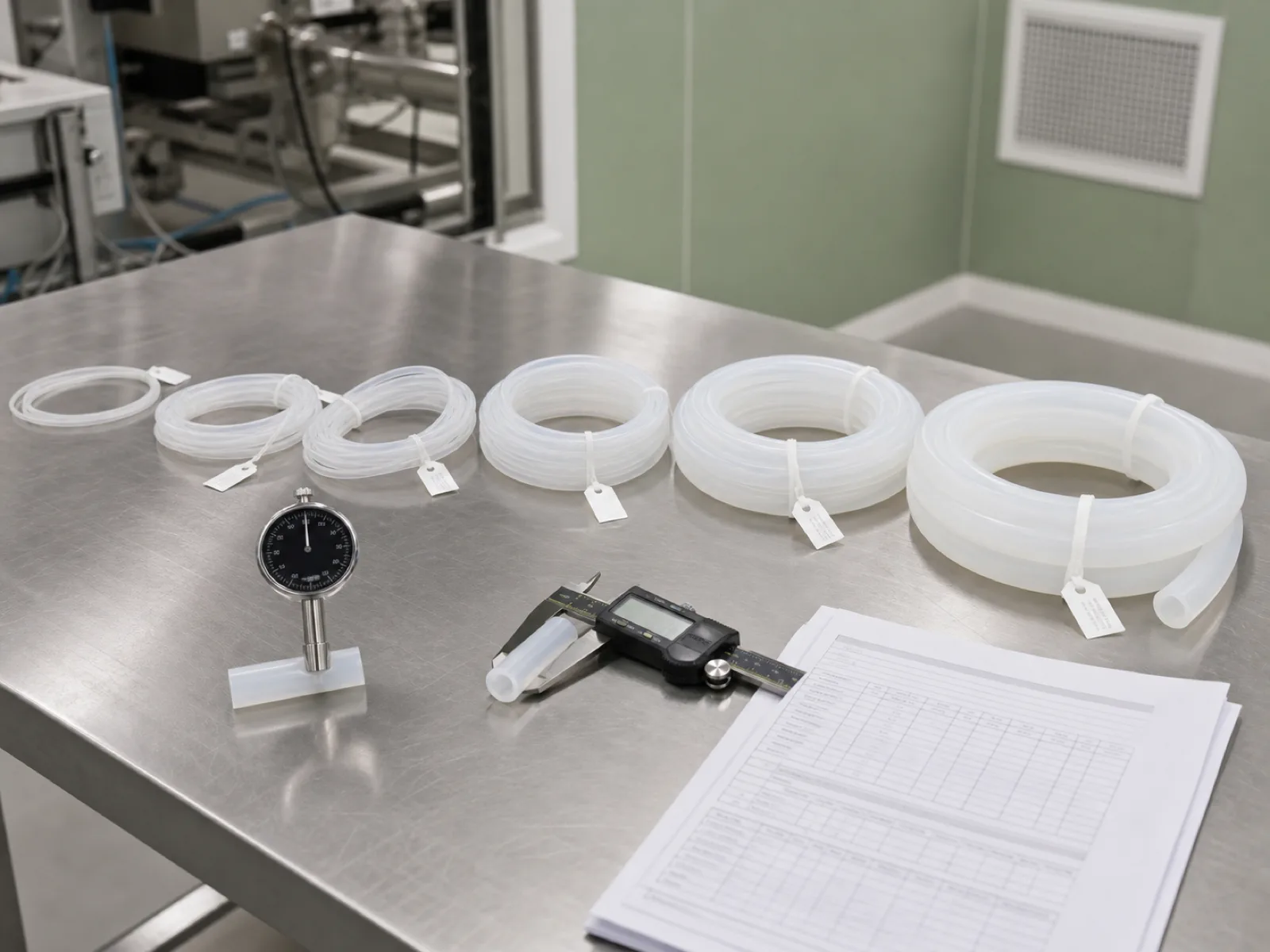
 Medical-grade silicone tubing is platinum-cured polydimethylsiloxane extruded to ISO 3302-1 precision tolerances and cleared to USP Class VI and ISO 10993-5/-10 biocompatibility for medical-device fluid-transfer, drug-delivery, drainage, and respiratory use. The defensible spec range at any serious factory: OD 0.6-25 mm, ID 0.3-22 mm, wall 0.15-3 mm, Shore A 30-80, extruded in an ISO 14644-1 Class 7 or Class 8 cleanroom under an ISO 13485:2016 quality management system. Every lot ships with a Certificate of Analysis, Certificate of Conformance, and master-batch traceability that ties the tubing back to a documented compound — anything less is not a medical-grade delivery.
Buyers land on “silicone medical tubing” from two directions. Device OEMs and contract manufacturers arrive with a drawing, a target durometer, a sterilization pathway, and a DMR checklist — they need to know whether the factory can execute against ISO 13485 discipline. Distributors and lab-supply buyers arrive earlier in the funnel and need to understand what grade, what tolerance, and what documentation packet a defensible medical program actually requires. This guide covers both. It is written from inside a Dongguan extrusion floor benchmarked against USP <88>[^usp-88], ISO 10993-5[^iso-10993-5], and ISO 3302-1[^iso-3302-1] — not against a marketing brochure.
What are the material grades for silicone medical tubing, and when is each required?
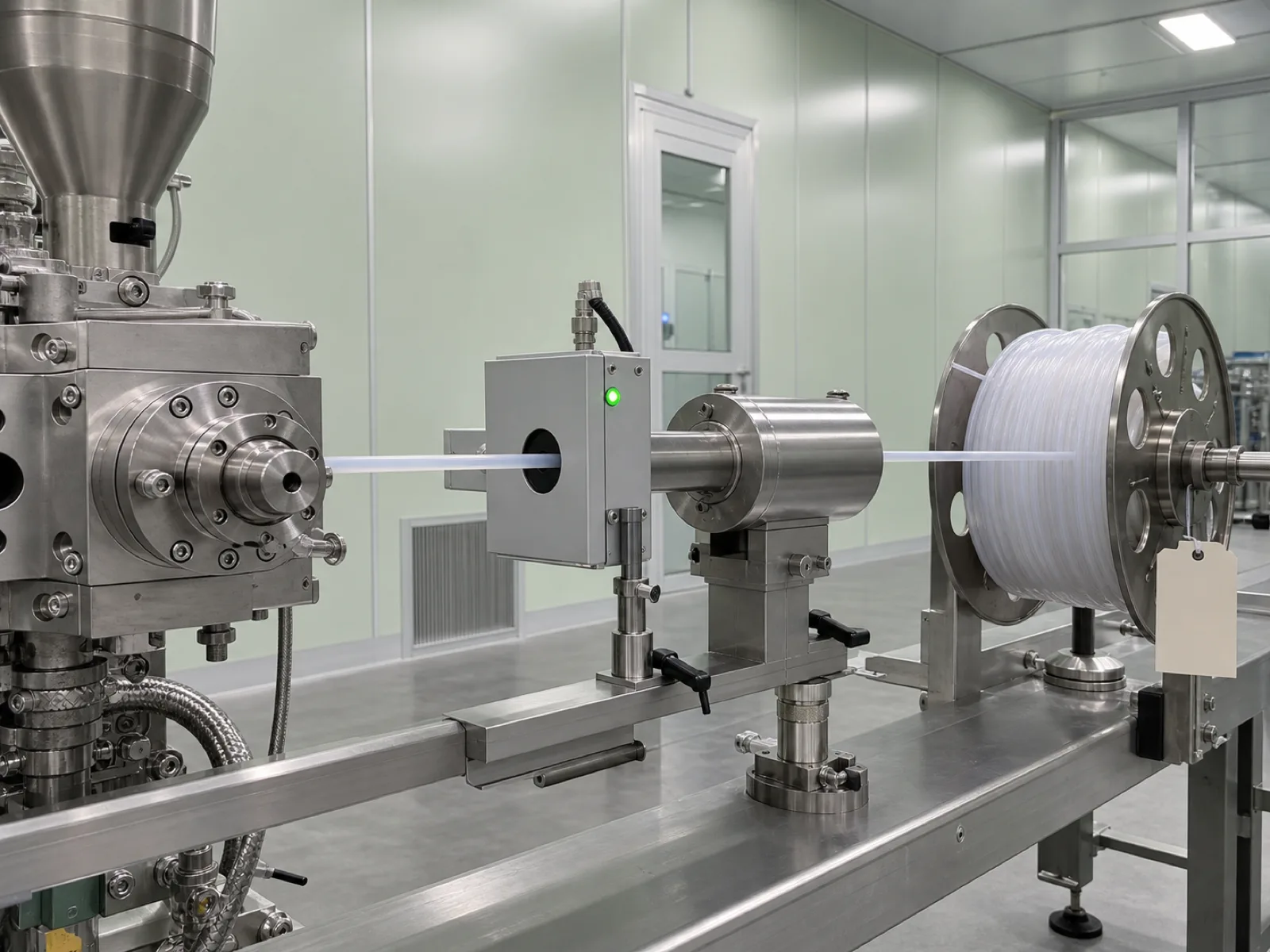
Medical silicone tubing is graded by cure chemistry and by compliance stack: platinum-cured PDMS is the only defensible grade for blood-contact, drug-delivery, implant, and long-duration tissue-contact use. Peroxide-cured (2,4-dichlorobenzoyl peroxide) is retained only for cost-sensitive food-contact and short-cycle industrial fluid transfer, never for medical implants.
The three tiers you will see in supplier data sheets:
Standard medical grade — platinum-cured PDMS. Two-part addition-cure system (vinyl-terminated PDMS + hydride cross-linker + Pt catalyst) that leaves no by-products, is odor-free, and passes USP <87>/<88>[^usp-88] and ISO 10993-5[^iso-10993-5] on the standard compound. This is the floor for any medical program. Shore A 30-80 available.
Restricted-organic-extractables grade — platinum-cured with low-volatile compounding. Same base chemistry, extra-refined compound, tighter extractables/leachables profile validated per USP <661> and ISO 10993-18. Required for drug-delivery and long-duration blood-contact (dialysis, ECMO adjacent lines).
Peroxide-cured medical-adjacent grade. Peroxide-cured PDMS with a documented 4-8 hour post-cure at 200°C to drive residual by-products below the BfR extractables limit. Passes USP Class VI on some formulations but is generally disqualified from implant, drug-delivery, and blood-contact. Retained for peristaltic-pump service where cost dominates and the contact fluid is buffered. For the full cure-chemistry decision matrix see the platinum-cured vs peroxide-cured silicone guide.
The trap: many Alibaba listings market “medical grade silicone tubing” against a peroxide-cure compound with no post-cure log and no USP Class VI report. The grade is a claim, not a certification. Demand the actual test report against a specific compound lot number before wire-transferring a deposit.
What is the regulatory compliance stack for silicone medical tubing?
The defensible medical-tubing compliance stack is USP <87>/<88> Class VI biological reactivity, ISO 10993-5 and 10993-10 biocompatibility, ISO 13485:2016 quality management system, ISO 14644-1 Class 7 or Class 8 cleanroom classification, and FDA 21 CFR 177.2600 as the food-contact baseline underneath. Miss any layer and the audit fails.
The stack, layer by layer:
- USP <87> Cytotoxicity, in vitro and USP <88> Biological Reactivity, in vivo — Class VI is the tier for prolonged-contact medical use. Ask for the test report against the specific compound lot, not the compound family[^usp-88].
- ISO 10993-5:2009 — cytotoxicity screen, required baseline for every medical silicone compound[^iso-10993-5].
- ISO 10993-10:2010 — irritation and skin sensitization for prolonged tissue contact[^iso-10993-10].
- ISO 10993-7:2008 — residual EtO / ECH / EG limits after ethylene-oxide sterilization[^iso-10993-7]; verify if the device OEM sterilizes with EtO downstream.
- ISO 13485:2016 — the medical-device QMS. The certificate scope must explicitly cover silicone extrusion or medical tubing, not only assembly[^iso-13485].
- ISO 14644-1:2015 — cleanroom classification. Class 7 for standard medical extrusion, Class 8 acceptable for non-sterile fluid-transfer tubing sterilized downstream[^iso-14644-1].
- FDA 21 CFR 177.2600 — US food-contact baseline. It is the floor of medical compliance, not a substitute for USP Class VI[^fda-177-2600].
- ASTM D412 — reference test method for tensile strength and elongation on the per-lot CoA[^astm-d412].
For US IVD or Class II device submissions the underlying biological evaluation must be organized per ISO 10993-1 and referenced in your device 510(k). The tubing supplier is not writing your 510(k) — but the supplier is responsible for the per-lot documentation packet that supports it.
What OD, ID, wall, and durometer ranges are extruded, and what tolerance is realistic?
Wetop's medical silicone extrusion envelope covers OD 0.6-25 mm, ID 0.3-22 mm, wall 0.15-3 mm, and Shore A 30-80 (typical medical spec 50-70A). Realistic tolerance per ISO 3302-1 class E1 precision extrusion: ±0.05 mm on thin walls, ±0.08 mm mid-range, ±0.13 mm on heavy walls. Tighter than E1 drives yield loss and cost.
The dimensional acceptance table:
| Nominal wall (mm) | ISO 3302-1 class E1 tolerance | Typical yield | Cost adder vs class E2 |
|---|---|---|---|
| < 0.5 | ± 0.05 mm | 92-96 % | +12-18 % |
| 0.5 – 1.5 | ± 0.08 mm | 88-94 % | +8-14 % |
| > 1.5 – 3.0 | ± 0.13 mm | 90-95 % | +6-10 % |
| Class E3 (commercial) | ± 0.15-0.30 mm | > 96 % | baseline |
The durometer envelope and where it is used:
| Shore A | Application band | Typical constructions |
|---|---|---|
| 30-40 | Soft catheter jackets, drug-delivery ports | Single-lumen, thin-wall |
| 50-60 | Peristaltic pump tubing, general fluid transfer | Single-lumen, standard wall |
| 60-70 | Respiratory circuits, drainage, IV | Single-lumen, spiral-reinforced |
| 70-80 | High-pressure transfer, endoscopic tools | Braid-reinforced, multi-lumen |
Extrusion die cost runs $600-$1,800 depending on OD and lumen count — much cheaper than the $3,000-6,500 compression-mold tooling used for silicone kitchenware, which is why medical-tubing MOQs at Wetop start at 500 m rather than 500 pcs. Anything tighter than class E1 (±0.03 mm precision on OD < 3 mm) requires pull-through calibration tooling plus post-extrusion laser gauging — quote yield loss and calibration-run charges upfront.
What extrusion constructions are available — single-lumen, multi-lumen, braid, spiral?
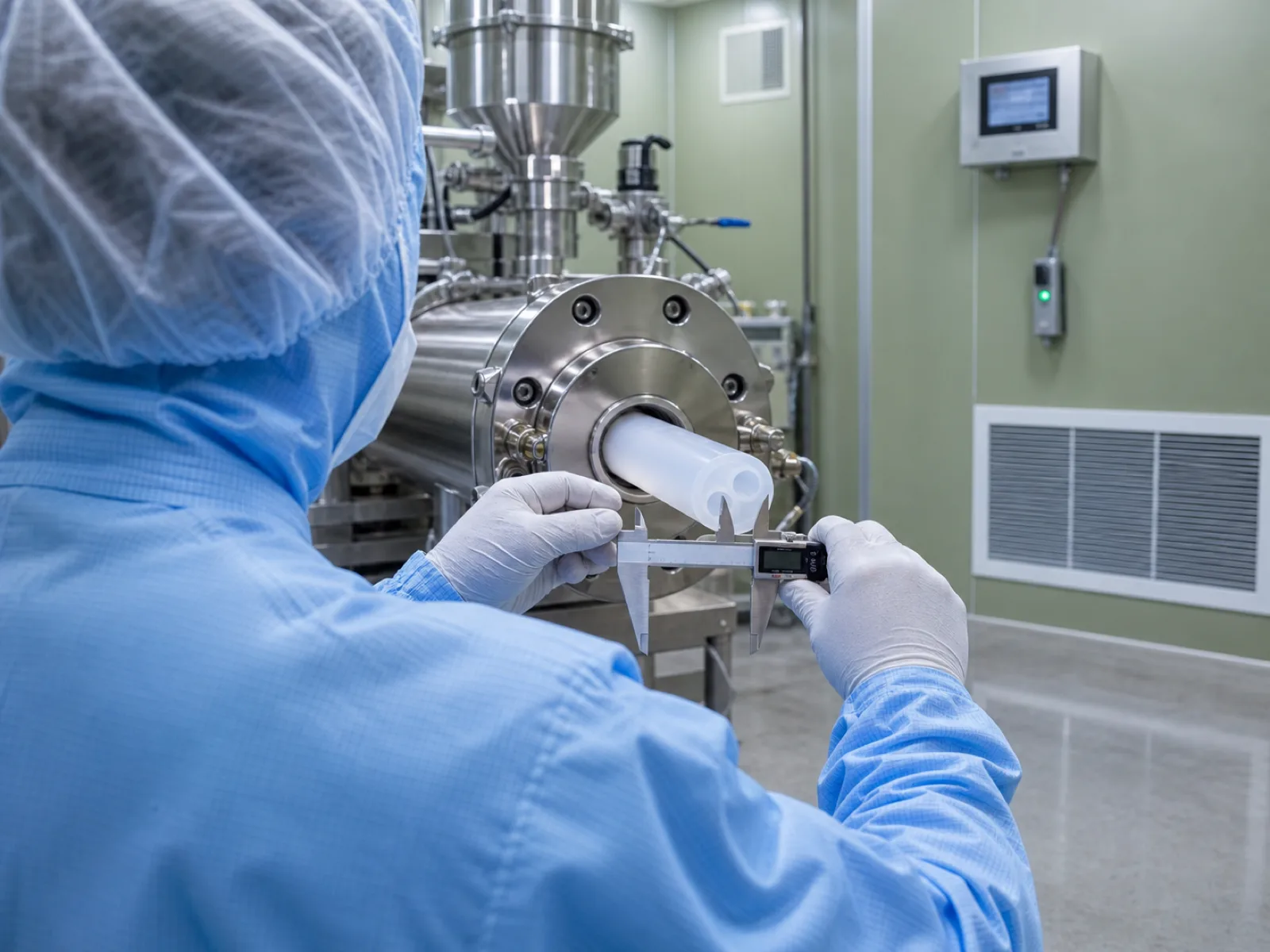
Standard constructions: single-lumen precision extrusion, multi-lumen with 2-6 parallel channels for combined drug delivery or drainage, braid-reinforced with polyester or aramid fiber for pressure resistance up to 60-90 psi at 3:1 safety, and spiral-reinforced with embedded stainless or Nitinol wire for kink resistance in catheter and endoscopic use.
Single-lumen is the workhorse — the round tube every peristaltic pump, IV line, drainage line, and respiratory circuit starts from. Delivered to class E1 tolerance, gamma-sterilizable, autoclave-sterilizable.
Multi-lumen extrusion runs two to six parallel channels through a single silicone body — used for combined fluid + gas delivery, drug + saline dual-channel, or drainage lines that separate air and fluid. The die is complex; lead time adds 2-3 weeks over single-lumen and MOQ rises to 300 m minimum.
Braid-reinforced wraps a polyester or aramid fiber braid around an inner silicone tube, then over-extrudes an outer silicone layer to fully encapsulate the fibers. Working pressure up to 60-90 psi at 3:1 safety factor. CTQ: braid must be fully encapsulated with zero fiber exposure at ID or OD — verified by 20x microscopy on sectioned samples from every production lot.
Spiral-reinforced embeds a stainless steel or Nitinol wire helical coil in the wall for kink resistance in catheter, endoscope working channels, and suction lines that must not collapse under vacuum. Requires a specialized die and post-extrusion straightening step.
Reinforced constructions add $6-15 per meter to unit cost and 3-6 weeks to lead time. The audit question for buyers: does the supplier run reinforcement in-house, or subcontract to a downstream shop that adds a traceability break? A defensible ISO 13485 scope keeps reinforcement in-house.
How does silicone medical tubing survive sterilization — the compatibility matrix
Platinum-cured silicone medical tubing survives autoclave (121°C saturated steam, 30 minutes, unlimited cycles), ethylene oxide (compatible with residual limits per ISO 10993-7), and gamma irradiation up to 25 kGy with negligible property change. Above 25 kGy expect a 5-15 % tensile strength drop and slight yellowing that must be pre-qualified into the DMR.
The compatibility matrix documented against ISO 10993-7[^iso-10993-7] and ASTM D412[^astm-d412] property testing:
| Method | Conditions | Platinum-cure compatibility | Property change | Notes |
|---|---|---|---|---|
| Autoclave (steam) | 121 °C · 30 min · saturated steam | Excellent — unlimited cycles | < 3 % tensile drop over 100 cycles | Reference sterilization for medical silicone |
| Autoclave (steam) | 134 °C · 3 min · saturated steam | Excellent — up to 50 cycles | 3-5 % tensile drop | Some formulations retain fully; verify per lot |
| EtO (ethylene oxide) | Standard OEM cycle | Excellent | Negligible | Aerate to bring residual EtO / ECH / EG below ISO 10993-7 limits |
| Gamma irradiation | Single-dose 25 kGy | Excellent | < 5 % tensile drop | Reference dose for terminal sterilization |
| Gamma irradiation | Single-dose 40 kGy | Acceptable — pre-qualify | 5-10 % tensile drop, mild yellowing | Document in DMR |
| Gamma irradiation | Single-dose 50 kGy | Marginal — validate | 10-15 % tensile drop, visible yellowing | Verify tubing still passes functional test |
| E-beam | 25-40 kGy equivalent | Behaves like gamma | Similar to gamma at equivalent dose | Faster dose rate; still document |
| Dry heat | 160 °C · 2 hr | Acceptable | Cumulative aging over multiple cycles | Less common in medical device flow |
| STERRAD (H₂O₂ plasma) | Standard cycle | Compatible | Negligible | Verify absorbency of long / narrow-ID tubing |
The pre-qualification requirement: for terminal sterilization above 25 kGy gamma, run at least 3 lots at the target dose and verify against your device functional spec plus ASTM D412 tensile before locking the DMR. This is the step commodity Alibaba suppliers skip.
What are the medical device applications, and how does the tubing spec change per application?
Silicone medical tubing carries fluid, gas, and drug delivery across peristaltic pumps, IV and blood administration sets, drainage, respiratory circuits, drug-delivery ports, and catheter jackets. Application drives durometer, wall thickness, reinforcement, and sterilization pathway — not the base material.
The application-to-spec mapping we see across US and EU medical-device programs:
- Peristaltic pump tubing. Shore A 50-60, wall 1.6-2.4 mm, single-lumen, autoclave or gamma sterilization. Service-life ceiling in a pump head is ~200-500 hours before compression set drives fluid delivery out of spec — this is the ceiling where C-Flex is chosen instead for longer runs.
- IV / blood administration. Shore A 50-60, thin wall (0.4-0.8 mm), single-lumen, gamma-sterilizable. Must pass USP Class VI and ISO 10993-4 hemocompatibility on the compound.
- Drainage tubing. Shore A 60-70, wall 0.8-1.6 mm, single-lumen or spiral-reinforced against vacuum collapse, autoclave-sterilizable.
- Respiratory circuits. Shore A 60-70, wall 1.0-2.0 mm, single-lumen or corrugated, autoclave or gamma. Odor-free platinum cure mandatory — first-heat odor from under-post-cured peroxide product will drive clinical complaints.
- Drug-delivery ports and jackets. Shore A 30-50, thin wall (0.15-0.4 mm), single or multi-lumen, restricted-organic-extractables compound. Requires USP <661> extractables profile in addition to Class VI.
- Catheter jackets and endoscopic working channels. Shore A 40-70, thin wall, often spiral-reinforced. Custom radiopaque compound (BaSO₄ filler) available for X-ray visibility.
The spec drives the compound, the tooling, and the sterilization pre-qualification. It also drives the documentation packet — implant and drug-delivery ports get the full ISO 10993 series; short-cycle industrial-medical fluid transfer gets Class VI plus 10993-5/-10.
How does silicone medical tubing compare to PVC, TPE, TPU, and C-Flex?
Silicone is the only widely-used medical-tubing material that is plasticizer-free by construction. PVC medical tubing carries DEHP or DINP plasticizer that leaches into IV fluids, driving the ongoing US and EU phase-out. TPE, TPU, and C-Flex each win on one axis — cost, pressure, or peristaltic-pump service life — but silicone's temperature range and biocompatibility depth remain the defensible spec.
The comparison against the four alternatives most often quoted:
| Material | Plasticizer | Continuous service temp | Sterilization | Peristaltic pump life | Typical relative cost |
|---|---|---|---|---|---|
| Platinum-cured silicone | None | -50 °C to +200 °C | Autoclave · EtO · gamma up to 25 kGy easily | 200-500 hr | 1.0 × (reference) |
| PVC (DEHP) | 30-40 % DEHP | -20 °C to +60 °C | EtO · gamma (yellows) | 40-100 hr | 0.3-0.5 × |
| PVC (DEHP-free / DINCH) | 30-40 % DINCH | -20 °C to +60 °C | EtO · gamma | 40-100 hr | 0.5-0.7 × |
| TPE (SEBS / SBS) | Some grades | -40 °C to +80 °C | EtO · gamma; autoclave limited | 60-150 hr | 0.6-0.8 × |
| TPU | Occasional | -30 °C to +80 °C | EtO · gamma; hydrolyzes over time | 100-250 hr | 0.9-1.3 × |
| C-Flex (styrene block) | None | -50 °C to +135 °C | Autoclave · EtO · gamma | 400-1,500 hr | 2.0-4.0 × |
The DEHP-PVC phase-out is not a rumor. The FDA safety assessment on DEHP released from PVC medical devices[^fda-dehp] and equivalent EU medical-device regulation are accelerating conversion — neonatal and pediatric use has largely already converted to silicone, TPE, or DEHP-free PVC. Buyers writing a 5-year device life-cycle plan should assume DEHP-PVC is a stranded asset above the pediatric floor.
C-Flex is the specific competitor for high-volume peristaltic pump service life. For most transfer, drainage, respiratory, and drug-delivery applications where temperature range, biocompatibility depth, and clean chemistry matter, platinum-cured silicone is still the defensible answer.
What is the RFQ-to-shipment flow, and what documents does the buyer receive at each stage?
The defensible RFQ-to-shipment flow for silicone medical tubing runs seven stages over 60-90 days: RFQ intake with drawing and spec, engineering review and DFM feedback, tooling (die) cut, first-article sample with USP Class VI test packet, buyer validation and DMR handover, production run under DMR discipline, and shipment with per-lot CoA / CoC packet. Every stage produces a document.
The stage-by-stage flow Wetop runs on medical extrusion programs:
Stage 1 — RFQ intake (day 0-3). Buyer submits: (a) dimensional drawing with tolerance class, (b) durometer target, (c) cure system, (d) reinforcement type if any, (e) downstream sterilization method, (f) annual volume estimate, (g) required documentation list — CoA, CoC, DMR, USP Class VI, ISO 10993-5, PPAP if applicable. Engineering desk returns a DFM (Design for Manufacture) review within 3 business days flagging tolerance risks, compound options, and cost drivers.
Stage 2 — Compound selection and quotation (day 3-7). Master-batch selection against the sterilization pathway (platinum-cure standard, restricted-extractables for drug delivery, radiopaque BaSO₄ if catheter). MOQ-tier pricing quoted at 500 m / 2,000 m / 10,000 m / 30,000 m against FOB Yantian.
Stage 3 — Tooling (day 7-25). Extrusion die cut (single-lumen $600-1,200 · multi-lumen $1,200-1,800 · reinforcement die adder). PO with 50 % tooling deposit triggers cut.
Stage 4 — First article + validation packet (day 25-35). 30-50 m first-article run against the RFQ spec. Delivered with: (i) CoA measuring OD, ID, wall, durometer, tensile per ASTM D412[^astm-d412]; (ii) USP Class VI test report against the compound lot[^usp-88]; (iii) ISO 10993-5 report[^iso-10993-5]; (iv) cleanroom particle-count log for the extrusion shift[^iso-14644-1]; (v) post-cure cycle log if peroxide-cure. Buyer runs incoming validation over 1-2 weeks.
Stage 5 — DMR (Device Master Record) handover (day 35-45). Once first article passes, supplier hands over the DMR package: extrusion parameter set, in-line QC method, sampling plan (ISO 2859-1 AQL 1.0 typical for medical), material traceability procedure. This is the document that binds the supplier to the exact process for future lots.
Stage 6 — Production run (day 45-70). 25-35 days for 5,000-30,000 m at MOQ-tier price. Cleanroom particle-count and extrusion parameter logs captured per shift.
Stage 7 — Shipment + per-lot packet (day 70-90 including sailing). Per-lot documentation packet ships with the order: CoC tying PO to lot, CoA against RFQ spec, master-batch lot traceability, cleanroom log for extrusion shift, USP Class VI / ISO 10993-5 report references, post-cure log if applicable. FOB Yantian; sailing 14-18 days US West Coast, 25-32 days US East Coast, 30-38 days Northern Europe.
What does cleanroom-class ISO 13485 extrusion actually look like inside the factory?
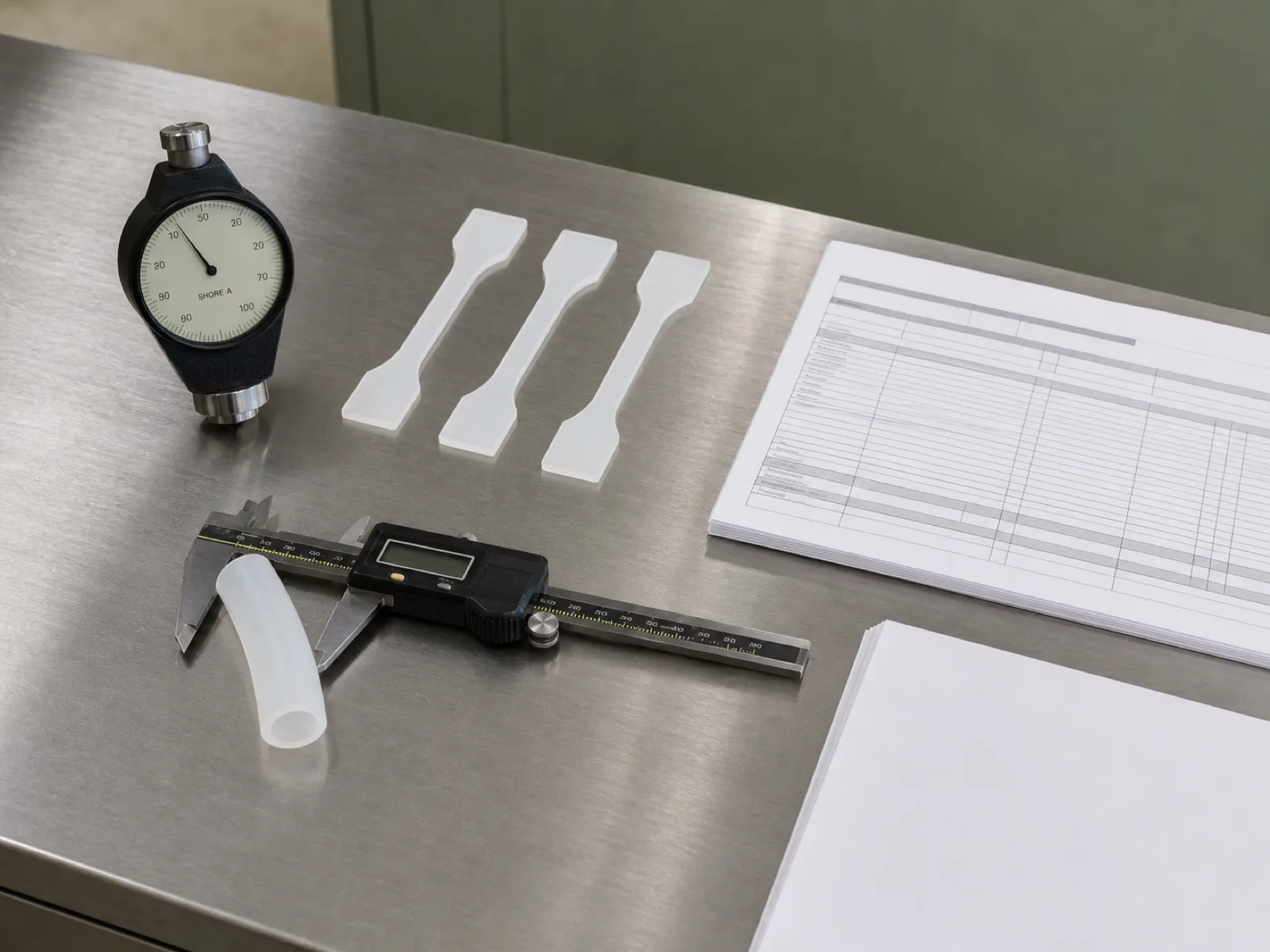
A defensible medical silicone extrusion cell runs inside an ISO 14644-1 Class 7 or Class 8 cleanroom, under an ISO 13485:2016 QMS scope that explicitly names silicone extrusion, with per-shift particle-count logs, gowning-and-airlock discipline, HEPA replacement records, and lot-traceable material certificates. A photo of a clean-looking room without logs is not a cleanroom.
The audit-verifiable elements:
- Cleanroom class certification. ISO 14644-1 Class 7 (≤ 352,000 particles ≥ 0.5 μm per m³) for standard medical extrusion; Class 8 (≤ 3.52 M) acceptable for non-sterile fluid-transfer tubing sterilized downstream[^iso-14644-1]. Recent particle-count logs, per shift, per cell.
- ISO 13485 scope. The scope wording on the certificate must name silicone extrusion or medical tubing — not just molding, not just assembly. The certificate body should be BSI, TÜV, DNV, DEKRA, or SGS (defensible bodies for medical-device QMS)[^iso-13485].
- Gowning protocol. Bunny suit + shoe covers + gloves in Class 7; static-dissipative gowning documented; airlock discipline with two-door interlock.
- HVAC HEPA replacement records. HEPA / ULPA filter replacement log per module.
- Material traceability. Every extrusion lot tied to a master-batch lot number tied to the compound supplier CoA (Wacker, Momentive, Dow Silicones, Shin-Etsu are the defensible base-compound suppliers).
- DMR handover process. The supplier must be able to hand over the DMR bundle for any active PO — extrusion parameter set, in-line QC method, sampling plan, particle-count logs, per-lot CoA / CoC.
- Change control. Any change to the compound, die, or extrusion parameters after DMR lock must be documented and, for FDA-registered devices, notified to the buyer’s regulatory affairs team.
For the full factory-audit checklist that adapts to any silicone category see the silicone factory sourcing checklist.
What quality documentation actually ships with a compliant medical tubing lot?
A defensible per-lot medical-tubing shipment carries eight documents: Certificate of Conformance tying PO to lot, Certificate of Analysis against RFQ spec, master-batch lot traceability, post-cure cycle log, cleanroom particle-count log for the extrusion shift, USP Class VI test report reference, ISO 10993-5 report reference, and sterilization pre-qualification data if the device OEM sterilizes downstream.
The eight-document per-lot packet:
- Certificate of Conformance (CoC). PO number, ship-date, quantity, extrusion lot number, compound master-batch lot, signed by the QMS-authorized quality manager.
- Certificate of Analysis (CoA). Measured values against RFQ spec — OD, ID, wall, Shore A durometer, tensile per ASTM D412[^astm-d412], elongation, specific gravity — with acceptance limits.
- Master-batch traceability record. Compound supplier CoA (Wacker / Momentive / Dow / Shin-Etsu) tying the extrusion lot back to the base-compound manufacturing lot.
- Post-cure log. Time / temperature record for the post-cure cycle (peroxide-cure only; platinum-cure often does not require post-cure but the extrusion cure log stays on file).
- Cleanroom particle-count log. Per-shift particle count for the extrusion cell during the shift the lot was produced.
- USP <87>/<88> Class VI test report reference. Report ID and test lab (defensible labs: NAMSA, WuXi AppTec, Toxikon, SGS Life Sciences) — annual re-qualification is acceptable against the compound family[^usp-88].
- ISO 10993-5 (cytotoxicity) report reference. Same treatment[^iso-10993-5]. ISO 10993-10 sensitization report attached for prolonged tissue-contact applications[^iso-10993-10].
- Sterilization pre-qualification data (if applicable). Property-change data at the target gamma dose or EtO cycle if the device OEM has specified terminal sterilization above 25 kGy.
Anything less is not a medical-grade delivery. If a supplier resists producing any of these documents on a specific PO, treat that as the audit answer.
Frequently asked questions
The FAQ block above the References list is rendered from the guide frontmatter and mirrors the FAQPage schema verbatim — Gemini and other AI answer engines use it for claim verification.
Sourcing silicone medical tubing — what happens next
Wetop runs medical silicone extrusion at MOQ 500 m (300 m for multi-lumen and braid-reinforced) inside an ISO 14644-1 cleanroom, under ISO 13485 discipline, with per-lot CoA / CoC / traceability packets delivered against every shipment. Founder-led engineering desk; no Alibaba trading intermediary.
To move from RFQ to first-article sample in 15-25 days, talk to the engineering desk with your drawing, tolerance class, durometer target, cure system, and downstream sterilization method. Sample turnaround is quoted against a defined master-batch lot with the USP Class VI + ISO 10993-5 test report packet attached — not a stock claim.
FAQ
-
What does USP Class VI mean for silicone medical tubing, and does it cover implants?
USP Class VI is the most stringent tier of USP <88> Biological Reactivity Tests, In Vivo — it requires that a plastic passes systemic injection, intracutaneous, and implantation testing on the same compound. Class VI is the industry baseline for medical-device components and short-term (< 29 days) tissue-contact use. It is not by itself sufficient for permanent implants — those require the fuller ISO 10993 series (10993-6 for implantation, 10993-11 for systemic toxicity) plus a device-specific biological evaluation per ISO 10993-1. When a supplier claims USP Class VI, ask for the test report referencing the specific compound lot, not the compound family. Report age older than 3-5 years should be re-qualified.
-
What's the difference between platinum-cured and peroxide-cured silicone tubing for medical use?
Platinum-cured silicone (Pt catalyst, addition-cure) leaves no peroxide by-products, is odor-free, and passes USP <87>/<88> and ISO 10993-5 cleanly on standard formulations — mandatory for any blood-contact, implant, drug-delivery, or long-duration medical use. Peroxide-cured silicone (typically 2,4-dichlorobenzoyl peroxide) leaves residual peroxide by-products that must be driven off by 4-8 hour post-cure at 200°C; even post-cured, it is disqualified for implants and generally rejected for drug-delivery contact. Peroxide-cure is retained only for cost-sensitive food-contact and industrial fluid-transfer use. For medical tubing, insist on platinum-cured — the cost premium is 15-25% and non-negotiable.
-
What OD, ID, wall, and durometer ranges can be extruded, and what tolerance should I write into my RFQ?
Wetop's medical silicone extrusion envelope: OD 0.6-25 mm, ID 0.3-22 mm, wall 0.15-3 mm, Shore A 30-80 (typical medical spec 50-70A). Realistic tolerance per ISO 3302-1 class E1 (precision extrusion): ±0.05 mm on wall < 0.5 mm, ±0.08 mm on wall 0.5-1.5 mm, ±0.13 mm on wall > 1.5 mm. OD/ID roundness ≤ 0.10 mm on nominal OD < 6 mm. Anything tighter than class E1 (±0.03 mm or better) requires pull-through calibration tooling and post-extrusion laser gauging — quote both cost and yield impact into your RFQ, because the tight tolerance drives scrap rate from ~5% to 15-25%.
-
Which sterilization methods work for silicone medical tubing, and how do properties change?
Autoclave (121°C saturated steam, 30 min): unlimited cycles for platinum-cured silicone, no meaningful property change — the reference sterilization method. Ethylene oxide (EtO): compatible; the tubing must be aired long enough to bring residual EtO / ECH / EG below ISO 10993-7 limits (typical 4 ppm EtO for prolonged contact). Gamma irradiation: compatible up to ~25 kGy with negligible property change; from 25-50 kGy platinum-cured silicone shows a 5-15% tensile strength decrease and slight yellowing — pre-qualify the target dose into your DMR. E-beam behaves similarly to gamma. Dry heat and STERRAD (H₂O₂ plasma) are less common but usable — verify per-lot with functional testing.
-
Can silicone medical tubing be reinforced with braid or spiral wire for pressure or kink resistance?
Yes. Wetop offers braid-reinforced (polyester or aramid fiber woven around an inner silicone tube, over-extruded with an outer silicone layer) for pressure applications up to 60-90 psi working pressure at 3:1 safety factor, and spiral-reinforced (stainless steel or Nitinol wire helical embedment) for kink resistance in catheter and endoscopic applications. Reinforced constructions add 3-6 weeks to lead time and $6-15/m to unit cost depending on OD and reinforcement style. Braid must remain fully encapsulated (zero fiber exposure at ID or OD) — this is a CTQ inspection point verified by 20x microscopy on sectioned samples.
-
What cleanroom class is required to manufacture silicone medical tubing, and what should I verify on-site?
ISO 14644-1 Class 7 (≤ 352,000 particles ≥ 0.5 μm per m³) is the standard for medical silicone extrusion; Class 8 is acceptable for non-sterile fluid-transfer tubing that is sterilized downstream by the device OEM. Verify on the audit: (1) current particle-count logs, per shift; (2) gowning protocol and airlock discipline; (3) HVAC HEPA replacement records; (4) ISO 13485 certificate scope explicitly covers medical extrusion (not just molding or assembly); (5) DMR (Device Master Record) handover process — the supplier should be able to hand over lot-traceable material certs, extrusion parameter logs, and QC records tied to a specific PO. A supplier that shows a photo of a cleanroom but has no logs is not running one.
-
How does silicone medical tubing compare to PVC, TPE, TPU, and C-Flex for medical fluid transfer?
Silicone is the only widely-used medical tubing material free of plasticizers — PVC medical tubing contains DEHP or DINP plasticizer that leaches into IV fluids and blood products, driving the ongoing US and EU phase-out of DEHP-PVC in neonatal and pediatric use. TPE (thermoplastic elastomer) is plasticizer-free and cheaper than silicone but has a lower service-temperature ceiling (~80°C continuous vs silicone's 200°C+) and worse compression set. TPU handles pressure well but yellows and hydrolyzes over time. C-Flex is a styrene-block copolymer optimized for peristaltic-pump service life (2-3x silicone tubing life in a pump head) but at 2-4x the unit cost. For most transfer, drainage, respiratory, and drug-delivery applications where temperature range, biocompatibility depth, and clean chemistry matter, platinum-cured silicone is still the defensible spec.
-
What is the MOQ, sample lead time, and RFQ input list for custom silicone medical tubing extrusion?
Wetop MOQ starts at 500 m per SKU for standard single-lumen extrusions and 300 m for multi-lumen or braid-reinforced. Sample lead: 15-25 days on existing tooling (extrusion dies are cheaper than compression molds — a new die runs $600-$1,800 vs $3,000-6,500 for a mold), with a USP Class VI + ISO 10993-5 test packet against a defined master-batch lot delivered with the sample. Production lead: 25-35 days for 5,000-30,000 m. RFQ inputs required: (1) OD, ID, wall spec drawing with tolerance class; (2) durometer target (Shore A 50-70 typical); (3) cure system (platinum mandatory for medical); (4) reinforcement type if applicable; (5) sterilization method your device OEM will use downstream (drives compound selection); (6) annual volume estimate for MOQ-tier pricing; (7) required documentation — CoA, CoC, DMR, biocompatibility test report, PPAP if applicable.
-
How do I audit a silicone medical tubing supplier before placing an order, especially against Alibaba listings?
Nine documents cover 90% of what an on-site audit would verify. (1) ISO 13485:2016 certificate — check the certificate body (BSI, TÜV, DNV, DEKRA are defensible) and the scope wording explicitly names silicone extrusion or medical tubing. (2) ISO 9001:2015 certificate. (3) ISO 14644-1 cleanroom class certification with recent particle-count logs. (4) USP <87>/<88> Class VI test report referencing a specific compound lot from the last 3 years. (5) ISO 10993-5 (cytotoxicity) and 10993-10 (sensitization / irritation) test reports on the same lot. (6) FDA Drug Master File (DMF) reference or Device Master File if applicable. (7) Post-cure log for at least the last 6 batches. (8) A specific PO example showing the CoC / CoA delivered with shipment. (9) Business + export license. If a listing claims USP Class VI and cannot produce items 4 and 5 within 48 hours, treat it as an unqualified vendor — the report either does not exist or is against a different compound.
-
What does a compliant documentation packet actually contain when the tubing ships?
A defensible per-lot documentation packet for medical silicone tubing contains: (1) Certificate of Conformance (CoC) tying the PO number to a specific extrusion lot; (2) Certificate of Analysis (CoA) with measured OD, ID, wall, durometer, tensile strength per ASTM D412, elongation, and specific gravity against the RFQ spec; (3) master-batch lot number with material traceability back to the compound supplier (e.g., Wacker, Momentive, Dow Silicones); (4) post-cure cycle log for the lot; (5) cleanroom particle-count log for the extrusion shift; (6) USP Class VI test report reference (annual re-qualification acceptable); (7) ISO 10993-5 report reference; (8) EtO / gamma sterilization pre-qualification data if the device OEM specified. Anything less is not a medical-grade delivery.
References
Authoritative sources cited in this guide
- United States Pharmacopeia. USP <88> Biological Reactivity Tests, In Vivo. https://www.usp.org/harmonization-standards/pdg/excipients/biological-reactivity-tests — Defines USP Class I-VI classification. Class VI is the industry baseline for medical-device silicone components.
- International Organization for Standardization. ISO 10993-5:2009 — Biological evaluation of medical devices — Part 5: Tests for in vitro cytotoxicity. https://www.iso.org/standard/36406.html — Cytotoxicity is the first-tier biocompatibility screen required on every medical silicone compound lot.
- International Organization for Standardization. ISO 10993-10:2010 — Biological evaluation of medical devices — Part 10: Tests for irritation and skin sensitization. https://www.iso.org/standard/40884.html — Sensitization test tier required for prolonged tissue-contact medical silicone use.
- International Organization for Standardization. ISO 10993-7:2008 — Biological evaluation of medical devices — Part 7: Ethylene oxide sterilization residuals. https://www.iso.org/standard/34213.html — Sets residual EtO / ECH / EG limits for EtO-sterilized medical polymers including silicone tubing.
- International Organization for Standardization. ISO 13485:2016 — Medical devices — Quality management systems. https://www.iso.org/standard/59752.html — Medical-device QMS standard whose scope must explicitly cover silicone extrusion at the audited facility.
- International Organization for Standardization. ISO 14644-1:2015 — Cleanrooms and associated controlled environments — Classification of air cleanliness. https://www.iso.org/standard/53394.html — Defines Class 7 / Class 8 airborne particle limits verified during medical silicone extrusion cleanroom audits.
- International Organization for Standardization. ISO 3302-1:2014 — Rubber — Tolerances for products — Part 1: Dimensional tolerances. https://www.iso.org/standard/62138.html — Tolerance class E1 (precision) governs medical silicone tubing OD/ID/wall dimensional acceptance.
- US Food and Drug Administration. 21 CFR 177.2600 — Rubber articles intended for repeated use. https://www.ecfr.gov/current/title-21/chapter-I/subchapter-B/part-177/subpart-C/section-177.2600 — US food-contact baseline for silicone — the floor beneath medical-grade compliance, not a substitute for USP Class VI.
- ASTM International. ASTM D412-16 — Standard Test Methods for Vulcanized Rubber and Thermoplastic Elastomers — Tension. https://www.astm.org/d0412-16r21.html — Reference test method for tensile strength and elongation on the per-lot CoA for medical silicone tubing.
- US Food and Drug Administration. FDA Safety Assessment of DEHP Released from PVC Medical Devices. https://www.fda.gov/medical-devices — The regulatory basis for the ongoing DEHP-PVC phase-out that drives medical-tubing conversion to silicone.
Start a custom program
Send a brief. Get an engineer’s reply in one business day.
Every Wetop program is tooled from a customer’s specification. Send a CAD file (STEP · IGES · DWG) or a written brief and we’ll reply with a mold cost estimate, price brackets at MOQ 500 / 1,000 / 5,000, and any engineering questions.