Buyer Guide · commercial intent
Silicone Oven Mitts OEM Manufacturing Guide
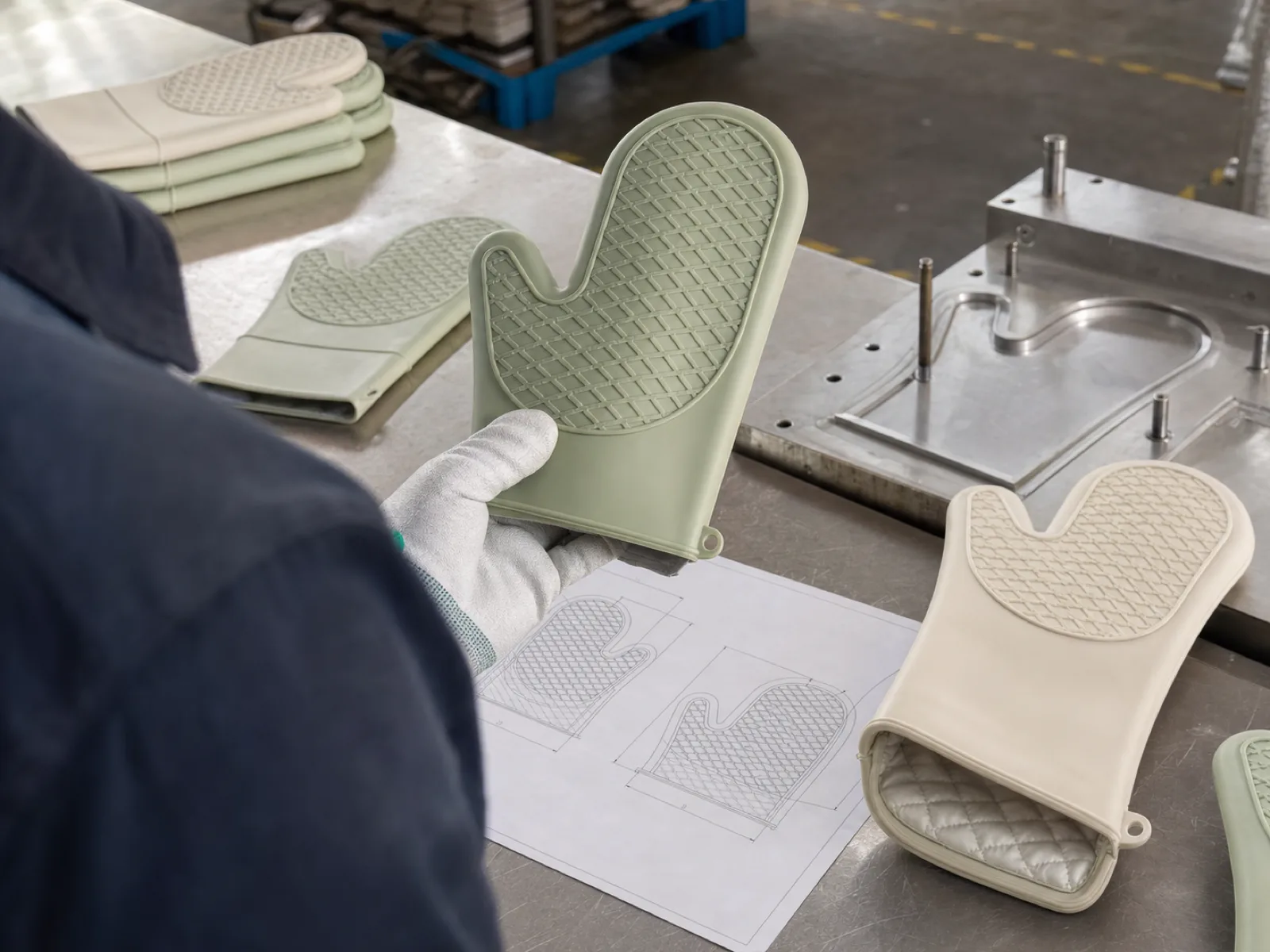 Buyer Guide
 A silicone oven mitt is a heat-protective kitchen glove built from a molded silicone outer shell bonded to a quilted cotton or polyester insulating liner, engineered to hold a continuous surface-contact range of −40 °C to 230 °C and clear FDA 21 CFR 177.2600 extractables. The silicone shell delivers waterproof, non-slip grip and steam resistance, while the liner delivers the actual burn protection that an unlined shell cannot. This guide is the engineering-desk brief for retail buyers running an oven mitt program at 3,000 to 500,000 pcs, covering the real heat-resistance spec, shell-and-liner construction, FDA and LFGB clauses, MOQ tiers, the QC regime, and landed-cost math a founder-led factory would put in front of a program manager on day one.
The silicone oven mitt looks like a commodity from a retail buyer’s seat — until the first container comes back with shell-to-liner delamination on 4 % of units, a scent-panel fail on the second production lot, and a customer-review thread complaining the mitt “still burns my hand.” None of those failures are random. They map cleanly to a handful of decisions the factory made — or skipped — during cure system selection, liner specification, bonding process, post-cure, and QC lot release. This guide is written from the engineering desk at Wetop’s Dongguan floor for buyers at housewares brands, sink-adjacent retail chains, and private-label programs who want the actual manufacturing math, not marketing copy.
What is a silicone oven mitt, and what does a retail-grade one need to deliver?
A silicone oven mitt is a heat-protective glove built by molding a platinum-cured silicone outer shell — usually with a criss-cross non-slip grip texture — over a quilted cotton or polyester insulating liner. A retail-grade unit must clear FDA 21 CFR 177.2600[^fda-177-2600] extractables, hold −40 °C to 230 °C continuous surface contact, resist steam and grease, and survive 200+ wash cycles without shell-to-liner delamination or odor absorption.
The category splits into four common architectures — short stovetop mitt, long forearm-protecting oven-and-grill mitt, mini pinch grip and pot holder, and five-finger glove-style mitt. Each shares the same two-layer engineering logic: a molded silicone shell for grip and waterproofing, and a textile liner for insulation. The shell runs Shore A 45–60 — softer than a spatula head, because the mitt has to flex around a hot handle without fighting the user’s grip. The liner is where the real thermal design happens: a quilted air-gap layer, typically 3–5 mm of cotton batting or polyester wadding, that slows conductive heat transfer long enough for the user to move the pan.
The failure economics matter. Retail return and complaint rates on silicone oven mitts run 2.0–3.5 % in the first 12 months for well-specified programs, and 5–8 % for programs that skipped the post-cure step, under-specified the liner, or used a weak shell-to-liner bond. On a 50,000-unit annual program at USD 12 retail, a three-point complaint-rate swing is real reverse-logistics money plus the shelf-space penalty a category buyer will not forget.
What temperature can silicone oven mitts actually withstand, and where do the marketing claims break down?
Platinum-cured silicone oven mitts hold −40 °C to 230 °C (−40 °F to 446 °F) as a continuous surface-contact range. The "450 °F" and "500 °F" figures on retail packaging are short spike ratings for contact under 30 seconds, not sustained handling temperatures. Above 250 °C, the silicone begins slow surface degradation. Crucially, the safe hold time your hand feels is governed by the liner, not the shell rating.
Two numbers get conflated on every oven mitt package, and buyers who do not separate them ship a product that fails against its own claims. The first number is the material service temperature — the temperature the silicone itself survives without degrading. That is genuinely −40 °C to 230 °C continuous, with brief spikes to 260 °C. The second number is the safe hold time — how long a user can grip a hot pan before conductive heat reaches the hand. That depends almost entirely on the insulating liner, and it is what actually protects the user.
A “500 °F silicone oven mitt” claim is technically defensible on the shell material and operationally misleading on hand protection. The honest spec table Wetop uses:
| Rating | Continuous | Short spike (< 30 s) | Governed by |
|---|---|---|---|
| Silicone shell material | −40 °C to 230 °C | 260 °C | Compound + cure |
| Grip surface contact (dry pan) | 230 °C | 260 °C | Shell thickness 2.0–4.0 mm |
| Steam / wet-load contact | 200 °C | 220 °C | Shell waterproofing |
| Safe hand hold time at 230 °C | 30–60 s | — | Quilted liner thickness + loft |
| Wash cycle (thermal + detergent) | 60 °C wash, tumble low | — | Shell-to-liner bond |
The engineering call: when a buyer asks for a “500 °F oven mitt,” we deliver a shell compound that survives a brief 260 °C spike and pair it with a liner specified to the hold-time the packaging implies — because the returns team, not the marketing team, absorbs the gap when the two do not match. The full material-science treatment of why silicone tops out where it does lives in the silicone temperature range explained guide if you need to defend the spec to a category buyer.
Does a silicone oven mitt need a fabric liner, and why does the liner drive burn protection?
Yes — a retail-grade silicone oven mitt needs an insulating liner. Silicone is heat-resistant but thermally conductive: an unlined shell transmits conductive heat to the hand in roughly 8–12 seconds at 230 °C. A quilted cotton or polyester liner adds an air-gap insulation layer that extends safe hold time to 30–60 seconds. The shell provides grip and waterproofing; the liner provides the actual burn protection.
This is the single most misunderstood point in the category, and the source of the “the mitt still burns my hand” review pattern. Silicone’s thermal conductivity is roughly 0.2 W/m·K — low for a solid, but not an insulator. Heat flows through a solid silicone wall steadily; the thicker the wall, the slower the flow, but a 3 mm shell alone buys only single-digit seconds of protection at oven temperatures. The liner solves this by introducing trapped air, which has a conductivity near 0.026 W/m·K — nearly ten times more insulating than the silicone itself.
Liner construction is therefore a load-bearing spec decision, not a comfort afterthought:
| Liner type | Insulation loft | Safe hold time at 230 °C | Wash durability | Best for |
|---|---|---|---|---|
| Unlined silicone shell only | none | 8–12 s | excellent | Pinch grips, trivets, low-heat handling |
| Single-layer cotton | 2–3 mm | 18–25 s | good | Budget short mitts |
| Quilted cotton batting | 3–5 mm | 30–45 s | good | Standard retail mitts |
| Quilted polyester wadding | 4–6 mm | 40–60 s | excellent | Premium long / grill mitts |
| Cotton + aramid blend liner | 4–6 mm | 55–75 s | excellent | Professional / high-heat segment |
The trade-off buyers weigh: cotton breathes and feels natural but degrades faster under repeated high-heat exposure; polyester wadding holds loft and wash durability longer but can compress under heavy use. Wetop’s default retail spec is a quilted cotton-poly blend liner at 4 mm loft, bonded to the shell with a heat-stable adhesive rated above the mitt’s working temperature so the bond does not fail before the shell does.
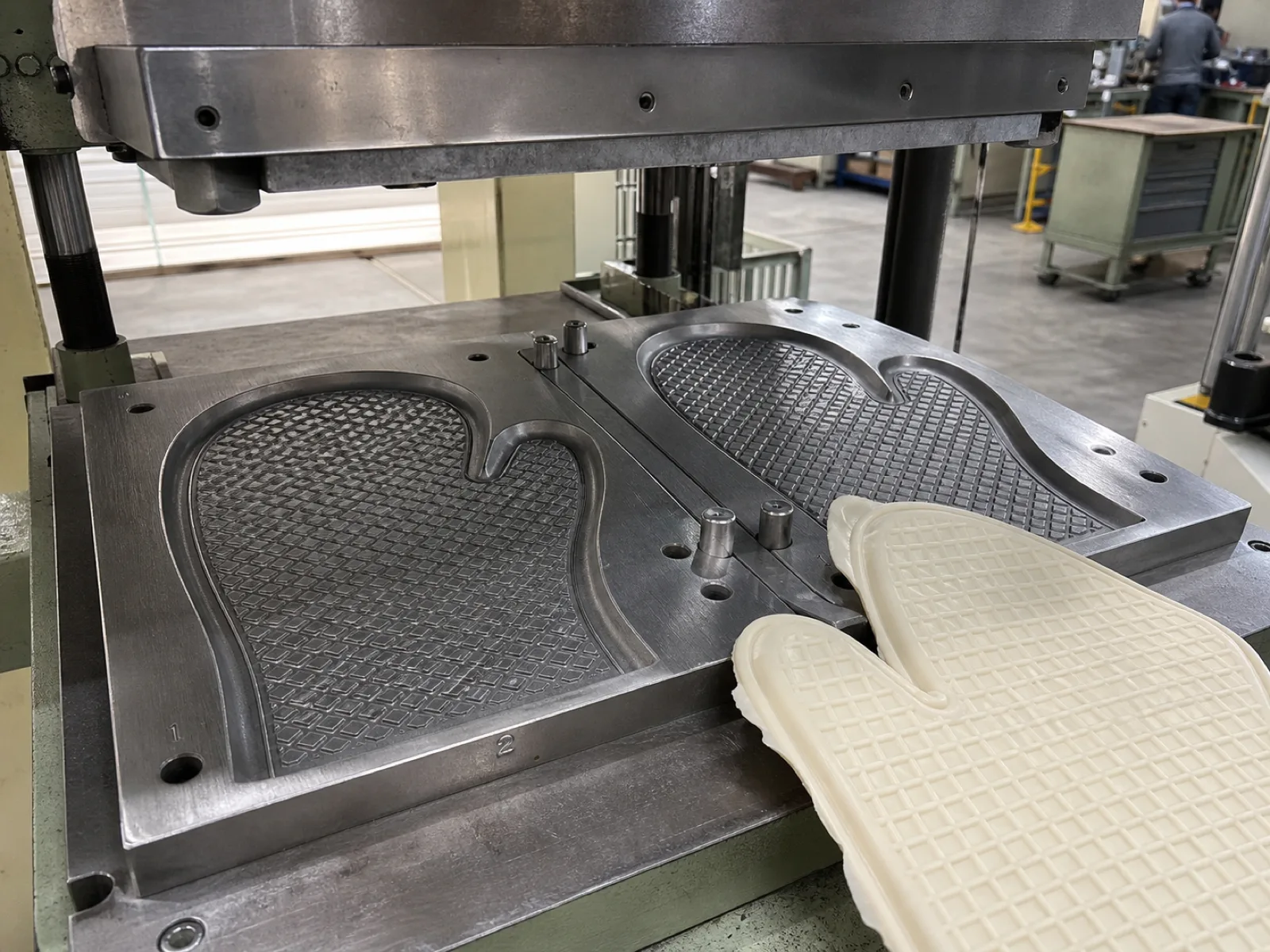
Platinum-cured vs peroxide-cured silicone — which cure system belongs on an oven mitt shell?
Platinum-cured silicone is the only cure chemistry that reliably passes retail scent-panel testing on oven mitts. Peroxide-cured shells leave residual benzoic acid and vinyl byproducts that off-gas a rubber odor over the first 20–30 wash cycles — the "smells like a tire" complaint pattern. Platinum-cured compound runs 12–18 % higher in raw-material cost and pays back within a small number of avoided returns.
Peroxide cure uses a free-radical initiator (dicumyl or 2,4-dichlorobenzoyl peroxide) whose crosslink reaction generates volatile byproducts — benzoic acid, acetophenone, chlorobenzoic acid — that a proper 4-hour, 200 °C post-cure is supposed to drive off. In practice, factories running compression cells on tight cycle times skip the post-cure to protect throughput, and 40–60 % of the volatile load stays in the shell, waiting to off-gas over wash cycles at the buyer’s kitchen. On an oven mitt, the problem is amplified: the mitt sits near hot food, and even a faint rubber note reads as a food-safety red flag to the consumer.
Platinum cure uses a Pt-catalyst addition reaction between vinyl-terminated and hydride-functional silicone. The reaction is stoichiometrically clean — no byproducts — which is why platinum-cured silicone ships to infant-feeding and medical applications with minimal post-cure[^nih-silicone-review]. For an oven mitt sold above a USD 8 shelf price, the reject-rate math kills peroxide before the raw-material savings pay in.
| Attribute | Peroxide-cured HCR | Platinum-cured HCR |
|---|---|---|
| Raw-material cost (USD/kg, 2026) | 5.20 – 7.00 | 6.80 – 9.20 |
| Requires post-cure to pass FDA? | Yes (4 h @ 200 °C) | Recommended, not always required |
| Volatile matter after cure | 0.4 – 1.2 % | 0.05 – 0.15 % |
| Scent-panel pass rate (unaged) | 60 – 75 % | 96 – 100 % |
| BfR XV[^bfr-xv] compliance path | Difficult — often fails | Standard |
| Typical use in oven mitts | Sub-USD-6 retail | USD 8+ retail |
For any oven mitt spec above a USD 8 shelf price, Wetop only quotes platinum-cured shell material. The odor and yellowing failure modes that come with peroxide are exactly the ones a retail category buyer notices first.
What FDA and LFGB clauses apply to a silicone oven mitt, and which governs the shell vs the liner?
The silicone shell falls under FDA 21 CFR 177.2600[^fda-177-2600] — total extractives ≤ 20 mg/in² in n-hexane after 7 hours at 66 °C — plus BfR Recommendation XV[^bfr-xv] for LFGB clearance. The cotton or polyester liner is a textile governed by flammability and dye-migration rules, not food-contact clauses. Buyers who assume one FDA cert covers the whole mitt get held at customs when the two components carry different compliance paths.
The two-material problem is under-appreciated on oven mitts because, unlike a spatula, the mitt is not primarily a food-contact tool — but the silicone shell still contacts food surfaces (grabbing a hot dish, a baking sheet, a jar), so retail buyers require food-contact clearance on the shell anyway. The liner, meanwhile, is a textile: its compliance concerns are flammability, azo-dye and formaldehyde limits, and any chemical finish. Each layer needs its own documentation, not one blanket statement.
For US-only programs, the minimum documentation packet is:
- Silicone shell: 21 CFR 177.2600 migration test report from an accredited lab (Intertek, SGS, or Eurofins), issued per production lot or per quarter
- Textile liner: fiber-content declaration, azo-dye / formaldehyde screen, and — where required — a flammability statement
- Assembly-level: CPSIA General Certificate of Conformity[^cpsc-cpsia] listing every applicable rule and the third-party lab that verified compliance
- State-level: California Prop 65 statement covering the shell, liner dye, and any adhesive
- Business-level: ISO 9001[^iso-9001] certificate (Wetop is certified since 2008)
For EU programs, add LFGB §30/31 batch testing on the shell (BfR XV as the technical basis[^bfr-xv]), a REACH SVHC declaration[^echa-reach] against the current candidate list, and an EU 1935/2004 Declaration of Compliance for the food-contact shell. The trap first-time buyers hit: an overseas listing that claims “FDA certified” usually means the base-silicone compound has 177.2600 clearance from its supplier — not that the finished mitt has been lot-tested by an accredited third-party lab. US Customs FDA import review does not accept the compound COA in place of a finished-good migration report. Buyers running into both US and EU should read the FDA vs LFGB silicone breakdown to understand where the two frameworks diverge on extractables and per-batch reporting.
Silicone oven mitts vs cotton, neoprene, and terry — the material comparison that decides your spec
Silicone oven mitts win on waterproofing, steam resistance, and non-slip grip: the shell does not soak through and scald like wet cotton, and it holds greasy cookware securely. Cotton wins on breathability and low cost but fails fast when wet. Neoprene sits between them on flex. For wet, greasy, or steam-heavy work, a silicone shell with a quilted liner is the durable, hygienic choice.
The material decision is not silicone-versus-everything; it is matching the material to the failure mode the buyer’s customer hits most. A dry-bake household mitt and a restaurant steam-line mitt fail differently, and the right material differs accordingly. The comparison that matters at the buyer’s desk:
| Attribute | Silicone shell + liner | All-cotton quilted | Neoprene | Terry cloth |
|---|---|---|---|---|
| Waterproof / steam-proof | Yes | No — wicks and scalds | Partial | No |
| Non-slip grip (greasy load) | Excellent (textured) | Poor | Good | Poor |
| Max continuous surface contact | 230 °C | ~200 °C (dry only) | ~180 °C | ~180 °C |
| Wipe-clean / hygienic | Yes — non-porous | No — absorbs stains | Partial | No |
| Wash durability | 200+ cycles | 50–80 cycles | 80–120 cycles | 40–70 cycles |
| Typical retail price | USD 8 – 20 | USD 4 – 10 | USD 6 – 14 | USD 3 – 8 |
The decisive advantage silicone holds is the steam-scald failure. A wet cotton mitt conducts heat far faster than a dry one — grabbing a steaming pot with a damp cotton mitt can transmit a burn in one to two seconds, because water bridges the air gaps that provided insulation. A silicone shell is waterproof: steam and spills stay on the outside, and the liner stays dry. For any kitchen environment with wet or greasy loads, that single property justifies the price premium.
OEM/ODM buyer flow — sizes, styles, MOQ tiers, tooling cost, and lead time
Wetop's silicone oven mitt MOQ starts at 500 pcs/color on existing tooling and 3,000 pcs on new custom molds. Custom mold tooling runs USD 3,500–6,500 for a compression mold covering shell and grip pattern. Sample lead time is 7–15 days on existing tools; new tools take 25–35 days. Bulk production runs 15–25 days after sample approval. Buyers own the mold after full amortization or explicit purchase.
The style architecture defines the tooling family. A coherent oven mitt line usually spans four styles, each customizable in cuff length, shell thickness, grip pattern, liner type, and Pantone color:
- Short mitt (10–12 in): stovetop and countertop reach, everyday household use
- Long mitt (13–17 in): deep-oven and grill reach, protects the wrist and forearm
- Mini pinch grip / pot holder: quick handling of hot lids and handles
- Five-finger glove mitt: maximum dexterity for plating and delicate work
MOQ tier structure at Wetop (2026 pricing):
| Program tier | MOQ per color | Tooling cost | Unit price band (FOB) | Best for |
|---|---|---|---|---|
| Wetop stock mitt, Wetop packaging | 500 pcs | USD 0 | USD 1.60 – 3.20 | Sample orders, small retailers |
| Stock mitt, custom Pantone + logo deboss | 1,000 pcs | USD 180 – 350 (logo insert) | USD 1.45 – 2.90 | Private-label test runs |
| Custom shell / grip pattern, new compression mold | 3,000 pcs | USD 3,500 – 6,500 | USD 1.30 – 2.50 | Housewares brands with distinct identity |
| Full private-label — custom mold + liner + hangtag + master carton | 5,000 – 10,000 pcs | USD 4,500 – 9,000 all-in | USD 1.50 – 2.80 all-in | Retail chain PL programs |
Sample timeline (existing tooling): color-matched pre-production sample in 7–10 days; retail-ready first-article sample with liner and packaging in 12–15 days. Sample timeline (new tooling): T1 sample off the new mold in 25–30 days; T2 corrections in 5–7 days; production release after T2 approval. Bulk production: 15–25 days for a standard container order, driven mainly by liner sourcing and pack-out complexity.
Mold ownership: the mold is the buyer’s asset upon full payment of tooling cost. Wetop’s standard tooling contract transfers title after the first production run ships, and we do not withhold molds as leverage at end-of-program. Buyers pairing mitts with a broader kitchen assortment can layer these MOQ tiers onto the shelf plan in the silicone kitchen utensils OEM guide.
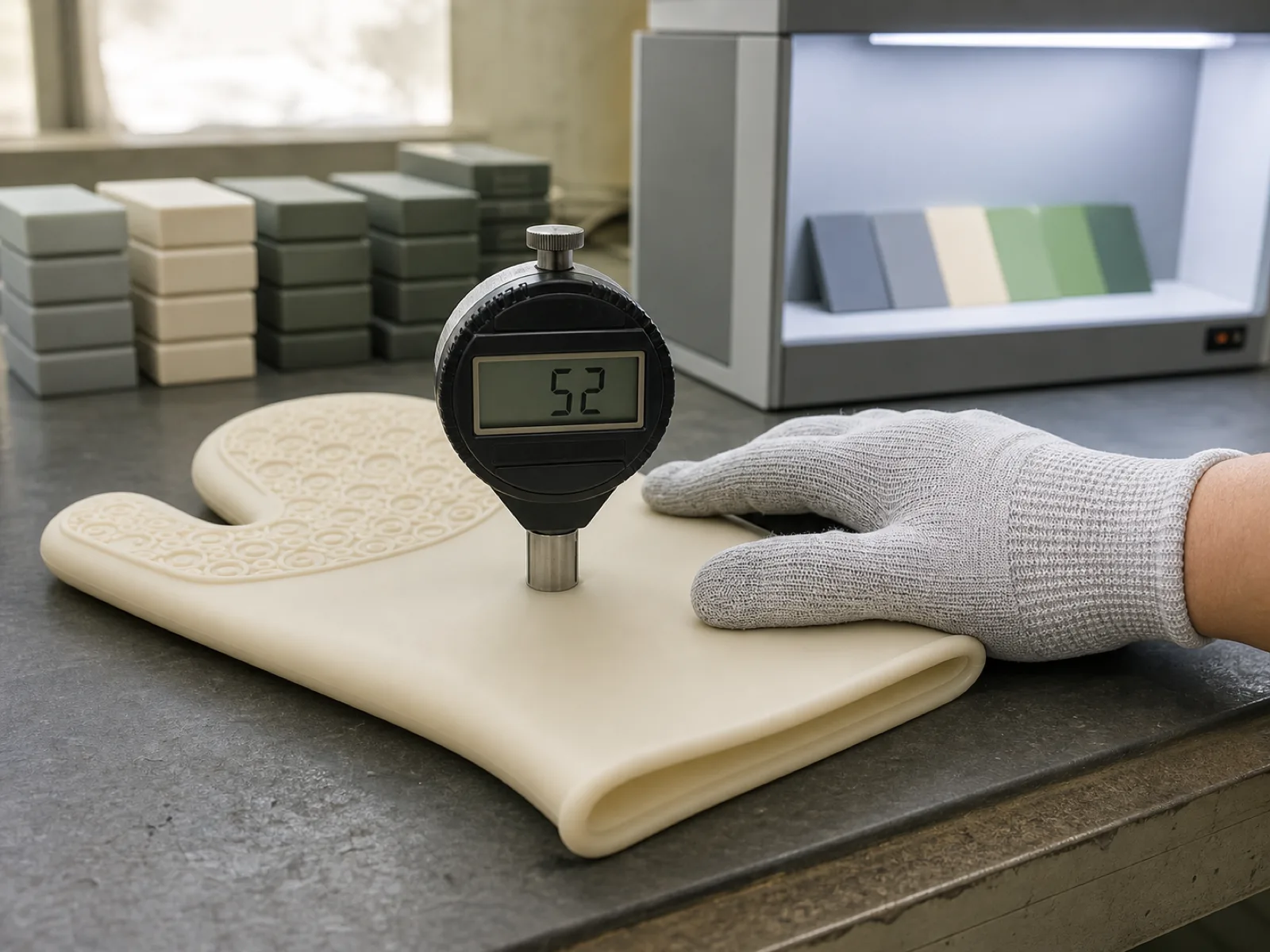
What QC and testing regime should a silicone oven mitt program run?
A ship-worthy silicone oven mitt clears five bench tests: a Shore A durometer check (spec ± 3 points), a shell-to-liner peel-bond test, a wash-cycle test (200 cycles at 60 °C), a scent panel after a 60 °C oven soak, and a conductive heat-resistance hold test on the assembled mitt. Any single fail holds the lot. Third-party pre-shipment inspection runs at AQL 1.5 sampling.
The QC regime separates a mitt that survives its warranty period from one that generates a return thread. Each test targets a specific documented failure mode:
- Shore A durometer — verifies cure completeness. A reading outside spec ± 3 signals under-cure or a compound-batch drift; both predict odor and grip-flattening downstream.
- Shell-to-liner peel bond — the assembled mitt is pulled at the shell-liner interface. A bond that fails below the target force predicts the delamination that dominates oven-mitt returns.
- Wash-cycle test — 200 cycles at 60 °C, then re-inspect for delamination, color migration, and grip-texture flattening. Drift beyond spec fails the lot.
- Scent panel — five blind noses after a 48-hour 60 °C oven soak. Any detectable rubber off-note fails — the peroxide-cure tell.
- Conductive heat-resistance hold — the assembled mitt is bench-tested for hand-side temperature rise against a heated surface, referencing ASTM F1060-style conductive/compressive methodology[^astm-standards], to confirm the liner delivers the labeled hold time.
The friction cost of skipping this: a full first-article test package runs USD 800–1,800 in third-party lab fees, absorbed by Wetop into tooling amortization or FOB unit price depending on program size. Skipping it saves the money and loses it many times over on the first customs hold or the first retail-buyer complaint escalation.
What does a silicone oven mitt cost landed to a US warehouse?
A 40HQ container of silicone oven mitts holds roughly 8,000–16,000 pcs depending on mitt size, liner loft, and inner-carton density. Landed cost to Los Angeles / Long Beach in 2026 runs USD 1.55–3.10 per piece: FOB Yantian USD 1.30–2.80, ocean freight, duty, and brokerage. Alibaba single-piece pricing routinely misleads first-time buyers by 200–400 % against true container-quantity landed cost.
The landed-cost math is the most underexplained variable in oven-mitt procurement, and it is more freight-sensitive than a spatula because the mitt is bulky — the quilted liner makes it low-density cargo, so a container holds far fewer units than a small utensil. Wetop’s landed-cost table for a typical retail spec (13-inch long mitt, platinum-cured shell, 4 mm cotton-poly liner, Pantone-matched, deboss logo, kraft hangtag):
| Line item | Cost per piece | Cost per 40HQ (12,000 pcs) |
|---|---|---|
| FOB Yantian (unit price, spec above) | USD 2.10 | USD 25,200 |
| Ocean freight, FOB Yantian → LA/LB | USD 0.30 | USD 3,600 |
| Duty (per HTS classification[^hts-usitc]) | USD 0.14 | USD 1,680 |
| Customs brokerage + ISF filing | USD 0.04 | USD 480 |
| Drayage (port → CA warehouse) | USD 0.10 | USD 1,200 |
| DDC (destination delivery, avg) | USD 0.08 | USD 960 |
| Landed cost, LA/LB warehouse | USD 2.76 | USD 33,120 |
At an assumed 3× retail markup, the 12,000-unit lot supports a USD 9.99 to USD 12.99 shelf price with room for retailer margin and MAP protection. The container-fill variable that changes the math: a 13-inch long mitt with a lofted liner packs at low density, so premium mitt lines carry higher per-unit freight than a thin stovetop mitt. Wetop’s shipping team runs a cubic-optimization pass on every program before booking, and mixed-size containers can meaningfully reduce freight per unit if the SKU mix is planned around inner-carton density.
What packaging and branding options work for a retail silicone oven mitt line?
Wetop's color desk matches Pantone solid-coated within ΔE ≤ 1.5 on a D65 light box using platinum-cured masterbatch. Logo options are debossed into the mold cavity (USD 180–350 per insert, zero unit-cost adder, unlimited wash durability), heat-transfer printed for full-color artwork (wears faster), or embroidered on the liner cuff. Packaging spans polybag, kraft sleeve with hangtag, and full-print retail box.
Branding on an oven mitt has two surfaces — the silicone shell and the fabric liner or cuff — which gives more options than a solid utensil. The economics by method:
| Method | Surface | Cost | Wash durability | Best use |
|---|---|---|---|---|
| Deboss (mold-cavity engraved) | Silicone shell | USD 180 – 350 per insert | Unlimited | Best-in-class — logo is a physical shell feature |
| Emboss (raised relief) | Silicone shell | USD 180 – 350 per insert | Unlimited | Same durability, raised look |
| Heat-transfer print | Silicone shell | USD 0.12 – 0.30 per unit | 40 – 80 cycles | Full-color / multi-color logos |
| Woven or printed cuff label | Fabric liner | USD 0.06 – 0.15 per unit | Excellent | Brand name, care instructions |
| Embroidery | Fabric cuff | USD 0.15 – 0.40 per unit | Excellent | Premium tactile branding |
Packaging options:
- Bulk polybag (USD 0.03–0.06 per unit, no retail-ready packaging)
- Kraft sleeve with hangtag (USD 0.20–0.40 per unit, e-commerce-ready)
- Header card with printed backer (USD 0.35–0.75, big-box retail standard)
- Full four-color printed box, FSC-certified board (USD 0.90–1.90, premium retail or gift-set)
The Pantone-plus-deboss shell combined with a woven cuff label is Wetop’s most-run private-label spec for new US housewares brands — retail-ready, distinctive, and durable through the wash cycles that wear down printed branding. Because silicone masterbatch pigments are inorganic for heat stability, muted earth tones, sage, cream, terracotta, and classic red and black hit ΔE ≤ 1.5 cleanly; deep saturated blues and neons are harder to hit within retail tolerance and are quoted with wider ΔE bands.
Care, lifespan, and what to bring to your first RFQ conversation
A well-built silicone oven mitt lasts 3–5 years of regular home use: dishwasher-safe on the top rack for unlined shells, machine wash below 40 °C for lined mitts, air-dry to protect liner loft. To get a firm factory quote, bring five documents — a spec sheet, a Pantone target, a logo file, a packaging spec, and an annual volume forecast. Missing any one turns the quote into a range that shifts on the second call.
Care guidance belongs on the hangtag because it protects the product’s reputation as much as the customer’s hands. Unlined silicone grips and pinch mitts are dishwasher-safe on the top rack. Lined mitts should be machine-washed below 40 °C and air-dried — high tumble-dry heat compresses the liner loft that provides insulation, so a mitt that is repeatedly hot-dried loses hold time over its life. With correct care, a platinum-cured shell with a quality liner holds its performance for 3–5 years of regular use.
The five RFQ documents that let the factory quote firm:
- Product spec sheet: mitt style and cuff length, shell thickness and Shore A target, grip pattern, liner type and loft, continuous surface-contact temperature rating, wash rating
- Color spec: Pantone solid-coated reference, acceptable ΔE tolerance, D65 light-box viewing standard
- Logo spec: vector file, placement drawing on shell or cuff, method preference (deboss / heat transfer / woven label)
- Packaging spec: retail readiness level (bulk / e-commerce / big-box / premium), material preference, sustainability requirements (FSC / recycled)
- Volume forecast: annual volume, launch quantity, target FOB date, replenishment cadence, sales channel
Wetop’s inbound-RFQ team turns a complete document set into a firm quote within 48 hours; an incomplete set triggers a discovery call that adds 5–7 days. The last engineering-desk suggestion: send the factory a competitor sample of the spec you want to beat. Wetop’s response is a teardown report identifying shell cure system, liner construction, Shore A reading, bond method, and a spec-improvement recommendation before quoting.
Ready to run a silicone oven mitt program?
Wetop is a founder-led, ISO 9001 silicone factory in Dongguan running platinum-cured compression cells dedicated to kitchenware. We ship silicone oven mitt programs to US and EU housewares brands, sink-adjacent retail chains, and private-label programs at 500-pc to 500,000-pc annual scale, with the shell-and-liner engineering, compliance packet, and QC regime built in.
If you have a spec sheet, an RFQ, or a competitor sample you want teardown-benchmarked, talk to the engineering desk. We will return a first-pass spec review, tooling estimate, and MOQ / lead-time / FOB unit-price band inside two business days.
FAQ
-
What temperature rating should we print on the oven mitt packaging?
Separate two claims on the pack, not one. Print the shell material rating (heat-resistant to 230 °C / 446 °F continuous, brief spikes to 260 °C) as one line, and a distinct 'safe hold time' claim tied to the liner as a second line. A single headline '500 °F' number is the source of the 'still burns my hand' review pattern and is hard to defend in a warranty dispute, because the shell genuinely survived the heat while the hand did not — the two ratings measure different things and belong on different lines of copy.
-
How do we choose the liner spec to hit a target burn-protection number?
The liner, not the shell, is the tuning knob. For any mitt a hand goes inside, specify the liner to the hold time your packaging implies: quilted cotton batting for standard retail, polyester wadding for premium loft retention, or a cotton-aramid blend for the high-heat professional segment. Unlined pinch grips, pot holders, and trivets are the exception — an 8–12 second contact window is acceptable there. On true mitts the shell-to-liner bond is what actually fails in the field, so bond strength belongs in the QC plan alongside the liner material choice.
-
What is the MOQ for a custom silicone oven mitt OEM order?
Wetop's silicone oven mitt MOQ starts at 500 pcs per color on existing tooling. A custom mitt shape, cuff length, or grip pattern that needs a new mold starts at 3,000 pcs to amortize the USD 3,500–6,500 tooling cost. Full private-label programs — custom liner, hangtag, and printed master carton — carry 5,000–10,000 pcs to hit retail landed-cost targets.
-
Which certifications does a silicone oven mitt retail program need?
For US big-box and DIY chains, the baseline packet is ISO 9001, a BSCI or Sedex social audit, a CPSIA General Certificate of Conformity, a California Prop 65 statement, and an accredited-lab FDA 21 CFR 177.2600 migration report on the silicone shell. EU-bound programs add LFGB §30/31 batch reports and REACH SVHC screening. Missing any single document can hold the shipment at customs.
-
How do silicone oven mitts fail QC after repeated washing?
Three failure modes dominate. Silicone-to-liner delamination — the shell separating from the fabric — accounts for the majority of returns on poorly bonded mitts. Odor absorption and yellowing come from under-cured peroxide compounds. Grip-texture flattening and Shore A drift come from residual solvents that a proper 4-hour, 200 °C post-cure would have driven off before shipment.
-
What sizes and styles of silicone oven mitts can be manufactured OEM?
The common architecture spans short mitts (10–12 in) for stovetop reach, long mitts (13–17 in) for deep-oven and grill reach that protect the forearm, mini pinch grips and pot holders for quick handling, and full five-finger glove-style mitts for dexterity. Cuff length, shell thickness (2.0–4.0 mm), grip pattern, liner type, and Pantone color are all customizable within one tooling family.
-
Can Wetop match a Pantone color and add a debossed logo to a silicone oven mitt?
Yes. Wetop's color desk matches Pantone solid-coated within ΔE ≤ 1.5 on a D65 light box using platinum-cured masterbatch. Debossed logos are engraved into the mold cavity at USD 180–350 per insert with zero unit-cost adder, and they outlast pad print or heat transfer by many multiples in wash cycles. Full-color heat-transfer branding is available for multi-color artwork but wears faster.
-
How long is the sampling and production lead time for silicone oven mitts?
On existing tooling, a color-matched pre-production sample takes 7–15 days, and a first-article retail-ready sample follows shortly after. A new custom mold takes 25–35 days for a T1 sample, plus 5–7 days for corrections. Bulk production after sample approval runs 15–25 days for a standard container order, subject to liner sourcing and pack-out complexity.
References
Authoritative sources cited in this guide
- US Food and Drug Administration. 21 CFR 177.2600 — Rubber articles intended for repeated use. https://www.ecfr.gov/current/title-21/chapter-I/subchapter-B/part-177/subpart-C/section-177.2600 — The controlling US extractables limit for food-contact silicone kitchen tools including oven mitt shells — total extractives in n-hexane ≤ 20 mg/in² over 7 hours at 66 °C.
- International Organization for Standardization. ISO 9001:2015 — Quality Management Systems — Requirements. https://www.iso.org/standard/62085.html — The QMS Wetop is certified against — the framework retail chain audits (BSCI / Sedex) build upon for supplier onboarding.
- ASTM International. ASTM International — Standards & Publications. https://www.astm.org/products-services/standards-and-publications/standards.html — Source for ASTM F1060 conductive/compressive heat-resistance test methodology used to bench-rate protective glove and mitt materials against hot surfaces.
- German Federal Institute for Risk Assessment (BfR). BfR Recommendations on Food Contact Materials — Recommendation XV, Silicones. https://www.bfr.bund.de/en/bfr_recommendations_on_food_contact_materials-7498.html — The technical basis for LFGB §30/31 clearance on silicone oven mitt shells — sets peroxide residual and volatile matter limits.
- European Chemicals Agency (ECHA). REACH Regulation (EC) No 1907/2006 — SVHC Candidate List. https://eur-lex.europa.eu/legal-content/EN/TXT/?uri=CELEX%3A32006R1907 — Screening list for any masterbatch, dye, or processing aid used in silicone oven mitts sold into the EU — updated twice yearly.
- US Consumer Product Safety Commission. Title 16 — Commercial Practices (CPSC / CPSIA rules). https://www.ecfr.gov/current/title-16 — Basis for the CPSIA General Certificate of Conformity that accompanies silicone kitchen textiles imported into the US.
- US International Trade Commission. Harmonized Tariff Schedule of the United States. https://hts.usitc.gov/ — The classification reference for silicone oven mitts imported into the US — gloves and mitts of rubber vs. textile-lined articles carry different duty columns.
- US National Library of Medicine (PubMed). Silicone in food-contact and medical applications — safety review. https://pubmed.ncbi.nlm.nih.gov/23256725/ — Peer-reviewed migration and biocompatibility data underpinning FDA and LFGB clearance of platinum-cured silicone.
Start a custom program
Send a brief. Get an engineer’s reply in one business day.
Every Wetop program is tooled from a customer’s specification. Send a CAD file (STEP · IGES · DWG) or a written brief and we’ll reply with a mold cost estimate, price brackets at MOQ 500 / 1,000 / 5,000, and any engineering questions.