Certification · informational intent
USP Class VI Biocompatibility Testing: 6 Tests Explained
 Certification
 USP Class VI biocompatibility testing is the strictest of six polymer safety classes defined in USP General Chapter <88>, requiring three in-vivo tests — Systemic Injection, Intracutaneous, and 5-day Implantation — performed with four extraction media at up to three temperature conditions. It proves a polymer causes no acute biological reactivity in live animal models. For silicone medical tubing, catheter jackets, and sealing components, a Class VI pass is the material-qualification floor buyers ask for before requesting device-level ISO 10993 or FDA submission work.
This spoke deepens one section of our cornerstone silicone medical tubing OEM guide — the cornerstone gives buyers the full sourcing frame (compound choice, tolerance, sterilization, packaging). This piece drills into what the cornerstone can only summarize: the six-test protocol, the numerical pass/fail rubric, the extraction matrix, and what a defensible Class VI COA must show. If you are specifying silicone for medical, food-contact-with-heat, or pharmaceutical-primary-packaging duty, this is the paperwork you will read line-by-line with your regulatory reviewer.
Key takeaways
- USP Class VI is the strictest of six USP plastic classes — it requires all three in-vivo tests (Systemic Injection, Intracutaneous, Implantation) using four extraction media at three temperature conditions.
- Class VI covers acute biological reactivity only — it does NOT replace ISO 10993 for genotoxicity, sensitization, or chronic toxicity screening.
- USP <87> in-vitro cytotoxicity and USP <88> in-vivo Class VI are complementary, not interchangeable: <87> is a 24-72 h cell-culture screen, <88> is a live-animal reactivity test.
- For silicone, passing Class VI hinges on a full 4-6 h post-cure at 200 °C — residual peroxide byproducts or platinum-catalyst inhibitors will spike erythema scores.
- A compliant Class VI COA must name lot number, extraction media, temperature/time, animal model counts, and numerical erythema/edema grades.
- A full Class VI test cycle at an accredited lab costs $8,000-$15,000 and takes 6-8 weeks.
- Class VI compliance is a material qualification, not an FDA clearance.
What are the six USP plastic classes and why is Class VI the strictest?
USP <88> defines six plastic classes (I through VI) that ramp up in the number of extraction media, temperature conditions, and in-vivo tests required. Class I is one test with one medium; Class VI requires all three in-vivo tests (Systemic Injection, Intracutaneous, Implantation) across all four extraction media at three temperature conditions — the full matrix.
The six classes are a compact way to signal how demanding the polymer’s contact application is. Class I plastics need only a Systemic Injection test with saline extraction — appropriate for low-contact, non-critical use. Class VI adds the implantation test and expands the extraction media to include alcohol-saline, polyethylene glycol 400, and vegetable oil, covering aqueous, lipophilic, and semi-polar leachable pathways. Because Class VI is the maximum-rigor bucket, buyers specifying silicone for medical tubing, catheter components, or pharma primary packaging default to it and skip the intermediate classes entirely.
| USP class | Systemic Injection | Intracutaneous | Implantation | Extraction media | Typical use |
|---|---|---|---|---|---|
| I | Yes (saline) | No | No | 1 | Non-contact packaging |
| II | Yes (saline + PEG) | No | No | 2 | Short-term food-contact |
| III | Yes | Yes | No | 3 | Skin-contact |
| IV | Yes | Yes | No | 4 | Mucosal-contact |
| V | Yes | Yes | Yes | 3 | Short-term implant screening |
| VI | Yes | Yes | Yes (5-day) | 4 | Medical / pharma / repeated implantation |
What are the three in-vivo tests inside USP Class VI?
Class VI requires three live-animal tests: Systemic Injection (mice, 72-hour observation for mortality and clinical signs), Intracutaneous (rabbits, 72-hour skin erythema and edema scoring), and Implantation (rabbit paravertebral muscle, 5-day tissue reaction with macroscopic and microscopic evaluation). All three must pass for the polymer to earn Class VI status.
The Systemic Injection Test dosing rabbits and mice with each of the four extracts intravenously (saline, alcohol-saline) or intraperitoneally (PEG 400, cottonseed oil). Animals are observed at 4, 24, 48, and 72 hours for mortality, weight loss, and clinical signs. Any death or significant systemic reaction fails the test.
The Intracutaneous Test injects 0.2 mL of each extract into rabbit dorsal skin at five sites per extract, with a matching vehicle control on the contralateral side. Erythema (redness) and edema (swelling) are scored on a 0-4 numerical scale at 24, 48, and 72 hours. The requirement is that the average score of the test sites minus the control sites is ≤ 1.0.
The Implantation Test places four strips of the test polymer (roughly 10 × 1 × 1 mm) into rabbit paravertebral muscle, with USP negative control plastic on the opposite side. After 5 days, the animal is euthanized, muscle harvested, and tissue reaction scored macroscopically (hemorrhage, necrosis, discoloration) and microscopically (inflammatory cell infiltration, fibrosis). Reaction grade > 1 fails.
What are the four extraction media and three temperature conditions?
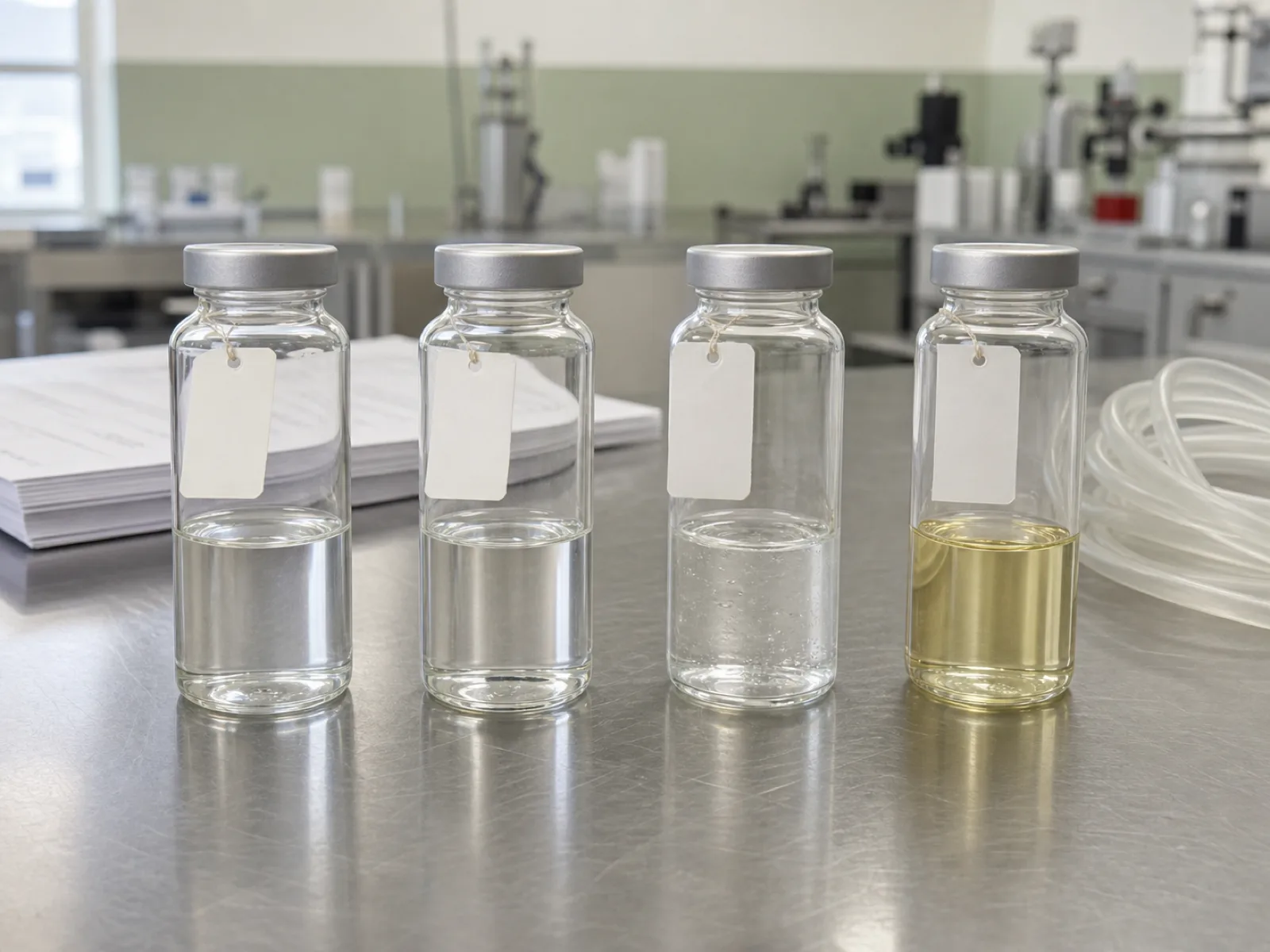
The four media are sodium chloride injection (saline), 1-in-20 ethanol in saline, polyethylene glycol 400, and vegetable oil (cottonseed oil per USP). The three temperature/time options are 50 °C / 72 h, 70 °C / 24 h, or 121 °C / 1 h — chosen based on polymer thermal stability. For platinum-cured silicone the standard is 70 °C / 24 h.
Each extraction medium targets a distinct leachable class. Saline extracts hydrophilic ionic residues (catalyst salts, water-soluble stabilizers). Alcohol-saline pulls semi-polar organics (residual solvents, low-molecular-weight cyclics). PEG 400 mimics blood-plasma proteins and extracts amphiphilic species. Cottonseed oil extracts truly lipophilic residues (silicone oligomers D3-D6, silane byproducts).
| Extraction medium | Leachable target | Physiological analog |
|---|---|---|
| Sodium chloride 0.9 % | Ionic / hydrophilic residues | IV fluid, saline drips |
| 1-in-20 ethanol in saline | Semi-polar organics | Blood + alcohol pathway |
| Polyethylene glycol 400 | Amphiphilic species | Plasma proteins |
| Cottonseed oil (vegetable) | Lipophilic organics, silicone oligomers | Adipose tissue, lipid-rich fluids |
Temperature choice matters. 121 °C / 1 h is the harshest and reserved for polymers that will actually be autoclaved in use; running it on a silicone that only sees 60 °C in service generates artefactual reactivity that flunks a compound that would otherwise pass. 70 °C / 24 h is the sensible default for medical-grade silicone tubing.
How is a USP Class VI test scored — the pass/fail rubric?
Intracutaneous erythema and edema are graded 0 (no reaction) to 4 (severe) at each observation window; the test polymer's average score minus the control's must be ≤ 1.0. Systemic Injection requires zero mortality and no clinical signs above the control. Implantation requires tissue reaction grade ≤ 1 macroscopically and ≤ 2 microscopically. Any single site above grade 2 fails.
The scoring rubric is where most vague vendor claims collapse. A “passes Class VI” line without the numerical grades is not verifiable. Below is the intracutaneous grading anchor most accredited labs use12:
| Grade | Erythema (redness) | Edema (swelling) |
|---|---|---|
| 0 | No erythema | No edema |
| 1 | Very slight, barely perceptible | Very slight, barely perceptible |
| 2 | Well-defined erythema | Slight, edges of area well-defined by raised skin |
| 3 | Moderate to severe erythema | Moderate, area raised approx. 1 mm |
| 4 | Severe erythema (beet redness) with eschar formation | Severe, area raised > 1 mm and extending beyond exposure zone |
Compliant COAs report the mean of five sites × 3 time points minus the control mean. For a Class VI silicone that mean should sit at 0.0-0.5 — anything approaching 1.0 signals a marginal formulation or an incomplete post-cure.
How does USP Class VI relate to ISO 10993 and USP <87>?
USP <87> is a 24-72 h in-vitro cytotoxicity screen on cultured mammalian cells — the fast pre-screen. USP <88> Class VI is the in-vivo verdict. ISO 10993-1 defines the full biological-evaluation framework: 10993-5 for cytotoxicity, 10993-10 for sensitization, 10993-3 for genotoxicity, 10993-6 for implantation. Class VI overlaps with 10993-6 acute implantation but does not cover the other endpoints.
The interoperability picture confuses most first-time buyers. A Class VI pass tells you nothing about whether the silicone triggers a delayed-type hypersensitivity response (10993-10) or damages DNA (10993-3). FDA reviewers explicitly note that Class VI can support material identity, but device-level biocompatibility follows the ISO 10993-1 risk-based matrix3. For a US 510(k) or EU MDR submission the practical path is: qualify the compound to USP Class VI, then run the missing 10993 endpoints on the finished device.
| Test | What it covers | Typical duration | Complements |
|---|---|---|---|
| USP <87> in-vitro cytotoxicity | Cell-culture reactivity | 24-72 h | ISO 10993-5 |
| USP <88> Class VI | Systemic + intracutaneous + 5-day implantation | 6-8 weeks | ISO 10993-6 (partial) |
| ISO 10993-5 | Cytotoxicity | 24-72 h | USP <87> |
| ISO 10993-10 | Sensitization (skin, LLNA) | 4-6 weeks | Not covered by Class VI |
| ISO 10993-3 | Genotoxicity (Ames, in-vitro micronucleus) | 6-8 weeks | Not covered by Class VI |
| ISO 10993-6 | Long-term implantation (1, 4, 12 weeks) | 3+ months | Extends Class VI’s 5-day window |
The takeaway: cite Class VI on your material qualification, cite the ISO 10993 series on the device dossier. Confusing the two is the fastest way to a Deficiency Letter from a notified body.
Why does silicone need a post-cure to pass Class VI?
Uncured platinum catalyst residues, unreacted vinyl groups, and volatile cyclic siloxanes (D3-D6) leach into cottonseed and PEG extracts and score as reactivity. A 4-6 hour post-cure at 200 °C drives volatiles off, completes cross-linking, and typically drops intracutaneous grades from 1-2 down to 0 — the delta between a Class VI fail and a comfortable pass.
We treat post-cure as non-negotiable for any medical-facing silicone lot. In peroxide-cured systems the peroxide decomposition byproducts (2,4-dichlorobenzoic acid from DCBP, for example) are the reactive species; in platinum-cured systems it is residual vinyl-hydride complexes and short-chain cyclics. Both pathways vent as gaseous or volatile species at 180-220 °C. Skipping post-cure to save four hours of oven time is one of the loudest tells of a factory that has not actually shipped Class VI product. For the underlying cure-system chemistry see our platinum-cured vs peroxide-cured silicone comparison.
Post-cure protocol we log on every medical lot: 4 hours at 200 °C for compression-molded parts, 6 hours for thick-wall extruded tubing (> 3 mm wall), tunnel oven with 20 air changes per hour to sweep volatiles. Documented per lot in the QC dossier that ships with the compliance packet described in our FDA vs LFGB silicone breakdown.
What must a defensible USP Class VI Certificate of Analysis contain?
A defensible Class VI COA names the polymer lot or batch number, the four extraction media used, the exact temperature and time (e.g. 70 °C / 24 h), the animal model counts (5 mice per Systemic, 3 rabbits per Intracutaneous, 2 rabbits per Implantation typical), the numerical erythema/edema/tissue-reaction grades per site and time-point, the pass/fail verdict per test, and the ISO 17025-accredited lab's signature and date.
Buyers should refuse any report that omits any of the above. A single-page “Certificate: Passes USP Class VI” from an unaccredited lab is not defensible in an audit — it protects neither the buyer’s regulatory submission nor the factory’s downstream liability position. The ISO 170254 accreditation stamp confirms the testing lab operates under a recognized quality system with documented method validation.
| COA element | Minimum acceptable |
|---|---|
| Polymer identification | Trade name + supplier lot |
| Sample lot / batch number | Traceable to a specific production run |
| Extraction media | All four named + purity grade |
| Temperature / time | e.g., 70 °C / 24 h |
| Animal counts | Species + count per test |
| Erythema / edema grades | Numerical, per site, per timepoint |
| Implantation histology | Macro + micro grade |
| Verdict per test | Pass / Fail with reference to USP <88> limits |
| Lab accreditation | ISO 17025 number + signature |
| Test date | Within the polymer lot’s shelf life |
Cost and timeline reality: a full Class VI cycle at an accredited lab is $8,000-$15,000 and 6-8 weeks — bake it into the tooling milestone. We schedule it in parallel with steel-cutting so the compliance packet is ready when first-article samples ship.
Frequently asked questions
What is USP Class VI biocompatibility testing in one sentence?
USP Class VI is the strictest of six plastic classes defined in USP <88>, requiring three in-vivo tests (Systemic Injection, Intracutaneous, and 5-day Implantation) using four extraction media at three temperature conditions to prove a polymer causes no acute biological reactivity in mice and rabbits.
What is the difference between USP <87> and USP <88> Class VI?
USP <87> is an in-vitro cytotoxicity screen on cultured mammalian cells for 24-72 hours; USP <88> is the in-vivo Class VI protocol on live mice and rabbits. Both are required for medical-contact plastics — <87> is a fast pre-screen, <88> is the pass/fail biocompatibility verdict.
What are the four extraction media used in USP Class VI testing?
Sodium chloride injection (saline), 1-in-20 ethanol in saline, polyethylene glycol 400, and vegetable oil (cottonseed oil per USP). Each medium simulates a different physiological or lipid environment the polymer’s leachables would encounter in contact with tissue or fluid.
What temperature and time conditions are used for USP Class VI extractions?
USP <88> allows three: 50 °C for 72 hours, 70 °C for 24 hours, or 121 °C for 1 hour (autoclave). Choice depends on the polymer’s thermal stability — for platinum-cured silicone, 70 °C / 24 h is standard because it clears the polymer’s use envelope without degrading it.
How is a USP Class VI test scored — what counts as pass or fail?
Systemic Injection scores mouse mortality and clinical signs; Intracutaneous scores rabbit skin erythema and edema on a 0-4 numerical scale; Implantation scores rabbit muscle tissue reaction (macroscopic + microscopic) at 5 days. Any grade > 1 average or any single grade > 2 fails Class VI.
Does USP Class VI replace ISO 10993 for medical devices?
No. Class VI covers acute reactivity only. ISO 10993-1 requires additional endpoints — cytotoxicity (10993-5), sensitization (10993-10), genotoxicity (10993-3), and chronic toxicity where applicable. FDA and EU MDR reviewers accept Class VI as material qualification, not device-level biocompatibility.
Why do platinum-cured silicones need a post-cure to pass Class VI?
Uncured platinum catalyst residues and unreacted vinyl groups leach into extraction media and score as reactivity. A 4-6 h post-cure at 200 °C drives the residuals off, cross-links the network fully, and typically drops erythema/edema grades from 1-2 to 0 — the difference between a Class VI pass and fail.
What must a valid USP Class VI Certificate of Analysis contain?
Lot or batch number, polymer identification, four extraction media used, extraction temperature and time, animal model counts (mice for Systemic, rabbits for Intracutaneous and Implantation), all numerical erythema/edema/tissue-reaction grades, pass/fail verdict per test, and the accredited testing lab’s signature and date.
How much does a full USP Class VI test cycle cost and how long does it take?
A full Class VI cycle at an ISO 17025-accredited lab runs $8,000-$15,000 depending on media count and turnaround. Timeline is 6-8 weeks: 1 week extractions, 1 week Systemic + Intracutaneous, 5 days Implantation observation, then histology and report. Budget it into tooling milestones.
Is USP Class VI the same as FDA approval?
No. Class VI is a material biocompatibility qualification. An FDA-regulated medical device using a Class VI silicone still needs its own 510(k), De Novo, or PMA pathway. Class VI shortens the material-safety portion of that submission — it does not replace the device clearance itself.
Talk to the engineering desk
Specifying silicone tubing, catheter jackets, or overmolded sealing components that will need a defensible Class VI packet? Send the drawing and target application — we will scope the compound choice, post-cure schedule, and testing lab against your regulatory pathway. Start on the contact page or come back to the cornerstone silicone medical tubing OEM guide for the full sourcing frame.
Footnotes
-
USP <88> Biological Reactivity Tests, In Vivo — United States Pharmacopeia. ↩
-
ISO 10993-10:2021 skin sensitization scoring reference — International Organization for Standardization. ↩
-
FDA guidance on ISO 10993-1 usage in biological evaluation — US Food and Drug Administration. ↩
-
ISO/IEC 17025:2017 testing lab competence standard — International Organization for Standardization. ↩
FAQ
-
What is USP Class VI biocompatibility testing in one sentence?
USP Class VI is the strictest of six plastic classes defined in USP <88>, requiring three in-vivo tests (Systemic Injection, Intracutaneous, and 5-day Implantation) using four extraction media at three temperature conditions to prove a polymer causes no acute biological reactivity in mice and rabbits.
-
What is the difference between USP <87> and USP <88> Class VI?
USP <87> is an in-vitro cytotoxicity screen on cultured mammalian cells for 24-72 hours; USP <88> is the in-vivo Class VI protocol on live mice and rabbits. Both are required for medical-contact plastics — <87> is a fast pre-screen, <88> is the pass/fail biocompatibility verdict.
-
What are the four extraction media used in USP Class VI testing?
Sodium chloride injection (saline), 1-in-20 ethanol in saline, polyethylene glycol 400, and vegetable oil (cottonseed oil per USP). Each medium simulates a different physiological or lipid environment the polymer's leachables would encounter in contact with tissue or fluid.
-
What temperature and time conditions are used for USP Class VI extractions?
USP <88> allows three: 50 °C for 72 hours, 70 °C for 24 hours, or 121 °C for 1 hour (autoclave). Choice depends on the polymer's thermal stability — for platinum-cured silicone, 70 °C / 24 h is standard because it clears the polymer's use envelope without degrading it.
-
How is a USP Class VI test scored — what counts as pass or fail?
Systemic Injection scores mouse mortality and clinical signs; Intracutaneous scores rabbit skin erythema and edema on a 0-4 numerical scale; Implantation scores rabbit muscle tissue reaction (macroscopic + microscopic) at 5 days. Any grade > 1 average or any single grade > 2 fails Class VI.
-
Does USP Class VI replace ISO 10993 for medical devices?
No. Class VI covers acute reactivity only. ISO 10993-1 requires additional endpoints — cytotoxicity (10993-5), sensitization (10993-10), genotoxicity (10993-3), and chronic toxicity where applicable. FDA and EU MDR reviewers accept Class VI as material qualification, not device-level biocompatibility.
-
Why do platinum-cured silicones need a post-cure to pass Class VI?
Uncured platinum catalyst residues and unreacted vinyl groups leach into extraction media and score as reactivity. A 4-6 h post-cure at 200 °C drives the residuals off, cross-links the network fully, and typically drops erythema/edema grades from 1-2 to 0 — the difference between a Class VI pass and fail.
-
What must a valid USP Class VI Certificate of Analysis contain?
Lot or batch number, polymer identification, four extraction media used, extraction temperature and time, animal model counts (mice for Systemic, rabbits for Intracutaneous and Implantation), all numerical erythema/edema/tissue-reaction grades, pass/fail verdict per test, and the accredited testing lab's signature and date.
-
How much does a full USP Class VI test cycle cost and how long does it take?
A full Class VI cycle at an ISO 17025-accredited lab runs $8,000-$15,000 depending on media count and turnaround. Timeline is 6-8 weeks: 1 week extractions, 1 week Systemic + Intracutaneous, 5 days Implantation observation, then histology and report. Budget it into tooling milestones.
-
Is USP Class VI the same as FDA approval?
No. Class VI is a material biocompatibility qualification. An FDA-regulated medical device using a Class VI silicone still needs its own 510(k), De Novo, or PMA pathway. Class VI shortens the material-safety portion of that submission — it does not replace the device clearance itself.
References
Authoritative sources cited in this guide
- United States Pharmacopeia. USP <88> Biological Reactivity Tests, In Vivo. https://www.usp.org/harmonization-standards/pdg/general-methods/biological-reactivity-tests
- United States Pharmacopeia. USP <87> Biological Reactivity Tests, In Vitro. https://www.usp.org/harmonization-standards/pdg/general-methods/biological-reactivity-tests
- International Organization for Standardization. ISO 10993-1:2018 — Biological evaluation of medical devices — Part 1: Evaluation and testing within a risk management process. https://www.iso.org/standard/68936.html
- International Organization for Standardization. ISO 10993-5:2009 — Biological evaluation of medical devices — Part 5: Tests for in vitro cytotoxicity. https://www.iso.org/standard/36406.html
- International Organization for Standardization. ISO 10993-10:2021 — Biological evaluation of medical devices — Part 10: Tests for skin sensitization. https://www.iso.org/standard/75279.html
- International Organization for Standardization. ISO 10993-6:2016 — Biological evaluation of medical devices — Part 6: Tests for local effects after implantation. https://www.iso.org/standard/61089.html
- US Food and Drug Administration. Use of International Standard ISO 10993-1 — Guidance for Industry and FDA Staff. https://www.fda.gov/regulatory-information/search-fda-guidance-documents/use-international-standard-iso-10993-1-biological-evaluation-medical-devices-part-1-evaluation-and
- US Food and Drug Administration. 21 CFR 177.2600 — Rubber articles intended for repeated use. https://www.ecfr.gov/current/title-21/chapter-I/subchapter-B/part-177/subpart-C/section-177.2600
- International Organization for Standardization. ISO/IEC 17025:2017 — General requirements for the competence of testing and calibration laboratories. https://www.iso.org/standard/66912.html
Start a custom program
Send a brief. Get an engineer’s reply in one business day.
Every Wetop program is tooled from a customer’s specification. Send a CAD file (STEP · IGES · DWG) or a written brief and we’ll reply with a mold cost estimate, price brackets at MOQ 500 / 1,000 / 5,000, and any engineering questions.