Manufacturing · informational intent
What Is Liquid Silicone Rubber (LSR)? Engineer's Explainer
 Manufacturing
 Liquid silicone rubber (LSR) is a two-part, platinum-cured polysiloxane compound that injects as a pumpable liquid and cures inside a heated steel tool in 15-90 seconds. It clears 21 CFR 177.2600 and LFGB §30/§31 on standard food-contact grades and USP Class VI on medical grades — with tighter tolerance and cleaner extractables than peroxide-cured HCR. For OEM production of kitchenware, medical, or automotive parts above ~5,000 units per year, LSR is the default cure system on any factory that is honest about cost per shot.
Buyers arrive at “what is liquid silicone rubber” from three angles: a product engineer trying to spec a new part, a sourcing manager comparing quotes from an LSR factory and a compression molder, and a brand owner who has been told the finished piece needs to clear FDA and LFGB and wants to know whether the material choice makes that harder or easier. This guide answers all three at engineering-desk depth. Everything below is written the way we brief a buyer’s technical team when they come to Wetop with a sink grid, drying rack, or drying mat program — the same way we spec platinum-cured LSR for our own kitchenware SKUs.
What is liquid silicone rubber, exactly?
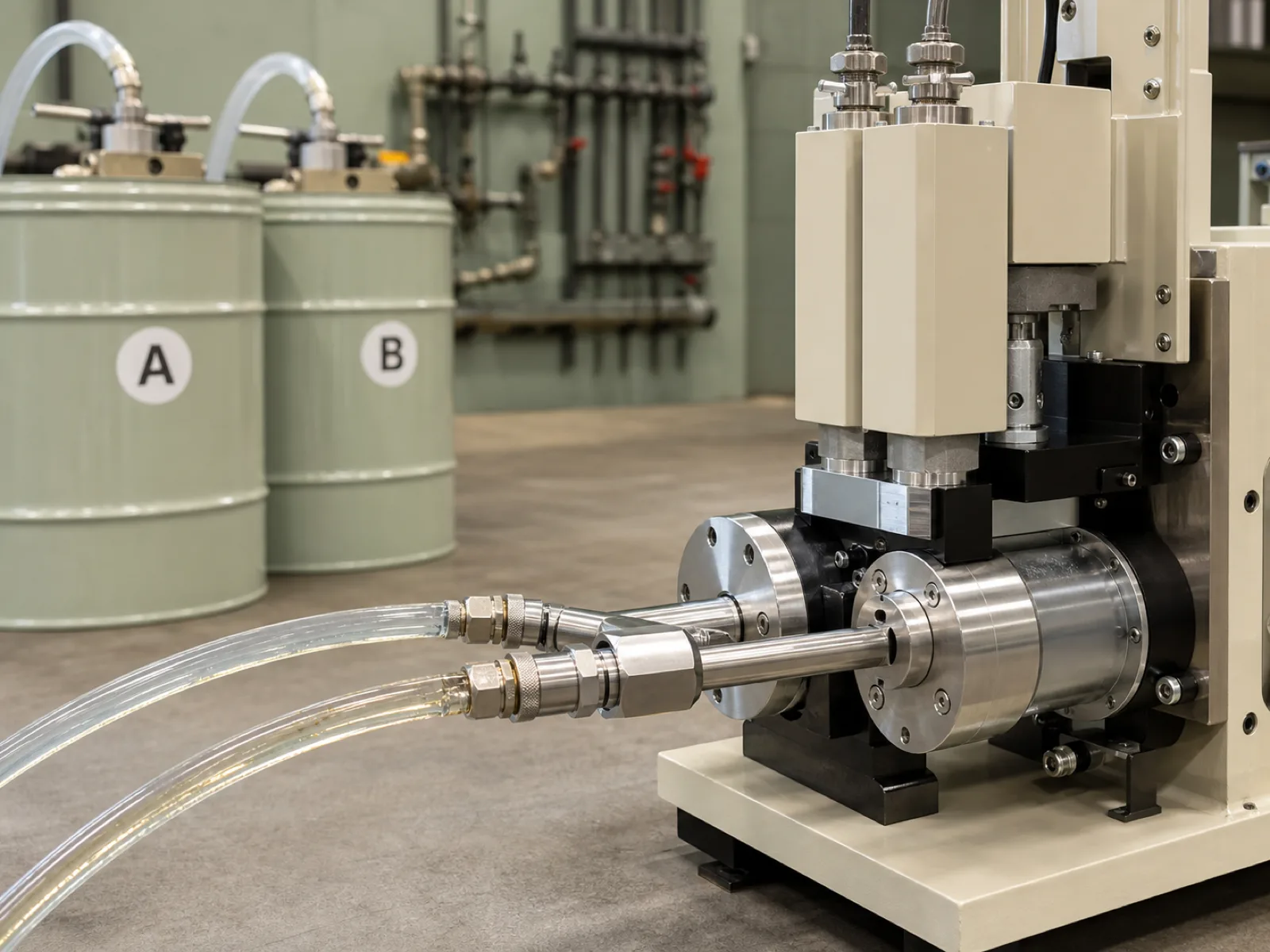
Liquid silicone rubber (LSR) is a two-part, platinum-cured polysiloxane elastomer supplied as pumpable A and B components at 100,000-1,000,000 cP. It is chemically identical in backbone to high-consistency rubber (HCR) — a Si-O-Si (siloxane) chain with methyl or vinyl side groups — but formulated to flow as a liquid, cure via hydrosilylation, and injection-mold in 15-90 second cycles inside a heated steel tool.
The material’s backbone is polydimethylsiloxane (PDMS) or polymethylvinylsiloxane, reinforced with fumed silica (typically 20-30 % by weight) to give it useful tensile and tear properties. Left un-reinforced, silicone gum has the mechanical strength of soft cheese. The silica turns it into a rubber. What makes LSR liquid rather than dough (HCR) is the molecular weight of the polymer chain: LSR uses shorter-chain siloxanes so the un-cured compound stays pumpable, and it relies on the platinum-catalyzed vinyl+SiH cross-link (hydrosilylation) to build up network strength during cure.
Two things follow from that chemistry. First, LSR has no leaving group when it cures — no by-product like the water from RTV condensation cure, no residual peroxide fragments from peroxide-cured HCR. That is why LSR shows a cleaner extractables and migration profile against food-contact tests per 21 CFR 177.26001 and LFGB §30/§312. Second, because the cure is catalyzed by platinum in the parts-per-million range, LSR is easy to inhibit — trace sulfur, tin, amines, or certain plastics on tooling can poison the catalyst and stop cure locally, which is why LSR tools are dedicated and why factories run separate storage for LSR versus HCR compound.
What are LSR’s standard material properties?
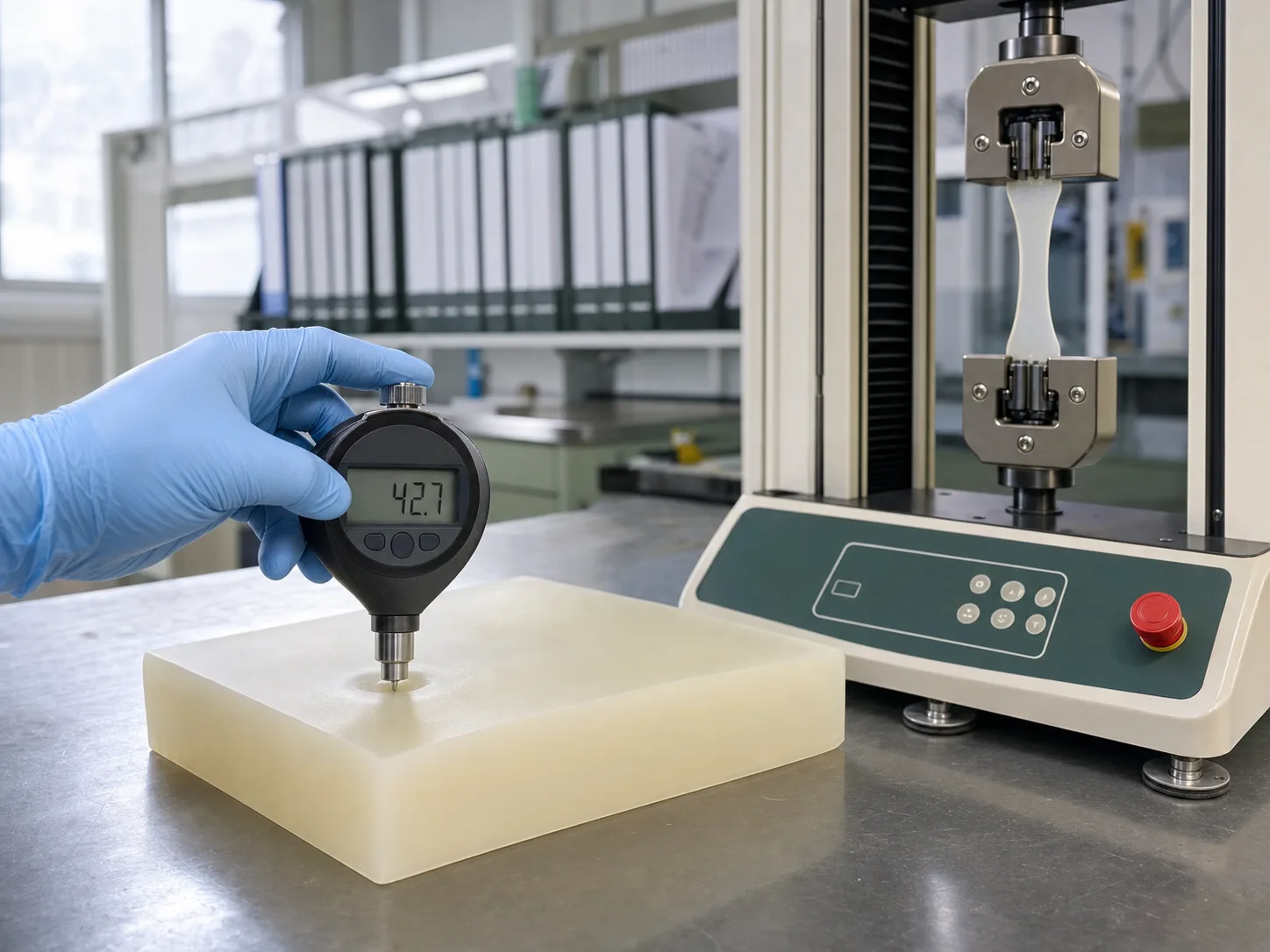
Standard LSR grades cover Shore A 5-80, tensile strength 6-10 MPa, elongation at break 400-700 %, tear strength 15-40 kN/m, and service temperature -60 °C to 200 °C continuous (short peaks 260 °C). Compression set is 20-40 % at 175 °C for 22 h. Dielectric strength runs 20-25 kV/mm — enough for automotive ignition boots and wearable electronics.
The property envelope is what most buyers actually need to know, so here it is in one place. All values below assume a post-cured, general-purpose LSR grade — properties measured per ASTM D2240 (hardness)3 and ASTM D412 (tensile and elongation)4.
| Property | Standard LSR range | Test method | Notes |
|---|---|---|---|
| Hardness (Shore A) | 5 - 80 | ASTM D2240 | Sweet spot for kitchenware: 40-70 A |
| Tensile strength | 6 - 10 MPa | ASTM D412 | Reinforced grades hit 11-12 MPa |
| Elongation at break | 400 - 700 % | ASTM D412 | Soft grades (30 A) push to 800 % |
| Tear strength (Die B) | 15 - 40 kN/m | ASTM D624 | High-tear grades hit 45+ kN/m |
| Compression set (175 °C, 22 h) | 20 - 40 % | ASTM D395 | Lower is better for gaskets |
| Continuous service temp | -60 °C to 200 °C | — | Short peaks 260 °C |
| Dielectric strength | 20 - 25 kV/mm | ASTM D149 | LED and automotive electrical grades |
| Specific gravity | 1.10 - 1.20 | ASTM D792 | Filled grades up to 1.5 |
| Linear shrinkage | 1.5 - 3.5 % | — | Tool designer must compensate |
Two properties matter more than the datasheet lets on. Compression set — the permanent deformation left after squeezing the part at 175 °C for 22 hours — is the number that determines whether a gasket survives 5 years of thermal cycling. A grade at 15 % C-set will still seal after a decade; a grade at 40 % is a one-year part. Linear shrinkage is what your tool designer compensates for at the CAD stage — under-compensate and the sink grid frame is 1.5 % undersized against the sink cutout, which is a live-fire failure mode we’ve seen on projects that came out of the wrong compound spec.
How does LSR injection molding actually work?
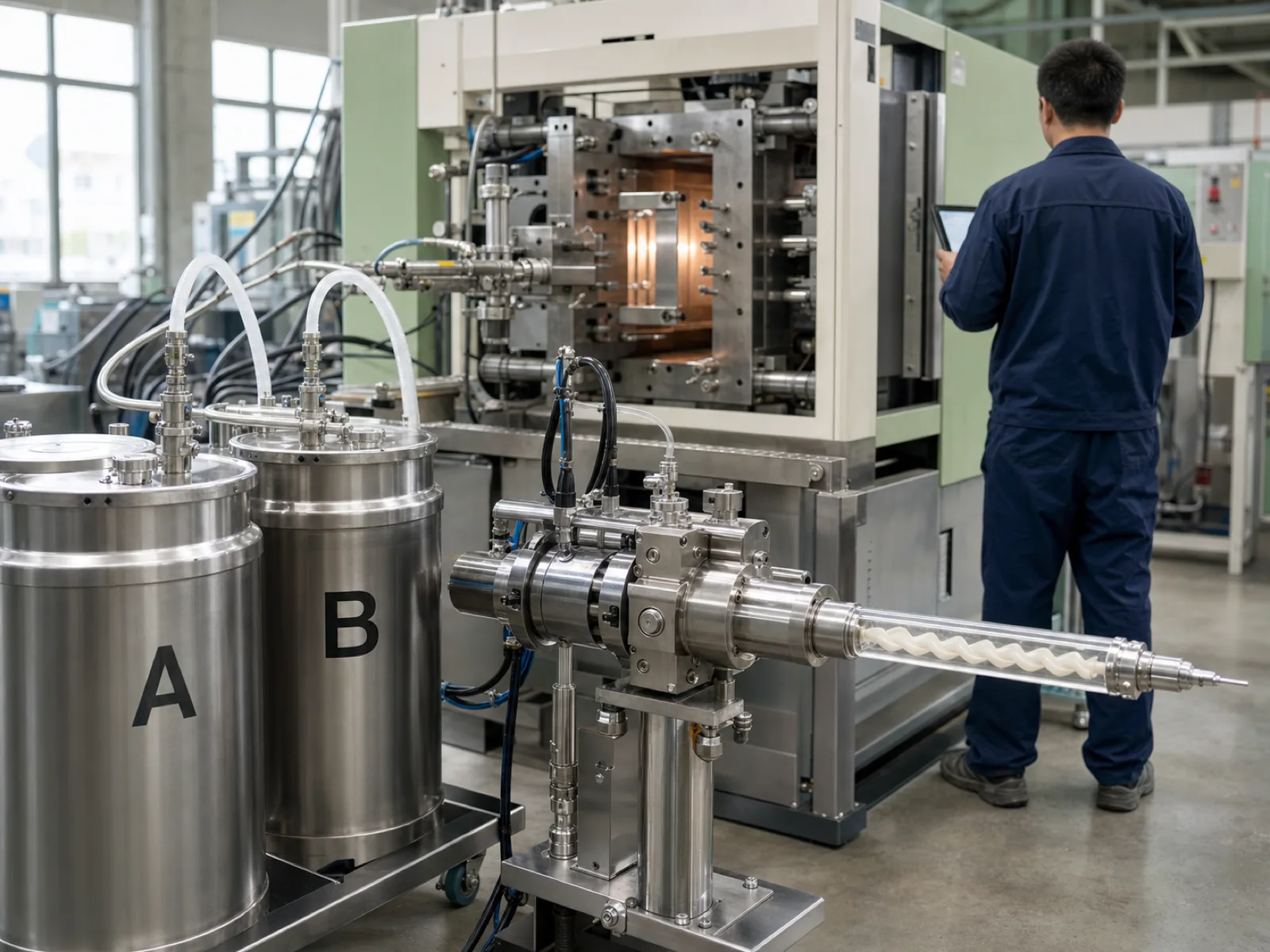
LSR injection molding meters two-part compound at 20-25 °C, injects it into a heated cavity at 160-200 °C, and cures it via platinum-catalyzed hydrosilylation in 15-90 seconds. Unlike thermoplastic molding, the barrel is cold and the tool is hot — the mirror image of PP or PC. A cold-runner system keeps the sprue and runner below 30 °C so no compound cures in the delivery path.
The process runs in seven steps, each of which is a lever a factory pulls to hit spec:
- Metering. A 1:1 volumetric pump doses A and B from drums into a static mixer. Ratio drift beyond ±1 % causes incomplete cure — factories log ratio per shot on production LSR cells.
- Static mixing. The mixer combines A and B in a helical passage. Shear is low so the compound stays cool. Mix quality is verified on line by cure-inhibitor spike tests during commissioning.
- Cold runner. The mixed compound moves through a temperature-controlled runner block held at 15-30 °C. This is what distinguishes an LSR tool from a hot-runner thermoplastic tool — same architecture, opposite thermal gradient.
- Cavity fill. Compound enters the heated cavity through a pin, edge, or valve gate. Fill takes 0.5-3 seconds depending on part volume.
- Cure. The heated cavity (160-200 °C) drives the platinum-catalyzed vinyl+SiH addition reaction. Full network build takes 15-90 seconds — 30 s is typical for a 3 mm wall.
- Demold. The tool opens; the elastomer part is stripped or ejected. Undercuts up to ~15 % strip cleanly because the material stretches without tearing.
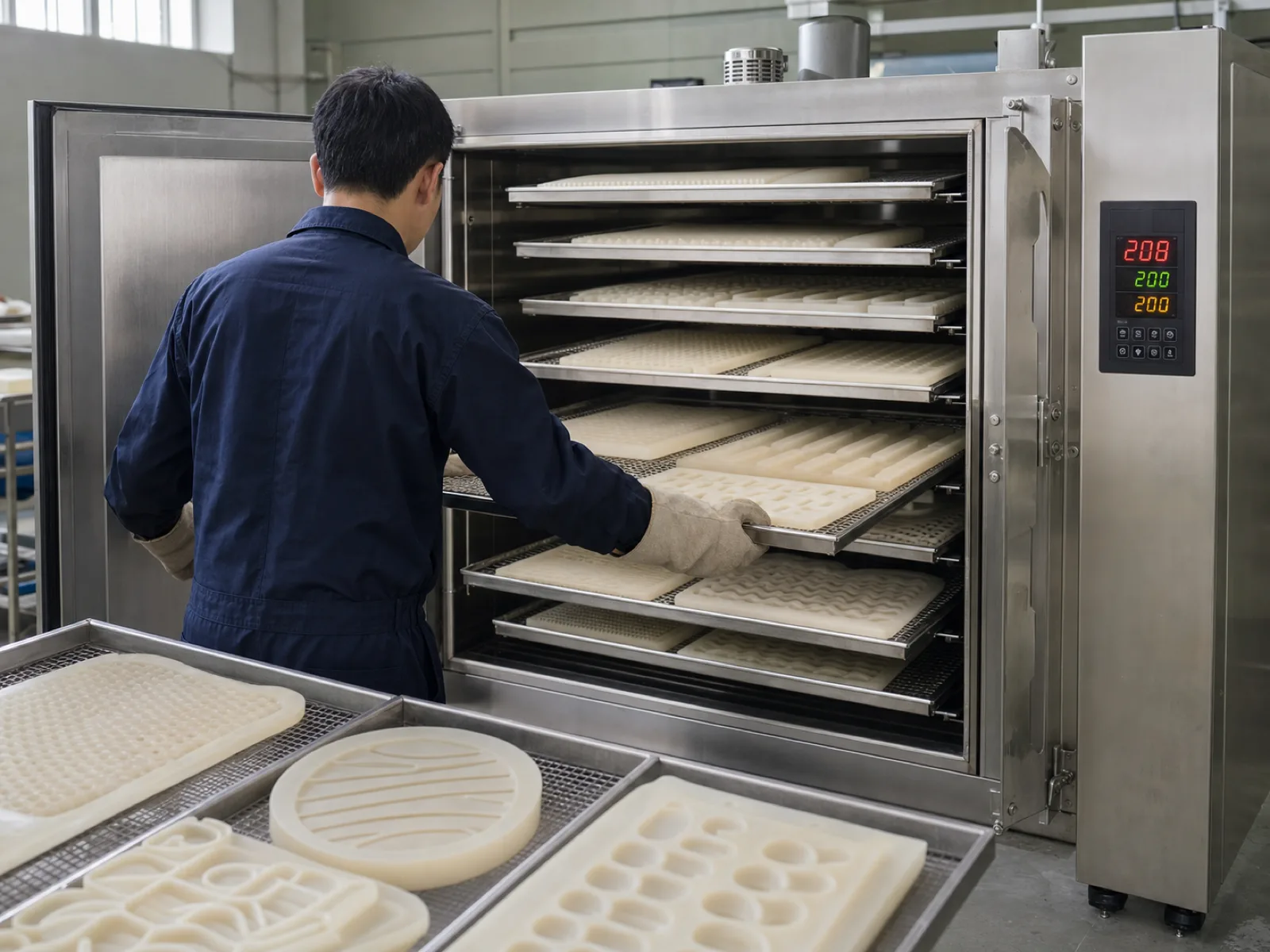
- Post-cure (optional but standard for food-contact). Parts hold in an air-circulated oven at 200 °C for 4-6 hours to volatilize residual reaction by-products. This is the step that unlocks per-batch LFGB §30/§31 test reports.
LSR vs HCR vs RTV vs thermoplastic elastomer — how do I pick?
For OEM production above ~5,000 units/year in food-contact, medical, or precision sealing, pick LSR. For deep or thick-walled parts (>10 mm) and legacy compression tools, HCR still wins. For prototyping, one-off molds, or ambient-temperature bonding, RTV is right. Thermoplastic elastomer (TPE) is a cost-driven substitute — it fails at temperatures above 130 °C and does not clear FDA food-contact automatically.
The decision matrix below is what our engineering desk walks buyers through when a program hasn’t fixed the cure system yet:
| Criterion | LSR | HCR | RTV | TPE |
|---|---|---|---|---|
| Cycle time | 15-90 s | 3-10 min | Hours-days | 20-60 s |
| Tolerance class (ISO 3302-1)5 | M1 (±0.05 mm) | M2-M3 | M4 | M2 |
| Wall thickness sweet spot | 0.5-6 mm | 3-15 mm | Any | 1-4 mm |
| Continuous service temp | -60 to 200 °C | -60 to 200 °C | -50 to 180 °C | -40 to 130 °C |
| FDA 21 CFR 177.2600 default | Yes (standard grades) | Requires re-testing | Not typical | No — grade-dependent |
| USP Class VI / ISO 10993 default | Yes (medical grades) | Case-by-case | No | No |
| Tool cost (single cavity) | US$8-15 k | US$3-8 k (compression) | US$0.5-2 k | US$5-10 k |
| Break-even vs. compression | ~5,000 units/yr | Reference | — | Cost-driven substitute |
| Recyclability | Thermoset (grind & re-use as filler) | Same | Same | Yes — remelts |
The genuinely honest read: LSR is not always right. If a program ships 800 units/year of a thick-walled gasket, LSR tooling never pays back and compression HCR wins. If the buyer needs recyclable material for sustainability compliance, TPE is the answer. But for the kitchenware, medical, and precision-sealing categories where Wetop concentrates — sink grids, drying racks, drying mats, food-contact seals — LSR is the default because it is the only cure system that hits ISO 3302-1 M1 tolerance, clears 21 CFR 177.2600 out of the drum, and holds cycle time under a minute.
What LSR grades exist beyond general purpose?
Beyond general-purpose Shore A 30-70 LSR, standard specialty grades include food-contact (21 CFR 177.2600), medical (USP Class VI, ISO 10993), self-lubricating (bleeds silicone oil for gaskets), electrically conductive (carbon or silver filled), flame-retardant (UL 94 V-0), optically clear (LED lenses, RI ~1.41), and self-adhesive (bonds to PC/PBT/PA in overmolding). Each specialty grade adds US$2-15/kg over the ~US$10-15/kg general-purpose base.
The grade taxonomy matters because a factory that only stocks general-purpose will price up your medical-grade RFQ at a specialty premium plus a small-lot buy premium from the compounder. Wetop keeps general-purpose (40 A, 50 A, 60 A, 70 A), food-contact, medical, and self-adhesive on the shelf; anything else is a special-order compound with a 2-4 week lead time from Wacker, Momentive, Shin-Etsu, Dow, or Elkem.
| Grade family | Marker property | Typical uses |
|---|---|---|
| General purpose | Standard PDMS + silica | Housewares, seals, kitchenware |
| Food-contact | Cleared per 21 CFR 177.2600 + LFGB §30/§31 | Sink grids, drying mats, baking mats |
| Medical | USP Class VI + ISO 10993-5/-10 | Wearables, tubing, drug-contact seals |
| Self-lubricating | Silicone-oil bleeding compound | O-rings, dynamic seals |
| Electrically conductive | Volume resistivity 1-100 Ω·cm | EMI gaskets, keypads |
| Flame-retardant | UL 94 V-0 | EV battery seals, aerospace |
| Optically clear | Transmission >90 %, RI ~1.41 | LED lenses, headlamp gaskets |
| Self-adhesive | Bonds PC/PBT/PA in-mold | Overmolded medical parts, wearables |
What compliance does LSR clear — and what still needs testing?
Standard LSR grades clear 21 CFR 177.2600 (US FDA)[^fda-177-2600], LFGB §30/§31 (Germany, adopted EU-wide)[^bfr-xv], and — for medical grades — USP Class VI[^usp-class-vi] plus ISO 10993-5[^iso-10993-5] and ISO 10993-10[^iso-10993-10]. What is not automatic on the finished part: California Prop 65 heavy-metals, REACH SVHC screening[^echa-reach], EU 10/2011 overall migration limit[^eu-10-2011], and per-batch traceability. The compound is compliant; the factory has to prove the part is.
This is where the RFQ conversation usually breaks down. A buyer assumes “LSR is FDA-approved” and expects a factory to hand back a passing test report as a matter of course. The compound material is cleared. The finished article — molded on a specific tool, post-cured on a specific oven schedule, packed in specific packaging — has to be tested against actual migration limits under the target end-use conditions.
Wetop’s default compliance stack on food-contact SKUs runs:
- Compound. Wacker, Shin-Etsu, or Elkem food-grade LSR with supplier declaration + material data sheet on file.
- Post-cure. 4-6 hours at 200 °C, tray-loaded, temperature logged.
- Per-batch test. LFGB §30/§31 overall migration on the finished article — reported per production batch, not just at qualification.
- REACH SVHC declaration. Confirmed no substance on the Candidate List above 0.1 % w/w6.
- EU 10/2011 crossover. Overall migration ≤ 10 mg/dm² per finished part7 when the customer’s spec calls for it.
- California Prop 65. Heavy-metals screen on demand — not free, so we quote it as a line item.
If a factory can’t show a per-batch test report — only a qualification-run test from three years ago — that is a bright red flag on the sourcing checklist. Compliance is not a one-time bureaucratic hurdle; it is a running QC discipline.
What are the design rules for LSR parts?
LSR handles wall thickness 0.5-6 mm (sweet spot 1.5-3 mm), draft angle 0.5-1° minimum on cored features, inside radius 0.25 mm minimum, and undercuts up to ~15 % without side actions because the cured elastomer strips off. Achievable tolerance is ISO 3302-1 M1 (±0.05 mm) on features under 10 mm and M2 (±0.10 mm) on larger dimensions. Overmolding onto PC, PBT, PA, and passivated metal is standard with self-adhesive grades.
Six design levers change LSR cost and yield more than any material choice:
- Wall thickness uniformity. Vary wall thickness by more than 3× across the part and cure kinetics diverge — thick sections still gel while thin sections have over-cured. Aim for a max wall / min wall ratio ≤ 3.
- Parting line. Place it where flash is invisible and easy to trim. A parting line running across a food-contact surface is a failure waiting to happen — molders defect out ~2-5 % of parts on visible flash.
- Gate location. Sub-gates and valve gates leave no vestige. Pin gates leave a witness mark. For sink grids and drying racks, we gate on a hidden underside face to keep the cosmetic surface clean.
- Vent design. LSR generates trapped gas at 160-200 °C. Vents (0.02-0.05 mm deep, 3-6 mm wide) at flow front stopping points prevent knit-line burns.
- Undercuts. LSR strips off undercuts up to ~15 % of the feature depth. Beyond that, you pay for side actions — US$3-6 k of tooling cost per side.
- Shrinkage compensation. Linear shrink 1.5-3.5 % depending on durometer, thickness, and post-cure. Tool designer compensates at CAD.
What does LSR tooling cost, and where does it break even against compression molding?
A mid-complexity LSR tool (single-cavity, cold-runner, P20 or H13 hardened steel) lands US$8-15 k. Multi-cavity production tools (4-16 cavity) run US$20-60 k. Tool life is 500,000 to 1,000,000+ shots. Break-even against compression molding is roughly 5,000 units/year for a typical kitchenware SKU — anything higher and LSR wins on cost per shot and cycle time.
Tooling economics is where LSR’s real answer emerges. Compression HCR wins on tool cost — a single-cavity compression tool for a sink grid might land at US$3-5 k against US$10-12 k for the equivalent LSR tool. But per-shot cost tells the opposite story. A compression cycle is 3-10 minutes; LSR is 30-60 seconds. A four-cavity LSR tool doing 45-second cycles outputs 320 parts/hour. A single-cavity compression tool at 5-minute cycles outputs 12 parts/hour — a 26× throughput gap.
| Tool type | Tooling cost (mid-complexity) | Cycle time | Throughput (parts/hr, single cavity) | Life |
|---|---|---|---|---|
| Compression HCR (aluminum) | US$3-5 k | 3-10 min | 6-20 | 100 k shots |
| Compression HCR (P20 steel) | US$5-8 k | 3-10 min | 6-20 | 300 k shots |
| LSR injection, single-cavity, cold-runner | US$8-15 k | 15-90 s | 40-240 | 500 k-1 M shots |
| LSR injection, 4-cavity, cold-runner | US$25-40 k | 15-90 s | 160-960 | 500 k-1 M shots |
| LSR injection, 8-cavity, cold-runner | US$40-60 k | 15-90 s | 320-1,920 | 500 k-1 M shots |
For a Wetop kitchenware SKU projecting 10,000 units/year, a 4-cavity LSR tool amortizes at US$3-4 per unit over the first-year batch and drops toward zero on year two. The same unit run through compression HCR needs about 500 machine-hours a year, versus about 30 hours for the LSR cell — that machine-time delta is what makes LSR the honest answer above ~5,000 units/year.
How do I actually write an RFQ for an LSR part?
A complete LSR RFQ specifies six variables: (1) 3D file in STEP or Parasolid, (2) target durometer ±5 Shore A, (3) color to Pantone Solid Coated, (4) certification stack (21 CFR 177.2600 / LFGB §30/§31 / USP Class VI as applicable), (5) annual volume and reorder cadence, (6) tolerance class per ISO 3302-1 (M1 medical, M2 consumer). Anything less and quotes come back non-comparable — one factory prices a general-purpose grade against another's food-contact spec.
The one-page RFQ template we ask buyers to send in — same format we use internally when we spec a new SKU:
1. Part identity
   Part name / program name
   3D file (STEP or Parasolid, not STL)
   2D drawing with critical dimensions flagged
   Annual volume + reorder cadence
   Ship-to country (drives certification stack)

2. Material spec
   Compound family: LSR / HCR / RTV
   Cure system: platinum only (default) / peroxide (only if user asks)
   Durometer: XX ±5 Shore A
   Color: Pantone Solid Coated ____
   Special grade: food-contact / medical / self-adhesive / FR / clear

3. Compliance stack
   FDA 21 CFR 177.2600 (yes/no)
   LFGB §30/§31 (yes/no)
   USP Class VI (yes/no)
   ISO 10993-5/-10 (yes/no)
   California Prop 65 (yes/no)
   REACH SVHC declaration (yes/no)

4. Tolerance
   ISO 3302-1 class: M1 / M2 / M3
   Critical dimensions with tighter tolerance called out on drawing

5. Testing deliverables (demand back from factory)
   Material data sheet
   First-article dimensional report
   Migration test report (LFGB / EU 10/2011)
   Per-batch test cadence (every lot / every N lots)
   PPAP-lite on first 3 production lots

6. Commercial
   Target FOB
   Target sample lead time
   Target production lead time
   Payment terms
For Wetop’s kitchenware program specifically — sink grids, drying racks, drying mats — MOQ is 500 units per SKU, sample lead time is 7-15 days on existing tooling, and every food-contact SKU ships with per-batch LFGB §30/§31 reports. That combination is what “real factory MOQ” means: not a paper MOQ enforced by contract, but the volume at which a food-contact production cell actually pays back.
Where does LSR show up in the real world?
LSR ships into six mature application categories: kitchenware (sink grids, drying racks, drying mats, baking mats), infant & nursing (bottle nipples, pacifiers), medical (tubing, seals, wearable adhesives, drug-contact seals), automotive (ignition boots, sensor seals, HVAC gaskets), electronics (keypads, EMI gaskets, LED optics), and personal care (menstrual cups, cosmetics tools). Kitchenware and infant/nursing account for the bulk of Wetop's platinum-cured production.
Wetop’s own book is deliberately narrow. We run one platinum-cured LSR injection cell and one hydraulic compression cell on a 7,500 m² floor in Dongguan. Every food-contact SKU ships against 21 CFR 177.2600 and LFGB §30/§31, per-batch test reports on file. Our kitchenware program covers three product families in that scope — silicone sink grids, silicone drying racks, and silicone drying mats — because those are the categories where LSR’s tolerance, cycle time, and food-contact compliance stack line up with the Top-5 US sink brand caliber our buyers demand. Anything outside that scope — automotive gaskets, medical wearables, LED optics — we refer out. That is a strategic choice, not a capability gap.
For a deeper walk through cure system economics, see platinum-cured vs peroxide-cured silicone. For the compliance-stack details a buyer’s QA team needs before releasing production, see FDA vs LFGB silicone compliance. For the temperature envelope covering food, oven, and freezer use, see silicone temperature range explained.
Talk to the engineering desk
If you are sourcing a silicone kitchenware SKU — sink grid, drying rack, drying mat — and want the RFQ answered by the people running the cell, contact the engineering desk. We answer in one business day with a quote that specifies compound, cure system, tolerance class, and per-batch compliance packet by default.
Footnotes
FAQ
-
What exactly is liquid silicone rubber and how is it different from regular silicone?
Liquid silicone rubber (LSR) is a two-part platinum-cured polysiloxane supplied as pumpable A + B components at 100,000-1,000,000 cP. 'Regular' silicone usually means HCR (high-consistency rubber) — a peroxide-cured, doughy compound compression-molded in slabs. LSR injects and cures in 15-90 s inside a heated steel tool; HCR takes 3-10 minutes per cycle and rarely holds ±0.05 mm.
-
What are the standard mechanical and thermal properties of LSR?
Standard LSR grades cover Shore A 5-80, tensile strength 6-10 MPa, elongation at break 400-700 %, tear strength 15-40 kN/m, compression set 20-40 % at 175 °C/22 h, and service temperature -60 °C to 200 °C continuous with short peaks to 260 °C. Dielectric strength is 20-25 kV/mm — enough for automotive ignition boots and wearable electronics.
-
Is liquid silicone rubber FDA and food-safe by default?
Standard LSR grades clear 21 CFR 177.2600 (US FDA food-contact) and LFGB §30/§31 (Germany, adopted across EU) out of the drum when properly post-cured 4-6 h at 200 °C. Medical grades clear USP Class VI and ISO 10993-5/-10 biocompatibility. Compliance is not automatic on the finished part — the factory must maintain traceability and per-batch test reports, which is why Wetop runs each production batch against a fresh LFGB packet.
-
How is LSR injection molding different from thermoplastic injection molding?
Thermoplastic melts in a heated barrel and solidifies in a cooled mold. LSR does the opposite: A+B are metered and static-mixed at 20-25 °C, injected into a heated tool at 160-200 °C where the platinum catalyst triggers hydrosilylation cure. LSR tools use a cold runner (kept below 30 °C) to prevent runner cure and gate waste — a $2-5 k tool premium that pays back within the first 20 k shots.
-
What is the difference between LSR, HCR, and RTV silicone?
LSR is low-viscosity two-part liquid, injection-molded, platinum-cured, 15-90 s cycles. HCR is high-consistency (dough-like) rubber, compression- or transfer-molded, peroxide- or platinum-cured, 3-10 min cycles. RTV (room-temperature vulcanizing) is one- or two-part liquid that cures at ambient temperature — used for prototyping, sealants, and mold-making, not high-volume parts. For OEM production of kitchenware, medical, or automotive parts, LSR or platinum-HCR is the default.
-
What LSR grades exist beyond general purpose?
Beyond general-purpose Shore A 30-70 grades, LSR is available as food-contact (21 CFR 177.2600), medical (USP Class VI), self-lubricating (bleeding oil for gaskets and o-rings), electrically conductive (carbon or silver filled), flame-retardant (UL 94 V-0), optically clear (LED lenses, refractive index ~1.41), and self-adhesive (bonds to PC/PBT/PA in overmolding). Each grade adds $2-15/kg over the ~$10-15/kg base.
-
What does LSR tooling cost and how many shots does it survive?
A mid-complexity LSR tool (single-cavity, cold-runner, hardened P20 or H13 steel) lands US$8-15 k. Multi-cavity production tools (4-16 cavity) run US$20-60 k. Tool life is typically 500,000 to 1,000,000+ shots — the abrasion mode is gate erosion and vent clog, not cavity wear. Break-even against compression molding is roughly 5,000 units/year for a kitchenware SKU; anything higher, LSR wins on cost per shot and cycle time.
-
How do I write an RFQ for a liquid silicone rubber part?
Send the factory: (1) 3D file in STEP or Parasolid, (2) target durometer ±5 Shore A, (3) color to Pantone Solid Coated, (4) certification stack (FDA 21 CFR 177.2600 / LFGB / USP Class VI as applicable), (5) annual volume and reorder cadence, (6) tolerance class per ISO 3302-1 (M1 for medical, M2 for consumer). Demand back: material data sheet, migration test report, first-article dimensional report, and a PPAP-lite packet on the first 3 lots.
-
What are the design rules for parts molded in LSR?
Wall thickness 0.5-6 mm (1.5-3 mm sweet spot), draft angle 0.5-1° minimum on cored features, minimum radius 0.25 mm at inside corners, tolerance class M1 (±0.05 mm) achievable on features under 10 mm and M2 (±0.1 mm) on larger dims. LSR handles undercuts up to ~15 % without side actions because the cured elastomer strips off. Overmolding onto PC, PBT, PA, and passivated metal is standard with self-adhesive grades.
-
Why does Wetop Silicone default to LSR (platinum-cured) for kitchenware?
Every food-contact SKU we ship — sink grids, drying racks, drying mats — must clear 21 CFR 177.2600 and LFGB §30/§31 with per-batch test reports. Peroxide-cured HCR needs additional post-cure and often still shows residual peroxide by-products that can migrate. Platinum-cured LSR cures via hydrosilylation with no leaving group — cleaner extractable profile, tighter cycle time, and the tolerance class our sink brand buyers spec (±0.1 mm on grid frames).
References
Authoritative sources cited in this guide
- US Food and Drug Administration (eCFR). 21 CFR 177.2600 — Rubber articles intended for repeated use. https://www.ecfr.gov/current/title-21/chapter-I/subchapter-B/part-177/subpart-C/section-177.2600 — US federal food-contact clearance every LSR grade in Wetop's kitchenware program is tested against.
- United States Pharmacopeia. USP <88> Biological Reactivity Tests, In Vivo — Class VI. https://www.usp.org/harmonization-standards/pdg/excipients/plastic-materials — Biocompatibility test protocol for medical-grade LSR; cited when a buyer asks whether a food-contact grade also covers skin-contact wearables.
- International Organization for Standardization. ISO 10993-5:2009 — Biological evaluation of medical devices — Part 5: Tests for in vitro cytotoxicity. https://www.iso.org/standard/36406.html — In vitro cytotoxicity screen paired with ISO 10993-10 on medical LSR grades.
- International Organization for Standardization. ISO 10993-10:2010 — Biological evaluation of medical devices — Part 10: Tests for irritation and skin sensitization. https://www.iso.org/standard/40884.html — Skin irritation and sensitization protocol referenced on medical LSR product data sheets.
- ASTM International. ASTM D2240 — Standard Test Method for Rubber Property — Durometer Hardness. https://www.astm.org/d2240-15r21.html — Shore A test method used on every LSR incoming batch check at Wetop.
- ASTM International. ASTM D412 — Standard Test Methods for Vulcanized Rubber and Thermoplastic Elastomers — Tension. https://www.astm.org/d0412-16r21.html — Tensile and elongation test method that defines the 6-10 MPa / 400-700 % ranges quoted on standard LSR grades.
- International Organization for Standardization. ISO 3302-1:2014 — Rubber — Tolerances for products — Part 1: Dimensional tolerances. https://www.iso.org/standard/60874.html — Defines the M1/M2/M3/M4 tolerance classes Wetop uses on LSR RFQs — M1 for medical, M2 for consumer kitchenware.
- German Federal Institute for Risk Assessment (BfR). BfR Recommendation XV — Silicones. https://www.bfr.bund.de/en/bfr_recommendations_on_food_contact_materials-7498.html — German food-contact silicone recommendation underpinning LFGB §30/§31 test methodology.
- European Chemicals Agency. REACH — Registration, Evaluation, Authorisation and Restriction of Chemicals. https://eur-lex.europa.eu/legal-content/EN/TXT/?uri=CELEX%3A32006R1907 — EU chemical framework; LSR compound suppliers must confirm no SVHC on the Candidate List above 0.1 % w/w.
- European Commission (EUR-Lex). Commission Regulation (EU) No 10/2011 on plastic materials and articles intended to come into contact with food. https://eur-lex.europa.eu/legal-content/EN/TXT/?uri=CELEX%3A02011R0010-20230831 — Cross-referenced when a buyer needs both LFGB and EU 10/2011 documentation on the same LSR SKU.
Start a custom program
Send a brief. Get an engineer’s reply in one business day.
Every Wetop program is tooled from a customer’s specification. Send a CAD file (STEP · IGES · DWG) or a written brief and we’ll reply with a mold cost estimate, price brackets at MOQ 500 / 1,000 / 5,000, and any engineering questions.