Home-fragrance / lifestyle brand · Multi-Category · Candle mold + catch-tray OEM
Home-fragrance brand · candle mold + tray OEM
Why this program is worth writing up
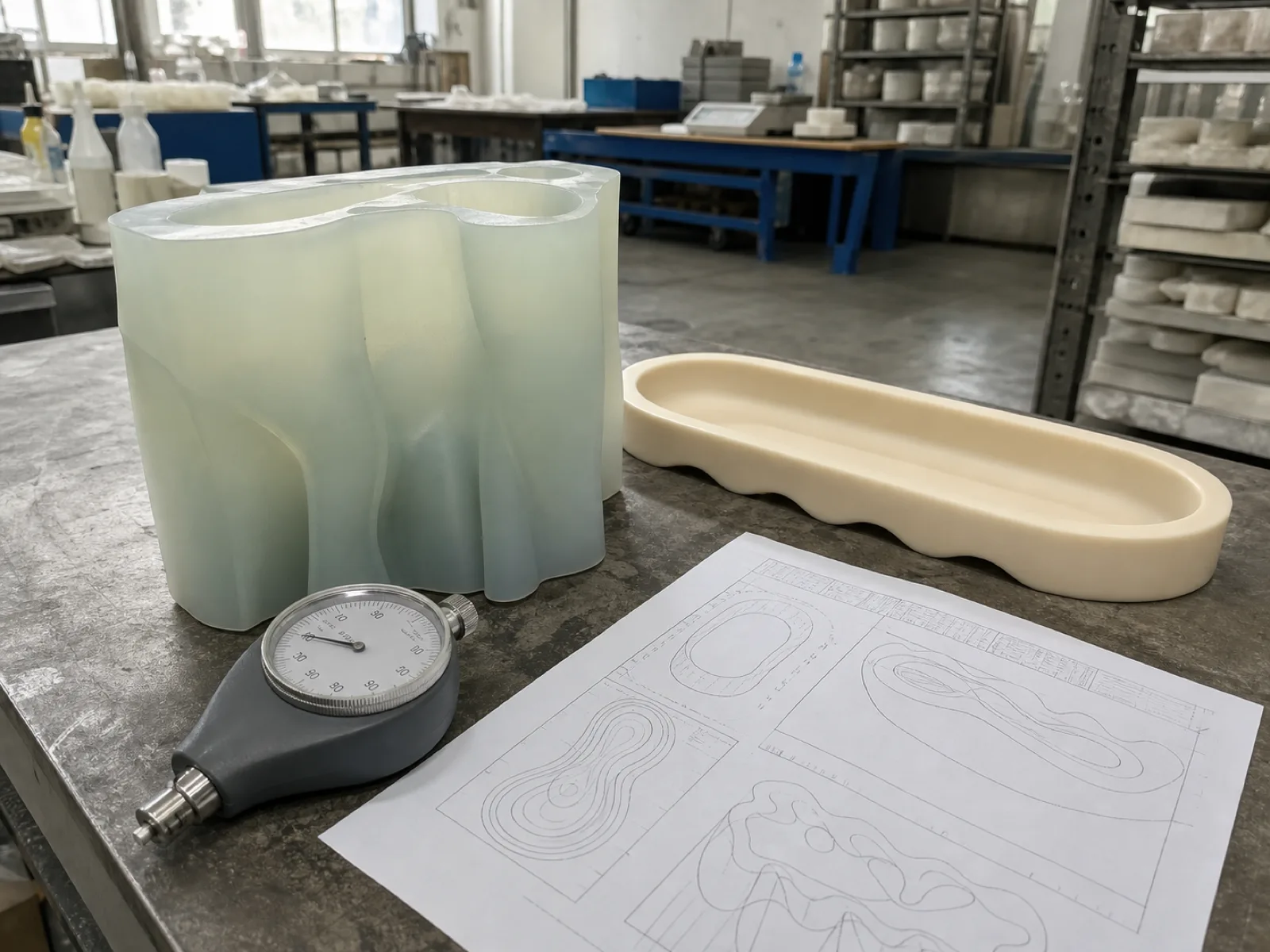
This is the OEM case where a single home-fragrance brand needed two silicone products that disagree with each other on every material axis — a soft, translucent, tear-tough mold and a firm, matte, color-disciplined tray — and the engineering answer was two qualified compounds under one compliance stack, not one compromise durometer that serves neither.
The brand is not named here — the program runs under an anonymization agreement standard for DTC and lifestyle-retail private-label work, and this account is an anonymized composite representative of the candle-adjacent silicone programs Wetop runs. What matters for other home-fragrance, home-decor, and lifestyle procurement readers is the shape of the decisions, not the logo: how a factory handles a two-durometer program, why the first tool got scrapped, and what “platinum-cured” actually buys a candle brand whose product touches molten wax.
The challenge: two products, opposite material logic
The challenge was a single brand needing a reusable sculptural candle mold at Shore A 25 (soft, translucent, tear-tough enough to release a thin-wall pour) and a matte catch-tray at Shore A 55 (firm, flat, color-held to ±0.6 ΔE across a cream-and-sage palette). One compound cannot serve both — a durometer soft enough to demold intricate wax tears under a tray's shelf-load, and a durometer firm enough for a flat tray cannot flex around a sculptural undercut.
The mold sits in a DIY pour kit and in the brand’s own studio, so it faces repeated demold cycles at candle-pour temperature (paraffin and soy blends pour between roughly 60 °C and 75 °C). The failure modes there are tear at thin reveals and progressive dimensional creep — a mold that stretches out of shape after 50 pours starts producing off-tolerance candles and generates returns. The tray, by contrast, is a shelf accessory: it must lie flat, resist wax drip and heat from a lit vessel, and match the brand’s muted retail palette closely enough that a mold and a tray photographed together read as one coordinated set.
The brand arrived carrying a specific scar. An earlier mold sample, sourced from an unaudited online marketplace listing, had left a faint haze on the poured wax surface after a few pours — a discoloration their customers photographed and returned. That is the fingerprint of a peroxide-cured or under-post-baked compound bleeding cure residue into the wax. Cure-system provenance moved to the top of the RFQ.
How we approached it: two qualified compounds, one QC discipline
We refused the compromise durometer and qualified two compounds. The mold family runs platinum-cured silicone at Shore A 25 ± 3 with tear strength ≥ 30 kN/m (Die B) and compression set ≤ 20% (ASTM D395, 22 h / 70 °C). The tray family runs Shore A 55 ± 3 with a matte SPI-textured cavity and master-batch color verified per lot at ±0.6 ΔE against a TPX Pantone reference under a D65 light booth.
The mold spec is where the engineering judgment lives. Tear strength is what lets a soft, thin-walled sculptural mold release a detailed pour without splitting at the reveal; compression set is what keeps that same mold dimensionally honest after 200 demold cycles at pour temperature. A mold house optimizing purely for softness — the “squishiest sample wins” instinct a marketplace buyer falls into — will quietly ship a high-compression-set compound that feels great in the hand and creeps out of tolerance inside a season. We locked ASTM D395 ≤ 20% into the compound qualification so that failure mode was closed on paper before tooling.
Both families are platinum-cured (addition-cure) silicone with a mandatory 4-hour post-bake at 200 °C. Addition cure produces no acidic by-products, so nothing migrates into the poured wax — the exact defect that sent the brand looking for an audited factory. This is the same cure-system logic covered in the platinum-cured vs peroxide-cured silicone guide; for a candle brand whose product literally sits inside the mold cavity, it is not an upgrade, it is the entry ticket.
The tray family runs its own discipline: color mixed in master-batch (dyed through the silicone gum before molding, not surface-coated), so the color is molecularly uniform through the part and cannot scuff off. Every lot is spectrophotometer-read at five points against a physical Pantone reference chip, ΔE00 formula, and the reading is logged on the batch certificate. Standard home-decor-tier color tolerance runs ±1.5–2 ΔE; we hold ±0.6 so a tray molded in month 12 still coordinates with a mold molded in month 1 on the same shelf.
The scrapped tool: why the first sculptural mold got re-cut
The first sculptural mold tool was scrapped after first-article. On first-shot demold the soft silicone tore at a 1.2 mm reveal because the original parting line and gate placement concentrated stress across the thinnest wall. Rather than ship a tool that would tear at random in the customer's hands, we re-cut it with a revised parting line and a fan gate that fed the thin section evenly — tear-free release before production start.
This is the “scrapped and restarted” discipline a broker model cannot afford and a real tooling floor treats as routine. The first tool was not wrong on paper — the cavity geometry matched the brand’s 3D reference — but the parting line ran through the sculptural undercut in a way that forced the demold pull straight across a 1.2 mm reveal. Soft silicone at Shore A 25 has generous elongation, but elongation does not save you from a stress riser at a sharp gate mark. The re-cut moved the parting line to follow the silhouette and switched the gate to a fan geometry that fills the thin wall without a jet mark, so the demold pull distributes across the whole section instead of tearing at one point.
Eating the cost of a re-cut tool at first-article is cheaper than eating a 3% field-return rate for eighteen months. The brand had quoted its prior DIY-mold return rate — from marketplace-sourced tooling — at roughly 3%, dominated by “mold tore.” Closing that at the tool stage is the difference between a program that scales and one that bleeds.
Specs and results
| Parameter | Candle mold family | Catch-tray family |
|---|---|---|
| Cure system | Platinum-cured (addition) | Platinum-cured (addition) |
| Durometer | Shore A 25 ± 3 (ASTM D2240) | Shore A 55 ± 3 (ASTM D2240) |
| Finish | Translucent, smooth cavity | Matte, SPI-textured cavity |
| Tear strength (Die B) | ≥ 30 kN/m | ≥ 22 kN/m |
| Compression set (ASTM D395, 22 h/70 °C) | ≤ 20% | ≤ 25% |
| Service temperature | -40 °C to 230 °C | -40 °C to 230 °C |
| Color tolerance | Natural translucent | ±0.6 ΔE (ΔE00, D65) across 4 colorways |
| Post-bake | 4 h at 200 °C | 4 h at 200 °C |
| MOQ | 500 / SKU | 500 / SKU |
| First-article lead | 12–15 days | 10–12 days |
| Production lead | 30–45 days | 30–45 days |
| Compliance per lot | FDA 21 CFR 177.2600 · LFGB §30/§31 · Prop 65 | FDA 21 CFR 177.2600 · LFGB §30/§31 · Prop 65 |
| Field return “mold tore” | < 0.4% (vs ~3% prior baseline) | n/a |
| Color-drift returns | n/a | < 0.4% |
Outcome: 18 months, 120,000 units, one qualification carried forward
The program has run 18 months at ~120,000 units/yr — roughly 45,000 molds and 75,000 catch-trays. The re-cut mold demolds tear-free at production speed; "mold tore" returns hold under 0.4% against the brand's ~3% marketplace baseline. The tray palette has held ±0.6 ΔE on every lot across four colorways, and the poured-wax discoloration failure has not recurred in 18 months of platinum-cure production.
The buyer-side pattern worth naming: the program grew on qualification carryover, not on a price cut. When the brand added a fifth tray colorway and a second sculptural-mold silhouette, the only net-new work was tooling and first-article — the two compound qualifications, the platinum-cure attestation, the color-control method, and the FDA + LFGB + Prop 65 compliance stack all carried over unchanged. That is the compounding advantage of qualifying material and process once, correctly, rather than re-opening the material question every SKU.
The other quiet win is the compliance cadence. Every lot ships with a certificate bundle referenced to the PO number — cure-system attestation, 21 CFR 177.2600 clause statement, LFGB §30/§31 results, Prop 65 attestation, and the per-lot ΔE color report for the tray family — retained 36 months under ISO 9001:2015. For a lifestyle brand whose product placed into a Tier-2 retail account mid-program, having per-batch documentation already structured for a retailer’s compliance desk removed the friction that usually stalls a shelf placement.
Related program and further reading
For a peer program in the same DTC/lifestyle segment — coordinated color across a rotating retail palette on a subscription cadence — see the subscription DTC brand color-refresh case study. For the tooling, draft, and demold engineering behind the mold family, the silicone candle mold manufacturing guide covers cavity design, cure system, and the thin-wall release problem in depth. The catch-tray side maps to the silicone decorative tray OEM guide.
Frequently asked
Q: Why does a candle mold need a compression-set spec? A: Because a mold that creeps out of shape after repeated demold at pour temperature produces off-tolerance candles and generates returns. We hold ASTM D395 compression set ≤ 20% (22 h at 70 °C) on the mold compound so it stays dimensionally honest across 200+ demold cycles. A buyer never sees this number on the DIY-kit box, but every “the candle came out wrong” return traces back to it.
Q: Why platinum-cured and not a cheaper peroxide compound? A: Platinum (addition) cure produces no acidic by-products, so nothing migrates into the poured wax. Peroxide-cured or under-post-baked silicone can bleed cure residue that hazes and discolors the wax surface — the exact failure the brand hit with a marketplace-sourced sample. Platinum cure plus a 4-hour 200 °C post-bake closes that failure mode.
Q: Can one silicone compound serve both the mold and the tray? A: No. The mold needs Shore A ~25 with high tear strength to release a soft sculptural pour; the tray needs Shore A ~55 to lie flat and resist shelf load. A single compromise durometer serves neither well. We qualified two compounds under one QC and compliance discipline — the right answer for a two-product program.
Q: What is the MOQ for adding a new tray colorway or mold silhouette? A: 500 units per SKU. Because the compound qualification, cure system, color-control method, and compliance stack carry over, a new colorway or silhouette needs only fresh tooling and first-article — not a re-qualification. That is why this program expanded on carryover rather than a price renegotiation.
Sourcing a candle mold, a decorative tray, or a coordinated home-fragrance accessory range and want it engineered to a spec rather than a marketplace listing? Talk to the engineering desk via contact — NDA templates, capacity data, and compound qualification records are available on request. More programs at case studies.
Sourcing a similar program?
Get a CAD review and quote in one business day.
MOQ 500 per SKU. Samples in 7-25 days. We can share a more detailed reference (under NDA) for an adjacent program. Email inquiry@wetopsilicone.com or use the form.