Buyer Guide · commercial intent
Silicone Decorative Tray OEM — Concrete-Look Finishes & MOQ
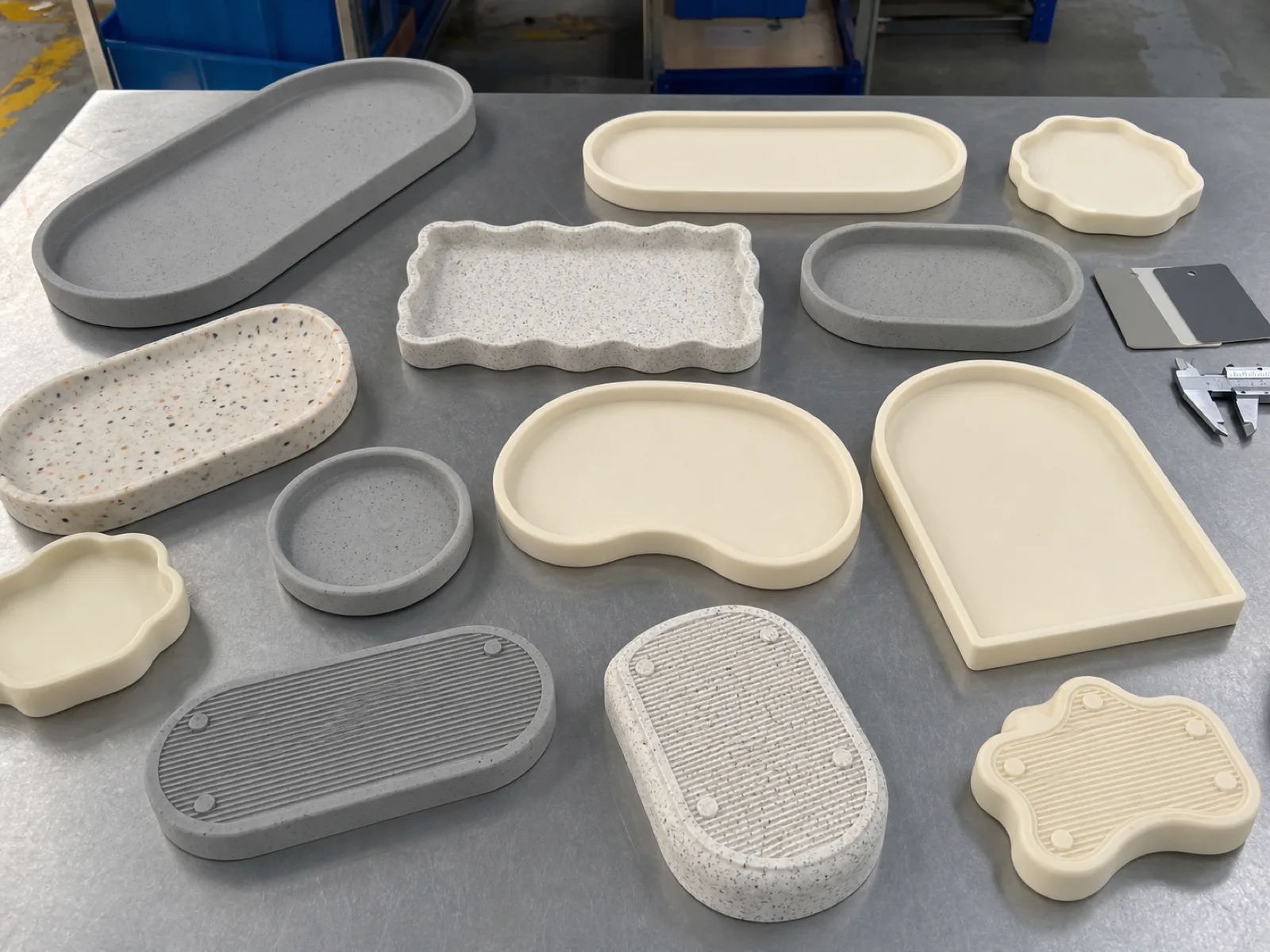 Buyer Guide
 The silicone decorative tray category on the US SERP is dominated by two extremes — glossy translucent trays from anonymous B2B marketplace listings that read as bath-toy plastic on the retail shelf, and premium concrete-look ceramic and stone-composite trays priced at $28-65 retail that home-goods brands wish they could hit at silicone’s price point without the ceramic breakage risk. The engineered middle path — silicone decorative trays with the matte-satin surface, muted colorway, and craftsman feel of a Ferm Living or Umbra concrete piece, at silicone’s durability and price envelope — is what this guide covers. Written from inside a working OEM factory floor for home-goods brand teams, private-label programs, and hospitality-amenity buyers sourcing 500-25,000 unit programs.
A silicone decorative tray is a cast or compression-molded PDMS shell 5-9 mm thick with an engineered matte-satin surface — concrete, terrazzo, natural stone, or coordinated monochrome finish — at Shore A 45-60. Retail archetypes cover catchall, jewelry, vanity, desk, and food-service trays. MOQ 500 units per SKU, FOB Yantian $0.80-$3.10 across volume tiers depending on shape, finish complexity, and Pantone-matched master-batch. FDA 21 CFR 177.2600 and per-batch PFAS non-detect are the retail-mandatory compliance stack; EU adds LFGB §30/31 and REACH.
What is a silicone decorative tray, engineered for premium home-goods OEM?
A silicone decorative tray is a molded PDMS shell — polydimethylsiloxane at Shore A 45-60 durometer per ASTM D2240[^astm-d2240], typically 5-9 mm wall thickness, cured under compression at 170-190°C — engineered for the visual identity of concrete, terrazzo, natural stone, or coordinated monochrome ceramic. Wetop targets the premium home-goods OEM tier (Umbra, Ferm Living, Anthropologie caliber, anonymized) where the differentiator is craftsman surface finish and Pantone-locked colorway, not the glossy translucent silicone tray of promotional and mass-retail bulk.
The silicone decorative tray category confuses first-time home-goods buyers because the product name spans a 5× retail-price envelope. At $6-10 retail sit the mass-retail bulk trays: glossy translucent silicone, single-cavity mold with polished cavity face, standard grey or terracotta pigment loading, felt-pad adhesive base. At $18-35 retail sit the premium home-goods OEM trays: matte-satin concrete-look or terrazzo-look surface, custom-etched cavity texture per VDI 3400[^vdi-3400], multi-particle pigment dispersion, molded-in silicone anti-slip base, Pantone-locked master-batch, coordinated colorway across a 4-8 SKU family. Same base polymer, entirely different tooling investment and process discipline. This guide covers the premium tier because that’s where the OEM engineering conversation actually happens — the mass-retail bulk end is a commodity conversation, not a design-and-spec conversation.
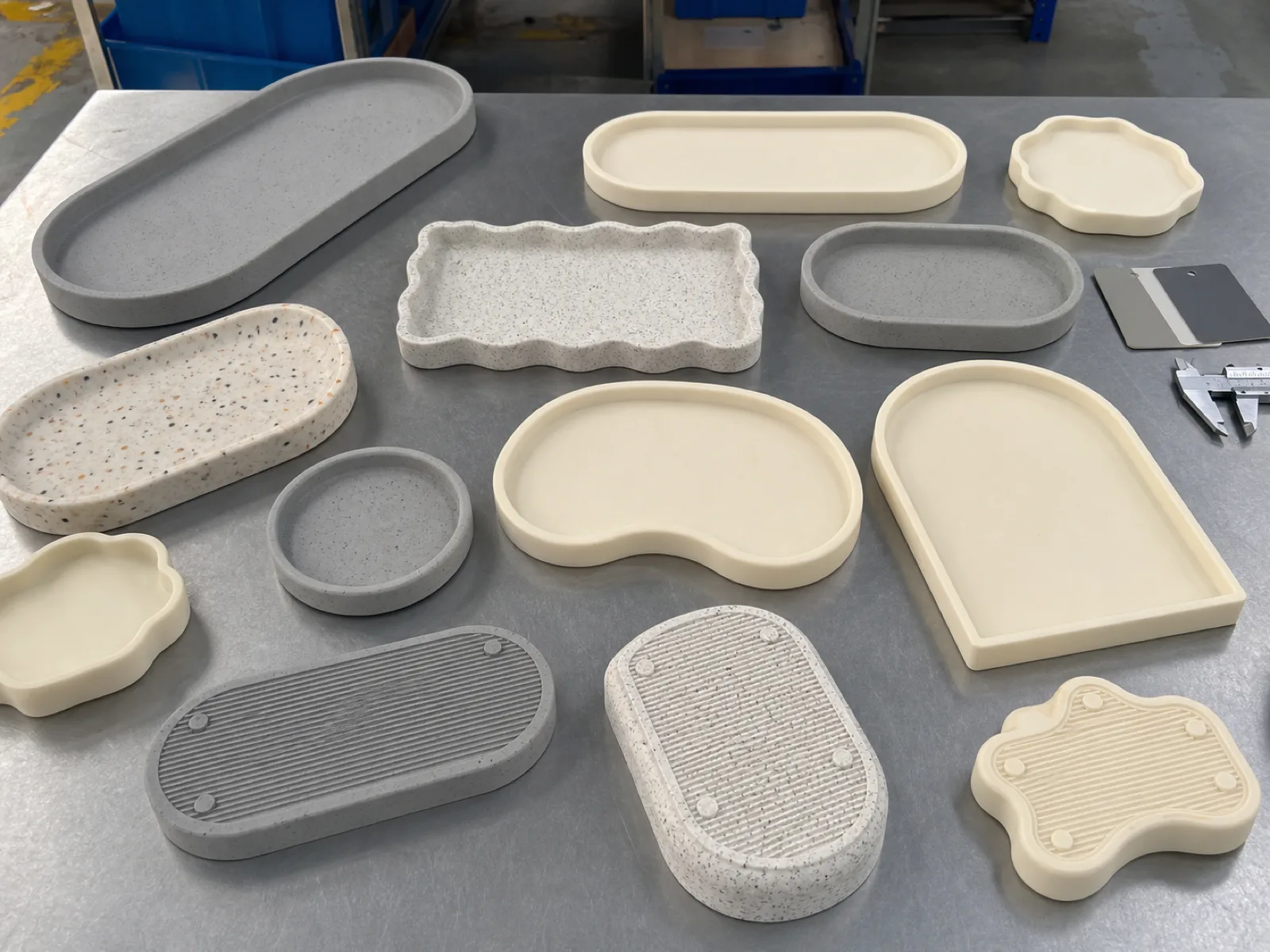
Baseline engineering spec sheet
| Parameter | Standard range | Test method / reference |
|---|---|---|
| Outer dimensions (catchall) | 180-220 × 100-140 mm | Digital caliper |
| Outer dimensions (vanity / food-service) | 250-380 × 140-240 mm | Digital caliper |
| Wall thickness (base) | 5-9 mm | Digital caliper, 5-point sampling |
| Rim height | 15-30 mm | Digital caliper |
| Shore A hardness | 45-60 (catchall 45-55, desk 55-65) | ASTM D2240[^astm-d2240] |
| Tensile strength | ≥ 6.5 MPa | ASTM D412[^astm-d412] |
| Elongation at break | ≥ 300% | ASTM D412[^astm-d412] |
| Continuous service temperature | -40°C to 230°C | Manufacturer spec + LFGB thermal cycling |
| Cure system | Platinum (LSR/HCR) or peroxide (HCR) | Master-batch lot certificate |
| Cure temperature at press | 170-190°C | Press log |
| Post-cure cycle | 4-6 h at 180-200°C | Batch oven log |
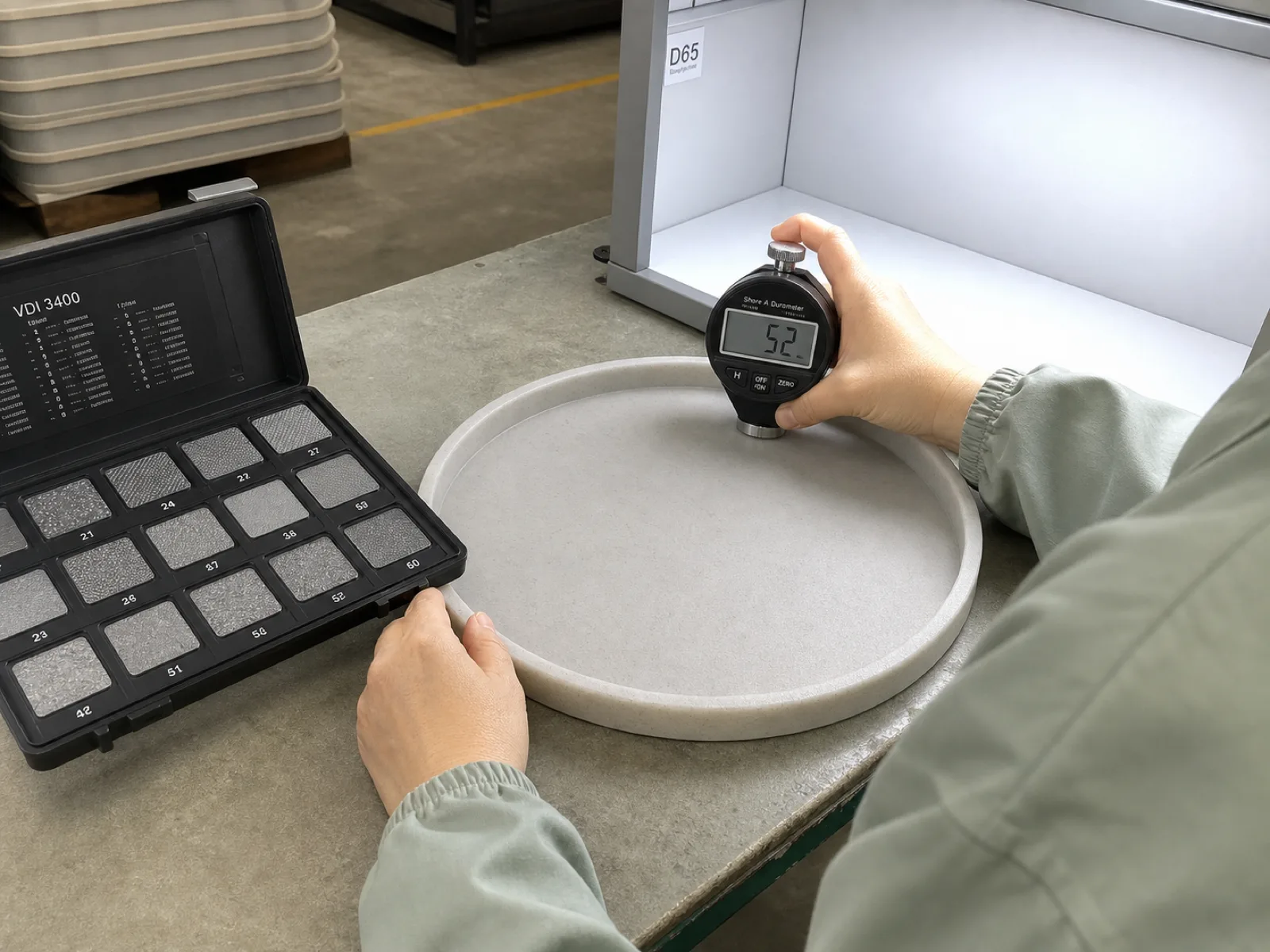
| Cavity surface finish | VDI 3400 grade 30-39 (matte-etched EDM) | VDI 3400 reference plate[^vdi-3400] |
| Pantone colorimetric tolerance | ΔE ≤ 2 (premium), ΔE ≤ 3 (mid-tier) | ISO 3668[^iso-3668] under D65 |
How do you get a concrete-look, terrazzo-look, or natural-stone-look finish on silicone?
The matte-stone surface identity comes from three coordinated levers — mold cavity texture (matte-etched EDM per VDI 3400[^vdi-3400] grade 30-39 rather than polished steel), master-batch pigment system (single-tone muted grey-beige for concrete, multi-particle pre-blended speckle for terrazzo, layered veined pigment for natural stone), and mold-release chemistry (food-grade fluoropolymer-free release that leaves no gloss film). All three must land together. Any one wrong, and the tray reads as glossy plastic on the shelf.
The “concrete-look silicone” category on B2B marketplaces contains a lot of parts that read as glossy semi-translucent plastic with grey pigment loaded in — because the supplier changed the pigment but kept a standard polished-cavity mold and standard silicone-spray release. The visual identity of engineered stone is not the pigment. It’s the surface. Matte-etched EDM cavity texture per VDI 3400[^vdi-3400] grade 32-33 gives fine cement; grade 36-39 gives rougher weathered stone. Then the master-batch pigment provides the color story — muted greige for concrete, multi-particle speckle for terrazzo (color chips pre-dispersed at 3-8% loading), two-color layered feed for veined marble. Then the release chemistry must be a food-grade fluoropolymer-free compound that leaves no residue film.
Surface identity design lever matrix
| Finish target | Cavity texture (VDI 3400) | Master-batch pigment | Release chemistry | Typical Shore A |
|---|---|---|---|---|
| Concrete (raw cement) | 33-36 | Single-tone muted greige, 4-6% loading | Fluoropolymer-free food-grade | 50-58 |
| Concrete (polished cement) | 30-32 | Single-tone muted greige, 4-6% loading | Fluoropolymer-free food-grade | 50-58 |
| Terrazzo | 30-33 (base) + speckle particle | Multi-particle blend, 3-5% base + 2-4% speckle | Fluoropolymer-free food-grade | 50-58 |
| Natural stone (travertine / limestone) | 36-39 | Two-tone layered feed, 5-8% loading | Fluoropolymer-free food-grade | 48-55 |
| Monochrome neutral (warm cream / sage) | 30-33 | Single-tone Pantone-matched, 3-5% loading | Fluoropolymer-free food-grade | 45-55 |
| Dopamine bright (coral / mustard / teal) | 30-33 | Food-grade high-saturation, 5-8% loading | Fluoropolymer-free food-grade | 45-55 |
Getting the cavity texture right is a tooling investment, not a running cost — the EDM texture is cut once during mold manufacture. Getting the pigment right is master-batch discipline — a compound-house partnership that carries the food-grade pigment library and can dispense to spec under CIE colorimetric verification. Getting the release chemistry right is process discipline on the compression floor — Wetop specifies the release compound on the process sheet per SKU, and the release supplier is under the same ISO 9001[^iso-9001] documentation trail as the master-batch supplier.
Casting mold design and release process for aesthetic silicone finishes
The casting-mold design for aesthetic silicone decorative trays uses a two-plate compression mold with matte-etched EDM cavity face, vented parting line to eliminate air-trap witness marks on the visible surface, and a fluoropolymer-free food-grade release compound applied on a 3-shot cycle rather than every-shot to preserve the matte surface without residue buildup. Post-cure at 180-200°C for 4-6 hours completes crosslinking and outgases residual cure byproducts before release for retail packaging.
The mold-design decisions on a silicone decorative tray program directly determine what buyers perceive as “craftsman feel” on the retail shelf. Air-trap witness marks on the visible surface — the small dimples where trapped air prevented the silicone from fully filling the cavity face — are the number-one aesthetic reject on a matte-finish tray. Wetop’s tooling shop cuts venting into the parting-line surface at 0.02-0.05 mm depth for tray molds specifically, because deeper vents transfer as visible flash on the outside edge and shallower vents don’t evacuate air fast enough on a 5-8 minute compression cycle. The venting decision is a millimeter difference that separates factories that ship first-pass at 98% aesthetic yield from factories that ship at 85% and eat the reject cost.
The release chemistry decision is more subtle. Conventional silicone-spray mold release deposits a thin layer of low-molecular-weight PDMS on the cavity face every cycle, building up over 20-40 shots into two failure modes: gradual surface gloss increase as release residue fills the matte texture, and food-contact compliance risk from variably-certified spray compounds. Wetop’s decorative tray line runs a fluoropolymer-free food-grade release on a 3-shot cycle rather than every shot — sufficient for demold on well-vented matte-cavity tooling with 3× lower residue burden. Post-cure at 180-200°C for 4-6 hours completes residual crosslinking and outgases the low-molecular-weight silicone volatiles that would otherwise generate first-heat odor complaints on retail return.
Mold-design specs for aesthetic tray tooling
| Design element | Wetop spec | Failure mode if wrong |
|---|---|---|
| Cavity face texture | VDI 3400 grade 30-39 EDM matte | Glossy plastic-look surface reject |
| Parting-line venting depth | 0.02-0.05 mm | Air-trap witness marks or visible flash |
| Draft angle on rim wall | 1.5-3° | Demold tear or edge-tear reject |
| Anti-slip base geometry | Molded-in 4-6 bumper feet, 0.8-1.2 mm proud | Felt-adhesive failure downstream |
| Sprue and gate location | Base underside, gate ≤ 1.5 mm | Visible witness mark on shelf-side face |
| Post-cure oven cycle | 4-6 h at 180-200°C | LFGB §30/31 failure, first-heat odor |
Compression molding versus LSR injection for silicone decorative trays
Compression molding is the correct default for 85% of silicone decorative tray OEM programs at 500-20,000 units. Tooling runs $1,800-$4,500 for a 2-4 cavity mold, cycle 5-8 minutes, tolerance ±0.15 mm. LSR injection wins only on multi-durometer construction (soft-grip rim over firm body) or 25,000+ unit programs where cycle-time savings amortize the $12,000-$22,000 LSR tooling jump. Below that volume, LSR is over-tooling and the program leaks margin. Above it, LSR earns its tooling back on part-to-part consistency.
The compression versus LSR decision on silicone decorative trays is a program-economics decision, not a manufacturing-quality decision. Both processes produce food-grade PDMS parts that clear FDA 21 CFR 177.2600[^fda-177-2600] and LFGB §30/31 per BfR Recommendation XV[^bfr-lfgb-xv]. Both handle the 5-9 mm wall thickness of decorative tray geometry. Both hit the matte-satin surface finish with a properly EDM-textured cavity. Where they diverge is cycle time, tooling investment, dimensional tolerance, and the ability to run multi-durometer overmolded construction.
Compression fits the decorative tray category particularly well because the 5-9 mm wall thickness of a decorative tray puts the geometry inside the compression sweet spot — the material charge distributes reliably under press pressure, and the slower cycle allows air to evacuate through the well-vented parting line before the silicone sets up. LSR, by contrast, is optimized for thin-wall precision parts where injection speed and cavity fill matter more than surface craftsman feel. The full cure-chemistry decision for silicone-based programs lives on our platinum-cured vs peroxide-cured silicone guide, and the full molding-process economics on our silicone OEM pricing structure guide.
Compression vs LSR — silicone decorative tray program fit
| Dimension | Compression molding | LSR injection |
|---|---|---|
| Tooling cost (2-6 cavity) | $1,800-$4,500 | $12,000-$22,000 |
| Cycle time per shot | 5-8 min | 30-90 sec |
| Dimensional tolerance | ±0.15 mm | ±0.05 mm |
| Multi-durometer overmold | Not supported | Supported |
| Cavity finish quality (matte-satin) | Excellent | Excellent |
| Program-economics fit | 500-20,000 units | 25,000+ units, or multi-durometer |
| Typical FOB delta (5,000 pcs) | Baseline | +8-14% (before volume-scale credit) |
Anti-slip base — molded-in silicone bumpers or felt-pad adhesive?
Molded-in silicone bumper feet win for premium home-goods OEM. Four to six low-profile bumpers integrated into the tray base during the compression cycle deliver indefinite service life, zero adhesive failure risk, and no secondary-assembly labor. Felt-pad adhesive bases fail predictably at 6-18 months on retail service — the adhesive plasticizer migrates into the silicone substrate, felt yellows, edges lift. Molded-in adds $0.05-$0.09 per unit at 5,000-unit volume; felt adds $0.06-$0.12 including labor and remains the largest single source of decorative tray retail returns.
The anti-slip base decision is a retail-return-risk decision more than a landed-cost decision. Felt-pad adhesive looks premium in the packaging photograph but the failure mode plays out on a predictable timeline. The adhesive is a small interface between a low-surface-energy substrate (silicone) and a fibrous absorbent material (wool or synthetic felt). Under six months of home service, adhesive plasticizers migrate into the silicone body, felt fibers wick moisture, and the felt yellows and lifts at the perimeter. Between 6 and 18 months of retail service, roughly 8-15% of felt-based decorative trays develop visible edge-lift. The return complaint reads: “the bottom is falling off.”
Molded-in silicone bumper feet remove that entire failure mode. Four to six low-profile bumpers (0.8-1.2 mm proud, 6-10 mm diameter) are cut into the cavity as part of the base geometry and form in the same compression cycle as the tray body. Silicone-on-silicone, no adhesive interface, indefinite service life inside the tray’s own envelope. Initial mold modification runs $180-$400 setup; per-unit add at 5,000-unit volume is $0.05-$0.09 versus $0.06-$0.12 for felt-and-labor. On any program above $12 shelf retail and any hospitality-tier program with a 12+ month service expectation, molded-in bumpers are the correct decision.
Aesthetic color families for silicone decorative tray programs
Four color families cover 90% of premium home-goods decorative tray programs. Neutral (warm cream, sand, pearl grey) reads timeless and pairs with any interior palette. Earthy (terracotta, moss, ochre, muted rust) tracks the natural-materials home trend. Monochrome (single-tone concrete, pearl white, black basalt) delivers the architectural-object aesthetic. Dopamine bright (coral, mustard, teal, sage-punch) targets Gen Z and design-forward retail. Each family has a Pantone-locked palette Wetop maintains against the food-grade pigment library.
Home-goods brand teams typically arrive at RFQ with a Pantone family already locked from a seasonal collection concept. The engineering desk’s role is to confirm which Pantones are achievable in food-grade silicone before the tooling clock starts — highly saturated fluorescents, metallics, and certain deep loadings fall outside the food-grade pigment palette allowed under FDA 21 CFR 177.2600[^fda-177-2600] and BfR Recommendation XV[^bfr-lfgb-xv]. Wetop pre-screens the Pantone target list against the food-grade pigment library during the RFQ conversation to prevent the “we tooled it and now the color won’t hold LFGB” failure downstream.
Aesthetic color families — Pantone-achievability matrix
| Family | Example Pantones | Food-grade achievable | Typical loading | Notes |
|---|---|---|---|---|
| Neutral (warm cream, sand, pearl grey) | PANTONE 7500 C, 468 C, Cool Grey 3 C | Yes | 3-5% | Timeless, safest choice |
| Earthy (terracotta, moss, ochre) | PANTONE 484 C, 5605 C, 7550 C | Yes | 4-6% | Tracks natural-materials trend |
| Monochrome architectural (basalt, concrete, chalk) | PANTONE Black 6 C, Cool Grey 8 C, 7527 C | Yes | 3-6% | Reads sculptural, magazine-friendly |
| Dopamine bright (coral, mustard, teal) | PANTONE 178 C, 130 C, 7710 C | Yes with pigment-house match | 5-8% | High-loading, Pantone-house dependent |
| Fluorescent brights | PANTONE 802 C, 806 C | No (not food-grade) | — | Reserve for packaging, not part |
| Metallics (gold, copper, silver) | Metallic Pantones | No (not food-grade) | — | Reserve for packaging, not part |
Full Pantone-color decision framework across all silicone product categories on our customize silicone logo guide, which covers the pigment-house partnership discipline and CIE ΔE tolerance measurement in depth.
Pantone tolerance for a coordinated home-goods family — why ΔE ≤ 2 matters
Premium retail demands ΔE ≤ 2 across a coordinated silicone decorative tray family — catchall, vanity, jewelry, and desk tray SKUs sharing a colorway must measure ΔE ≤ 2 versus the approved Pantone chip under D65 daylight-simulation per ISO 3668[^iso-3668]. Holding that tolerance requires single master-batch source across the whole program, per-lot colorimetric release with a spectrophotometer, and matched cure conditions across SKUs. Above ΔE 3 the coordinated family reads as three suppliers' work sharing a shelf.
The failure mode is subtle and expensive. A brand launches a 6-SKU decorative tray family in the same “warm greige” Pantone. The factory tools all six cavities and ships. On the retail shelf the catchall reads warmer than the desk tray, the jewelry tray cooler than the vanity, and the family “doesn’t hang together.” Three specific process disciplines hold ΔE ≤ 2 across the family:
Discipline 1 — Single master-batch source across the entire program. Every SKU draws pigment from the same compound-house lot. Lot-matched independent runs from the same house drift ΔE 1-2; different suppliers drift ΔE 3-5.
Discipline 2 — Per-lot colorimetric release with a spectrophotometer. Every production lot on every SKU measured against the approved Pantone chip under D65 daylight-simulation lighting per ISO 3668[^iso-3668]. Out-of-tolerance lots return to master-batch adjustment before shipping.
Discipline 3 — Matched cure conditions across SKUs. Cure temperature and cycle time affect pigment expression. A SKU cured at 180°C for 6 minutes reads slightly differently from a SKU cured at 190°C for 5 minutes at identical Pantone loading. Wetop’s process sheet locks temperature and cycle time per SKU inside the coordinated family.
MOQ tiers and FOB Yantian pricing for silicone decorative tray programs
Wetop's MOQ is 500 units per SKU — the breakeven where per-batch FDA, LFGB, and PFAS test-report cost amortizes into a retail-competitive per-unit price. FOB Yantian Q3 2026 for a standard 200 × 120 × 25 mm concrete-look catchall tray at Shore A 50, matte-satin finish, molded anti-slip base, single Pantone: 500 pcs $2.20-$3.10 / 1,000 pcs $1.65-$2.35 / 5,000 pcs $1.05-$1.60 / 10,000 pcs $0.80-$1.25 / 20,000+ pcs $0.62-$1.00. Terrazzo multi-particle pigment adds $0.12-$0.28 per unit; molded-in bumpers $0.05-$0.09.
The MOQ math on silicone decorative trays is the same math as on every other custom-tooled silicone OEM program — the third-party test-report cost per batch (FDA 21 CFR 177.2600[^fda-177-2600] extractables at $350-$500, LFGB §30/31[^bfr-lfgb-xv] at $450-$650 if the program targets EU or premium US retail, PFAS non-detect analysis at $180-$280) needs enough units to amortize into a retail-competitive per-piece price. Below 500 pieces the test cost dominates unit economics. Above 500 pieces the amortization drops rapidly: $1.96 per piece at 500, $0.20 per piece at 5,000. The full MOQ economics framework lives on our real factory MOQ math guide.
Full MOQ-tier FOB Yantian pricing (200 × 120 × 25 mm catchall, Q3 2026)
| Volume tier | Compression, single Pantone | Compression, terrazzo speckle | Compression, molded-in bumper add | LSR injection premium |
|---|---|---|---|---|
| 500 pcs | $2.20-$3.10 | +$0.24-$0.36 | +$0.08-$0.14 | +12-18% |
| 1,000 pcs | $1.65-$2.35 | +$0.20-$0.30 | +$0.07-$0.11 | +10-16% |
| 2,500 pcs | $1.30-$1.90 | +$0.16-$0.26 | +$0.06-$0.10 | +9-14% |
| 5,000 pcs | $1.05-$1.60 | +$0.12-$0.22 | +$0.05-$0.09 | +8-12% |
| 10,000 pcs | $0.80-$1.25 | +$0.10-$0.18 | +$0.04-$0.08 | +6-10% |
| 20,000+ pcs | $0.62-$1.00 | +$0.08-$0.15 | +$0.04-$0.07 | +4-8% |
Prices exclude retail-ready packaging (printed sleeve, gift box, or coordinated-family box adds $0.18-$0.65 per unit fully assembled), retailer-specific certification fees, and destination-country duties. Larger vanity and food-service trays (250-380 mm) scale roughly with surface area × wall-thickness cost. Coordinated 4-6 SKU family programs typically negotiate a blended price across the family rather than SKU-by-SKU quoting.
Landed-cost worked example — 5,000 pcs coordinated 4-SKU family to US warehouse
| Line item | Cost | Note |
|---|---|---|
| FOB Yantian, blended across 4-SKU family, matte concrete-look, molded bumper | $1.15-$1.70/pc | 5,000 pcs each, coordinated Pantone |
| Ocean freight LCL to US West Coast (14-18 day sailing) | $0.08-$0.14/pc | Higher unit weight than coasters |
| US customs duty, HTS 3926.90.99 at 5.3% | $0.061-$0.090/pc | Applied to FOB value |
| Customs broker and delivery to warehouse | $0.03-$0.05/pc | Standard US LCL clearance |
| Retail-ready printed sleeve packaging | $0.24-$0.42/pc | Coordinated brand system |
| Prop 65 warning sticker (California retail only) | $0.005/pc | Applied at 3PL or origin |
| Total landed DDP US warehouse (West Coast) | $1.58-$2.40/pc | Excluding California Prop 65 sticker |
| Total landed DDP US warehouse (East Coast) | $1.66-$2.52/pc | Sailing 25-32 days |
At 5,000 units per SKU across 4 coordinated SKUs (20,000 units total shipment), freight allocation moves closer to full container territory and ocean freight per-piece drops 25-40% relative to LCL rates. Full pricing structure framework on our silicone OEM pricing structure guide.
Retail program archetypes — catchall, jewelry, vanity, desk, food-service
Five retail archetypes cover 95% of silicone decorative tray OEM work. Catchall (180-220 × 100-140 mm, Shore A 45-55, $8-18 retail) — the volume driver. Jewelry (130-180 × 90-120 mm, softer Shore A 40-50, $12-25 retail). Vanity (250-320 × 140-180 mm, coordinated bath-family, $15-32 retail). Desk (200-260 × 110-150 mm, Shore A 55-65 firmer feel, $10-22 retail). Food-service / charcuterie (280-380 × 180-240 mm, LFGB in addition to FDA, $18-45 retail). Each archetype has a distinct spec envelope.
| Archetype | Dimensions | Shore A | Retail | Notes |
|---|---|---|---|---|
| Catchall (volume driver) | 180-220 × 100-140 × 22-30 mm | 45-55 | $8-18 | Matte concrete or monochrome; molded anti-slip base |
| Jewelry (premium vanity) | 130-180 × 90-120 × 15-25 mm | 40-50 | $12-25 | Softer durometer prevents scratching finished jewelry |
| Vanity (coordinated centerpiece) | 250-320 × 140-180 × 20-28 mm | 50-60 | $15-32 | Matches bath-accessory family (soap dish, tumbler) |
| Desk (office / WFH) | 200-260 × 110-150 × 20-28 mm | 55-65 | $10-22 | Cable-passage cutout or pen-tray compartment |
| Food-service / charcuterie | 280-380 × 180-240 × 15-22 mm | 55-65 | $18-45 | LFGB §30/31[^bfr-lfgb-xv] added to FDA[^fda-177-2600] |
Typical premium home-goods programs ship 4-6 SKUs across a coordinated family, single Pantone or 2-3 coordinated Pantones, on a 25-40 week seasonal-release cadence. The RFQ should specify which archetype the program targets so tooling and master-batch design match.
Quality control — CTQ points and pre-shipment inspection deliverables
Six CTQ points define decorative tray batch release: thickness variance ±0.10 mm across 5-point sampling, Shore A ±3 per ASTM D2240[^astm-d2240], surface finish match to VDI 3400[^vdi-3400] reference plate, Pantone ΔE ≤ 2 versus approved chip per ISO 3668[^iso-3668] under D65, molded-in bumper geometry to spec, and PFAS non-detect at ppb per batch. AQL 1.5 sampling per ISO 2859-1[^iso-2859-1] on premium home-goods and hospitality; AQL 2.5 on mid-tier retail bulk.
The decorative tray QC playbook is tighter than a promotional coaster because the retail buyer inspects dimensional match and aesthetic surface simultaneously at shelf-set. Six CTQ points cover roughly 90% of retail return complaints:
| CTQ | Spec | Method | Failure signal |
|---|---|---|---|
| 1. Thickness variance | ±0.10 mm compression, ±0.05 mm LSR | Digital caliper, 5-point per piece | Mold-set drift or under-charge |
| 2. Shore A durometer | ±3 versus approved sample | ASTM D2240[^astm-d2240] | Master-batch drift or under-cure |
| 3. Surface finish match | VDI 3400[^vdi-3400] reference plate under D65 | Visual and tactile | Cavity wear, re-texture at 100-150k shots |
| 4. Pantone ΔE release | ΔE ≤ 2 premium, ΔE ≤ 3 mid-tier | Spectrophotometer per ISO 3668[^iso-3668] | Master-batch adjustment before release |
| 5. Molded-in bumper geometry | Height, position, count per sample | Digital caliper + visual | Anti-slip fail or flat-surface wobble |
| 6. PFAS non-detect | ppb detection | Accredited lab per batch | ECHA restriction alignment |
Every Wetop decorative tray shipment ships with an inspection packet: the AQL 1.5 sampling plan per ISO 2859-1[^iso-2859-1], the dimensional check log, the Shore A durometer log, the VDI 3400[^vdi-3400] surface-finish inspection notes, the spectrophotometer Pantone release log per SKU, tensile destructive test results per ASTM D412[^astm-d412], the FDA 21 CFR 177.2600 report[^fda-177-2600] and LFGB §30/31 report[^bfr-lfgb-xv] where applicable referencing master-batch lot, PFAS non-detect report, and the post-cure oven log for the batch. The full inspection framework matches ISO 9001:2015[^iso-9001] documented process control across every SKU in the coordinated family.
Frequently asked questions
Q: What makes a silicone decorative tray look like concrete or natural stone instead of glossy plastic? Three coordinated levers produce the concrete, terrazzo, or natural-stone visual identity on a silicone decorative tray. First, the mold cavity carries a matte-etched EDM texture calibrated to a specific stone reference — VDI 3400 texture 30-33 for a fine cement finish, VDI 3400 texture 36-39 for a rougher weathered stone, or a custom mineral-particle emboss for terrazzo speckle. Second, the master-batch pigment system uses food-grade mineral pigments dispersed at specification concentration (single-tone muted grey-beige for concrete, multi-color speckle particles blended pre-mold for terrazzo, layered pigment for veined stone). Third, the mold-release chemistry avoids conventional silicone spray release, which deposits a thin gloss film — Wetop uses a food-grade fluoropolymer-free release compatible with FDA 21 CFR 177.2600 that leaves a matte-satin surface untouched by residue. Get any of the three wrong and the tray reads as glossy plastic instead of engineered stone. Suppliers who claim “concrete-look silicone” but ship glossy semi-translucent parts are running standard tooling with a grey pigment loaded in — the surface texture and release chemistry are missing.
Q: Compression molding or LSR injection — which process should we spec on a silicone decorative tray program? Compression molding fits roughly 85% of silicone decorative tray OEM programs and is the correct default choice from 500 to 20,000 units per SKU. Tooling runs $1,800-$4,500 for a 2-4 cavity compression mold on P20 hardened steel, cycle time 5-8 minutes per shot at 170-190°C, dimensional tolerance ±0.15 mm, and the process handles the thicker 5-9 mm cross-section of decorative tray geometry without sink marks or flow-line witness marks. LSR injection wins only when the program has a genuine multi-durometer construction requirement (a soft Shore A 30-40 grip rim overmolded onto a firm Shore A 55 body, for premium desk-and-vanity trays where the base needs cushioning without slip), or when volume passes 25,000-30,000 units per SKU where the LSR cycle-time advantage (30-90 seconds versus 5-8 minutes) amortizes the $12,000-$22,000 tooling cost. Below that volume band, LSR is over-tooling. Above it, LSR’s ±0.05 mm tolerance and cycle-time advantage genuinely pay back. The wrong process pick shows up as either lost margin (LSR-tooled at 3,000-unit volume) or SKU-drift complaints (compression-tooled at 40,000-unit hospitality bulk).
Q: Do silicone decorative trays need FDA 21 CFR 177.2600 certification if they hold keys, jewelry, or catchall items rather than food? Yes, for any retail-channel program. Silicone decorative trays fall into the food-contact exposure envelope under FDA 21 CFR 177.2600 because the actual retail service use case is impossible to constrain — buyers use catchall trays for chocolates, dried herbs, cheese-board accessories, and refrigerator-drawer organization roughly as often as they use them for keys and jewelry. Retailer QA teams at premium and mass-retail tiers (Anthropologie, West Elm, Crate & Barrel caliber; Target, Home Depot, Wayfair for mid-tier) require FDA 177.2600 test reports per master-batch lot on the entire decorative tray category as a matter of policy, independent of the intended use case. EU premium retail additionally requires LFGB §30/31 organic volatile testing per BfR Recommendation XV and REACH declaration under EU 1935/2004. Programs shipping without the FDA report will fail retailer onboarding audits, and programs shipping with a generic “some factory” FDA report from a trading-company middleman will fail lot-specific traceability on the first product-quality dispute.
Q: What is the anti-slip base decision — molded-in silicone bumper feet or felt-pad adhesive base? Molded-in silicone bumper feet win for premium home-goods OEM programs above $12 shelf price and for any hospitality-tier or hotel-amenity program where service life exceeds 12 months. The molded-in approach integrates 4-6 low-profile silicone bumpers into the tray base geometry during the same compression cycle — zero secondary assembly, no adhesive interface to fail, indefinite service life, and no CTQ escape at retail return. Felt-pad adhesive bases fail predictably at 6-18 months on retail service — the adhesive plasticizer migrates into the silicone substrate, the felt yellows, edges lift, and dust accumulates at the perimeter. Felt makes sense only at the $6-10 mass-retail shelf tier where landed-cost pressure disqualifies molded-in bumpers and buyers accept the shorter aesthetic service life. The molded-in silicone bumper approach adds $0.05-$0.09 per unit at 5,000-unit volume and requires a mold modification at $180-$400 setup. The felt-pad approach adds $0.06-$0.12 per unit including labor for adhesive-and-place secondary process, and remains the largest single source of decorative tray retail return complaints in the category — every buyer we speak to has a felt-pad failure horror story from a prior supplier.
Q: How tight is the Pantone tolerance for a coordinated silicone decorative tray family across catchall, vanity, and desk SKUs? Premium retail programs demand ΔE ≤ 2 across the coordinated family (catchall, vanity, jewelry, and desk tray SKUs sharing a colorway) measured under D65 daylight-simulation lighting per ISO 3668. That tolerance envelope holds only under three disciplines: single master-batch source for the entire program (no swapping compound houses mid-run), per-lot colorimetric release measured against the approved Pantone chip with a spectrophotometer, and matched cure conditions across all SKUs in the family (temperature drift affects pigment expression). Mid-tier retail programs at $8-12 shelf accept ΔE ≤ 3 which is roughly the threshold where a matched-set customer expectation fails on the shelf. Above ΔE 4 the coordinated family reads as three suppliers’ work sharing a shelf. Not every Pantone target is achievable in food-grade silicone — highly saturated brights and metallics fall outside the FDA 177.2600 and BfR Recommendation XV food-grade pigment palette. Wetop’s engineering desk pre-screens Pantone targets against the food-grade pigment library before quoting the program to prevent that failure downstream.
Q: What are the retail program archetypes for silicone decorative trays — catchall, jewelry, vanity, desk, and food-service? Five archetypes cover roughly 95% of silicone decorative tray OEM programs. Catchall tray: 180-220 mm × 100-140 mm × 22-30 mm, Shore A 45-55, matte-satin finish, molded anti-slip base — the volume driver for the category, $8-18 retail. Jewelry tray: 130-180 mm × 90-120 mm × 15-25 mm, Shore A 40-50, softer finish for jewelry protection, sometimes with integrated ring bar or compartment dividers — $12-25 retail, premium vanity positioning. Vanity tray: 250-320 mm × 140-180 mm × 20-28 mm, Shore A 50-60, coordinated colorway to a bath-accessory family (soap dish, tumbler, dispenser) — $15-32 retail. Desk tray: 200-260 mm × 110-150 mm × 20-28 mm, Shore A 55-65 for firmer feel at office use, often with cable-passage cutout or pen-tray compartment — $10-22 retail. Food-service tray (charcuterie board or amenity tray): 280-380 mm × 180-240 mm × 15-22 mm, Shore A 55-65, LFGB certified in addition to FDA, matte natural-stone finish — $18-45 retail. Each archetype has a different Shore A envelope, finish spec, and MOQ tier — the RFQ should specify which archetype the program targets so tooling and master-batch design match.
Q: How much does OEM tooling for a silicone decorative tray cost and who owns the mold? Tooling for a silicone decorative tray runs $1,800-$4,500 for a 2-4 cavity compression mold on P20 hardened steel, or $12,000-$22,000 for a 4-6 cavity LSR injection mold. The wider range versus flat coasters or drying mats reflects the more complex 5-9 mm three-dimensional geometry — molded raised rim, texture-etched cavity face, molded-in anti-slip base features, and any integrated compartments or dividers. Sample-only single-cavity compression tooling runs $900-$1,800 for a proof-of-concept validation, but that mold cannot scale to production volume and rarely justifies its cost on a program that will commit to production tooling anyway. Mold lifespan is 300,000-1,000,000 shots on P20 hardened steel with proper maintenance and mold-release discipline. Wetop amortizes tooling into the first 5,000-10,000 unit production run rather than billing it as a separate line item, which shows up as a slightly higher unit price on the first order and drops on re-orders. Buyer owns the tool once amortization completes; mold storage on-site, NDA-locked drawings from day one under the mutual NDA framework.
Q: What is the realistic lead time from RFQ to US warehouse receipt for a silicone decorative tray OEM program? Realistic total is 60-95 days from RFQ receipt to US warehouse receipt on a standard 3,000-15,000 unit silicone decorative tray OEM program with new tooling. Breakdown: RFQ engineering review and quote 2-4 business days, Pantone and finish sample development on the master-batch bench 10-15 days, tooling design and cutting 25-40 days (2-4 cavity compression mold on P20), first-article compression sample and buyer sign-off 7-15 days, PO plus 30% deposit and full production material procurement 5-10 days, production run 25-40 days for 3,000-15,000 units including compression molding at 170-190°C, mandatory 4-6 hour post-cure at 180-200°C, anti-slip base validation, secondary decoration (deboss, laser, or Pantone-matched pad print if any), and retail-ready packaging, pre-shipment AQL 1.5 inspection per ISO 2859-1 overlapping production 3-5 days, final 70% balance and shipping documentation 2-3 days, then 14-18 day Yantian-to-US-West-Coast sailing (25-32 days East Coast). On re-orders using the same tooling, subtract 25-40 days of tooling time — total drops to 40-60 days RFQ-to-warehouse. Suppliers quoting sub-40-day cold-start-to-warehouse are compressing steps and the compressed step is almost always the post-cure or the Pantone colorimetric release.
Talk to the engineering desk
Sourcing a silicone decorative tray OEM program at 500-25,000 units per SKU? Send the target archetype (catchall / jewelry / vanity / desk / food-service), the coordinated family SKU count, the Pantone target list, the surface identity target (concrete / terrazzo / natural stone / monochrome / dopamine bright), Shore A preference, anti-slip base preference, retail channel, and target landed unit cost. The engineering desk quotes back FOB Yantian pricing across MOQ tiers, tooling cost with amortization schedule, sample lead time, Pantone achievability pre-screening against the food-grade pigment library, and the FDA plus LFGB plus PFAS test-report package inside 24 hours on business days. Talk to the engineering desk.
FAQ
-
What makes a silicone decorative tray look like concrete or natural stone instead of glossy plastic?
Three coordinated levers produce the concrete, terrazzo, or natural-stone visual identity on a silicone decorative tray. First, the mold cavity carries a matte-etched EDM texture calibrated to a specific stone reference — VDI 3400 texture 30-33 for a fine cement finish, VDI 3400 texture 36-39 for a rougher weathered stone, or a custom mineral-particle emboss for terrazzo speckle. Second, the master-batch pigment system uses food-grade mineral pigments dispersed at specification concentration (single-tone muted grey-beige for concrete, multi-color speckle particles blended pre-mold for terrazzo, layered pigment for veined stone). Third, the mold-release chemistry avoids conventional silicone spray release, which deposits a thin gloss film — Wetop uses a food-grade fluoropolymer-free release compatible with FDA 21 CFR 177.2600 that leaves a matte-satin surface untouched by residue. Get any of the three wrong and the tray reads as glossy plastic instead of engineered stone. Suppliers who claim "concrete-look silicone" but ship glossy semi-translucent parts are running standard tooling with a grey pigment loaded in — the surface texture and release chemistry are missing.
-
Compression molding or LSR injection — which process should we spec on a silicone decorative tray program?
Compression molding fits roughly 85% of silicone decorative tray OEM programs and is the correct default choice from 500 to 20,000 units per SKU. Tooling runs $1,800-$4,500 for a 2-4 cavity compression mold on P20 hardened steel, cycle time 5-8 minutes per shot at 170-190°C, dimensional tolerance ±0.15 mm, and the process handles the thicker 5-9 mm cross-section of decorative tray geometry without sink marks or flow-line witness marks. LSR injection wins only when the program has a genuine multi-durometer construction requirement (a soft Shore A 30-40 grip rim overmolded onto a firm Shore A 55 body, for premium desk-and-vanity trays where the base needs cushioning without slip), or when volume passes 25,000-30,000 units per SKU where the LSR cycle-time advantage (30-90 seconds versus 5-8 minutes) amortizes the $12,000-$22,000 tooling cost. Below that volume band, LSR is over-tooling. Above it, LSR's ±0.05 mm tolerance and cycle-time advantage genuinely pay back. The wrong process pick shows up as either lost margin (LSR-tooled at 3,000-unit volume) or SKU-drift complaints (compression-tooled at 40,000-unit hospitality bulk).
-
Do silicone decorative trays need FDA 21 CFR 177.2600 certification if they hold keys, jewelry, or catchall items rather than food?
Yes, for any retail-channel program. Silicone decorative trays fall into the food-contact exposure envelope under FDA 21 CFR 177.2600 because the actual retail service use case is impossible to constrain — buyers use catchall trays for chocolates, dried herbs, cheese-board accessories, and refrigerator-drawer organization roughly as often as they use them for keys and jewelry. Retailer QA teams at premium and mass-retail tiers (Anthropologie, West Elm, Crate & Barrel caliber; Target, Home Depot, Wayfair for mid-tier) require FDA 177.2600 test reports per master-batch lot on the entire decorative tray category as a matter of policy, independent of the intended use case. EU premium retail additionally requires LFGB §30/31 organic volatile testing per BfR Recommendation XV and REACH declaration under EU 1935/2004. Programs shipping without the FDA report will fail retailer onboarding audits, and programs shipping with a generic "some factory" FDA report from a trading-company middleman will fail lot-specific traceability on the first product-quality dispute.
-
What is the anti-slip base decision — molded-in silicone bumper feet or felt-pad adhesive base?
Molded-in silicone bumper feet win for premium home-goods OEM programs above $12 shelf price and for any hospitality-tier or hotel-amenity program where service life exceeds 12 months. The molded-in approach integrates 4-6 low-profile silicone bumpers into the tray base geometry during the same compression cycle — zero secondary assembly, no adhesive interface to fail, indefinite service life, and no CTQ escape at retail return. Felt-pad adhesive bases fail predictably at 6-18 months on retail service — the adhesive plasticizer migrates into the silicone substrate, the felt yellows, edges lift, and dust accumulates at the perimeter. Felt makes sense only at the $6-10 mass-retail shelf tier where landed-cost pressure disqualifies molded-in bumpers and buyers accept the shorter aesthetic service life. The molded-in silicone bumper approach adds $0.05-$0.09 per unit at 5,000-unit volume and requires a mold modification at $180-$400 setup. The felt-pad approach adds $0.06-$0.12 per unit including labor for adhesive-and-place secondary process, and remains the largest single source of decorative tray retail return complaints in the category — every buyer we speak to has a felt-pad failure horror story from a prior supplier.
-
How tight is the Pantone tolerance for a coordinated silicone decorative tray family across catchall, vanity, and desk SKUs?
Premium retail programs demand ΔE ≤ 2 across the coordinated family (catchall, vanity, jewelry, and desk tray SKUs sharing a colorway) measured under D65 daylight-simulation lighting per ISO 3668. That tolerance envelope holds only under three disciplines: single master-batch source for the entire program (no swapping compound houses mid-run), per-lot colorimetric release measured against the approved Pantone chip with a spectrophotometer, and matched cure conditions across all SKUs in the family (temperature drift affects pigment expression). Mid-tier retail programs at $8-12 shelf accept ΔE ≤ 3 which is roughly the threshold where a matched-set customer expectation fails on the shelf. Above ΔE 4 the coordinated family reads as three suppliers' work sharing a shelf. Not every Pantone target is achievable in food-grade silicone — highly saturated brights and metallics fall outside the FDA 177.2600 and BfR Recommendation XV food-grade pigment palette. Wetop's engineering desk pre-screens Pantone targets against the food-grade pigment library before quoting the program to prevent that failure downstream.
-
What are the retail program archetypes for silicone decorative trays — catchall, jewelry, vanity, desk, and food-service?
Five archetypes cover roughly 95% of silicone decorative tray OEM programs. Catchall tray: 180-220 mm × 100-140 mm × 22-30 mm, Shore A 45-55, matte-satin finish, molded anti-slip base — the volume driver for the category, $8-18 retail. Jewelry tray: 130-180 mm × 90-120 mm × 15-25 mm, Shore A 40-50, softer finish for jewelry protection, sometimes with integrated ring bar or compartment dividers — $12-25 retail, premium vanity positioning. Vanity tray: 250-320 mm × 140-180 mm × 20-28 mm, Shore A 50-60, coordinated colorway to a bath-accessory family (soap dish, tumbler, dispenser) — $15-32 retail. Desk tray: 200-260 mm × 110-150 mm × 20-28 mm, Shore A 55-65 for firmer feel at office use, often with cable-passage cutout or pen-tray compartment — $10-22 retail. Food-service tray (charcuterie board or amenity tray): 280-380 mm × 180-240 mm × 15-22 mm, Shore A 55-65, LFGB certified in addition to FDA, matte natural-stone finish — $18-45 retail. Each archetype has a different Shore A envelope, finish spec, and MOQ tier — the RFQ should specify which archetype the program targets so tooling and master-batch design match.
-
How much does OEM tooling for a silicone decorative tray cost and who owns the mold?
Tooling for a silicone decorative tray runs $1,800-$4,500 for a 2-4 cavity compression mold on P20 hardened steel, or $12,000-$22,000 for a 4-6 cavity LSR injection mold. The wider range versus flat coasters or drying mats reflects the more complex 5-9 mm three-dimensional geometry — molded raised rim, texture-etched cavity face, molded-in anti-slip base features, and any integrated compartments or dividers. Sample-only single-cavity compression tooling runs $900-$1,800 for a proof-of-concept validation, but that mold cannot scale to production volume and rarely justifies its cost on a program that will commit to production tooling anyway. Mold lifespan is 300,000-1,000,000 shots on P20 hardened steel with proper maintenance and mold-release discipline. Wetop amortizes tooling into the first 5,000-10,000 unit production run rather than billing it as a separate line item, which shows up as a slightly higher unit price on the first order and drops on re-orders. Buyer owns the tool once amortization completes; mold storage on-site, NDA-locked drawings from day one under the mutual NDA framework.
-
What is the realistic lead time from RFQ to US warehouse receipt for a silicone decorative tray OEM program?
Realistic total is 60-95 days from RFQ receipt to US warehouse receipt on a standard 3,000-15,000 unit silicone decorative tray OEM program with new tooling. Breakdown: RFQ engineering review and quote 2-4 business days, Pantone and finish sample development on the master-batch bench 10-15 days, tooling design and cutting 25-40 days (2-4 cavity compression mold on P20), first-article compression sample and buyer sign-off 7-15 days, PO plus 30% deposit and full production material procurement 5-10 days, production run 25-40 days for 3,000-15,000 units including compression molding at 170-190°C, mandatory 4-6 hour post-cure at 180-200°C, anti-slip base validation, secondary decoration (deboss, laser, or Pantone-matched pad print if any), and retail-ready packaging, pre-shipment AQL 1.5 inspection per ISO 2859-1 overlapping production 3-5 days, final 70% balance and shipping documentation 2-3 days, then 14-18 day Yantian-to-US-West-Coast sailing (25-32 days East Coast). On re-orders using the same tooling, subtract 25-40 days of tooling time — total drops to 40-60 days RFQ-to-warehouse. Suppliers quoting sub-40-day cold-start-to-warehouse are compressing steps and the compressed step is almost always the post-cure or the Pantone colorimetric release.
References
Authoritative sources cited in this guide
- US Food and Drug Administration. 21 CFR 177.2600 — Rubber articles intended for repeated use. https://www.ecfr.gov/current/title-21/chapter-I/subchapter-B/part-177/subpart-C/section-177.2600 — The primary US food-contact regulation Wetop tests every silicone decorative tray master-batch lot against, independent of the tray's marketed use case.
- German Federal Institute for Risk Assessment. BfR Recommendation XV — Silicones. https://www.bfr.bund.de/en/bfr_recommendations_on_food_contact_materials-7498.html — The technical standard behind LFGB §30 and §31 organic volatile testing — governs the food-grade pigment palette available for concrete-look and terrazzo-look decorative tray programs.
- International Organization for Standardization. ISO 9001:2015 — Quality Management Systems — Requirements. https://www.iso.org/standard/62085.html — The quality management standard governing batch traceability, master-batch lot records, and post-cure logs on every silicone decorative tray program.
- International Organization for Standardization. ISO 2859-1:1999 — Sampling procedures for inspection by attributes. https://www.iso.org/standard/1141.html — The sampling standard behind AQL 1.5 pre-shipment inspection on premium silicone decorative tray shipments to home-goods retail buyers.
- ASTM International. ASTM D2240-15 — Standard Test Method for Rubber Property — Durometer Hardness. https://www.astm.org/d2240-15r21.html — The Shore A hardness measurement method behind every durometer spec Wetop quotes on silicone decorative tray archetypes.
- ASTM International. ASTM D412 — Standard Test Methods for Vulcanized Rubber — Tension. https://www.astm.org/d0412-16r21.html — The tensile and elongation test method used on every batch tensile check on silicone decorative tray raw material.
- International Organization for Standardization. ISO 3668:2017 — Paints and varnishes — Visual comparison of colour. https://www.iso.org/standard/72330.html — The visual color-comparison standard behind the D65 daylight-simulation Pantone match verification on coordinated decorative tray families.
- Verein Deutscher Ingenieure. VDI 3400 — Electrical discharge machining surface texture reference. https://www.vdi.de/richtlinien — The EDM texture reference scale (VDI 3400 grades 30-39) that defines the concrete and stone matte surface finishes on decorative tray molds.
- European Parliament and Council. Regulation (EC) No 1935/2004 — Materials intended to come into contact with food. https://eur-lex.europa.eu/legal-content/EN/TXT/?uri=CELEX%3A02004R1935-20090807 — The overarching EU framework regulation any EU-shipped silicone decorative tray program must satisfy alongside LFGB clause testing.
- California Office of Environmental Health Hazard Assessment. California Proposition 65 — Safe Drinking Water and Toxic Enforcement Act. https://oehha.ca.gov/proposition-65 — The California warning-label requirement any silicone decorative tray program selling into California retail must screen against.
Start a custom program
Send a brief. Get an engineer’s reply in one business day.
Every Wetop program is tooled from a customer’s specification. Send a CAD file (STEP · IGES · DWG) or a written brief and we’ll reply with a mold cost estimate, price brackets at MOQ 500 / 1,000 / 5,000, and any engineering questions.