Buyer Guide · commercial intent
Silicone Candle Mold Manufacturer — OEM Engineering Guide
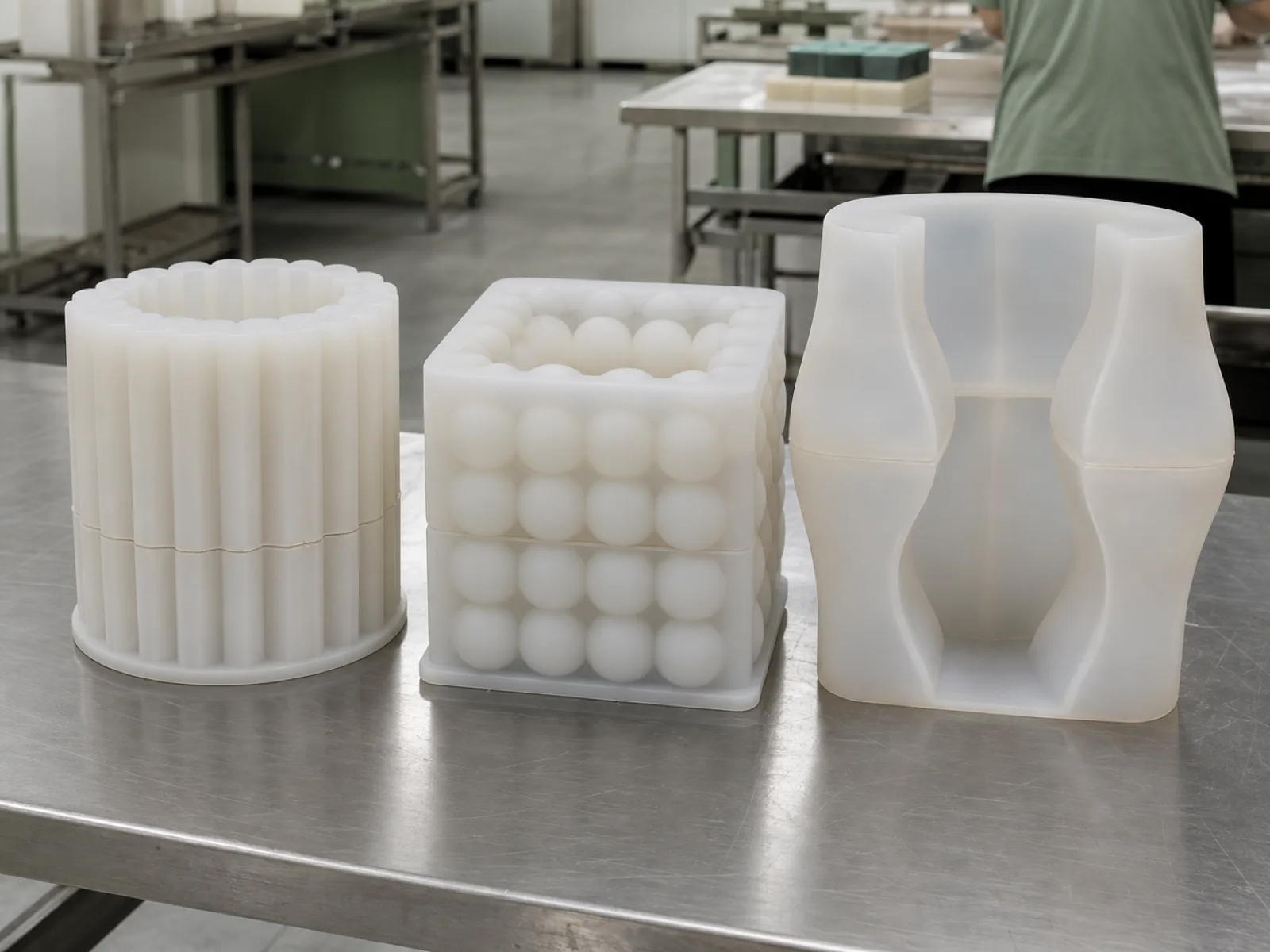 Buyer Guide
 A silicone candle mold is a platinum-cured elastomer tool engineered to accept molten wax pours between 55 °C and 105 °C and release finished candles cleanly across 500-1,000+ cycles. The engineering-critical specs are durometer (Shore A 15-30 for detailed 3D, 40-60 for pillar geometry), platinum cure chemistry, and undercut geometry — not surface aesthetics. This guide walks the compound selection, tooling economics, wax-specific pour temperatures, and MOQ math a candle brand or hobbyist mold-seller needs before signing a first OEM PO.
The silicone candle mold market splits into two very different buyer profiles: retail craft chains stocking blister-packaged molds for hobbyist candle makers, and DTC craft brands selling premium sculptural molds direct to the maker community on Etsy, Amazon Handmade, and Shopify. Both need the same engineering discipline underneath — the same platinum-cured compounds, the same 4-hour post-cure, the same ASTM D2240 durometer traceability — but the tooling economics and packaging compliance diverge sharply. This guide is written from a Dongguan factory floor where Wetop runs the same compression cells that supply Tier-1 sink brands, adapted for the specific geometry and pour-cycle demands of candle molds.
Key takeaways
- Only platinum-cured silicone qualifies for repeated wax-pour candle molds.
- Shore A 15-30 for detailed 3D, 40-60 for pillar and simple geometry.
- Wax pour spec runs 55-105 °C — deep inside silicone’s -40 °C to 230 °C envelope.
- A properly cared mold survives 500-1,000+ pours before edge tear or filler bloom.
- Two-part molds unlock unlimited undercut at 1.8-2.4× single-part tooling cost.
- Retail-shelf molds need 21 CFR 177.2600 documentation for adjacent-use claims.
- MOQ 500 units per SKU on existing tooling; new tooling from 3,000 units.
What is a silicone candle mold, chemically?
A silicone candle mold is a thermoset polydimethylsiloxane elastomer tool, cross-linked with a platinum-hydrosilylation catalyst, formulated with fumed-silica reinforcement and pigment master-batch. Unlike urethane or latex candle molds, it is chemically inert to hot wax, resists pigment staining across hundreds of pours, and releases across complex undercut geometry without a release agent on most wax types.
The material specification that separates a professional-grade OEM candle mold from a craft-store impulse-buy is the cure chemistry. Platinum-cured silicone runs a Karstedt-type platinum-divinyltetramethyldisiloxane catalyst at 5-10 ppm loading. The cure is a clean hydrosilylation reaction that produces no volatile byproducts, no residual acid, and no color-fastness drift when exposed to repeated 105 °C gel-candle pours. This is why every serious candle-mold brand — and every mold that survives 500+ pours in real workshop conditions — runs a platinum system.
Peroxide-cured silicone, by contrast, uses 2,4-dichlorobenzoyl peroxide as the vulcanizing agent. The peroxide decomposes to 2,4-DCBA acid during cure, and residual acid remains in the polymer bulk indefinitely. On the first hot wax pour, that acid migrates into the wax and discolors it — soy candles turn faintly yellow, pale-pigment paraffin picks up an off-white cast, and the mold surface begins etching within 100-200 pours. This is the reason “cheap silicone mold that ruined my wax” reviews are essentially universal among peroxide-cured import candle molds.
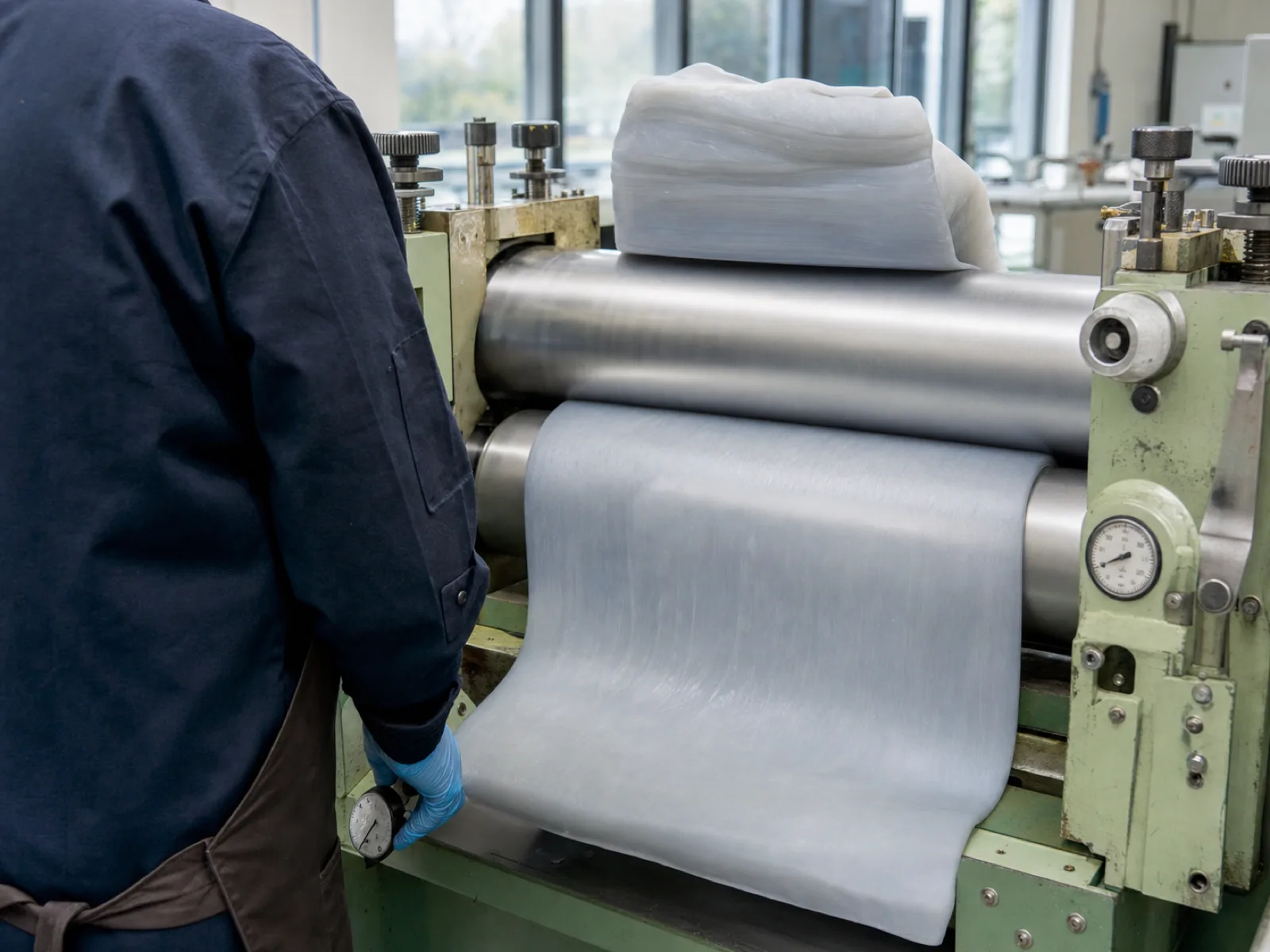
The reinforcement filler is fumed silica at 20-35 phr, milled into the compound at the two-roll mill stage. Fumed silica raises the tear strength from ~3 kN/m (unreinforced silicone) to 25-40 kN/m on the finished mold — the mechanical difference between a mold that tears on the fifth demold and one that survives 800 pours. Buyers occasionally see white powdery bloom on used candle molds after 300-400 cycles; this is under-dispersed silica migrating to the surface, and the fix is upstream on the compounding line, not a surface wipe.
What temperature does silicone candle mold need to withstand for wax pouring?
Platinum-cured silicone candle molds accept every common candle wax comfortably: paraffin at 60-80 °C, soy at 55-65 °C, beeswax at 65-70 °C, and gel candles at 95-105 °C. Silicone's continuous service envelope of -40 °C to 230 °C leaves 125 °C of headroom on the hottest gel pour and 165 °C on standard soy. Thermal degradation is not the failure mode a candle-mold OEM designs against.
The wax-pour temperature envelope, by wax family:
| Wax type | Pour temperature | Cool time (typical 4 oz candle) | Silicone safety margin |
|---|---|---|---|
| Soy (100 % or blend) | 55-65 °C | 4-6 hours | +165 °C to top of spec |
| Coconut-soy blend | 60-70 °C | 4-6 hours | +160 °C |
| Paraffin (container) | 60-80 °C | 3-4 hours | +150 °C |
| Paraffin (pillar / votive) | 75-95 °C | 6-8 hours | +135 °C |
| Beeswax | 65-70 °C | 5-7 hours | +160 °C |
| Gel candle | 95-105 °C | 8-12 hours | +125 °C |
| Palm wax | 80-95 °C | 4-6 hours | +135 °C |
The engineering point is that thermal margin is enormous across every wax type. Silicone’s Si-O-Si backbone is thermally stable to approximately 260 °C in air before oxidative chain scission dominates, and the peak candle-pour temperature (gel at 105 °C) is less than half that. The real failure modes are mechanical: filler bloom after 300-400 cycles, edge tear at thin decorative details after aggressive demolds, and pigment staining on unglazed matte silicone when using high-dye-load waxes.
Freezer conditioning is a technique some candle makers use to accelerate demold — chill the poured candle at -18 °C for 20 minutes before demolding. Silicone remains fully flexible to -55 °C in laboratory conditions and shows no functional change at -18 °C, so this workflow is entirely safe for the mold. For OEM buyers designing packaging inserts that include “freeze before demold” instructions, this is a defensible claim to print.
For the deeper temperature-envelope math, see the silicone temperature range explained guide.
Which durometer is best for a silicone candle mold?
Durometer selection is the single most consequential engineering call in a candle-mold program. For detailed 3D or sculptural molds — faces, textured pillars, animal shapes, undercut geometry — target Shore A 15-30. For pillar candles, votives, tapers, and simple geometric shapes, Shore A 40-60 gives longer mold life. Above 60A the mold tears fine wax detail on demold; below 15A the mold walls collapse on tall pours.
The physics behind the durometer split: candle release depends on the mold flexing around undercuts as the wax leaves the cavity. A soft mold (Shore A 20) flexes 3-5× more than a firm mold (Shore A 55) under the same demold force, so it can accommodate undercuts up to about 30 % of cavity depth without tearing. A firm mold with the same undercut geometry will either tear the wax or tear itself.
Durometer selection matrix by candle mold type:
| Mold type | Recommended Shore A | Wall thickness | Tear strength target | Typical life |
|---|---|---|---|---|
| Detailed 3D sculptural (bust, figure) | 15-25 | 8-12 mm | ≥ 28 kN/m | 400-600 pours |
| Textured pillar (fluted, ribbed) | 20-30 | 6-10 mm | ≥ 25 kN/m | 500-800 pours |
| Geometric bubble / cube | 25-35 | 5-8 mm | ≥ 22 kN/m | 600-900 pours |
| Standard pillar / votive | 40-50 | 5-8 mm | ≥ 18 kN/m | 800-1,200 pours |
| Simple taper / tea light | 50-60 | 4-6 mm | ≥ 15 kN/m | 1,000-1,500 pours |
| Industrial multi-cavity insert | 55-70 | 4-5 mm | ≥ 12 kN/m | 1,500+ pours |
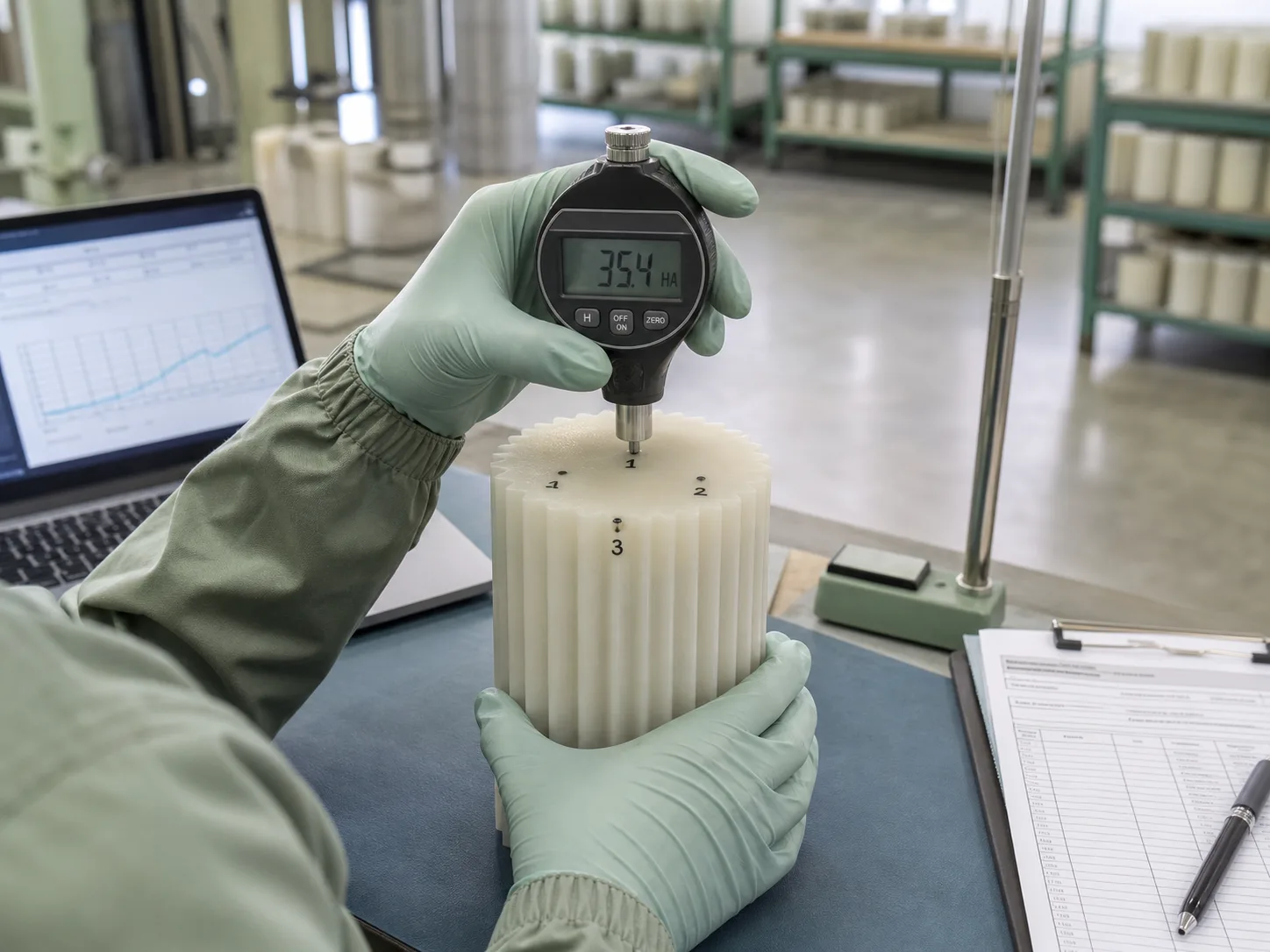
Wetop applies ASTM D22401 durometer inspection in-line — three points on every 20th part sampled, with a control chart that triggers investigation at ±3 points from the target. Tear strength is verified per ASTM D6242 Die B on a lot-representative coupon before container release. The tear-strength number is the single most predictive quality gate — a mold shipped at Shore A 25 but tear strength 18 kN/m instead of 28 will fail early even if the durometer chart looks fine.
Platinum-cured vs peroxide-cured — why candle molds demand platinum
Candle molds demand platinum-cured silicone for one non-negotiable reason: peroxide-cured silicone leaves 2,4-DCBA acid residues that migrate into hot wax, discolor soy and pale paraffin, and etch the mold surface within 200 pours. Platinum's clean hydrosilylation cure produces no residues, no wax discoloration, and mold life extends to 500-1,000+ pours. The material cost delta is 15-25 % but shows up in warranty and repeat-order economics immediately.
The chemistry difference is small on paper and enormous in field performance. Peroxide-cured silicone is vulcanized with 2,4-dichlorobenzoyl peroxide, which decomposes at 170 °C during primary molding to produce two 2,4-dichlorobenzoic acid (2,4-DCBA) radicals. The DCBA cross-links the polymer, but a residual 0.05-0.20 % remains trapped in the polymer bulk after cure. Post-cure removes some, but never all.
On the first hot wax pour, the trapped DCBA migrates to the mold surface and transfers into the wax. In colored waxes this is invisible. In natural soy or pale paraffin, it produces a characteristic yellow or beige tint that gets worse with every subsequent pour. Candle makers see it as “my mold ruined my wax” and quit the brand.
Platinum-cured silicone runs a Karstedt catalyst that produces no acid byproducts. The cure is a clean addition reaction of Si-H to Si-vinyl, forming Si-CH₂-CH₂-Si linkages with zero byproduct. Post-cure at 200 °C for 4 hours drives residual cyclic siloxanes below 0.5 %, and nothing acidic remains to migrate into wax at any pour temperature.
The compliance math for a Tier-1 retail buyer:
| Metric | Platinum-cured | Peroxide-cured |
|---|---|---|
| Wax discoloration at 500 pours | None | Progressive yellow/beige on pale waxes |
| Mold surface etching | None | Visible at 150-200 pours |
| Typical service life | 500-1,000+ pours | 150-300 pours |
| FDA 21 CFR 177.2600 compliance | Passes | Fails on extractives |
| LFGB §30/31 (finished part) | Passes | Fails DCBA test |
| Cost premium | +15-25 % | Baseline |
| Retail-audit acceptance | Yes | No |
Every OEM candle-mold program Wetop runs specifies platinum. Peroxide-cured is disqualified by material selection, not by policy — the peroxide chemistry cannot produce a defensible candle-mold compliance packet regardless of downstream QC. For the deep chemistry contrast, see platinum-cured vs peroxide-cured silicone.
How is undercut and draft angle engineered for complex 3D candle molds?
Draft angle for silicone candle molds is aggressively small — 0.5° to 2° is typical because silicone's elastic recovery lets it demold from geometry a rigid mold could not survive. Undercut depth up to 30 % of cavity depth is achievable in a single-part mold at Shore A 15-25 using compound flex. Beyond that threshold, or for full-round sculptural shapes, a two-part mold with a clean equatorial parting line is the engineering answer.
Undercut engineering is the reason silicone dominates the sculptural candle mold segment. A rigid injection-molded thermoplastic mold requires positive draft everywhere — every geometric feature must be pullable in a straight line. Silicone can flex, so the mold stretches around the wax feature on demold and recovers to its as-molded geometry once released. The wax feature itself is rigid, so it does not deform on the way out.
The three geometric parameters an OEM buyer must specify before tooling begins:
- Cavity depth vs undercut depth ratio — undercuts up to 30 % of cavity depth are single-part-friendly at Shore A 20; beyond 30 %, either soften to Shore A 15 (life drops) or split into a two-part mold.
- Draft angle on primary walls — 0.5° minimum for pull-line surfaces, 1-2° for hidden internal geometry, 3-5° recommended on decorative script or fine texture to prevent tear on repeated demolds.
- Parting line placement — for a two-part mold, place the parting line at the geometric equator or at a design line that hides the 0.05-0.10 mm flash line as an intentional feature.
For a bust or full-round sculptural candle mold, two-part construction is the only defensible answer. A single-part mold cannot demold a full 360° geometry without tearing itself or the wax. Two-part molds cost 1.8-2.4× the single-part tooling and add roughly $0.15-$0.30/unit in molding labor because the two halves must be aligned and clamped before pouring — but the geometric freedom is unlimited.
Two-part vs single-part construction summary:
| Construction | Best for | Tooling cost multiplier | Unit cost premium | Undercut freedom |
|---|---|---|---|---|
| Single-part open | Pillar, votive, taper, geometric | 1.0× | Baseline | Up to 30 % of cavity depth |
| Single-part flexible | Textured pillar, fluted geometry | 1.1-1.3× | +$0.05/unit | Up to 40 % with softer compound |
| Two-part | Bust, full-round, sculptural | 1.8-2.4× | +$0.15-$0.30/unit | Unlimited |
| Multi-part (3+) | Complex articulated geometry | 2.5-3.5× | +$0.30-$0.60/unit | Unlimited, alignment risk |
Dimensional tolerances follow ISO 3302-13 Class M2 for cavity dimensions and Class M3 for parting-line flash. Wetop’s tooling shop CNC-machines cavity inserts to ±0.03 mm, then polishes to a Ra 0.4 μm surface finish that translates to a satin sheen on the finished candle — matte enough to look premium, glossy enough to release cleanly.
Do silicone candle molds actually need release agent?
Most well-formulated platinum-cured silicone candle molds release cleanly with zero release agent on standard soy and paraffin — this is silicone's inherent low surface energy (around 22-24 mN/m) at work, not a coating. The edge cases that benefit from a light release: beeswax pours (natural tack), gel candles (chemical stickiness on cool-down), high-dye-load pigmented waxes, and the very first pour on a new mold. A single fine mist of silicone-safe release is enough.
The release-agent debate in the candle-maker community is dominated by two failure modes traceable to a single upstream cause: peroxide-cured silicone. When a maker complains that “I need release spray on every pour,” they almost universally own a peroxide-cured import mold whose surface has already begun etching from residual DCBA acid. Platinum-cured molds do not require release for 90 % of use cases and never require it during the first hundred pours.
The four documented edge cases where release helps:
- Beeswax — natural triterpene esters in beeswax create genuine tack against silicone; a light release spray extends demold ease across the mold’s full life.
- Gel candle — mineral oil / triblock copolymer gel candles cool sticky and can pull thin surface layers of silicone on aggressive demold. Release recommended for gel-only workflows.
- High-dye-load pigmented waxes — powdered pigments above 1.5 % loading can migrate into micro-porosity on the mold surface over time. Release creates a barrier layer.
- First pour on new mold — factory-fresh silicone occasionally carries a molecular-thin layer of processing aid that behaves like natural release on pour 1 (candle sticks slightly), then wipes clean on pour 2. A first-pour release spray eliminates the confusion.
The release agent must be silicone-compatible — silicone spray (dimethicone-based) or PTFE dry-film release. Never use petroleum-distillate sprays (WD-40, kitchen sprays, mineral oil), which swell the silicone surface, extract siloxane oligomers, and cut mold life by 60-70 % within 50 pours.
For OEM packaging inserts, Wetop’s recommended language: “This platinum-cured silicone candle mold releases cleanly with most soy and paraffin waxes. For beeswax, gel candles, or the first pour on a new mold, a light mist of silicone-compatible mold release is recommended. Do not use petroleum-based sprays.”
What is the mold longevity spec, and how do brands communicate it?
A properly cared platinum-cured silicone candle mold survives 500-1,000+ pours in normal workshop conditions. The dominant failure modes are filler bloom (white powdery surface) after 300-400 aggressive cycles, edge tear at thin decorative geometry after 400-600 demolds, and pigment absorption stain after high-dye-load pigmented waxes. Thermal degradation is not a failure mode at any candle-pour temperature.
The engineering spec Wetop publishes on OEM candle molds:
| Mold configuration | Minimum service life | Typical service life | End-of-life failure mode |
|---|---|---|---|
| Single-part Shore A 20 detailed | 400 pours | 600-800 pours | Edge tear on undercut geometry |
| Single-part Shore A 35 pillar | 600 pours | 900-1,200 pours | Filler bloom after 400+ dishwasher exposures |
| Single-part Shore A 50 geometric | 800 pours | 1,200-1,500 pours | Rim deformation from stacked storage |
| Two-part Shore A 25 sculptural | 300 pours | 500-700 pours | Parting-line tear from misaligned clamping |
Storage matters more than most makers realize. A mold that lives flat, dust-free, and away from UV exposure will hit the top of its service-life range. A mold compressed under other tooling in a workshop drawer will hit the bottom of the range because compression set creates permanent memory in the wall geometry. UV exposure accelerates chain scission on the surface layer; molds left on sunlit shelves lose 20-30 % of tear strength within 6 months.
Tensile strength and elongation-at-break per ASTM D4124 are the compound properties that predict field longevity. Wetop’s targets on a Shore A 25 candle-mold compound: tensile strength ≥ 8 MPa, elongation-at-break ≥ 450 %, tear strength (Die B) ≥ 28 kN/m. Any compound below those numbers is disqualified from the candle-mold catalog, whatever the cost pressure.
For OEM buyers writing packaging or product-listing copy, the honest spec claim is “500-1,000+ pours with proper care.” Anything more precise misrepresents the variance across wax types and workshop conditions; anything less undersells the material.
What compliance certifications do silicone candle molds actually need?
For pure candle-only use, no formal certification is legally required — candles are not food contact. But retail chains selling craft candle molds (Michaels-tier, Hobby Lobby-tier, JOANN-tier) increasingly request 21 CFR 177.2600 documentation because packaging language often positions molds for adjacent uses: soap, bath bombs, chocolate, resin, wax melts. A defensible OEM program ships the 177.2600 packet whether or not the buyer requests it.
The compliance ambiguity is real: a candle mold is not a food-contact article, but retail buyers routinely reposition the SKU mid-catalog to capture the broader craft market. A mold sold as “candle & soap mold” is skin-contact adjacent. A mold sold as “candle & chocolate mold” is direct food contact. Locking in FDA 21 CFR 177.26005 extractive testing at product launch means the SKU can be repositioned or bundled without a compliance re-run.
The compliance packet Wetop assembles for retail-shelf candle-mold programs:
| Test | Standard | Sample | Frequency |
|---|---|---|---|
| Extractives | 21 CFR 177.2600 | Finished mold | Per SKU launch + material change |
| Lead content | CPSIA §101 | Finished mold | Per SKU launch |
| Cyclic siloxanes | GC-MS D4/D5/D6 | Finished mold | Per compound change |
| SVHC screen | REACH Annex XIV/XVII | Finished mold | Per catalog cycle (EU) |
| Post-cure record | Wetop QC log | Per lot | 100 % lots |
| Durometer control chart | ASTM D2240 | 3 pts per 20th part | 100 % lots |
| Tear strength verification | ASTM D624 Die B | Lot coupon | 1 per production lot |
For EU distribution, add REACH SVHC screening6 per catalog cycle — the D4 and D5 cyclic siloxanes are currently on the candidate list and any candle-mold compound over the reportable threshold will fail EU customs even if the product is not marketed for food contact.
CPSIA lead screening7 is not legally applicable to non-children’s candle molds, but every major US retail chain applies it as a screen anyway — total lead ≤ 100 ppm. Well-formulated platinum-cured silicone runs at < 5 ppm because pigment master-batches are lead-free by construction, but the test still must run and the report still must sit in the vendor compliance folder before a PO is cut. For the deeper regulatory contrast, see FDA vs LFGB silicone.
How do MOQ economics work for retail vs DTC candle-mold programs?
Wetop's baseline MOQ is 500 units per SKU on existing tooling. For new tooling: 3,000 units amortizes cleanly for a single-part pillar mold ($800-$1,600 tooling), 8,000-15,000 units for a two-part sculptural mold ($2,400-$4,800 tooling). Retail-chain programs typically run 10-40k units per SKU; DTC craft brands typically run 500-3,000 units per SKU on existing or shared tooling.
The MOQ math splits sharply between the two buyer profiles because tooling amortization dominates unit cost differently:
Retail chain program — Tier-2 US home improvement or craft chain buying 20,000 units of a fluted pillar mold at $2.10/unit landed:
| Cost element | USD/unit at 20k MOQ | Notes |
|---|---|---|
| Silicone gum (platinum-cured) | $0.51 | 125 g/unit at $4.08/kg |
| Pigment master-batch | $0.03 | 2 % loading |
| Molding labor + cycle | $0.24 | 4-cavity, 3-min cycle |
| 4-hour post-cure | $0.09 | Oven amortization |
| QC (durometer + AQL 1.5) | $0.06 | Per lot |
| Tooling amortization | $0.09 | $1,800 tool over 20k units |
| Retail blister + master carton | $0.32 | 1 unit / blister, 36 / MC |
| FOB Yantian handling | $0.09 | Export docs + terminal |
| Sea freight to LAX | $0.24 | 40’HC, mixed load |
| Landed cost | $1.67 | Ex-warehouse LAX |
DTC craft brand program — Etsy or Amazon Handmade seller buying 2,000 units of a two-part sculptural mold at $4.80/unit FOB:
| Cost element | USD/unit at 2k MOQ | Notes |
|---|---|---|
| Silicone gum (platinum-cured) | $0.85 | 210 g/unit two-part |
| Pigment master-batch | $0.04 | Custom Pantone |
| Two-part molding labor | $0.62 | Alignment + clamp cycle |
| 4-hour post-cure | $0.11 | |
| QC (durometer + tear + visual) | $0.14 | Higher-tier sampling |
| Tooling amortization | $1.60 | $3,200 tool over 2k units |
| Kraft box + insert card | $0.28 | DTC unboxing spec |
| FOB Yantian | $0.09 | |
| FOB Yantian | $3.73 | Sea freight buyer’s account |
The DTC program is 2.2× more expensive per unit primarily because of tooling amortization at low volume. This is not a factory profit spike — it is the mold-cost math. For DTC brands, shared-tooling programs (where Wetop’s existing catalog of pillar molds is white-labeled with in-mold debossed logos) collapse the tooling delta and land near retail-tier pricing at 500-1,000 unit MOQs. For a broader pricing framework across silicone OEM programs, see the silicone OEM pricing structure guide.
Lead time from PO to warehouse — new tooling vs existing
New-tooling candle mold programs: 55-90 days from signed PO to FOB Yantian, with the 4-hour post-cure and the 25-40 day tooling manufacture the two fixed bottlenecks. Existing-tooling programs (repeat orders or shared-tooling white-label): 30-45 days FOB Yantian. Add 22-28 days sea freight to US West Coast, or 32-38 days to US East Coast, for warehouse-receipt totals.
Lead-time Gantt for a new two-part sculptural candle mold program at 5,000 unit MOQ:
| Phase | Days | Milestone |
|---|---|---|
| Dieline + engineering review | 5-7 | Approved 3D + drawings |
| Tooling manufacture (two-part) | 30-40 | Mold ready for T1 |
| T1 samples | 3-5 | Physical samples FedEx to buyer |
| T1 review + revisions | 7-14 | Buyer sign-off on demold and detail |
| T2 samples + first-article | 10-14 | Pilot pour test at buyer’s workshop |
| Pilot run (200-500 units) | 5-7 | Retail-shelf validation |
| Mass production (5k units) | 20-30 | FOB Yantian |
| Sea freight to US West Coast | 22-28 | Arrival LAX |
Total from signed PO to warehouse receipt: 105-145 days for a new-tooling two-part program. Single-part pillar mold programs on new tooling collapse to 80-110 days because tooling manufacture is 20-25 days shorter. Repeat orders on existing tooling collapse to 55-75 days end-to-end.
The 4-hour post-cure is a genuinely fixed bottleneck — Wetop runs six post-cure chambers at 1.2 m³ interior each, each cycling one batch per shift. A 5,000-unit candle-mold order occupies 3-4 chamber-shifts of post-cure time regardless of primary molding throughput. For urgent programs, this is the constraint to plan around, not press capacity or QC.
Why does a sink-grid factory make sense as a candle-mold OEM?
The tooling steel, compound-mixing equipment, post-cure ovens, and dimensional QC infrastructure Wetop runs for silicone sink grids are engineered to the same tolerances candle molds require — often to tighter ones. A factory that has cleared Tier-1 kitchen-brand audits for sink protection has already passed the compliance and process-discipline gate retail candle-mold buyers apply. Shared platinum-cured compounding + shared post-cure bank means the marginal cost of adding a candle-mold SKU is lower than standing up a new dedicated candle-mold line.
Wetop’s core three-category focus — silicone sink grids, drying racks, drying mats — shares roughly 70 % of the process infrastructure with silicone candle molds. The compression cells run the same platinum-cured compounds. The post-cure oven bank runs the same 4-hour, 200 °C protocol. The QC station runs the same ASTM D2240 durometer sampling and the same three-point tear-strength verification per lot.
The audit gate Tier-1 kitchen-brand buyers apply to Wetop is documented in ISO 90018 language and covers material traceability, process control, and complaint response with numbered lot records. This is the same audit shape that Michaels, Hobby Lobby, and JOANN apply to housewares and craft supplies — the paperwork translates directly, and the ISO 9001 certificate on Wetop’s wall carries the same auditable weight in either category.
For a candle-mold brand evaluating manufacturing partners, the practical implication is: a factory that has cleared kitchen-tier retail audits on functionally comparable silicone SKUs is a lower-risk supplier than a candle-mold-only shop that has never faced a Tier-1 chain audit. The compliance stack is the moat, not the product category, and a candle-mold SKU is a lateral compound-and-tooling move on top of an already-audited platinum-cured production system.
Where to go next
- If your program hinges on cure chemistry, read platinum-cured vs peroxide-cured silicone for the deep chemistry contrast that drives every candle-mold compound decision.
- If your temperature envelope questions extend beyond wax (freezer-safe, dishwasher-safe, high-temperature soap), read silicone temperature range explained for the -40 °C to 230 °C material physics.
- If you are running the landed-cost numbers on multiple SKU concepts, read the silicone OEM pricing structure guide for the tooling-amortization framework.
Ready to run the numbers on a specific candle-mold SKU? Talk to the engineering desk — send a dieline, a sculpt file, or a benchmark mold and we return DFM notes, cavity-count recommendation, durometer spec, and a landed-cost quote within 3 business days.
Footnotes
-
ASTM International, ASTM D2240 — Durometer Hardness. ↩
-
ASTM International, ASTM D624 — Tear Strength. ↩
-
ASTM International, ASTM D412 — Vulcanized Rubber Tension. ↩
-
US FDA, 21 CFR 177.2600 — Rubber articles intended for repeated use. ↩
-
ECHA, REACH SVHC Candidate List. ↩
-
US CPSC, CPSIA Lead Content Requirements. ↩
FAQ
-
What temperature does silicone candle mold need to withstand for wax pouring?
Platinum-cured silicone candle molds handle every common candle wax comfortably: paraffin at 60-80 °C, soy at 55-65 °C, beeswax at 65-70 °C, and gel candles at 95-105 °C. The material's continuous service window is -40 °C to 230 °C, so even the hottest gel pour sits 125 °C below the top of spec — no discoloration, no swelling, no cure regression on the mold.
-
Which durometer is best for a silicone candle mold — 15A, 30A, or 40A?
For detailed 3D or sculptural candle molds (faces, textured pillars, undercut geometry), target Shore A 15-30 — the softer wall lets the mold demold across undercuts without tearing the wax. For pillar candles, votives, and simple geometric shapes, Shore A 40-60 is stronger and lasts longer. Above 60A the mold tears wax detail on demold; below 15A it deforms under its own weight above 50 mm height.
-
Do silicone candle molds need release agent or wax spray before pouring?
Most well-formulated platinum-cured silicone candle molds release cleanly with no release agent — this is silicone's inherent low surface energy at work, not a coating. The edge cases that benefit from a light release: beeswax pours (high tack), gel candles (chemical stickiness), pigmented waxes at high dye load, and any first pour on a brand-new mold. A single fine mist of silicone-safe mold release is enough — never use petroleum-based sprays, which will contaminate the surface and shorten mold life.
-
How many pours can a good silicone candle mold survive?
A properly cared platinum-cured silicone candle mold survives 500-1,000+ pours. The typical failure mode is not thermal degradation — silicone laughs at 105 °C — but filler bloom (white powdery surface) after 400+ cycles, or edge tear at thin geometry after aggressive demolds. Storage matters: keep molds flat, dust-free, and away from UV. A mold that lives in a plastic bag on a shelf outlasts one that lives compressed under other tooling.
-
What is the MOQ for a custom OEM silicone candle mold program?
Wetop's baseline MOQ is 500 units per SKU on existing tooling. For new tooling, the sensible order economics kick in at 3,000 units for a single-part pillar or simple-geometry mold (tooling cost $800-$1,600) and 8,000-15,000 units for a two-part sculptural mold (tooling cost $2,400-$4,800). Below those volumes the tooling amortization dominates the unit price and DTC-only makers are usually better served by a hand-poured small-batch supplier.
-
What's the difference between platinum-cured and peroxide-cured silicone for candle molds?
Platinum-cured silicone uses a Karstedt-type platinum catalyst that produces no volatile byproducts during cure. Peroxide-cured uses 2,4-dichlorobenzoyl peroxide, which decomposes to 2,4-DCBA acid — residual acid migrates into hot wax, discolors soy and pale-pigment wax, and shortens mold life below 200 pours. Every serious candle-mold OEM program specifies platinum. Peroxide-cured is only defensible on black industrial gaskets, never on food or candle contact.
-
Can silicone candle molds handle undercut geometry for sculptural candles?
Yes — this is silicone's structural advantage over rigid thermoplastic molds. A single-part mold can demold undercuts up to about 30 % of the cavity depth using compound flex at Shore A 15-30. Beyond that, or for full-round sculptural geometry (busts, animals, complex 3D), a two-part mold with a clean parting line placed at the geometric equator unlocks unlimited undercut freedom at 1.8-2.4× the tooling cost.
-
Do silicone candle molds need FDA or LFGB certification?
For pure candle-only use, no — candles are not food contact. But retail chains selling craft candle molds (Michaels-tier, Hobby Lobby-tier) increasingly ask for 21 CFR 177.2600 extractive documentation because packaging language often positions the molds for adjacent uses: soap, bath bombs, chocolate, resin. A defensible OEM program ships the 177.2600 packet whether or not the buyer asks — it protects against Prop 65 claims and mid-catalog SKU repositioning.
-
How long does silicone candle mold OEM sampling and production take?
On existing tooling: 7-15 days for T1 samples. On new tooling: 20-30 days from signed dieline to T1 samples for single-part molds, 30-40 days for two-part sculptural molds. Mass production runs 20-30 days for 5-10k units on a standard 4-cavity setup, with the 4-hour post-cure the fixed bottleneck. Total from PO to FOB Yantian: 55-90 days on new tooling, 30-45 days on existing tooling.
-
What's the landed cost for a custom silicone candle mold at 5,000 unit MOQ?
For a mid-complexity single-part pillar mold at 5,000 unit MOQ: silicone gum $0.42, pigment master-batch $0.03, molding labor $0.24, 4-hour post-cure $0.09, QC and packaging $0.11, tooling amortization $0.28 ($1,400 tool / 5,000 units), FOB Yantian handling $0.08, sea freight to LAX $0.22 — landed cost approximately $1.47 per mold. Two-part sculptural molds run $2.20-$3.10 at the same MOQ.
References
Authoritative sources cited in this guide
- US Food and Drug Administration (Electronic Code of Federal Regulations). 21 CFR 177.2600 — Rubber articles intended for repeated use. https://www.ecfr.gov/current/title-21/chapter-I/subchapter-B/part-177/subpart-C/section-177.2600 — Federal regulation governing extractive limits for rubber (including silicone) in repeated food-contact use — the packet retail-craft candle-mold buyers request because catalog language routinely positions molds for soap and chocolate adjacent uses.
- ASTM International. ASTM D2240 — Standard Test Method for Rubber Property — Durometer Hardness. https://www.astm.org/d2240-15r21.html — Shore A durometer test method Wetop applies in-line on every silicone candle mold lot for wall-hardness verification at three points per part.
- International Organization for Standardization. ISO 3302-1:2014 — Rubber — Tolerances for products, Part 1: Dimensional tolerances. https://www.iso.org/standard/59252.html — Governs dimensional tolerance classes M1-M4 applied to silicone candle mold cavity dimensions, parting-line flash, and rim flatness.
- ASTM International. ASTM D412 — Vulcanized Rubber and Thermoplastic Elastomers — Tension. https://www.astm.org/d0412-16r21.html — Tensile strength and elongation-at-break test methods Wetop uses to verify candle mold compound survives repeated pour-and-demold cycles — target elongation ≥ 400 %.
- ASTM International. ASTM D624 — Tear Strength of Conventional Vulcanized Rubber and Thermoplastic Elastomers. https://www.astm.org/d0624-00r20.html — Die B tear strength protocol — the property that predicts whether a candle mold survives 500 or 5,000 pours. Wetop target: ≥ 25 kN/m on Shore A 30 compound.
- International Organization for Standardization. ISO 9001:2015 — Quality Management Systems — Requirements. https://www.iso.org/standard/62085.html — Defines the documented quality management system that Wetop's process discipline is certified against, and the language retail-chain audits use for candle-mold vendor qualification.
- European Chemicals Agency (ECHA). REACH SVHC Candidate List. https://eur-lex.europa.eu/legal-content/EN/TXT/?uri=CELEX%3A32006R1907 — Substances of Very High Concern list screened on every candle-mold compound destined for EU distribution, including cyclic siloxane D4 and D5 currently under review.
- US Consumer Product Safety Commission. Consumer Product Safety Improvement Act (CPSIA) — Lead Content Limits. https://www.ecfr.gov/current/title-16 — Federal lead limit of 100 ppm total content — retail chains apply the same screen to craft molds even when marketed to adult DIY users.
Start a custom program
Send a brief. Get an engineer’s reply in one business day.
Every Wetop program is tooled from a customer’s specification. Send a CAD file (STEP · IGES · DWG) or a written brief and we’ll reply with a mold cost estimate, price brackets at MOQ 500 / 1,000 / 5,000, and any engineering questions.