Buyer Guide · commercial intent
Collapsible Silicone Pet Bowl Manufacturing Guide
 Buyer Guide
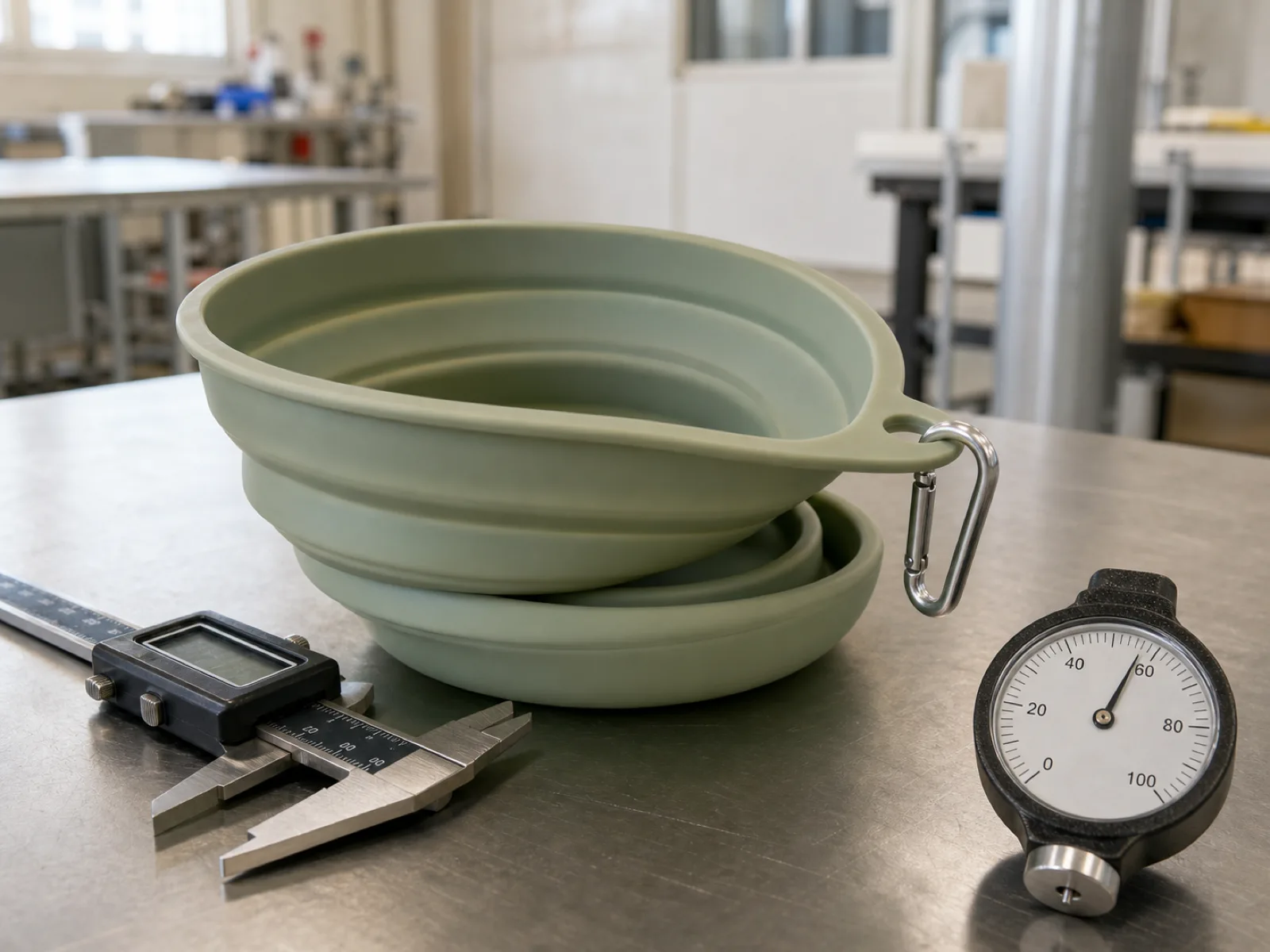
 A collapsible silicone pet bowl is a one-piece platinum-cured silicone bowl with an accordion-rib wall that folds flat for travel and locks upright for feeding, typically at 350 mL, 500 mL, or 1000 mL capacity. For OEM buyers, the useful specification is not "food-grade silicone" — it is a defensible packet of FDA 21 CFR 177.2600 test data, a 2.0-2.5 mm rib wall thickness, a 55-65 Shore A durometer call-out, and a 15 kg carabiner pull test per production lot. Wetop molds this category on our compression line in Dongguan at a 500-unit MOQ per SKU per color, with per-lot test reports and a 4-6 hour post-cure that separates a shippable travel bowl from a returnable one.
Collapsible silicone pet bowls are one of the highest-turn travel accessories on Chewy, Petco, and Amazon Pet, and most competing pages selling them share three problems: they conflate silicone with TPE, they cite no per-lot test data, and they describe the accordion-fold geometry qualitatively when a serious pet brand needs measurable specs to defend the SKU to a category buyer. This engineering brief is written for the sourcing lead, product engineer, or founder building or refreshing a private-label travel-bowl lineup — not for the pet owner comparing bowls at retail. Every claim below carries a number, a standard reference, or a process spec that Wetop’s engineering desk can hold against a purchase order.
What actually makes a collapsible silicone pet bowl fold and lock?
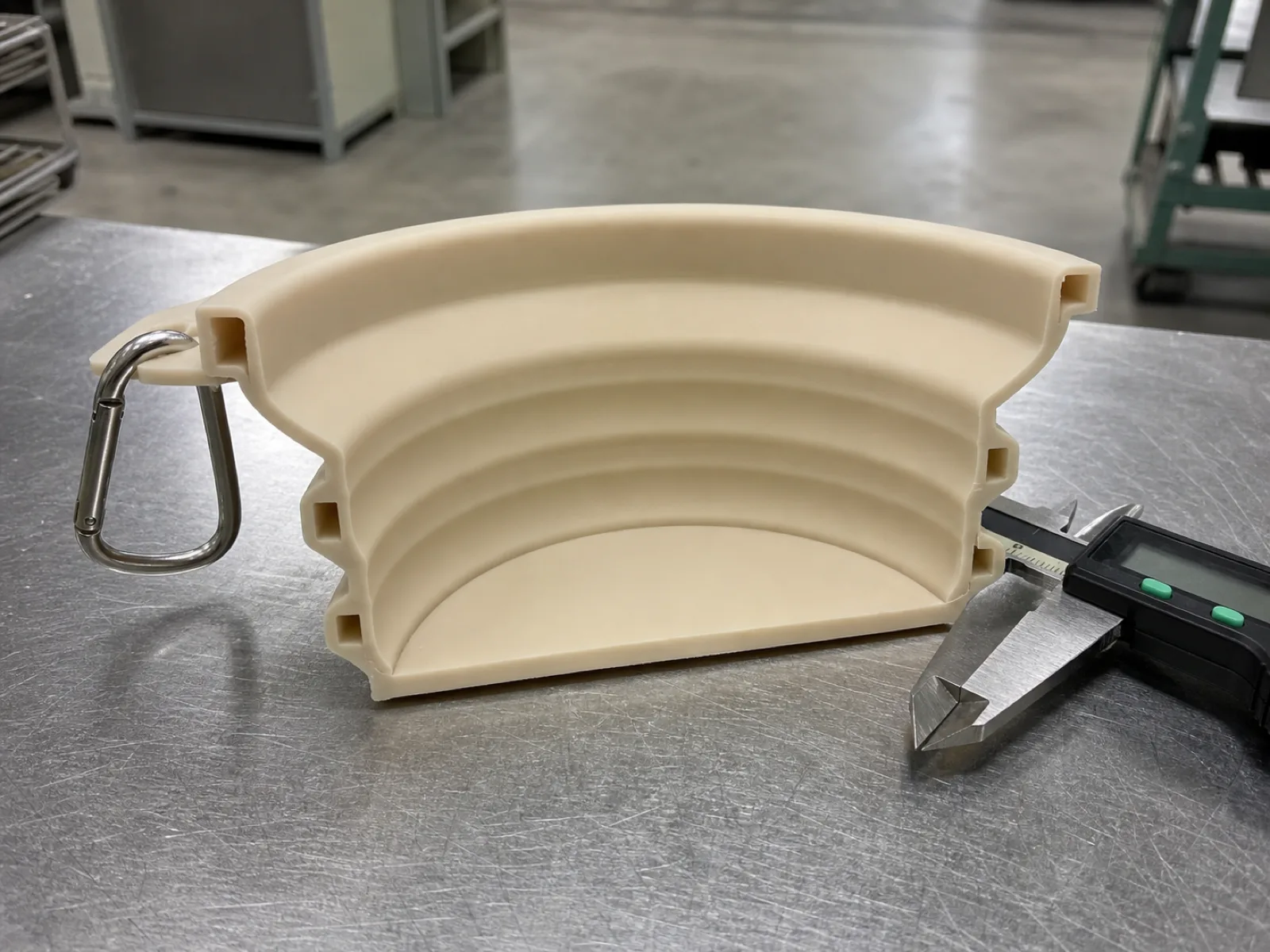
A collapsible silicone pet bowl folds because its wall is molded as an accordion of thin ribs (2.0-2.5 mm) at 8-11 mm pitch, and it locks upright because the rib crown snaps past a small over-center angle when erected. The wall thickness, the rib pitch, and the durometer (55-65 Shore A) together determine whether the bowl collapses crisply or crumples, and whether it stands under water weight or tips.
The fold mechanism is not a hinge — it is a controlled buckling of each rib segment along a preferred axis. When the user pushes the rim down, each rib inverts through an over-center geometry and stacks flat; when the user pulls the rim up, each rib snaps back through the same over-center angle and holds. Get the wall too thin (< 1.8 mm) and the ribs collapse under water weight; too thick (> 2.8 mm) and the user has to press hard to fold the bowl and it will not lock into its collapsed state at all.
Durometer sets the snap character. A 60 Shore A body feels crisp on the fold-and-erect action and holds water for a 22 kg dog leaning into the bowl; a 45 Shore A body feels floppy and tips at half the capacity load; a 75 Shore A body is stiff enough that most users cannot fold it one-handed. Wetop’s default is 60 Shore A on the body and 65 Shore A on the base plate for stability without sacrificing the fold action. For the underlying material chemistry decision — platinum vs peroxide cure — see the platinum vs peroxide guide.
What rib pitch, wall thickness, and durometer actually work?
Wetop's engineering baseline for a 500 mL collapsible silicone pet bowl is a three-rib accordion at 2.0-2.5 mm wall thickness, 8-11 mm rib pitch, 60 Shore A body, and a 3.0 mm base plate. That combination folds crisply, holds shape upright under 500 mL of water and a 25 kg dog leaning in, and passes 5,000+ fold cycles in ASTM D573[^astm-d573] accelerated aging.
The critical relationship is rib pitch to wall thickness. A pitch-to-thickness ratio near 4:1 (say 10 mm pitch at 2.5 mm wall) gives a controlled buckling angle around 60°, which produces the crisp fold-and-snap action a category buyer feels in-hand at a retail trade show. Ratios above 5:1 fold too easily and let the bowl tip; ratios below 3:1 require excessive push-down force and often fail to reach the fully collapsed state.
| Bowl capacity | Rib count | Rib pitch | Rib wall thickness | Body durometer | Base thickness |
|---|---|---|---|---|---|
| 200 mL (cat / toy) | 2 | 7-9 mm | 1.8-2.0 mm | 55 Shore A | 2.5 mm |
| 350 mL (small dog) | 2 | 8-10 mm | 2.0-2.2 mm | 60 Shore A | 3.0 mm |
| 500 mL (small / medium) | 3 | 8-11 mm | 2.0-2.5 mm | 60 Shore A | 3.0 mm |
| 1000 mL (medium / large) | 3 | 10-12 mm | 2.3-2.6 mm | 60-65 Shore A | 3.5 mm |
| 1500 mL (giant breed) | 4 | 10-13 mm | 2.5-2.8 mm | 65 Shore A | 3.5-4.0 mm |
Tolerance matters because rib-to-rib drift shows on the retail shelf. Wetop holds rib pitch at ±0.15 mm across a 120 mm rim on compression tooling and ±0.05 mm on LSR tooling. A 0.4 mm rib-height drift across cavities produces visibly asymmetric fold action and generates category-buyer rejections at inspection.
Compression molding or LSR injection — which process is right for the volume?
Compression molding is the right process below 20,000 annual units per SKU: aluminum single-cavity tooling runs 800-2,400 USD and cavity life covers the run. Liquid silicone rubber (LSR) injection molding justifies its 8,000-18,000 USD tool cost above 20,000 annual units per SKU or when a two-shot carabiner-loop insert requires ±0.05 mm tolerance. For a first-year private-label launch, compression wins on economics almost every time.
The process decision is a volume-and-tolerance math problem, not a quality problem. Both compression and LSR produce food-grade silicone parts that clear FDA 21 CFR 177.26001 and LFGB §30/§312; the difference is unit economics at scale and tolerance at extreme volume. Compression molding cycles a preformed silicone billet in a heated tool for 5-8 minutes, holds ±0.15 mm tolerance, and runs on aluminum tooling that costs less than one-fifth of an LSR tool. LSR is a fully automated injection process that cycles in 30-90 seconds, holds ±0.05 mm, and prints crisper accordion ribs — but the tool is a hardened steel two-plate mold with cold-runner block, not a simple aluminum cavity.
For a three-SKU private-label launch projecting 8,000-15,000 units in year one, aluminum compression tooling is the correct call. The break-even against LSR sits around 20,000-25,000 annual units per SKU including tool amortization; below that, LSR just moves cost from unit to tool without a defensible payback. The exception is if the buyer needs a two-shot overmold — a stainless carabiner insert co-molded with the silicone rim, for example — where LSR’s insert-loading automation is genuinely faster than the compression tool’s hand-place cycle.
| Process | Tool cost per SKU | Tool lead time | Cycle time | Cavity life | Tolerance | Break-even |
|---|---|---|---|---|---|---|
| Compression, aluminum single-cavity | 800-2,400 USD | 18-25 days | 5-8 min | 30-50k cycles | ±0.15 mm | Baseline |
| Compression, aluminum 4-cavity | 2,400-4,800 USD | 22-30 days | 5-8 min | 30-50k cycles | ±0.15 mm | ~5,000 units |
| Compression, steel 4-cavity | 3,500-8,000 USD | 30-40 days | 5-8 min | 250k+ cycles | ±0.10 mm | ~15,000 units |
| LSR, steel 8-cavity cold-runner | 8,000-18,000 USD | 40-55 days | 30-90 s | 500k+ cycles | ±0.05 mm | ~20-25,000 units |
What FDA and LFGB test packet does a pet brand actually need on file?
For US retail: FDA 21 CFR 177.2600[^fda-177-2600] migration test with n-hexane and 8 % ethanol simulants at 40 °C for 240 hours, plus a California Prop 65 heavy-metals statement[^oehha-prop65]. For EU retail: LFGB §30/§31 tests derived from BfR Recommendation XV[^bfr-xv], plus a REACH SVHC declaration[^echa-reach]. Every report must tie to the production lot code laser-marked on the bowl, not a generic material data sheet from the compound supplier.
The distinction between a generic material data sheet and a per-lot test report is where most low-tier factories lose the deal with a serious pet brand’s compliance team. A material data sheet says “this compound has been tested for food contact.” It does not prove that the material molded into the bowl this month was actually the same compound, or that it was cured to the same specification. A per-lot report tests the finished part from the specific production run and ties the result to a lot code visible on the underside of the bowl.
Wetop’s default test cadence is one FDA 21 CFR 177.2600 report per production lot per SKU, one LFGB §30/§31 report per calendar year per compound family (renewed on formulation change), and one Prop 65 heavy-metals scan per lot. Reports are issued by SGS, Intertek, or TÜV — buyer’s choice. The compliance packet also includes an ISO 90013 QMS certificate confirming batch traceability, sub-supplier control, and non-conformance logging are in place. For the underlying US-vs-EU regulatory comparison, the FDA vs LFGB guide walks through the paragraph-level differences and per-lot documentation requirements.
| Market | Required test | Standard | Frequency | Typical lab |
|---|---|---|---|---|
| US retail | Overall migration | FDA 21 CFR 177.26001 | Per production lot | SGS / Intertek |
| US retail | Heavy metals | California Prop 654 | Per production lot | SGS / Intertek |
| EU retail | Overall + specific migration | LFGB §30/§31 (BfR XV)2 | Annual per compound; on formulation change | TÜV / SGS |
| EU retail | SVHC declaration | REACH Annex XIV / XVII5 | Annual, tracked at 0.1 % w/w | Self-declared, lab-verified |
| Global | Shore A hardness | ASTM D22406 | Per production lot | In-house + third-party audit |
| Global | Tensile / elongation | ASTM D4127 | Per compound qualification | Third-party |
| Global | Accelerated aging | ASTM D5738 | Per new geometry | In-house / third-party |
How does the carabiner clip and D-ring integrate, and what pull test does it need?
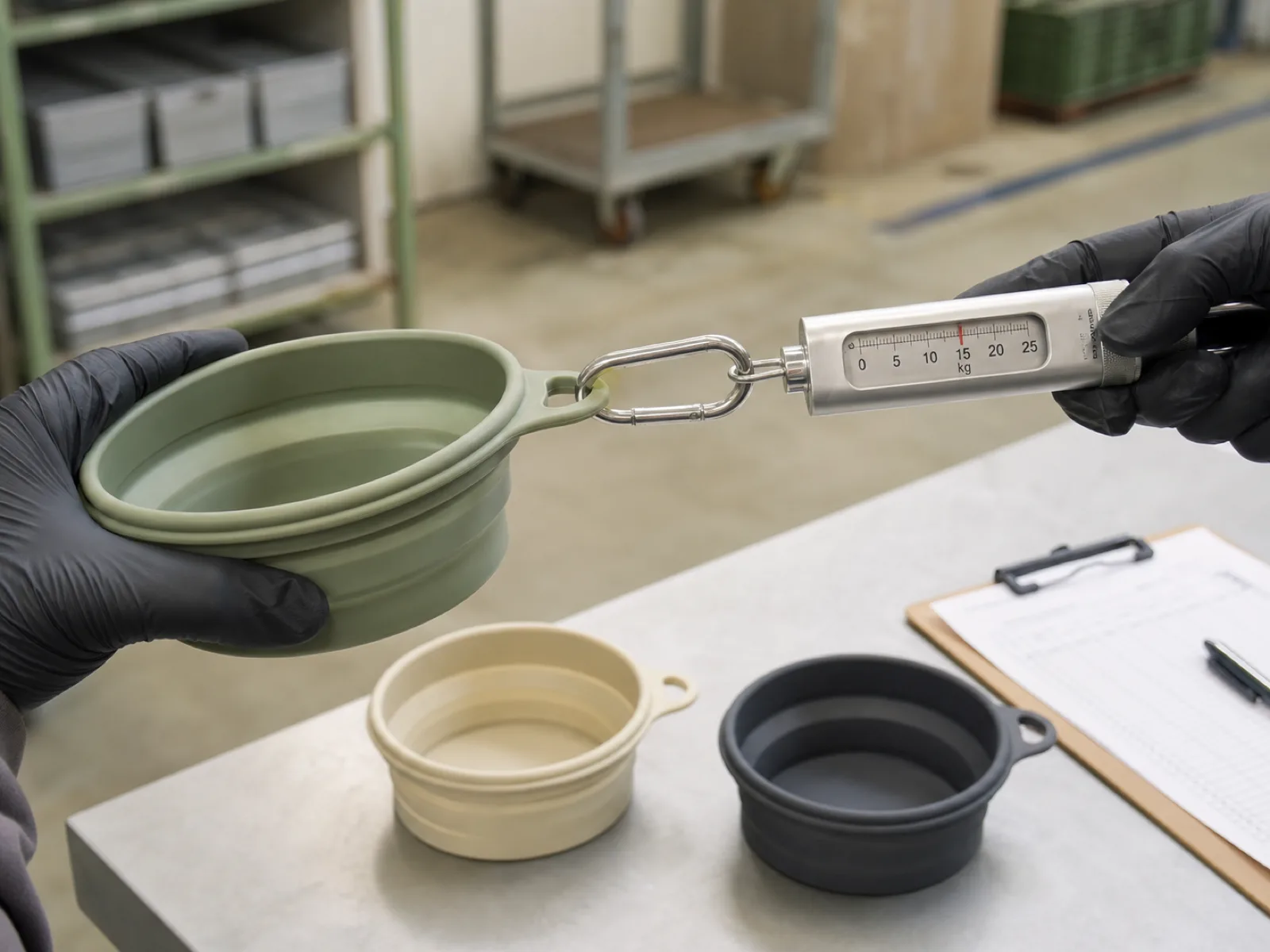
A defensible collapsible silicone pet bowl uses a stamped 304 stainless carabiner or D-ring routed through an integral silicone rim loop with a 6-8 mm cross-section. The loop must pass a 15 kg / 30 s static pull test per production lot with zero tear propagation, and the carabiner itself must survive a 20 kg static load without spring failure or gate distortion.
Hardware integration is where low-tier collapsible pet bowls fail hardest. Two failure patterns dominate: zinc-alloy carabiners that corrode within three to six months of outdoor use, and undersized silicone rim loops that tear at the carabiner contact point after 200-400 attach-detach cycles. Both failures show up as one-star reviews on Amazon Pet, and both are avoidable with a per-lot 15 kg pull test that a factory either runs or does not.
Wetop’s default hardware spec: 304 stainless carabiner (2.5-3.0 mm wire diameter, rolled edge on the silicone contact side, spring-gate rated for 25 kg static), threaded through an integral silicone rim loop molded at 6-8 mm cross-section (thicker than the rib wall) with a lapped mold finish so the carabiner slides without abrading the loop. On production, we sample n=5 bowls per 500-unit lot on a spring gauge, hold 15 kg for 30 seconds, and record the result on the QC sheet that follows the compliance packet. Any rim-loop tear, gate distortion, or spring failure kicks the entire lot back to the press for root-cause review before it ships.
What is the actual MOQ, tooling cost, and lead time for a private-label lineup?
Wetop's MOQ is 500 units per SKU per Pantone-matched color. A three-size lineup (350 mL / 500 mL / 1000 mL) on one shared tool base with three cavity inserts hits an aggregate 1,500-unit minimum. Aluminum single-cavity tooling runs 800-2,400 USD per cavity with an 18-25 day lead time; production steel tooling runs 3,500-8,000 USD with a 30-40 day lead time; LSR tooling starts at 8,000 USD.
Tooling amortization is the number that actually drives landed cost. A single aluminum-cavity tool at 1,500 USD amortizes across roughly 5,000 units before the per-piece tooling contribution drops below 0.05 USD; below that, the price stabilizes at the compound-plus-cure-plus-labor floor. For a first-year private-label launch projecting 8,000-15,000 units across three sizes, an aluminum tool base with three interchangeable cavity inserts is the right call — the tool base cost is shared, and each cavity insert adds 300-600 USD instead of a full new tool. Steel tooling makes sense at 20,000+ annual units per size or when tolerance drift on aluminum (typically after 30,000-50,000 cycles) starts driving QC rejects.
Typical program economics for a three-SKU collapsible-bowl launch:
| Line item | Aluminum prototype tooling | Production steel tooling | LSR tooling |
|---|---|---|---|
| Tool cost per SKU (single-cavity) | 800-2,400 USD | 3,500-8,000 USD | 8,000-14,000 USD |
| Tool cost per SKU (4-cavity, higher volume) | 2,400-4,800 USD | 8,000-16,000 USD | 14,000-22,000 USD |
| T1 sample lead time | 7-15 days after tool cut | 10-18 days | 12-20 days |
| Tool cut lead time | 18-25 days | 30-40 days | 40-55 days |
| First bulk shipment | 30-45 days from PO | 35-50 days from PO | 45-60 days from PO |
| Break-even units per year | Baseline | ~15,000 | ~20-25,000 |
| Cavity life before drift-refresh | 30-50k cycles | 250k+ cycles | 500k+ cycles |
Sample flow: T0 concept + engineering drawing (Wetop-drafted, 3-5 days from brief) → T1 tooling drawing sign-off (buyer, 2-5 days) → T2 cavity cut → T1 sample (aluminum tool, 3-5 days after cut) → sample-approval iteration (typically 1-2 rounds) → bulk PO release. Total: 6-9 weeks from brief to bulk shipment on aluminum tooling; 8-12 weeks on steel; 10-14 weeks on LSR. For a companion perspective on how the 500-unit MOQ interacts with the compression cycle economics, see the slow-feeder OEM guide.
What customization does an OEM collapsible bowl actually support at MOQ?
At 500-unit MOQ per SKU per color, Wetop includes Pantone-matched masterbatch (target ΔE ≤ 1.5 in D65 light-box), in-mold debossed logo, laser-marked lot code on the underside, retail-ready hangtag, and poly bag or blister packaging. Silk-screen and pad-print logos are available but wear off after 300-600 dishwasher cycles; debossed logo is the durable default for on-body branding.
The Pantone match runs to a ΔE ≤ 1.5 in D65 light-box comparison against the buyer’s chip on standard sage / cream / navy / warm charcoal families; on saturated colors (deep red, hunter green, blaze orange) Wetop holds ΔE ≤ 2.0. In-mold debossing is engraved into the cavity itself — no separate deboss operation — so it is free at any volume once the tool is cut. Laser-marked lot codes are added post-press with a fiber laser at 3-4 mm character height, providing full batch traceability back to the platinum-cure lot, the QC sheet, and the third-party test report.
Retail-ready packaging Wetop supports in-house: kraft-paper hangtag with capacity icon, cleaning-instruction text, and weight-tier size icon printed inline; poly bag with vent hole; folded corrugated carton with barcode; and, for higher-volume programs, a retail-ready blister card with planogram-compliant hook and UPC. Amazon and Chewy prep requirements (FNSKU labels, poly-bag suffocation warning, prep-service compliance) are supported at the pack-out stage. For a deeper look at the deboss-vs-print-vs-laser trade-offs for on-body branding, the logo customization guide walks through the durability data.
Why do collapsible pet bowls develop odor, bloom, or yellowing — and how does post-cure prevent it?
Odor, bloom, and yellowing are cure-cycle failures, not material failures. Silicone leaving the press still holds residual cross-linker and low-molecular-weight silicone chains that outgas over weeks. A 4-6 hour post-cure at 200 °C drives these off. Skipping post-cure to shave 6-8 hours of lead time is the top return driver on Amazon and Chewy collapsible pet bowl listings.
Post-cure is the single most under-discussed step in collapsible silicone pet bowl manufacturing, and it is the one Wetop refuses to compromise on. In the press, cure completes to roughly 92-96 % cross-link density in 5-8 minutes at 180-200 °C — enough to demold and hold shape, not enough to drive out volatiles. The remaining 4-8 % of cross-linking, plus the residual chain fraction, needs a secondary thermal cycle in an oven at 200 °C for 4-6 hours. During that dwell, low-molecular-weight cyclosiloxanes (D3-D6) and any leftover platinum-catalyst byproducts volatilize off. The finished part is dimensionally stable, odor-free, and holds appearance for the life of the SKU.
Wetop’s post-cure log is part of the compliance packet: oven ID, load-in time, load-out time, and thermocouple trace signed off by the shift lead. Any lot missing a valid post-cure record is held from shipment. This is not exotic — it is what ISO 90013 batch-traceability requires — but it is the discipline that separates a factory writing a defensible packet from one that will produce an odor complaint in month three.
Sizing, capacity ladder, and SKU strategy for a private-label lineup
A retail-ready collapsible pet bowl lineup ships 350 mL (small dog / puppy), 500 mL (small / medium dog), and 1000 mL (medium / large dog) SKUs off three cavity inserts in one shared tool base. That is the minimum viable range at Wetop's 1,500-unit aggregate MOQ; premium lineups add a 200 mL cat/travel SKU and a 1500 mL giant-breed SKU, but the three-tier ladder covers roughly 85 % of the US dog population by weight.
Capacity is specified against a single-meal water dose or a single dry-food portion at Association of American Feed Control Officials (AAFCO) dosing guidance. A 500 mL collapsible bowl holds one to one-and-a-half cups of water for a medium-breed feeding stop on a hike; a 1000 mL bowl holds a full daily water top-up for a large dog or a doubled kibble portion for a growth-stage puppy. Overflow is worse than under-capacity — a bowl filled to the rim above the top rib compromises the accordion’s structural integrity and produces early tipping. Wetop specifies useful-capacity at 85 % of geometric-capacity to build in that margin.
Adjacent SKUs to consider at MOQ: a color-matched food-grade silicone slow-feeder bowl on the same 500-unit MOQ, a silicone travel mat with a raised lip to catch water and kibble, and a two-in-one design that pairs a collapsible water bowl with a collapsible food bowl on a shared carabiner. The two-in-one is a strong halo product for a pet brand’s DTC hiking-and-travel line.
References
The engineering positions above trace to the following standards and peer-reviewed sources:
Ready to spec a collapsible silicone pet bowl program?
If you’re building a new private-label collapsible pet bowl lineup — or refreshing an existing one that keeps returning on odor, rib cracking, or carabiner rip-out — Wetop’s engineering desk will draft the accordion geometry, cavity layout, and compliance packet against your target capacity ladder, retail channel, and volume forecast. Send the brief through the contact form with target volume, size range, and preferred cure system, and expect a drafted engineering drawing within three business days. For the underlying compound and packet decisions, the platinum vs peroxide cure guide, the FDA vs LFGB comparison, and the slow-feeder OEM guide are the three companion reads.
Footnotes
-
21 CFR 177.2600 — Rubber articles intended for repeated use. US Food and Drug Administration. https://www.ecfr.gov/current/title-21/chapter-I/subchapter-B/part-177/subpart-C/section-177.2600 ↩ ↩2
-
BfR Recommendation XV — Silicones. German Federal Institute for Risk Assessment. https://www.bfr.bund.de/en/home.html ↩ ↩2
-
ISO 9001:2015 — Quality Management Systems — Requirements. International Organization for Standardization. https://www.iso.org/standard/62085.html ↩ ↩2
-
Proposition 65 — Chemicals Known to the State to Cause Cancer or Reproductive Toxicity. California Office of Environmental Health Hazard Assessment. https://oehha.ca.gov/proposition-65 ↩
-
REACH — Regulation (EC) No 1907/2006. European Chemicals Agency. https://eur-lex.europa.eu/legal-content/EN/TXT/?uri=CELEX%3A32006R1907 ↩
-
ASTM D2240 — Standard Test Method for Rubber Property — Durometer Hardness. ASTM International. https://www.astm.org/d2240-15r21.html ↩
-
ASTM D412 — Standard Test Methods for Vulcanized Rubber and Thermoplastic Elastomers — Tension. ASTM International. https://www.astm.org/d0412-16r21.html ↩
-
ASTM D573 — Standard Test Method for Rubber — Deterioration in an Air Oven. ASTM International. https://www.astm.org/d0573-04r19.html ↩
FAQ
-
What is a collapsible silicone pet bowl actually made of?
A defensible collapsible silicone pet bowl is molded from platinum-cured food-grade silicone rubber (typically 55-65 Shore A) tested against FDA 21 CFR 177.2600 and LFGB §30/§31. Lower-tier products use peroxide-cured silicone or thermoplastic elastomer (TPE) blends that bloom and yellow under repeated saliva and dishwasher exposure. Insist on a platinum-cure declaration and a per-lot migration test report.
-
How thick should the walls and accordion ribs on a collapsible pet bowl be?
Wetop's engineering baseline is a 2.0-2.5 mm wall thickness on each accordion rib with an 8-11 mm rib pitch and a 3-rib stack for a 500 mL bowl. Below 1.8 mm the bowl folds too easily and tips when a dog laps water; above 2.8 mm the bowl feels stiff and does not lock into its collapsed state. Base and rim use 3.0-3.5 mm thickness for rigidity.
-
Is compression molding or LSR injection molding better for a collapsible silicone pet bowl?
For a first-year private-label launch under 20,000 units per SKU, compression molding is the right call — aluminum tooling runs 800-2,400 USD per cavity and cavity life covers the run. Liquid silicone rubber (LSR) injection molding only justifies its 8,000-18,000 USD tool cost above 20,000 annual units per SKU, and the tolerance advantage (±0.05 mm vs ±0.15 mm) rarely matters for a pet bowl geometry.
-
How many fold cycles should a collapsible silicone pet bowl survive?
Wetop's internal fatigue spec targets 5,000+ full fold-and-erect cycles without visible rib cracking on a 60 Shore A body. That translates to two folds per day for approximately seven years of normal use. Peroxide-cured or under-post-cured silicone cracks at 800-1,500 cycles at the outer rib radius; the failure mode is a compliance and returns problem, not a cosmetic one.
-
Does the carabiner clip on a collapsible silicone pet bowl need its own test?
Yes — the metal carabiner or D-ring must pass a 15 kg / 30 s static pull test per production lot, and the silicone rim it clips through must show no tear propagation. Wetop uses a stamped 304 stainless carabiner with a rolled edge on the silicone loop side; low-tier products use zinc-alloy carabiners that corrode after 3-6 months of outdoor use and pull through the rim under 8-10 kg of load.
-
What sizes does a retail-ready collapsible pet bowl lineup usually ship?
The industry-standard SKU ladder is 350 mL (toy / small dog), 500 mL (small / medium dog), and 1000 mL (medium / large dog). Wetop molds all three off one shared tool base with three cavity inserts for a 1,500-unit aggregate minimum. Premium lineups add a 200 mL cat/travel SKU and a 1500 mL giant-breed SKU, but the three-tier ladder covers roughly 85 % of the US dog population by weight.
-
Can we do a Pantone-matched color and debossed logo at 500-unit MOQ?
Yes — Pantone-matched masterbatch (target ΔE ≤ 1.5 in D65 light-box) and in-mold debossed logo are included at 500-unit MOQ per SKU per color at Wetop. Debossing is engraved into the cavity itself with no separate operation. Silk-screen and pad printing are available but wear off after 300-600 dishwasher cycles; for a collapsible pet bowl we recommend debossed logo as the durable default and silk-screen only for retail hangtag graphics.
-
What is the actual lead time from RFQ to first bulk shipment?
Wetop's default cadence: T1 sample 7-15 days from art approval on an aluminum single-cavity tool; sample approval iteration 1-2 rounds (5-10 days); first bulk shipment 30-45 days from PO on a 500-2,000 unit run. Full timeline: brief-to-bulk is 6-9 weeks on aluminum tooling and 8-12 weeks on steel tooling for higher-volume programs.
-
How does a collapsible silicone pet bowl compare to a foldable fabric bowl or TPE bowl?
Silicone holds shape when erected, is dishwasher-stable to 230 °C, and clears FDA 21 CFR 177.2600 cleanly. Fabric bowls (nylon with a wire rim) leak, wick odor, and cannot be sanitized in a dishwasher. TPE bowls collapse but soften above 80 °C, fail the dishwasher sanitize cycle, and typically do not meet LFGB §30/§31. For a retail-shelf pet bowl at Chewy or Petco, silicone is the only category that survives a 12-month warranty.
-
What compliance documents do Petco, Chewy, and Amazon Pet actually require?
For US retail (Chewy, Petco, Amazon Pet): FDA 21 CFR 177.2600 test report against the production lot, California Prop 65 heavy-metals statement, and a lot-code laser-marked on the bowl or base. For EU retail (Zooplus, EU Amazon): LFGB §30/§31 report derived from BfR Recommendation XV, plus a REACH SVHC declaration and an EU importer address on the label. Wetop issues all four in the standard compliance packet with every production run.
References
Authoritative sources cited in this guide
- US Food and Drug Administration. 21 CFR 177.2600 — Rubber articles intended for repeated use. https://www.ecfr.gov/current/title-21/chapter-I/subchapter-B/part-177/subpart-C/section-177.2600 — The federal migration-limits regulation any US pet brand shipping food-contact silicone must have on file per production lot.
- International Organization for Standardization. ISO 9001:2015 — Quality Management Systems — Requirements. https://www.iso.org/standard/62085.html — The documented QMS Wetop's compression and LSR lines are certified against, including batch traceability required for pet-category retail chains.
- ASTM International. ASTM D2240 — Standard Test Method for Rubber Property — Durometer Hardness. https://www.astm.org/d2240-15r21.html — The Shore A hardness test protocol referenced on every collapsible pet bowl rib and base durometer spec on Wetop's engineering drawings.
- ASTM International. ASTM D412 — Standard Test Methods for Vulcanized Rubber and Thermoplastic Elastomers — Tension. https://www.astm.org/d0412-16r21.html — Tensile-strength and elongation-at-break methodology used to validate that a collapsible bowl rib survives 5,000+ fold cycles without tear propagation.
- ASTM International. ASTM D573 — Standard Test Method for Rubber — Deterioration in an Air Oven. https://www.astm.org/d0573-04r19.html — The accelerated-aging protocol Wetop's engineering desk runs to project 12-month dishwasher-cycle durability against a 168-hour / 100 °C oven exposure.
- German Federal Institute for Risk Assessment (BfR). BfR Recommendation XV — Silicones. https://www.bfr.bund.de/en/home.html — The material-composition and migration-testing framework LFGB §30/§31 tests are built against — the compliance backbone for EU pet retail listings.
- European Chemicals Agency (ECHA). REACH — Registration, Evaluation, Authorisation and Restriction of Chemicals (Regulation EC 1907/2006). https://eur-lex.europa.eu/legal-content/EN/TXT/?uri=CELEX%3A32006R1907 — The EU chemicals regulation governing SVHC declarations required on any silicone pet product entering the EU retail channel.
- California Office of Environmental Health Hazard Assessment (OEHHA). California Proposition 65 — Chemicals Known to the State to Cause Cancer or Reproductive Toxicity. https://oehha.ca.gov/proposition-65 — The California heavy-metals and reproductive-toxicant regulation triggered on any pet product sold into a California retail channel or DTC customer.
Start a custom program
Send a brief. Get an engineer’s reply in one business day.
Every Wetop program is tooled from a customer’s specification. Send a CAD file (STEP · IGES · DWG) or a written brief and we’ll reply with a mold cost estimate, price brackets at MOQ 500 / 1,000 / 5,000, and any engineering questions.