Manufacturing · commercial intent
Silicone Logo Decoration — Deboss vs Print vs Laser vs IML
What changed: Rewritten to v2 advanced-GEO standard — added direct-answer blocks per H2, expanded to 7 FAQs, 8 Tier-1 References (ISO / FDA / BfR / ASTM / CIE / DIN / ANSI / NIST), added decoration workshop and Pantone matching photographs, added durability matrix table.
 Manufacturing
 The single most-common decoration question on a silicone OEM RFQ is “which method survives the dishwasher?” — usually asked by a product manager whose retail buyer expects the brand mark to look fresh at 12 months. This guide is the decoration decoder: four methods, four durability profiles, and what to spec for each retail tier.
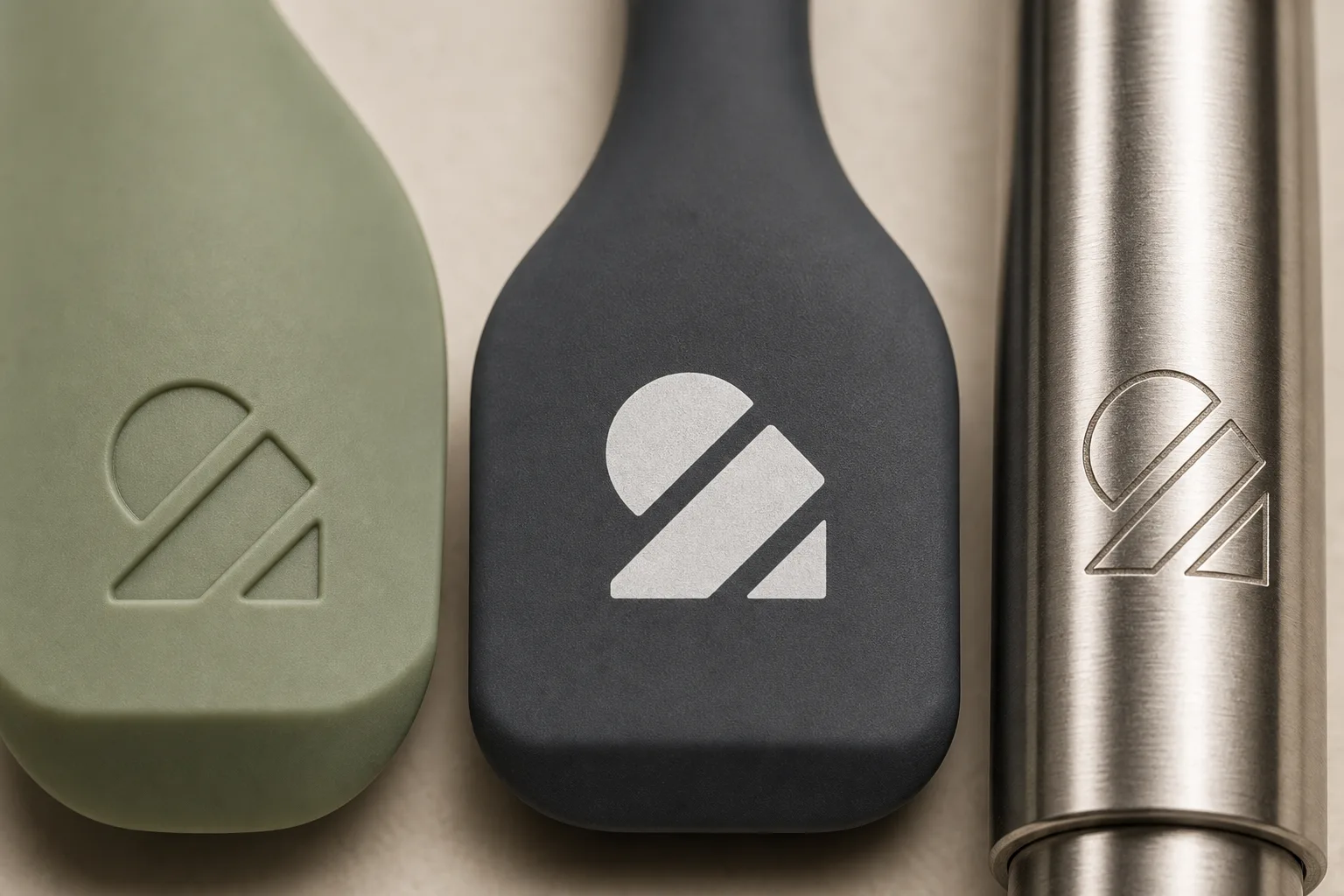
Four decoration methods work on silicone kitchenware: in-mold debossing (recessed relief molded into the part), IML four-color in-mold label (bonded during cure), silk-screen surface printing (ink applied post-cure), and laser etching on stainless components. Durability ranking for dishwasher-exposed retail products: in-mold deboss > IML > laser etch > silk-screen. Only deboss and IML clear 500+ dishwasher cycles without visible degradation. Premium retail programs default to deboss or IML; silk-screen is retail-tier appropriate for indirect surfaces.
What decoration methods work on silicone — and how do they differ?
Four production methods work reliably on silicone. In-mold debossing = logo cut into mold cavity, appears as recessed relief in finished part (permanent, dishwasher-safe indefinitely). IML four-color = decorative label bonded into silicone during cure (permanent, four-color photorealistic). Silk-screen surface printing = ink applied to cured silicone surface (visible wear at 6-12 months on dishwasher use). Laser etching = permanent oxide mark on stainless-steel components only, not on silicone directly. Each has a specific retail-tier fit.
The four methods break down by application layer:
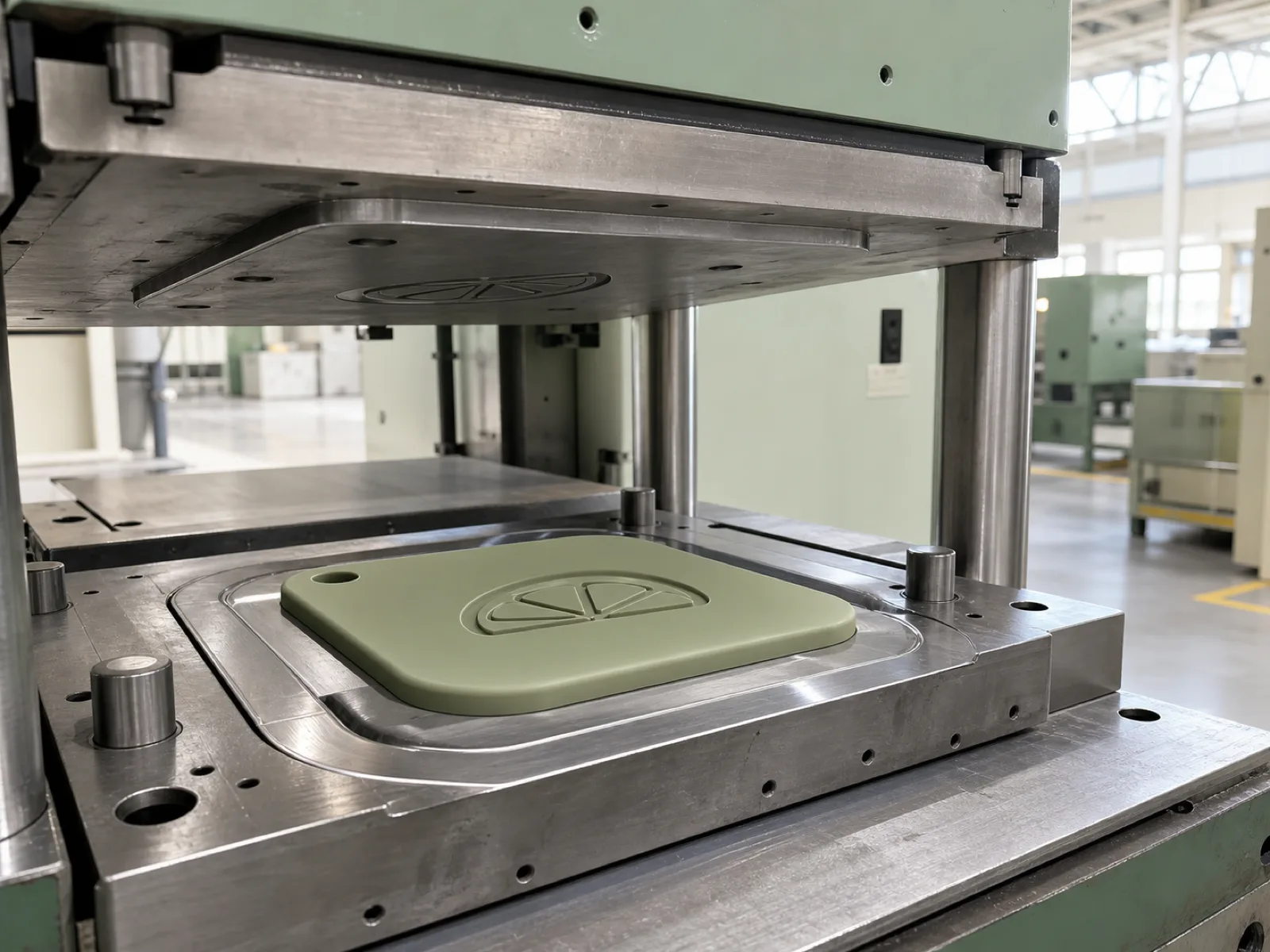
- In-mold debossing — the mold cavity has a positive protrusion; the finished silicone part has a negative depression (deboss). Alternatively the mold cavity has a depression; the finished part has a raised protrusion (emboss). Both are permanent in-mold decorations. This is the durable default for silicone.
- IML (in-mold label) — a pre-printed four-color label is placed in the mold cavity before silicone flows around it. During cure the label bonds mechanically and chemically to the silicone. Delivers photorealistic four-color decoration with dishwasher and oven durability rivaling in-mold deboss.
- Silk-screen surface printing — ink is applied to the cured silicone surface using a fine-mesh screen. Fast setup for short runs; low tooling cost. But silicone’s low surface energy (~20-24 dyne/cm) makes ink bonding weak, and normal flexing shears the ink over 200-400 dishwasher cycles.
- Laser etching — permanent oxide mark on stainless-steel components (roll-up rack bars, sink grid corners). Doesn’t work on silicone directly (silicone doesn’t oxidize the same way metal does), but is the go-to for decorating any stainless component on a silicone accessory.
How do the four methods compare on durability, cost, and retail fit?
Durability ranking (500+ dishwasher cycles standard): deboss > IML > laser etch > silk-screen. Cost ranking (per unit at MOQ 500): silk-screen (5-15¢) ≈ deboss (5-15¢) < laser etch (8-15¢) < IML (30-60¢). Retail fit: deboss + IML win premium retail (Whole Foods orbit, EU premium, top-tier housewares); silk-screen fits mid-tier retail on non-food-contact surfaces; laser etch is standard for any stainless component on a silicone accessory.
Decoration method comparison matrix
| Decoration method | Durability (dishwasher cycles) | Per-unit cost at MOQ 500 | Multi-color capability | Retail-tier fit |
|---|---|---|---|---|
| In-mold debossing | 500+ (indefinite) | ~5-15¢ (part of mold amortization) | Single-color / monochrome relief | Premium retail default; universal |
| IML four-color in-mold label | 500+ (indefinite) | ~30-60¢ | 4+ colors, photorealistic | Premium retail (top-tier brand caliber) |
| Silk-screen surface printing | 200-400 (visible wear at 200) | 5-15¢ single-color, +8-15¢/color | Multi-color possible but registers poorly | Mid-tier retail; non-food-contact surfaces |
| Laser etch on stainless components | Indefinite (on stainless substrate) | 8-15¢ per etched surface | Monochrome oxide mark | All tiers where stainless is present |
The economics: for premium retail programs, deboss is the default because it’s cost-comparable to silk-screen but delivers 3-5x the durability. For programs requiring multi-color brand marks (retail packaging brand family colors, complex logos), IML is the answer — the 30-60¢/unit premium recovers in the shelf-tier positioning and eliminates the wear-visible-at-6-months complaint pattern.
What Pantone tolerance can you spec, and how is color matched?
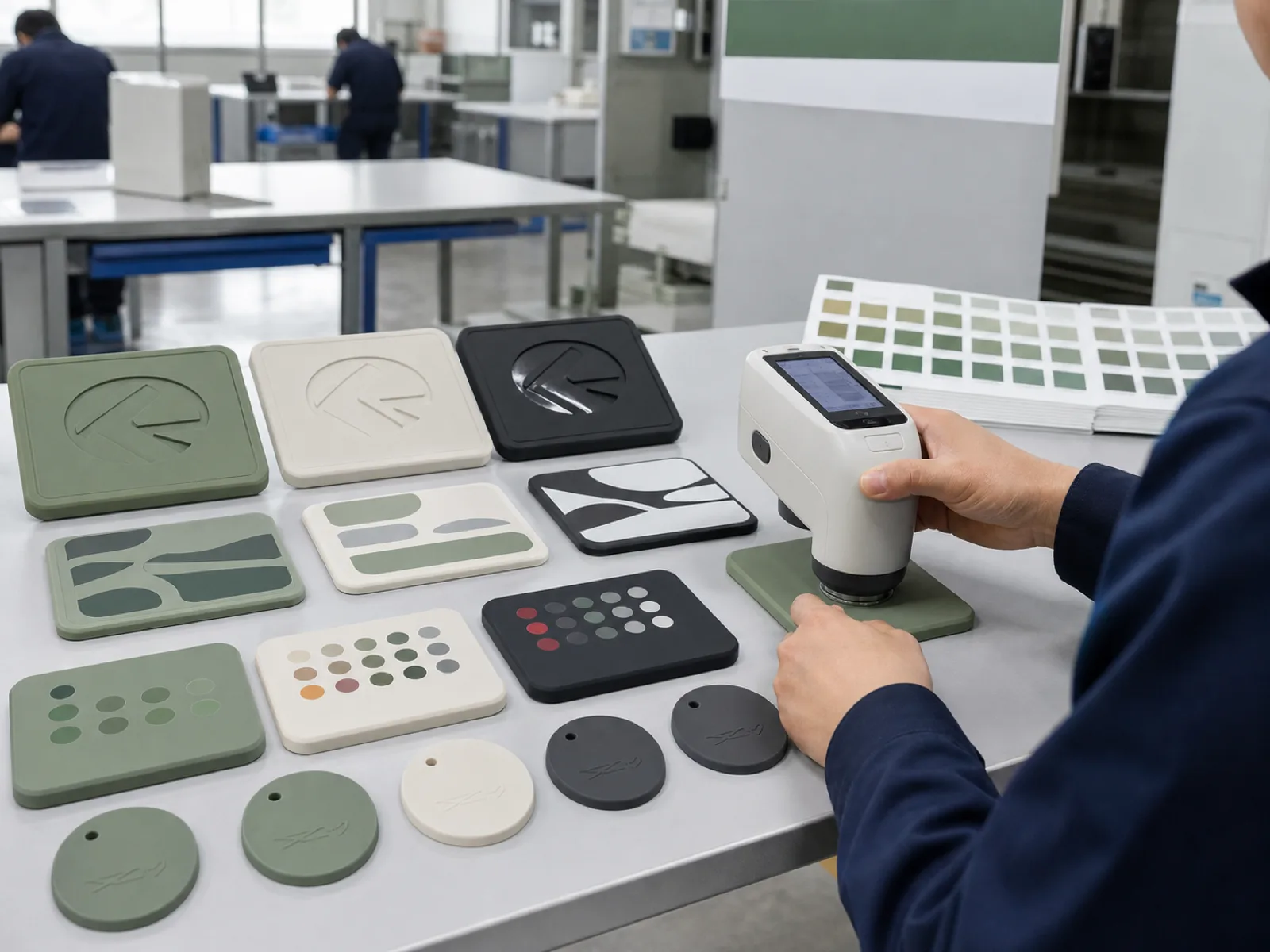
Wetop holds ±0.5 ΔE Pantone tolerance measured via spectrophotometer against TPX (matte) or TPG (glossy) reference per CIE color measurement standards[^cie-pantone]. Color is mixed in master-batch — the silicone gum is dyed molecular through the polymer before molding, not surface-coated post-cure. This delivers batch-to-batch consistency the human eye can't distinguish (typical retail-observable threshold is ~2-3 ΔE). Compound-house standard is ±1-2 ΔE; ±0.5 requires per-batch spectrophotometer verification and disciplined dye-mixing.
The Pantone matching workflow at Wetop’s shop floor:
- Customer supplies Pantone reference — TPX (matte) or TPG (glossy) reference number, or physical swatch card.
- Compound-house pre-cure verification — silicone gum dyed to target Pantone before molding; spectrophotometer measurement per CIE ΔE method1 verifies pre-press.
- First-article verification — molded first-article sample measured post-cure; ΔE reported against reference.
- Per-batch verification — running production batches sampled and measured; every batch’s color certificate documented and filed per ISO 9001 documented process control2 with 36-month retention.
- Customer color approval sign-off — first-article Pantone verification signed by customer QA team before mass production release.
Tolerance benchmarking:
- ±0.5 ΔE — Wetop standard; premium retail spec; indistinguishable to human eye.
- ±1 ΔE — good compound-house standard; hard to spot without spectrophotometer.
- ±2 ΔE — typical premium silicone OEM standard; subtle side-by-side drift visible.
- ±3 ΔE — most generic Chinese silicone OEM baseline; visibly different shade in side-by-side comparison.
- ±5 ΔE or worse — commodity tier; visible drift, obvious to consumer.
Reference framework for spectrophotometer calibration comes from NIST measurement standards3 and DIN color-fastness testing4.
Which decoration method is safe for food-contact silicone?
In-mold decoration (deboss or IML) is universally safe for food-contact. Silk-screen inks and laser-etched stainless components should be positioned on non-food-contact surfaces per FDA 21 CFR 177.2600 general guidance[^fda-177-2600] and BfR Recommendation XV[^bfr-lfgb-xv] specific-migration testing framework. Silk-screen ink formulations are not automatically food-contact-compliant; specific food-safe ink chemistries exist but require additional verification. Best practice: keep silk-screen decoration on external/non-food surfaces only.
The food-contact rules by decoration method:
- In-mold deboss + IML — Safe by chemistry. The decoration is the silicone itself (or a bonded label that has been through the same FDA 21 CFR 177.2600 and LFGB §30/31 extraction testing as the base silicone). Universal safe.
- Silk-screen inks — Depends on ink formulation. Standard silk-screen inks are for hard substrate decoration and may not clear FDA/LFGB extraction testing on food-contact positions. Food-safe silk-screen ink formulations exist but require verification. Best practice: use silk-screen only on non-food-contact surfaces.
- Laser-etched stainless components — Safe by chemistry. Stainless steel is inherently food-safe when the etching produces only oxide (not chemical contamination of the surface). Verified against ISO food-contact requirements for the stainless grade.
The FDA vs LFGB decoder walks the food-contact regulatory framework in detail.
What Wetop OEMs on decoration
Wetop runs all four decoration methods in-house on the same certified shop floor. Standard method for premium retail: in-mold deboss or IML four-color, with laser etch on any stainless components. Standard method for mid-tier retail: in-mold deboss on food-contact surfaces + silk-screen on non-food-contact surfaces if needed. ±0.5 ΔE Pantone tolerance verified per batch with spectrophotometer measurement per CIE standards[^cie-pantone] and TPX/TPG Pantone reference. Every batch ships with a color certificate referencing the master-batch lot.
Wetop’s decoration defaults:
- Premium retail — In-mold deboss for monochrome brand marks; IML four-color for logos, brand family artwork, and multi-color designs. ±0.5 ΔE Pantone tolerance standard.
- Mid-tier retail — In-mold deboss on food-contact surfaces + silk-screen on non-food-contact surfaces if needed. ±0.5-1 ΔE Pantone tolerance standard.
- Amazon FBA private-label — In-mold deboss for brand mark; laser etch on stainless components. Balances durability with cost.
- Multi-SKU program (retail family) — Consistent Pantone across all SKUs verified at initial press run; color certificates filed per SKU and per batch.
MOQ 500 per SKU on all decoration methods. See MOQ & lead time on custom silicone kitchenware for how decoration timing fits into the schedule, silicone OEM pricing structure for how decoration adds to unit cost, and platinum vs peroxide cure decision for how cure system interacts with color matching stability.
Sourcing a program where decoration durability is a hard spec? Email inquiry@wetopsilicone.com with your brand-mark artwork, Pantone references, and target retail tier — we come back with a decoration-method recommendation and per-unit cost breakdown.
Ready to source? Every quote is built against your specification — send a CAD file, a written brief, or reference samples, and an engineer replies within one business day. Request a quote →
Footnotes
-
International Commission on Illumination (CIE). CIE Colorimetry, 4th Edition. https://cie.co.at/publications/colorimetry-4th-edition ↩
-
International Organization for Standardization. ISO 9001:2015 — Quality Management Systems. https://www.iso.org/standard/62085.html ↩
-
US National Institute of Standards and Technology. NIST Color Measurement Calibration. https://www.nist.gov/ ↩
-
Deutsches Institut für Normung. DIN Color Fastness Testing Standards. https://www.din.de/en ↩
FAQ
-
Which silicone decoration method is most durable?
In-mold debossing — the logo or artwork is cut into the mold cavity and appears as a recessed relief in the finished silicone. Zero surface layer to wear off; survives 500+ dishwasher cycles, UV exposure, oven temperatures to 230°C[^bfr-lfgb-xv] and daily commercial kitchen use. IML (in-mold label) four-color is the durable full-color option — the label is bonded into the silicone during cure. Silk-screen surface printing wears within 6-12 months on dishwasher-exposed retail products; laser etching is for stainless-steel components only (not on silicone directly). The [capabilities page](/capabilities/) shows all four methods running on the Wetop shop floor.
-
How much do the four decoration methods cost per unit?
At MOQ 500: in-mold deboss ~5-15¢/unit (part of the mold tooling amortization — the extra cavity detail adds 5-10% to tooling cost); silk-screen surface printing ~5-15¢/unit for single-color, +8-15¢ per additional color; laser etch on stainless components ~8-15¢/unit per etched surface; IML four-color decoration ~30-60¢/unit. IML has the highest per-unit cost but delivers the durable full-color option needed for premium retail. See [silicone OEM pricing structure](/guide/silicone-oem-pricing-structure/) for how decoration fits into the seven-line cost stack.
-
Why does silk-screen printing wear off silicone?
Two mechanisms. First, silicone surface energy is very low (~20-24 dyne/cm) — meaning surface coatings including silk-screen inks have weak mechanical bonding to the substrate. Second, silicone is designed to flex — every dishwasher cycle, oven use, and normal handling flexes the surface, gradually shearing the ink bond. Standard silk-screen ink formulations are designed for hard, rigid substrates (metal, plastic thermoplastics), not for a low-surface-energy flexible elastomer. Even 'silicone-optimized' silk-screen inks show visible wear within 12 months of daily dishwasher use. This is why deboss and IML are the durable choices for premium retail.
-
What's the difference between deboss and emboss on silicone?
Deboss = recessed into the surface (mold cavity has a positive protrusion, so the silicone part has a negative depression). Emboss = raised from the surface (mold cavity has a negative depression, so the silicone part has a positive protrusion). Both are permanent in-mold decorations that survive dishwasher and normal use indefinitely. For food-contact areas, deboss is preferred because raised emboss creates food-trap corners that are harder to clean. For non-food-contact areas (backs of drying mats, undersides of silicone bowls), emboss is fine and often used for better visibility. Wetop runs both.
-
How is Pantone color matched on silicone?
Master-batch color matching. The silicone gum itself is dyed to the target Pantone before the polymer enters the press — the color is molecular and uniform through the entire part, not a surface coating that wears off. Standard tolerance: ±0.5 ΔE measured via spectrophotometer against TPX (matte) or TPG (glossy) Pantone reference following CIE color measurement standards[^cie-pantone]. Every batch's color is verified pre-press with spectrophotometer measurement and documented with a color certificate. This is why we can hit ±0.5 ΔE reliably batch-to-batch — the discipline is in the compound-house dye-mixing log and the spectrophotometer verification, not in post-molding surface treatment. See [platinum vs peroxide cure guide](/guide/platinum-cured-vs-peroxide-cured-silicone/) for how cure system interacts with color matching.
-
Can I use silk-screen or laser decoration on food-contact areas of silicone?
Silk-screen ink on direct food-contact areas is not recommended. Silk-screen ink formulations may not clear the specific migration tests under LFGB §30/31[^bfr-lfgb-xv] on food-contact positioning. Best practice: silk-screen inks and laser-etched stainless components should be positioned on non-food-contact surfaces (backs of drying mats, exterior of silicone bowls, undersides of utensils). For food-contact decoration, use in-mold deboss or IML with certified food-contact ink chemistry. See [FDA vs LFGB decoder](/guide/fda-vs-lfgb-silicone/) for the food-contact regulatory framework.
-
What durability testing should retail buyers expect for silicone decoration methods?
Industry-standard protocols include 500+ dishwasher cycles (typically 2 cycles per day equivalent, spanning ~250 days of daily commercial use), UV exposure testing at defined intensity levels per DIN or ANSI standards[^din-color-fastness][^ansi-standards], normal-wear abrasion testing per ASTM D5296[^astm-d5296]. In-mold deboss + IML pass 500+ dishwasher and UV testing without visible degradation. Laser etch on stainless components passes indefinitely on the stainless substrate. Silk-screen typically shows visible wear at 200-400 dishwasher cycles depending on ink formulation and use pattern. Premium retail buyer QA typically runs 500+ dishwasher cycle validation on submitted samples before program approval.
References
Authoritative sources cited in this guide
- International Organization for Standardization. ISO 9001:2015 — Quality Management Systems — Requirements. https://www.iso.org/standard/62085.html — The QMS standard behind master-batch color matching documentation and per-batch spectrophotometer verification cycle.
- US Food and Drug Administration. 21 CFR 177.2600 — Rubber articles intended for repeated use. https://www.ecfr.gov/current/title-21/chapter-I/subchapter-B/part-177/subpart-C/section-177.2600 — The US food-contact regulation whose scope governs decoration method selection on food-contact areas of silicone kitchenware.
- German Federal Institute for Risk Assessment. BfR Recommendation XV — Silicones. https://www.bfr.bund.de/en/bfr_recommendations_on_food_contact_materials-7498.html — The technical standard behind LFGB §30/31 migration testing — determines whether silk-screen ink chemistry is acceptable on food-contact positions.
- ASTM International. ASTM D5296-19 — Standard Test Method. https://www.astm.org/d5296-19.html — Reference method for analytical characterization of silicone including color matching verification and abrasion testing.
- International Commission on Illumination (CIE). CIE Color Measurement Standards. https://cie.co.at/publications/colorimetry-4th-edition — The reference framework for the ΔE color-difference measurement behind Pantone matching tolerance specifications.
- Deutsches Institut für Normung (DIN). DIN Color Fastness Testing Standards. https://www.din.de/en — The German industrial standards framework for UV and abrasion color-fastness testing applied to silicone decoration methods.
- American National Standards Institute (ANSI). ANSI Standards for Color and Appearance. https://www.ansi.org/ — The US industrial standards framework for surface finishing and color-appearance measurement on silicone retail products.
- US National Institute of Standards and Technology (NIST). NIST Color Measurement Calibration. https://www.nist.gov/ — The measurement-calibration authority behind spectrophotometer verification workflows in silicone Pantone matching.
Start a custom program
Send a brief. Get an engineer’s reply in one business day.
Every Wetop program is tooled from a customer’s specification. Send a CAD file (STEP · IGES · DWG) or a written brief and we’ll reply with a mold cost estimate, price brackets at MOQ 500 / 1,000 / 5,000, and any engineering questions.