Buyer Guide · commercial intent
How to Choose the Best Silicone Spatula (Buyer Guide)
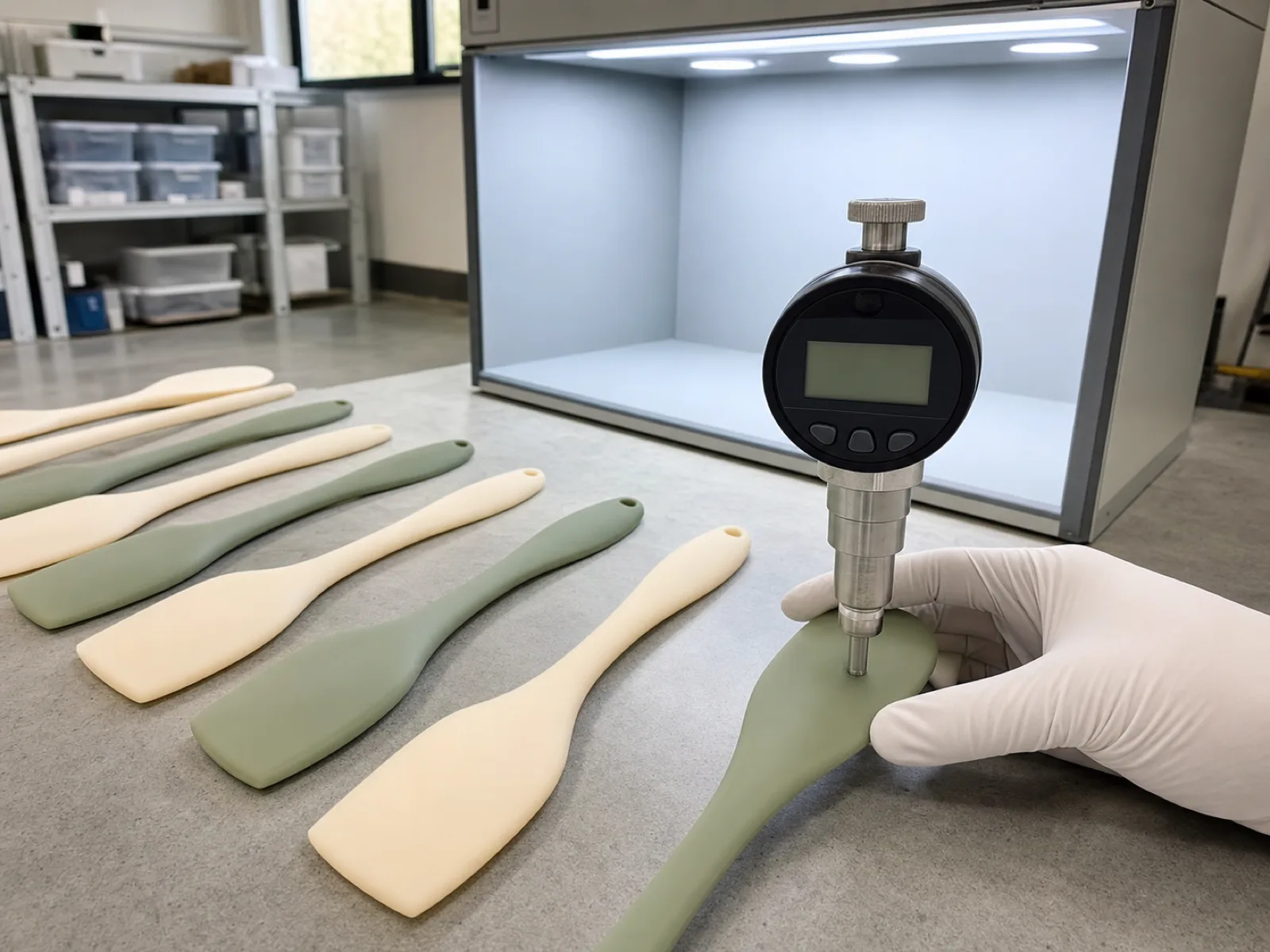 Buyer Guide
 The best silicone spatula is a one-piece, food-grade tool with a seamless head molded over a stainless-steel or fiberglass core, a task-matched Shore A hardness, and a continuous heat rating of −40 °C to 230 °C (446 °F). What separates it from a cheap one is not the color or the brand name but three verifiable engineering choices: seamless construction, platinum-cured silicone, and a hardness that fits the job. This buyer guide, written from a founder-led silicone factory's engineering desk, walks through every spec that decides whether a spatula lasts five years or twists apart in a dishwasher.
Most silicone-spatula buying advice ranks products by star count and handle color, and that misses where the durability actually lives. The failure modes in this category are not random — a head that separates, a surface that stains, a blade that warps all trace back to specific decisions a factory made during material and construction selection. This guide reverses the review-site approach: instead of naming a winner, it hands you the checklist a manufacturing engineer would use to judge any silicone spatula, from a USD 4 big-box unit to a USD 14 premium seamless one.
What separates the best silicone spatula from a cheap one?
The best silicone spatula wins on three engineering choices a shopper can verify: a one-piece seamless head molded over a metal core, platinum-cured food-grade silicone rather than peroxide-cured, and a Shore A hardness matched to the task. A cheap spatula skips all three — a joined head that separates, a compound that smells and yellows, and a soft generic hardness that folds under load.
Everything else — color, handle ergonomics, price, brand story — is secondary to those three. They are also the three things retail packaging is least likely to state plainly, because two of them cost the factory more money. A “food-safe, heat-resistant, dishwasher-safe” label describes the entire category and tells you nothing about which product will survive year three.
These three matter more than the marketing because they map directly to how spatulas fail: head separation traces to two-piece construction, odor and staining to cure chemistry, deflection and warping to hardness and core spec. Get them right and the tool is effectively permanent; get any one wrong and the failure shows up long after the return window closes.
The buyer’s decision framework, in order of leverage:
| Priority | Spec to verify | Best-in-class | Red flag |
|---|---|---|---|
| 1 | Construction | One-piece seamless head over metal core | Visible seam at head-to-handle joint |
| 2 | Cure chemistry | Platinum-cured, odorless out of box | Chemical / benzoic-acid smell |
| 3 | Head hardness | Task-matched Shore A 55–72 | One soft hardness for every tool |
| 4 | Core material | 304 stainless or fiberglass | Nylon-only or magnetic 430 steel |
| 5 | Heat rating | −40 °C to 230 °C continuous | ”600 °F” printed with no continuous rating |
Work down that list on any candidate spatula and the ranking sorts itself, regardless of which brand made it.
What temperature can the best silicone spatula actually handle?
Quality food-grade silicone spatulas hold −40 °C to 230 °C (−40 °F to 446 °F) as a continuous working range. The 500–600 °F figures on packaging are short spike ratings for the head only, not sustained temperatures. Above 250 °C the surface dulls and the head stiffens over time, so 446 °F is the number that governs everyday cooking, sautéing, and candy work.
The heat number is the most-marketed and least-understood spec in the category. A “600 °F” claim is technically defensible — silicone’s Si–O backbone survives a brief 315 °C spike without melting — but operationally misleading, because it invites cooks to leave a spatula resting on a hot pan edge, where cumulative high-heat exposure oxidizes the methyl side groups and slowly turns the head chalky and brittle.
What matters for a buyer is the continuous rating, and where the weak link sits. The head tolerates the most heat; the head-to-handle joint tolerates the least, running cooler than the head on a two-piece design because the bond line degrades before the silicone does. That gap is one more reason one-piece construction wins — a seamless tool has no thermally weak joint to fail first.
| Component | Continuous working | Short spike (< 5 min) | What fails first |
|---|---|---|---|
| Head (platinum-cured, Shore A 65) | −40 °C to 230 °C | 250 °C | Surface dulling, upward hardness drift |
| Two-piece head-to-handle joint | Below the head rating | Below the head spike | Adhesive or snap-fit lets go |
| Dishwasher exposure | ~70 °C, alkaline detergent | n/a | Color migration on under-cured heads |
The continuous rating matters because it maps onto real cooking, not lab conditions. Everyday sautéing and stir-frying sit well inside the range; a pan of caramel or hard-crack candy runs around 150 °C to 160 °C, still comfortably below the 230 °C ceiling; a deglaze or a reduction never approaches it. The only realistic way a home cook pushes a spatula past its continuous rating is by leaving it resting in a dry, empty pan over a lit burner, or propped against the lip of a screaming-hot skillet — which is exactly the habit the inflated 600 °F number encourages. A spatula that lives its whole service life below 230 °C, as almost all of them do, never dulls or stiffens from heat. The number to design around is therefore not the peak the material can survive once, but the temperature it can hold thousands of times without changing.
For deeper background on how the cure system governs a spatula’s thermal behavior, the platinum-cured vs peroxide-cured silicone breakdown covers the degradation chemistry in detail. The practical takeaway: buy for 446 °F continuous, ignore the 600 °F headline, and treat any spatula that prints only the spike number as a marketing-first product.
Why one-piece construction is the single most important feature
A one-piece silicone spatula molds the head continuously over the core with zero joint, so nothing can separate, trap food, or harbor bacteria. A two-piece spatula bonds a molded head onto a handle, and that interface is where the bulk of return complaints originate — the head twists off in the dishwasher. Construction, not color or brand, is the strongest predictor of longevity.
The joint is the highest-leverage decision on the entire product, and it is visible to the naked eye. Run a fingernail along the transition from head to handle: a one-piece tool is a single continuous surface, while a two-piece tool has a seam, a color break, or a slight step where the silicone head meets a separate plastic or wood handle.
Why the joint fails is straightforward materials physics. Silicone and the ABS or nylon in a separate handle expand at markedly different rates, so every heat-and-cool cycle in a dishwasher works the bond a little looser. Eventually the head twists off. Worse, before it separates, the micro-gap at the seam becomes a wet-dry pocket that traps food residue, which is exactly the harborage the FDA’s hygienic-design principles for food-contact tools warn against.
| Construction | Joint strength | Failure mode | Real-world durability |
|---|---|---|---|
| Two-piece — head glued to plastic handle | Low | Adhesive delamination | Head separates in months |
| Two-piece — head snap-fit onto handle | Moderate | Snap-fit fatigue crack | Loosens over one to two years |
| One-piece — silicone over 304 core, 1.2 mm | Very high | Core yields before silicone tears | Effectively permanent |
There is a hygiene failure that shows up long before the head ever separates, and it is the more important one for a food tool. The seam on a two-piece spatula is never perfectly sealed. Every wash cycle drives a little water into the micro-gap between the silicone head and the handle by capillary action; the tool comes out of the dishwasher looking dry, but moisture, starch, and fat residue sit trapped inside the joint where no brush reaches. That warm, damp, food-rich pocket is a textbook harborage for bacteria and, over months, for mildew and a sour smell that will not wash out — the failure the FDA’s hygienic-design principles for food-contact equipment are written to prevent. A one-piece head, molded as a single continuous surface, has no gap to ingress, nothing to trap, and nothing to harbor: it dries completely because there is no interior to stay wet. This is why seamless construction is a food-safety decision as much as a durability one, and why it belongs at the top of the checklist rather than treated as a finish detail.
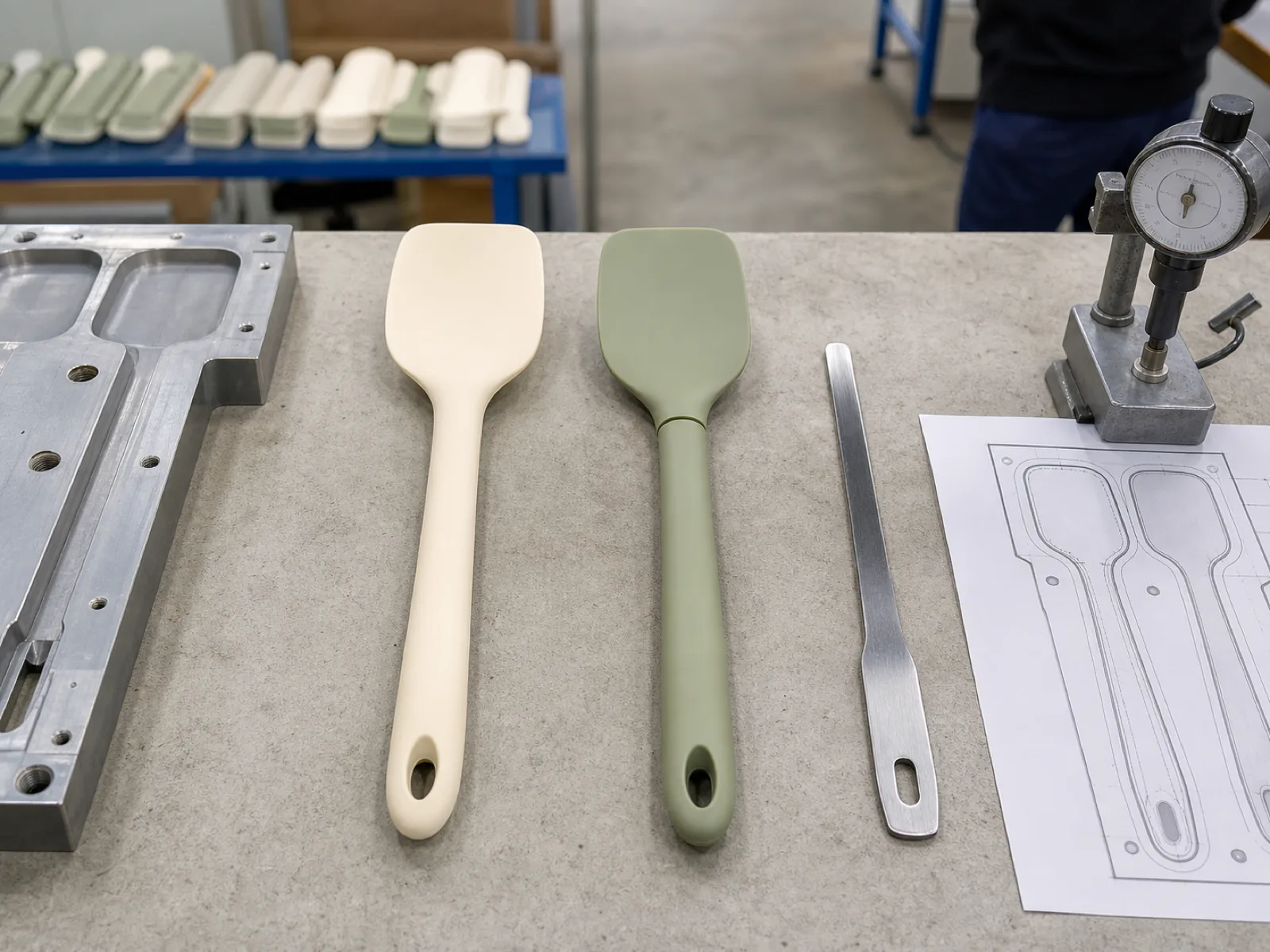
The cost difference to the factory is a few cents per unit. The difference to the owner is a spatula that lasts five years versus one that fails inside the first, and a food tool that stays sanitary versus one that quietly turns into a bacteria reservoir. The manufacturing side of this decision — mold design, core placement, cure cycle — is covered in the silicone spatula OEM manufacturing guide for buyers sourcing at volume.
What Shore A hardness makes the best silicone spatula for each task?
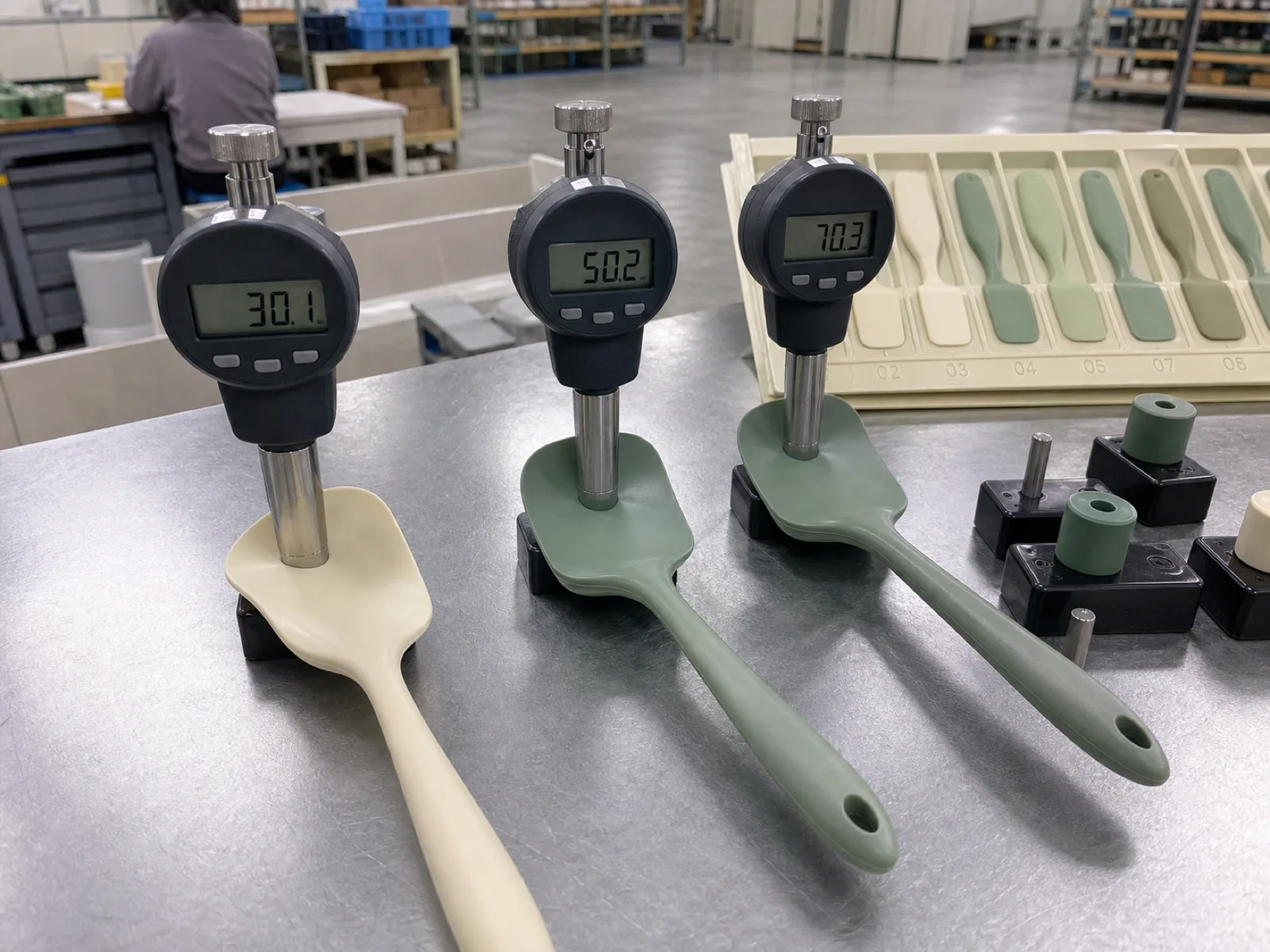
There is no single best hardness — the best silicone spatula matches Shore A durometer to the job. A pancake turner needs Shore A 68–72 to lift a load without folding; a general spoonula lands at 62–68; a soft jar scraper runs 55–62 so it conforms to a curved wall. A set that molds every head to one generic hardness compromises half its tools.
Shore A is the standardized durometer scale for flexible rubber, measured per ASTM D2240, and it is the number that decides whether a spatula feels flimsy, firm, or stiff. Too soft and a turner folds under a fried egg; too stiff and a scraper cannot follow the contour of a mixing bowl. The best product lines vary hardness deliberately by head type rather than treating durometer as an afterthought.
| Spatula type | Ideal Shore A | Why | Feel in hand |
|---|---|---|---|
| Flat / slotted turner | 68 – 72 | Lifts and flips a load without deflection | Firm, spatula holds its shape under weight |
| General spoonula | 62 – 68 | Balances scooping stiffness with folding flex | Medium, versatile |
| Spreader / offset | 60 – 66 | Enough give to spread evenly, enough body to control | Medium-soft |
| Jar / bowl scraper | 55 – 62 | Conforms to curved walls to sweep clean | Soft, flexible edge |
The reason hardness has to be chosen deliberately is that it is set at the compound stage, not adjusted later. Shore A is read with a spring-loaded durometer per ASTM D2240: the instrument presses a standardized indenter into the cured silicone and reports how far it sinks, from 0 (gel-soft) to 100 (bottle-cap hard). A silicone kitchen tool lives in the 50-to-75 band, and a factory hits a target number by dialing the base polymer, filler load, and cure — it cannot make one cured head softer at the tip and firmer at the shoulder. That is the trap in a bargain “spatula set” molded from a single mid-hardness compound: it is acceptable at nothing. The turner is too soft to lift cleanly, the scraper too stiff to conform, and only the middle spoonula lands anywhere near right. A considered line runs different compounds for different heads, and the extra cost is a second or third material batch, not a different technology.
A useful in-store test: press the head against a flat surface and flex it. A turner should resist and spring back with authority; a scraper should bend easily and hug the surface. If a “spatula set” flexes identically across every piece, the maker used one compound for all of them — a cost decision, not a performance one. The full durometer reference lives in the Shore A hardness chart for silicone, which maps each hardness band to its kitchen-tool application.
Is the silicone actually food-grade — and how do you verify it?
Genuine food-grade silicone clears FDA 21 CFR 177.2600 extractables and, for European sale, LFGB clearance under BfR Recommendation XV. The best spatulas use platinum-cured silicone, which stays odor-neutral; peroxide-cured heads can retain residual byproducts that off-gas an odor and are more prone to yellowing unless fully post-cured. "BPA-free" on a silicone label is true by definition and tells you nothing.
Food-grade is the one claim every silicone spatula makes and few substantiate. The FDA framework for food-contact materials sets the extractables limit the head must meet; peer-reviewed migration studies confirm platinum-cured silicone clears it with wide margin. But the label rarely states the cure system, which is the variable that actually governs safety-adjacent performance like odor and taste transfer.
The two cure chemistries behave very differently in a kitchen. Peroxide curing leaves volatile byproducts — benzoic acid, acetophenone — that a proper 200 °C post-cure is supposed to drive off. Factories that skip the post-cure to protect throughput ship heads that off-gas an odor and can transfer a faint taste to delicate food over the first weeks of use. Platinum curing produces no such byproducts; the reaction is stoichiometrically clean, which is why it is the standard for infant and medical silicone.
| Attribute | Peroxide-cured | Platinum-cured |
|---|---|---|
| Odor out of box | Faint benzoic-acid / rubber smell | Odorless |
| Blind scent-panel result | Frequently flagged | Reliably neutral |
| Yellowing risk over time | Elevated | Minimal |
| LFGB / BfR XV path | Often fails without heavy post-cure | Standard |
| Typical shelf tier | Sub-USD-4 | USD 4 and up |
For a program buyer, the retail sniff test is not enough — food-grade is a documentation question, and the paper either exists or it does not. A credible supplier can produce, on request, a raw-material certificate of analysis that names the base compound and the cure package; a finished-good migration or extractables test report demonstrating the head meets FDA 21 CFR 177.2600 (and, for European retail, LFGB clearance built on BfR Recommendation XV); and a pigment declaration screened against the REACH SVHC candidate list for anything sold into the EU. A vendor who answers “it’s food-grade silicone, trust us” but cannot hand over the CoA and a current test report is asking you to underwrite a claim you cannot defend to your own retail customer. The single most useful question on a first sourcing call is simply which cure system the compound uses and whether the head receives a secondary high-temperature post-cure — the answer predicts odor, taste transfer, and yellowing more reliably than any spec on the datasheet.
How to verify as a shopper: smell the head through the packaging vents — a chemical note is a peroxide tell. For a program purchase, request the raw-material certificate of analysis naming the base compound and cure package, and screen pigments against the REACH SVHC list for EU-bound goods. The full chemistry teardown is in the platinum-cured vs peroxide-cured silicone comparison.
Does the internal core material matter?
Yes — the hidden core is what keeps a silicone spatula from warping under heat and load. The best cores are 304 stainless steel at 1.2 mm or better, or a fiberglass rod for lighter tools; both resist bending fatigue. Nylon-only cores soften near their heat limit and warp, and magnetic 430-grade steel work-hardens and cracks under repeated flexing far sooner than 304. Full encapsulation with no exposed metal is essential.
The core is invisible in the store, but it is the difference between a turner that stays flat after a year of flipping and one that develops a permanent bend. A silicone head alone has no structural rigidity — it relies entirely on the core to carry load and hold shape. Three materials appear in the market, and they are not equivalent.
Stainless steel is the durability benchmark. 304-grade — austenitic, nickel-bearing, non-magnetic — stays ductile through the flex range and resists bending fatigue at 1.2 mm thickness. The cheaper 430-grade is ferritic and magnetic; it work-hardens and cracks at the head-to-handle transition well before a stainless-quality tool would. A refrigerator magnet is a free field test: if it grabs the core, the steel is the lower grade.
Fiberglass rods appear in lighter, thinner spatulas and spreaders. They will not corrode, add almost no weight, and resist heat well, but they carry less bending load than steel, so they suit scrapers and spreaders more than heavy turners.
Nylon-only cores are the budget choice. Nylon is fine at room temperature but softens as it approaches its heat limit, so a nylon-cored turner can take a set — a permanent warp — if leaned against a hot pan. It is acceptable for a soft scraper that never bears load, and a poor choice for anything that lifts.
| Core material | Flex durability | Heat behavior | Best fit |
|---|---|---|---|
| 304 stainless, ≥ 1.2 mm | Very high | Stable to head rating | Turners, heavy-duty tools |
| Fiberglass rod | High, lighter load | Stable, no corrosion | Spreaders, light spatulas |
| 430 stainless | Low – moderate | Stable but brittle | Avoid — cracks under flex |
| Nylon only | Low under load | Softens near limit, warps | Soft scrapers only |
Grade is only half the core story; placement and encapsulation are the other half. A core has to sit centered in the head so silicone of even thickness surrounds it — an off-center core leaves a thin silicone wall on one face that tears or telegraphs the metal edge under load, and it is a common defect on cheaply tooled heads. The core also has to stop short of the working tip, so the flexible last few millimeters of the blade are pure silicone that can conform and will never scratch a coating. Any point where the metal breaks the surface — an exposed tip, a bare punch-out at the hang hole, a pinhole over a filler void — is both a hygiene breach, because it lets water reach the steel and rust it from inside, and a coating hazard. When you inspect a sample, hold it to the light and flex it: a well-encapsulated core shows a uniform, opaque head with no bright line or hard ridge where the metal sits, and no glint at the edges.
Whatever the core, it must be fully encapsulated — no metal exposed at the head tip or the handle punch-out, both for hygiene and to keep a steel edge from scratching nonstick coatings.
Spatula, spoonula, scraper, or turner — matching type to task
The four core silicone tool types each solve a different job: a spatula is the flexible flat blade for folding and spreading, a spoonula adds a shallow bowl to scoop and stir, a jar scraper is a stiff single-flat-edge tool for straight-wall vessels, and a turner is a stiff wide blade for lifting and flipping. The best kitchen set carries all four, not one head shape in several sizes.
“Silicone spatula” is a catch-all that hides four distinct tools, and buying the wrong type for a task is the quiet reason a well-made spatula still disappoints. Matching type to use is as important as material.
- Spatula (flat blade): thin, flexible, tapered edge. Folds egg whites, spreads batter, scrapes a flat pan. The most versatile single tool.
- Spoonula (spoon-spatula hybrid): a spatula edge with a shallow bowl. Scoops and stirs while still scraping a bowl clean — the best all-rounder if you buy only one.
- Jar scraper: a stiffer, narrower head with a straight edge, sized to reach into jars and straight-wall containers. Sweeps the last of the peanut butter or mayonnaise.
- Turner: a wide, stiff, flat blade for lifting and flipping — pancakes, eggs, fish fillets. Needs the highest hardness and the strongest core of the four.
A coherent starter set is three to five pieces spanning these types rather than a 2-inch, 4-inch, and 6-inch version of the same flat blade. Buyers assembling a full utensil assortment can layer these types into a broader line using the silicone kitchen utensils OEM guide as the sourcing reference.
How the respected brands compare — and what the comparison actually tells you
Brands like OXO, GIR, DI ORO, and U-Taste converge on the same core specs: one-piece seamless heads, a stainless or fiberglass core, food-safe platinum-grade silicone, and a task-matched hardness. What differs is ergonomics, color range, warranty, and price — not a proprietary material. The takeaway for a buyer is that specs, not logos, decide quality, and any of those specs is verifiable on an unbranded product too.
The premium silicone-spatula brands are worth studying not because one is secretly best, but because they have already converged on the specifications this guide describes. When independent test kitchens and product reviewers rank spatulas, the winners share a profile: seamless construction, a rigid core, a clean-curing silicone, and a hardness suited to the tool’s job. That convergence is the useful signal — it confirms the checklist.
| Spec dimension | What the respected brands share | What varies between them |
|---|---|---|
| Construction | One-piece seamless heads | Handle shape and material |
| Core | Stainless steel or fiberglass | Thickness and weight balance |
| Silicone | Food-safe, low-odor platinum-grade | Color palette and finish |
| Hardness | Task-matched by head type | Exact durometer targets |
| Price / warranty | — | USD 8–15 range, warranty length |
The practical consequence: a buyer does not have to pay a premium logo to get premium specs. An unbranded or private-label spatula that verifiably has a one-piece head, a stainless core, and a clean-curing silicone performs like the name brands, because it is built to the same physics. The brand premium buys ergonomics, color, and a warranty — real value for some buyers, but not a different material science. For retail buyers sourcing to this same spec bar, the private-label economics are laid out in the silicone spatula OEM manufacturing guide.
How to test a silicone spatula before you commit
Four quick tests separate a durable silicone spatula from a future failure: run a fingernail along the head-to-handle transition (a seam signals two-piece separation risk), hold a magnet to the core (a stick signals brittle 430-grade steel), smell the head (a chemical note signals under-cured peroxide silicone), and flex the head (identical give across a set signals one generic compound).
You do not need a lab to judge a spatula — you need four deliberate checks that each target one failure mode. Run them in the store or on the sample before a bulk order.
- The seam test. Slide a fingernail from the tip of the head to the handle. A one-piece tool is one continuous surface. Any seam, step, or color break at the transition means separate parts bonded together — the separation risk.
- The magnet test. Touch a magnet to the core through the handle end or the exposed punch-out. Non-magnetic means 304-grade stainless (good); a magnetic pull means 430-grade (cracks under flex) or a low-grade steel.
- The smell test. Open the packaging and smell the head. Odorless is platinum-cured and fully post-cured. A benzoic-acid, rubber, or chemical note is under-cured peroxide silicone that will off-gas and can transfer taste.
- The flex test. Bend each head in a set. A well-designed line varies stiffness by tool — a firm turner, a soft scraper. If every piece flexes identically, the maker used one compound for all of them.
For a program-level purchase, add two bench tests before committing to a container: a repeated-dishwasher run followed by a Shore A reading (a meaningful hardness drift from the first-article value is a fail), and a scent panel after a warm oven soak (any off-note is a fail). These are the same acceptance tests a disciplined factory runs at lot release.
Signs of a cheap silicone spatula that will melt, warp, or separate
A cheap silicone spatula shows its future failure at purchase: a visible seam at the head-to-handle joint (will separate), a hard glossy sheen instead of a matte-satin finish (thermoplastic, not real silicone), a magnetic core (430-grade steel that cracks under flex), a chemical smell (under-cured peroxide compound that off-gasses), and only a "600 °F" spike number printed with no continuous heat rating.
Every failure mode has a tell you can spot before you buy. The cheap-spatula signature is a cluster of these, and any two together is enough to walk away.
- Visible joint seam. The single strongest warning — two-piece construction that will separate in the dishwasher.
- Hard, plasticky sheen. Real food-grade silicone reads matte-satin with a subtle translucency. A hard glossy, hard-reflective surface is often a cheaper thermoplastic elastomer molded to look like silicone; it will scuff and can deform under heat.
- Magnetic core. A magnet that grabs the core means low-grade 430 steel — the fatigue-crack material.
- Chemical smell. Under-cured peroxide silicone off-gasses and can taint food.
- Only a spike heat rating. Packaging that shouts “600 °F” but never states a continuous working temperature is hiding the number that matters.
- One hardness across a set. A cost shortcut that compromises half the tools.
None of these require expertise — they require thirty seconds of attention. A spatula that passes all six is very likely a well-built tool regardless of brand or price, and one that fails two or more will disappoint no matter how good the reviews looked.
What are the MOQ, tooling, and lead times for a custom silicone spatula?
A private-label silicone spatula runs an MOQ of 500 pieces per SKU, molded on a machined aluminum tool that takes roughly 7–25 days to first sample depending on cavity count and geometry. Decoration — debossing, pad-printing, or laser-marking — adds no separate tooling. Each color or head shape counts as its own SKU against the minimum.
The economics of a custom spatula are set by the mold. A new head shape needs its own machined aluminum tool, and that tooling cost is amortized across the run, which is why an MOQ of 500 pieces per SKU is the practical floor. First samples off a new tool typically land in 7–25 days once the drawing, core spec, and Shore A target are locked — simpler single-cavity geometries at the low end, complex or multi-cavity heads at the high end. A restyle of a proven head — a new color or handle on an existing mold — skips most of that tooling clock. Treat every distinct color and head shape as its own SKU: a three-color, two-shape program is six SKUs, each carrying the 500-piece minimum and its own color-match approval.
Private-label decoration is where a spatula stops being a commodity and starts carrying a brand, and three methods dominate. Debossing molds the logo or size mark straight into the silicone — it is cut into the tool, so it costs nothing per unit and never wears off, but it is a monochrome recessed impression, not a printed graphic. Pad-printing lays a colored logo onto the handle; it delivers brand color and is the standard for handle branding, but printed ink on flexible silicone is the least durable option and can abrade over years of washing. Laser-marking etches a permanent, high-contrast monochrome mark, ideal for a brand name or compliance code. Most programs pair a debossed head mark for permanence with a pad-printed handle logo for color.
Ready to source silicone spatulas to this spec?
Wetop is a founder-led, ISO 9001 silicone factory in Dongguan that molds one-piece, platinum-cured silicone spatulas to the exact specs in this guide — seamless heads over 304 stainless or fiberglass cores, task-matched Shore A hardness, and FDA 21 CFR 177.2600 and LFGB-cleared compounds, at 500-piece to 500,000-piece annual scale for housewares brands, retail chains, and private-label programs.
If you have a spec sheet, a target retail price, or a competitor sample you want teardown-benchmarked against this checklist, talk to the engineering desk. We return a first-pass spec review, a hardness-and-core recommendation, and an MOQ, lead-time, and FOB unit-price band within two business days.
FAQ
-
Are silicone spatulas safe for nonstick cookware?
Yes — food-grade silicone is softer than the ceramic or PTFE coating on nonstick pans, so it will not scratch or gouge the surface the way metal or hard nylon can. Confirm the head is solid silicone to the tip with no exposed metal core, which is the only edge that could mar a coating.
-
Do the best silicone spatulas stain or hold odors?
Properly made ones resist both. Staining and odor absorption come from an incomplete cure that leaves polymer chains free to bind pigments and kitchen aromatics. A platinum-cured head that received a full 200 °C post-cure stays odor-neutral and shrugs off tomato and turmeric; an under-cured peroxide head yellows and smells within weeks.
-
What Shore A hardness is best for a nonstick-safe spatula?
For nonstick pans, a soft-to-medium head in the Shore A 55–65 range is ideal — it flexes to hug the pan surface without the pressure a stiff turner would apply. More important than the exact durometer is that the head is solid silicone right to the tip, with no exposed metal core that could scratch a ceramic or PTFE coating.
-
Can I order one-piece and two-piece spatulas in the same purchase order?
Yes, but they are different molds and cure setups, so each build counts as its own SKU against the 500-piece minimum. Most private-label programs standardize on one-piece heads for the seamless, no-seam hygiene story and reserve two-piece construction only when a customer specifically wants a wood or metal handle for shelf appeal.
-
What is the minimum order for a custom-color silicone spatula?
The MOQ is 500 pieces per SKU, and a custom color counts as its own SKU because it needs a dedicated pigment masterbatch and a color-match approval against your target. A three-color program is three SKUs of 500; a single stock color skips the color-matching step and moves faster.
-
How long does tooling and a first sample take for a custom silicone spatula?
A new head shape needs a machined aluminum mold, and first samples typically land 7–25 days after the drawing and Shore A target are locked, depending on cavity count and geometry. Restyling an existing head — a new color or handle on a proven mold — skips most of that and samples much faster.
References
Authoritative sources cited in this guide
- US Food and Drug Administration. 21 CFR 177.2600 — Rubber articles intended for repeated use. https://www.ecfr.gov/current/title-21/chapter-I/subchapter-B/part-177/subpart-C/section-177.2600 — The controlling US extractables limit for food-contact silicone kitchen tools — total extractives in n-hexane ≤ 20 mg/in² over 7 hours at 66 °C.
- US Food and Drug Administration. Food Contact Substances (FCS) — regulatory overview. https://www.fda.gov/food/food-ingredients-packaging — FDA's framework for materials that contact food, the basis for any legitimate food-grade silicone claim on a spatula.
- ASTM International. ASTM D2240 — Standard Test Method for Rubber Property, Durometer Hardness. https://www.astm.org/products-services/standards-and-publications/standards.html — The test method behind every Shore A hardness value cited for silicone spatula heads.
- International Organization for Standardization. ISO 9001:2015 — Quality Management Systems — Requirements. https://www.iso.org/standard/62085.html — The quality-management standard a credible spatula factory is certified against — the audit framework retail buyers rely on.
- German Federal Institute for Risk Assessment (BfR). BfR Recommendation XV — Silicones. https://www.bfr.bund.de/en/bfr_recommendations_on_food_contact_materials-7498.html — The technical basis for LFGB clearance on silicone kitchenware — sets peroxide residual and volatile-matter limits that govern odor and taste transfer.
- European Chemicals Agency (ECHA). REACH Regulation (EC) No 1907/2006 — SVHC Candidate List. https://eur-lex.europa.eu/legal-content/EN/TXT/?uri=CELEX%3A32006R1907 — Screening list for pigments and additives in a silicone spatula sold into the EU — relevant to color and stain-resistance claims.
- US National Library of Medicine (PubMed). Silicone in medical and food-contact applications — safety review. https://pubmed.ncbi.nlm.nih.gov/23256725/ — Peer-reviewed migration and biocompatibility data underpinning the food-safety case for platinum-cured silicone.
- ASTM International. ASTM D2240-15(2021) — Standard Test Method for Rubber Property, Durometer Hardness. https://www.astm.org/d2240-15r21.html — The specific Shore A durometer standard behind the hardness bands in this guide's spatula-selection table.
Start a custom program
Send a brief. Get an engineer’s reply in one business day.
Every Wetop program is tooled from a customer’s specification. Send a CAD file (STEP · IGES · DWG) or a written brief and we’ll reply with a mold cost estimate, price brackets at MOQ 500 / 1,000 / 5,000, and any engineering questions.