Certification · informational intent
Is Silicone Safe for Dogs? Materials Guide
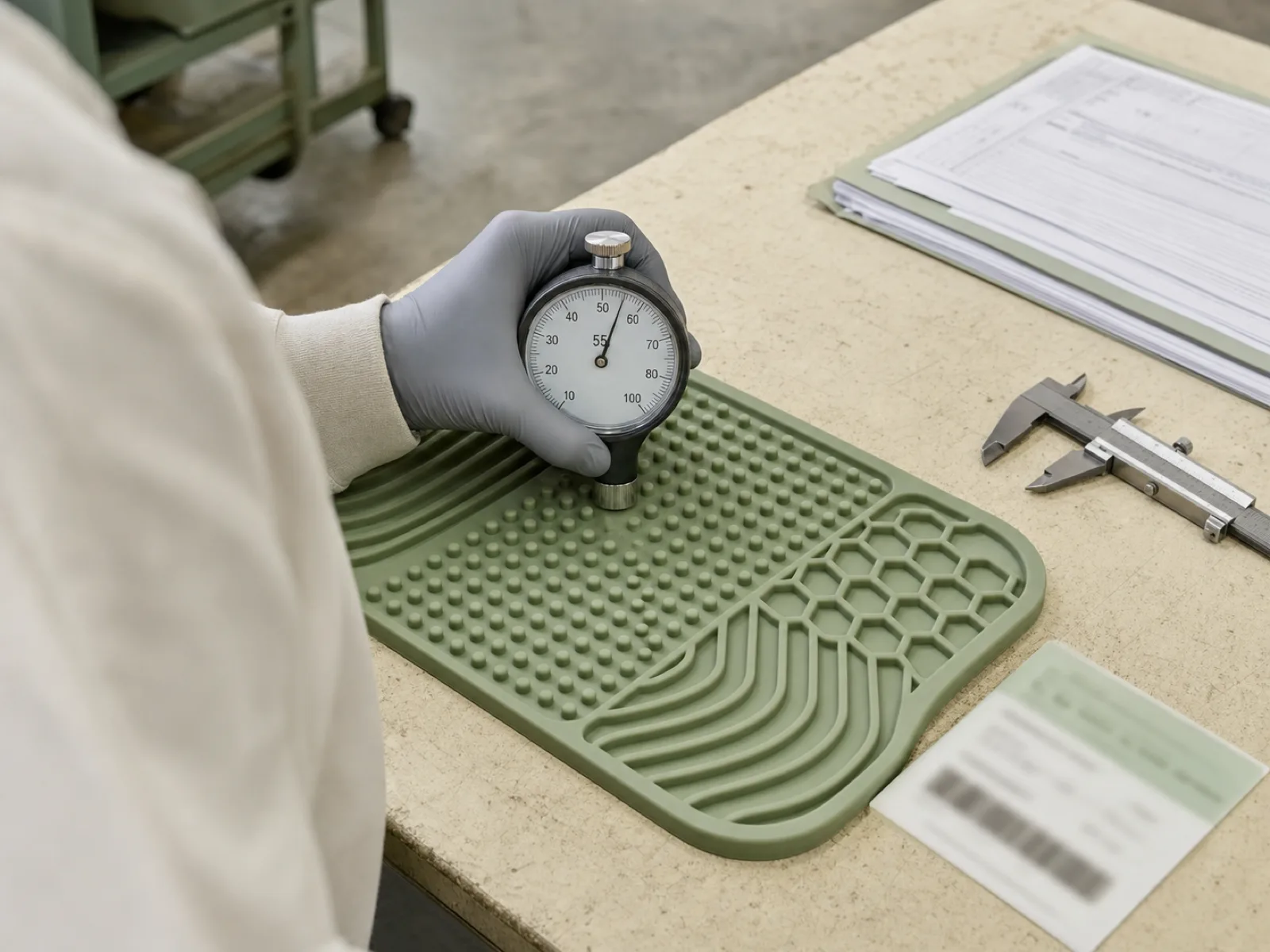 Certification
 Food-grade platinum-cured silicone is safe for dogs to lick, drink from, and chew moderately when the material clears FDA 21 CFR 177.2600 or LFGB §30/§31 migration testing. The polymer is chemically inert against saliva, gastric acid, and freezer-to-dishwasher thermal cycling from -40 °C to 230 °C. It is not, however, a chew-toy substitute — aggressive chewers will tear Shore A 50-70 lick mats and slow feeders, and swallowed fragments larger than the dog's throat diameter are a foreign-body risk requiring veterinary evaluation.
Pet brands and dog owners searching “is silicone safe for dogs” usually want a yes-or-no answer. The answer is yes, with three engineering asterisks: cure system, filler load, and post-cure discipline. This guide walks through the material chemistry, the two regulatory frameworks (FDA and LFGB) that qualify silicone for oral contact, the practical safety envelope for lick mats and slow feeders, and the manufacturer-side checks a pet brand sourcing OEM should demand before signing a PO. Every claim in this guide traces to a Tier-1 primary source cited at the end — because every claim in a pet-safety guide should.
What food-grade silicone actually is (siloxane chemistry)
Food-grade silicone is polydimethylsiloxane (PDMS) — a synthetic polymer built from alternating silicon and oxygen atoms with methyl side groups. The Si-O backbone is one of the most thermodynamically stable bonds in industrial polymer chemistry, which is why food-grade silicone does not degrade in dog saliva, gastric fluid, or the freezer-to-dishwasher thermal cycles a lick mat sees weekly.
Silicone is often confused with rubber or plastic. It is neither. Natural rubber is a carbon-carbon backbone polymer that oxidizes and cracks over time. Thermoplastics like polypropylene and polyethylene have carbon backbones that soften and eventually leach plasticizers when heated. Silicone’s silicon-oxygen backbone has a bond dissociation energy of roughly 445 kJ/mol — significantly higher than a carbon-carbon bond at 347 kJ/mol. That energy difference is why the US EPA classifies PDMS as a chemically inert substance for regulatory purposes[^fda-inert-ingredient-silicone], and why silicone is the material of choice for infant-nipple manufacturing where the safety bar is highest.
The consequence for dogs is direct: when a dog licks a silicone mat or drinks from a silicone bowl, the polymer does not chemically interact with the dog’s saliva enzymes or stomach acid. Migration testing under FDA 21 CFR 177.2600 quantifies exactly how much (or how little) siloxane oligomer transfers into simulated foods over 24-hour exposure. Well-post-cured platinum silicone shows migration below the analytical detection limit for most consumer applications[^pubmed-silicone-migration].
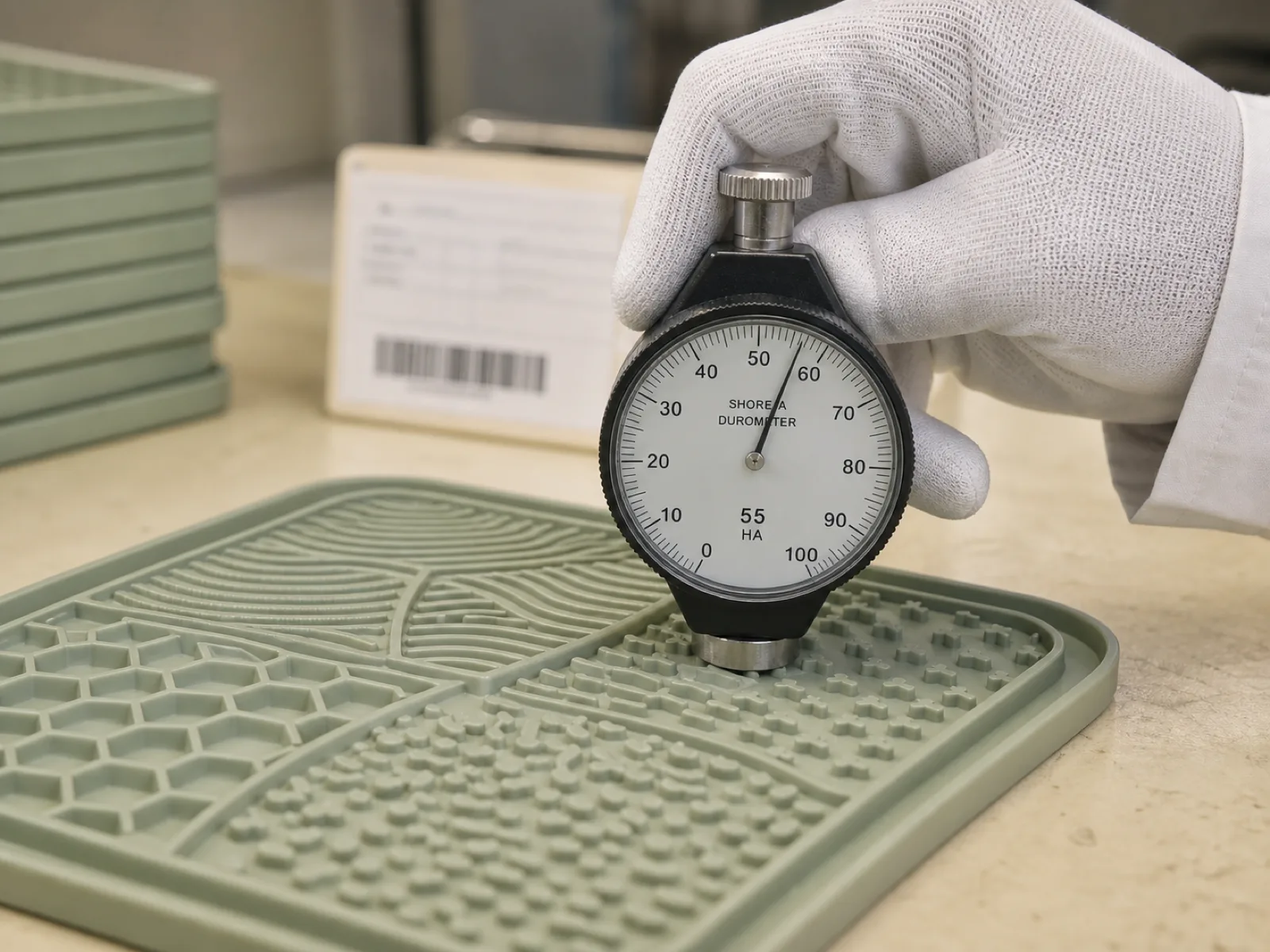
Does FDA 21 CFR 177.2600 apply to pet products?
FDA 21 CFR 177.2600 technically regulates rubber articles for human food contact, but it is the de-facto safety standard the pet industry applies to silicone bowls, lick mats, and slow feeders. A responsible OEM factory tests pet-contact SKUs to the same migration limits as human food-contact articles — extractive limits on n-hexane and distilled water at 25 °C and 121 °C. LFGB §30/§31 is the German-equivalent and often stricter analog.
The regulatory reality: the FDA does not maintain a separate framework for pet-food-contact materials. The industry convention is to apply human-grade standards because dogs and cats have similar or more acidic gastric environments than humans, and the same siloxane oligomers that would migrate into human food would migrate into pet food. Two regulatory tests matter:
- FDA 21 CFR 177.2600 §e — extractive limits in distilled water: the finished silicone article, after any required post-cure, must show total extractives ≤ 20 mg/in² for the first 7-hour extraction and ≤ 1 mg/in² for subsequent 2-hour extractions at reflux temperature[^fda-177-2600].
- LFGB §30/§31 — German food-contact framework: §30 addresses the raw material (the silicone compound), §31 addresses the finished article. Migration is measured against food simulants at temperatures up to 100 °C for 24 hours, referencing BfR Recommendation XV for silicones[^bfr-xv].
For pet-brand sourcing, the demand is straightforward: the batch shipped to your warehouse should carry a test report referencing one or both of these clauses, with the report date within 12 months of production and the sample linked to a resin lot number. A generic “FDA-compliant” declaration letter with no report attached is not evidence — it is marketing.
Related reading: our FDA vs LFGB silicone comparison breaks down which clauses matter most for pet-contact SKUs vs kitchen bakeware.
Platinum-cured vs peroxide-cured silicone for pet products
Platinum-cured silicone is the only defensible standard for pet-contact SKUs. Peroxide-cured silicone can retain 2,4-dichlorobenzoic acid residues if the factory skimps on the 4-hour, 200 °C post-cure step — those residues have a faint chemical odor and can migrate into food. Platinum cure eliminates the residue by chemistry: the catalyst is inert platinum, and the byproduct is silica, not an aromatic acid.
The cure chemistry difference has direct pet-safety consequences:
| Cure system | Catalyst | Post-cure byproduct | Odor when new | Pet-safety verdict |
|---|---|---|---|---|
| Platinum-cure (addition cure) | Platinum complex (5-15 ppm) | None — reaction is 100 % addition | Neutral | Preferred for all pet-contact SKUs |
| Peroxide-cure (radical cure) | 2,4-dichlorobenzoyl peroxide or similar | 2,4-dichlorobenzoic acid | Faint chemical smell if under-post-cured | Acceptable only with rigorous 4-6 hour post-cure at 200 °C and per-batch VOC testing |
A poorly-run peroxide-cure line skipping the full post-cure ships silicone that has a faint chemical odor when unpackaged and can transfer trace acid residue to a lick mat’s food side. Platinum-cure removes the failure mode by chemistry rather than by process discipline — which is why every Wetop pet-contact SKU is quoted platinum-cure only. For the underlying chemistry, see our platinum-cured vs peroxide-cured silicone deep dive.
The platinum catalyst itself is worth a note. Platinum in the 5-15 ppm range is used industry-wide (Dow, Wacker, Shin-Etsu, Momentive base compounds). The metal is bound in a coordination complex, not free ionic platinum, and does not migrate under EN 71-3 heavy-metal migration testing[^en-71-3]. This is the same catalyst chemistry used in USP Class VI biocompatibility-qualified silicones[^usp-class-vi] for medical implants — the safety bar for that use case is orders of magnitude stricter than pet products.
What if my dog swallows a piece of silicone?
A coin-sized piece of food-grade silicone typically passes through a medium-to-large dog's GI tract in 24-72 hours without absorption because silicone is chemically inert. Monitor for stool passage. Call the veterinarian if the piece is larger than the dog's throat diameter, if vomiting persists beyond a few hours, if the dog refuses food for more than 12 hours, or if the abdomen becomes distended — these are the imaging-triggering signs of obstruction.
The mechanism why silicone passes safely: the polymer is not enzymatically digestible. Canine gastric acid at pH 1-2 does not break the silicon-oxygen backbone, and the pancreatic and intestinal enzymes have no receptor sites for PDMS. The piece travels through the digestive tract mechanically, the same way a swallowed cherry pit does, and exits in stool.
The obstruction risk is mechanical, not chemical. A piece larger than the pyloric sphincter opening (roughly 1 cm for a 10 kg dog, 2 cm for a 40 kg dog) may get stuck at the stomach exit or elsewhere in the small intestine. Warning signs requiring same-day veterinary attention:
- Repeated vomiting within 4 hours of swallowing
- Refusal to eat for more than 12 hours
- Distended, painful abdomen
- Lethargy paired with any of the above
- Constipation lasting more than 24 hours
For chronic destroyers, the design remedy is not softer silicone but bonded suction mounting or larger-format lick mats that resist tear-out. See our silicone slow feeder OEM guide for the design-for-durability constraints pet brands should specify at RFQ.
Chew-resistance reality: silicone is not a chew toy
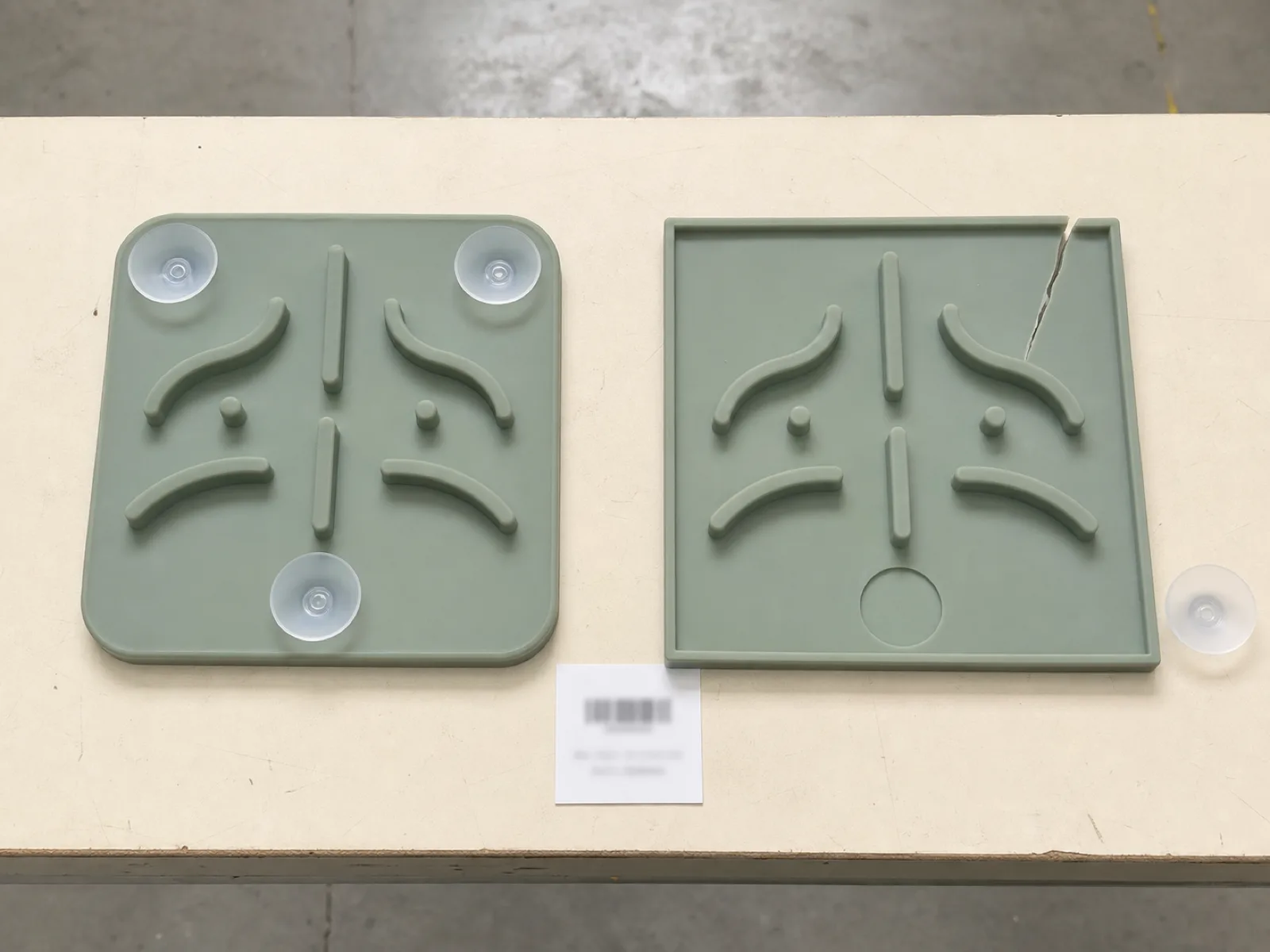
Silicone is not engineered as a chew toy for aggressive chewers. Shore A 50-70 lick mats and slow feeders are designed for tongue and moderate jaw work, not the sustained shearing force of a Kong-tier chewer. If the target user is a heavy chewer, the SKU brief should call out either a bonded-nylon core, a stainless-reinforced ring, or a design that does not present a tear-initiation edge.
The tear failure mode is mechanical: silicone in the Shore A 50-70 range has a tear strength of typically 20-40 kN/m per ASTM D624. That is more than enough for lick-plate use with a dog’s tongue, but a sustained bite that catches a corner or an unbonded edge concentrates force at the tear-initiation point, and the material propagates a tear cleanly along the shear line.
Design implications for pet brands:
- Round every corner ≥ 3 mm radius. Sharp corners are tear-initiation points.
- Bond suction cups to the base — do not glue-on after cure. In-mold bonded suction resists tear-out; post-cure glued suction pulls off and creates a tear edge.
- Specify overmolded edges when the SKU faces heavy chewers. A hard-durometer rim (Shore A 80+) around a soft feed surface (Shore A 50) reduces catch points.
- Ban thin unsupported flanges. Anything below 3 mm thickness with an edge exposed becomes a chew-initiation zone.
The honest engineering answer to “will my dog destroy this silicone lick mat” is: depends on the dog. A calm labrador who uses the mat as intended will get years of use. A destroyer will find the weakest tear-initiation point in 15 minutes. Silicone is a food-contact and enrichment surface, not a Kong replacement.
Silicone vs plastic vs stainless for dog bowls and mats
Platinum-cured silicone beats plastic on leaching (no BPA or phthalates), thermal tolerance (dishwasher-safe at 230 °C), and biofilm resistance (non-porous surface). Stainless steel remains the gold standard for high-volume feeding stations. Silicone wins the travel bowl, lick mat, and slow feeder categories where flexibility, freezer tolerance, and dishwasher compatibility all matter simultaneously.
The material trade-off matrix for the four common pet-contact material classes:
| Property | Platinum silicone | Polypropylene plastic | Stainless steel 304 | TPR / thermoplastic elastomer |
|---|---|---|---|---|
| BPA / phthalate leaching | None | Variable; failure risk under heat | None | Variable by grade |
| Thermal envelope | -40 °C to +230 °C | -20 °C to +90 °C | -100 °C to +400 °C | -40 °C to +80 °C |
| Dishwasher-safe | Yes, top and bottom rack | Top rack only, warps at 90 °C+ | Yes, all racks | Top rack only |
| Freezer-safe | Yes, no cracking | Brittle below -20 °C | Yes | Brittle below -30 °C |
| Surface porosity | Non-porous | Non-porous when new; scratches trap bacteria | Non-porous, hard | Semi-porous, biofilm risk |
| Chin acne / biofilm risk | Low | Elevated on scratched bowls | Lowest | Highest |
| Weight for travel | Light | Light | Heavy | Light |
| Chew resistance | Moderate (design-dependent) | Moderate | Very high | Low |
| Typical cost index | 3-5× plastic | 1× baseline | 5-8× plastic | 1.2-2× plastic |
The one place silicone loses to plastic is unit cost. Silicone raw material runs $6-14/kg at compound level vs $1-2/kg for polypropylene. For a pet brand chasing a $2 shelf-price bowl, plastic is the only option. For a $12-25 shelf-price lick mat, slow feeder, or premium travel bowl, silicone’s safety envelope justifies the delta by a wide margin.
How to spot low-quality silicone with fillers
Low-cost factories cut silicone with cheap fillers — calcium carbonate, talc, or even ground plastic — to hit lower BOM prices. The three-part sniff test catches most of it: the pinch-and-twist white test (real silicone stays uniform color when stretched, filler silicone shows a white stress line), the sharp-chemical smell test on a new unpackaged product, and the water-boil test (10 minutes in boiling water should produce zero milky discoloration in the water).
The three field tests a pet brand’s QC team can run without lab equipment:
- Pinch-and-twist white test. Take a corner of the silicone article, pinch it firmly, and twist 180°. Platinum-cured food-grade silicone stays its base color under stress. Filler-loaded silicone reveals a white stress line at the twist point — the fillers are what turn white, and they are the same fillers that will migrate under repeated flexing.
- Smell test. Unpackage a new article and sniff at 20 cm. Neutral or very faintly milky odor is acceptable. A sharp chemical, sulfurous, or rubbery smell indicates either peroxide-cure without full post-cure or filler contamination — both are pass-on-purchase signals.
- Boiling water test. Submerge the article in a pot of boiling water for 10 minutes. Real food-grade silicone leaves the water clear. Filler-loaded silicone tints the water milky-cloudy as calcium carbonate migrates out under thermal stress.
The lab-grade test the OEM factory should run per batch is EN 71-3 heavy-metal migration on the eight target elements (lead, cadmium, chromium III, chromium VI, arsenic, mercury, barium, selenium)[^en-71-3]. Filler-cut silicone frequently fails cadmium and lead migration because the cheap filler sources are contaminated. A batch-linked EN 71-3 report from an accredited lab (SGS, TÜV, Intertek, Bureau Veritas) is a fraud-catcher — the factory that cuts corners cannot produce it.
Temperature range: why -40 °C to 230 °C matters for pet products
Platinum-cured silicone's -40 °C to 230 °C envelope is exactly what a modern pet-product SKU needs: freezer lick mats stuffed with peanut butter and yogurt at -18 °C, dishwasher cycles at 75-85 °C, and boiling-water sanitization at 100 °C. Plastic bowls warp starting at 90 °C; TPR gets brittle below -30 °C. Silicone is the only elastomer that clears the entire pet-use temperature window without degradation or leaching.
The temperature envelope maps to specific pet-use cases:
- Freezer at -18 °C to -25 °C — frozen lick mats, ice-cube bowl liners, cold-therapy toys. Silicone stays flexible; plastic and TPR crack.
- Refrigerator at 0 °C to 5 °C — chilled bowl inserts, raw-food serving. All materials work.
- Ambient use at 15 °C to 30 °C — normal feeding. All materials work.
- Dishwasher wash cycle at 70 °C to 85 °C — standard cleaning. Plastic warps and scratches; silicone is unaffected.
- Dishwasher sanitize cycle at 85 °C to 90 °C — deep sanitization. Silicone is at 40 % of its thermal envelope.
- Boiling water sanitization at 100 °C — deep clean between multi-pet households. Silicone unaffected.
- Beyond pet use at 200 °C to 230 °C — silicone would still be stable, though there is no legitimate pet-use case at these temperatures.
For deeper reading on the thermal chemistry behind these limits, see our silicone temperature range explained guide.
What pet brands should demand from a silicone OEM
A pet brand sourcing OEM silicone should demand seven things: batch-level FDA 21 CFR 177.2600 or LFGB test reports (not declaration letters), EN 71-3 heavy-metal migration data, VOC test data, ISO 9001 QMS documentation, traceable resin-lot numbers from a Tier-1 base supplier, platinum-cure confirmation, and a documented 4-6 hour post-cure at 200 °C. Anything less is unverifiable.
The seven-item OEM sourcing checklist for pet-contact silicone:
- Batch-level FDA 21 CFR 177.2600 or LFGB §30/§31 test report from an accredited lab (SGS, TÜV, Intertek, Bureau Veritas), dated within 12 months of production, linked to a specific resin lot number.
- EN 71-3 heavy-metal migration data covering all 19 target elements per the 2019 revision — not just the legacy eight.
- VOC (volatile organic compound) test data measuring residual siloxane oligomers and cure-catalyst residues. Peroxide-cure factories skipping the full post-cure fail here first.
- ISO 9001:2015 quality-management-system certificate with a valid expiry date and named certification body. This is table-stakes for any serious OEM.
- Traceable resin-lot numbers from a Tier-1 base-compound supplier — Dow, Wacker Chemie, Shin-Etsu, or Momentive. The Tier-1 raw material producers are audited to global chemical-safety standards; unknown Chinese-domestic base compounds carry unverifiable filler and cure-catalyst risk.
- Explicit platinum-cure confirmation in writing on the technical data sheet. Peroxide-cure factories occasionally quote platinum-cure prices; the TDS catches the mismatch.
- Documented 4-6 hour post-cure at 200 °C in the production traveler. This step drives residual siloxane oligomers below detection limits, which is what makes migration testing pass consistently.
The reason for the strictness is straightforward: every failure mode in pet-silicone safety (chemical migration, heavy-metal contamination, filler leaching, catalyst residue) is traceable to one of the seven items above. A factory that cannot produce all seven has one or more failure modes latent in its shipments. Wetop’s engineering desk quotes the full compliance packet standard on every pet-contact SKU — see our capabilities page for the process-control detail behind each item.
Frequently asked questions
For structured buyer-facing questions and answers, see the FAQ block above; the same content is emitted as FAQPage JSON-LD schema for AI-answer-engine extraction. If a question is not answered here, contact the engineering desk — the response goes back within one business day and includes the underlying test-report reference where relevant.
References
The claims in this guide are anchored to primary regulatory and scientific sources. Full citations are rendered as footnotes and in the site’s structured References block:
- FDA 21 CFR 177.2600 — federal migration limits for rubber articles for repeated food contact[^fda-177-2600]
- BfR Recommendation XV — German scientific dossier behind LFGB silicone compliance[^bfr-xv]
- USP <88> Class VI — biocompatibility standard used as a proxy for premium pet-safety claims[^usp-class-vi]
- EN 71-3:2019 — European heavy-metal migration limits for toys, applied to chewable pet silicone[^en-71-3]
- EU 10/2011 — consolidated European food-contact-materials framework[^eu-10-2011]
- ISO 10993-5:2009 — cytotoxicity test protocol for medical-grade silicone[^iso-10993-5]
- PubMed migration study — peer-reviewed measurement of siloxane oligomer migration from infant silicone[^pubmed-silicone-migration]
- ASTM D2240 — Shore A durometer test method for specifying pet-product silicone hardness[^astm-d2240]
- US EPA Inert Ingredient Database — regulatory classification of PDMS as chemically inert[^fda-inert-ingredient-silicone]
Next step
If you are sourcing silicone lick mats, slow feeders, collapsible bowls, or drying mats for a pet brand and want the full compliance packet (FDA 21 CFR 177.2600 + LFGB §30/§31 + EN 71-3 + VOC + platinum-cure TDS + batch traceability) documented per shipment, talk to the engineering desk. MOQ is 500 pieces per SKU per color, sample lead time is 7-15 days on existing tooling, and every quote includes the resin-lot-linked test-report reference before the PO is signed.
FAQ
-
Is silicone safe for dogs to chew and lick?
Yes, for licking and moderate chewing on food-grade platinum-cured silicone that clears FDA 21 CFR 177.2600. Lick mats, slow feeders, and collapsible bowls at Shore A 50-70 are dishwasher-safe and inert against saliva. However, silicone is not engineered as a chew toy — aggressive chewers (Kong-tier jaw force) will tear it, and swallowed pieces become a foreign-body risk.
-
What happens if my dog swallows a piece of silicone?
For small pieces smaller than the dog's throat diameter, food-grade silicone typically passes through the GI tract in 24-72 hours without absorption because silicone is chemically inert. Monitor stool. Call the vet immediately if the piece is larger than a quarter, if the dog vomits repeatedly, refuses food for more than 12 hours, or shows a distended abdomen — these signal possible obstruction requiring imaging.
-
Is silicone or plastic better for a dog bowl?
Platinum-cured silicone beats plastic on three fronts: no BPA or phthalate leaching at temperature, dishwasher-safe up to 230 °C without warping, and non-porous surface that resists the biofilm buildup implicated in canine chin acne. Stainless steel remains the gold standard for high-volume feeding stations; silicone wins on travel bowls, lick mats, and slow feeders where flexibility matters.
-
How can I tell if a dog product uses food-grade silicone?
Look for three signals: an FDA 21 CFR 177.2600 or LFGB §30/§31 declaration on the packaging with a test-report reference number, the pinch-and-twist white test (real platinum-cured silicone stays uniform color when stretched; filler-cut silicone shows a white stress line), and a neutral odor when dry. Sharp chemical smell or milky-white stretch marks indicate peroxide-cure or filler-loaded material.
-
Are silicone lick mats and slow feeders safe for daily use?
Yes, when the SKU carries a batch-linked FDA or LFGB report and is dishwasher-cleaned between uses. Silicone's non-porous surface prevents the bacterial biofilm that grows inside porous rubber slow feeders. Replace the mat when suction cups fail or when the surface shows tears deeper than 2 mm — the tear edges become tooth-catch points that accelerate destruction.
-
What Shore A hardness is safe for pet-contact silicone products?
Shore A 40-60 for lick mats and collapsible bowls (soft enough to press by tongue, firm enough to resist tearing), Shore A 60-70 for slow feeders and food-grade toys (durable against moderate chewing), Shore A 70+ for structural elements like bowl bases. Below Shore A 30 the material becomes gel-like and prone to tearing; above Shore A 80 it loses the flexibility that makes silicone valuable for pet use.
-
Does silicone leach chemicals when frozen or microwaved?
No, platinum-cured silicone that clears FDA 21 CFR 177.2600 is stable from -40 °C to 230 °C with no measurable plasticizer migration — this is the temperature window verified by USP Class VI testing on medical-grade silicone. The failure mode belongs to peroxide-cured silicone under-post-cured at the factory: residual 2,4-dichlorobenzoic acid can migrate. Platinum-cure eliminates the residue by chemistry.
-
What certifications should pet brands demand from a silicone OEM factory?
Batch-level FDA 21 CFR 177.2600 test reports (not just a declaration), LFGB §30 for material and §31 for finished-article migration, EN 71-3 heavy-metal migration test data covering the eight target elements, VOC test data, ISO 9001:2015 QMS documentation, and traceable resin-lot numbers from a Tier-1 base compound supplier like Dow, Wacker, Shin-Etsu, or Momentive. Anything less means unverifiable safety.
References
Authoritative sources cited in this guide
- US Food and Drug Administration. 21 CFR 177.2600 — Rubber articles intended for repeated use. https://www.ecfr.gov/current/title-21/chapter-I/subchapter-B/part-177/subpart-C/section-177.2600 — The federal regulation defining migration limits for silicone rubber intended for repeated food contact — the same standard applied to pet-food-contact SKUs.
- German Federal Institute for Risk Assessment (BfR). BfR Recommendation XV — Silicones. https://www.bfr.bund.de/en/bfr_recommendations_on_food_contact_materials-58935.html — The underlying scientific dossier behind LFGB §30/§31 compliance for silicone food-contact articles, including migration limits for volatile organic compounds.
- United States Pharmacopeia. USP <88> Biological Reactivity Tests, In Vivo — Class VI. https://www.usp.org/harmonization-standards/pdg/excipients — Biocompatibility standard used to qualify implant-grade and infant-contact silicones; a strong proxy for pet-safety claims because the acceptance criteria exceed food-contact requirements.
- European Committee for Standardization (CEN). EN 71-3:2019+A1:2021 — Safety of toys — Part 3: Migration of certain elements. https://www.cencenelec.eu/ — Migration limits for 19 elements including lead, cadmium, chromium, and arsenic — the standard pet brands should demand batch-level compliance against for chewable silicone.
- European Union. Commission Regulation (EU) No 10/2011 on plastic materials and articles intended to come into contact with food. https://eur-lex.europa.eu/legal-content/EN/TXT/?uri=CELEX%3A02011R0010-20230831 — The consolidated EU framework governing overall migration and specific migration limits — silicone articles marketed in Europe cross-reference this regulation alongside LFGB.
- International Organization for Standardization. ISO 10993-5:2009 — Biological evaluation of medical devices — Part 5: Tests for in vitro cytotoxicity. https://www.iso.org/standard/36406.html — The cytotoxicity test methodology used to qualify medical-grade silicone; the same protocol is optional but recommended for premium pet-contact SKUs where the brand claims biocompatibility.
- Food Additives & Contaminants (via PubMed). Migration of volatile compounds from silicone rubber baby teats. https://pubmed.ncbi.nlm.nih.gov/9829040/ — Peer-reviewed measurement of siloxane oligomer migration from silicone infant products — the primary data set behind the safety of platinum-cured, well-post-cured silicone for oral contact applications.
- ASTM International. ASTM D2240 — Standard Test Method for Rubber Property—Durometer Hardness. https://www.astm.org/d2240-15r21.html — The Shore A durometer test method referenced throughout this guide when specifying pet-product silicone hardness (40-60 for lick mats, 60-70 for slow feeders).
- US Environmental Protection Agency. Inert Ingredient Database — Silicone/Polydimethylsiloxane. https://www.epa.gov/pesticide-registration/inert-ingredients-overview-and-guidance — Regulatory basis for classifying medical- and food-grade silicone (polydimethylsiloxane) as chemically inert — the technical reason a swallowed silicone fragment passes through the GI tract without absorption.
Start a custom program
Send a brief. Get an engineer’s reply in one business day.
Every Wetop program is tooled from a customer’s specification. Send a CAD file (STEP · IGES · DWG) or a written brief and we’ll reply with a mold cost estimate, price brackets at MOQ 500 / 1,000 / 5,000, and any engineering questions.