Certification · informational intent
Is Silicone Safe for Pets? A Materials Guide
 Certification
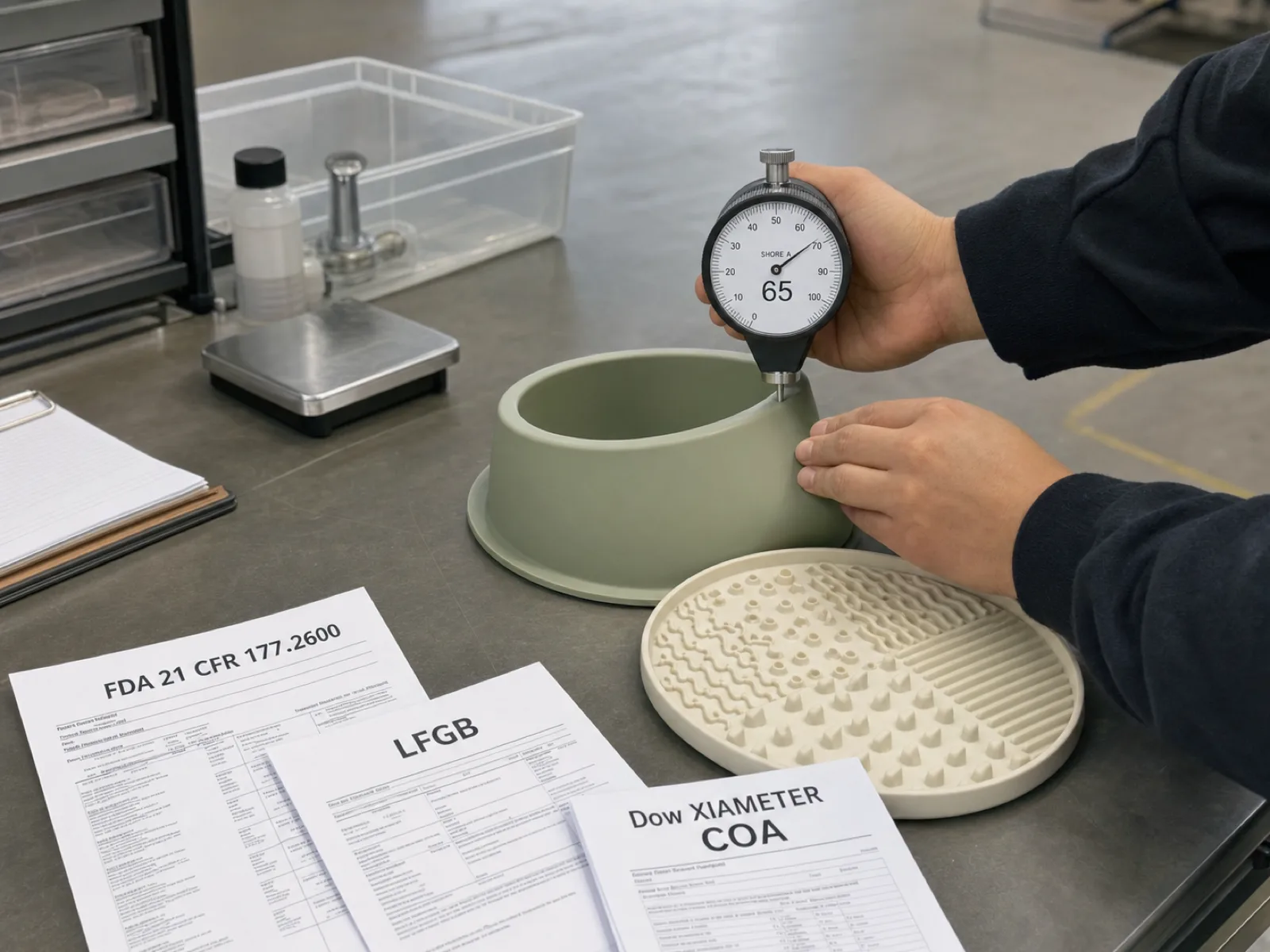
 Is silicone safe for pets? The engineering answer is that platinum-cured food-grade silicone, verified by per-batch FDA 21 CFR 177.2600 and LFGB §30/31 extraction reports, is safe for pet feeding accessories — bowls, lick mats, slow feeders, and cat feeding stations. The pet-specific safety variable human food-contact guides ignore is chew behavior: silicone is chemically inert and indigestible, but a fragment large enough to obstruct the GI tract is a mechanical hazard for the pet, not a chemical one. The dividing line between a safe pet SKU and an unsafe one is upstream — the cure system, the post-cure oven log, and the compound-house filler and colorant discipline, not the marketing label on the retail box.
Key takeaways
- Platinum-cured food-grade silicone with per-batch FDA and LFGB reporting is the safe substrate for pet feeding accessories — the same evidence packet as human food contact, applied to pet SKUs.
- The pet-specific risk factor is chew behavior. Silicone is indigestible; a fragment large enough to obstruct the small intestine of a small-breed dog or cat is a surgical emergency, not a toxicity event.
- Cat chin acne is driven by porous plastic bowls leaching phthalates and harboring bacteria — platinum-cure food-grade silicone is non-porous and phthalate-free by chemistry, which is why veterinary dermatology guidance names it a safe substrate.
- Field screens (pinch-twist, smell, burn) catch obvious filler-cut fakes; they are not a substitute for a batch-level FDA + LFGB extraction report from an accredited lab.
- For pet-brand OEM buyers, the safety evidence packet is identical to a premium kitchen program: named raw-material COAs, post-cure oven logs, per-batch third-party test reports, and a PFAS non-detect certificate.
What silicone actually is, and why the grade matters for pets
Silicone is polydimethylsiloxane (PDMS), an inorganic-organic polymer with an Si–O backbone rather than the carbon backbone of plastic. Food-grade PDMS is compounded to comply with FDA 21 CFR 177.2600 and LFGB §30/31; industrial-grade PDMS is not, and can carry non-food fillers or colorants unsafe for pet contact.
The confusion behind almost every “is silicone safe for pets” search is that “silicone” names a family, not a material. The same polymer backbone underlies aquarium sealant, kitchen bakeware, medical tubing, and construction weatherproofing — but the compounded formulations, the cure systems, and the finished-part testing regimes are radically different across those categories. A silicone spatula tested to FDA 21 CFR 177.2600 is a food-safe article; a tube of hardware-store silicone sealant sitting on the same shelf is not, even though both are “silicone.”1
For pet products — bowls, lick mats, slow feeders, cat feeding stations, and chew-adjacent accessories — the relevant grade is the same food-grade classification that applies to human food contact. The regulatory bodies do not publish a pet-specific standard because the exposure pathway is identical: repeated oral and food-contact use, dishwasher and microwave temperatures, and the possibility of chewed fragments being ingested. Our engineering guide to whether silicone is safe for buyers generally walks through the human food-contact case; this guide extends the same framework to the pet-specific edge cases that guide does not cover.
Is silicone safe for dogs — bowls, lick mats, and slow feeders
Platinum-cured food-grade silicone is safe for dogs at feeding behavior — licking, mouthing, and light chewing during eating. It is not rated as a chew toy. The chemical polymer is inert; the mechanical risk is a determined chewer biting off a fragment large enough to obstruct the GI tract of a small-breed dog.
For lick mats and slow feeders, which are the two categories driving the volume of pet-silicone sales, the safety analysis has two axes. Chemical safety is answered by the same evidence packet as human food contact: FDA 21 CFR 177.2600 extraction reporting on n-hexane and water simulants, LFGB §30/31 migration reporting on the three BfR simulants, per-batch traceability to the master-batch lot on the PO.2 Mechanical safety is answered by behavior — the product is designed for lick-feeding, not for the sustained bite pressure of a determined chewer working through a rubber toy.
The failure mode we see on retail returns for pet-silicone lick mats is nearly always mechanical, not chemical. A pet-brand customer service log will show a small percentage of returns citing “my dog chewed off a piece” — the dog was using a lick mat as a chew toy, outside its design intent. The correct product-page copy names the intended behavior explicitly (lick-feeding, slow-feeding, freezable puree) and recommends supervision on first several uses. Slow-feeder pet bowls with silicone puzzle inserts follow the same logic: safe substrate, feeding-behavior use case, supervise if the animal is a chewer.
Is silicone safe for cats — chin acne, feeding mats, and cat-specific edge cases
Yes — veterinary dermatology guidance names silicone and stainless steel as the two substrates safe for cats prone to chin acne. Plastic bowls are the identified trigger because polypropylene surfaces are porous and can leach phthalates and additives; platinum-cure food-grade silicone is non-porous and phthalate-free by chemistry.
Feline chin acne — technically feline acne, a comedonal dermatitis under the chin — is one of the most-searched cat-specific silicone questions. The veterinary consensus points to porous bowl surfaces as a driver: microscopic pits in polypropylene bowls harbor Malassezia and staphylococcal biofilms, and phthalate plasticizers used in flexible plastic bowl materials leach onto the chin during feeding. Stainless steel and ceramic are the classical safe alternatives; platinum-cure food-grade silicone joins that list on the same chemistry logic — the polymer surface is non-porous at the finished-part level, and PDMS chemistry contains no phthalates or BPA.
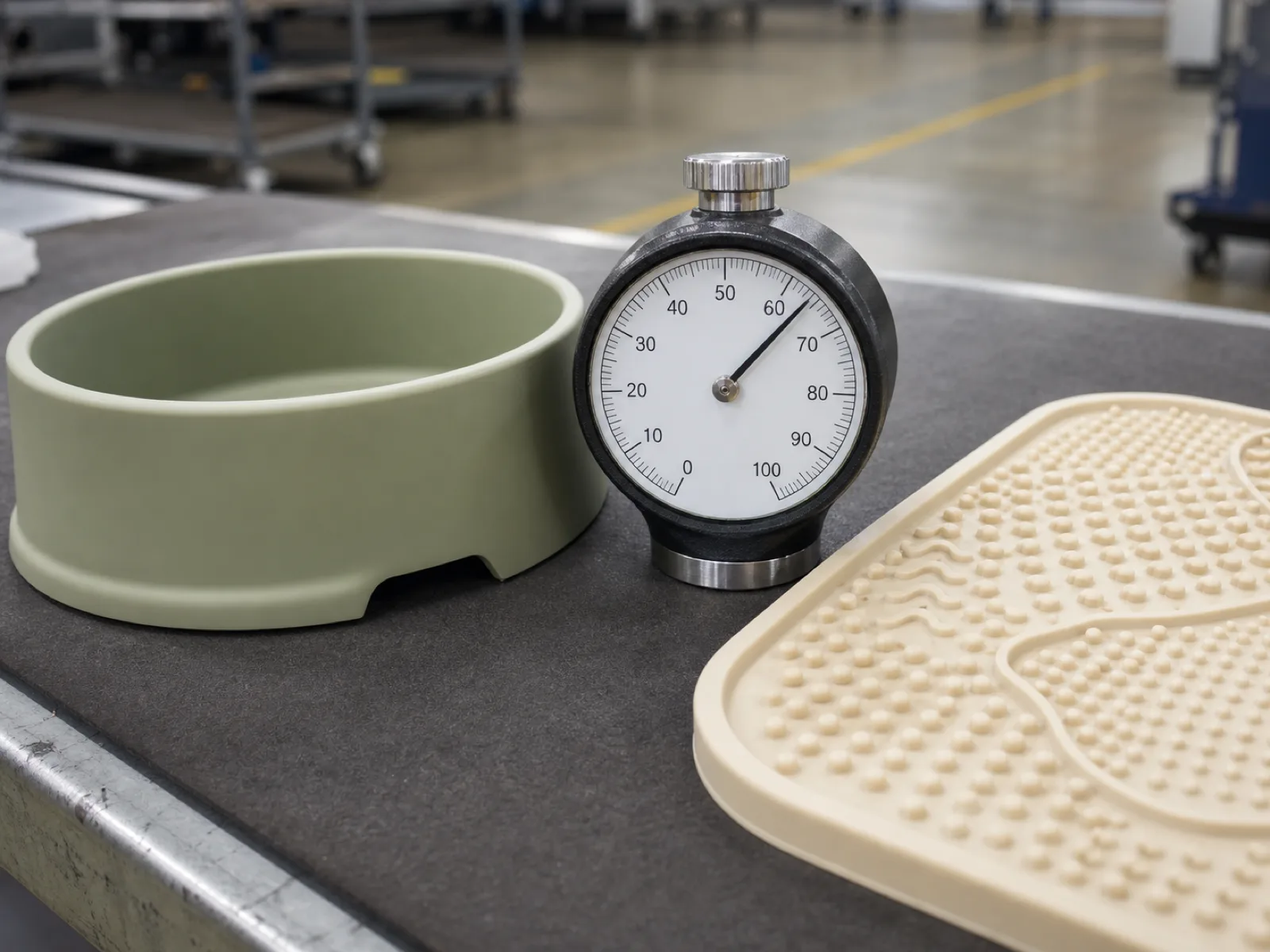
The cleaning discipline still matters. A silicone cat feeding mat left unwashed for a week accumulates food debris the same as any substrate; the surface’s non-porosity means bacterial colonization stays on the surface rather than embedding in pits, which is why silicone and stainless steel both respond well to a daily wipe and weekly dishwasher cycle. Dishwasher top-rack at 65°C is well inside food-grade silicone’s -40°C to 230°C operating window; the 90°C sanitize cycle used occasionally is also fine, but running silicone through sanitize every single load accelerates elastomer aging visible after 12-18 months. See our silicone temperature range guide for the full window and the aging failure modes.
What happens if a pet swallows silicone
Silicone is indigestible to mammalian GI enzymes and does not release toxins in the gut. Small fragments typically pass in 24-72 hours. A fragment large enough to obstruct the pylorus or small intestine — roughly larger than a 2 cm cube for a medium dog, proportionally smaller for cats and toy breeds — is a mechanical surgical emergency.
The chemistry logic behind the clinical guidance: PDMS is an inert synthetic polymer, and mammalian digestive enzymes cannot cleave the Si–O backbone. A swallowed silicone fragment therefore behaves like any other indigestible foreign body — it moves through the GI tract passively, driven by peristalsis, and either passes in stool or lodges at an anatomical narrowing (pylorus, ileocecal valve).3 The clinical presentation is classical foreign-body obstruction: vomiting, refusal to eat, lethargy, absent stool, palpable abdominal discomfort. Imaging (X-ray with barium if the piece is radiolucent, ultrasound) locates the fragment; the intervention is endoscopic retrieval or surgical enterotomy depending on location.
The pet-brand product-safety takeaway is not that silicone becomes unsafe if swallowed — it doesn’t chemically — but that pet-product spec sheets should name the design behavior explicitly and note that any silicone accessory can become a foreign-body hazard if used outside intent. The size threshold is behavior-specific, and the veterinary emergency line is the correct escalation path within the first 72 hours of a suspected large-fragment ingestion.
Food-grade vs medical-grade vs industrial silicone for pet products
Food-grade silicone is verified against FDA 21 CFR 177.2600 and LFGB §30/31. Medical-grade adds USP Class VI biocompatibility (systemic injection, intracutaneous, implantation testing). Industrial-grade is untested against biological or food simulants and is the wrong substrate for any pet product entering the mouth.
For pet feeding accessories, food-grade is the correct floor. Medical-grade adds biocompatibility testing designed for surgical implant and device applications and is over-specified for a lick mat — the additional cost buys certification that does not correspond to any real-world pet exposure pathway. Where medical-grade does become the right spec is for a small subset of pet products contacting broken skin or open wounds: post-surgical cone-and-collar interior linings, veterinary tubing, and dental chew accessories that penetrate gum tissue. For those, USP Class VI is the applicable standard, layered on top of FDA and LFGB.
Industrial-grade silicone is the substrate to avoid. Compression-molded gaskets, extruded seals, and construction-grade silicone tubing produced without food-grade compounding discipline can carry CaCO3 or talc fillers cut into the base gum, non-food colorants, and mold-release residues that fail extraction testing on any of the biological or food simulants. The cost delta between industrial and food-grade at the raw-material level is 15-25%; the finished-part testing delta is the difference between a report that says “compliant” and one that says “exceeded specific migration limit for element X.”
Silicone vs plastic vs stainless vs ceramic for pet bowls
For pet bowls the four substrates trade off across five properties: chemical safety, chew resistance, cleaning discipline, temperature range, and lifespan. Platinum-cure food-grade silicone matches or beats plastic on every axis and matches stainless on chemical safety while adding cushion and grip.
| Property | Platinum-cure food-grade silicone | Polypropylene / PP plastic | Stainless steel 304 | Ceramic (glazed) |
|---|---|---|---|---|
| Chemical safety substrate | FDA 21 CFR 177.2600 + LFGB §30/31 | FDA 21 CFR 177.1520 (no LFGB path for PP) | FDA CFR 175.300 / 21 CFR 177.1210 | FDA CPG 545.400 heavy-metal leach |
| BPA / phthalates | Zero by chemistry | Phthalate plasticizers in flexible grades | Zero | Zero (unless lead-glaze counterfeit) |
| Surface porosity | Non-porous at finished-part level | Porous at microscopic level (biofilm risk) | Non-porous | Non-porous when glaze intact |
| Chew resistance | Feeding-behavior only, not chew toy | Poor — crazes and cracks | Excellent | Excellent until dropped |
| Temperature range | -40 °C to 230 °C continuous | 0 °C to 100 °C practical | -270 °C to 900 °C+ | -20 °C to 250 °C practical |
| Dishwasher | Top rack, 65-90 °C safe | Warps above 70 °C over time | Any cycle | Any cycle, glaze wear over years |
| Cat chin-acne substrate risk | Named safe by vet dermatology | Named trigger by vet dermatology | Named safe | Named safe |
| Typical lifespan | 5-10 years | 12-24 months | 15-20 years | 5-15 years (breakage) |
| Weight / non-slip base | Light + silicone base grips | Light + slides | Heavy, needs rubber ring | Heavy, needs pad |
The retail decision that drives the “is silicone safe for pets” search is almost always a pet-owner replacing a plastic bowl. Silicone and stainless are the two substrates that answer the chemical-safety and chin-acne concerns; the differentiator is silicone’s built-in non-slip and cushion versus stainless’s chew resistance and lifespan. Pet-brand product pages should not overclaim silicone as a chew-toy substrate — that is not what the substrate is engineered for.
How to identify genuinely food-grade silicone at purchase
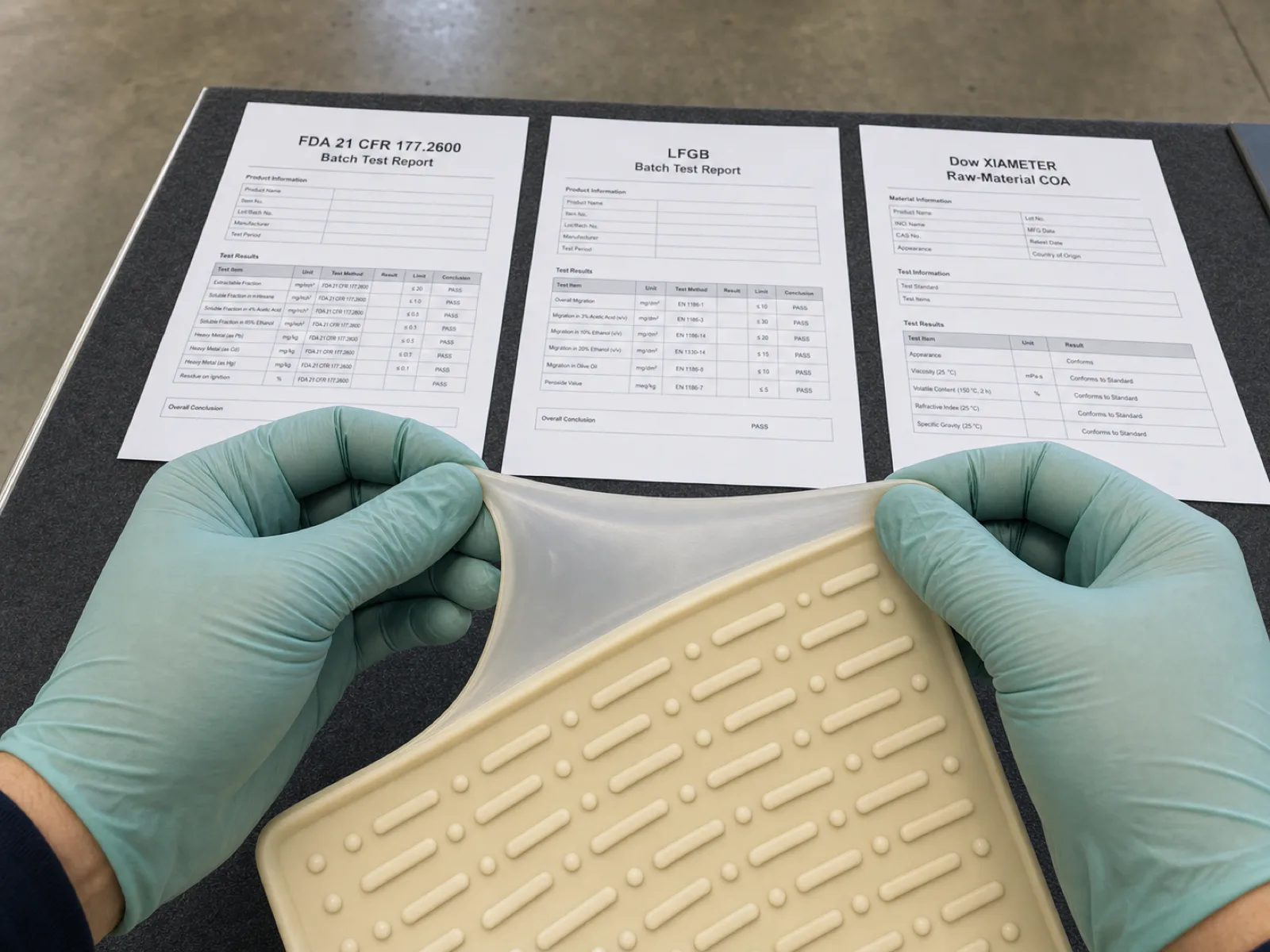
Three field screens plus one paperwork check. Field screens: pinch-twist (genuine silicone stays clear; filler-loaded silicone turns white); smell test (no odor for platinum-cure; ammonia or vinegar for un-post-cured peroxide); burn test (white ash for genuine; black soot for filler-cut). Paperwork: batch-level FDA + LFGB extraction report from an accredited lab.
The pinch-twist test is the most useful and cheapest field screen. Stretch or twist a corner of the finished part between finger and thumb; genuine food-grade silicone maintains a translucent uniform appearance under stress because the polymer network is homogeneous, while filler-cut silicone develops white streaks or a white haze at the stress point because the mineral filler particles separate mechanically from the elastomer matrix. This is not a chemistry test, it is a homogeneity test — and it catches the specific cost-down trick (CaCO3 filler cut into base gum) that produces the highest failure rate on downstream LFGB testing.
The smell test catches under-post-cured peroxide-cure silicone. Freshly demolded peroxide-cure with an inadequate post-cure oven cycle carries residual acetophenone and dicumyl peroxide byproducts that smell mildly of ammonia or vinegar. Properly post-cured platinum-cure silicone has no smell out of the package. If a pet product has a sharp chemical smell when the retail box is opened, it has skipped the post-cure step — see our platinum-cure vs peroxide-cure guide for the chemistry detail.
The burn test is the definitive field screen but destructive. Snip a corner off the part, apply a butane lighter flame in a controlled setting, and observe the residue. Genuine food-grade silicone burns to pure white ash (SiO2). Filler-cut silicone leaves black soot or gray residue where the organic fillers carbonize. None of these three screens replace a batch-level FDA + LFGB extraction test report — they identify obvious fakes at the retail level and give buyers the confidence to demand paperwork.
Silicone sealant safety around aquariums and cages
Fully cured 100% silicone aquarium sealant with no anti-mildew additive is inert and safe for pet enclosures once cure is complete (24-72 hours). Hardware-store bathroom silicone sealant contains fungicidal biocides toxic to fish, reptiles, and small mammals and must never substitute for aquarium-grade product.
The confusion here traces back to the polymer-family issue. “Silicone” in a tube of construction sealant is the same polymer backbone as silicone in a lick mat, but the compounded product is radically different: one-part room-temperature-vulcanizing (RTV) formulations cross-link through moisture-cure chemistry, releasing acetic acid (acetoxy cure) or oxime by-products during cure. Fully cured RTV silicone is inert; the safety window is during the 24-72-hour cure phase, when off-gassing is measurable and biocide additives (if present) can migrate into water.
For aquarium and vivarium applications, the correct spec is “100% silicone aquarium sealant, no anti-mildew additive” — read the tube label explicitly. Bathroom sealants marketed for “mildew resistance” contain fungicidal actives (typically isothiazolinones or synthetic pyrethroids) that are engineered to leach into water; those are toxic to aquatic life at concentrations well below the reptile and mammalian thresholds. Ventilate during cure, wait the full 72 hours before introducing animals or water, and verify the acetic acid smell has fully dissipated before returning the enclosure to service.
Temperature range, dishwasher safety, and long-term durability
Food-grade silicone's safe operating window is -40 °C to 230 °C continuous, 250 °C short excursion. That covers every pet-feeding scenario: freezer for lick-mat puree, refrigerator for wet-food storage, microwave for warming, dishwasher top rack at 65-90 °C. Above 250 °C volatile cyclic siloxanes begin to release, which is why silicone is not a stovetop-element substrate.
Pet-feeding use cases live entirely inside the safe window, which is the material engineering answer to why silicone is the substrate of choice for freezer-safe lick mats and microwave-warmable slow feeders. Freezer storage at -18 °C is far above the -40 °C floor; microwave heating for warming refrigerated wet food peaks around 60 °C at the food, with the silicone container running cooler because it does not couple with microwave energy directly. Dishwasher top-rack cycles at 65 °C are routine; 90 °C sanitize cycles are safe on occasional use but visibly age the elastomer surface after 200-300 cycles.
The long-term durability curve for a well-manufactured platinum-cure pet-silicone product is 5-10 years of daily-use lifespan before mechanical fatigue (surface tackiness, edge tearing, permanent set) drives replacement. Cheaper peroxide-cure or filler-cut product typically shows visible degradation in 12-24 months — surface bloom, discoloration, loss of grip — which is the retail signal that the substrate was not what the label claimed. The PFAS-free sustainability guide covers the end-of-life and material-purity aspect for buyers evaluating pet-brand OEM programs against sustainability KPIs.
Manufacturing red flags — how cheap pet-silicone SKUs actually fail
The two upstream failure modes are cure-system substitution (peroxide-cure sold as platinum-cure with truncated post-cure) and compound-house adulteration (CaCO3 or talc filler cut into branded base gum, non-food colorant master-batches, migratable mold-release residues). Both are invisible in the finished part and only surface on LFGB §30/31 extraction testing.
Peroxide-cure silicone is 15-25% cheaper than platinum-cure at the base-gum level, and the compression-molding cycle runs 20-40% shorter. The safety failure mode is the post-cure step — LFGB §30/31 requires 4-6 hours of oven post-cure at 180-200 °C to drive residual peroxide byproducts below the extraction ceiling. Factories optimizing for throughput truncate that cycle to 60-90 minutes; the parts pass FDA (which does not run the 3% acetic acid simulant that catches acetophenone) and fail LFGB whenever a downstream buyer independently tests.4
Compound-house adulteration is the upstream red flag. Reputable pet-brand OEM programs specify the base-gum brand explicitly (Dow XIAMETER, Wacker ELASTOSIL, Momentive Silopren, Shin-Etsu KE-series) and audit the compound house’s mixing records against declared filler and colorant loads. Unbranded Chinese base gum with unbranded pigment master-batch is the upstream flag for downstream extraction failure — see the sourcing checklist for the full pre-PO audit protocol pet-brand buyers use to catch this pattern.
Frequently asked questions
The nine FAQs above address the highest-volume “is silicone safe for pets” questions from search intent data — dog chew behavior, cat chin acne, ingestion clinical response, lick-mat daily use, food-grade classification, aquarium sealant safety, field-screen verification, dishwasher and microwave safety, marketplace SKU failure modes, and OEM verification protocol. Each answer references the same evidence packet: named base-gum brand, per-batch FDA 21 CFR 177.2600 and LFGB §30/31 test reports, master-batch lot traceability, and PFAS non-detect certification.
Working with Wetop on a pet-brand OEM program
For pet-brand product managers and sourcing leads evaluating silicone lick mats, slow feeders, feeding bowls, cat feeding stations, or veterinary-adjacent accessories, our engineering team will walk through the evidence packet specific to your channel (US retail chain, EU pet specialty, DTC subscription, veterinary distribution) and confirm the FDA + LFGB + PFAS non-detect certification path against your PO release checklist. Reach out via the contact form with your SKU, target retail channel, and expected volume — we’ll return a spec sheet, sample plan, and per-batch documentation protocol within two business days.
References
Footnotes
-
21 CFR 177.2600 — Rubber articles intended for repeated use. US Food and Drug Administration. ↩
-
BfR Recommendation XV — Silicones. German Federal Institute for Risk Assessment. ↩
-
Gastrointestinal Foreign Bodies in Dogs and Cats — Clinical Guidance. American Veterinary Medical Association. ↩
-
Toxicological Profile of Cyclic Volatile Methylsiloxanes (D4, D5, D6). US National Library of Medicine / PubMed. ↩
FAQ
-
Is silicone safe for dogs to chew on daily?
Platinum-cured food-grade silicone is safe for licking, mouthing, and light chewing — the polymer is inert, non-toxic, and indigestible. It is not safe as a heavy-chew toy for a determined chewer. Silicone lick mats, slow feeders, and bowls are designed for feeding behavior, not aggressive chewing. If your dog can bite off pieces larger than a 2 cm cube, discontinue and switch to a substrate rated for chew behavior (natural rubber, nylon). The safety concern is mechanical obstruction, not chemical toxicity — an ingested silicone fragment does not release toxins in the GI tract.
-
Is silicone safe for cats, especially cats with chin acne?
Yes — veterinary dermatology guidance identifies plastic bowls as a chin-acne trigger because the porous polymer surface harbors bacteria and can leach phthalates onto the chin over feeding cycles. Platinum-cure food-grade silicone is non-porous at the finished-part level and contains no phthalates by chemistry, which is why silicone and stainless steel are the two substrates commonly recommended as chin-acne-safe alternatives. Wipe daily and dishwasher weekly to maintain the surface — the substrate is only as safe as the cleaning discipline.
-
What happens if a pet swallows a piece of silicone?
Silicone is a synthetic polymer indigestible to mammalian GI enzymes — a swallowed fragment does not break down chemically and does not release toxins. Small pieces (under 1 cm for a medium dog, proportionally smaller for cats and toy breeds) typically pass through in 24-72 hours. Pieces large enough to obstruct the pylorus or small intestine are a surgical emergency. Warning signs are vomiting, refusal to eat, lethargy, and absence of stool. Call your vet immediately if any of these appear within 72 hours of a suspected silicone ingestion — an X-ray or ultrasound confirms location.
-
Is a silicone lick mat safe for daily use with cats or small dogs?
A platinum-cure food-grade silicone lick mat with per-batch FDA + LFGB reporting is safe for daily lick-feeding of yogurt, wet food, or peanut butter. The pet-specific risk is chew behavior — supervise the first several uses to confirm the animal licks rather than bites the mat. If pieces are being torn off, the mat is being used outside its design intent and should be discontinued. Dishwasher-safe at 65°C top rack; do not run through a 90°C sanitize cycle repeatedly, which accelerates elastomer aging at the finished-part level.
-
How is food-grade silicone different from industrial-grade silicone for pet products?
Food-grade silicone is verified against FDA 21 CFR 177.2600 (extraction testing under n-hexane and water) and LFGB §30/31 (three-simulant migration under BfR Recommendation XV). Industrial-grade silicone — the kind used in gaskets, seals, and construction sealants — is not tested against food or biological simulants and can carry non-food fillers, non-food colorants, and non-food process aids. For any pet product entering the mouth or contacting food, the finished part must carry per-batch food-grade extraction test reports referencing the master-batch lot on your PO — not a 'representative' report from three years ago.
-
Are silicone sealants and adhesives around aquariums and cages safe for pets?
Aquarium-grade silicone sealant is not food-grade silicone rubber — it is a room-temperature-cure acetoxy or neutral-cure sealant that off-gasses acetic acid or oxime during cure. Fully cured aquarium-grade sealant is inert and safe for fish; hardware-store bathroom sealant contains anti-mildew biocides that are toxic to aquatic life and small mammals. Cure time is typically 24-72 hours before contact with animals or water. Use only products labeled '100% silicone aquarium sealant' with no anti-mildew additive, ventilate during cure, and never introduce animals to a freshly sealed enclosure.
-
How do I tell if a pet product is genuinely food-grade silicone at purchase?
Three field screens plus one paperwork check. Field screens: (1) pinch-twist — stretch and twist a corner of the part; genuine food-grade silicone stays clear, filler-loaded silicone turns white where CaCO3 or talc separates; (2) smell — genuine platinum-cure has no smell out of the package, peroxide byproducts smell mildly of ammonia or vinegar; (3) burn — a snipped-off corner burned in a controlled setting leaves pure white ash for genuine silicone, black soot for filler-cut silicone. Paperwork: request the batch-level FDA + LFGB test report from the seller. No report, no confidence.
-
Is silicone dishwasher-safe and microwave-safe for pet bowls and feeding accessories?
Yes, within the -40°C to 230°C operating window of food-grade silicone. Dishwasher top rack at 65°C is well below the ceiling. Microwave heating for warming wet food is safe — silicone does not couple with microwave energy so it heats only via the food. The safety failure mode is dry-oven or stovetop element contact above 250°C, which drives volatile cyclic siloxane release. Pet-feeding use cases live entirely inside the safe window, which is why silicone is the substrate of choice for microwave-warming lick mats and freezer-safe slow feeders.
-
Why do cheap marketplace pet-silicone SKUs still fail food-grade testing?
The failure mode is upstream compounding, not the silicone polymer itself. Unbranded compound houses cut platinum-cure or peroxide base gum with CaCO3, talc, or fumed-silica filler to hit a target price per kilogram. Non-food colorant master-batches carry heavy-metal pigments. Mold-release agents on the finished part introduce migratable substances. When an independent buyer runs LFGB §30/31 extraction testing on these SKUs, TNVR and specific-migration limits get exceeded. The polymer is safe; the finished part is not. This is why pet-brand OEM programs specify branded raw material (Dow / Wacker / Momentive / Shin-Etsu) and audit the compound house, not just the molder.
-
How do I verify a pet-silicone supplier's safety claim before placing an OEM PO?
Six documents per SKU, before any PO release: (1) raw-material COA from a named base-gum brand; (2) master-batch lot number that will feed your production run; (3) post-cure oven log for that master-batch lot; (4) FDA 21 CFR 177.2600 extraction test report from an accredited lab, referencing the same lot number; (5) LFGB §30/31 test report, same lot; (6) PFAS non-detect certificate. If the supplier substitutes 'representative batch' reports older than 90 days, or refuses to name the base-gum brand, or ships FDA-only when your retail channel needs LFGB, walk. See the [sourcing checklist](/guide/sourcing-silicone-factory-checklist/) for the full pre-PO audit.
References
Authoritative sources cited in this guide
- US Food and Drug Administration (Code of Federal Regulations). 21 CFR 177.2600 — Rubber articles intended for repeated use. https://www.ecfr.gov/current/title-21/chapter-I/subchapter-B/part-177/subpart-C/section-177.2600 — The primary US regulation defining what makes a silicone article food-safe. The correct regulatory anchor for pet feeding accessories entering the mouth or contacting food.
- German Federal Institute for Risk Assessment (BfR). BfR Recommendation XV — Silicones. https://www.bfr.bund.de/en/bfr_recommendations_on_food_contact_materials-7498.html — The technical standard underlying LFGB §30/31 for food-contact silicone. Defines the three-simulant migration test regime that catches under-cured or filler-cut pet SKUs.
- European Chemicals Agency (ECHA). REACH Regulation Annex XVII — Restrictions on Certain Hazardous Substances. https://eur-lex.europa.eu/legal-content/EN/TXT/?uri=CELEX%3A32006R1907 — The EU restriction regime covering phthalates, heavy metals, and D4/D5/D6 cyclic siloxanes — the substances most likely to be reintroduced by non-food fillers and colorants on cheap pet-silicone SKUs.
- European Chemicals Agency (ECHA). PFAS Universal Restriction Proposal. https://eur-lex.europa.eu/legal-content/EN/TXT/?uri=CELEX%3A32006R1907 — Drives PFAS non-detect certification as a standard evidence-packet component for pet-brand OEM programs shipping into the EU.
- European Parliament and Council (EUR-Lex). Regulation (EC) No 1935/2004 on materials intended to come into contact with food. https://eur-lex.europa.eu/legal-content/EN/TXT/?uri=CELEX%3A02004R1935-20090807 — Pan-EU framework for food-contact materials — extended by market practice to pet-feeding accessories where owners expect equivalent standards.
- US National Library of Medicine / PubMed. Toxicological Profile of Cyclic Volatile Methylsiloxanes (D4, D5, D6). https://pubmed.ncbi.nlm.nih.gov/29627188/ — Peer-reviewed toxicology on D4/D5/D6 cyclic siloxanes — the compounds a post-cure discipline is designed to drive below extraction ceilings.
- American Veterinary Medical Association. Gastrointestinal Foreign Bodies in Dogs and Cats — Clinical Guidance. https://www.avma.org/resources-tools/pet-owners/petcare/foreign-body-ingestion — Veterinary reference for foreign-body ingestion thresholds and clinical signs — the applied context for the 'what if my pet swallows silicone' question.
- US Food and Drug Administration. 21 CFR Part 73 — Color Additives Exempt from Certification. https://www.ecfr.gov/current/title-21/chapter-I/subchapter-A/part-73 — The regulation food-grade pigment master-batches must comply with. Referenced because non-food colorants are the most common upstream failure on cheap pet-silicone SKUs.
Start a custom program
Send a brief. Get an engineer’s reply in one business day.
Every Wetop program is tooled from a customer’s specification. Send a CAD file (STEP · IGES · DWG) or a written brief and we’ll reply with a mold cost estimate, price brackets at MOQ 500 / 1,000 / 5,000, and any engineering questions.