Manufacturing · informational intent
ISO 9001:2015 Audit Walkthrough — Clause by Clause for a
 Manufacturing
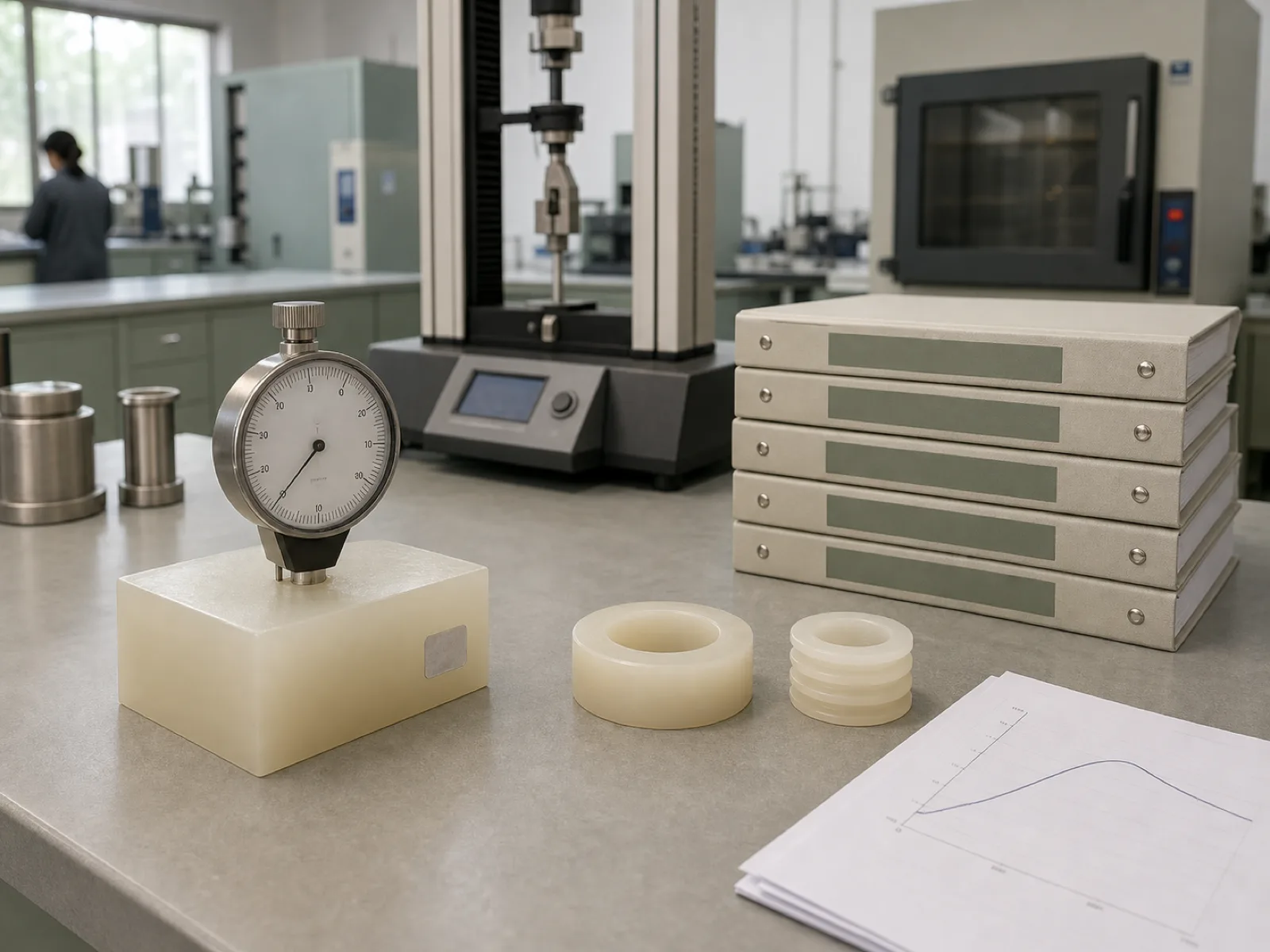
 An ISO 9001:2015 audit inside a silicone factory is a clause-by-clause test of whether the shop floor does what the quality manual says it does. The auditor walks the mixing room, cure oven, deflashing, and QC lab and pulls records at random against production orders active that day. Seven clauses — 4, 5, 6, 7, 8, 9, and 10 — carry the weight; everything else is context.
This is a spoke guide off the silicone factory sourcing checklist cornerstone. The checklist tells you what to ask on the RFP; this walkthrough shows you what the auditor actually does inside the factory, clause by clause, so you can read a certificate scope, interpret a nonconformity report, and verify that “ISO 9001 certified” means something specific in the plant your program will run in.
What ISO 9001:2015 actually tests inside a silicone factory
ISO 9001:2015 tests whether the factory has a functioning quality management system — documented processes, evidence they are followed, and a closed loop from nonconformity to corrective action. It does not test whether the silicone is food-safe, whether the Shore A is on-target, or whether the cure system is platinum. Those are material-level tests that ride alongside the QMS, not inside it.
The confusion is worth clearing up because it drives most sourcing mistakes: a factory can hold a valid ISO 9001 certificate and still make bad parts if the QMS documents a process that itself is wrong. The certificate proves the process is documented, calibrated, and audited. The material compliance evidence (FDA 21 CFR 177.2600, LFGB §30/31, BfR Recommendation XV) proves the parts meet a specification. Serious sink and cookware brands ask for both, treated as independent lines of evidence.
The seven clauses that matter for a silicone factory audit map to the process flow:
| Clause | Title | What it tests in a silicone plant |
|---|---|---|
| 4 | Context of the organization | QMS scope explicitly covers mixing, curing, deflashing, QC — not just “manufacturing” |
| 5 | Leadership | Signed quality policy, org chart, responsibility matrix for silicone lines |
| 6 | Planning | Risk register naming mold contamination, Shore A drift, incomplete cure |
| 7 | Support | Calibration of durometer, tensile tester, oven thermocouples; operator competence records |
| 8 | Operation | Mixing ratio logs, cure profile records, in-process Shore A checks, raw-material COA traceability |
| 9 | Performance evaluation | Internal audit schedule, management review minutes, CAPA closure metrics |
| 10 | Improvement | Nonconformance log with root-cause analysis, corrective-action effectiveness verification |
Clauses 1-3 are scope and definitions; the auditor reads them but does not sample against them. Everything real happens in 4-10.
Clause 4 — Context of the organization
The auditor verifies that the QMS scope statement on the certificate matches what the factory actually does. For a silicone plant this means the scope names the processes — compression molding, injection molding of LSR, HTV mixing, post-cure ovens — not a generic phrase like "manufacturing of rubber products." A scope that is too broad or too vague is itself a nonconformity.
Interested-party mapping under clause 4.2 is where a silicone factory documents who cares about the QMS and what they expect: the sink brand asking for PPAP, the cookware brand asking for LFGB testing, the regulatory bodies enforcing 21 CFR 177.2600, and the raw-material suppliers whose COAs feed traceability. A one-page interested-party register is standard.
The QMS scope statement is where the fake-certificate detection starts. A real scope for a 60-employee silicone factory reads something like: “Design, manufacture, and supply of silicone rubber products including compression-molded and injection-molded LSR components for kitchenware, sink accessories, and industrial gaskets.” A vague scope (“manufacturing”) on a certificate with no CB name and no IAF MLA logo is the pattern the sourcing checklist is designed to filter.
Clause 5 — Leadership
Clause 5 tests whether top management is visibly accountable for the QMS. The auditor asks to see the quality policy signed by the GM, the responsibility matrix showing who owns each silicone line, and the management review minutes from the last 12 months. A silicone factory where the QMS is delegated entirely to a QA manager without GM engagement fails this clause.
Sample questions the auditor asks the GM directly: What did the last management review conclude? What are your top three quality KPIs this quarter? Who owns the corrective-action effectiveness for the flash-defect nonconformity raised in Q1? If the GM cannot answer without looking it up, clause 5.1 is nonconformant regardless of paperwork.
Quality objectives under 5.1.1 are also inspected. In a silicone factory these typically read: first-pass yield ≥ 97%, customer complaint rate ≤ 0.5% of shipped lots, on-time CAPA closure ≥ 95%, calibration overdue rate = 0%. Numbers, not adjectives.
Clause 6 — Planning and the risk register
Clause 6 requires a documented risk register — the auditor pulls it and expects to see silicone-specific process risks, not generic entries. For a silicone factory the risk register names mold contamination, Shore A drift beyond ±5 points, incomplete cure at the geometric center of thick sections, color batch inconsistency, and platinum-catalyst inhibition from sulfur cross-contamination. Each risk is scored and has a mitigation.
A serious risk register is not a template downloaded from a consultant. It has entries a shop-floor engineer wrote, phrased in the vocabulary the process actually uses. The auditor recognizes the difference immediately.
Example entries the auditor expects to find:
- Risk: Platinum catalyst inhibition from operator handling peroxide-cured material on the same day. Score: high. Mitigation: dedicated tooling, hand-wash protocol between cure systems, batch-quarantine on suspicion. Owner: molding supervisor.
- Risk: Cure incomplete at part center for wall thickness > 8 mm. Score: medium. Mitigation: DOE-derived cure profile with 20% dwell margin, first-article dissection test each new tool. Owner: process engineer.
- Risk: Shore A drift over a 20,000-cycle production run. Score: medium. Mitigation: in-process durometer check every 500 parts against calibrated reference block, batch-reject at ±5 points. Owner: line QC.
Quality objectives feed off the risk register. If a risk is scored high but no objective addresses it, clause 6.2 is nonconformant.
Clause 7 — Support (calibration, competence, documented information)
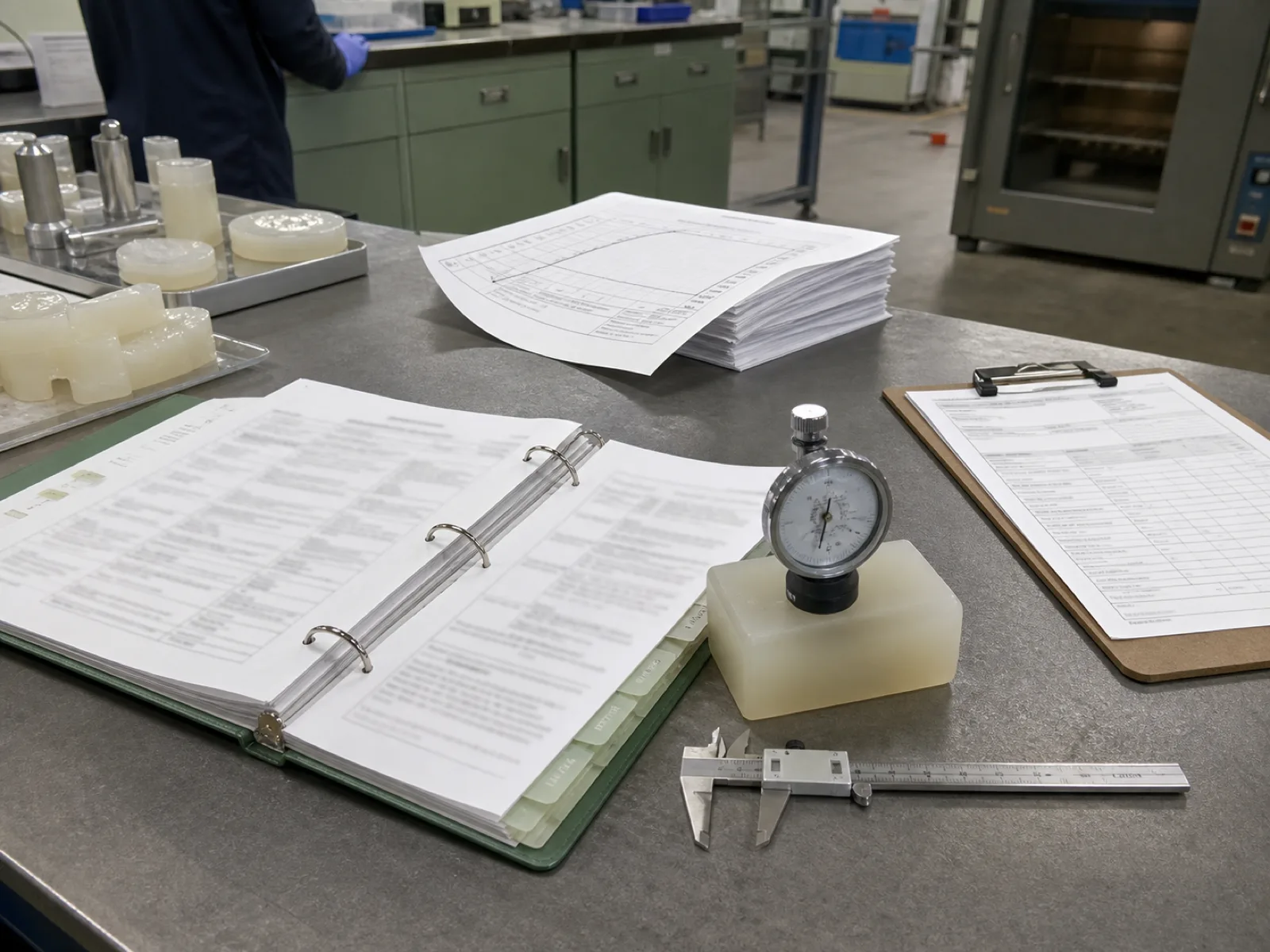
Clause 7 is where the most common silicone nonconformities live. The auditor pulls calibration certificates for every measuring instrument used to accept product — durometers, tensile testers, oven thermocouples, calipers, weighing scales for pigment dosing. Every certificate must be from an ISO 17025 accredited lab, in date, and the instrument physically labeled with its next-due date. An expired calibration sticker on a durometer used that shift is an automatic finding.
Competence records under 7.2 are the second common trap. For a silicone factory the auditor expects to see a training matrix showing which operator is qualified on which press or oven, with dated sign-offs from the shift supervisor and an evidence trail — typically first-article inspection under supervision. A new operator running an unfamiliar press without a documented competence sign-off is a clause 7.2 nonconformity.
Documented information under 7.5 requires that current versions of work instructions are at the workstation and obsolete versions are removed. The auditor walks the floor and physically checks the revision number posted at each press against the current revision in the document control system. A mismatch is a finding.
Typical clause 7 findings from surveillance audits of silicone factories:
- Durometer calibration certificate expired 6 weeks prior, still in use on production
- Oven thermocouple calibration not traceable to an ISO 17025 accredited lab
- Weighing scale for pigment dosing calibrated internally without a documented method
- New molding operator producing accepted parts without competence sign-off from supervisor
- Superseded work instruction still posted at press #3
Fixing clause 7 findings is disciplined record-keeping, not capex — which is why they recur.
Clause 8 — Operational planning and control
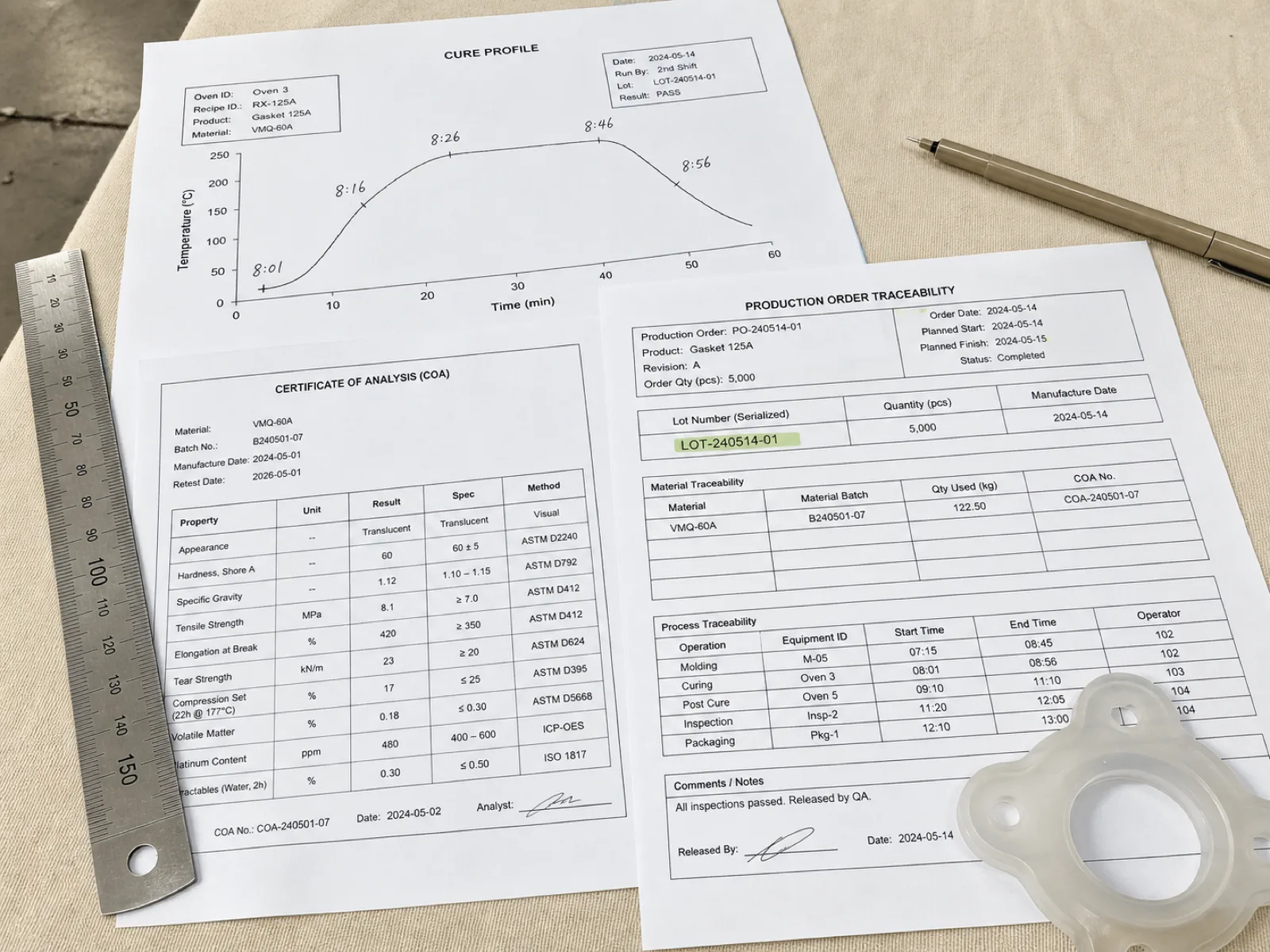
Clause 8 is the largest and heaviest-sampled clause in a silicone factory audit. The auditor picks a production order active on the shop floor and traces it end-to-end: raw material COA from HTV or LSR supplier, mixing ratio log signed by the mixer operator, cure profile printout from the press, in-process Shore A check with the calibration-current durometer, final QC sign-off with a serialized traceability tag. If any link breaks, clause 8 is nonconformant.
The trace is done on a live order, not a completed job pulled from the archive. That is deliberate — it tests whether the QMS operates in real time, not whether the paperwork can be reconstructed after the fact.
Sub-clause 8.4 (control of externally provided processes, products, and services) is where raw-material supplier evaluation lives. For a silicone factory this means an approved supplier list for HTV, LSR, pigments, and catalysts with documented evaluation criteria — typically ISO 9001 status of the supplier, COA reliability, and per-batch material test conformance. The auditor asks to see the evaluation record for the current HTV supplier.
Sub-clause 8.3 (design and development) is triggered when the factory does OEM design work for customers — which is most silicone factories. The auditor expects a documented design review process: customer requirements captured, design outputs (drawings, mold specs, cure recipes) reviewed against inputs, design changes controlled through a change request procedure. Wetop’s process is described in the customization walkthrough.
Sub-clause 8.5.2 (identification and traceability) is where silicone factories most often lose points. The requirement is that every lot can be traced from finished shipment back to raw-material batch. In practice this means a lot number stamped or labeled on the part, a production-order record linking the lot number to the mixing batch, and a mixing batch record linking to the raw-material COA. Break any link and clause 8.5.2 is nonconformant.
Clause 9 — Performance evaluation
Clause 9 tests whether the factory measures its own performance. The auditor checks that internal audits have run against a documented schedule covering all clauses over a 12-month cycle, that management review meetings happen quarterly with documented inputs and outputs, and that customer satisfaction data is collected — complaint rate, on-time delivery, PPAP or FAI approval rate. Missing any of these is a clause 9 finding.
Internal audit under 9.2 is where a factory that treats ISO 9001 as a paperwork exercise gets caught. The auditor asks to see the internal audit report from the last cycle and cross-checks the findings against the CAPA log — every internal-audit finding should have a corrective action opened, worked, verified, and closed. A clean internal audit report with no findings raised over 12 months is itself suspicious.
Management review under 9.3 must have documented inputs: internal audit results, customer complaints, process performance data, status of previous management review actions, changes in external issues. The output is documented decisions on resource allocation, quality objective updates, and CAPA effectiveness verification.
Clause 10 — Improvement and CAPA
Clause 10 tests the corrective-action loop. Every nonconformity — from an internal audit, a customer complaint, or a production defect — must be logged, root-caused (typically 5-why or fishbone), assigned a corrective action, and then verified for effectiveness 30-60 days later. A CAPA closed the same day it was opened, without effectiveness verification, is a clause 10 nonconformity.
The most common silicone-factory example is the flash-defect CAPA. A customer complaint on flash triggers a 5-why: excessive flash → mold parting-line wear → wear beyond spec → mold not on scheduled maintenance → PM schedule not integrated with production planning. The corrective action addresses the fifth why, not the first. Effectiveness verification checks whether flash-defect complaints have recurred in the 60 days since the CAPA closed.
A CAPA log with 40 open items, 20 closed same-day, and no effectiveness verification is worse than no CAPA log at all — it demonstrates the closed-loop mechanism is broken. This is the finding that separates factories that use ISO 9001 to run better from factories that carry it as a marketing badge.
Stage 1 vs Stage 2 audit — what actually happens on-site
Stage 1 is a 1-day document review, often mixed on-site and off-site, verifying the QMS documentation is complete and the factory is ready for Stage 2. Stage 2 is a 2-3 day full on-site audit for a 60-employee silicone factory: the auditor walks the shop floor, samples records against live production, interviews operators and management, and raises nonconformities. Stage 2 is where certification is decided.
A typical Stage 2 agenda for a silicone factory looks like this:
| Day | Session | Focus |
|---|---|---|
| 1 AM | Opening meeting + GM interview | Clause 5 leadership commitment, quality objectives, management review outputs |
| 1 PM | Shop floor walk — mixing room, presses | Clauses 7, 8 — calibration stickers, mixing ratio logs, cure profiles |
| 2 AM | Shop floor walk — deflashing, QC lab | Clauses 7, 8 — in-process checks, durometer calibration, final QC records |
| 2 PM | Document sampling — traceability trace | Clause 8.5.2 — one live order traced from raw material to finished lot |
| 3 AM | CAPA log and internal audit review | Clauses 9, 10 — corrective-action effectiveness, internal audit follow-through |
| 3 PM | Closing meeting — findings review | Nonconformities classified as major or minor, next-step timeline |
The auditor’s day rate runs USD 800-1,200 for an internationally accredited CB. Total Stage 1 + Stage 2 auditor fees for a first-time certification run USD 4,000-8,000 exclusive of CB management fee (typically USD 2,000-4,000/year) and internal preparation cost.
Common nonconformities silicone factories receive
The pattern across recertification audits of silicone factories in Guangdong is remarkably consistent. In descending frequency:
- Cure profile records incomplete — operators knew the recipe, but the shift record does not show the profile was followed. Clause 8.1 minor NC.
- Raw-material COA not traceable to finished lot — the HTV COA is on file, the finished lot is shipped, but no record links the two. Clause 8.5.2 major NC.
- Uncalibrated measuring instrument in use — durometer or thermocouple with an expired calibration sticker used to accept product. Clause 7.1.5 major NC.
- CAPA effectiveness not verified — corrective actions closed without the 30-60 day follow-up check. Clause 10.2 minor NC.
- Shore A results outside tolerance without documented review — durometer readings recorded outside the ±5 point spec with no evidence of MRB review or disposition. Clause 8.7 minor NC.
Major NCs must be closed with objective evidence before certification is granted or renewed. Minor NCs can be closed at the next surveillance audit. The mix and severity of findings is itself information the buyer should ask to see under NDA during supplier vetting.
How to verify a silicone factory’s ISO 9001 certificate is authentic
Run three checks. First, the accreditation body logo on the certificate must be an IAF MLA signatory — verify at iaf.nu. Second, take the certification body name and the certificate number and check the CB's public register — SGS, BSI, TÜV Rheinland, Bureau Veritas, DNV, and DEKRA all publish accessible registers. Third, read the scope wording — a real scope names the silicone processes; a fake certificate uses vague language. Skip any of these three and the certificate could be mill-issued.
The IAF MLA signatory list is the anchor. Common accreditation bodies you should recognize on a certificate include UKAS (UK), ANAB (US), CNAS (China), DAkkS (Germany), JAS-ANZ (Australia/New Zealand), UAF (Ukraine — legitimate but check scope), and INMETRO (Brazil). A logo from an accreditation body not on the IAF signatory list is not evidence of anything internationally recognized.
Fake ISO 9001 certificates in the silicone industry typically fail at least one of these tests:
- No CB name or an unfamiliar CB not registered in any public database
- No accreditation body logo, or a logo from an unaccredited body
- Scope wording that is vague or does not match the actual processes
- Certificate number that returns nothing when cross-checked with the CB register
- Certificate PDF only, without the supporting surveillance audit report
A serious factory shares both the certificate PDF and the most recent surveillance audit report under NDA. If the audit report is refused, the certificate should be treated as unverified — return to the sourcing checklist Question 8 (audit welcome) to filter.
ISO 9001 vs FDA / LFGB / medical-grade audits — what does not overlap
ISO 9001 covers the QMS, nothing else. FDA 21 CFR 177.2600 requires per-batch third-party testing against food-contact extraction limits. LFGB §30/31 requires organic-volatile emission testing. Medical-grade silicone requires biocompatibility testing per ISO 10993. Each of these rides alongside ISO 9001 as an independent evidence stream — the QMS certifies the process, the material testing certifies the product.
The mapping many sourcing teams miss:
| Concern | Covered by ISO 9001? | Independent evidence needed |
|---|---|---|
| QMS documentation and calibration | Yes | — |
| Traceability from raw material to finished lot | Yes (clause 8.5.2) | — |
| Food-contact safety (US) | No | 21 CFR 177.2600 extraction test per lot |
| Food-contact safety (EU) | No | LFGB §30/31 test per lot, BfR Rec XV compliance |
| Medical-device biocompatibility | No | ISO 10993 test series |
| Social compliance (labor) | No | Sedex SMETA / SA8000 / BSCI audit |
| Environmental management | No | ISO 14001 certification |
| Occupational H&S | No | ISO 45001 certification |
A supplier who answers “we are ISO 9001 certified” to a food-contact safety question is misreading the standard. The correct answer references the per-batch material test report — see the FDA vs LFGB explainer for the material side and the platinum vs peroxide cure system comparison for the process choice that drives what the QMS is documenting.
Surveillance and recertification cadence
After initial certification, the standard cadence is annual surveillance audits for years 2 and 3, then full recertification at Stage 2 depth in year 4. Surveillance audits sample a subset of clauses each year — always clauses 9 and 10 plus one rotating operational clause. Miss a surveillance window and the certificate is suspended; suspension over 6 months triggers withdrawal and a restart from Stage 1.
The rotating operational clause each surveillance year is why factories should not “prepare” only for the next audit — the auditor can sample any clause and typically picks the one the factory is weakest on based on prior findings. A factory that treats surveillance as a check-the-box exercise typically accumulates repeat nonconformities on the same clauses, which itself becomes a major finding at recertification (systematic lack of improvement, clause 10.3).
Closing — how a buyer should use this walkthrough
The practical use of the clause-by-clause map is not to audit factories yourself. It is to read a certificate scope with informed skepticism, ask the right two or three follow-up questions during vetting, and know what to request under NDA when a program moves to shortlist stage.
The two documents to ask for under NDA:
- Full ISO 9001 certificate PDF — with CB name, certificate number, IAF MLA accreditation body logo, and scope wording that names silicone processes.
- Most recent surveillance audit report — with the findings register, so you can see what nonconformities were raised and how they were closed.
A factory that ships both without hesitation is a factory that is running the QMS, not carrying it. That is the signal.
Wetop Silicone has been ISO 9001 certified since 2008 and maintains active audit-ready posture across all clauses. To review our certificate scope, surveillance history, and audit welcome procedure for your program, contact the engineering team.
FAQ
-
What is the difference between a Stage 1 and Stage 2 ISO 9001 audit in a silicone factory?
Stage 1 is a 1-day off-site or partial on-site document review — the auditor reads the quality manual, checks that clauses 4-10 have documented procedures, and verifies the QMS scope covers the actual silicone processes (mixing, curing, deflashing, QC). Stage 2 is a 2-3 day on-site audit for a 60-employee silicone factory. The auditor walks the shop floor, samples records against what operators are doing that shift, interviews the GM on clause 5 leadership commitments, and pulls calibration certificates, cure profile logs, and raw-material COAs at random. Stage 2 is where nonconformities get raised.
-
How does an ISO 9001 auditor test clause 8 (operational control) inside a silicone factory?
The auditor picks a production order active on the floor that day and traces it end-to-end. That means: (1) the raw material batch — HTV or LSR — with a supplier COA on file, (2) the mixing ratio log showing catalyst and pigment additions signed by the mixer operator, (3) the cure profile printout from the press or oven showing temperature and dwell time against the specified recipe, (4) the in-process Shore A durometer check with a calibration sticker on the instrument, (5) final QC sign-off with a serialized traceability tag. If any link breaks, clause 8 is nonconformant. This is a silicone-specific version of the generic process-approach requirement.
-
What are the most common nonconformities silicone factories receive during ISO 9001 audits?
Five recur across the industry: (1) undocumented cure profiles — operators know the recipe but there is no signed record it was followed, (2) missing raw-material COA traceability from HTV or LSR supplier to finished lot, (3) uncalibrated durometers or ovens with expired calibration stickers, (4) CAPA logs that close corrective actions without effectiveness verification 30-60 days later, (5) Shore A results drifting outside the ±5 point tolerance stated in the drawing without a documented review. Two of the five are clause 7 (support), two are clause 8 (operation), one is clause 10 (improvement). Fixing them is disciplined record-keeping, not capex.
-
How do I verify a silicone factory's ISO 9001 certificate is authentic, not fake?
Three checks in order. First, look at the accreditation body logo on the certificate — it should be an IAF MLA signatory (UKAS, ANAB, CNAS, DAkkS, JAS-ANZ). Cross-reference at iaf.nu. Second, take the certification body name (the CB that actually issued the cert — SGS, BSI, TÜV Rheinland, Bureau Veritas, DNV, DEKRA, etc.) and check their public register with the certificate number — every real CB has one. Third, check the certificate scope wording — a fake certificate typically says something vague like 'manufacturing' while a real one names the specific silicone processes (mixing, compression molding, injection molding of silicone rubber products). A mill-issued 'ISO 9001 certified' logo with no certificate number or CB name is not evidence of anything.
-
How much does an ISO 9001:2015 audit cost for a 60-employee silicone factory?
The rough numbers for a 60-employee single-site silicone factory in Guangdong: initial certification (Stage 1 + Stage 2) runs 4-6 auditor-days at USD 800-1,200 per day, plus a certification-body management fee. Surveillance audits in years 2 and 3 are 1-2 auditor-days each. Recertification in year 4 resets the cycle at 3-4 auditor-days. Total 3-year TCO is typically USD 8,000-14,000 depending on the CB, exclusive of internal preparation cost — which for a first-time cert is usually the larger number because a consultant is hired to build the QMS documentation.
-
How does ISO 9001 audit output feed into a sink brand's PPAP or FAI submission?
A sink brand's supplier quality engineer treats the ISO 9001 QMS as the foundation and the PPAP or FAI as the program-specific overlay. Specifically: (1) clause 7 calibration records back the measurement system analysis section of PPAP, (2) clause 8 production control records back the process flow diagram and control plan sections, (3) clause 9 internal audit findings and clause 10 CAPA closure demonstrate ongoing capability, (4) clause 6 risk register maps directly to the PPAP PFMEA. A silicone factory with a clean ISO 9001 record turns PPAP submission into an assembly job rather than a document-creation job. That is why many sink and cookware brands make ISO 9001 a shortlist prerequisite.
-
Does ISO 9001 cover FDA food-contact or LFGB compliance for silicone kitchenware?
No — and this is the single most misunderstood point in silicone OEM sourcing. ISO 9001:2015 certifies that the factory has a functioning quality management system. It says nothing about whether the finished part meets FDA 21 CFR 177.2600, LFGB §30/31 organic-volatile limits, BfR Recommendation XV, or California Proposition 65. Those require separate per-batch third-party test reports from an ISO 17025 accredited lab (SGS, Intertek, TÜV SÜD, Bureau Veritas). A serious silicone factory carries ISO 9001 as the QMS foundation and layers material compliance testing on top of every production lot — see [FDA vs LFGB Silicone](/guide/fda-vs-lfgb-silicone/) for the material side and the [sourcing checklist](/guide/sourcing-silicone-factory-checklist/) for how the two lines of evidence combine during vetting.
-
What surveillance audit cadence should I expect after initial ISO 9001 certification?
The standard cycle is annual surveillance for years 2 and 3, then full recertification in year 4. Surveillance audits are 1-2 auditor-days and cover a sampled subset of clauses each year — typically clause 9 (internal audit + management review), clause 10 (CAPA effectiveness), plus one operational clause rotated year over year. Recertification is a full re-audit against all clauses at Stage 2 depth. If a factory misses a surveillance window, the certificate is suspended until the audit is completed; if suspension exceeds 6 months, the certification is withdrawn and the factory has to restart at Stage 1.
-
What is the difference between an ISO 9001 audit and a customer supplier audit for silicone?
An ISO 9001 audit tests conformance to the ISO 9001:2015 standard by an accredited third-party CB. A customer supplier audit tests conformance to the specific buyer's supplier quality requirements — which are usually ISO 9001 plus additional program-specific requirements (color batch tolerance, packaging standards, on-time delivery KPIs, social compliance under Sedex SMETA or SA8000). The two audits share about 60-70% of the ground: clauses 7, 8, 9, 10 overlap heavily. The remaining 30-40% is buyer-specific. A factory that runs a clean ISO 9001 QMS typically passes customer audits with minor findings on the buyer-specific overlay, not on the QMS core.
References
Authoritative sources cited in this guide
- International Organization for Standardization. ISO 9001:2015 — Quality management systems — Requirements. https://www.iso.org/standard/62085.html — The primary standard whose clauses 4-10 the entire audit walkthrough tracks against.
- International Organization for Standardization. ISO 19011:2018 — Guidelines for auditing management systems. https://www.iso.org/standard/70017.html — The audit-methodology standard describing Stage 1 / Stage 2 structure, evidence sampling, and nonconformity classification.
- International Organization for Standardization. ISO/IEC 17021-1:2015 — Requirements for bodies providing audit and certification of management systems. https://www.iso.org/standard/61651.html — The requirements CBs (SGS, BSI, TÜV, Bureau Veritas, DNV) must meet to issue an accredited ISO 9001 certificate — the standard behind the IAF MLA verification workflow.
- International Accreditation Forum. IAF Multilateral Recognition Arrangement (MLA). https://iaf.nu/en/iaf-mla/ — The signatory list used to verify that an accreditation body on a certificate (UKAS / ANAB / CNAS / DAkkS / JAS-ANZ) is internationally recognized.
- US Food and Drug Administration. 21 CFR 177.2600 — Rubber articles intended for repeated use. https://www.ecfr.gov/current/title-21/chapter-I/subchapter-B/part-177/subpart-C/section-177.2600 — The US food-contact regulation ISO 9001 does not cover — cited to draw the boundary between QMS certification and material compliance.
- International Organization for Standardization. ISO/IEC 17025:2017 — General requirements for the competence of testing and calibration laboratories. https://www.iso.org/standard/66912.html — The accreditation standard for the third-party labs that issue durometer, tensile, and LFGB test certificates that feed clause 7 and clause 8 records.
- German Federal Institute for Risk Assessment. BfR Recommendation XV — Silicones. https://www.bfr.bund.de/en/bfr_recommendations_on_food_contact_materials-7027.html — The EU silicone food-contact reference behind LFGB §30/31 testing that rides alongside ISO 9001 in kitchenware audits.
- Automotive Industry Action Group (AIAG). PPAP — Production Part Approval Process. https://www.aiag.org/ — The submission framework whose evidence sections (control plan, PFMEA, MSA) are backed by ISO 9001 clause 6, 7, and 8 records — the mapping cited in the PPAP FAQ.
Start a custom program
Send a brief. Get an engineer’s reply in one business day.
Every Wetop program is tooled from a customer’s specification. Send a CAD file (STEP · IGES · DWG) or a written brief and we’ll reply with a mold cost estimate, price brackets at MOQ 500 / 1,000 / 5,000, and any engineering questions.