Certification · commercial intent
Phthalate-Free Silicone Explained for OEM Buyers
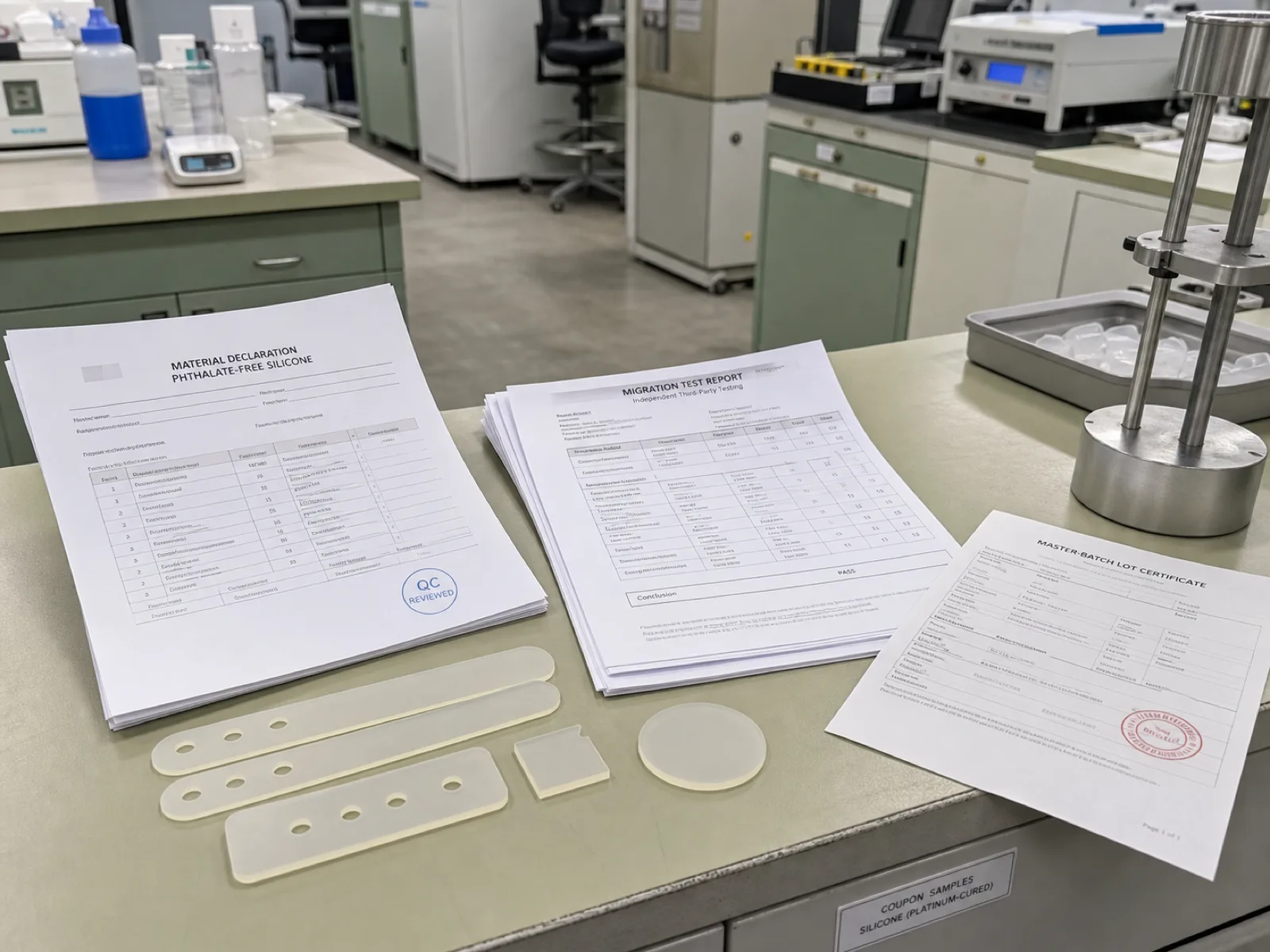 Certification
 “Is your silicone phthalate-free?” is one of the first compliance questions on a retail or housewares RFQ — and it is also one of the most misunderstood. The honest engineering answer is that the question is slightly mis-framed: silicone is phthalate-free by chemistry, not by additive removal. But the harder, correct answer is that your specific compound is only verifiably phthalate-free when the documentation proves it. This guide separates the chemistry from the verification.
Silicone is phthalate-free by design because phthalates are plasticizers added to soften rigid plastics like PVC, whereas silicone's siloxane backbone is already flexible and needs no plasticizer — so there is nothing of that class to leach out. The regulated phthalates such as DEHP, DBP, and BBP are endocrine-active plasticizers restricted under CPSIA and EU REACH, and none of them are ingredients in silicone chemistry. The verifiable claim, however, comes from testing: FDA 21 CFR 177.2600, EU Regulation 10/2011 migration limits, and a per-batch third-party report turn "phthalate-free" from a marketing word into documented compliance.
Is silicone phthalate-free?
Yes — silicone is inherently phthalate-free. Phthalates are plasticizers added to soften rigid polymers like PVC. Silicone's -Si-O-Si- siloxane backbone is flexible on its own and never requires a plasticizer, so no phthalate is present to migrate. The remaining task is not removing phthalates but documenting purity: verifying the specific compound with food- or medical-grade test reports.
The reason the answer is “yes by chemistry” and not “yes by testing alone” matters for how you write a specification. In a plasticized plastic — flexible PVC being the textbook case — a rigid polymer chain is softened by dispersing 20–40% by weight of a phthalate ester between the chains. Those ester molecules are not chemically bonded; they are physically trapped, which is exactly why they migrate into food, skin oils, and air over time.1
Silicone works on an entirely different principle. Its flexibility comes from the siloxane backbone itself — alternating silicon and oxygen atoms with a bond geometry that rotates freely at room temperature. The rubber is soft because of what the polymer is, not because of something added to it. There is no plasticizer role to fill, so a phthalate never enters the formulation. This is the single fact most consumer blogs get right but never explain: the phthalate-free property is structural, not a feature the manufacturer opted into.
That is also why “phthalate-free silicone” as a product category is, strictly, a redundancy — like “gluten-free water.” The commercially useful version of the claim is narrower: this compound is a verified, tested, food- or medical-grade silicone with documentation you can hand to a compliance auditor. The rest of this guide is about earning that second sentence.
What are phthalates, and why are they regulated?
Phthalates are esters of phthalic acid used as plasticizers to soften rigid plastics. The regulated set — DEHP, DBP, BBP, DINP, DIDP, and DnOP — is classified as endocrine-disrupting because several members interfere with hormone signaling. They are restricted by name under CPSIA, EU REACH, and EU food-contact rules, specifically because they leach from the flexible plastics that contain them.
Phthalates are a family of chemicals built on the same phthalic-acid core with different alcohol side chains. The side chain determines the behavior, but the ones that draw regulatory attention share a role: they make hard plastics bendable. The most-restricted members and their typical restriction basis:
| Phthalate | Abbrev. | Primary regulatory status |
|---|---|---|
| Di(2-ethylhexyl) phthalate | DEHP | CPSIA banned in children’s articles; REACH Annex XIV SVHC |
| Dibutyl phthalate | DBP | CPSIA banned; REACH SVHC |
| Benzyl butyl phthalate | BBP | CPSIA banned; REACH SVHC |
| Diisononyl phthalate | DINP | CPSIA restricted in children’s articles |
| Diisodecyl phthalate | DIDP | CPSIA restricted (interim) |
| Di-n-octyl phthalate | DnOP | CPSIA restricted (interim) |
The health concern is endocrine disruption — the ability of certain phthalates to mimic or interfere with hormones, which is why the US NIEHS studies them as a public-health topic1 and why the US CPSC permanently restricted the primary set for children’s toys and childcare articles under the Consumer Product Safety Improvement Act.2 In the EU, DEHP, DBP, BBP, and DIBP are on the REACH candidate list of Substances of Very High Concern.3
The through-line for a silicone buyer: every one of these restrictions targets a plasticizer in a flexible plastic. The regulators wrote the rules around the leaching mechanism. Since silicone has no plasticizer, it sits outside the mechanism entirely — but the paperwork that proves your part is silicone, and not a plasticized look-alike, is what closes the loop.
Why does silicone need no plasticizer?
Because the siloxane backbone is already flexible. Silicone is built from repeating silicon-oxygen (-Si-O-Si-) units whose bond angles rotate freely, giving the polymer rubber-like elasticity from -60 °C to well above 200 °C without any softening additive. A plasticizer exists only to loosen rigid chains; silicone chains are never rigid, so the additive — and its leaching risk — is designed out.
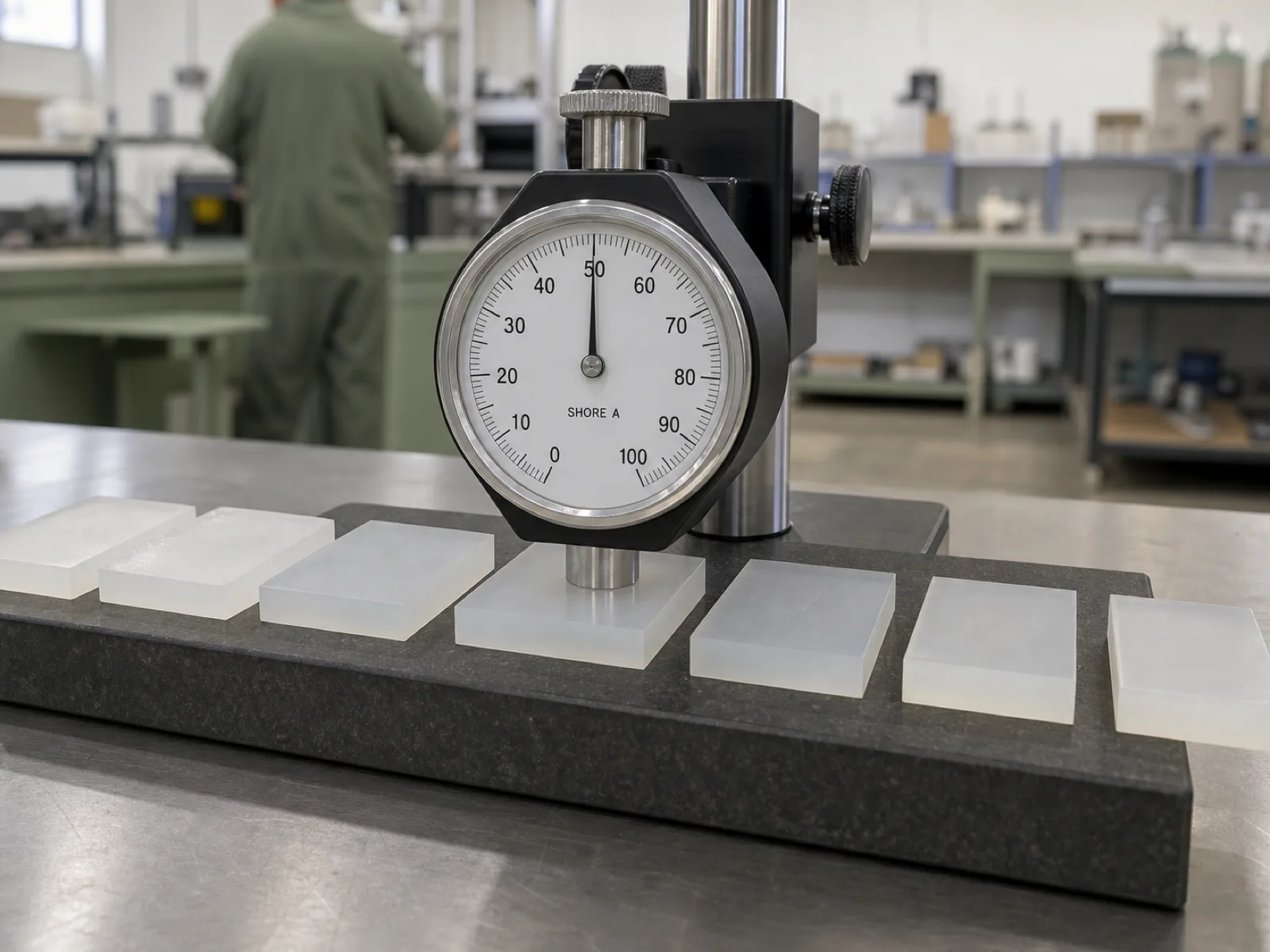
Hardness in silicone is engineered by three levers, none of which is a phthalate:
- Polymer chain length — longer siloxane chains crosslink into a softer, more extensible network.
- Reinforcing filler loading — fumed silica raises hardness and tear strength; more filler, harder part.
- Cure system and crosslink density — how tightly the network is knitted together sets the final modulus.
The practical proof is the durometer range: the same base silicone family spans roughly Shore A 10 (a squishy gel-like seal) to Shore A 80 (a stiff gasket) purely by adjusting chain length, filler, and crosslink density. A flexible PVC part hits its soft grades only by loading in more phthalate. That is the entire divergence in one number: silicone changes hardness by changing its own structure; plasticized plastic changes hardness by changing how much migrating additive it carries.
This also explains silicone’s non-leaching thermal behavior. Because there is no low-molecular-weight plasticizer sitting between the chains, heating silicone does not “sweat out” a softener the way a warm vinyl part can. The temperature range holds without the material chemically changing its additive balance — a property worth pairing with our silicone temperature range guide when you are speccing hot-fill or oven-safe programs.
What’s the caveat — is all “silicone” automatically pure?
No. "Silicone" names a polymer, not a purity grade. The base chemistry is phthalate-free, but cheap compounds can carry non-food-grade fillers, non-compliant pigments, and slip or processing additives that introduce other contaminants. Only a tested food-grade or medical-grade compound — with a report tied to a lot number — is a verifiable claim. "It's silicone, so it's safe" is not defensible.
This is the gap that consumer pages skip and that a B2B buyer cannot afford to. A finished silicone part is the base polymer plus everything the compounder and molder added: reinforcing filler, color master-batch, catalyst, and often a mold-release or slip additive. Each is a place where a low-cost supply chain can substitute a non-compliant grade to shave cost.
The realistic contamination risks in adulterated “silicone” — none of which are phthalates, which is itself instructive — include:
- Non-food-grade filler extenders — excess precipitated silica or calcium-carbonate extenders loaded past the food-grade formulation to cut polymer cost.
- Non-compliant pigments — colorants outside the FDA/EU permitted list, occasionally carrying heavy-metal contaminants that fail a migration or total-lead screen.
- Mold-release residue — spray release agents that transfer to the part surface; some legacy chemistries carry fluorinated compounds (a separate concern covered in our PFAS-free silicone guide).
So the phthalate question and the purity question are actually two questions. Silicone answers the first by chemistry. Only testing answers the second. A supplier who responds to “is this phthalate-free?” with “yes, it’s silicone” has answered the easy half and dodged the half that matters — whether this batch of this compound passes migration and extractables limits.
How does cure system affect residual byproducts?
Cure system changes the residual profile, not the phthalate status. Platinum-cured (addition) silicone produces no cure byproducts, leaving the cleanest extractable profile. Peroxide-cured silicone generates acidic decomposition byproducts that a 4–6 hour post-cure at ~200 °C drives off. Neither system involves phthalates, but the cure route and post-cure belong on the compound documentation because they govern what migration testing actually measures.
Two crosslinking chemistries dominate industrial silicone, and they leave different fingerprints on an extractables report:
| Attribute | Platinum-cured (addition) | Peroxide-cured (free-radical) |
|---|---|---|
| Cure byproduct | None (hydrosilylation) | Acidic peroxide decomposition residues |
| Post-cure requirement | Optional / short | 4–6 h at ~200 °C typically required |
| Residual extractables | Lowest | Low after full post-cure |
| Typical use | Medical, baby, premium food-contact | General food-contact, industrial |
| Phthalate content | None | None |
The takeaway is that “phthalate-free” is table stakes for both routes — the differentiator is the overall extractables and volatiles profile, which is what a premium or medical-adjacent buyer is really specifying when they ask about purity. Platinum-cure is the default for medical and infant programs precisely because it leaves nothing behind to extract. Peroxide-cure reaches a comparably clean state, but only with a verified post-cure, which is why the post-cure step is a documentation item, not an optional finishing touch. For the full decision framework, see our platinum-cured vs peroxide-cured silicone comparison.
Which standards verify a phthalate-free claim?
Five standards carry the weight: FDA 21 CFR 177.2600, EU Regulation 10/2011, USP Class VI, ISO 10993, and LFGB. The first two govern food contact and set migration limits — including phthalate-specific SMLs in EU 10/2011. The USP and ISO tiers govern medical biocompatibility. Cite them by clause on the Certificate of Compliance; a claim without a clause reference is not verifiable.
This is where an authoritative supplier separates from a marketplace listing: naming the standard by number rather than waving a generic “food-safe” flag. The map of which standard proves what:
| Standard | Jurisdiction / scope | What it verifies |
|---|---|---|
| FDA 21 CFR 177.26004 | US food-contact, repeated-use rubber | Total extractives within reflux limits |
| EU Regulation 10/20115 | EU food-contact plastics | Overall + specific migration limits, incl. phthalate SMLs |
| LFGB §30/31 | Germany / EU food-contact | Sensory + migration compliance per batch |
| USP Class VI6 | US medical-grade materials | In-vivo biological reactivity |
| ISO 10993 series7 | Medical device biocompatibility | Chemical characterization, extractables/leachables |
EU Regulation 10/2011 is the sharpest tool for this specific topic, and it is the one every competitor page omits. Because it regulates plastics, it explicitly lists the phthalates permitted as plasticizers and assigns each a specific migration limit (SML). For example, the regulation sets SMLs for the plasticizer phthalates it authorizes and prohibits others outright in food-contact plastics.5 A silicone part tested against 10/2011 is measured on the same ruler as the plasticized plastics the rule was written for — and returns non-detect on the phthalate line, which is exactly the evidence a premium EU program wants on file. The broader US framework these food-contact substance rules sit inside is FDA’s food-packaging program.8
Which standards you demand depends on the program tier — a distinction we break down fully in the FDA vs LFGB decoder. For food-contact housewares, FDA 177.2600 plus LFGB and EU 10/2011 is the core. For anything medical-adjacent, USP Class VI and ISO 10993 stack on top.
How does migration and extractables testing prove it?
Migration testing is the lab evidence behind the claim. FDA 21 CFR 177.2600 uses reflux extraction in food simulants to cap total extractives; EU 10/2011 sets overall migration and phthalate-specific SMLs measured against simulants; GC-MS screens for the phthalate panel directly. A phthalate-free claim is only as good as the accredited-lab report — tied to your master-batch lot — that documents these results.
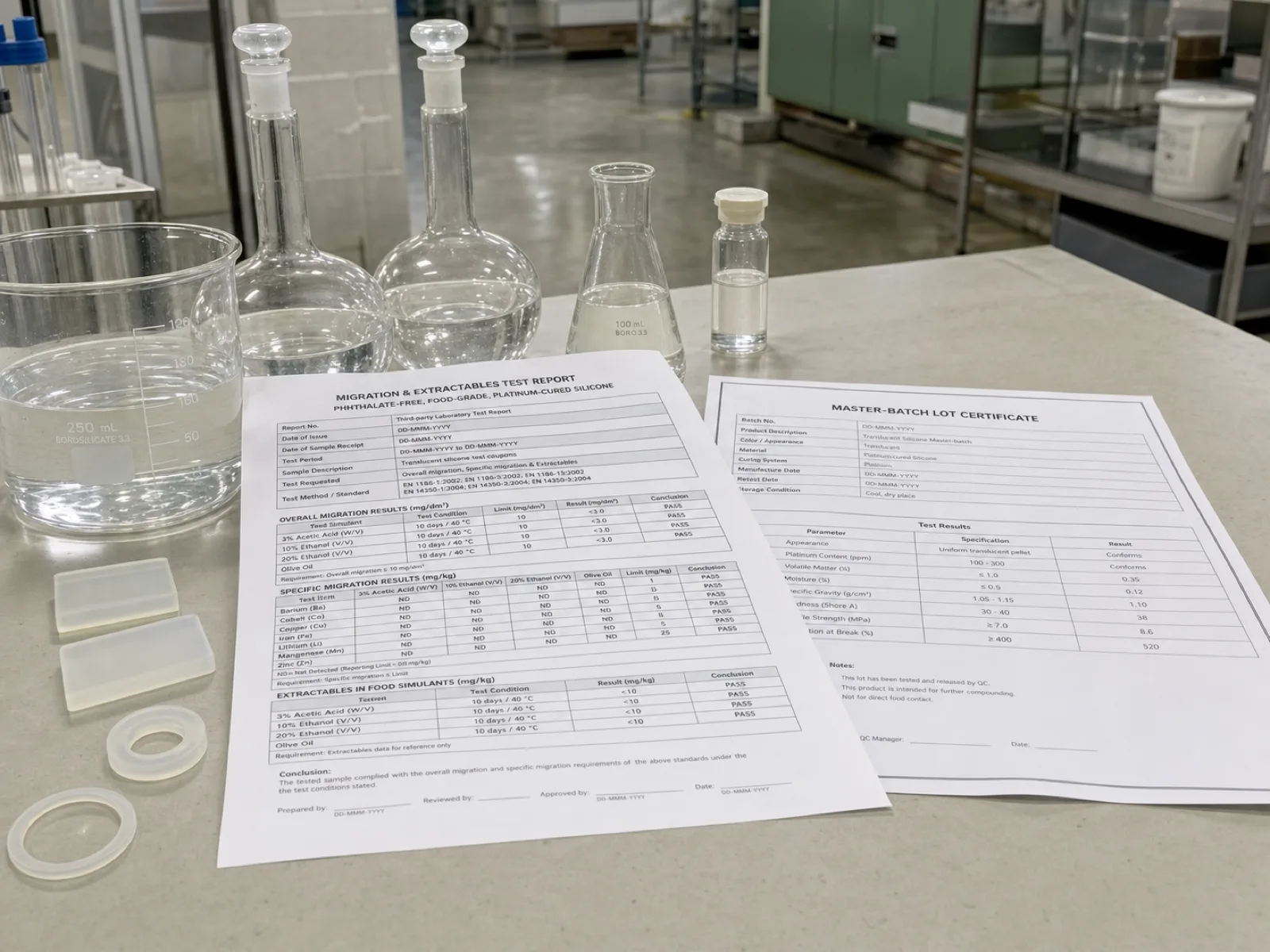
The testing that stands behind “phthalate-free” works on the same logic as the regulations: measure what actually comes out of the material into a food-contact scenario. The three layers a serious compliance packet includes:
- Total extractives (FDA 21 CFR 177.2600) — the part is refluxed in specified food simulants (water, n-hexane, and others depending on intended use), and the extracted residue must fall under the regulation’s limits.4
- Migration testing (EU Regulation 10/2011) — overall migration limit (OML) across all substances plus specific migration limits (SMLs) for regulated substances, measured against simulants at defined time/temperature.5
- Phthalate screen (GC-MS) — a direct analytical screen against the DEHP/DBP/BBP/DINP/DIDP/DnOP panel with mg/kg detection limits, requested when the retail buyer’s spec calls for a named-phthalate report even though silicone returns non-detect.
The strategic point competitors miss: the phthalate-free claim is not self-evident, it is evidenced. Any supplier can print “phthalate-free” on a spec sheet. A supplier operating at OEM standard produces the migration report from SGS, Intertek, TÜV, Bureau Veritas, or Eurofins, referencing the production lot, on request. When you write your RFQ, make the report — not the adjective — the deliverable.
Food-grade vs medical-grade vs industrial-grade silicone
The three grades differ by documentation depth, not by phthalate content — all silicone is phthalate-free. Industrial-grade meets mechanical specs with minimal food/medical testing. Food-grade adds FDA 21 CFR 177.2600 and LFGB migration compliance. Medical-grade adds USP Class VI and ISO 10993 biocompatibility. You pay for the level of verified evidence the application requires, not for a different base chemistry.
| Grade | Core standards | Phthalate status | Typical documentation |
|---|---|---|---|
| Industrial | Mechanical/thermal spec only | Phthalate-free | Material datasheet, RoHS/REACH statement |
| Food-grade | FDA 21 CFR 177.2600, LFGB, EU 10/2011 | Phthalate-free | Migration/extractables report per lot |
| Medical-grade | USP Class VI, ISO 10993 series | Phthalate-free | Biocompatibility + extractables/leachables |
The insight buyers should internalize: moving up the grade ladder does not buy you a “more phthalate-free” material — the base silicone is phthalate-free at every tier. What you buy is a deeper stack of verification, and correspondingly higher material and testing cost. Over-speccing medical-grade for a food-contact drying mat wastes money; under-speccing industrial-grade for an infant-feeding component fails an audit. We map this trade-off in detail in the food-grade vs medical-grade silicone guide, and note that for medical work Wetop supplies silicone components (tubing, cushions, ear tips) characterized to USP Class VI and ISO 10993 — not finished, cleared devices.
How should a B2B buyer request phthalate-free documentation?
Ask for documents tied to a lot number, not adjectives. A defensible phthalate-free package is: a Certificate of Compliance citing FDA 21 CFR 177.2600 and/or EU 10/2011 by clause; a third-party migration/extractables report from an accredited lab referencing your master-batch lot; a REACH/SVHC and California Prop 65 statement; and RoHS if required. No report tied to a lot is marketing, not compliance.
Turn the claim into a procurement checklist your supplier either meets or does not:
- Certificate of Compliance / Conformity (CoC) — names the specific standard and clause the compound is certified against, not a generic “food-safe.”
- Certificate of Analysis (CoA) — the batch-level record with the material identity and test summary for the production lot you are buying.
- Third-party migration/extractables report — from SGS, Intertek, TÜV, Bureau Veritas, or Eurofins, referencing your master-batch lot number, not a “representative sample.”
- Phthalate-specific GC-MS screen — when the retail buyer’s spec demands a named-panel report.
- REACH SVHC + California Prop 65 statement — the two declarations retail compliance teams request by default.
- RoHS declaration — for any part with an electronic or hardware pairing.
The tell of a serious supplier is speed and specificity: the documents come back referencing a lot number within days, and every certificate names a clause. Wetop ships this stack per production batch on food-contact and medical-component programs — MOQ 500 per SKU, first samples in 7–25 days from our Dongguan floor — with the migration report bundled at no per-unit surcharge on premium programs.
What Wetop delivers on phthalate-free compliance
Wetop treats phthalate-free as a documented default, not a talking point. Every food-contact and medical-component program ships a food- or medical-grade compound with migration and extractables testing per FDA 21 CFR 177.2600 and EU Regulation 10/2011, plus a per-batch packet referencing the master-batch lot. MOQ is 500 per SKU, first samples run 7–25 days from Dongguan.
The chemistry gives you the phthalate-free property for free; the discipline is in proving it the same way every batch. On a food-contact drying-mat or sink-grid program, that means a food-grade compound cleared to FDA 21 CFR 177.26004 and LFGB, migration-tested against EU Regulation 10/20115 simulants, with the third-party report referencing the specific master-batch lot rather than a one-time reference sample. Named-phthalate GC-MS screens, REACH SVHC statements, RoHS, and California Prop 65 declarations are produced on request within days, not weeks.
For medical-adjacent work, Wetop supplies silicone components — tubing, cushions, ear tips, cushioning pads — characterized to USP Class VI6 and the ISO 109937 series. We do not sell finished, FDA-cleared devices; we supply the biocompatible silicone that your device passes into your own regulatory pathway. That distinction keeps the compliance claims defensible: we document the material, you document the device.
The founder-led engineering desk in Dongguan runs one compression cell and one LSR injection cell on a 7,500 m² floor, and the compliance packet is engineered into the program from the first sample — not bolted on when a retail buyer’s auditor finally asks for it. If your specification lists “phthalate-free” as a line item, the honest first question back is “against which standard, and do you want the migration report per batch?” — because that is the version of the claim that survives an audit.
Ready to source? Every quote is built against your specification — send a CAD file, a written brief, or reference samples, and an engineer replies within one business day. Request a quote →
Footnotes
-
US National Institute of Environmental Health Sciences. Endocrine Disruptors — Environmental Health Topics. https://www.niehs.nih.gov/health/topics/agents/endocrine ↩ ↩2
-
US Consumer Product Safety Commission. Consumer Product Safety Improvement Act — Phthalates. https://www.cpsc.gov/ ↩
-
European Chemicals Agency. Substances restricted under REACH (Annex XVII) and the SVHC Candidate List. https://echa.europa.eu/ ↩
-
US Food and Drug Administration / eCFR. 21 CFR 177.2600 — Rubber articles intended for repeated use. https://www.ecfr.gov/current/title-21/chapter-I/subchapter-B/part-177/subpart-C/section-177.2600 ↩ ↩2 ↩3
-
European Commission / EUR-Lex. Commission Regulation (EU) No 10/2011 on plastic materials and articles intended to come into contact with food. https://eur-lex.europa.eu/legal-content/EN/TXT/?uri=CELEX%3A32011R0010 ↩ ↩2 ↩3 ↩4
-
United States Pharmacopeia. USP <88> Biological Reactivity Tests, In Vivo (Class I–VI Plastics). https://www.usp.org/ ↩ ↩2
-
International Organization for Standardization. ISO 10993 — Biological evaluation of medical devices. https://www.iso.org/standards.html ↩ ↩2
-
US Food and Drug Administration. Food Ingredients & Packaging — Food Contact Substances. https://www.fda.gov/food/food-ingredients-packaging ↩
FAQ
-
Can silicone leach phthalates into food or drink?
No. Phthalates leach out of plasticized plastics because they are loosely bound additives — small molecules physically dispersed in a rigid polymer to soften it. Silicone contains no phthalate plasticizer to begin with: the siloxane backbone is inherently flexible, so there is nothing of that class to migrate. The only migration risk in silicone is un-reacted low-molecular-weight siloxane oligomers, which a proper post-cure drives off and which food-contact migration testing (FDA 21 CFR 177.2600, EU 10/2011) is designed to measure.
-
Is phthalate-free the same as BPA-free for silicone?
No — they are two different claims, and consumers routinely conflate them. BPA (bisphenol A) is a monomer used to make polycarbonate plastic and epoxy resin liners. Phthalates are plasticizers used to soften flexible PVC. Silicone chemistry uses neither: no bisphenol monomer, no phthalate plasticizer. So food-grade silicone is inherently both BPA-free and phthalate-free — but a serious supplier documents each claim separately, because your retail buyer's compliance checklist lists them as separate line items.
-
Which phthalates are actually banned in food-contact and children's products?
In the US, CPSIA permanently bans DEHP, DBP, and BBP above 0.1% in children's toys and childcare articles, and adds DINP, DIBP, DPENP, DHEXP, and DCHP to the restricted list. In the EU, REACH restricts DEHP, DBP, BBP, and DIBP as SVHCs, and Regulation 10/2011 sets specific migration limits for phthalates permitted as plasticizers in food-contact plastics. None of these are constituents of silicone — the restrictions target plasticized PVC and similar flexible plastics.
-
How do I prove my silicone supplier's phthalate-free claim?
Demand documents, not adjectives. Request: (1) a Certificate of Compliance citing FDA 21 CFR 177.2600 and/or EU 10/2011 by clause; (2) a third-party migration or extractables test report from an accredited lab (SGS, Intertek, TÜV, Bureau Veritas, Eurofins) that references your master-batch lot; (3) a phthalate-specific screen (GC-MS) if the retail buyer's spec calls for one; and (4) a REACH/SVHC and California Prop 65 statement. A claim without a lab report tied to a lot number is marketing, not compliance.
-
Does cheap or 'filled' silicone contain phthalates?
It can contain contaminants — though rarely phthalates specifically. The real risk in low-cost 'silicone' is adulteration: excess non-food-grade fillers (fumed or precipitated silica extenders), non-compliant pigments, and slip or processing additives added to cut cost or ease molding. These can push a part over a heavy-metal or migration limit even when phthalates are absent. This is why 'it's silicone, so it's safe' is not a defensible claim — only a tested food-grade or medical-grade compound with per-batch documentation is verifiable.
-
Is food-grade silicone automatically phthalate-free?
By chemistry, yes — but the phrase 'food-grade' on its own is a marketing label, not a certification. A genuinely food-grade compound compliant with FDA 21 CFR 177.2600 and LFGB is phthalate-free because silicone contains no phthalate plasticizer, and the compliance testing confirms migration stays within limits. The gap is verification: ask which standard the 'food-grade' label maps to, and for the test report behind it. An unverified 'food-grade' sticker with no clause reference proves nothing.
-
What test detects phthalates in silicone?
Gas chromatography-mass spectrometry (GC-MS) is the standard analytical method for phthalate screening, typically against a defined panel (DEHP, DBP, BBP, DINP, DIDP, DnOP and related esters) with detection limits in the low mg/kg range. For food-contact verification, this sits alongside overall and specific migration testing per EU Regulation 10/2011 and total extractives per FDA 21 CFR 177.2600 reflux extraction. On silicone the phthalate screen almost always returns non-detect — the value is having the report on file.
-
What certifications should phthalate-free silicone carry?
For food-contact programs: FDA 21 CFR 177.2600 (US) and LFGB §30/31 with EU Regulation 10/2011 migration testing (EU) form the core. For medical-adjacent components: USP Class VI and the ISO 10993 biocompatibility series. Supporting declarations that retail buyers request: REACH SVHC statement, RoHS, and California Proposition 65. Wetop supplies this stack per production batch referencing the master-batch lot — see how the pieces fit in the FDA vs LFGB decoder.
References
Authoritative sources cited in this guide
- US Food and Drug Administration / eCFR. 21 CFR 177.2600 — Rubber articles intended for repeated use. https://www.ecfr.gov/current/title-21/chapter-I/subchapter-B/part-177/subpart-C/section-177.2600 — The US food-contact regulation for repeated-use rubber articles, including silicone — defines the reflux extraction limits behind a food-grade phthalate-free claim.
- European Commission / EUR-Lex. Commission Regulation (EU) No 10/2011 on plastic materials and articles intended to come into contact with food. https://eur-lex.europa.eu/legal-content/EN/TXT/?uri=CELEX%3A32011R0010 — Sets overall and specific migration limits (SMLs), including phthalate-specific SMLs for the plasticizers permitted in food-contact plastics.
- US Food and Drug Administration. Food Ingredients & Packaging — Food Contact Substances. https://www.fda.gov/food/food-ingredients-packaging — FDA's overview of how food-contact materials are regulated, providing the framework a 21 CFR 177.2600 compliance claim sits inside.
- United States Pharmacopeia. USP <88> Biological Reactivity Tests, In Vivo (Class I–VI Plastics). https://www.usp.org/ — The biocompatibility classification used for medical-grade silicone components — the highest tier of material safety documentation.
- International Organization for Standardization. ISO 10993 — Biological evaluation of medical devices. https://www.iso.org/standards.html — The biocompatibility standard series governing chemical characterization and extractables/leachables evaluation of medical-grade silicone components.
- US National Institute of Environmental Health Sciences (NIH). Endocrine Disruptors — Environmental Health Topics. https://www.niehs.nih.gov/health/topics/agents/endocrine — The public-health basis for phthalate concern — phthalates are studied here as endocrine-active plasticizers.
- US Consumer Product Safety Commission (eCFR). 16 CFR Part 1307 — Prohibition of Children's Toys and Child Care Articles Containing Specified Phthalates. https://www.ecfr.gov/current/title-16/part-1307 — The US statutory phthalate restrictions for children's toys and childcare articles (DEHP, DBP, BBP, DINP and additions).
- European Chemicals Agency (ECHA). Substances restricted under REACH (Annex XVII) and the SVHC Candidate List. https://echa.europa.eu/ — The EU chemicals framework restricting DEHP, DBP, BBP, and DIBP as substances of very high concern in consumer articles.
Start a custom program
Send a brief. Get an engineer’s reply in one business day.
Every Wetop program is tooled from a customer’s specification. Send a CAD file (STEP · IGES · DWG) or a written brief and we’ll reply with a mold cost estimate, price brackets at MOQ 500 / 1,000 / 5,000, and any engineering questions.