Buyer Guide · commercial intent
Private Label Silicone Kitchen Products — 5-Step OEM Process
What changed: Rewritten to v2 advanced-GEO standard — added direct-answer blocks per H2, expanded to 7 FAQs, 8 Tier-1 References (ISO / FDA / BfR / IATF / WIPO / USPTO / EUIPO / ECHA), added mold workshop and QC photographs, added 5-step process gantt reference.
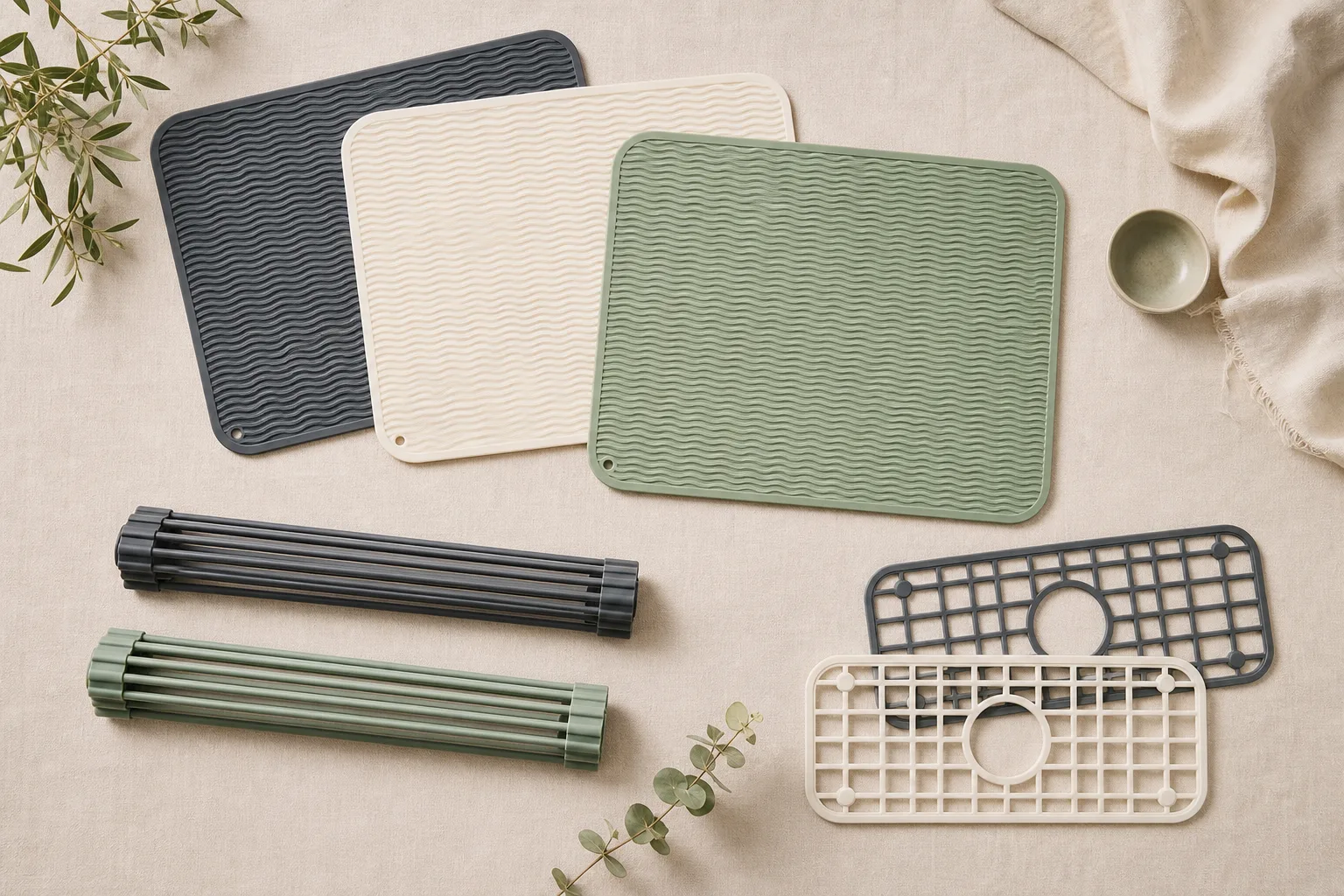 Buyer Guide
 The single most-common question from a first-time private-label silicone buyer is “how does this whole program actually work — from RFP to my retail launch?” — usually asked by a product manager who’s been given a retail launch date and needs to work backward. This guide is the 5-step process, the timelines that hold, the documents that protect exclusivity, and what to spec at each stage.
A private-label silicone kitchenware OEM program runs in 5 stages: RFP + spec confirmation, CAD sign-off + P20 mold tooling, first-article + revision cycle, mass production + per-batch FDA and LFGB testing, and retail-ready packing + shipping. End-to-end timeline for a first-time program on new tooling: 90-120 calendar days from signed PO to first shipment. Reorders against existing tooling: 45-60 days. Brand-exclusivity protection sits in mutual NDA + mold dedication clause. Per-unit price at MOQ 500 for Tier 2 retail: $3-5 FOB Yantian.
What are the 5 stages of a private-label silicone OEM program?
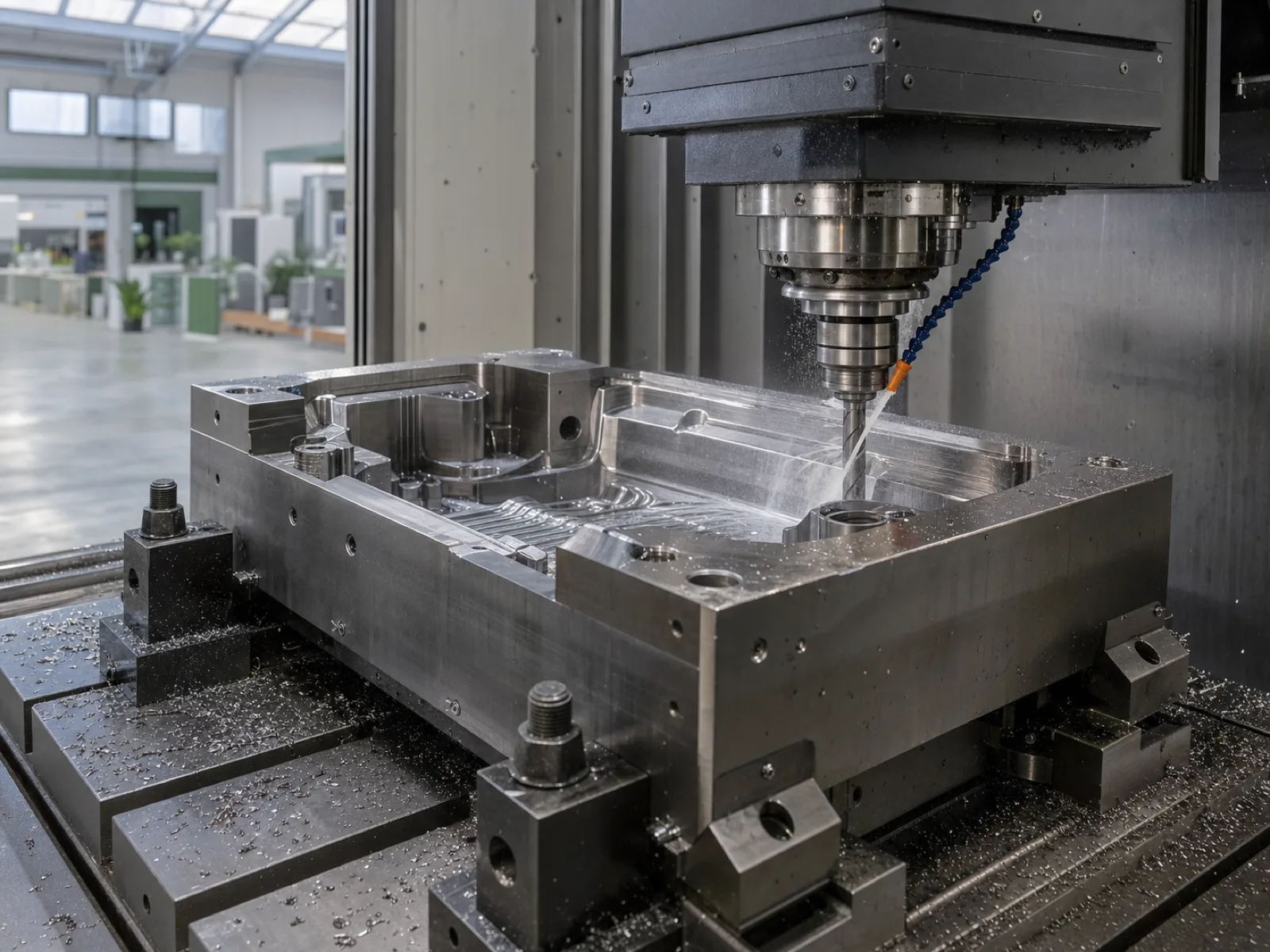
Five stages structure any serious private-label silicone kitchenware program. Stage 1: RFP + spec confirmation (3-5 days). Stage 2: CAD sign-off + P20 mold tooling on 5-axis CNC (10-14 days single-cavity; 14-21 days multi-cavity). Stage 3: First-article production + customer sample approval cycle (12-21 days including revisions). Stage 4: Mass production with per-batch FDA + LFGB testing under ISO 2859-1 sampling (30-45 days). Stage 5: Retail-ready packing + documentation packet + shipping (5-10 days pre-freight). Total: 90-120 calendar days from signed PO to first shipment on a first-time program.
The 5-stage breakdown
| Stage | Duration (business days) | What happens | Key deliverable |
|---|---|---|---|
| 1. RFP + spec confirmation | 3-5 | CAD or written brief review, dimensional feasibility, cure system decision (platinum vs peroxide), MOQ tier decision, per-unit pricing quote issued | Signed quote + PO |
| 2. CAD sign-off + P20 mold tooling | 10-14 single-cavity / 14-21 multi-cavity | Rough machining, heat treatment / hardening, precision cutting, polishing, CMM dimensional verification against customer CAD | Tooled mold ready for first-article |
| 3. First-article + revision cycle | 5-7 first-article + 7-14 revision cycle | Press setup, cure trial, post-cure at 180-200°C per BfR Rec XV1, dimensional inspection, product photography sent to customer, customer QA review, revisions if needed, second sample if revision required | Signed first-article approval |
| 4. Mass production + per-batch testing | 30-45 calendar days | Compression or LSR injection cycles across cavities, mandatory post-cure per LFGB compliance, AQL 1.5 pre-pack inspection under ISO 2859-12, per-batch FDA + LFGB third-party testing at accredited lab, PFAS non-detect testing on premium programs | Finished product ready for pack + ship |
| 5. Packing + docs + shipping | 5-10 (pre-freight) | Retail-ready packaging (per program spec), master-batch lot cert + FDA/LFGB reports + post-cure log bundled into one PDF, FCL/LCL booking, DDP if applicable, customs docs | Shipment on the water / in DDP transit |
Add ocean freight time (25-35 days FOB Yantian → US East Coast or EU) or DDP AWD air freight (5-8 days) after Stage 5 to arrive at customer’s warehouse.
How does brand-mark exclusivity actually work in a private-label OEM relationship?
Three documents anchor brand-exclusivity protection. Mutual NDA covering technical drawings, brand-mark artwork, packaging concepts, and cost data (Wetop signs customer template or provides ours). Mold dedication clause in the PO — the tooled mold is customer property; Wetop doesn't run the customer's geometry for competing buyers. Multi-year non-compete for tooled designs, negotiable for programs at MOQ 2,000+. Wetop treats these as standard documentation, not add-on friction — the [12-question sourcing checklist](/guide/sourcing-silicone-factory-checklist/) Question 9 walks the framework.
The three-document exclusivity stack:
- Mutual NDA — covers technical drawings, CAD files, brand-mark artwork, packaging concepts, sales channel information, cost/pricing data, and any communication about the program. Standard duration 3-5 years with automatic renewal. Wetop provides a template or signs the customer’s version. See our NDA page for the standard framework.
- Mold dedication clause in the PO — the tooled mold is customer property; Wetop doesn’t run the specific geometry for competing buyers. This is Standard on all Wetop programs; not an add-on. The tooling cost is quoted as customer NRE (non-recurring engineering), often refunded against the first 5,000 pieces of production.
- Multi-year non-compete for tooled designs — for programs above MOQ 2,000 or multi-year commitments, Wetop can dedicate press capacity + engineering resources to your program only. Negotiable term with different economic frameworks depending on volume commitment and duration.
Category-level exclusivity (Wetop doesn’t OEM competing product in the same retail category for a competing brand) is available as a contract term on higher-volume programs.
What IP protection exists for a private-label silicone product design?
Three separate IP frameworks apply to private-label silicone kitchenware, each with different enforcement mechanics. Utility patents (USPTO in US[^uspto-design] / equivalent authorities in EU and CN) for functional inventions that are novel and non-obvious. Design patents / registered community designs (EUIPO in EU[^euipo-design]) for distinctive visual appearance not driven by function. Trademarks and trade dress protection for brand-mark and packaging visual identity, protected via trademark registration. WIPO harmonizes international IP protection frameworks[^wipo-ipd]. Wetop's role is supporting IP protection through mold dedication + NDA enforcement — not IP legal counsel.
The three IP frameworks in practice:
- Utility patents — protect functional inventions with novel geometry or mechanism. Applies to distinctive features like specific drainage channel patterns, unique locking mechanisms, or novel manufacturing methods. Filed with USPTO for US protection, EPO for EU, CNIPA for China. Cost $8,000-$25,000+ per jurisdiction to file and prosecute. Duration 20 years from filing.
- Design patents / registered community designs — protect distinctive visual appearance not driven by function. Applies to overall silhouette + surface aesthetic. Faster and cheaper than utility patents (typically $2,000-$5,000 per jurisdiction). Duration 15 years from grant (US design patent) or 25 years total (EU RCD, in 5-year renewal cycles).
- Trademarks and trade dress — protect brand-mark + packaging visual identity. Trademark registration is via USPTO for US, EUIPO for EU, national IP offices elsewhere. Trade dress protection extends to distinctive product packaging shape. Duration indefinite as long as trademark is used and maintained.
WIPO publishes international IP protection frameworks3 that harmonize protection across jurisdictions — useful for global private-label programs. Wetop’s role in IP protection is operational (mold dedication + NDA enforcement + confidential handling of customer materials); IP legal strategy is the customer’s IP counsel’s domain.
How does the compliance packet work on a private-label silicone program?
Every batch ships with a bundled compliance packet. FDA 21 CFR 177.2600 third-party extract report[^fda-177-2600] referencing the master-batch lot number. LFGB §30/31 three-simulant migration report per BfR Recommendation XV[^bfr-lfgb-xv] on programs where EU exposure is possible. PFAS non-detect analysis on premium retail programs (aligned with ECHA restriction trajectory[^echa-pfas-proposal]). Master-batch lot certificate specifying cure chemistry + Shore A hardness + Pantone reference. Post-cure cycle log (temperature × time × batch identifier, retained 36+ months per ISO 9001[^iso-9001]). Compound-house material traceability chain.
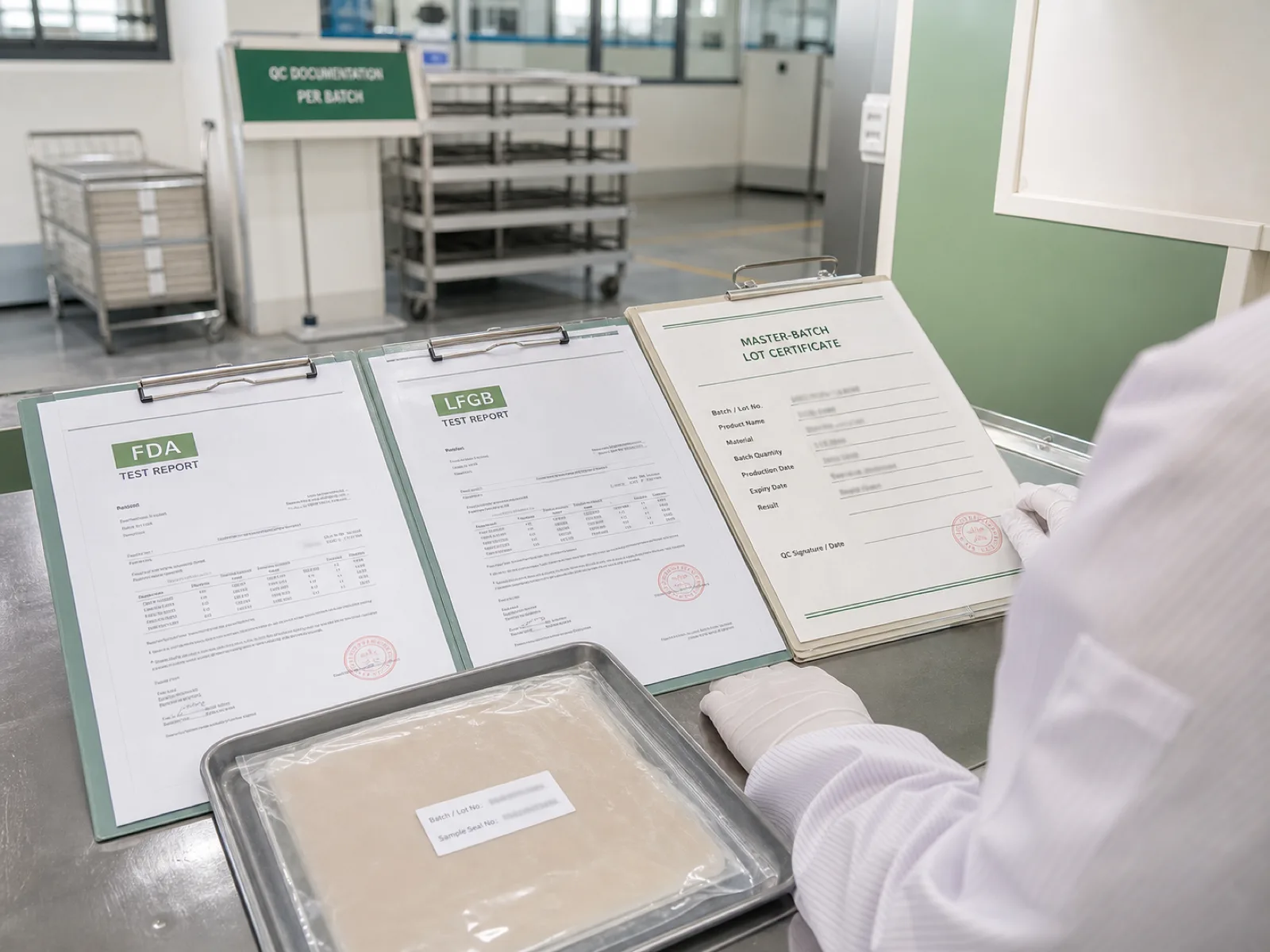
The compliance packet structure:
- FDA 21 CFR 177.2600 third-party extract report — from SGS / Intertek / TÜV / Bureau Veritas, per production batch, referencing master-batch lot number.
- LFGB §30/31 three-simulant migration report — same lab, same batch, three simulants (water, 3% acetic acid, 95% ethanol) per BfR Recommendation XV1.
- PFAS non-detect analysis — parts-per-billion detection limits, accredited lab, bundled on premium programs.
- Master-batch lot certificate — cure system, Shore A hardness per ASTM measurement, Pantone reference, compound-house lot number, batch identifier.
- Post-cure cycle log — temperature-time profile, batch identifier, ISO 9001 documented process control retention.
- Compound-house material traceability chain — the paper trail from finished-part master-batch lot back to raw silicone gum lot number.
All six documents bundled into one PDF referencing your PO number, delivered with the shipment tracking information.
What Wetop delivers on private-label programs
Wetop runs private-label programs with transparent line-item pricing, per-batch compliance packet included, mold dedication as standard. MOQ 500 per SKU on new tooling; MOQ 250 on reorders against existing tooling. Sample lead time 7-15 business days on existing tooling; 18-25 days on new P20 tooling from CAD sign-off. Mass production 30-45 calendar days after sample approval. Every batch documented with FDA + LFGB + master-batch lot cert bundled at no add-on. PFAS non-detect included on premium retail programs at no per-unit surcharge.
Wetop’s private-label program defaults:
- Transparent line-item pricing — every quote lists raw compound, tooling amortization at defined volume tiers, press time, post-cure, testing, color matching, and packaging as separate lines.
- Volume tier discount curve documented at 500 / 1,000 / 2,000 / 5,000 breakpoints on every quote.
- Testing bundled at no add-on — FDA + LFGB per batch; PFAS non-detect on request or bundled on premium programs.
- Mold dedication as standard — tooled molds are customer property, dedicated storage, not run for competing buyers.
- Category-level exclusivity + multi-year non-compete available as contract terms on programs above MOQ 2,000 or multi-year commitments.
- PPAP-adjacent first-article discipline4 — sample approval treated as documented milestone, not open-ended cycle.
See MOQ & lead time on custom silicone kitchenware for how the timeline runs, silicone OEM pricing structure for the per-line cost breakdown, and the 12-question sourcing checklist for how to vet Wetop or any other silicone OEM before signing.
Sourcing a private-label program with a retail launch date to hit? Email inquiry@wetopsilicone.com with your CAD or written brief, target retail tier, and target ship date working backward — we come back with the 5-stage schedule, per-unit quote at MOQ 500 / 1,000 / 5,000, and any engineering questions we’d need answered before committing.
Ready to source? Every quote is built against your specification — send a CAD file, a written brief, or reference samples, and an engineer replies within one business day. Request a quote →
Footnotes
-
German Federal Institute for Risk Assessment. Recommendation XV — Silicones. https://www.bfr.bund.de/en/bfr_recommendations_on_food_contact_materials-7498.html ↩ ↩2
-
International Organization for Standardization. ISO 2859-1:1999 — Sampling procedures for inspection by attributes. https://www.iso.org/standard/1141.html ↩
-
World Intellectual Property Organization. WIPO IP Protection Framework. https://www.wipo.int/portal/en/index.html ↩
-
International Automotive Task Force. IATF 16949:2016. https://www.iatfglobaloversight.org/iatf-169492016/ ↩
FAQ
-
How long does an end-to-end private-label silicone program take from RFP to first shipment?
90-120 calendar days for a first-time program on new tooling. Sequence: 3-5 days spec review + CAD confirmation, 10-14 days P20 mold cutting on 5-axis CNC, 5-7 days first-article sample production, 7-14 days customer approval + revision cycle (this is where most programs slip — buffer it), 30-45 days mass production including per-batch FDA + LFGB testing under ISO 2859-1 sampling[^iso-2859-1], 5-10 days pre-shipment inspection + documentation packet, then ocean freight or DDP AWD. Reorders against existing tooling drop to 45-60 calendar days. See [MOQ & lead time guide](/guide/moq-and-lead-time-silicone-oem/) for the complete 13-row schedule breakdown.
-
What documents does a private-label program need to sign to protect the brand?
Three documents establish the private-label relationship: (1) mutual NDA covering technical drawings, brand-mark artwork, packaging concepts, sales channel information, and cost/pricing data. Wetop provides a template or signs the customer's template. (2) Purchase order with mold dedication clause — the tooled mold is customer property; we don't run your geometry for competing buyers. Non-compete term negotiable. (3) Master supply agreement or similar for multi-year programs, defining pricing frameworks, quality standards, IP protection, and dispute resolution. Wetop treats these as standard documentation, not add-on friction. See the [NDA page](/nda/) for our standard template.
-
Can I be the exclusive brand in a particular retail channel or category?
Yes, negotiable in the PO or master supply agreement. Wetop offers three exclusivity mechanisms: (1) SKU exclusivity — the specific geometry + brand mark combination we produce runs only for you. Standard on all programs. (2) Category-level exclusivity — Wetop doesn't OEM competing product in the same retail category to a competing brand. Available as a contract term for programs above MOQ 2,000. (3) Multi-year non-compete — Wetop dedicates specific press capacity + engineering resources to your program only. Available for programs at MOQ 5,000+ or multi-year commitments. Each level carries different economic terms and volume commitments; the [sourcing checklist](/guide/sourcing-silicone-factory-checklist/) Question 9 walks the framework.
-
What IP protection exists for a private-label silicone product design?
Three separate IP frameworks apply, and each has different enforcement mechanics. (1) Utility patents — for functional inventions that are novel and non-obvious, filed with USPTO in the US[^uspto-design] or corresponding EU/CN patent authorities. Applies to distinctive functional features (specific geometry that solves a specific problem). (2) Design patents / registered community designs — for distinctive visual appearance not driven by function, filed with USPTO or EUIPO in the EU[^euipo-design]. Applies to the specific silhouette + surface design. (3) Trademarks and trade dress — for brand-mark + packaging visual identity, protected via trademark registration. WIPO harmonizes international IP protection frameworks[^wipo-ipd]. Wetop supports customer IP protection by keeping tooled molds customer-dedicated and enforcing NDA covenants.
-
What is the actual per-unit cost breakdown for a private-label silicone kitchenware program?
Seven line items at MOQ 500. Raw silicone compound (20-30% of unit price), P20 mold amortization ($4/unit at MOQ 500 dropping to $0.40/unit at MOQ 5,000), dedicated press time (10-20%), post-cure oven cost (5-10%), per-batch FDA + LFGB third-party testing (2-30¢/unit depending on volume), master-batch Pantone color matching (5-8%), and retail-ready packaging (15-35%, most variable). Baseline unit price: $3.00-$5.00 USD FOB Yantian for typical Tier 2 retail geometry. See [silicone OEM pricing structure](/guide/silicone-oem-pricing-structure/) for the full stack. Volume tier discount curve: MOQ 1,000 ~10-15% cheaper per unit, MOQ 5,000 ~35-40% cheaper.
-
How does the IATF 16949 PPAP framework apply to private-label silicone programs?
PPAP (Production Part Approval Process) is the automotive industry's first-article approval discipline[^iatf-16949] — but the framework's discipline maps cleanly onto serious retail OEM programs. Applied to silicone: PPAP submission before mass production requires master-batch lot certificate, dimensional verification against CAD (with CMM measurement), first-article inspection report, and process capability (Cpk) documentation. The framework treats the sample-to-mass-production transition as a documented approval-decision milestone, not an unbounded schedule risk. Wetop runs PPAP-adjacent discipline on every new program — the customer's decision to release mass production is a specific date on the schedule, not 'when you're ready.' This converts private-label program commitment from a leap-of-faith into a documented engineering acceptance.
-
What happens if there's a quality issue on a shipped batch?
The compliance packet documents traceability. Every shipment includes the FDA + LFGB per-batch test reports, PFAS non-detect on premium programs, master-batch lot cert with cure system + Pantone reference + Shore A hardness, and post-cure cycle log. If a downstream defect is reported, the response workflow: (1) request the master-batch lot number + shipment reference from the customer, (2) pull the corresponding batch documentation from the 36-month ISO 9001 retention archive[^iso-9001], (3) identify the specific production batch + press cycle + QC record, (4) determine root cause (mold contamination, off-spec master-batch, press temperature drift, or downstream damage), (5) implement corrective action per ISO 9001 process control and communicate to customer within one business day. This is why the paperwork discipline matters — root cause resolution depends on batch traceability that pre-exists the incident.
References
Authoritative sources cited in this guide
- International Organization for Standardization. ISO 9001:2015 — Quality Management Systems — Requirements. https://www.iso.org/standard/62085.html — The QMS standard behind master-batch lot retention, per-batch documentation, and the 36-month traceability that anchors private-label program quality accountability.
- US Food and Drug Administration. 21 CFR 177.2600 — Rubber articles intended for repeated use. https://www.ecfr.gov/current/title-21/chapter-I/subchapter-B/part-177/subpart-C/section-177.2600 — The US food-contact regulation whose per-batch testing is bundled into every Wetop private-label program's compliance packet.
- German Federal Institute for Risk Assessment. BfR Recommendation XV — Silicones. https://www.bfr.bund.de/en/bfr_recommendations_on_food_contact_materials-7498.html — The technical standard behind LFGB §30/31 whose per-batch report is standard on premium-tier private-label programs.
- International Automotive Task Force. IATF 16949:2016 — Quality management systems (automotive). https://www.iatfglobaloversight.org/iatf-169492016/ — The PPAP framework whose first-article approval discipline maps onto serious silicone OEM sample-to-mass-production transitions.
- World Intellectual Property Organization. WIPO IP Protection Framework. https://www.wipo.int/portal/en/index.html — The international framework harmonizing patent, trademark, and design protection across jurisdictions relevant to global private-label programs.
- US Patent and Trademark Office. USPTO Design Patent Framework. https://www.uspto.gov/patents/basics/types-patent-applications/design-patent-application-guide — The US design patent framework applicable to distinctive visual appearance of private-label silicone kitchenware products.
- European Union Intellectual Property Office. EUIPO Registered Community Design. https://euipo.europa.eu/ohimportal/en/rcd — The EU registered community design framework applicable to private-label silicone kitchenware in EU markets.
- European Chemicals Agency (ECHA). PFAS Universal Restriction Proposal. https://eur-lex.europa.eu/legal-content/EN/TXT/?uri=CELEX%3A32006R1907 — The regulatory framework driving PFAS non-detect testing as a standard compliance packet line item on premium private-label programs.
Start a custom program
Send a brief. Get an engineer’s reply in one business day.
Every Wetop program is tooled from a customer’s specification. Send a CAD file (STEP · IGES · DWG) or a written brief and we’ll reply with a mold cost estimate, price brackets at MOQ 500 / 1,000 / 5,000, and any engineering questions.