Buyer Guide · commercial intent
Silicone Bib Wholesale — Buyer's Guide for OEM Programs
 Buyer Guide
 Silicone bib wholesale programs sit at the intersection of two regulatory tracks — food-contact clearance under FDA 21 CFR 177.2600[^fda-177-2600] and LFGB §30/31, and children's-product safety under CPSIA Section 101[^cpsia-101] and ASTM F963-23[^astm-f963]. Factory-direct MOQ starts at 500 pieces per SKU on shared tooling and 2,000 pieces on dedicated custom molds, with FOB China pricing between $0.80 and $3.50 depending on weight, colorway, and packaging tier. First-cycle lead time is 90-100 days end-to-end; landed cost to a US 3PL runs approximately 1.35× FOB.
Buyers usually arrive at “silicone bib wholesale” search after a first order has already gone wrong — a lot came in off-color, a Children’s Product Certificate turned out to be missing when the container hit Long Beach, or a “factory” quote came from an office that also sells three unrelated categories. This guide is written for private-label brand owners, Amazon aggregators, and retail category managers who need to specify, price, and qualify a real silicone baby bib manufacturer for a program that will run more than one PO. It covers the two compliance stacks, factory-vs-trader diagnostics, MOQ and tooling economics, the QC packet retailers actually accept, and the landed-cost math from FOB to shelf.
What separates a real silicone bib factory from a trading company?
A real silicone bib factory owns the compression or LSR injection mold, runs its own mixing and curing on-site, and can produce a live video of a mold change within 24 hours. Trading companies aggregate orders across three or four small workshops, share tooling between unrelated customers, and cannot show a single accountable chain of custody when a Children's Product Certificate audit hits. The tell is quote turnaround, tooling ownership, and lot-specific documentation.
Four fingerprints separate the two on the sourcing call. First, business address: a factory has one physical molding site with a matching business license and a Google-Maps satellite image showing the building footprint; a trader has an office address shared with two or three unrelated companies. Second, tooling ownership: a factory can pull the mold from its rack on request and show the cavity impression on video; a trader routes the request through an unnamed subcontractor and returns three days later. Third, quote structure: a factory returns a technical quote in 48-72 hours breaking out compound, mold number, cycle time, and packaging separately; a trader quotes a flat per-piece price with no line items. Fourth, CPC readiness: a factory has a template Children’s Product Certificate on file and can name its third-party testing lab (Intertek, SGS, Bureau Veritas, TÜV); a trader has never heard the term.
What compliance stacks does a wholesale silicone baby bib need?
Wholesale silicone baby bibs need two parallel compliance stacks, not one. The food-contact stack covers FDA 21 CFR 177.2600 for US shipments and LFGB §30/31 for EU shipments, plus California AB 1200 PFAS-free declarations from 2027. The children's-product stack covers CPSIA Section 101 lead and phthalate limits, ASTM F963-23 mechanical safety, and 16 CFR 1501 small-parts testing for the US; EN 71-3 migration of certain elements and REACH SVHC screening for the EU. Buyers who only carry the food-contact leg fail at customs on the toy-safety leg.
The two stacks test different things on different sample masses at different labs. The food-contact stack extracts the silicone in food-simulating solvents (distilled water, 3 % acetic acid, 50 % ethanol, food oil) and measures total extractables at 40 °C or 100 °C per the CFR protocol. The children’s-product stack digests the bib in acid and measures total lead content at ≤ 90 ppm in coating and ≤ 100 ppm in substrate per CPSIA, along with eight regulated phthalates each capped at 1000 ppm[^cpsc-1501]. A single supplier report that claims to cover both is either fabricated or a compound-level document that does not survive customs scrutiny. See our FDA vs LFGB silicone deep-dive for the food-contact side and the CPSC Business Guidance page for the CPSIA side.
| Region | Food-contact leg | Children’s-product leg | Additional |
|---|---|---|---|
| US retail | FDA 21 CFR 177.2600 | CPSIA §101 + ASTM F963-23 + 16 CFR 1501 + CPC | California Prop 65 · AB 1200 PFAS (2027) |
| EU retail | LFGB §30/31 | EN 71-3 migration of elements | REACH SVHC · Toys Directive 2009/48/EC |
| Canada | Health Canada food contact | Consumer Product Safety Act (CCPSA) | SOR/2016-193 phthalates |
| Australia | FSANZ food contact | AS/NZS 8124 toy safety | Product Safety Australia registration |
What is the MOQ structure for silicone bib wholesale?
Factory-direct MOQ at Wetop is 500 pieces per SKU on shared tooling in a stock colorway, 1,000 pieces for a custom Pantone-matched color run because master-batch has its own minimum, and 2,000 pieces for a dedicated new mold. Trading companies quote 100-piece MOQs by aggregating orders — the low floor comes with shared molds, no colorway control, and pooled inspection. Real factory pricing under 500 pieces almost always signals a discontinued-stock closeout, not a legitimate small run.
The MOQ math is compound-driven, not part-driven. A four-cavity LSR injection mold produces one bib every 45-60 seconds, so a 500-piece run occupies the press for roughly 90-125 minutes plus mold-change and QC — a full production shift when you add setup and first-article approval. Below 500 pieces the fixed setup cost per piece exceeds the material cost, and the factory either loses money or quotes a small-order surcharge that erases the “low MOQ” advantage. Our real factory MOQ math guide covers the underlying press economics and why the 500-piece floor exists across the industry, not just at one factory.
| Program tier | MOQ per SKU | Tooling cost | Per-piece FOB range |
|---|---|---|---|
| Shared mold + stock color + polybag | 500 pieces | $0 | $0.80 - $1.60 |
| Shared mold + custom Pantone color | 1,000 pieces | $150-400 (master-batch) | $1.20 - $2.20 |
| Shared mold + debossed logo | 500 pieces | $80-250 (deboss insert) | $1.00 - $2.00 |
| Dedicated custom mold + retail carton | 2,000 pieces | $1,800-4,500 (compression) or $6,000-12,000 (LSR) | $1.80 - $3.50 |
How is wholesale silicone bib pricing built up?
Wholesale silicone bib FOB pricing decomposes into four buckets: raw silicone compound at 40-55 % of FOB, direct labor and press time at 15-20 %, packaging and hang tags at 10-15 %, and factory overhead plus margin at 20-25 %. A 100-gram toddler bib in platinum-cured food-grade silicone runs $0.42-0.55 in raw material alone at $4.20-5.50 per kilo compound price. Retail-ready folding cartons add $0.15-0.35 per piece and can move the FOB by a full pricing tier without touching the bib itself.
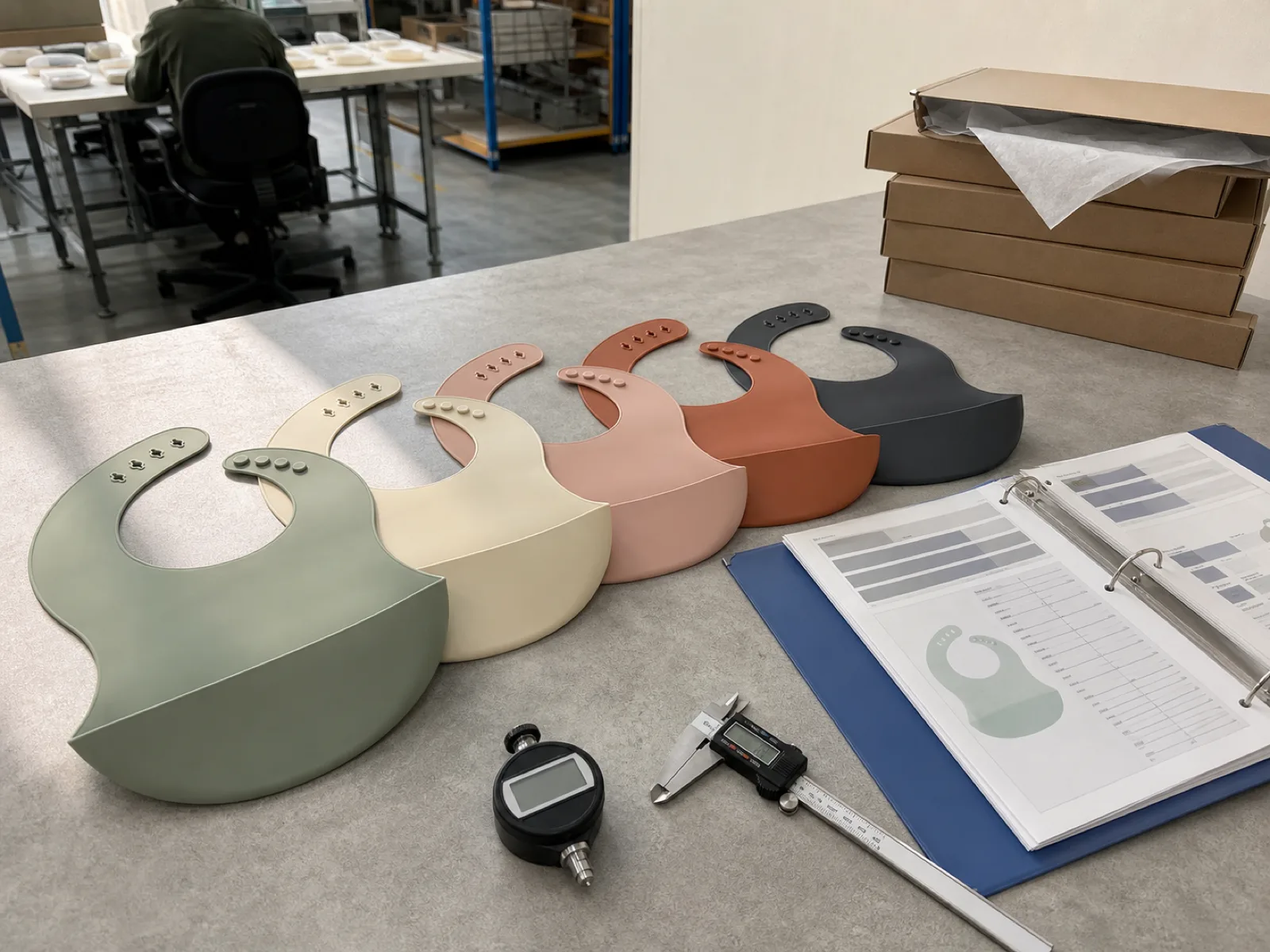
The dominant cost driver is silicone weight, which is why bib geometry matters more than bib size. A 60-gram flat infant bib and a 140-gram bib with a deep crumb-catcher pocket are two different price bands even at the same face dimensions, because the pocket doubles the material use on the pocket area. Colorway is the second-largest driver — stock colors (natural, sage, terracotta, charcoal, dusty pink) run at the color master-batch’s own MOQ and add nothing per piece, while a custom Pantone match requires a dedicated master-batch order of 25-50 kg minimum, amortized across the first PO. Logo debossing is cheap ($80-250 insert amortized) and printing is not — silicone screen printing on food-contact surfaces is unstable and most retail buyers reject it.
What custom OEM options does a silicone bib factory offer?
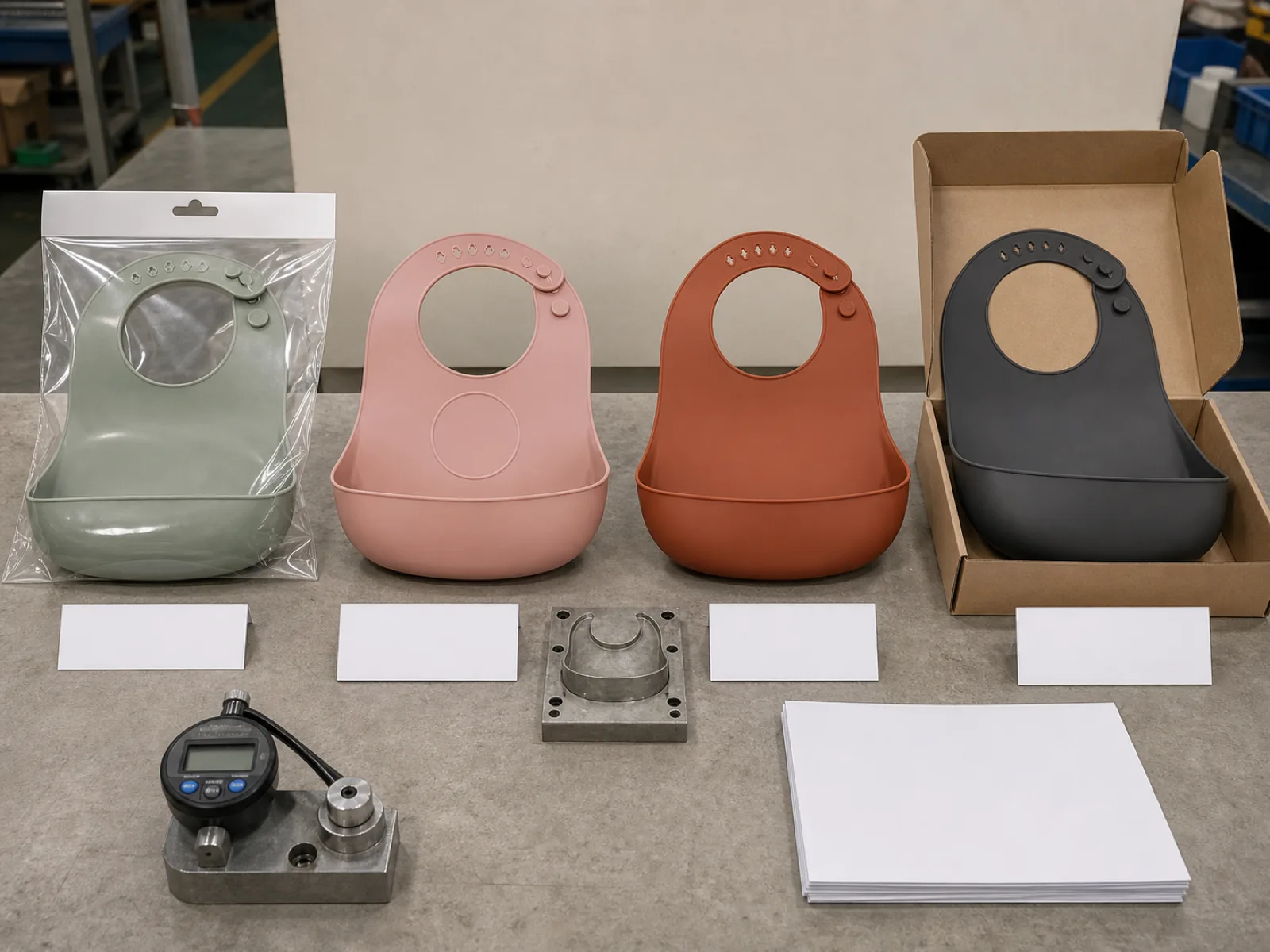
Custom OEM options for silicone bibs fall into four levers. Colorway options include stock catalog colors (no upcharge) and Pantone-matched custom colors ($150-400 master-batch setup). Logo options include debossed marks ($80-250 mold insert), laser marking ($0.05-0.15 per piece runtime), and hang-tag branding ($0.04-0.12 per tag). Pocket geometry can be modified within the shared mold's parametric range or requires a new dedicated mold. Packaging tiers run from bare polybag to Target-compliant retail folding cartons.
Debossing is the cleanest logo lever because it is molded into the bib body itself — no ink, no delamination, no CPSIA lead-in-surface-coating concern. The deboss insert is a small tool-steel plate that mounts into the existing mold cavity, so a shared-tool program can carry twelve different customer logos on twelve different insert plates without opening a new mold. Laser marking on silicone works but leaves a matte-gray mark that fades under dishwasher cycles, so it is used mostly for lot codes and date stamps rather than brand marks. Screen printing on silicone requires a plasma-treated surface, an addition-cure silicone ink, and a post-cure oven cycle — most factories that offer it have not actually validated the ink’s food-contact status. See our customize silicone logo guide for the full comparison.
What tooling costs and mold-life numbers apply?
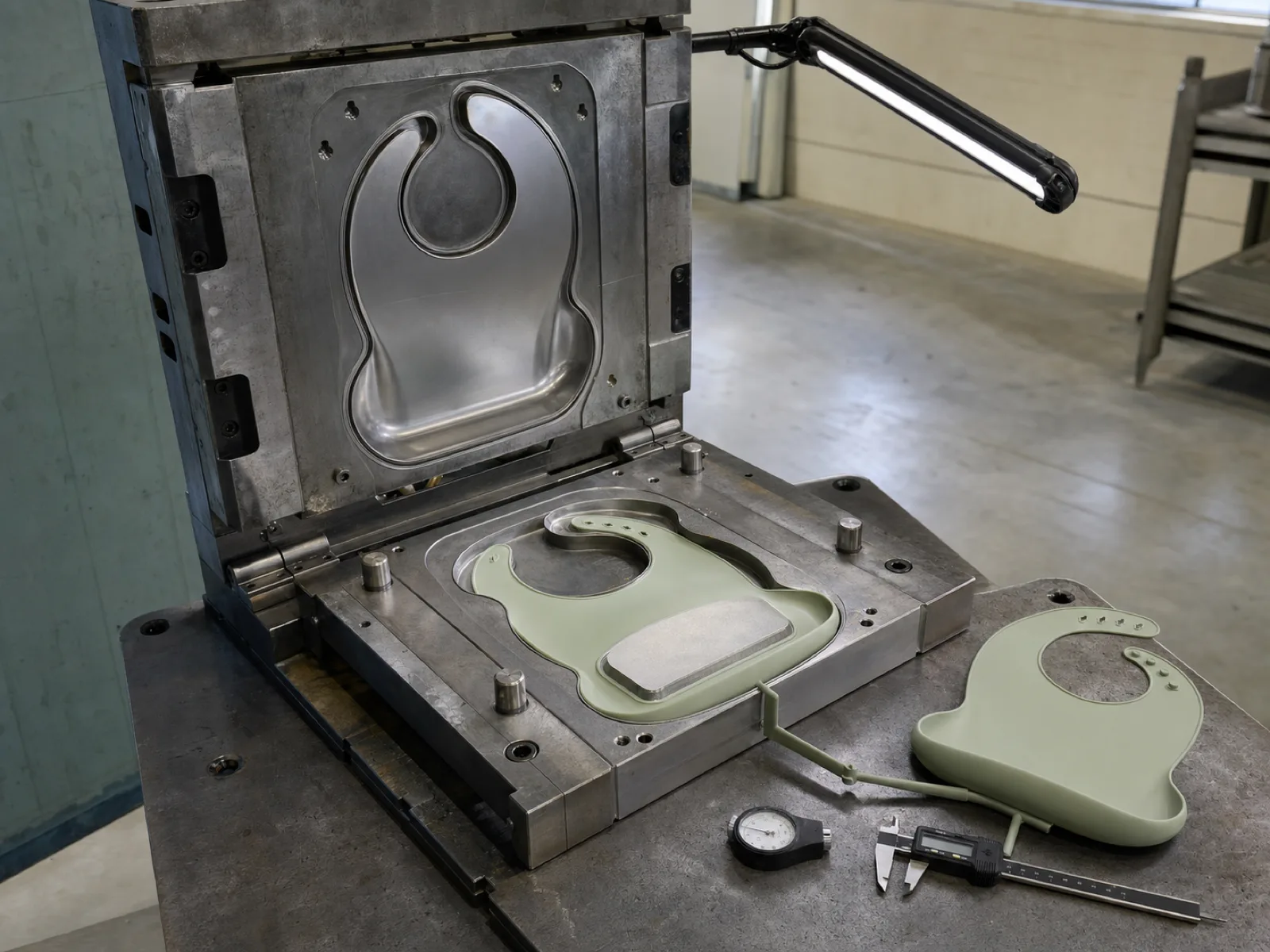
Custom tooling for a silicone bib runs $1,800-4,500 for a single-cavity compression mold and $6,000-12,000 for a four-cavity LSR injection mold. Compression tooling in P20 tool steel holds 300,000-500,000 shots before cavity refresh; LSR injection tooling in H13 hardened steel holds 1,000,000+ shots. Tooling ownership belongs to the buyer once the invoice is paid, with the mold stored at the factory rent-free for the program's active life and returned or destroyed on written request.
The compression-vs-LSR choice tracks program volume. Below 20,000 pieces per year, compression tooling amortizes faster and the slower cycle time (2-4 minutes per shot vs 45-60 seconds for LSR) does not bottleneck the program. Above 50,000 pieces per year, LSR injection is the correct choice because press time drops by roughly 4× and the four-cavity mold produces 4,000-5,000 bibs per press per day. The tooling PO should explicitly state ownership transfer at invoice payment, storage terms during the program’s active life, and disposition on program termination. Shared tooling programs skip the tooling cost entirely but give up colorway exclusivity and geometric distinctiveness.
What is the lead time for a first wholesale order?
First-cycle lead time from a real silicone bib factory runs 90-100 days end-to-end: 15-25 days for tooling if a new mold is required, 7-10 days for sampling and first-article approval, 25-35 days for mass production of 5,000-20,000 pieces, and 30-40 days for sea freight to US West Coast plus customs and drayage. Repeat orders on existing tooling collapse to 40-50 days because tooling and sampling drop out. Trading companies quote 45 days by starting the clock at production kickoff and ignoring the front-end.
The single biggest schedule miss on first orders is treating the sampling stage as a formality. First-article approval takes 3-5 buyer-side business days on average — the sample ships DHL air, the buyer measures, inspects colorway under D65 lighting, cross-checks the deboss depth against the spec, and either signs the golden-sample form or returns comments. If the sample fails on colorway or geometry, the factory reworks the master-batch or the deboss insert and re-samples in 5-7 days, which cascades into the production start date. Building in one full re-sample cycle on the timeline is the difference between a program that ships on time and one that misses the retail set date.
What QC packet should ship with every lot?
The mandatory QC packet has six line items. Raw material Certificate of Analysis from the silicone compound supplier. In-process durometer per ASTM D2240[^astm-d2240] at Shore A 40-60 with ±5 tolerance. Tear strength per ASTM D624[^astm-d624] die C at ≥ 20 kN/m. Small-parts cylinder test per 16 CFR 1501 for children under three years. Snap or button pull-off force ≥ 15 lbf per ASTM F963-23 Section 8.7. Final inspection at AQL 2.5 for major and 4.0 for minor defects per ANSI/ASQ Z1.4.
The QC packet is where trader-vs-factory becomes irreversible on paper. A real factory generates lot-specific Certificates of Analysis at end-of-run with actual measured durometer, actual tear strength, actual snap pull-off values, operator IDs, and metrology equipment IDs. A trader generates a PDF template with the same nominal values every shipment — the tell is trivial to catch: request lot data for the previous three shipments and cross-check numbers. If durometer reads 55 Shore A to the exact tenth on every lot, the CoA is fabricated. Small-parts testing per 16 CFR 1501 uses a specific cylinder (“small parts test fixture”) 3.17 cm in diameter and 5.71 cm deep — any bib component that fits fully inside without compression is a choking-hazard failure for the under-three age grade.
| QC line item | Test standard | Acceptance criterion | Frequency |
|---|---|---|---|
| Compound identity | Supplier CoA | Grade certificate match | Per raw material batch |
| Durometer hardness | ASTM D2240 | Shore A 40-60 ±5 | Every 500 pieces in-process |
| Tear strength | ASTM D624 die C | ≥ 20 kN/m | Every production lot |
| Snap pull-off force | ASTM F963-23 §8.7 | ≥ 15 lbf | Every production lot |
| Small parts | 16 CFR 1501 | No pass-through | Every design revision |
| Final inspection | ANSI/ASQ Z1.4 | AQL 2.5 major / 4.0 minor | Every shipment |
How do I calculate landed cost from FOB to US retail?
Landed cost from FOB China to a US 3PL runs approximately 1.35× the FOB price for volumes above 5,000 pieces per PO. On a $1.50 FOB bib, ocean freight adds 12-18 % ($0.22), US import duty on HTS 3924.90.5650 baby articles is 3.4 % ($0.06), customs brokerage and drayage add $0.10-0.15, 3PL receiving and 90-day storage add 8-10 % ($0.13), and returns reserve at 6-8 % adds another $0.10. Delivered cost lands around $2.00; retail sell-in at a 2.2-2.5× keystone reaches $4.40-5.00 wholesale to $9-15 retail.
The 1.35× multiplier holds above 5,000 pieces per PO; below that, ocean freight per piece rises sharply because a 20-foot container carries roughly 40,000-60,000 bibs depending on weight and packaging, and consolidating LCL freight adds $80-150 in fixed handling fees. Air freight is generally not viable for silicone bibs because the weight-to-value ratio is unfavorable — $6-8 per kg air rate lands a 100-gram bib at $0.60-0.80 in freight alone, doubling FOB cost. The break-even is around 500 pieces for air, above which sea freight always wins on landed cost even with the 30-40 day transit. Retailers that require a 60-day fill-rate on repeat orders typically hold six weeks of safety stock at the 3PL to bridge the sea-freight lead time.
What packaging tier does the retail channel require?
Packaging tier is determined by the retail channel, not the buyer's preference. Amazon FBA requires FNSKU labels, GS1 GTIN barcodes, and case-pack conformance (typically 6 or 12 units per master carton, under 50 lb, dimensions ≤ 25 × 20 × 20 inches). Target and Walmart require retail-ready folding cartons with printed lot codes, age grading, country-of-origin marking legible without opening, and CPC accompanying the shipment. Boutique and DTC channels can use polybag with hang tag. Retail-ready folding cartons add $0.15-0.35 per piece and 8-12 days to lead time.
The two most common wholesale silicone bib failures at retail intake are missing country-of-origin marking (US Customs 19 CFR 134 requires it on the outermost individual retail package, legible in English) and missing CPC (CPSIA requires a Children’s Product Certificate to accompany each shipment of a children’s product). Both are shipment-refusal issues at the port or the retailer’s DC, not just paperwork issues. A supplier that has not shipped Target or Walmart retail-ready cartons before will typically miss the folding-carton tolerance on the first order — Target’s flat-pack folding-carton spec, for example, allows ±0.8 mm on external dimensions, tighter than a first-time carton print run usually achieves.
Silicone vs alternative bib materials — when does silicone win?
Silicone wins over cotton-backed, TPE, and EVA bibs on dishwasher and sterilizer resistance, staining, temperature range, and lifespan. Platinum-cured silicone holds a -60 °C to +230 °C working range, survives 500+ dishwasher cycles without color migration, and does not absorb food dyes or oils. Cotton-backed bibs stain permanently within 20-30 wash cycles. TPE and EVA bibs lose durometer above 80 °C and cannot survive steam sterilization. Silicone loses on cold-weather softness — below 0 °C the bib becomes stiff enough that toddlers push back on wearing it.
The staining resistance advantage is the single biggest sell-through driver for silicone at retail. Turmeric, tomato, blueberry, and beetroot pigments migrate into cotton and TPE bibs within days and never wash out; on food-grade silicone, the same pigments wipe off with warm water and dish soap because the polymer surface energy is too low for the pigment to adhere covalently. This is why parents replace fabric bibs every three to six months and silicone bibs once every twelve to eighteen months. The lifespan differential is a retail merchandising story worth featuring on the hang tag: “Replaces 4-6 fabric bibs” is a defensible sell-through claim on food-grade silicone certified to FDA 21 CFR 177.2600 and CPSIA Section 101.
How do I remotely qualify a Chinese silicone bib manufacturer?
Run a four-step remote qualification: (1) request the ISO 9001:2015 certificate[^iso-9001] and cross-check the accreditation body against IAF MLA membership; (2) get a live video walk of the molding cell showing mold change and durometer testing; (3) order paid samples on your drawing and measure durometer, snap pull-off, and dimensions on your own metrology equipment; (4) send samples for third-party FDA 177.2600 and CPSIA §101 testing at Intertek, SGS, TÜV, or Bureau Veritas before releasing tooling PO.
The four steps take 30-45 days and eliminate roughly 90 % of the fake-factory risk. Step 3 is the one most often skipped and most often regretted. A factory sending its own dimensional and durometer data on the first article is not lying — it is measuring what came off the press on the day the operator wanted the numbers to look good. Your metrology is the only data that matters, because your metrology is what the retail buyer or Amazon 3PL will use when the container arrives. For the China-specific logistics — Yantian port cut-off, Shenzhen airport routing, sample-to-PO timeline — see our full sourcing silicone factory checklist.
Wetop as your silicone bib wholesale supplier
Wetop runs LSR injection and compression molding cells for food-grade and children’s-product silicone programs under ISO 9001:2015 factory certification. We ship per-lot Certificates of Analysis referencing ASTM D2240 durometer, ASTM D624 tear strength, ASTM F963-23 snap pull-off, and 16 CFR 1501 small-parts testing, alongside compound-level FDA 21 CFR 177.2600, LFGB §30/31, EN 71-3, and REACH SVHC[^echa-reach] documentation. We are a founder-led independent factory in Dongguan — 90 minutes to Yantian Port, two hours to Hong Kong airport — with a 60-person team on 7,500 m² and a track record of shipping wholesale programs to Tier-2 US and EU retail channels.
If you are moving off a trading company or specifying a new silicone bib wholesale program and want a real factory quote, send us your spec and we will return a technical quote within three business days including compound compliance documentation, tooling cost, mold cavity plan, packaging tier options, and a first-article timeline. Include target weight (60-140 g), colorway (stock or Pantone), logo lever (deboss, laser, or hang tag), packaging tier (polybag, hang tag, or retail-ready carton), annual volume estimate, and target markets so we can quote both compliance stacks against your actual retail requirements.
References
The specifications, test methods, and regulatory citations in this guide are drawn from the following primary standards and government sources. All URLs are the publisher’s canonical location; clause numbers and test conditions cited above match the current published revision.
FAQ
-
What is the MOQ for silicone bib wholesale from a factory?
Factory-direct MOQ at Wetop is 500 pieces per SKU when the program uses an existing shared mold in a stock colorway, and 2,000 pieces per SKU when a dedicated custom mold is opened. Trading companies often quote 100-piece MOQs by combining your order with two or three other buyers on the same mold — the price looks low but you lose colorway control, packaging control, and inspection accountability. A real silicone bib manufacturer will publish separate MOQs for the bib body, the crumb-catcher pocket detail, custom colorway, custom packaging, and logo debossing. Anything below 500 pieces at true factory pricing is either an aggregated order or a discontinued-stock closeout.
-
What certifications do wholesale silicone baby bibs need for US and EU retail?
US retail requires two parallel tracks. Food-contact clearance is FDA 21 CFR 177.2600 rubber articles for repeated use, and children's product compliance is CPSIA Section 101 (lead and phthalate limits) plus ASTM F963-23 mechanical safety, with a Children's Product Certificate signed by the importer. EU retail requires LFGB §30/31 for food contact and EN 71-3 migration of certain elements for the toy-safety leg, plus REACH SVHC screening. California AB 1200 PFAS-free declaration is required for products sold in California from 2027. A supplier that only cites FDA is missing the CPSIA leg — that is a shipment-refusal risk at the port.
-
How much does a silicone bib cost wholesale FOB China?
Wholesale silicone bib FOB pricing runs $0.80 to $3.50 per piece. A basic 60-gram infant bib in a stock color with polybag packaging lands at $0.80-1.20. A 100-gram toddler bib with crumb-catcher pocket, adjustable button neck closure, and printed hang tag lands at $1.60-2.40. A 140-gram premium bib with debossed logo, Pantone-matched custom color, retail-ready folding carton, and CPC bundled into the price lands at $2.80-3.50. The three biggest cost drivers are silicone weight (raw material is 40-55 % of FOB), colorway complexity, and retail-ready packaging.
-
What is the difference between food-grade FDA compliance and CPSIA children's product compliance?
FDA 21 CFR 177.2600 is a food-contact regulation covering the silicone compound's extractables in food-simulating solvents. CPSIA Section 101 is a children's product safety law covering total lead content (≤ 90 ppm in surface coating, ≤ 100 ppm in substrate) and phthalates (eight regulated phthalates each ≤ 1000 ppm). A silicone bib for infants 6-36 months must pass both because it contacts food and is a children's article. The tests are done by different labs, on different sample masses, against different chemistries. A single FDA report is not proof of CPSIA compliance and vice versa — buyers who accept one document for both requirements are one CPSC inspection away from a recall.
-
How do I choose between a trading company and a factory-direct silicone bib supplier?
Four fingerprints separate factories from traders. First, address — a factory has one physical extrusion/molding site with a matching business license; a trader has an office address that houses three or four unrelated companies. Second, tooling ownership — a factory owns the molds and can show a live tool-change video; a trader borrows tooling from unnamed subcontractors. Third, quote turnaround — a factory returns a technical quote in 48-72 hours with a specific mold number; a trader takes 5-10 days with only a per-piece price. Fourth, CPC and CoA — a factory generates lot-specific Certificates of Analysis with real durometer readings; a trader sends a PDF template. Our [sourcing checklist](/guide/sourcing-silicone-factory-checklist/) covers the full audit protocol.
-
What tooling costs are involved in custom silicone bib OEM?
Custom tooling for a silicone bib runs $1,800 to $4,500 for a single-cavity compression mold and $6,000 to $12,000 for a four-cavity LSR injection mold. Shared tooling — where you use the factory's existing mold and only pay for colorway and logo setup — costs $150-400 for the color master-batch and $80-250 for a debossing insert. Mold life on P20 tool steel runs 300,000-500,000 shots for compression and 1M+ shots for LSR. Ownership clauses matter: the tooling PO should state that the buyer owns the mold after the invoice is paid, that the mold is stored at the factory rent-free for the program's active life, and that it will be returned or destroyed on written request.
-
What is the lead time for a first wholesale order of custom silicone bibs?
First-cycle lead time from a real factory runs 90-100 days end-to-end. Sample development is 7-10 days on shared tooling or 25-35 days if a new mold is required. First-article samples ship, buyer inspects and signs off in 3-5 days. Mass production runs 25-35 days for 5,000-20,000 pieces. Sea freight to US West Coast is 18-22 days ocean plus 5-7 days customs and drayage to a 3PL. Repeat orders on the same tooling collapse to 40-50 days total because sampling drops out. Trading companies quote 45-day first-cycle timelines by starting the clock at production kickoff and ignoring tooling and sampling — which is why so many wholesale silicone bib orders miss the retail set date.
-
What quality control tests should a wholesale silicone bib supplier run?
The mandatory QC packet has six line items. Raw material Certificate of Analysis from the silicone compound supplier (Dow, Wacker, Shin-Etsu, or Elkem grade). In-process durometer per ASTM D2240 at Shore A 40-60 with ±5 tolerance. Tear strength per ASTM D624 die C at ≥ 20 kN/m. Small-parts cylinder test per 16 CFR 1501 for any bib intended for children under three years. Snap or button pull-off force ≥ 15 lbf per ASTM F963-23 Section 8.7. Final inspection at AQL 2.5 for major defects and AQL 4.0 for minor defects, with a documented sample size per ANSI/ASQ Z1.4. Anything less is a factory that has not shipped to a real retail buyer.
-
How do I calculate landed cost from FOB silicone bib wholesale to US retail?
Landed cost math for a $1.50 FOB silicone bib works out to roughly $2.00 delivered to a US 3PL. Ocean freight adds 12-18 % (about $0.22 on $1.50). US import duty on HTS 3924.90.5650 baby articles is 3.4 % (about $0.06). Customs brokerage, port fees, and drayage add $0.10-0.15. 3PL receiving, storage for 90 days, and pick-and-pack add 8-10 % (about $0.13). Returns reserve at 6-8 % for retail sell-in adds another $0.10. The 1.35× FOB rule of thumb holds for volumes above 5,000 pieces per PO; below that, freight and 3PL fixed costs push it toward 1.50×.
-
What packaging specs matter for Target, Walmart, and Amazon FBA silicone bib listings?
Retail-ready packaging is the line between a wholesale order that sells through and one that ends up in a returns bin. Target and Walmart require GS1 GTIN barcodes, a printed lot code, age grading (6-36 months typical), and country-of-origin marking that is legible without opening the package. Amazon FBA adds FNSKU labels and case-pack requirements — usually 6 or 12 per master carton, weight under 50 lb, dimensions under 25 × 20 × 20 inches. Retail-ready folding cartons cost $0.15-0.35 each and add 8-12 days to lead time. Polybag with hang tag is $0.04-0.08. A supplier that cannot produce a Target-compliant retail carton on request is a wholesale-only supplier, not a retail-ready one.
References
Authoritative sources cited in this guide
- US Food and Drug Administration. 21 CFR 177.2600 — Rubber Articles Intended for Repeated Use. https://www.ecfr.gov/current/title-21/chapter-I/subchapter-B/part-177/subpart-C/section-177.2600
- US Consumer Product Safety Commission. Consumer Product Safety Improvement Act (CPSIA) Section 101 — Children's Product Safety. https://www.ecfr.gov/current/title-16
- US Consumer Product Safety Commission. 16 CFR 1501 — Method for Identifying Toys and Other Articles Intended for Use by Children Under 3 Years of Age Which Present Choking, Aspiration, or Ingestion Hazards. https://www.ecfr.gov/current/title-16/chapter-II/subchapter-C/part-1501
- ASTM International. ASTM F963-23 — Standard Consumer Safety Specification for Toy Safety. https://www.astm.org/f0963-23.html
- ASTM International. ASTM D2240 — Standard Test Method for Rubber Property — Durometer Hardness. https://www.astm.org/d2240-15r21.html
- ASTM International. ASTM D624 — Standard Test Method for Tear Strength of Conventional Vulcanized Rubber. https://www.astm.org/d0624-00r20.html
- European Committee for Standardization (CEN). EN 71-3:2019+A1:2021 — Safety of Toys — Migration of Certain Elements. https://standards.iteh.ai/catalog/standards/cen/93c0ce27-6a86-4a8f-8f6d-5b0a2ef29a76/en-71-3-2019a1-2021
- European Chemicals Agency. REACH Candidate List of Substances of Very High Concern (SVHC). https://eur-lex.europa.eu/legal-content/EN/TXT/?uri=CELEX%3A32006R1907
- International Organization for Standardization. ISO 9001:2015 — Quality Management Systems — Requirements. https://www.iso.org/standard/62085.html
Start a custom program
Send a brief. Get an engineer’s reply in one business day.
Every Wetop program is tooled from a customer’s specification. Send a CAD file (STEP · IGES · DWG) or a written brief and we’ll reply with a mold cost estimate, price brackets at MOQ 500 / 1,000 / 5,000, and any engineering questions.