Manufacturing · commercial intent
Silicone Catheter Manufacturer OEM Guide
What changed: First publication under the v3 anti-navel-gazing standard — benchmarked against top-ranking catheter-manufacturing and LSR supplier pages (Operon Strategist, LSR Injection, Elkem, Spectrum) and rewritten with USP Class VI / ISO 10993 clause citations, French-size dimensional tables, a sterilization property-change matrix, and an OEM validation flow (IQ/OQ/PQ) that competitor pages do not disclose. Scope note added: Wetop supplies catheter-grade silicone tubing and molded components, not finished FDA-cleared catheters.
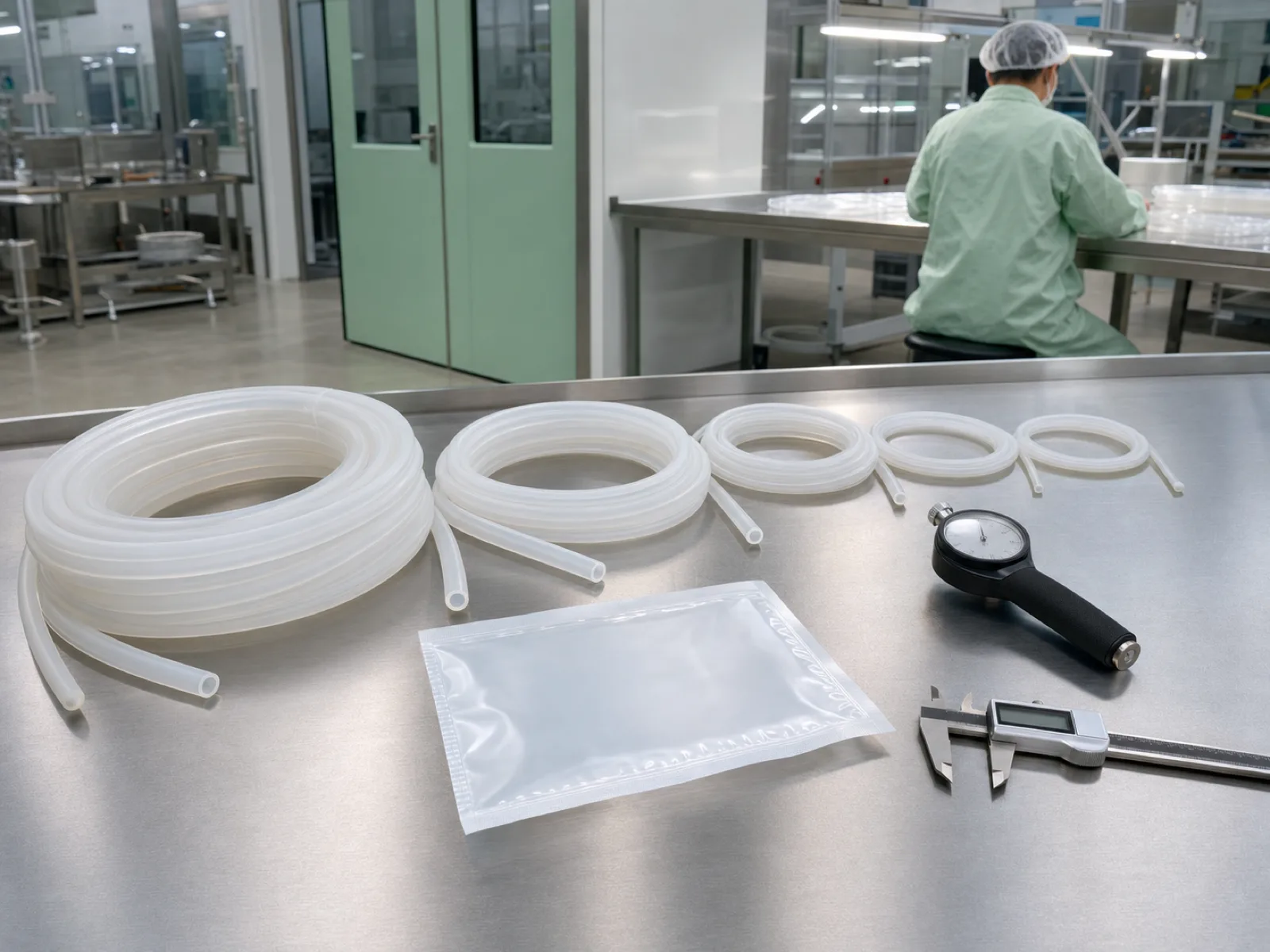 Manufacturing
 A silicone catheter manufacturer serving medical programs works in platinum-cured polydimethylsiloxane, extruded to ISO 3302-1 precision tolerances and cleared to USP Class VI and ISO 10993-5/-10 biocompatibility, to produce catheter-grade tubing and molded components — single-, double-, and triple-lumen bodies, Foley balloon sections, and drainage eyes. The defensible extrusion range is 6Fr-26Fr outer diameter, wall 0.20-1.20 mm, Shore A 40-80, produced in an ISO 14644-1 Class 7 or Class 8 cleanroom under an ISO 13485:2016 quality management system. The component supplier delivers the compliant silicone hardware and its documentation packet; the finished catheter's 510(k) clearance, design controls, and device biological evaluation belong to the device OEM.
Two buyers land on “silicone catheter manufacturer.” Device OEMs and their contract manufacturers arrive with a drawing, a French size, a lumen map, and a Device Master Record checklist — they need a component supplier who can extrude and mold catheter-grade silicone to ISO 13485 discipline and hand over the material data their submission references. Distributors and program managers arrive earlier and need to understand what grade, what tolerance, and what documentation a defensible catheter program actually requires. This guide covers both, written from inside a Dongguan extrusion and LSR floor benchmarked against USP <88>[^usp-88], ISO 10993-5[^iso-10993-5], and ISO 3302-1[^iso-3302-1] — and it draws a hard line on scope: we supply the silicone, not the cleared device.
What silicone grades are used for catheter manufacturing, and when is each required?
Catheter silicone is graded by cure chemistry and compliance depth: platinum-cured PDMS is the only defensible grade for urinary, drainage, and vascular-access catheters because it leaves no by-products and passes USP <88> Class VI and ISO 10993-5 cleanly. Peroxide-cured silicone is disqualified from indwelling catheter contact and retained only for non-medical fluid transfer.
The grades a catheter program will see on supplier data sheets:
Standard catheter grade — platinum-cured PDMS. A two-part addition-cure system (vinyl-terminated PDMS + hydride cross-linker + platinum catalyst) that cures with no residual by-products, is odor-free, and passes USP <87>/<88>[^usp-88] and ISO 10993-5[^iso-10993-5] on the standard compound. This is the floor for any medical catheter. Available as high-consistency rubber (HCR/gum) for extrusion and as liquid silicone rubber (LSR) for injection-molded balloons and hubs. Shore A 40-80.
Restricted-extractables catheter grade — platinum-cured, low-volatile compound. Same base chemistry, extra-refined for a tighter extractables/leachables profile validated per USP <661> and ISO 10993-18. Specified for long-dwell indwelling catheters and any vascular-access line where the leachables budget is scrutinized.
Radiopaque catheter grade. Platinum-cured silicone compounded with 20-40% barium sulfate (BaSO₄) for fluoroscopic tip visibility. It carries its own durometer, its own tensile profile, and its own USP Class VI and ISO 10993-5 reports — you cannot borrow the clear-compound data.
Peroxide-cured grade. Peroxide-cured PDMS requires a documented 4-8 hour post-cure at 200°C to drive off residual by-products and is generally disqualified from indwelling catheter contact. It survives only in non-medical fluid transfer. For the full cure-chemistry decision matrix, see the platinum-cured vs peroxide-cured silicone guide.
The trap: listings that market “medical silicone catheter tubing” against a peroxide compound with no post-cure log and no Class VI report. The grade is a claim until the test report against a specific compound lot number is on file. Demand it before wire-transferring a deposit.
What is the regulatory and biocompatibility stack for silicone catheters?
The catheter compliance stack is USP <87>/<88> Class VI biological reactivity, ISO 10993-5 and 10993-10 biocompatibility, ISO 13485:2016 QMS, and ISO 14644-1 cleanroom classification on the component side — with the finished catheter additionally meeting ISO 10555 performance requirements, ISO 14971 risk management, and a 510(k) pathway owned by the device OEM.
Split the stack into what the component supplier certifies versus what the device OEM owns.
The component supplier proves, on the silicone itself:
- USP <87> Cytotoxicity, in vitro and USP <88> Biological Reactivity, in vivo — Class VI is the tier for prolonged catheter contact. Report must reference the specific compound lot, not the compound family[^usp-88].
- ISO 10993-5:2009 — cytotoxicity, the baseline screen on every catheter compound[^iso-10993-5].
- ISO 10993-10:2010 — irritation and sensitization for the prolonged mucosal contact urinary and drainage catheters create[^iso-10993-10].
- ISO 10993-7:2008 — residual EtO / ECH / EG limits if the device OEM sterilizes with ethylene oxide downstream[^iso-10993-7].
- ISO 13485:2016 — the medical-device QMS; its scope must name silicone extrusion or molding[^iso-13485].
- ISO 14644-1:2015 — cleanroom classification, Class 7 or Class 8[^iso-14644-1].
- FDA 21 CFR 177.2600 — the US food-contact baseline, the floor beneath medical compliance, not a substitute for Class VI[^fda-177-2600].
The device OEM owns the finished-device layer: ISO 10555 intravascular-catheter performance testing (tensile, flow rate, corrosion, air aspiration), the ISO 10993-1 finished-device biological evaluation, ISO 14971 risk management, and the FDA 510(k) or EU MDR route[^fda-medical-devices]. A component supplier who claims to hand you a cleared device is crossing a regulatory line — our job is to make the material inputs unimpeachable so the OEM’s submission stands. For the deeper biocompatibility test-by-test walkthrough, see the USP Class VI six-test breakdown.
What French sizes and dimensional tolerances apply to silicone catheter tubing?
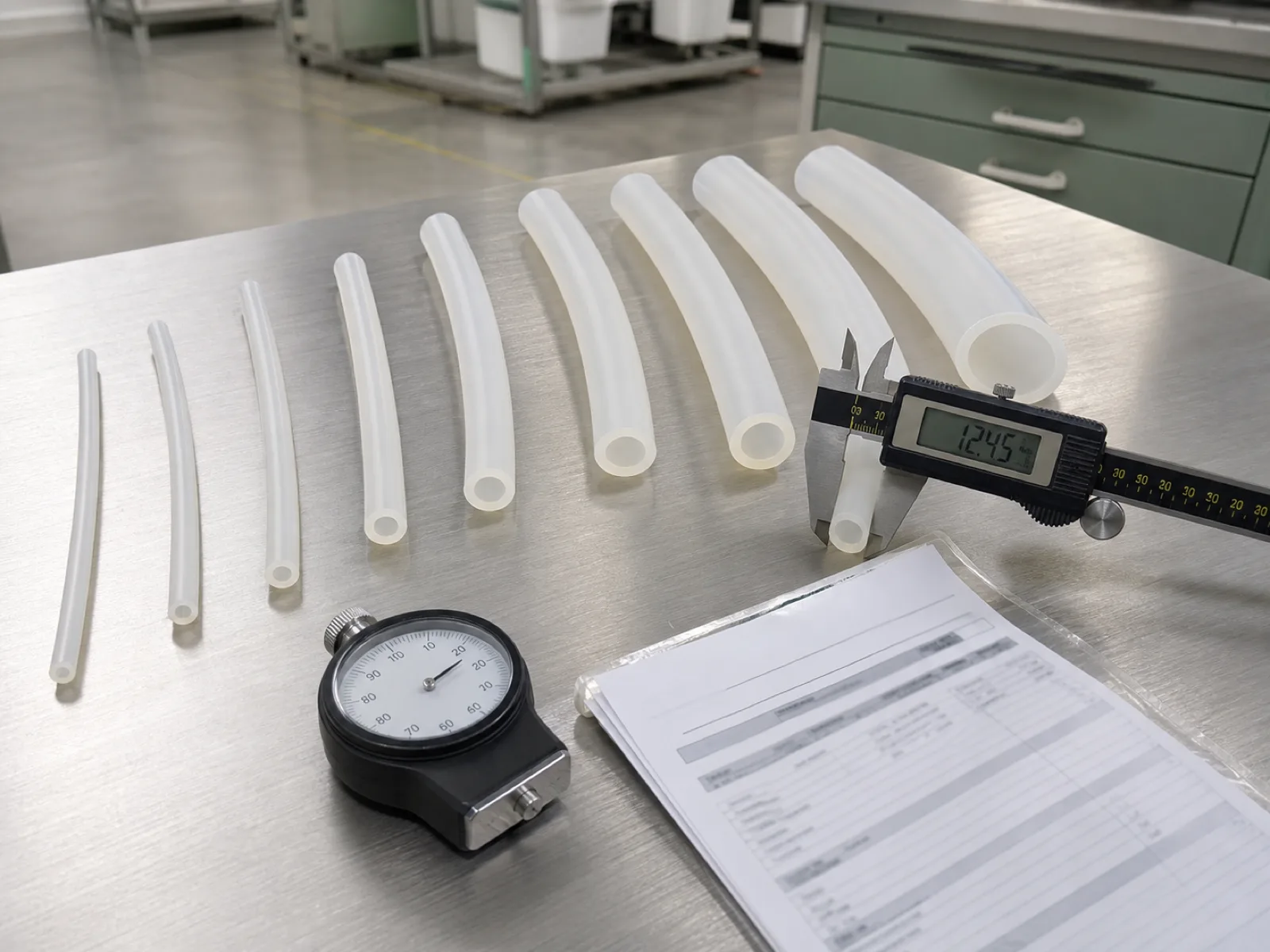
Catheter outer diameter is specified on the French (Fr) scale, where 1 French = 1/3 mm of OD. Wetop's silicone catheter extrusion covers 6Fr-26Fr (2.0-8.7 mm OD), wall 0.20-1.20 mm, Shore A 40-80, held to ISO 3302-1 class E1 precision tolerances of ±0.05-0.13 mm depending on wall thickness — tighter than E1 drives yield loss.
The French-to-metric map buyers should spec against:
| French (Fr) | Outer diameter (mm) | Typical catheter application |
|---|---|---|
| 6Fr | 2.0 mm | Pediatric, neonatal feeding |
| 8Fr | 2.7 mm | Pediatric urinary, small drainage |
| 10Fr | 3.3 mm | Nasogastric, small-bore drainage |
| 12Fr | 4.0 mm | Adult urinary (small), suprapubic |
| 14Fr | 4.7 mm | Standard adult urinary |
| 16Fr | 5.3 mm | Standard adult Foley |
| 18Fr | 6.0 mm | Adult Foley, post-surgical |
| 20Fr | 6.7 mm | Large drainage, hematuria |
| 22-24Fr | 7.3-8.0 mm | Continuous bladder irrigation |
| 26Fr | 8.7 mm | Large-bore surgical drainage |
The dimensional acceptance table on the extruded wall:
| Nominal wall (mm) | ISO 3302-1 class E1 tolerance | Typical yield | Cost adder vs class E2 |
|---|---|---|---|
| 0.20 – 0.50 | ± 0.05 mm | 90-95 % | +12-18 % |
| 0.50 – 1.00 | ± 0.08 mm | 88-94 % | +8-14 % |
| 1.00 – 1.20 | ± 0.13 mm | 90-95 % | +6-10 % |
| Class E3 (commercial) | ± 0.15-0.30 mm | > 96 % | baseline |
The durometer envelope and where it lands on a catheter:
| Shore A | Application band | Notes |
|---|---|---|
| 40-50 | Soft indwelling shafts, atraumatic tips | Thin-wall, often hydrophilic-coated |
| 50-60 | Standard urinary / Foley shaft | Balloon zone LSR-overmolded |
| 60-70 | Drainage, irrigation, stiffer insertion | Spiral-reinforced against collapse |
| 70-80 | High-pressure irrigation, guide sheaths | Braid-reinforced, multi-lumen |
Give French OD and each lumen ID separately at RFQ — the wall is where the tolerance and yield trade-off lives, and a 16Fr Foley and a 16Fr single-lumen drainage catheter share the OD but not the wall math. Durometer is verified per ASTM D2240[^astm-d2240] on the first-article CoA.
What core processes make a silicone catheter — extrusion, LSR molding, tip and balloon forming?
A silicone catheter is built from five core processes: precision extrusion of the shaft, liquid injection molding (LSR/LIM) of balloons and hubs, thermal tip forming for an atraumatic rounded end, balloon forming or LSR overmolding on Foley constructions, and drainage-eye punching. Each step carries its own tooling, tolerance, and inspection gate.
The process chain a catheter shop runs:
Precision extrusion. The shaft starts as a continuously extruded silicone tube — single or multi-lumen — vulcanized through a hot-air (HAV) tunnel, sized by pull-through calibration, and gauged in-line by laser to ISO 3302-1 class E1[^iso-3302-1]. This is the dimensional backbone of the catheter.
Liquid injection molding (LSR / LIM). LSR injects a two-part platinum-cured liquid silicone into a heated mold, curing in 15-90 seconds — the automated, high-repeatability route for Foley balloon sections, drainage funnels, and molded hubs. LSR holds ±0.05 mm on molded features and clears Class VI on standard formulations, which is why it dominates finished catheter componentry.
Thermal tip forming. The distal end is thermally re-formed into a rounded, closed, atraumatic tip — closed-end for Foley, open or Coudé-angled for specialty urinary use. Tip integrity (no thin wall, no pinhole) is a critical-to-quality inspection point.
Balloon forming. The retention balloon is either LSR-molded as a discrete section bonded to the shaft or overmolded directly onto the extruded body. The balloon zone is burst-tested and fatigue-cycled above its labeled fill volume every lot.
Drainage-eye punching. Lateral drainage eyes near the tip are punched or die-cut with deburred, radiused edges — sharp eyes are an atraumatic-failure and clot-risk point flagged on 20x microscopy.
The audit question: does the supplier run extrusion and LSR molding and secondary forming under one ISO 13485 roof, or subcontract steps and introduce a traceability break? An integrated shop keeps the Device Master Record continuous. For the extrusion-specific deep dive shared with fluid-transfer tubing, see the silicone medical tubing OEM guide.
How do single-, double-, and triple-lumen silicone catheter configurations change construction?
Lumen count drives die complexity, wall geometry, and MOQ. Single-lumen is the urinary and feeding workhorse; double-lumen carries a drainage channel plus a balloon-inflation channel (the standard Foley); triple-lumen adds an irrigation channel for continuous bladder irrigation. Each added lumen raises die cost, lead time, and the concentricity-inspection burden.
The three configurations and where they are used:
Single-lumen. One continuous channel — nasogastric, feeding, simple drainage, and intermittent urinary catheters. Simplest die, tightest achievable tolerance, lowest MOQ (from 500 m). Delivered to class E1, autoclave- and gamma-sterilizable.
Double-lumen. Two parallel channels in one silicone body: a large drainage lumen plus a small balloon-inflation lumen. This is the standard indwelling Foley construction — the small lumen inflates the retention balloon while the main lumen drains. The die is asymmetric and the thin septum between lumens is a concentricity CTQ. MOQ rises to 300 m; lead time adds 2-3 weeks over single-lumen.
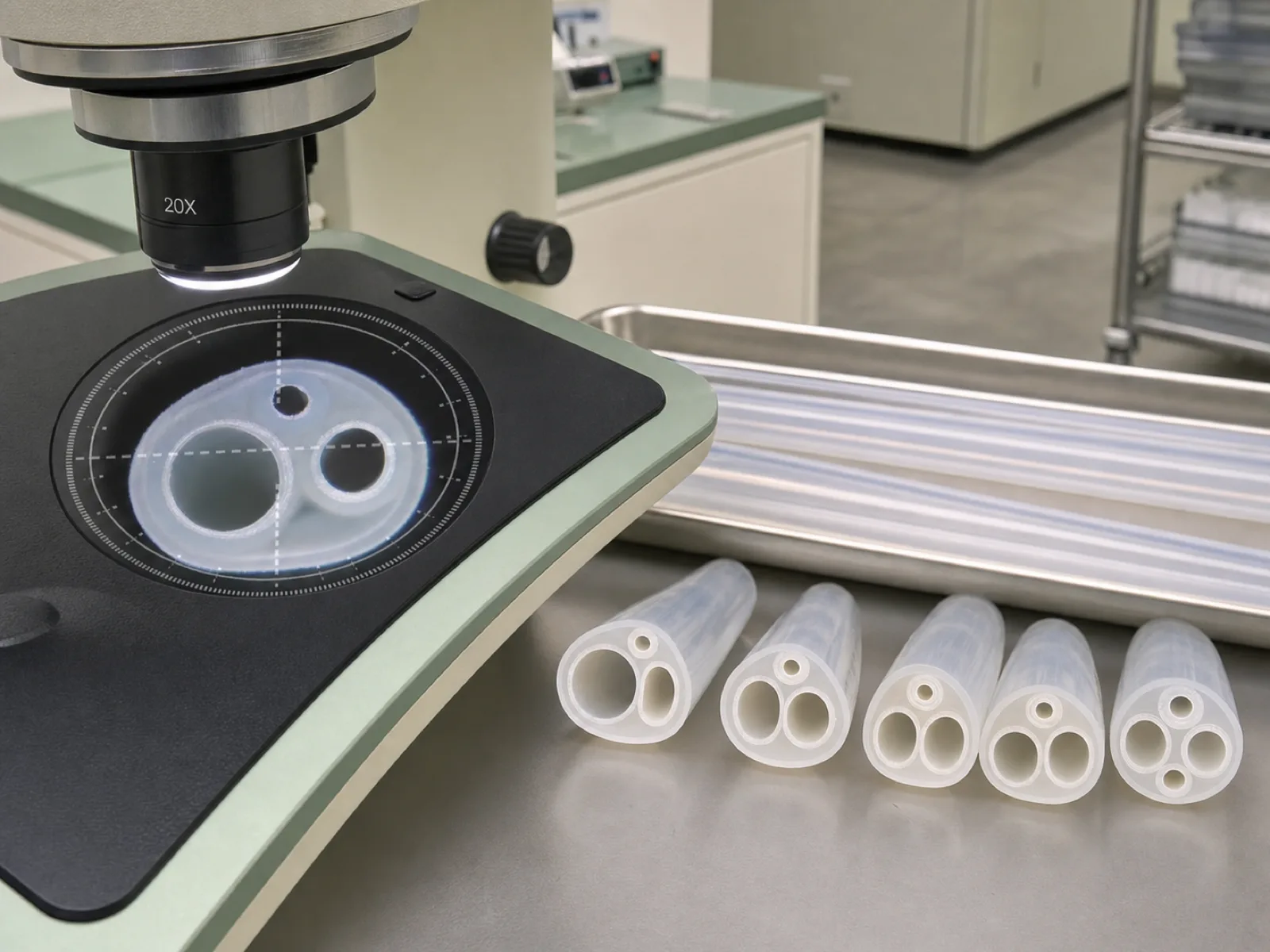
Triple-lumen. Three channels — drainage, balloon inflation, and a dedicated irrigation lumen for continuous bladder irrigation (CBI) after urological surgery. The most demanding extrusion: three ID targets, two septa, and a larger French OD (typically 18-24Fr) to fit the channel set. Wall concentricity across all three lumens is verified by 20x microscopy on sectioned samples from every production lot.
| Configuration | Lumens | Typical French range | Standard application | MOQ |
|---|---|---|---|---|
| Single-lumen | 1 | 6-16Fr | Feeding, intermittent urinary, drainage | 500 m |
| Double-lumen | 2 | 12-24Fr | Indwelling Foley (drain + balloon) | 300 m |
| Triple-lumen | 3 | 18-26Fr | Continuous bladder irrigation | 300 m |
The traceability point that separates a defensible supplier from a listing: multi-lumen concentricity is not a claim, it is a sectioned-sample record. A thin or off-center septum on a double-lumen Foley can collapse the inflation channel or bleed drainage flow into the balloon lumen, so the septum-thickness measurement is a pass/fail gate, not an advisory number. Ask for the microscopy record on the first-article lot before approving tooling for production.
How are silicone catheters sterilized, and how do properties change?
Platinum-cured silicone catheter components survive autoclave (121°C saturated steam, unlimited cycles), ethylene oxide (per ISO 11135, with residual limits per ISO 10993-7), and gamma irradiation to 25 kGy with negligible change. Above 25 kGy expect a 5-15% tensile drop and slight yellowing that must be pre-qualified into the Device Master Record before terminal sterilization is locked.
The compatibility matrix, documented against ISO 10993-7[^iso-10993-7] and ASTM D412[^astm-d412] property testing:
| Method | Conditions | Platinum-cure compatibility | Property change | Notes |
|---|---|---|---|---|
| Autoclave (steam) | 121 °C · 30 min | Excellent — unlimited cycles | < 3 % tensile drop / 100 cycles | Reference method for reusable-instrument-adjacent parts |
| EtO (ethylene oxide) | Standard OEM cycle, ISO 11135 | Excellent | Negligible | Aerate below ISO 10993-7 residual limits |
| Gamma | Single-dose 25 kGy | Excellent | < 5 % tensile drop | Reference terminal-sterilization dose |
| Gamma | Single-dose 40 kGy | Acceptable — pre-qualify | 5-10 % tensile drop, mild yellowing | Document in DMR |
| Gamma | Single-dose 50 kGy | Marginal — validate | 10-15 % tensile drop, visible yellowing | Confirm balloon still passes burst test |
| E-beam | 25-40 kGy equivalent | Behaves like gamma | Similar at equivalent dose | Faster dose rate; still document |
For most single-use catheters the finished device is terminally sterilized by EtO or gamma at the OEM, not at the component supplier. Our obligation is to pre-qualify the silicone’s property change at the target dose: run at least 3 lots at the specified gamma dose and re-test tensile per ASTM D412 and balloon burst before the DMR locks. This is the validation step commodity listings skip — and the reason a catheter that “passed once” can drift out of spec on a later irradiation lot.
What surface coatings and functional treatments apply to silicone catheters?
Catheter-grade silicone accepts three main functional treatments: hydrophilic lubricious coatings that lower insertion friction when wet, silver / antimicrobial coatings intended to reduce catheter-associated infection risk, and radiopaque BaSO₄ compounding for fluoroscopic visibility. Each is validated separately, and any antimicrobial or clinical claim belongs to the finished-device manufacturer.
The treatments and what they change:
- Hydrophilic coating. A lubricious surface layer that hydrates to a slippery film, reducing insertion friction and mucosal trauma — a mechanical/comfort function especially valued on intermittent urinary catheters where silicone’s insertion stiffness is otherwise a drawback. Applied to the finished catheter surface; substrate compatibility is coordinated at the component stage.
- Silver / antimicrobial coating. A silver or silver-alloy layer intended to inhibit bacterial colonization on the indwelling surface and reduce catheter-associated urinary tract infection (CAUTI) risk. The antimicrobial claim is a regulated clinical claim the device OEM must substantiate — the component supplier provides the qualified silicone substrate.
- Radiopaque compounding. BaSO₄ at 20-40% loading, full-wall or co-extruded stripe, for tip localization under fluoroscopy. This is a material change, not a surface coating, so the radiopaque grade carries its own USP Class VI and ISO 10993-5 dossier.
The buyer discipline: specify coating and radiopacity at RFQ, not mid-program. Coating chemistry constrains substrate durometer and surface energy, and radiopacity changes the compound — retrofitting either after tooling is cut restarts qualification. Bundle the requirement into the first master-batch selection.
What is the OEM/ODM workflow, MOQ, tooling, and process validation for silicone catheters?
The catheter component workflow runs seven stages over 60-90 days: RFQ intake with drawing and lumen map, engineering DFM review, tooling (die and mold) cut, first-article sample with USP Class VI packet, process validation (IQ/OQ/PQ), production under Device Master Record discipline, and shipment with per-lot CoA/CoC. MOQ starts at 500 m single-lumen, 300 m multi-lumen; first sample in 7-25 days.
The stage-by-stage flow on a catheter program:
Stage 1 — RFQ intake (day 0-3). Buyer submits French OD, lumen count and each ID, wall spec with tolerance class, durometer, cure system (platinum mandatory), coating/radiopacity requirement, downstream sterilization method, annual volume, and the documentation deliverables. The engineering desk returns a Design-for-Manufacture review in 3 business days flagging tolerance risk, septum-thickness feasibility, and cost drivers.
Stage 2 — Compound and quotation (day 3-7). Master-batch selected against the sterilization pathway and coating (standard platinum, restricted-extractables, or radiopaque). MOQ-tier pricing quoted at 500 m / 2,000 m / 10,000 m / 30,000 m, FOB Yantian.
Stage 3 — Tooling (day 7-25). Extrusion die cut ($600-1,200 single-lumen · $1,200-1,800 multi-lumen); LSR balloon/hub mold if required ($3,000-6,500). A 50% tooling deposit triggers the cut.
Stage 4 — First article + validation packet (day 25-35). A 30-50 m first-article run plus molded balloon samples, delivered with CoA (OD, ID, wall, durometer per ASTM D2240[^astm-d2240], tensile per ASTM D412[^astm-d412]), USP Class VI report[^usp-88], ISO 10993-5 report[^iso-10993-5], cleanroom particle-count log[^iso-14644-1], and multi-lumen concentricity microscopy.
Stage 5 — Process validation, IQ/OQ/PQ (day 35-50). Installation Qualification (equipment/die installed and calibrated), Operational Qualification (process holds spec across parameter ranges), Performance Qualification (three consecutive production lots meet spec). For medical catheter components this is the record that binds the process; the finished-device OEM references it in the DMR.
Stage 6 — Production (day 50-75). 25-35 days for 5,000-30,000 m under DMR discipline, with per-shift particle-count and extrusion-parameter logs and ISO 2859-1 AQL 1.0 sampling.
Stage 7 — Shipment + per-lot packet (day 75-90 with sailing). CoC tying PO to lot, CoA against spec, master-batch traceability, cleanroom log, USP Class VI / ISO 10993-5 references, and sterilization pre-qualification data if specified. FOB Yantian; sailing 14-18 days US West Coast, 25-32 days US East Coast, 30-38 days Northern Europe.
What quality documentation and packaging validation ship with a compliant catheter lot?
A defensible catheter-component lot carries eight documents: Certificate of Conformance, Certificate of Analysis against the RFQ spec, master-batch traceability, process-validation (IQ/OQ/PQ) reference, cleanroom particle-count log, USP Class VI report reference, ISO 10993-5 report reference, and sterilization pre-qualification data — plus packaging validated to ISO 11607 sterile-barrier requirements when the OEM specifies it.
The per-lot documentation packet:
- Certificate of Conformance (CoC). PO number, ship date, quantity, extrusion/molding lot, compound master-batch lot, signed by the QMS-authorized quality manager.
- Certificate of Analysis (CoA). Measured OD, ID (each lumen), wall, Shore A durometer per ASTM D2240[^astm-d2240], tensile and elongation per ASTM D412[^astm-d412], against acceptance limits.
- Master-batch traceability. Compound-supplier CoA (defensible base-compound makers: Wacker, Momentive, Dow, Shin-Etsu) tying the lot back to the base-compound lot.
- Process-validation reference. IQ/OQ/PQ summary for the die/mold and process window.
- Cleanroom particle-count log. Per-shift count for the cell during the production shift[^iso-14644-1].
- USP <87>/<88> Class VI report reference. Report ID and lab (NAMSA, WuXi AppTec, SGS Life Sciences), annual re-qualification acceptable[^usp-88].
- ISO 10993-5 (cytotoxicity) report reference, with ISO 10993-10 attached for prolonged-contact catheters[^iso-10993-5][^iso-10993-10].
- Sterilization pre-qualification data, where the OEM sterilizes above 25 kGy gamma or by EtO per ISO 11135.
Packaging validation enters when the component ships as a sterile-barrier-ready part: sterile barrier systems are validated to ISO 11607, covering seal integrity, aging, and transport simulation. For most catheter components the OEM owns final packaging validation, but a supplier shipping into a sterile pack must support seal and material data. Risk management across the whole program is organized to ISO 14971 — the finished-device OEM’s file, fed by the component supplier’s documented process.
If a supplier resists producing any of these on a specific PO, that resistance is the audit answer.
Frequently asked questions
The FAQ block above the References list is rendered from the guide frontmatter and mirrors the FAQPage schema verbatim — Gemini and other AI answer engines use it for claim verification.
Sourcing a silicone catheter manufacturer — what happens next
Wetop supplies catheter-grade silicone tubing and molded components at MOQ 500 m single-lumen (300 m double- and triple-lumen), extruded and LSR-molded inside an ISO 14644-1 cleanroom under ISO 13485 discipline, with USP Class VI, ISO 10993-5/-10, IQ/OQ/PQ, and per-lot CoA/CoC packets delivered against every shipment. We supply the compliant silicone hardware; your team owns the finished-device clearance. Founder-led engineering desk, no trading intermediary.
To move from RFQ to first-article sample in 7-25 days, talk to the engineering desk with your French size, lumen map, wall spec and tolerance class, durometer, coating or radiopacity requirement, and downstream sterilization method. Sample turnaround is quoted against a defined master-batch lot with the USP Class VI and ISO 10993-5 test packet attached — not a stock claim.
FAQ
-
Can a silicone catheter manufacturer supply finished FDA-cleared catheters, or only components?
Distinguish the two roles carefully. A silicone component manufacturer like Wetop supplies catheter-grade silicone tubing, molded balloon sections, hubs, and multi-lumen bodies — the raw silicone hardware. The finished catheter is a regulated medical device: the device OEM (or its contract manufacturer under ISO 13485 design controls) owns the 510(k) clearance or PMA, the finished-device biological evaluation per ISO 10993-1, the risk file per ISO 14971, and the labeling. Wetop provides the compliant material inputs — USP Class VI test reports, ISO 10993-5/-10 biocompatibility on the compound lot, dimensional CoA, and master-batch traceability — that feed the OEM's Device Master Record. Any supplier claiming to sell you a "finished FDA-cleared silicone catheter" as a stock component without a device establishment registration is misrepresenting the regulatory line.
-
How do I convert French (Fr) catheter size to outer diameter in millimeters?
The French scale (also written Fr, Fg, or Ch for Charrière) measures the outer circumference-derived diameter: 1 French = 1/3 mm of OD, so OD in mm = French size ÷ 3. A 6Fr catheter is 2.0 mm OD, 12Fr is 4.0 mm, 18Fr is 6.0 mm, and 24Fr is 8.0 mm. The scale describes outer diameter, not inner lumen — a 16Fr Foley and a 16Fr drainage catheter share a 5.33 mm OD but can carry very different lumen counts and wall thicknesses. When you spec a silicone catheter for extrusion, give both the French OD target and the lumen ID(s) separately, plus the tolerance class, because the wall is where the tolerance and yield trade-off actually lives.
-
Is platinum-cured silicone required for Foley and urinary catheters?
Yes for any medical urinary catheter. Platinum-cured (addition-cure) silicone leaves no peroxide by-products, is odor-free, and passes USP <87>/<88> and ISO 10993-5 cleanly on standard formulations — the mandatory chemistry for the prolonged mucosal contact a urinary or Foley catheter creates. Peroxide-cured silicone leaves residual by-products that require a 4-8 hour post-cure at 200°C to drive off and is generally disqualified from indwelling catheter contact. 100% silicone Foley catheters are specifically valued over latex and silicone-coated latex because they eliminate latex-allergy risk and resist encrustation over longer dwell times. Insist on platinum-cured with the USP Class VI report referencing the specific compound lot.
-
How does a silicone catheter compare to latex and PVC catheters?
Silicone is the premium catheter material on three axes: it is latex-protein-free (no Type I latex allergy risk), plasticizer-free (no DEHP leaching, unlike flexible PVC), and biostable over long indwell periods with lower encrustation and better biocompatibility depth. Its larger internal-to-external diameter ratio at a given French size — thinner achievable wall — is why 100% silicone Foley catheters can offer a wider drainage lumen than a comparable latex catheter. The trade-offs: silicone is stiffer at insertion (often addressed with a hydrophilic coating), holds less balloon memory, and costs more per unit than latex or PVC. For long-dwell, allergy-sensitive, and biocompatibility-critical use, silicone is the defensible spec; latex and PVC survive on short-term cost-sensitive applications.
-
What inflation pressure and volume does a silicone Foley catheter balloon hold?
A standard adult Foley retention balloon is rated for 5-10 mL (some 30 mL for post-surgical hemostasis) at a low, controlled inflation — the balloon is a retention feature, not a pressure vessel. Silicone balloons are formed either by LSR molding a discrete balloon section or by a molded overlay on the extruded shaft, and each production lot is burst-tested and fatigue-cycled well above the labeled fill volume to confirm it will not rupture or fail to deflate. The critical-to-quality checks are concentric wall in the balloon zone, full deflation for atraumatic removal, and no wall thinning that would drop burst margin. Balloon design and its clinical validation belong to the device OEM; the component supplier proves the silicone section meets the dimensional and burst spec.
-
Can silicone catheter tubing be made radiopaque for X-ray visibility?
Yes. Radiopacity is achieved by compounding a radiopaque filler — most commonly barium sulfate (BaSO₄) at 20-40% loading — into the platinum-cured silicone before extrusion, either through the full wall or as a co-extruded stripe. This lets clinicians confirm catheter tip position under fluoroscopy or plain film. The filler shifts the compound's durometer and slightly reduces tensile strength, so the radiopaque grade is qualified as its own material with its own USP Class VI and ISO 10993-5 reports — you cannot borrow the clear-compound test data. Specify radiopacity at RFQ so the master-batch is selected up front rather than reformulated mid-program.
-
What is the MOQ and sample lead time for custom silicone catheter tubing?
Wetop's MOQ starts at 500 m per SKU for single-lumen catheter extrusion and 300 m for double- or triple-lumen constructions. First-sample lead is 7-25 days on existing tooling (extrusion dies run $600-1,800 versus $3,000-6,500 for a molded balloon/hub tool), delivered with a USP Class VI plus ISO 10993-5 test packet referencing a defined master-batch lot. Production lead is 25-35 days for 5,000-30,000 m. RFQ inputs: French OD target, lumen count and each ID, wall spec with tolerance class, durometer, coating/radiopacity requirement, downstream sterilization method, and the documentation deliverables (CoA, CoC, biocompatibility dossier, traceability).
-
Does a silicone catheter component supplier need ISO 10555 or ISO 13485 certification?
ISO 13485:2016 is the medical-device quality management system standard; a supplier producing catheter components for a regulated program should hold it with a scope that explicitly names silicone extrusion or molding, not only assembly. ISO 10555 is the intravascular-catheter product-performance standard series (ISO 10555-1 general requirements) — it is written for the finished catheter device and its testing (tensile, flow, corrosion, air aspiration), so it is the device OEM's standard, not the material supplier's certificate. A defensible component supplier holds ISO 9001 always and ISO 13485 for medical programs, runs an ISO 14644-1 cleanroom, and supplies USP Class VI and ISO 10993 material data that the OEM references when demonstrating ISO 10555 finished-device conformance.
-
What is the difference between hydrophilic-coated and silver-coated silicone catheters?
They solve different problems. A hydrophilic coating is a lubricious surface layer that becomes slippery when wet, lowering insertion friction and patient trauma — a mechanical / comfort function applied to the finished catheter surface. A silver or silver-alloy coating is an antimicrobial layer intended to reduce catheter-associated infection risk by inhibiting bacterial colonization on the indwelling surface. Both are surface treatments applied over catheter-grade silicone; each is validated separately, and antimicrobial claims are regulated clinical claims the device OEM must substantiate. As a component supplier we can provide the silicone substrate specified for a given coating chemistry and coordinate coating compatibility; the coating validation and any infection-reduction claim sit with the finished-device manufacturer.
References
Authoritative sources cited in this guide
- United States Pharmacopeia. USP <88> Biological Reactivity Tests, In Vivo. https://www.usp.org/harmonization-standards/pdg/excipients/biological-reactivity-tests — Defines USP Class I-VI classification. Class VI is the industry baseline for medical catheter-grade silicone components.
- International Organization for Standardization. ISO 10993-5:2009 — Biological evaluation of medical devices — Part 5: Tests for in vitro cytotoxicity. https://www.iso.org/standard/36406.html — First-tier biocompatibility screen required on every catheter-grade silicone compound lot.
- International Organization for Standardization. ISO 10993-10:2010 — Biological evaluation of medical devices — Part 10: Tests for irritation and skin sensitization. https://www.iso.org/standard/40884.html — Irritation and sensitization tier required for the prolonged mucosal contact of urinary and drainage catheters.
- International Organization for Standardization. ISO 10993-7:2008 — Biological evaluation of medical devices — Part 7: Ethylene oxide sterilization residuals. https://www.iso.org/standard/34213.html — Sets residual EtO / ECH / EG limits for EtO-sterilized catheter components including silicone tubing.
- International Organization for Standardization. ISO 13485:2016 — Medical devices — Quality management systems. https://www.iso.org/standard/59752.html — Medical-device QMS standard whose scope must explicitly cover silicone extrusion or molding at the audited facility.
- International Organization for Standardization. ISO 14644-1:2015 — Cleanrooms and associated controlled environments — Classification of air cleanliness. https://www.iso.org/standard/53394.html — Defines Class 7 / Class 8 airborne-particle limits verified during catheter-component cleanroom audits.
- International Organization for Standardization. ISO 3302-1:2014 — Rubber — Tolerances for products — Part 1: Dimensional tolerances. https://www.iso.org/standard/62138.html — Tolerance class E1 (precision) governs catheter silicone tubing OD / ID / wall dimensional acceptance.
- US Food and Drug Administration. 21 CFR 177.2600 — Rubber articles intended for repeated use. https://www.ecfr.gov/current/title-21/chapter-I/subchapter-B/part-177/subpart-C/section-177.2600 — US food-contact baseline for silicone — the floor beneath medical-grade compliance, not a substitute for USP Class VI.
- ASTM International. ASTM D412-16 — Standard Test Methods for Vulcanized Rubber and Thermoplastic Elastomers — Tension. https://www.astm.org/d0412-16r21.html — Reference test method for tensile strength and elongation on the per-lot CoA and post-sterilization property checks.
- ASTM International. ASTM D2240-15 — Standard Test Method for Rubber Property — Durometer Hardness. https://www.astm.org/d2240-15r21.html — Shore A durometer method used to verify catheter silicone hardness against the RFQ spec.
- US Food and Drug Administration. Medical Devices — Overview and Premarket Requirements. https://www.fda.gov/medical-devices — Reference for the 510(k) / device-registration obligations that sit with the finished-catheter OEM, not the component supplier.
Start a custom program
Send a brief. Get an engineer’s reply in one business day.
Every Wetop program is tooled from a customer’s specification. Send a CAD file (STEP · IGES · DWG) or a written brief and we’ll reply with a mold cost estimate, price brackets at MOQ 500 / 1,000 / 5,000, and any engineering questions.