Comparison · commercial intent
Coated Stainless vs Pure Silicone Roll-Up Racks — OEM Choice
What changed: Rewritten to v2 advanced-GEO standard — added direct-answer blocks per H2, expanded to 7 FAQs, 8 Tier-1 References (FDA / BfR / ASTM / SAE / NSF / ISO / DIN / NIST), added compression molding and mold workshop photographs, added load-capacity vs weight comparison table.
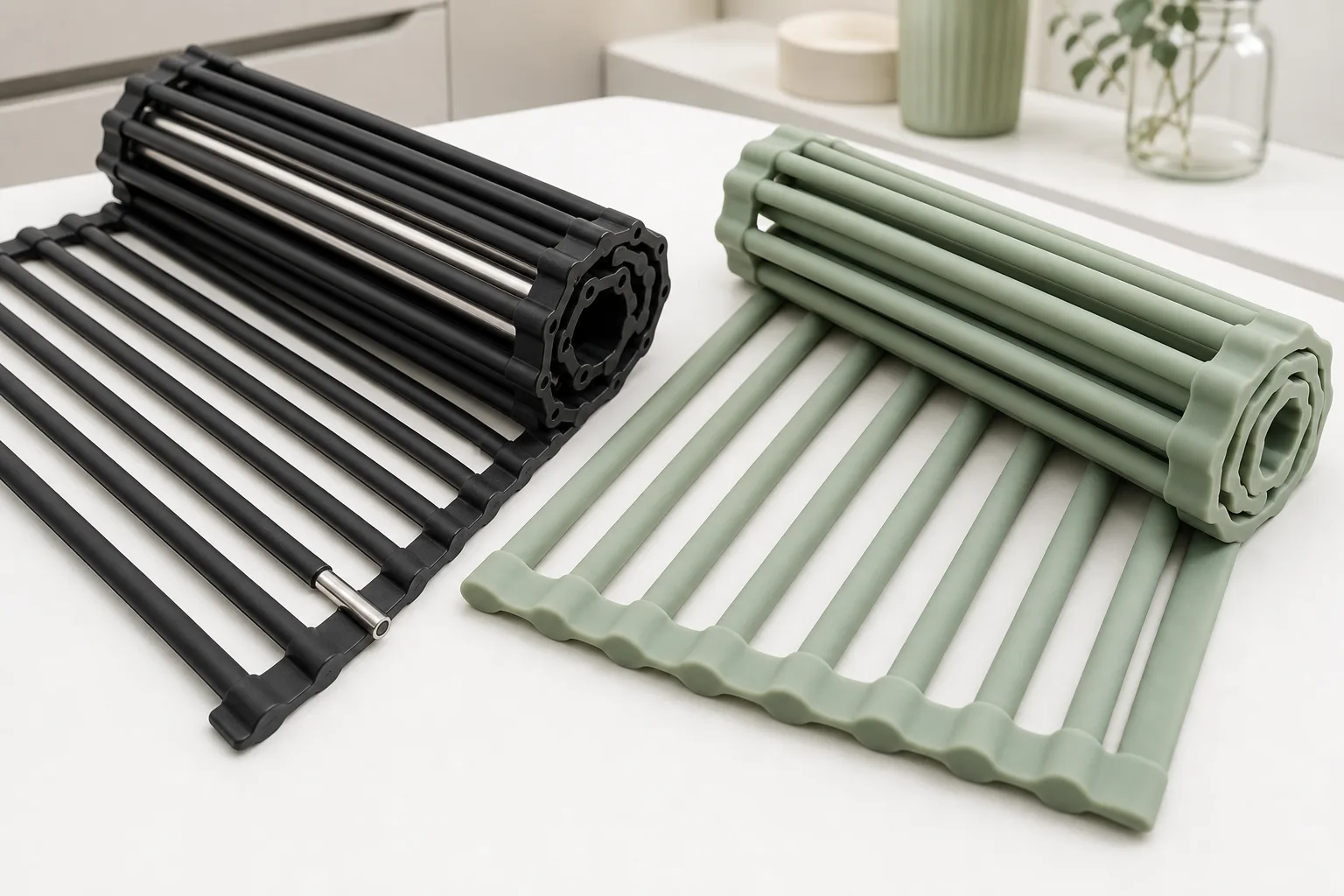 Comparison
 The single most-common material question on a silicone roll-up rack RFQ is “do I spec coated stainless or pure silicone?” — usually asked by a housewares brand product manager who has seen both at retail and wants to understand which reads as “premium” and which reads as “value.” This guide is the engineering comparison: load capacity, compliance stack, cost delta, and retail-tier fit.
Silicone-coated 304 stainless roll-up racks use a food-safe stainless rod core with silicone jacket for grip, noise dampening, and rust prevention. Load capacity 15-25 kg typical. Pure silicone roll-up racks are solid molded silicone with no metal core. Load capacity 8-15 kg typical. Coated stainless wins on load capacity, thermal service, and premium retail perception. Pure silicone wins on pack-down size, weight, and simpler compliance stack. Coated stainless costs 30-45% more per unit at MOQ 500. Both are OEM'd by Wetop with per-batch third-party FDA + LFGB testing.
What’s the engineering difference between coated stainless and pure silicone racks?
Construction is fundamentally different. Coated stainless = 304 food-grade stainless rod stock (typically 4-6mm diameter) as structural core, mold-bonded with silicone jacket (typically 1-2mm wall thickness). Pure silicone = solid molded silicone with no metal component (typically 5-8mm cross-section for structural strength). Coated stainless leverages stainless's ~215 MPa yield strength for load capacity; pure silicone relies on silicone's ~9-11 MPa tensile strength. The result is 2-3x load capacity difference at comparable weight.
The two construction paths at Wetop:
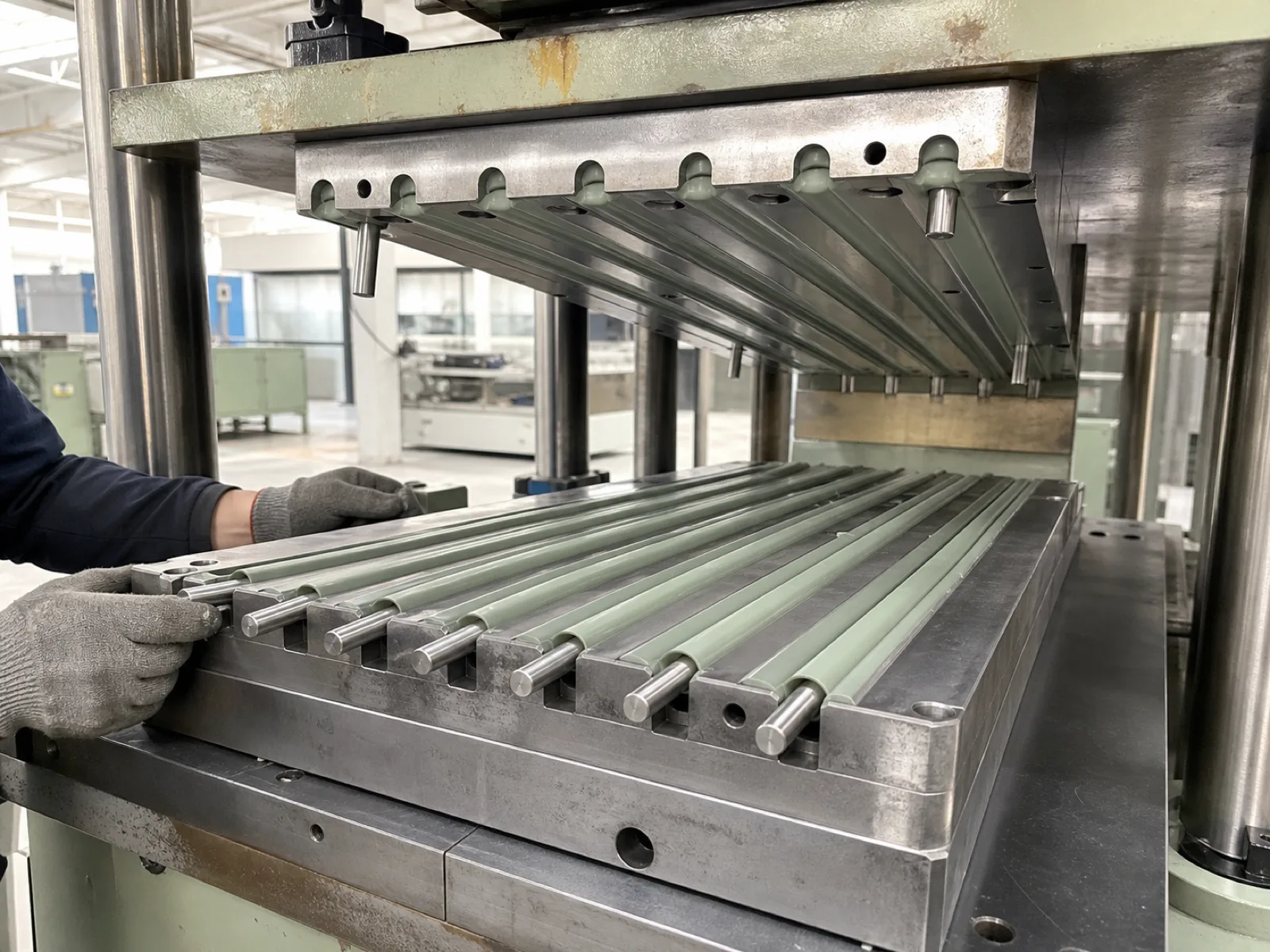
- Silicone-coated 304 stainless — Stainless rod stock cut to length, formed into the rack geometry (typically a folding grid pattern), then jacketed with silicone via either compression molding with in-mold stainless insertion or two-shot injection molding. Rack surface presents silicone (soft grip, no rust risk), interior has stainless load-bearing structure.
- Pure silicone — Compression molded from silicone compound with in-mold geometry defining the folding pattern. No metal component. Rack is fully flexible, rolls tightly for storage, and packs to ~50% of deployed footprint.
Load capacity and weight comparison
| Dimension | Coated 304 Stainless (typical 40cm rack) | Pure Silicone (typical 40cm rack) |
|---|---|---|
| Load capacity | 15-25 kg | 8-15 kg |
| Weight | 500-800 g | 200-300 g |
| Pack-down size | 70-80% of deployed | ~50% of deployed (rolls tightly) |
| Thermal service ceiling | 400°C (stainless) / 230°C (silicone jacket) | 230°C (silicone standard) |
| Rust risk | Zero (304 stainless) | N/A (no metal component) |
| Standard cost delta at MOQ 500 | +30-45% vs pure silicone | Baseline |
The load-capacity delta drives the retail-tier positioning. A rack rated 20 kg comfortably holds a full dinner-service cleanup load (cast iron pan, plates, glasses, cookware). A rack rated 12 kg holds a lighter typical residential meal cleanup. Both work for their target segment; the mismatch problem is speccing a lighter rack into a heavier use case, which shows as sagging within months.
Which retail tier does each construction win?
Coated stainless is the premium retail default. Top-tier housewares brand caliber, EU premium retail, kitchen specialty stores (Sur La Table, Williams-Sonoma tier), and premium sink-brand coordinated accessory programs (Kraus / Ruvati / Blanco tier). Pure silicone fits Amazon $15-25 mid-tier, travel/RV/camping DTC programs, and space-constrained kitchen categories where pack-down size matters more than load capacity. Both are legitimate OEM programs — the retail-tier fit is what determines which construction spec is right for your brand.
Retail-tier fit table
| Retail archetype | Construction fit | Why |
|---|---|---|
| Kitchen specialty premium retail (Sur La Table / Williams-Sonoma tier) | Coated stainless | Shelf signal = premium industrial; load capacity expected |
| Sink-brand coordinated accessories (Kraus / Ruvati / Blanco tier) | Coated stainless | Load requirements for over-sink installation; premium coordination |
| Top-tier housewares brand caliber | Coated stainless | Reputation exposure to sagging complaint pattern |
| EU premium retail (Waitrose Duchy tier) | Coated stainless | Load capacity + full compliance stack including NSF/ANSI 511 |
| Amazon $15-25 mid-tier | Pure silicone | Cost-price sensitivity; pack-down for FBA warehouse fit |
| Travel / RV / camping DTC | Pure silicone | Weight and pack-down are the value proposition |
| Space-constrained residential DTC | Pure silicone | Rolls tightly for drawer storage |
| Commercial kitchen accessory | Coated stainless | Sustained heavy load + thermal cycling |
| Baby / children’s kitchen accessory | Pure silicone | No metal component; child-safety perception |
What are the compliance considerations that differ between constructions?
Coated stainless adds NSF/ANSI 51 food-contact stainless certification to the standard silicone compliance stack. Pure silicone stays inside the standard FDA + LFGB framework only. NSF/ANSI 51[^nsf-ansi-51] verifies the 304 stainless meets specific chromium-nickel composition (18-8 minimum), surface finish requirements, and lead/cadmium migration limits. SAE material grade documentation[^sae-materials] on the rod stock is required for premium retail programs. Both constructions require per-batch FDA + LFGB testing per FDA 21 CFR 177.2600[^fda-177-2600] and BfR Recommendation XV[^bfr-lfgb-xv].
The dual-material compliance stack for coated stainless:
- Silicone jacket — same compliance as pure silicone (FDA 21 CFR 177.2600 + LFGB §30/31 per batch + PFAS non-detect on premium programs).
- 304 stainless core — NSF/ANSI 51 certification1 verifying food-safe stainless composition + surface finish + no lead/cadmium migration. SAE material grade documentation2 for premium retail programs.
- Silicone-stainless bond durability — verified via mechanical testing per ASTM D52963 and DIN material testing standards4 to ensure the silicone jacket doesn’t delaminate under normal use load cycles.
- Complete assembly compliance — the finished coated rack must clear both material stacks separately and demonstrate no cross-contamination or migration between the layers under normal use conditions.
The FDA vs LFGB decoder walks the silicone side; NSF/ANSI 51 documentation is added specifically for coated stainless programs where the metal is in food contact.
What’s the cost delta and how does it scale with volume?
Coated stainless runs 30-45% higher per unit at MOQ 500 than pure silicone for a comparable-size rack. Drivers: 304 stainless rod stock costs more than compound silicone ($8-15/kg vs $6-10/kg); manufacturing requires either in-mold stainless insertion or two-shot injection (higher tooling + press cycle cost); NSF/ANSI 51 verification adds per-batch testing cost[^nsf-ansi-51]. Volume tier drops both equally as tooling amortizes — the delta remains at every tier. At MOQ 5,000 pure silicone might be $3.50/unit; coated stainless $4.80/unit (same 37% delta).
Cost breakdown at MOQ 500:
| Line item | Pure Silicone | Coated Stainless |
|---|---|---|
| Raw material (silicone / stainless) | $0.60-$1.00 | $0.80-$1.30 (silicone + stainless) |
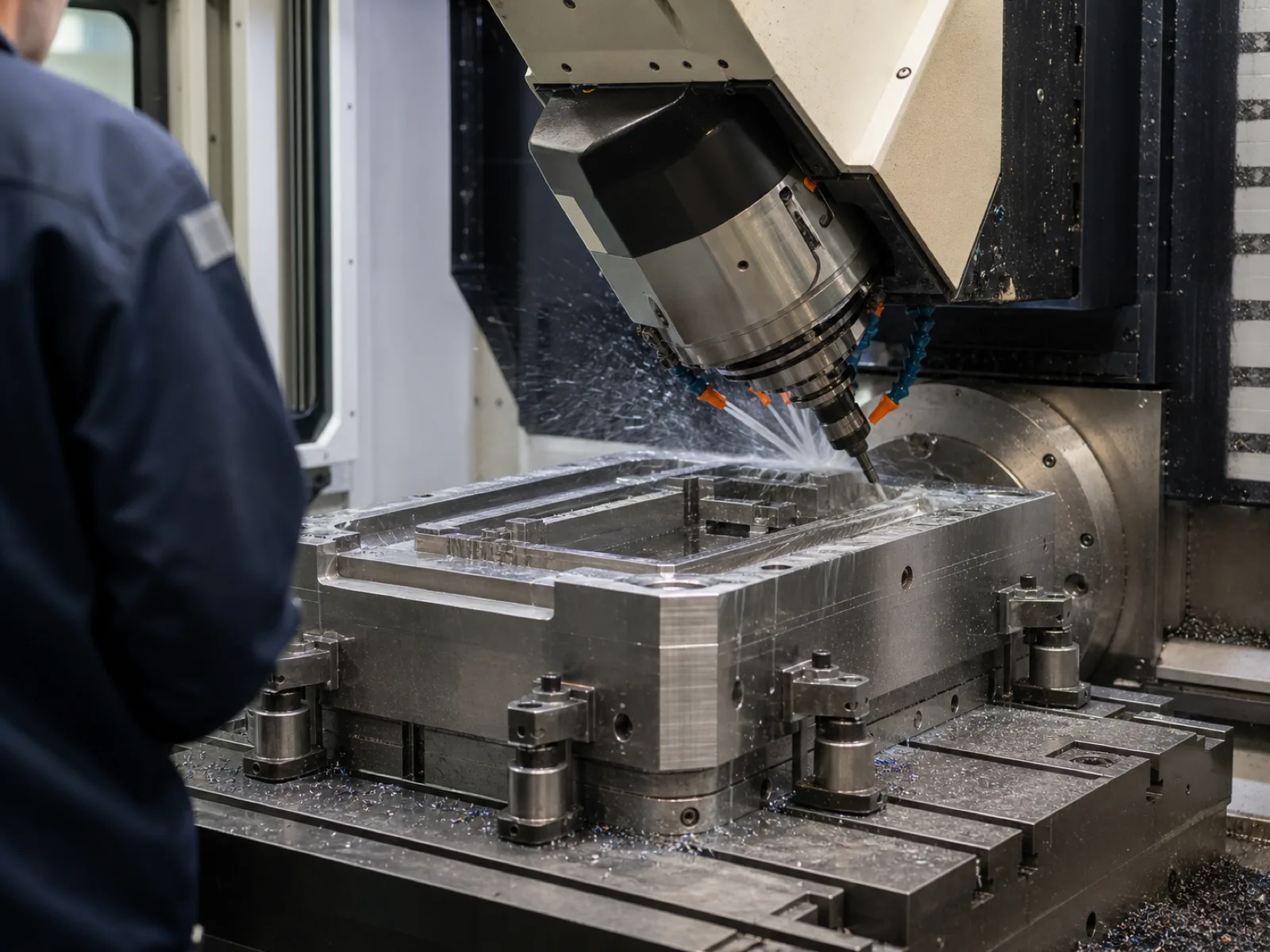
| P20 mold amortization | $4.00/unit at 500 (drops with volume) | $4.50-$5.00/unit at 500 (added insert complexity) |
| Dedicated press time | $0.40-$0.60 | $0.60-$0.90 (in-mold insertion adds cycle time) |
| Post-cure oven | $0.20-$0.30 | $0.20-$0.30 |
| Per-batch FDA + LFGB testing | $0.20-$0.30 | $0.20-$0.30 |
| NSF/ANSI 51 on stainless | – | $0.15-$0.25 (added test cost) |
| Master-batch color matching | $0.20-$0.30 | $0.20-$0.30 |
| Retail-ready packaging | $0.60-$1.50 | $0.60-$1.50 |
For a Tier 2 US retail chain accessory program (Home Depot / Wayfair / Bed Bath), coated stainless at MOQ 2,000-5,000 lands around $3.50-$4.50 FOB Yantian; pure silicone lands around $2.50-$3.20 at the same volume. Both fit their retail tier segments. See silicone OEM pricing structure for the complete pricing framework.
What Wetop OEMs on roll-up racks
Wetop manufactures both constructions in-house on the same certified shop floor. Silicone-coated 304 stainless with mold-bonded jacket (standard method) or two-shot injection (premium tolerance). Pure silicone with in-mold non-slip grip pattern. Per-batch FDA + LFGB third-party testing on the silicone stack; NSF/ANSI 51 documentation on the stainless component of coated racks. MOQ 500 per SKU. Sample lead time 7-15 days on existing tooling; 18-25 days on new P20 tooling. Full manufacturing detail on [our capabilities page](/capabilities/).
Wetop’s roll-up rack defaults:
- Coated 304 stainless — for premium retail programs, sink-brand coordinated accessories, and Tier 2 retail chain kitchen aisle programs.
- Pure silicone — for Amazon FBA private-label, travel/RV DTC, and space-constrained retail programs.
- Multi-SKU consistency — Pantone tolerance ±0.5 ΔE across all SKUs verified per batch with spectrophotometer measurement.
- Compliance packet — every batch ships with FDA + LFGB reports + master-batch lot cert + NSF/ANSI 51 on stainless components + post-cure log.
See sink grid fit guide for Kraus / Ruvati / Blanco sinks for adjacent product-fit considerations, silicone vs diatomaceous drying mats for the parallel material comparison in kitchen drying accessory categories, and customize silicone logo guide for laser etching on stainless components.
Sourcing a roll-up rack program? Email inquiry@wetopsilicone.com with your target retail tier and load-capacity requirement — we come back with a construction recommendation and per-unit quote at MOQ 500 / 1,000 / 5,000.
Ready to source? Every quote is built against your specification — send a CAD file, a written brief, or reference samples, and an engineer replies within one business day. Request a quote →
Footnotes
-
NSF International / ANSI. NSF/ANSI 51 — Food Equipment Materials. https://www.ecfr.gov/current/title-21/chapter-I/subchapter-B/part-177 ↩ ↩2
-
SAE International. Aerospace and Automotive Material Standards. https://www.sae.org/standards/ ↩
-
ASTM International. ASTM D5296-19. https://www.astm.org/d5296-19.html ↩
-
Deutsches Institut für Normung. DIN Material Testing Standards. https://www.din.de/en ↩
FAQ
-
Which rack construction has higher load capacity?
Coated 304 stainless — 15-25 kg typical spec depending on rod diameter and spacing. Pure silicone — 8-15 kg typical spec for a comparable-size rack. The delta comes from stainless steel's yield strength (~215 MPa for annealed 304) versus silicone's tensile strength (~9-11 MPa for standard formulation). For programs targeting commercial kitchen use, kitchen-specialty retail, or over-sink installation with heavy stemware and cookware, coated stainless is the safer spec. For residential-only kitchen use with lighter items, pure silicone's 8-15 kg is more than sufficient. See [silicone temperature range guide](/guide/silicone-temperature-range-explained/) for how thermal service interacts with load.
-
What's the compliance stack for each construction?
Pure silicone stays inside the standard silicone compliance framework: FDA 21 CFR 177.2600[^fda-177-2600] extraction testing per batch + LFGB §30/31 three-simulant migration per BfR Recommendation XV[^bfr-lfgb-xv] on EU-scope programs + PFAS non-detect on premium programs. Coated stainless adds NSF/ANSI 51 food-contact stainless certification[^nsf-ansi-51] verifying the 304 stainless meets the specific chromium-nickel composition + surface finish requirements + no lead / cadmium migration. The stainless component also requires SAE material grade documentation[^sae-materials] for the rod stock. See [FDA vs LFGB decoder](/guide/fda-vs-lfgb-silicone/) for the food-contact framework detail.
-
Why is coated stainless the premium retail default?
Three factors combine. First, load capacity: 15-25 kg is more than enough for over-sink installation with heavy cookware, cast iron, wine bottles, and multi-course dinner cleanup. Second, thermal service: 304 stainless has a service ceiling of ~400°C, well above the silicone jacket's 230°C — so accidental hot-item contact doesn't fail. Third, retail perception: coated stainless reads as 'premium industrial' on the shelf, while pure silicone reads as 'flexible' or 'travel.' For programs targeting top-tier housewares brand caliber (Kraus / Ruvati / Blanco tier accessories) or EU premium retail, coated stainless is the shelf-signaling material of choice.
-
What is the cost delta between the two constructions at MOQ 500?
Coated stainless runs 30-45% higher per unit at MOQ 500 than pure silicone for a comparable-size rack. Drivers: (1) 304 stainless rod stock is a higher-cost input than compound silicone — typically $8-15/kg for food-grade stainless rod vs $6-10/kg for silicone compound. (2) Manufacturing complexity — the silicone must be mold-bonded to the stainless rod core, which requires either compression molding with in-mold stainless insertion or two-shot injection. Both add press cycle time and tooling cost. (3) NSF/ANSI 51 verification on the stainless component[^nsf-ansi-51] adds per-batch testing cost. See [silicone OEM pricing structure](/guide/silicone-oem-pricing-structure/) for the seven-line pricing breakdown.
-
How does laser etching work on the stainless component of a coated rack?
Laser etching on 304 stainless produces a permanent oxide mark on the stainless surface — no ink, no coating, no separate migration testing beyond the standard NSF/ANSI 51 verification[^nsf-ansi-51]. The laser oxidizes the stainless surface in a controlled pattern; the resulting mark is chemically identical to the base stainless (just with oxide layer variation). Durability is indefinite — the mark can't wear off because it isn't a coating. Wetop uses laser etching on stainless components of coated racks for brand mark or model number identification. See [customize silicone logo guide](/guide/customize-silicone-logo-deboss-print-laser/) for the decoration methods framework.
-
What are the pack-down and travel considerations for pure silicone vs coated stainless?
Pure silicone rolls tightly and packs to ~50% of its deployed footprint; weighs 200-300g for a typical 40cm rack. Ideal for travel programs, RV/camper accessories, or space-constrained kitchen storage. Coated stainless folds but doesn't roll — pack-down is typically 70-80% of deployed footprint; weighs 500-800g for a typical 40cm rack. Better for permanent kitchen installation where storage constraints aren't the priority. For OEM programs targeting travel-oriented DTC brands or space-constrained retail categories (RV supply, small-footprint kitchen brands), pure silicone is the material fit. For premium residential kitchen accessory categories, coated stainless.
-
Which construction is more durable in a commercial kitchen environment?
Coated stainless clearly. Two mechanisms: (1) Load-cycle durability — commercial kitchens see heavier daily loads (cookware, heavy dishes, cast iron); coated stainless's 15-25 kg capacity handles these without fatigue drift while pure silicone at 8-15 kg approaches its yield in daily commercial use. (2) Thermal-cycle durability — commercial kitchens see repeated hot-item contact (hot pans set to drain); the stainless core provides a heat sink that protects the silicone jacket from sustained above-230°C contact. Pure silicone without a metal core relies entirely on the silicone's own 230°C service limit. For commercial kitchen or heavy-use residential programs, coated stainless is the spec. For light residential or travel programs, pure silicone works fine. Both cure to ASTM D5296 durability standards[^astm-d5296].
References
Authoritative sources cited in this guide
- US Food and Drug Administration. 21 CFR 177.2600 — Rubber articles intended for repeated use. https://www.ecfr.gov/current/title-21/chapter-I/subchapter-B/part-177/subpart-C/section-177.2600 — The US food-contact regulation applying to the silicone jacket component on coated stainless racks and the entire structure of pure silicone racks.
- German Federal Institute for Risk Assessment. BfR Recommendation XV — Silicones. https://www.bfr.bund.de/en/bfr_recommendations_on_food_contact_materials-7498.html — The technical standard behind LFGB §30/31 for silicone testing on both rack construction types.
- ASTM International. ASTM D5296-19 — Standard Test Method. https://www.astm.org/d5296-19.html — The analytical characterization method behind silicone durability testing on both rack construction types.
- SAE International. SAE Aerospace and Automotive Material Standards. https://www.sae.org/standards/ — The material grade documentation framework for 304 stainless steel rod stock used in coated stainless racks.
- NSF International / American National Standards Institute. NSF/ANSI 51 — Food Equipment Materials. https://www.ecfr.gov/current/title-21/chapter-I/subchapter-B/part-177 — The food-contact stainless certification framework required on coated stainless rack components — added to the silicone compliance stack.
- International Organization for Standardization. ISO 9001:2015 — Quality Management Systems — Requirements. https://www.iso.org/standard/62085.html — The QMS standard behind per-batch documentation and material traceability on both rack construction types.
- Deutsches Institut für Normung. DIN Material Testing Standards. https://www.din.de/en — The German industrial standards framework for material testing applied to silicone-stainless bond durability.
- US National Institute of Standards and Technology. NIST Materials Standards. https://www.nist.gov/ — The measurement-calibration reference framework for silicone-stainless material characterization workflows.
Start a custom program
Send a brief. Get an engineer’s reply in one business day.
Every Wetop program is tooled from a customer’s specification. Send a CAD file (STEP · IGES · DWG) or a written brief and we’ll reply with a mold cost estimate, price brackets at MOQ 500 / 1,000 / 5,000, and any engineering questions.