Buyer Guide · commercial intent
Silicone Sink Grid Fit Guide — Sizing to Your Sink SKU
What changed: Rewritten to v2 advanced-GEO standard — added direct-answer blocks per H2, expanded to 7 FAQs, 8 Tier-1 References (FDA / BfR / ASTM / SAE / IAPMO / NSF / DIN / ISO), added mold workshop and QC photographs, added 4-dimension sink grid spec framework.
 Buyer Guide
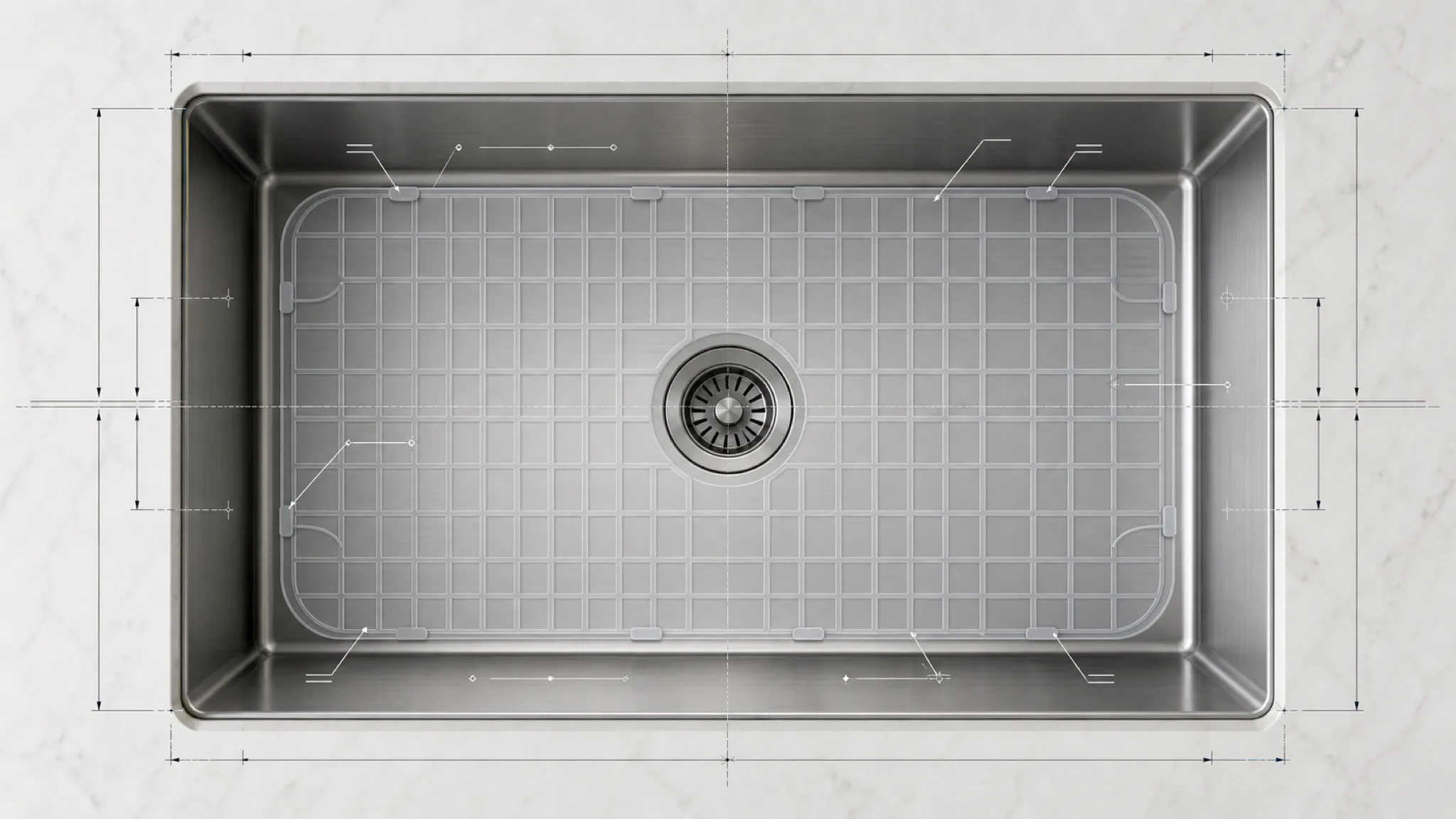
 The single most-common question on a sink grid OEM RFQ is “can you make it fit my [Kraus / Ruvati / Blanco] sink model?” — usually asked by a product manager working on a coordinated sink-accessory range. This guide is the fit framework: the four dimensions that matter, where to get them from the sink OEM, and the tolerance envelope that separates a clean-fitting grid from a program-killing gap.
A silicone bottom grid fits a specific sink SKU when four dimensions match: bay length, bay width, drain cutout position and diameter, and corner radius. All four must be specified from the sink OEM's technical drawing, not from measuring a finished sink. Tolerance envelope: bay dimensions ±2mm, drain cutout position ±3mm, corner radius ±2mm. Tighter causes seat problems; looser causes visible gaps. Drain cutout is the most-common program-killer because sink OEMs sometimes silently revise position between CAD versions.
What are the four critical spec dimensions for a silicone sink grid?
Bay length, bay width, drain cutout, corner radius. Bay length and width are the interior bay dimensions from the sink OEM's technical drawing (not the sink's external footprint, and not measured from a finished sink). Drain cutout is the offset from a defined reference corner or edge to the drain center — this is where sink OEMs sometimes silently revise between CAD versions and where programs typically break. Corner radius is the internal bay corner curvature (typically 25-50mm on modern sinks; some ultra-modern zero-radius designs use 3-5mm minimum). All four must be sourced from the current sink OEM CAD, verified at grid CAD sign-off.
The four-dimension spec framework — dimensional verification runs against ASTM D5296 measurement discipline1 and ISO 9001 documented process control2:
- Bay length — interior bay dimension, front-to-back on a rectangular sink. Typical range 300-500mm on premium residential sinks. Tolerance ±2mm.
- Bay width — interior bay dimension, left-to-right on a rectangular sink. Typical range 200-450mm on premium residential sinks. Tolerance ±2mm.
- Drain cutout position + diameter — offset from a defined reference edge to drain center; drain hole diameter (typically 90mm for standard 3.5” drains; some Kraus and Ruvati sinks use 100mm for larger throughput). Position tolerance ±3mm; diameter tolerance ±1mm.
- Corner radius — internal bay corner curvature. Typical modern sinks: 25-50mm radius; ultra-modern zero-radius designs: 3-5mm minimum. Tolerance ±2mm.
For programs targeting UK / EU plumbing markets, IAPMO fittings certification3 adds plumbing-industry accessory verification alongside the standard silicone stack of FDA 21 CFR 177.26004 and LFGB §30/31 per BfR Recommendation XV5. Stainless components on the grid (some designs include integrated stainless strainers) verify against NSF/ANSI 516 and SAE material grade documentation7. DIN dimensional standards8 apply to European market programs.
How do you actually get accurate sink dimensions from the sink OEM?
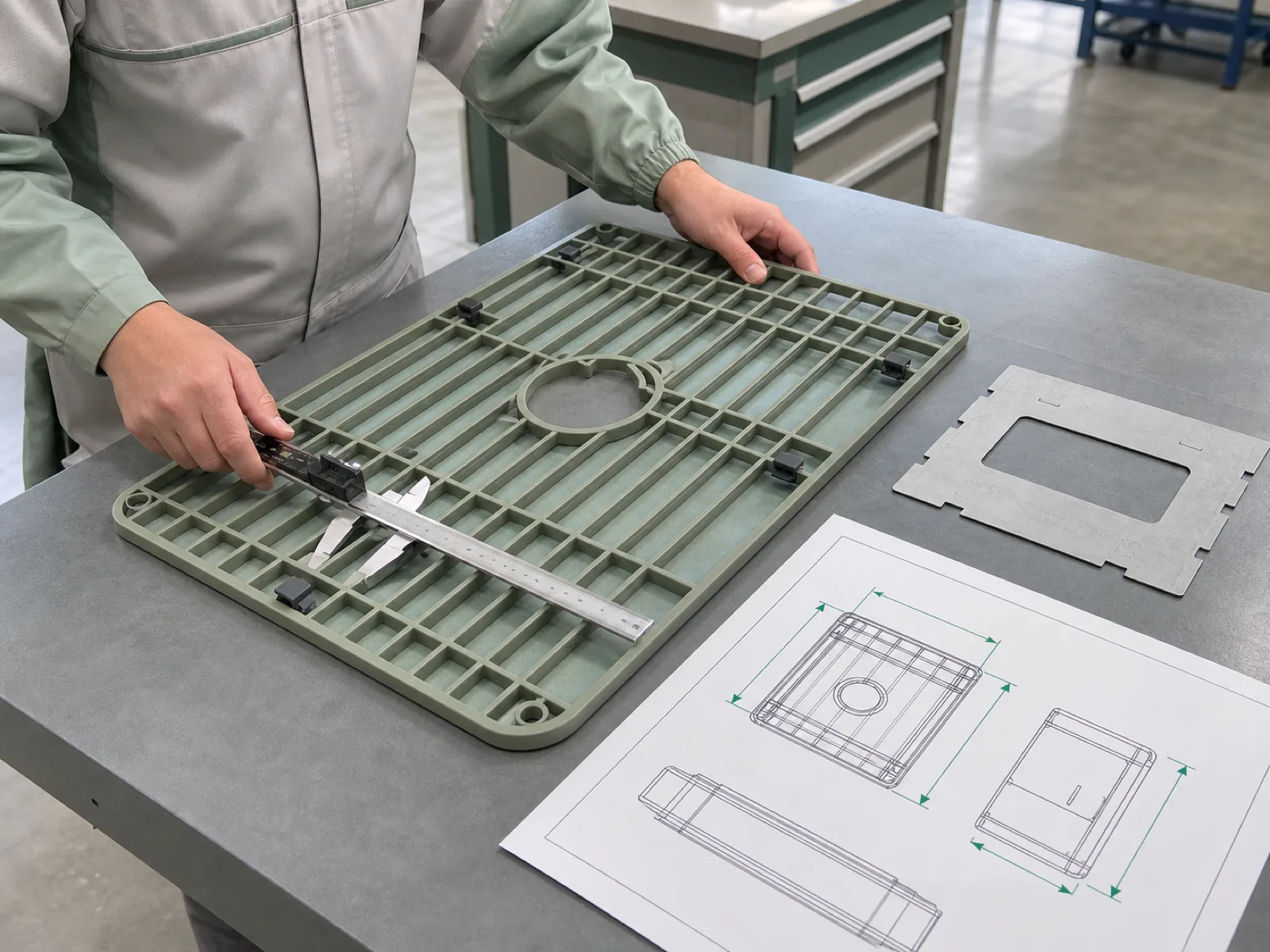
Three paths depending on your relationship with the sink brand. Sink-brand accessory partner: the sink brand provides sink CAD (STEP or DWG) under NDA as part of the accessory program spec. Independent silicone accessory OEM: request installation-spec documentation from the sink OEM's dealer/distributor network — dimensioned drawings sufficient for grid tooling are typically available through IAPMO-certified plumbing distributors[^iapmo-fittings]. Independent from published listings only: request the sink OEM's product-page spec sheet PDF; the dimensioned drawings are usually sufficient though the drain position is worth confirming against a current sample.
The three dimension-sourcing paths:
- Sink-brand accessory partner (highest confidence) — direct sink CAD supplied under NDA, current-production version. All four dimensions match production sink.
- Dealer/distributor spec docs (medium confidence) — installation drawings from IAPMO-certified plumbing distributors. Bay dimensions and corner radius reliable; drain cutout position should be verified against a current sample to catch silent revisions.
- Product-page spec PDF (lower confidence, but usable) — spec sheets from the sink OEM’s public product page. Bay dimensions reliable; drain position and corner radius should be verified against a physical sink sample before grid tooling is cut.
Regardless of path, the golden rule: request the CURRENT sink CAD, not a 6-month-old reference document. Sink OEMs silently revise drain position and occasionally corner radius between CAD versions for drainage improvements or strainer redesigns. Programs that don’t confirm the current spec at grid CAD sign-off can end up with grids that don’t fit current-production sinks.
Why is drain cutout the most-common program-killer on sink grid OEM programs?
Sink OEMs sometimes silently revise drain position between CAD versions. A drain that shifted 2-4mm between CAD v3 and CAD v4 (for a drainage-flow improvement) is visible when the grid is placed in the sink — the drain cutout doesn't center on the strainer, creating a visible gap. Retail QA flags it as a fit defect. Recovery requires mold re-cut, which is a 6-week schedule impact typically absorbed at the OEM's cost. Prevention: verify drain position against the CURRENT sink CAD at grid CAD sign-off, and cut the first-article against a physical sample sink if possible.

The failure pattern (documented across multiple sink-brand OEM programs):
- Sink OEM provides CAD v3 at the start of the grid RFQ.
- Grid CAD is developed against sink CAD v3 dimensions; sign-off proceeds.
- Sink OEM releases CAD v4 with a 2-4mm drain position revision (typically for a drainage or strainer redesign). Change is often not proactively communicated to accessory partners.
- Grid mold is cut against CAD v3 drain position.
- First-article grid is produced; when placed in a current-production sink, the drain cutout is offset from the strainer.
- Retail QA flags the fit defect at first-article inspection.
- Recovery: mold re-cut on OEM cost, 6-week schedule impact.
Prevention checklist:
- Request the sink OEM engineering team confirm the current CAD version at grid CAD sign-off, not the dealer document.
- Cross-reference drain position dimensions between CAD and a physical current-production sink sample.
- If schedule permits, cut the first-article grid mold against a physical sink sample rather than CAD only.
- Bake a 5-7 business day buffer into the pre-tooling schedule for sink CAD version verification.
What material and formulation is standard for silicone sink grids?
Platinum-cured silicone with in-mold non-slip feet. Standard Shore A 50-60 (medium hardness — flexible enough to conform to sink bay corners, firm enough to hold shape under load). 4-6 raised silicone feet on the grid bottom prevent sink-bottom scratching and dampen impact noise from dropped utensils. Master-batch Pantone color-matched to the sink finish family (matte black, brushed stainless coordinated grey, granite composite cinder, fireclay cream, or custom Pantone). Per-batch FDA + LFGB testing[^fda-177-2600][^bfr-lfgb-xv] on food-contact applications.
The standard sink grid spec:
- Silicone formulation — platinum-cured LSR (PFAS-free by chemistry) or post-cured peroxide-cure HCR with PFAS-free process aids verified per batch. See platinum vs peroxide guide for the cure system decision.
- Shore A hardness — 50-60 standard; some programs spec 40-50 for softer feel or 60-70 for firmer support under heavier cookware.
- In-mold non-slip feet — 4-6 raised silicone feet on the grid bottom, positioned at load-bearing points. Cast integral to the grid; no separate assembly step.
- Color — master-batch Pantone matched to the sink finish family (typical ranges: matte black RAL 9005 / TPX 419 C tier; brushed stainless coordinated grey RAL 7038 tier; granite composite cinder tone; fireclay cream tone; custom Pantone for retail-exclusive finishes). Tolerance ±0.5 ΔE per decoration guide.
- Decoration — in-mold deboss for brand mark (recessed relief, permanent, dishwasher-safe indefinitely).
What’s the compliance stack for sink grid OEM programs?
Standard silicone food-contact stack plus optional plumbing-industry certifications. FDA 21 CFR 177.2600[^fda-177-2600] extract testing per batch. LFGB §30/31 three-simulant migration per BfR Recommendation XV[^bfr-lfgb-xv] on EU-scope programs. PFAS non-detect per batch on premium retail programs. For programs targeting UK / EU premium plumbing markets, IAPMO fittings certification[^iapmo-fittings] adds plumbing-industry accessory verification. Programs with stainless strainer components add NSF/ANSI 51 documentation[^nsf-ansi-51].
The compliance stack by program type:
| Program archetype | FDA 177.2600 | LFGB §30/31 | PFAS non-detect | IAPMO | NSF/ANSI 51 |
|---|---|---|---|---|---|
| US mass retail (Home Depot / Wayfair) | ✅ Required | Nice-to-have | Nice-to-have | – | – |
| US premium natural retail (Whole Foods orbit) | ✅ Required | ✅ Required | ✅ Required | – | – |
| US kitchen specialty (Sur La Table tier) | ✅ Required | ✅ Required | ✅ Required | – | If stainless component |
| EU premium plumbing / retail | ✅ Required | ✅ Required | ✅ Required | ✅ Required | – |
| UK premium plumbing distributor | ✅ Required | ✅ Required | ✅ Required | ✅ Required | – |
| Sink-brand coordinated accessory OEM | ✅ Required | ✅ Required | ✅ Required | Often required | If stainless component |
What Wetop OEMs on sink grids
Wetop OEMs silicone sink grids sized to specific sink SKU dimensions. MOQ 500 per unique grid SKU. Program scope: 3-8 SKUs per sink brand covering the sink family's most popular bay dimensions. Platinum-cured LSR standard with Shore A 50-60 and in-mold non-slip feet. Pantone color-matched to sink finish family (±0.5 ΔE tolerance verified per batch). Per-batch FDA + LFGB testing standard; PFAS non-detect on premium programs; IAPMO on EU / UK plumbing-scope programs.
Wetop’s sink grid program defaults:
- Sink CAD verification — we request current-production sink CAD at RFQ stage and confirm dimensional match before quoting.
- Grid CAD sign-off — customer-approved CAD signed off before P20 mold cutting starts; drain position specifically confirmed against current sink OEM CAD.
- First-article physical verification — first-article grid produced and placed in a physical sample sink for fit confirmation before mass production release.
- Multi-SKU consistency — Pantone ±0.5 ΔE across all SKUs in the program verified per batch with spectrophotometer measurement.
- Compliance packet — FDA + LFGB + master-batch lot cert + post-cure log per batch; PFAS non-detect and IAPMO added per program scope.
See coated stainless vs pure silicone racks for adjacent kitchen accessory material choices, customize silicone logo guide for Pantone tolerance and decoration methods, and platinum vs peroxide cure guide for the material formulation framework.
Sourcing a silicone sink grid program with a specific sink brand model in mind? Email inquiry@wetopsilicone.com with the sink brand + model number + your target retail tier — we come back with a fit-scope recommendation, sample CAD spec framework, and per-unit quote at MOQ 500 / 1,000 / 5,000.
Ready to source? Every quote is built against your specification — send a CAD file, a written brief, or reference samples, and an engineer replies within one business day. Request a quote →
Footnotes
-
ASTM International. ASTM D5296-19. https://www.astm.org/d5296-19.html ↩
-
International Organization for Standardization. ISO 9001:2015 — Quality Management Systems. https://www.iso.org/standard/62085.html ↩
-
International Association of Plumbing and Mechanical Officials. IAPMO Fittings and Plumbing Standards. https://www.iapmo.org/ ↩
-
US Food and Drug Administration. 21 CFR 177.2600. https://www.ecfr.gov/current/title-21/chapter-I/subchapter-B/part-177/subpart-C/section-177.2600 ↩
-
German Federal Institute for Risk Assessment. Recommendation XV — Silicones. https://www.bfr.bund.de/en/bfr_recommendations_on_food_contact_materials-7498.html ↩
-
NSF International / ANSI. NSF/ANSI 51 — Food Equipment Materials. https://www.ecfr.gov/current/title-21/chapter-I/subchapter-B/part-177 ↩
-
SAE International. Material Standards. https://www.sae.org/standards/ ↩
-
Deutsches Institut für Normung. DIN Material Testing Standards. https://www.din.de/en ↩
FAQ
-
What sink brands does Wetop OEM silicone grids for?
Wetop OEMs silicone sink grids to fit sink product families from major North American and European premium sink brands including Kraus, Ruvati, Blanco, VIGO, Elkay, Houzer, Karran, Kohler, and equivalent-tier brands. Program scope: typically 3-8 SKUs per sink brand covering the sink family's most popular bay dimensions. Each SKU requires unique tooling — see [MOQ & lead time on custom silicone](/guide/moq-and-lead-time-silicone-oem/) for how multi-SKU programs schedule. We anonymize customer references per NDA; anonymized program archetypes on [case studies](/case-studies/).
-
What are the four critical dimensions I need to specify?
Bay length + bay width + drain cutout position + corner radius. Bay length and width are the interior bay dimensions (not the sink's external footprint). Drain cutout position is the offset from a defined reference corner or edge to the drain center — this is where sink OEMs sometimes silently revise between CAD versions. Corner radius is the internal bay corner curvature (typically 25-50mm on modern sinks; some ultra-modern zero-radius designs use 3-5mm minimum). All four numbers must come from the sink OEM's technical drawing, not from measuring a finished sink (finished sinks have manufacturing variance beyond the spec).
-
How do I get the sink brand's technical drawing?
Two paths depending on relationship. If you're an accessory OEM partner to the sink brand: the sink brand provides sink CAD (STEP or DWG) under NDA as part of the accessory program spec. If you're an independent silicone accessory OEM without direct sink-brand relationship: the sink OEM's dealer/distributor network typically has installation-spec documentation available with dimensioned drawings sufficient for grid tooling. IAPMO-certified plumbing distributors typically hold detailed spec docs[^iapmo-fittings]. If you're speccing from published product listings only: request the sink OEM's spec sheet PDF (typically available on the product page or from the dealer network); the dimensioned drawings are usually sufficient.
-
What's the tolerance envelope on the four spec dimensions?
Bay length ±2mm; bay width ±2mm; drain cutout position ±3mm; corner radius ±2mm. Tighter than ±2mm on bay dimensions causes 'won't seat' installation problems because sinks themselves have manufacturing variance in that same envelope. Looser than ±3mm on drain cutout shows as visible gap around the drain strainer — the aesthetic complaint retail buyers audit. Corner radius tolerance ±2mm allows for sink manufacturing variance while keeping the grid corners visibly aligned with sink corners. See [platinum vs peroxide cure guide](/guide/platinum-cured-vs-peroxide-cured-silicone/) for how cure system affects dimensional stability.
-
How does the drain cutout revision issue actually kill programs?
Sink OEMs sometimes silently revise drain position between CAD versions — typically to improve drainage performance or accommodate a redesigned strainer assembly. If the revision happens between grid CAD sign-off and first-article production, the grid drain cutout may be offset from the current-production sink drain by 2-4mm. This is visible when the grid is placed in the sink; the drain cutout doesn't center on the strainer. Retail QA flags it as a fit defect. Recovery: mold re-cut, which is a 6-week schedule impact and typically absorbed at the OEM's cost. Prevention: request the CURRENT sink CAD from the sink brand's engineering team (not the dealer document), verify drain position at CAD sign-off, and have the grid mold cut against a first-article physical sink sample if possible. Wetop's [Round 3 sink-brand case study](/case-studies/remold-mid-program/) walks through this exact program-killer pattern.
-
What material and formulation should I spec for silicone sink grids?
Platinum-cured silicone with in-mold non-slip feet (typically 4-6 raised silicone feet on the grid bottom to prevent sink-bottom scratching and dampen impact noise). Standard Shore A 50-60 (medium hardness — flexible enough to conform to sink bay corners, firm enough to hold shape under load). Master-batch Pantone color-matched to the sink finish family (matte black, brushed stainless coordinated grey, granite composite cinder, fireclay cream, or custom Pantone). See [platinum vs peroxide cure guide](/guide/platinum-cured-vs-peroxide-cured-silicone/) for cure system decision and [customize silicone logo guide](/guide/customize-silicone-logo-deboss-print-laser/) for color match tolerance framework.
-
What certifications does the sink grid program need?
Standard silicone food-contact stack: FDA 21 CFR 177.2600[^fda-177-2600] extract testing per batch + LFGB §30/31 three-simulant migration per BfR Recommendation XV[^bfr-lfgb-xv] for EU-scope programs + PFAS non-detect on premium retail programs. For programs targeting UK / EU premium plumbing markets, additional IAPMO fittings certification[^iapmo-fittings] verifies the grid meets plumbing-industry accessory standards. For US premium retail programs, NSF/ANSI 51 documentation[^nsf-ansi-51] on any stainless components (some sink grid designs include stainless strainer accessories). See [FDA vs LFGB decoder](/guide/fda-vs-lfgb-silicone/) for the food-contact certification framework.
References
Authoritative sources cited in this guide
- US Food and Drug Administration. 21 CFR 177.2600 — Rubber articles intended for repeated use. https://www.ecfr.gov/current/title-21/chapter-I/subchapter-B/part-177/subpart-C/section-177.2600 — The US food-contact regulation whose extraction testing applies to silicone sink grids in food-preparation contact.
- German Federal Institute for Risk Assessment. BfR Recommendation XV — Silicones. https://www.bfr.bund.de/en/bfr_recommendations_on_food_contact_materials-7498.html — The technical standard behind LFGB §30/31 for silicone sink grid EU program compliance.
- ASTM International. ASTM D5296-19 — Standard Test Method. https://www.astm.org/d5296-19.html — The analytical characterization method behind dimensional verification of silicone sink grids against the sink OEM CAD spec.
- SAE International. SAE Material Standards. https://www.sae.org/standards/ — The material grade documentation framework relevant for stainless components on premium sink grid programs.
- International Association of Plumbing and Mechanical Officials. IAPMO Fittings and Plumbing Standards. https://www.iapmo.org/ — The plumbing-industry accessory standard applicable to sink grid programs targeting UK / EU plumbing markets.
- NSF International / ANSI. NSF/ANSI 51 — Food Equipment Materials. https://www.ecfr.gov/current/title-21/chapter-I/subchapter-B/part-177 — The food-contact material certification framework applicable to sink grid programs with stainless components.
- Deutsches Institut für Normung. DIN Material Testing Standards. https://www.din.de/en — The German industrial standards framework for silicone-stainless material characterization on sink grid programs.
- International Organization for Standardization. ISO 9001:2015 — Quality Management Systems — Requirements. https://www.iso.org/standard/62085.html — The QMS standard behind per-batch documentation and material traceability on silicone sink grid programs.
Start a custom program
Send a brief. Get an engineer’s reply in one business day.
Every Wetop program is tooled from a customer’s specification. Send a CAD file (STEP · IGES · DWG) or a written brief and we’ll reply with a mold cost estimate, price brackets at MOQ 500 / 1,000 / 5,000, and any engineering questions.