Buyer Guide · commercial intent
Silicone Sponge OEM Guide — Density, Cure, Compliance, MOQ
 Buyer Guide
 Silicone sponge is one of the most-misunderstood material categories in housewares OEM sourcing. The top-ranking SERP pages are all aerospace and industrial gasket suppliers — Stockwell, SRP, National Silicone, Stigall, Secon — writing for engineers specifying window gaskets against AMS 3195/3196 or MIL-R-46089. None of them cover the FDA 21 CFR 177.2600 + LFGB §30/31 + PFAS packet that a housewares brand actually needs to list a silicone dish sponge, cleaning pad, or sink-adjacent cellular kitchenware SKU at retail. This guide fills the gap from inside a working OEM factory floor.
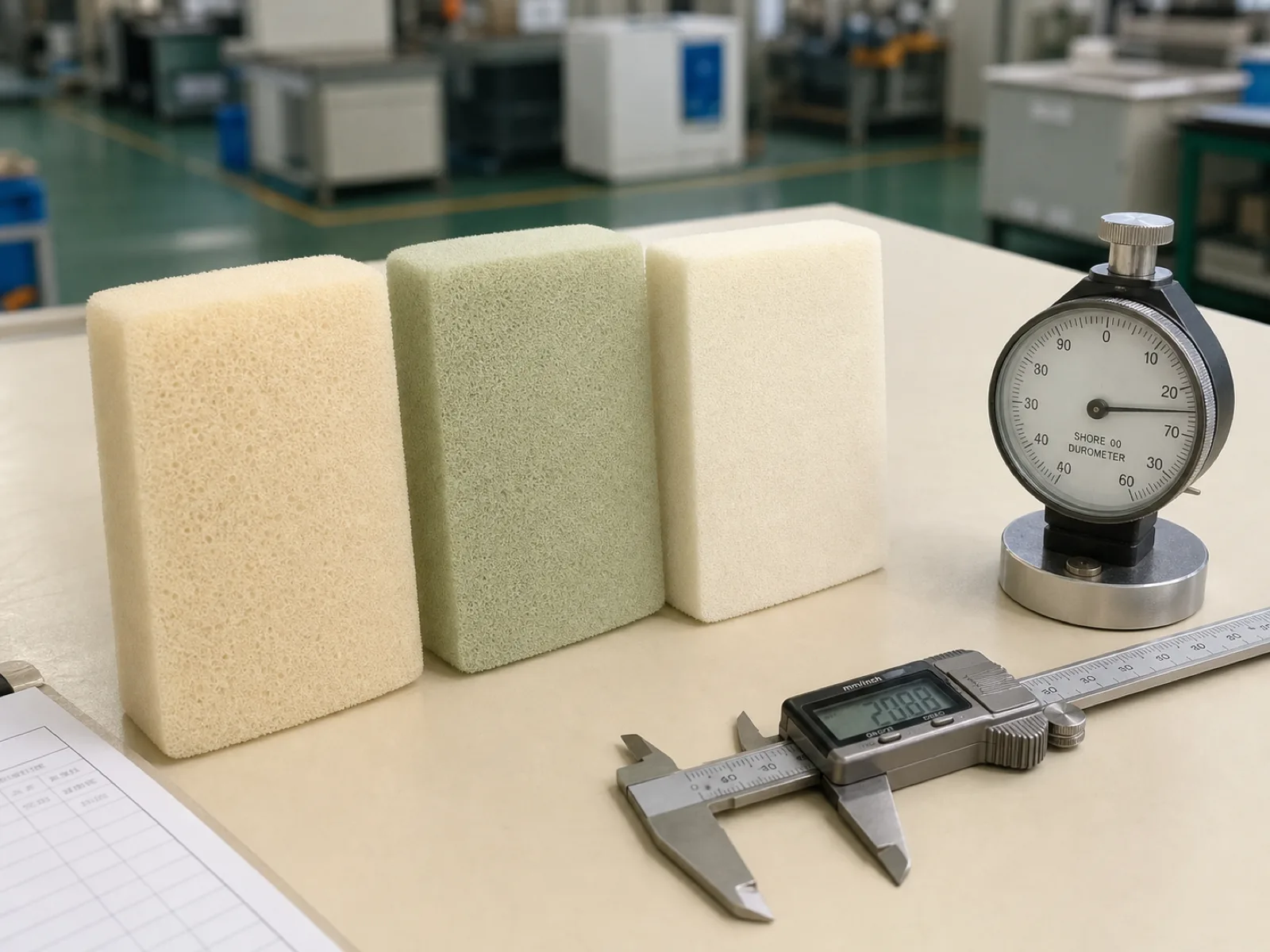
Silicone sponge is a cellular polydimethylsiloxane elastomer produced by chemical blowing agent decomposition during cure, at density 240-720 kg/m³, Shore 00 hardness 20-70, in closed-cell or open-cell structure. For housewares OEM programs — dish sponges, cleaning pads, cellular kitchenware — the mandatory compliance stack is FDA 21 CFR 177.2600, LFGB §30/31 per BfR Recommendation XV, and per-batch PFAS non-detect. MOQ 500 pieces per SKU with FOB Yantian at $0.78-$1.15 for a standard 110×70×25 mm closed-cell platinum-cure dish sponge, dropping to $0.42-$0.62 at 10,000 pieces.
What is silicone sponge and how does the cellular structure form?
Silicone sponge is a cellular silicone elastomer — polydimethylsiloxane compound expanded during cure by decomposition of a chemical blowing agent (typically azodicarbonamide or a hydrazide at 0.5-3.0 % load) that releases nitrogen gas into the polymer matrix. The gas expansion produces a foam-like cellular structure at density 240-720 kg/m³, classified as closed-cell or open-cell per ASTM D1056[^astm-d1056]. Base silicone chemistry is identical to solid silicone — only the blowing agent and cure profile differ.
The mechanical function of a silicone sponge is defined by three variables: cell structure (open vs closed), density (kg/m³), and Shore 00 hardness. Density and hardness track loosely together — higher density usually means higher Shore 00 — but they can be tuned independently by varying blowing agent load and base compound stiffness. Cell structure is a separate axis, controlled by cure profile: fast-rising cures with high blowing-agent load produce open-cell (interconnected cells, breathable, water-absorbing) structure; slower controlled-rise cures produce closed-cell (sealed cells, impermeable, water-repelling).
For a housewares OEM program the axis that matters most is cell structure. A silicone dish sponge needs closed-cell — it must not absorb dishwater into its structure and grow bacteria. A silicone cleaning pad meant to hold detergent needs open-cell. The retail-return complaint that a “silicone sponge smells after two weeks” is almost always an open-cell sponge that was specified as closed-cell by a buyer who didn’t ask the question.
Baseline engineering spec sheet
| Parameter | Standard range | Test method |
|---|---|---|
| Density | 240-720 kg/m³ (retail housewares: 320-480) | ASTM D1056[^astm-d1056] |
| Shore 00 hardness | 20-70 (retail housewares: 40-60) | ASTM D2240[^astm-d2240] |
| Cell structure | Closed-cell or open-cell | ASTM D1056[^astm-d1056] |
| Tensile strength | ≥ 0.7 MPa (closed-cell), ≥ 0.4 MPa (open-cell) | ASTM D412 |
| Elongation at break | ≥ 150% | ASTM D412 |
| Tear resistance | ≥ 4 kN/m | ASTM D624 |
| Compression set (22 h at 70°C) | ≤ 25% | ASTM D1056 |
| Continuous service temperature | -60°C to 230°C | Manufacturer spec + LFGB thermal cycling |
| Peak short-exposure temperature | 260°C (aerospace-grade to 316°C) | Compound spec |
| Cure system | Platinum (LSR/HCR) or peroxide (HCR) | Master-batch lot certificate |
Silicone sponge vs silicone foam — which cell structure for which application?
Closed-cell silicone sponge for dish sponges, kitchen scrub pads, sink cellular grip layers, and any application where water absorption is a failure mode. Open-cell silicone foam for acoustic damping, ventilation gaskets, air filtration, and cleaning pads where liquid absorption is the design intent. Per ASTM D1056[^astm-d1056] the two are separate material classes with distinct compression, water-resistance, and permeability profiles — do not accept a spec sheet that treats them interchangeably.
The industrial-gasket-supplier top-5 SERP pages for “silicone sponge” tend to lump both structures together because their end customers (aerospace, electronics enclosure, medical equipment gasket buyers) rarely need to distinguish them at spec time. In housewares OEM the distinction is load-bearing.
Application-driven cell structure decision
| Application | Cell structure | Density (kg/m³) | Shore 00 |
|---|---|---|---|
| Silicone dish sponge (retail housewares) | Closed-cell | 320-480 | 40-60 |
| Silicone scrub pad (dishwashing, no liquid retention) | Closed-cell | 400-560 | 50-70 |
| Cleaning pad (holds detergent) | Open-cell | 240-320 | 30-45 |
| Sink cellular cushion layer | Closed-cell | 320-400 | 40-55 |
| Bath / spa exfoliation sponge | Closed-cell or open-cell (specialty) | 240-400 | 30-50 |
| Kitchen tool grip (soft-touch overmold) | Closed-cell | 480-640 | 60-70 |
| Gasketing (window, enclosure) | Closed-cell (industrial) | 400-640 | 50-70 |
| Acoustic / vent damping (industrial) | Open-cell | 160-320 | 20-40 |
For a silicone dish sponge OEM program specifically, closed-cell is the answer 95% of the time. The one exception is a specialty scrub-and-hold cleaning pad where the buyer wants the sponge to retain detergent between uses — that goes open-cell, and the SKU marketing has to educate the consumer to squeeze it dry between washes or the return-review complaint category is guaranteed.
What compliance stack does a food-contact silicone sponge need?
The mandatory stack for housewares retail is FDA 21 CFR 177.2600[^fda-177-2600] (US food contact), LFGB §30/31 organic volatile testing per BfR Recommendation XV[^bfr-lfgb-xv] (EU food contact), ISO 9001:2015[^iso-9001] quality management, and per-batch PFAS non-detect testing. This is a different packet from the industrial silicone sponge stack (AMS 3195/3196, MIL-R-46089) that top-ranking SERP suppliers cite. A housewares brand sourcing from an aerospace-tier silicone sponge supplier will discover at PO time that the food-contact packet was never built.
The gap between industrial-tier and housewares-tier silicone sponge compliance is the single largest sourcing trap in this material category. It is why a housewares brand pulling silicone sponge suppliers off Alibaba or from a Google search of “silicone sponge manufacturer” routinely ends up with a supplier who quotes a competitive unit price and then cannot ship the FDA/LFGB packet.
The four-layer housewares compliance stack
Layer 1 — FDA 21 CFR 177.2600 (US baseline). The primary US regulation governing food-contact silicone (and other rubber articles) intended for repeated use. Tests aqueous, 8 % ethanol, and n-heptane extractables against defined limits. Every US retail SKU needs this on file per master-batch lot. Wetop tests at accredited third-party labs (SGS, Intertek, TÜV, Bureau Veritas) as the default packet on every housewares silicone sponge program.
Layer 2 — LFGB §30/31 (EU / premium US). German Food and Feed Code sections 30 and 31, technically grounded in BfR Recommendation XV[^bfr-lfgb-xv] and framed by EU Regulation 1935/2004[^ec-1935-2004]. Tests organic volatile extractables under stricter protocols than FDA — this is the reason mandatory 4-6 hour post-cure exists on silicone sponge. Peroxide-cure silicone sponge without post-cure fails LFGB §30 organic volatile testing. Any EU retail program and any US premium retail program will demand this alongside FDA.
Layer 3 — ISO 9001:2015 (quality system). The internationally recognized quality management system standard. Not a product certification — it certifies the factory’s documented process discipline. Auditors verify certificate validity, scope (silicone molding must be in-scope, not just trading), and the current calendar date on the certificate. Wetop’s scope covers compression molding of silicone sponge and solid silicone, LSR injection, secondary process (post-cure, printing, deburring), and QC.
Layer 4 — PFAS non-detect (accelerating requirement). Per-batch PFAS testing at parts-per-billion detection limits from an accredited lab. Driven by the ECHA universal restriction proposal[^echa-pfas-proposal] and downstream retailer spec adoption. Now table-stakes on any EU premium program and increasingly required on US West Coast retail — particularly on dish sponges and food-contact cleaning pads where the SKU touches food surfaces.
Industrial vs housewares compliance stack — the material trap
| Compliance element | Industrial silicone sponge | Housewares silicone sponge |
|---|---|---|
| Regulatory anchor | AMS 3195/3196 (aerospace), MIL-R-46089, ASTM D1056 grade | FDA 21 CFR 177.2600, LFGB §30/31, EC 1935/2004 |
| Blowing agent selection | Optimized for temperature range | Optimized for food-contact residue |
| Post-cure discipline | Optional; driven by outgassing spec | Mandatory 4-6 h at 180-200°C |
| PFAS testing | Rarely required | Table stakes for EU premium |
| Traceability doc | Cert of Conformance to spec | Per-batch third-party test report |
| Buyer audience | Aerospace, electronics enclosure, medical device | Housewares brands, retail chains, food-service |
An industrial silicone sponge supplier can ship an AMS 3195 gasket with a Certificate of Conformance in 3 weeks and never build an FDA report. A housewares OEM supplier ships a food-contact silicone sponge with the FDA + LFGB + PFAS packet as the default because a Tier 2 retail chain audit will demand it before listing. Full FDA-vs-LFGB decision breakdown on our FDA vs LFGB silicone decoder.
Platinum-cured or peroxide-cured silicone sponge — which cure system?
Platinum-cure by default for EU premium, PFAS-free positioning, baby-tier, and any SKU with dishwasher-cycle exposure. Peroxide-cure with mandatory 4-6 hour post-cure at 180-200°C for US mid-tier retail dish sponges at $2-5 shelf price. The cure decision drives the first-heat odor category on retail reviews — under-post-cured peroxide-cure silicone sponge outgasses residual blowing-agent decomposition byproducts on first heated exposure and generates the "silicone smell" return complaint.
Both cure systems use the same silicone polymer (PDMS) and can carry the same chemical blowing agent. The catalyst that triggers crosslinking is where they diverge — platinum for platinum-cure, organic peroxide for peroxide-cure — and that catalyst choice cascades into byproduct chemistry, first-heat odor risk, per-unit cost, and regulatory positioning.
For silicone sponge specifically, the cure decision has an amplified consequence relative to solid silicone. The cellular structure gives residual peroxide decomposition byproducts a much larger internal surface area from which to outgas, and a much longer diffusion path out of the finished part. Under-post-cured peroxide-cure silicone sponge dish sponges will out-gas for the first 15-30 uses (versus 5-8 uses for a solid silicone baking mat) and produce a smell complaint category that platinum-cure sponges almost never generate.
Cost delta at silicone sponge MOQ tiers
| Cure system | 500 pcs (110×70×25 mm dish sponge) | 1,000 pcs | 5,000 pcs | 10,000 pcs |
|---|---|---|---|---|
| Peroxide-cure (post-cured, PFAS-free process aid verified) | $0.62-$0.92 | $0.50-$0.75 | $0.40-$0.58 | $0.34-$0.50 |
| Platinum-cure (LSR or premium HCR) | $0.78-$1.15 | $0.62-$0.92 | $0.48-$0.72 | $0.42-$0.62 |
| Delta | +18-25% | +18-23% | +17-24% | +18-24% |
Numbers are FOB Yantian, Q3 2026 benchmarks, standard 110×70×25 mm closed-cell dish sponge with 1-color debossed logo, density 400 kg/m³, Shore 00 50. Custom Pantone-matched master-batch adds $0.06-$0.12 per unit. Sculpted scrub-side surface debossing adds $0.04-$0.08 per unit.
Full engineering decision framework on our platinum-vs-peroxide-cured silicone decision guide.
Manufacturing route — compression mold, die-cut sheet, or extrusion?
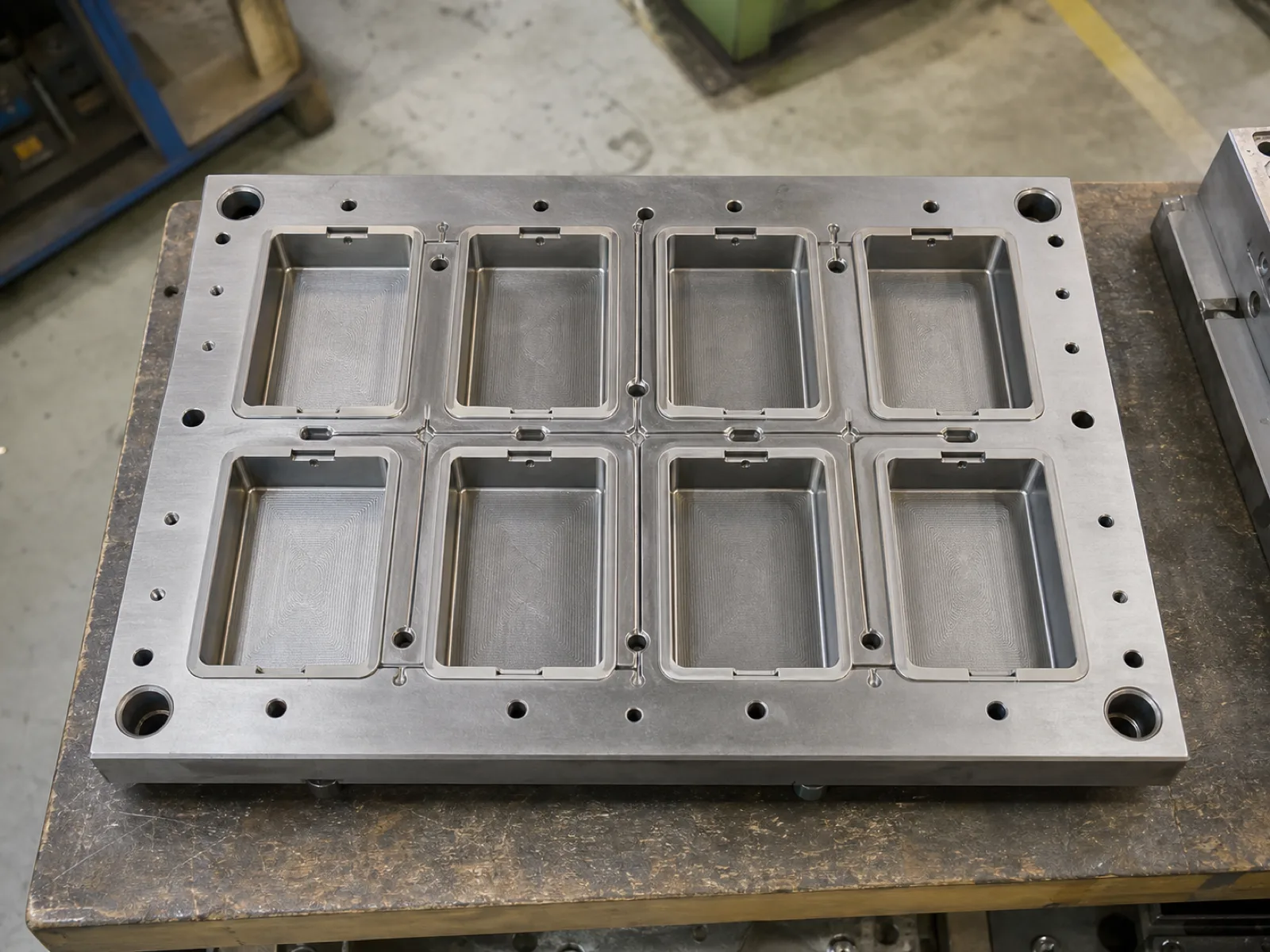
Compression mold for shaped 3D silicone sponge parts — dish sponges, cleaning pads with sculpted scrub side, housewares parts with debossed logo. Die-cut sheet for flat gaskets and pads from a pre-cured slab. Extrusion for continuous profiles (edge trims, tubing). For a silicone dish sponge OEM program the answer is compression mold in 95% of cases; the retail-friendly grip and logo geometry require it and no other route can produce the finished surface finish at scale.
The route decision is a geometry-first, then volume-second question. It is not a cost-first question — the per-unit cost delta between the three routes at MOQ 500-5,000 is smaller than the geometric and surface-finish constraints each route imposes.
Route decision matrix for silicone sponge
| Route | Best for | MOQ | Tooling cost | Per-unit cost floor | Waste rate |
|---|---|---|---|---|---|
| Compression mold | Shaped housewares parts, debossed logo, sculpted geometry | 500 pcs | $2,400-$3,800 | $0.42/pc (10k) | 3-5% |
| Die-cut sheet | Flat gaskets, cushion pads from a slab | 1,000-2,000 pcs | $200-$800 | $0.55/pc (10k) | 20-30% off-cut |
| Extrusion | Continuous profiles (edge trim, tubing, cord) | 500 lm | $600-$1,500 | Quote per meter | 2-4% |
| Molded frothing | Ultra-low density (<200 kg/m³) specialty | 1,000 pcs | $3,500-$5,000 | Specialty | 5-8% |
The compression mold + chemical blowing agent route is where a housewares silicone sponge program lives. Every one of the top-5 SERP industrial-supplier pages sells die-cut sheet as the default because their end-customer application (gaskets) is flat. Housewares customers pay a small unit-cost premium for a much better surface finish and the ability to mold a debossed logo in the same step as cure.
MOQ tiers and FOB Yantian pricing benchmarks for silicone sponge
Wetop's MOQ is 500 pieces per SKU for silicone sponge OEM programs — the minimum that supports per-batch third-party FDA + LFGB + PFAS test report economics. FOB Yantian Q3 2026 for a standard 110×70×25 mm closed-cell platinum-cure dish sponge with 1-color debossed logo: 500 pcs $0.78-$1.15, 1,000 pcs $0.62-$0.92, 5,000 pcs $0.48-$0.72, 10,000 pcs $0.42-$0.62. Tooling for a new shape runs $2,400-$3,800 amortized against first-order volume.
The MOQ math for silicone sponge follows the same logic as solid silicone housewares. Below 500 pieces per SKU, the per-batch third-party compliance packet cost ($800-$1,200 combined for FDA + LFGB + PFAS) dominates the per-unit price to the point where the finished product is not retail-competitive. Above 500 pieces the test cost amortizes to $1.60-$2.40 per piece and drops fast — 5,000 pieces amortizes to $0.16-$0.24 per piece.
Full MOQ-tier FOB Yantian pricing (110×70×25 mm closed-cell dish sponge, Q3 2026)
| Volume tier | Peroxide-cure post-cured | Platinum-cure LSR/HCR | Sculpted scrub debossing add | Pantone master-batch add |
|---|---|---|---|---|
| 500 pcs | $0.62-$0.92 | $0.78-$1.15 | +$0.06-$0.08 | +$0.10-$0.15 |
| 1,000 pcs | $0.50-$0.75 | $0.62-$0.92 | +$0.05-$0.07 | +$0.08-$0.12 |
| 2,500 pcs | $0.44-$0.65 | $0.54-$0.80 | +$0.04-$0.06 | +$0.07-$0.10 |
| 5,000 pcs | $0.40-$0.58 | $0.48-$0.72 | +$0.04-$0.06 | +$0.06-$0.09 |
| 10,000 pcs | $0.34-$0.50 | $0.42-$0.62 | +$0.03-$0.05 | +$0.05-$0.08 |
| 20,000+ pcs | $0.28-$0.42 | $0.35-$0.52 | Quote | Quote |
Prices exclude retail packaging (a typical color header card with a display bag runs $0.14-$0.28 per unit fully assembled), certification fees for a specific retailer or regulatory scope beyond the default packet, and destination-country duties.
Tooling investment for custom silicone sponge geometry
New compression tooling amortizes as follows for a silicone sponge mold:
- Small (up to 90×60×20 mm, 8-cavity): $2,400-$3,000
- Standard (110×70×25 mm dish sponge, 6-cavity): $2,600-$3,200
- Complex geometry (sculpted grip, multi-surface deboss): $3,000-$3,800
- Multi-cavity mid-volume (12-16 cavity): $3,800-$5,500
Wetop typically amortizes tooling against the first production order rather than billing as a separate line item. Full pricing structure detail on the silicone OEM pricing structure guide.
The design spec checklist a buyer must send to get a real quote
Ten data points make a silicone sponge quote real vs speculative: outline dimensions with tolerance class, wall thickness at critical sections, cell structure (open or closed), density (kg/m³), Shore 00 hardness, cure system (platinum or peroxide + post-cure), color and Pantone reference, adhesive backing (if any), certification packet required, and annual volume estimate with seasonality. A supplier who quotes without these ten data points is quoting a category, not a program.
The gap between a real quote and a placeholder quote is the difference between a program that ships on time and a program that discovers spec conflicts during pilot production. The ten data points below are what Wetop’s engineering desk needs to price a silicone sponge OEM program with confidence.
The 10-point buyer spec sheet
| # | Data point | Standard example | Why it drives the quote |
|---|---|---|---|
| 1 | Outline dimensions + tolerance class | 110×70×25 mm ±0.5 mm | Sets cavity count and cycle time |
| 2 | Wall / cross-section thickness | Uniform 25 mm | Affects cure profile and post-cure duration |
| 3 | Cell structure | Closed-cell | Drives blowing agent selection |
| 4 | Density | 400 kg/m³ ±30 | Sets compound formula |
| 5 | Shore 00 hardness | 50 ±5 | Verifies compound formula |
| 6 | Cure system | Platinum-cure | Sets catalyst cost + regulatory positioning |
| 7 | Color + Pantone ref | Warm sage, Pantone 5615 C | Master-batch cost adder |
| 8 | Adhesive backing | None (or 3M VHB / acrylic PSA) | Secondary process cost |
| 9 | Certification packet | FDA 21 CFR 177.2600 + LFGB §30/31 + PFAS non-detect | Per-batch test cost |
| 10 | Annual volume + seasonality | 40,000 pcs / year, 60% Q3-Q4 | Tooling amortization + capacity reservation |
For a buyer who cannot yet provide all ten, Wetop’s engineering desk will fill in retail-tier defaults and quote a bracketed price range with those defaults noted explicitly on the RFQ response. That transparency is the discipline that separates a serious silicone sponge OEM from a broker.
The four data points that separate serious suppliers from datasheet copiers
Compression set per ASTM D1056[^astm-d1056], tensile strength per ASTM D412, tear resistance per ASTM D624, and density per ASTM D1056 measured on the exact master-batch lot the supplier will produce your order from. Any supplier can copy a nominal datasheet from a competitor. Only a real factory can produce a third-party physical test report tied to a specific compound lot on a specific date. Ask for the physical test report, not the datasheet.
The datasheet copy is the single most-common failure mode in silicone sponge sourcing. A trading company or a small compression shop pulls the physical property table from a Wacker, Momentive, or Dow Corning silicone compound spec sheet and presents it as their factory’s capability. The nominal properties look identical to any real factory’s — because they are copied from the same upstream compound-house spec.
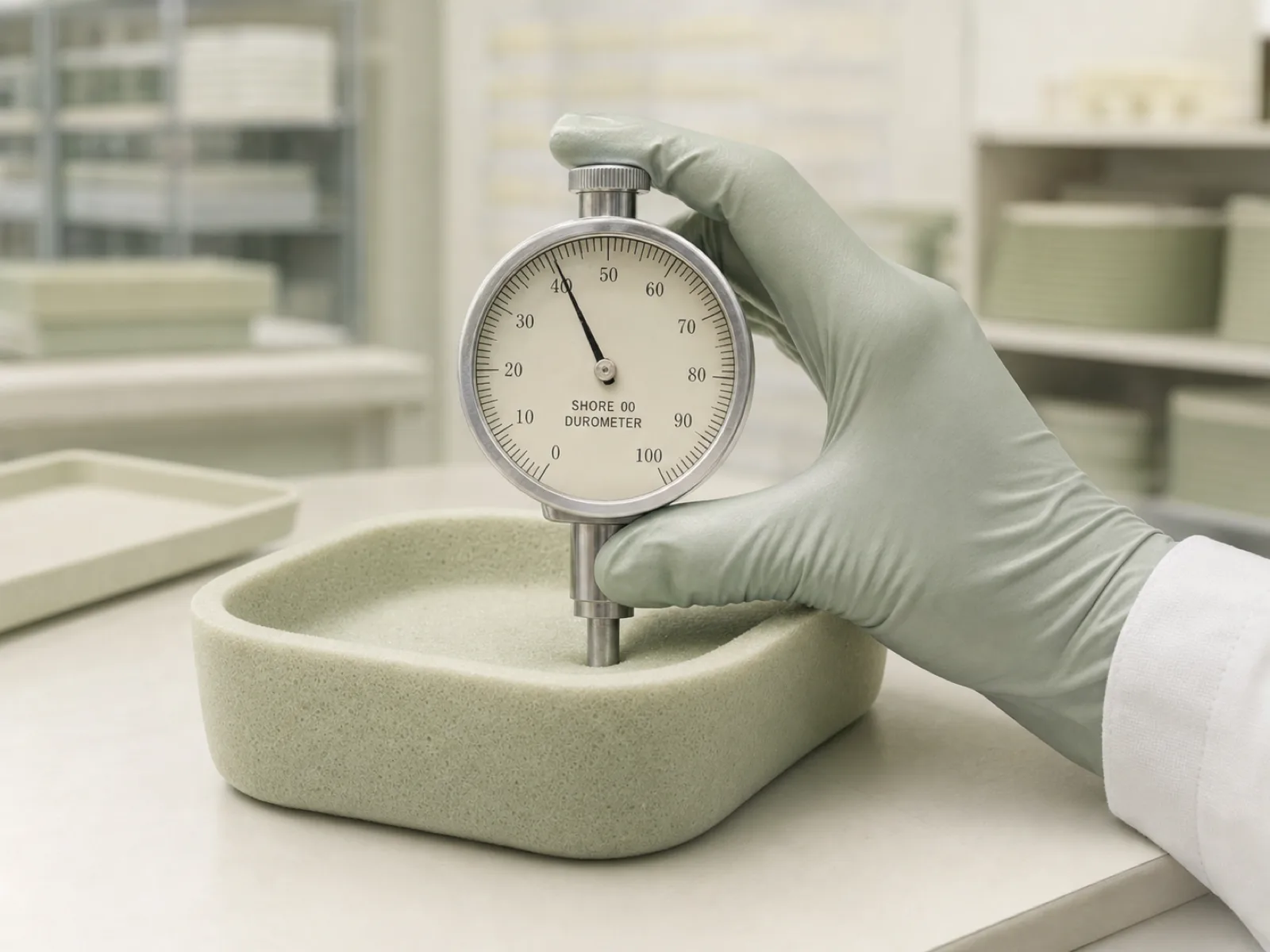
The four physical properties below are the ones a serious buyer must verify on the actual master-batch lot Wetop will produce their order from, not on a nominal datasheet.
The four verification properties for silicone sponge
Compression set per ASTM D1056 — the percentage of thickness a sample fails to recover after 22 hours of compression at 70°C. Retail-quality closed-cell silicone sponge should measure ≤ 25%. A compression set > 40% on a dish sponge means the SKU will crush flat after 3-4 weeks of retail use and generate return complaints. Under-post-cured peroxide-cure sponge is the most-common cause of high compression set.
Tensile strength per ASTM D412 — the stress at rupture, measured in MPa. Retail closed-cell sponge should measure ≥ 0.7 MPa. Below that, the sponge tears during dishwashing action. Above 1.2 MPa the sponge is too stiff for scrubbing conformity. This is the mechanical property that separates a real silicone sponge from a filled or extended compound with talc or calcium carbonate substitutes.
Tear resistance per ASTM D624 — the force per unit thickness required to propagate a tear, measured in kN/m. Retail closed-cell sponge should measure ≥ 4 kN/m. Below that, small nicks (fingernails, dishware edges) rip through the sponge and generate return complaints inside the first 2 weeks of use.
Density per ASTM D1056 — mass per unit volume, measured in kg/m³. Retail closed-cell dish sponge target 320-480 kg/m³. This is the property that most easily reveals a filled or extended compound — a nominal 400 kg/m³ measured at 550-600 kg/m³ means the compound has been extended with talc, calcium carbonate, or recycled silicone filler that will fail LFGB extractables testing.
How to audit a silicone sponge factory — the six-document packet
Six documents cover 90% of what an on-site audit would verify. ISO 9001:2015 certificate with silicone molding in-scope; FDA 21 CFR 177.2600 and LFGB §30/31 test reports referencing a master-batch lot from the last 6 months; post-cure oven log from the same lot; PFAS non-detect report from an accredited lab; factory production video showing compression presses and post-cure ovens in actual use; business license and export license copies. If a supplier resists sending any of these, treat the resistance as the audit answer.
A retail chain buyer’s factory audit standard is documentation depth, not visual impression. A polished factory photo does not clear a Tier 2 US home improvement chain vendor onboarding. A per-batch test report referencing a specific master-batch lot from the last 6 months does.
The six-document remote audit packet
-
ISO 9001:2015 certificate. Current validity date visible. Scope explicitly covers silicone molding (compression, LSR, or both). Trading-only scope is a disqualifier for OEM. Wetop’s certificate covers compression molding of silicone sponge and solid silicone, LSR injection, secondary process, and QC.
-
FDA 21 CFR 177.2600 and LFGB §30/31 test reports. Both reports must reference a specific master-batch lot number from the last 6 months, be issued by an accredited third-party lab (SGS, Intertek, TÜV, Bureau Veritas), and match the compound spec (Shore 00, density, cure system) the supplier will produce your order from.
-
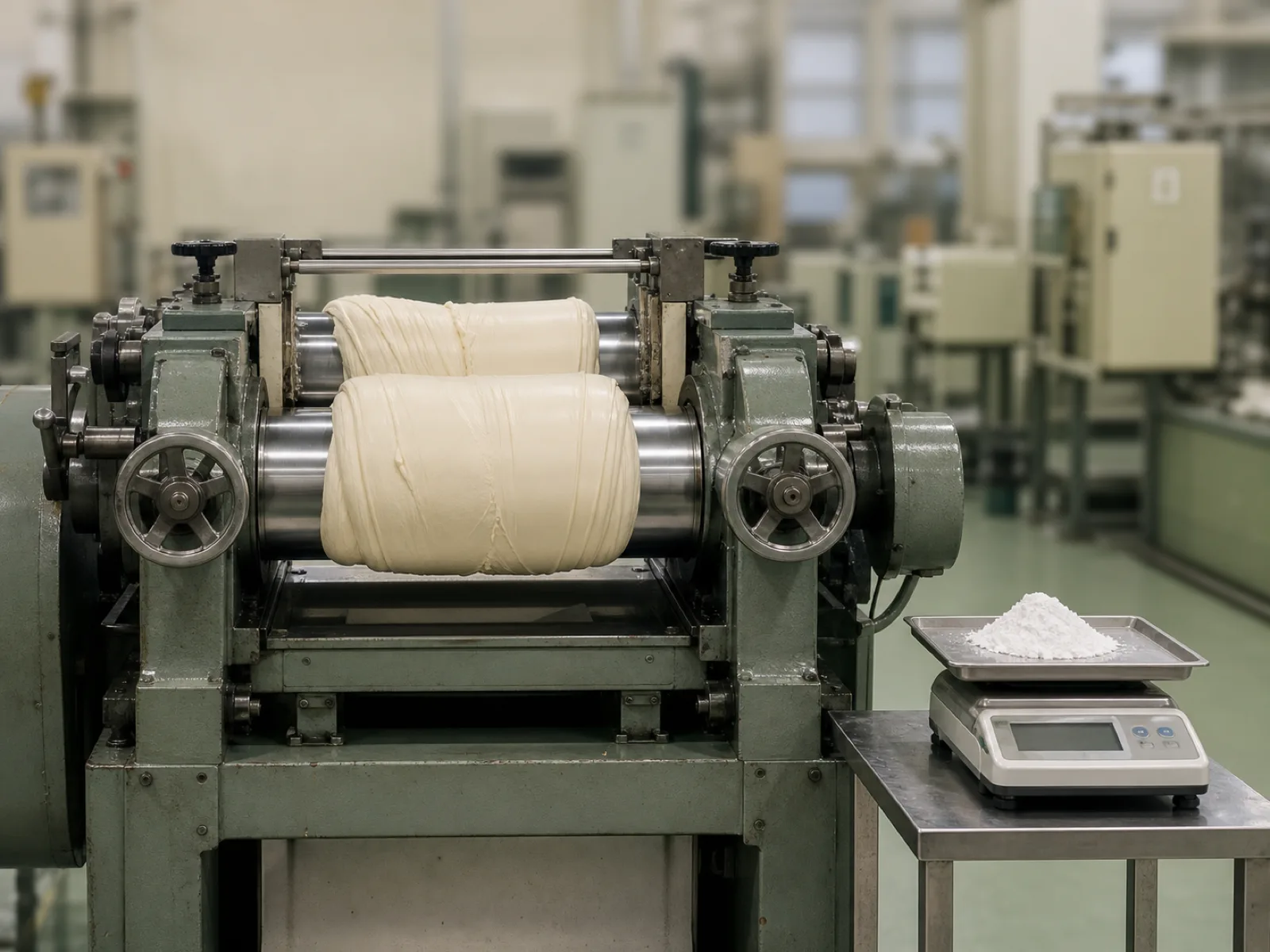
Post-cure oven log. A batch record showing 4-6 hour cycles at 180-200°C on the same master-batch lot referenced in the LFGB report. This is the document most-commonly missing from industrial-tier silicone sponge suppliers who do not run post-cure.
-
PFAS non-detect report. From an accredited lab, at parts-per-billion detection limits, on the same master-batch lot. Verifies no PFAS-containing process aid was used in the compound formulation. Increasingly table-stakes on EU and US West Coast retail.
-
Factory production video or dated photos. Compression presses in actual use, post-cure ovens running, QC bench with durometer and calipers. Stock imagery from a compound-house marketing kit is a red flag; a 30-second video walk of the actual production floor is what a Tier 2 chain onboarding wants.
-
Business license and export license. Chinese business license with the current calendar-year renewal date, export license, and (for larger programs) a customs AEO status if the buyer’s freight forwarder requests it.
Sourcing red flags on B2B marketplaces for silicone sponge
Five red flags account for most housewares brand disappointments: an aerospace-spec (AMS 3195, MIL-R-46089) listing repositioned to housewares without an FDA packet; "food-grade" claimed without a clause citation and third-party report; prices below $0.30/pc at MOQ 500 for a 110×70×25 mm closed-cell sponge; "platinum-cure" claimed on a $0.35 unit price; no post-cure oven log ever offered. Any one of these should trigger a request for the six-document packet before further engagement.
The marketplace-listing pattern for silicone sponge tips toward these five red flags because the industrial suppliers who dominate the SERP and marketplace surface for the keyword built their operations around a different customer (aerospace, electronics, medical device) and are now retargeting housewares buyers without rebuilding the compliance stack.
The five-flag decision tree
- Flag 1: Aerospace spec but no FDA clause. Listing cites AMS 3195/3196 or MIL-R-46089 but has no reference to 21 CFR 177.2600. The supplier is an industrial gasket shop retargeting housewares without the food-contact compliance packet.
- Flag 2: “Food-grade” without citation. No clause number, no test report offered on request. The supplier is repackaging a Chinese domestic compound of unknown lineage. Ask for the test report referencing a specific master-batch lot from the last 6 months; if the response is a nominal datasheet, disqualify.
- Flag 3: Sub-$0.30/pc at MOQ 500. For a 110×70×25 mm closed-cell sponge, this is below the compound cost floor for a real PDMS with a compliant blowing agent. The compound is extended with talc, calcium carbonate, or recycled silicone that will fail LFGB extractables.
- Flag 4: “Platinum-cure” at $0.35/pc. Platinum catalyst cost is $180-$260/kg vs $60-$90/kg for organic peroxide, and the delta at the finished-part level is $0.15-$0.25/pc across MOQ tiers. A platinum claim at peroxide pricing is a mislabel.
- Flag 5: No post-cure log ever. Either the supplier does not run post-cure (fails LFGB §30/31 organic volatile testing) or does not document it (fails ISO 9001 batch traceability). Either failure disqualifies the supplier from EU retail and premium US retail.
Full sourcing-checklist framework on the silicone factory sourcing checklist guide.
Total landed cost model — FOB Yantian to US warehouse for a silicone dish sponge program
A 5,000-piece silicone dish sponge OEM program FOB Yantian at $0.60/pc lands into a US Midwest warehouse at approximately $0.88-$0.98/pc after freight, tariff, MPF/HMF, customs broker, and drayage. Domestic US silicone sponge OEM at the same food-contact spec runs $2.20-$3.60/pc at MOQ 500 — the compound cost is higher, labor is dramatically higher, and most US shops carrying silicone sponge capability are industrial-tier without the housewares FDA/LFGB packet discipline.
The landed-cost delta is the honest answer to “why not source domestically.” It is not marketing — it is the freight, duty, and labor arithmetic that any US housewares brand runs before signing a purchase order.
5,000-piece silicone dish sponge landed cost, FOB Yantian to US Midwest warehouse (Q3 2026)
| Cost element | Per-unit | Notes |
|---|---|---|
| FOB Yantian, platinum-cure, 110×70×25 mm | $0.60 | Wetop Q3 2026 benchmark |
| Ocean freight (FCL West Coast) | $0.14-$0.18 | Amortized on 22,000-piece container fill |
| Ocean freight (LCL or East Coast) | +$0.06-$0.14 | Adds to FCL baseline |
| Section 301 tariff (currently 4.2% on HS 3926.90.99) | $0.03 | Rate as of Q3 2026 schedule |
| MPF + HMF | $0.02 | US Customs fees |
| Customs broker | $0.02 | Per-entry amortized |
| Drayage + deconsolidation | $0.05-$0.10 | Yantian → US Midwest warehouse |
| Total landed cost | $0.88-$0.98/pc | Before packaging assembly |
The domestic-US equivalent for a comparable food-contact silicone sponge OEM program at MOQ 500 runs $2.20-$3.60/pc. Wetop’s landed-cost advantage on a housewares silicone sponge program is 55-70% at MOQ 500, widening at higher volumes. The compliance-packet gap adds an additional non-cost dimension — most domestic US silicone sponge shops are industrial-tier and do not build the FDA + LFGB + PFAS packet as a default.
Frequently asked questions
The FAQ block below mirrors the FAQPage JSON-LD on this page and is the buyer-language answer set Wetop’s engineering desk fields most often on silicone sponge sourcing.
Ready to source a silicone sponge OEM program?
Silicone sponge sits at the intersection of two supplier populations that rarely overlap: aerospace-tier industrial suppliers with process depth but no food-contact packet, and low-cost housewares-tier suppliers with the packet but no process discipline. Wetop runs both — a housewares-tier compliance packet (FDA + LFGB + PFAS per master-batch lot) on top of industrial-tier ISO 9001 process control, out of a 7,500 m² Dongguan floor at MOQ 500.
Send an RFQ with the 10-point spec checklist above and Wetop’s engineering desk will return a bracketed price at MOQ tiers, cure recommendation, and a first-article sample timeline inside 2 business days. For programs where the spec is still being defined, our engineers will fill retail-tier defaults and note them explicitly on the response.
Talk to the engineering desk →
References
FAQ
-
What is silicone sponge actually made of and how is the cellular structure formed?
Silicone sponge is a cellular polydimethylsiloxane (PDMS) elastomer produced by mixing a chemical blowing agent (typically azodicarbonamide or a hydrazide) into the silicone compound before cure. During the compression or extrusion cure cycle at 160-200°C the blowing agent decomposes and releases nitrogen gas that expands the polymer into a foam-like cellular matrix. Cell structure is controlled by cure profile, blowing-agent load (0.5-3.0 % by weight), and compound viscosity — a fast-rising cure with high blowing agent produces open-cell (breathable, water-absorbing) structure, while a slower controlled rise produces closed-cell (impermeable, water-repelling) structure. Base silicone polymer is identical to solid silicone; only the blowing agent and cure profile differ.
-
What is the difference between silicone sponge and silicone foam?
In industrial practice the terms are used interchangeably, but the ASTM D1056 distinction is real: silicone sponge is a closed-cell cellular silicone (cells sealed, no continuous air path), while silicone foam is an open-cell cellular silicone (cells interconnected, breathable). Closed-cell sponge is used for gasketing, sealing, cushioning against water and dust ingress, and for dish sponges where scrubbing action needs a firm impermeable surface. Open-cell foam is used for acoustic damping, ventilation gaskets, and cleaning pads where liquid absorption is required. For a silicone dish sponge OEM program targeting housewares retail, closed-cell at 320-480 kg/m³ density is the retail default; open-cell shows up only in specialty cleaning-pad SKUs.
-
What density and hardness grade should I specify for a food-contact silicone sponge?
For food-contact housewares (dish sponges, scrub pads, sink drying mats with cellular cushion layer) the retail defaults are density 320-480 kg/m³, Shore 00 hardness 40-60, and closed-cell structure. Softer (Shore 00 20-40, density 240-320 kg/m³) reads as too flimsy on retail shelf and collapses under scrubbing pressure. Firmer (Shore 00 60-70, density 480-720 kg/m³) works but drives up compound cost and reduces scrubbing conformity to curved dish surfaces. Note that silicone sponge is measured on the Shore 00 scale (very soft materials) rather than Shore A — a Shore 00 50 sponge is approximately Shore A 5, one-tenth as firm as a Shore A 50 solid silicone gasket. Ask the supplier to state the scale explicitly on any quote.
-
Does silicone sponge clear FDA 21 CFR 177.2600 and LFGB for food-contact use?
Yes — silicone sponge produced with a food-grade PDMS base polymer and a compliant blowing agent clears FDA 21 CFR 177.2600 aqueous, 8% ethanol, and n-heptane extractables testing, and clears LFGB §30/31 organic volatile testing per BfR Recommendation XV when post-cured 4-6 hours at 180-200°C. The catch: most industrial silicone sponge suppliers use aerospace-grade AMS 3195/3196 or MIL-R-46089 specs and never build the FDA/LFGB packet because their customers don't need it. When a housewares brand sources a silicone dish sponge from an industrial gasket supplier, the compliance packet is missing at PO time and the SKU cannot be listed at retail without a 4-8 week delay to re-test. Wetop runs FDA + LFGB + PFAS testing per master-batch lot as the default packet for every housewares OEM program.
-
What is the MOQ and price for a custom silicone dish sponge OEM program?
Wetop's MOQ is 500 pieces per SKU. FOB Yantian Q3 2026 benchmarks for a standard 110×70×25 mm closed-cell platinum-cure silicone dish sponge with 1-color debossed logo and density 400 kg/m³: 500 pcs $0.78-$1.15 / 1,000 pcs $0.62-$0.92 / 5,000 pcs $0.48-$0.72 / 10,000 pcs $0.42-$0.62 / 20,000+ pcs $0.35-$0.52. Peroxide-cure with disciplined post-cure runs 15-22 % below platinum. Compression tooling for a new shape runs $2,400-$3,800 amortized against first-order volume. Add $0.06-$0.12 per unit for custom Pantone-matched master-batch, $0.04-$0.08 for scrub-side surface texture debossing.
-
Should I choose compression mold, die-cut sheet, or extrusion for a silicone sponge program?
Route selection is driven by geometry, not by volume. Compression mold: shaped 3D parts (dish sponges with contoured grip, sink-adjacent cleaning pads with sculpted scrub side, housewares parts with debossed logo). MOQ 500, tooling $2,400-$3,800, best surface finish. Die-cut sheet: flat gaskets and pads cut from a slab of pre-cured silicone sponge. MOQ 1,000-2,000, tooling $200-$800 for a steel-rule die, higher material waste (20-30% off-cut). Extrusion: continuous profiles (window gaskets, edge trims, tubing). MOQ 500 linear meters, tooling $600-$1,500 for a die, cheapest per meter for long runs. A silicone dish sponge OEM program is compression mold in 95% of cases — the retail-friendly grip and logo geometry require it.
-
How do I audit a silicone sponge factory without visiting in person?
Six documents cover 90% of what an on-site audit would verify. (1) ISO 9001:2015 certificate with current validity date and scope covering silicone molding (not just trading). (2) FDA 21 CFR 177.2600 and LFGB §30/31 test reports referencing a specific master-batch lot number from the last 6 months. (3) Post-cure oven log showing 4-6 hour cycles at 180-200°C from the same lot. (4) Factory production photos or short video showing compression presses and post-cure ovens in actual use, not stock imagery. (5) PFAS non-detect test report from an accredited lab (SGS, Intertek, TÜV, Bureau Veritas). (6) Business license and export license copies. If a supplier resists sending any of these — most commonly items 3 and 5 — treat the resistance itself as the audit answer.
-
What are the sourcing red flags on B2B marketplaces for silicone sponge?
Five red flags account for most housewares brand disappointments. (1) A listing that cites AMS 3195, MIL-R-46089, or aerospace specs but no FDA 21 CFR 177.2600 — the supplier is an industrial gasket shop retargeting housewares buyers without building the food-contact compliance packet. (2) "Food-grade" claimed but no clause citation and no third-party report — the supplier is repackaging a Chinese domestic compound of unknown lineage. (3) Prices below $0.30/pc at MOQ 500 for a 110×70×25 mm closed-cell sponge — the compound is filled with recycled silicone or non-silicone extenders (talc, calcium carbonate) that will fail LFGB extractables. (4) "Platinum-cure" claimed on a $0.35 unit price — inconsistent with input cost; peroxide-cure being mislabeled. (5) No post-cure oven log ever offered — either the supplier does not run post-cure or does not document it, and either failure kills EU retail compliance.
-
What is the total landed cost of a silicone dish sponge program vs sourcing domestically in the US?
A 5,000-piece silicone dish sponge OEM program FOB Yantian at $0.60/pc lands into a US Midwest warehouse at approximately $0.88-$0.98/pc after freight ($0.14-$0.18/pc on FCL West Coast, higher on LCL or East Coast), 4.2% Section 301 tariff ($0.03/pc at current schedule), 3.4% MPF and HMF ($0.02/pc), customs broker ($0.02/pc), and drayage/deconsolidation ($0.05-$0.10/pc). Domestic US silicone sponge OEM at the same spec runs $2.20-$3.60/pc at MOQ 500 — the compound cost is higher (~15%) and labor cost is dramatically higher, and most US shops that carry silicone sponge capability are industrial-tier without housewares FDA/LFGB packet discipline. Wetop's landed cost advantage on a housewares OEM program is 55-70% before considering the compliance packet gap.
References
Authoritative sources cited in this guide
- US Food and Drug Administration. 21 CFR 177.2600 — Rubber articles intended for repeated use. https://www.ecfr.gov/current/title-21/chapter-I/subchapter-B/part-177/subpart-C/section-177.2600 — The primary US food-contact regulation Wetop cures every silicone sponge batch against, testing per master-batch lot at an accredited third-party lab.
- German Federal Institute for Risk Assessment. BfR Recommendation XV — Silicones. https://www.bfr.bund.de/en/bfr_recommendations_on_food_contact_materials-7498.html — The technical standard behind LFGB §30 and §31 organic volatile testing for food-contact silicone — the reason mandatory 4-6 hour post-cure exists on silicone sponge.
- International Organization for Standardization. ISO 9001:2015 — Quality Management Systems — Requirements. https://www.iso.org/standard/62085.html — The quality management system Wetop is certified against — governs batch traceability, post-cure records, and audit documentation trail for every silicone sponge program.
- International Organization for Standardization. ISO 2859-1:1999 — Sampling procedures for inspection by attributes. https://www.iso.org/standard/1141.html — The sampling standard behind AQL 1.5 inspection Wetop runs pre-shipment on every silicone sponge batch.
- ASTM International. ASTM D1056 — Standard Specification for Flexible Cellular Materials — Sponge or Expanded Rubber. https://www.astm.org/d1056-20.html — The measurement standard behind every density, compression deflection, and cell-structure classification (open vs closed) Wetop quotes on a silicone sponge program.
- ASTM International. ASTM D2240-15 — Standard Test Method for Rubber Property — Durometer Hardness. https://www.astm.org/d2240-15r21.html — The measurement standard behind every Shore 00 and Shore A hardness spec Wetop quotes on silicone sponge and solid silicone programs.
- European Parliament and Council. Regulation (EC) No 1935/2004 — Materials intended to come into contact with food. https://eur-lex.europa.eu/legal-content/EN/TXT/?uri=CELEX%3A02004R1935-20090807 — The overarching EU framework regulation for food-contact materials — LFGB compliance on silicone sponge sits inside this framework.
- European Chemicals Agency. PFAS Universal Restriction Proposal. https://eur-lex.europa.eu/legal-content/EN/TXT/?uri=CELEX%3A32006R1907 — The regulatory action driving per-batch PFAS non-detect testing on food-contact silicone sponge — table stakes for EU premium retail and accelerating into US West Coast retail.
- US Consumer Product Safety Commission. CPSIA — Consumer Product Safety Improvement Act. https://www.ecfr.gov/current/title-16 — The US consumer product safety framework any children's-tier or bath-adjacent silicone sponge SGU program must certify against.
Start a custom program
Send a brief. Get an engineer’s reply in one business day.
Every Wetop program is tooled from a customer’s specification. Send a CAD file (STEP · IGES · DWG) or a written brief and we’ll reply with a mold cost estimate, price brackets at MOQ 500 / 1,000 / 5,000, and any engineering questions.