Buyer Guide · commercial intent
Silicone Earbud Tips Manufacturer — OEM Sourcing & Design
What changed: First publication targeting the silicone-earbud-tips buyer intent. The existing SERP is a mix of Alibaba-style catalog pages and blog posts that never publish dimensional-tolerance data, pigment biocompatibility guidance, or tiered MOQ math. This guide corrects that with LSR-vs-HCR process economics, ±0.1 mm CMM inspection protocol, and 21 CFR 177.2600 + ISO 10993 citations at the section level.
 Buyer Guide
 The silicone earbud tip category on the English-language SERP is dominated by Alibaba-style catalog pages that publish neither a dimensional-tolerance number nor a pigment-migration test method, and by consumer blog posts comparing retail replacement tips. Neither serves an OEM device engineer specifying a silicone earbud tips manufacturer for a 100 k-piece program. This guide is the B2B sourcing reality of manufacturing custom silicone earbud tips — from LSR material selection and Shore A durometer choice through nozzle-bore CMM inspection, biocompatibility citations at the section level, and honest 500-piece MOQ tooling economics — written from inside a Dongguan LSR injection cell.
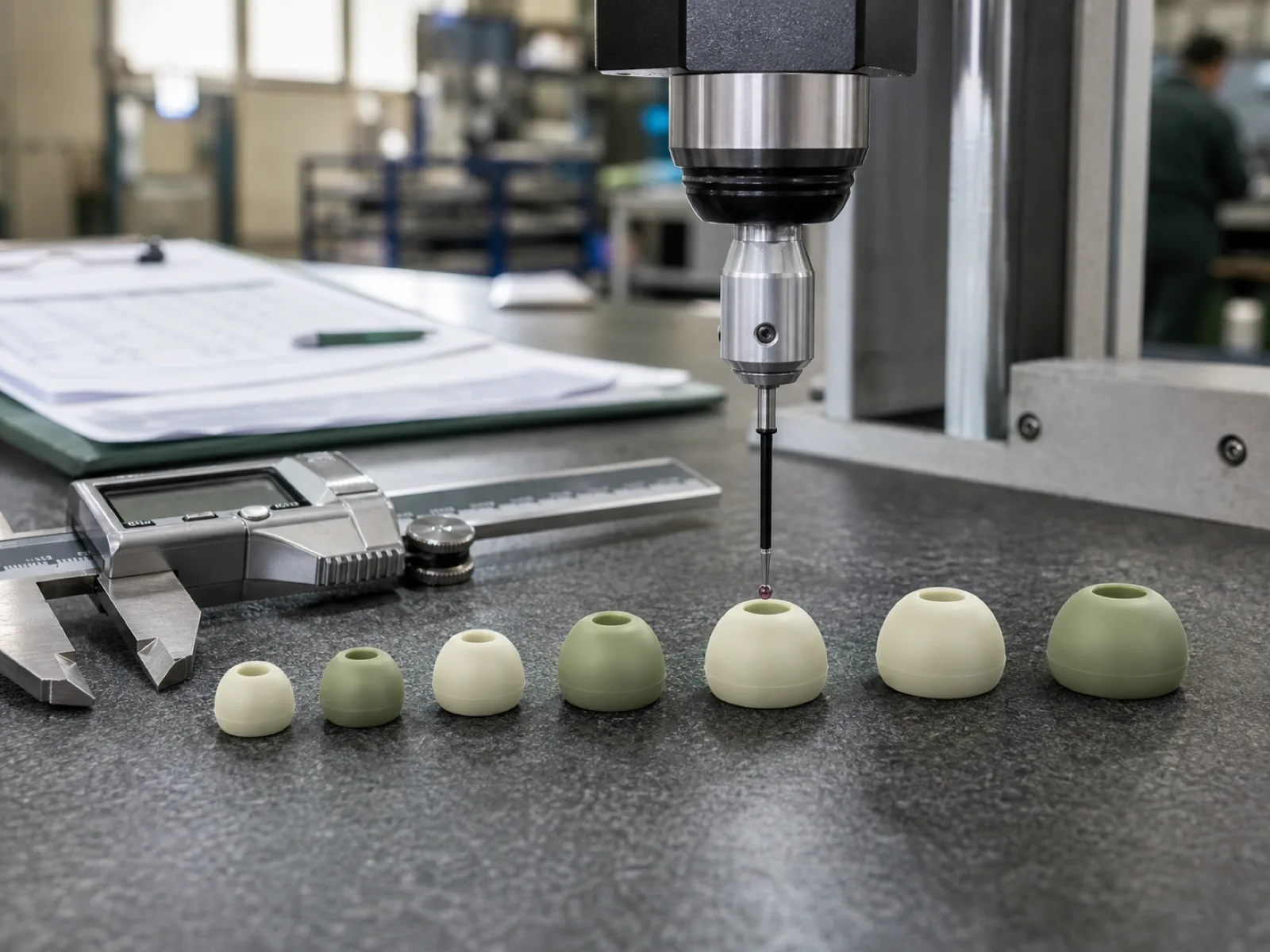
A silicone earbud tip is a platinum-cured LSR (liquid silicone rubber) injection-molded elastomer part at Shore A 20-40 durometer, cleared for prolonged skin contact under ISO 10993-5 and ISO 10993-10, and molded to ±0.05-0.10 mm on the sound-bore inner diameter with CMM verification on every batch. Nozzle-bore compatibility matrix: 4.0 mm generic earbuds, 4.5 mm Sony and Sennheiser, 5.2 mm Apple AirPods Pro, 6.0 mm Jabra and wired EarPods — inner-bore tolerance ±0.05 mm, miss it and the tip falls off. MOQ 500 pieces per SKU, LSR 32-cavity tooling $14,000-$22,000, unit cost $0.14-$0.22 at 50 k volume FOB Yantian, prototype 7-15 days and production 25-40 days from PO.
What is a silicone earbud tip, and how is it engineered for OEM production?
A silicone earbud tip is a two-part LSR injection-molded elastomer part at Shore A 20-40 durometer per ASTM D2240[^astm-d2240], cleared for prolonged skin contact under ISO 10993-5[^iso-10993-5] cytotoxicity and ISO 10993-10[^iso-10993-10] skin irritation. The tip slips onto the earbud nozzle, seals the ear canal, and delivers 15-30 dB passive isolation. Standard geometry is a single-flange oval or round dome with a molded nozzle-grip lip, sound-bore ID held to ±0.05 mm, wall thickness 0.3-0.6 mm.
The category confuses first-time consumer-electronics OEMs because the visible part looks trivial — a soft rubber dome with a hole. The engineering underneath spans four disciplines: platinum-cured LSR chemistry with catalyst residue control, dimensional precision on a 5 mm sound-bore that fits a 5.2 mm nozzle within 0.10 mm, biocompatibility for continuous ear-canal skin contact, and pigment migration control at 30-40°C body temperature. Get any one wrong and the tip either falls off the earbud, tears at the bore edge, discolors the ear canal, or triggers a return.
Silicone earbud tips dominate the acoustic-interface market on wireless earbuds, wired IEMs (in-ear monitors), and medical hearing-aid domes because silicone is the only elastomer that combines the required combination of biocompatibility, temperature stability, tear strength, and dimensional consistency across mass-production LSR tooling.
- Consumer wireless earbuds. AirPods Pro, Sony WF-1000, Sennheiser Momentum True Wireless, Jabra Elite tier and hundreds of mid-tier private-label brands.
- Wired IEMs and stage monitors. Shure, Westone, and premium audiophile brands using single-flange, double-flange, and triple-flange geometries.
- Medical hearing-aid open and closed domes. Phonak, Oticon, ReSonic tier — cleared under USP Class VI1 and ISO 13485 device-level QMS.
- Industrial hearing protection. Electronic ear-plugs for the shooting-sports, aviation, and heavy-machinery markets.
Baseline engineering spec sheet
| Parameter | Standard range | Test method |
|---|---|---|
| Base durometer | Shore A 20-40 | ASTM D22402 |
| Tensile strength | ≥ 7.0 MPa | ASTM D412 |
| Elongation at break | ≥ 400% | ASTM D412 |
| Tear strength (die B) | ≥ 20 kN/m | ASTM D6243 |
| Sound-bore ID tolerance | ±0.05 mm | CMM with 2 mm ruby probe |
| Wall thickness | 0.3-0.6 mm | Optical measurement |
| Compression set (22 h / 70°C) | ≤ 15% | ASTM D395 method B |
| Continuous service temperature | -40°C to 200°C | Manufacturer spec |
| Post-cure cycle | 4 h @ 200°C | Batch oven log |
| Cure system | Platinum-cured LSR default | Master-batch lot certificate |
| Skin-contact biocompatibility | Pass | ISO 10993-54 + ISO 10993-105 |
Which silicone material and durometer should a manufacturer use?
Platinum-cured LSR (liquid silicone rubber) at Shore A 30-40 is the OEM default for consumer earbud tips. Fully automated injection molding, ±0.05 mm tolerance, cleanest post-cure profile for extractables, and biocompatible on standard formulations. Shore A 20-30 for premium comfort applications (accepts shorter tear life). Shore A 45-55 for medical hearing-aid domes where retention matters more than wear comfort. HCR peroxide-cured compression molding is used only for prototype work or programs below 25 k annual volume.
Material selection on a silicone earbud tip is a two-axis decision: base polymer platform (LSR platinum-cured almost always; HCR only at very low volumes or for prototype iteration) and durometer band (Shore A 20-55 depending on application). The cure decision cascades into every downstream compliance layer — see the platinum-cured vs peroxide-cured guide for the full matrix.
Durometer decision drives comfort vs retention
| Durometer band | Feel | Wear comfort | Service life | Best use |
|---|---|---|---|---|
| Shore A 10-20 | Ultra-soft, marshmallow | Highest (6-8 h+ sessions) | 3-6 months | Sleep earbuds, in-flight |
| Shore A 20-30 | Soft conform | High (4-6 h) | 6-12 months | Premium consumer, IEM |
| Shore A 30-40 | Standard OEM | Standard (4-6 h) | 12-18 months | Wireless earbuds retail default |
| Shore A 40-50 | Firmer, retentive | Medium (2-4 h) | 18-24 months | Sports earbuds, active use |
| Shore A 45-55 | Firm dome | Retention over comfort | 24-36 months | Medical hearing-aid domes |
Why LSR beats HCR on earbud tips above 25 k annual volume
The LSR economics cross HCR at roughly 25 k annual pieces per SKU. Above that volume LSR is not optional — the cost per piece keeps dropping, dimensional consistency shot-to-shot stays flat, and the biocompatibility profile is cleaner because the post-cure strips catalyst residue in a documented profile. See the LSR explainer for the full process comparison.
| Metric | LSR injection | HCR compression |
|---|---|---|
| Cycle time (single shot) | 30-45 seconds | 3-5 minutes |
| Dimensional tolerance | ±0.05 mm | ±0.15 mm |
| Cavity count typical | 16-64 | 8-16 |
| Deflashing | Automated in-mold | Manual trim |
| Tooling cost (32-cav) | $14,000-$22,000 | $6,000-$10,000 |
| Post-cure profile | Cleanest for extractables | Longer for volatile strip |
| Break-even volume | > 25 k annual | < 25 k annual |
Nozzle-diameter compatibility and inner-bore tolerancing
Nozzle-bore ID is the single hardest spec to hold on a silicone earbud tips manufacturer program. Standard nozzle matrix: 4.0 mm generic earbuds, 4.5 mm Sony and Sennheiser, 5.2 mm Apple AirPods Pro, 6.0 mm Jabra and wired EarPods. Tip inner-bore ID molded 0.10-0.20 mm smaller than nozzle OD for interference fit, tolerance ±0.05 mm on the tip, verified on CMM with a 2 mm ruby probe on first article and every 250-shot production sample.
The nozzle-bore fit is where cheap eartips fail in the retail box. Too tight and the tip splits at the grip lip on first install; too loose and it falls off in the user’s ear during a jog. The interference fit sits in a 0.10 mm window, and holding the tip ID to ±0.05 mm demands both LSR injection molding and CMM-level inspection — capabilities most trading companies pretending to be factories don’t have.
Nozzle compatibility matrix
| Earbud category | Nozzle OD | Tip ID target | Tip ID tolerance |
|---|---|---|---|
| Generic mid-tier earbuds | 4.0 mm | 3.85-3.95 mm | ±0.05 mm |
| Sony WF-1000, Sennheiser Momentum | 4.5 mm | 4.35-4.45 mm | ±0.05 mm |
| Apple AirPods Pro 1/2 | 5.2 mm | 5.00-5.10 mm | ±0.05 mm |
| Jabra Elite, wired EarPods | 6.0 mm | 5.85-5.95 mm | ±0.05 mm |
| Medical hearing-aid domes | 1.5-2.5 mm (varies) | Custom per device | ±0.03 mm |
How Wetop holds the ID tolerance
Two capabilities decide whether a factory can hold ±0.05 mm on the sound-bore ID across a 100 k-piece production run. First, LSR tooling cut on a 3-axis EDM (electrical discharge machining) with ±0.01 mm precision on the tool ID surface — precision that survives 500 k+ shots before wear. Second, CMM inspection on the finished part with a 2 mm ruby probe and 3-sigma capability logged on every FAIR. Wetop supplies the CMM report with every earbud-tip program at first article and posts every 250-shot production check into the batch traceability record required under ISO 90016.
The three most common failures we redesign tools for
- Tip falls off after 3-5 uses. ID molded 0.05 mm too large, or grip-lip creep after post-cure exceeded 0.10 mm. Fix: tighten cavity ID by 0.03-0.05 mm on tool rework, extend post-cure by 2 hours to fully complete cure and eliminate creep.
- Tip splits at grip lip on first install. ID molded 0.10 mm too small (over-interference), or wall too thin at the grip transition. Fix: open cavity ID by 0.05 mm, thicken the grip-lip wall from 0.3 mm to 0.4 mm.
- Tip audibly resonates on high-frequency test tones. Sound-bore diameter under-sized relative to the flange diameter, creating a Helmholtz resonance in the audio band. Fix: verify bore-to-flange ratio against the acoustic model, adjust sound-bore ID upward without violating nozzle-fit interference.
LSR injection molding process and cycle-time economics
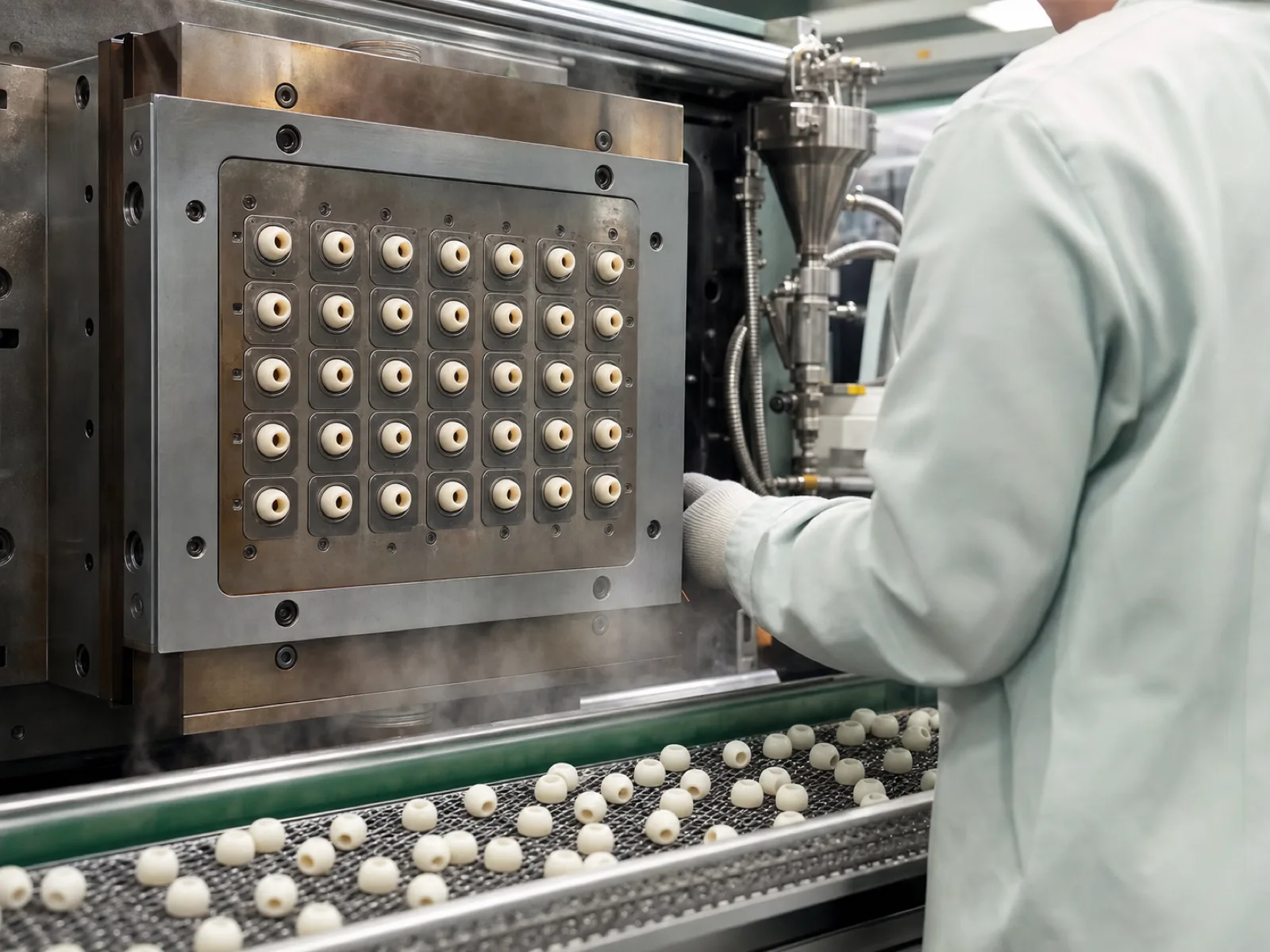
LSR injection molding on a 32-cavity tool runs a 30-45 second cycle, cures at 175-190°C tool temperature with a 4-hour post-cure at 200°C to strip cyclic siloxanes and complete the platinum-catalyzed reaction. Multi-cavity economics: 32-cavity LSR tool at 42-second cycle produces 2,700 tips per hour per machine — 21,600 per 8-hour shift, 65,000 per 24-hour shift on a lights-out cell. Cavity utilization above 90% is the KPI Wetop logs per ISO 9001 process control.
Understanding the LSR process economics is what separates an OEM buyer negotiating from data from one accepting whatever unit-cost the factory quotes. The two variables that dominate the per-piece cost are cavity count and cycle time. Everything else — material, energy, direct labor, mold amortization — is a rounding error at production volume.
LSR earbud-tip production math
| Cavity count | Cycle time | Pieces per hour | Pieces per 8-h shift | 30-day production |
|---|---|---|---|---|
| 16-cavity | 40 sec | 1,440 | 11,500 | 350,000 |
| 32-cavity | 42 sec | 2,740 | 22,000 | 660,000 |
| 48-cavity | 45 sec | 3,840 | 30,700 | 920,000 |
| 64-cavity | 50 sec | 4,610 | 36,900 | 1,110,000 |
For a program at 250 k annual pieces per SKU, a 16-cavity tool amortizes across a single week of production. For 1 M+ annual programs the 48- or 64-cavity investment pays back inside the first month.
Post-cure protocol matters more than cycle time
The 4-hour post-cure at 200°C is where cheap eartips shortcut — some factories drop it to 2 hours to move parts faster, and the tips ship with residual cyclic siloxanes and incomplete cure. Field consequences: yellowing under UV, silicone bloom (a white waxy film that appears at 30-60 days), permanent set drift, and in the worst case a faint chemical smell that triggers Amazon returns tagged “smells weird.” Wetop logs oven-cycle time and peak temperature on every batch — the traceability record required under ISO 90016.
Pigment biocompatibility and colorant migration control
Silicone earbud-tip pigment migration is the silent QC failure buyers rarely audit. Off-the-shelf silicone colorants — especially bright translucent gaming or premium reds — can migrate at 30-40°C ear-canal skin oil exposure over months of daily wear. Wetop uses only pigments listed in FDA 21 CFR 178.3297[^fda-178-3297] (colorants for polymers), verifies each color batch against USP <661>[^usp-661] extractables-and-leachables at 40°C / 72 h in artificial cerumen simulant, and logs pigment lot to finished-part traceability.
Pigment biocompatibility on skin-contact silicone parts is a topic no competitor page publishes and most trading companies don’t test. The base silicone can clear ISO 10993-5 and 10993-10 cleanly; add the wrong colorant and the finished part fails E&L testing at 30-60 day accelerated aging. The failure mode is either visible discoloration on the tip surface, faint discoloration in the ear canal, or a positive irritation reading on an ISO 10993-10 patch test — the last of which is what triggers a product-safety review.
Wetop’s pigment discipline
- Only FDA-listed colorants from 21 CFR 178.32977 and equivalent EU listings — no “food-grade” language accepted without a specific listing citation.
- Pigment supplier lot traceability recorded on the batch card and archived per ISO 90016.
- Extractables-and-leachables per USP <661>8 on every new color at 40°C / 72 h in ear-cerumen simulant before production release.
- ISO 10993-129 chemical characterization on colored parts for medical hearing-aid programs — not just the base silicone.
- REACH SVHC10 screening on every pigment lot for EU-shipped SKUs.
The three retail eartip colors we refuse to quote without paid E&L
- Fluorescent orange. Historical pigment chemistry with a documented migration profile at body-temperature skin contact.
- High-chroma red. Cadmium-adjacent pigment risk unless a specific rhodamine or iron-oxide substitute is spec’d.
- Translucent purple. Manganese violet chemistry migrates at 30-40°C; substitute with a manganese-free formulation only.
Every other color — the cream, sage, slate, matte black, and white that cover 80% of consumer earbud production — clears Wetop’s standard palette and ships without incremental E&L cost.
Geometry variants — single, double, triple-flange, oval bore, angled nozzle
Six production geometries cover 99% of the consumer and medical earbud-tip market. Round single-flange, oval single-flange (AirPods Pro / Sony WF-1000 shape), double-flange (deeper insertion), triple-flange (IEM and hearing protection), angled-nozzle (10-20° axis offset for anatomical fit), and silicone-foam hybrid (silicone outer + slow-recovery foam core). Wetop quotes all six on LSR tooling; angled-nozzle and hybrid geometries need 5-10 extra days of sampling cycle.
Geometry choice on an earbud-tip program is a tradeoff between passive isolation, wear comfort, and manufacturing complexity. The retail default (round single-flange) is the easiest to mold concentrically and the widest-fitting across adult ear-canal anatomy. Premium consumer brands move to oval single-flange for the AirPods Pro / Sony WF-1000 look and better seal on 60% of ear canals. IEM and hearing-protection categories use double or triple-flange for insertion depth and isolation.
Geometry decision matrix
| Geometry | Passive isolation | Wear comfort | Mold complexity | Best use |
|---|---|---|---|---|
| Round single-flange | 15-20 dB | High | Low | Retail default, generic earbuds |
| Oval single-flange | 20-25 dB | High | Medium | AirPods Pro / Sony WF-1000 tier |
| Double-flange | 25-30 dB | Medium | Medium-high | IEM, deeper-insertion consumer |
| Triple-flange | 28-32 dB | Lower | High | Stage IEM, hearing protection |
| Angled-nozzle | 20-25 dB | Highest | High | Anatomical-fit premium |
| Silicone-foam hybrid | 30-35 dB | High | Highest | Premium noise-cancelling accessory |
Regulatory and compliance path — FDA, USP, ISO 10993, REACH, Prop 65
Consumer earbud tips carry a standard compliance stack: FDA 21 CFR 177.2600[^fda-177-2600] material clearance, FDA 21 CFR 178.3297[^fda-178-3297] pigment clearance, ISO 10993-5[^iso-10993-5] cytotoxicity, ISO 10993-10[^iso-10993-10] skin irritation and sensitization, REACH SVHC[^echa-reach] screening (EU), California Prop 65 warning-list check, and RoHS for the packaged assembly. Medical hearing-aid domes add USP Class VI[^usp-88] and ISO 13485 device-level QMS. Wetop supplies material-level and part-level reports; the customer's regulatory team handles device-level.
The regulatory work breaks into three sequential efforts: material qualification (does the base silicone and pigment clear FDA and REACH?), part-level biocompatibility (does the finished tip pass ISO 10993-5 and 10993-10 skin-contact testing?), and device-level submission (medical hearing-aid programs only, cleared by the customer’s regulatory team). Wetop owns the first two.
Compliance stack by device category
| Device category | Material | Part-level biocompatibility | Chemical / market |
|---|---|---|---|
| Consumer wireless earbuds | 21 CFR 177.260011 + 178.32977 | ISO 10993-54 | REACH10 + Prop 65 + RoHS |
| Premium IEM / audiophile | Same as above | ISO 10993-5 + 10993-105 | REACH + Prop 65 + RoHS |
| Medical hearing-aid dome | USP Class VI1 | ISO 10993-5 + 10993-10 + 10993-129 | ISO 13485 device-level QMS |
| Industrial hearing protection | 21 CFR 177.2600 | ISO 10993-5 | REACH + Prop 65 |
The three test reports Wetop supplies with every OEM program
- Material certificate. FDA 21 CFR 177.2600 clearance on the base LSR grade with the specific supplier lot number, plus 21 CFR 178.3297 clearance on every pigment lot used.
- Biocompatibility packet. ISO 10993-5 cytotoxicity and ISO 10993-10 skin irritation reports on the finished-tip test coupon, run by an ILAC-accredited lab.
- E&L report. USP <661> extractables-and-leachables at 40°C / 72 h in ear-cerumen simulant, per pigment lot for colored SKUs.
MOQ, tooling, and pricing — the honest math
Wetop MOQ is 500 pieces per SKU on standard LSR tooling (a five-size XS/S/M/L/XL set clears at 2,500 pieces first-run). Tooling cost bands FOB Yantian, Q3 2026: LSR 16-cavity $8,000-$14,000, 32-cavity $14,000-$22,000, 64-cavity $22,000-$38,000. Unit cost 10 k pieces $0.28-$0.45, 50 k $0.14-$0.22, 250 k $0.07-$0.11. Prototype 7-15 days on rapid tooling; production 25-40 days from PO. Full pricing math on the [pricing structure guide](/guide/silicone-oem-pricing-structure/).
Unit-cost curve
| Annual volume | Cavity count | Unit cost (FOB Yantian, Q3 2026) |
|---|---|---|
| 5 k-25 k | 16-cavity LSR or HCR | $0.28-$0.45 |
| 25 k-100 k | 32-cavity LSR | $0.14-$0.22 |
| 100 k-500 k | 48-cavity LSR | $0.09-$0.14 |
| 500 k+ | 64-cavity LSR (lights-out cell) | $0.07-$0.11 |
Unit cost above is per finished tip in bulk poly-bag packaging. Retail kitting (blister card with size set + printed insert) adds $0.15-$0.35 per set. Silicone-foam hybrid geometry adds $0.20-$0.40 per piece for the two-component molding cycle.
Sampling workflow
- Day 0-2. Dimensional CAD review + 3D-printed fit sample for design confirmation.
- Day 3-14. Single-cavity LSR sample tool + 200-piece pilot for durometer / feel / bore-fit approval.
- Day 15-42. Multi-cavity production tool T1 sample.
- Day 43-48. FAIR (First Article Inspection Report) with CMM sound-bore ID data, durometer, tensile, and biocompatibility test-coupon result.
- Day 49+. Production release.
Packaging options
- Bulk OEM. Poly-bagged in 500 or 1,000-piece counts for downstream kitting by the earbud OEM.
- Retail kitted. XS-XL five-size set on a printed blister card or in a plastic clam-shell with insert card.
- Individually poly-bagged. Each size sealed in a labeled poly-bag for retail-return replacement SKU programs.
The seven failure modes we redesign LSR tools to prevent
Seven failure modes account for over 90% of the field returns we've re-tooled around. Tear at sound-bore edge (wall thickness too thin, insufficient tear strength). Permanent set after 3-month wear (post-cure too short, incomplete platinum reaction). Yellowing under UV (residual catalyst not stripped). Silicone bloom (cyclic siloxanes not post-cured out). Pigment migration (non-FDA colorant). Audible resonance (wrong bore-to-flange ratio). Dimensional creep at the nozzle-grip lip (post-cure protocol shortened).
Every failure mode maps to a specific process control that a serious silicone earbud tips manufacturer either has in place or doesn’t. Trading companies quoting silicone eartips on Alibaba universally lack at least four of these controls — the reason their samples look fine and their production returns spike at month three.
| Failure mode | Root cause | Wetop control |
|---|---|---|
| Tear at sound-bore edge | Wall < 0.3 mm, low tear strength | ASTM D624 die B ≥ 20 kN/m qualification |
| Permanent set after 3 mo | Post-cure < 4 h at 200°C | 4-6 h post-cure, oven cycle logged |
| Yellowing under UV | Residual platinum catalyst | Full 4-6 h post-cure completes reaction |
| Silicone bloom (white waxy film) | Cyclic siloxanes not stripped | 200°C post-cure strips D4-D6 volatiles |
| Pigment migration | Non-FDA colorant | 21 CFR 178.3297 pigment discipline |
| Audible resonance | Wrong bore-to-flange ratio | Acoustic model check before tool cut |
| Grip-lip dimensional creep | Post-cure too short | 4-6 h post-cure + 30-day accelerated aging test |
Frequently asked questions
What is a silicone earbud tip and what material does a manufacturer use to produce it? A silicone earbud tip is a soft, hollow ear-canal interface molded from platinum-cured liquid silicone rubber (LSR) at Shore A 20-40 durometer, cleared for prolonged skin contact under ISO 10993-5 and 10993-10. Production-grade tips are injection-molded on multi-cavity LSR tools, post-cured 4 hours at 200°C to strip cyclic siloxanes, and optically inspected on a CMM or vision system for sound-bore diameter, wall thickness, and flange concentricity. HCR compression molding is used only for low-volume prototype work.
What Shore A durometer should I spec on a silicone earbud tip for consumer earbuds vs medical hearing aids? Consumer earbuds (Apple, Sony, Sennheiser tier): Shore A 30-40. Premium comfort (long-flight or sleep earbuds): Shore A 20-30. Medical hearing-aid domes: Shore A 40-55. Ultra-soft 10-20A is possible but tears at the sound-bore edge within 3 months on daily-wear applications.
How does an earbud tips manufacturer control the nozzle-bore inner-diameter tolerance? Nozzle-bore ID is molded 0.10-0.20 mm smaller than the nozzle OD for interference fit, tolerance ±0.05 mm. Wetop verifies bore ID on a CMM with a 2 mm ruby probe at first article and every 250-piece production sample. Tooling is cut on a 3-axis EDM with ±0.01 mm precision to hold the ID over 500 k+ shots.
LSR injection molding vs HCR compression — which process should I pick? LSR wins above roughly 25 k annual pieces per SKU. Cycle time 30-45 seconds vs 3-5 minutes, dimensional tolerance ±0.05 mm vs ±0.15 mm, automated demolding vs manual deflashing. LSR tooling runs $12,000-$28,000 vs $3,500-$8,500 for HCR. Below 25 k, HCR compression payback beats LSR.
What regulatory certifications does a silicone earbud tip need? Consumer earbuds: FDA 21 CFR 177.2600 + 178.3297, ISO 10993-5 cytotoxicity, ISO 10993-10 skin irritation, REACH SVHC, California Prop 65, RoHS. Medical hearing-aid domes add USP Class VI and ISO 13485 device-level QMS.
What is the MOQ, tooling cost, and lead time for a custom silicone earbud tip OEM program? MOQ 500 pieces per SKU. LSR 16-cavity tool $8,000-$14,000, 32-cavity $14,000-$22,000, 64-cavity $22,000-$38,000. Prototype 7-15 days, first article 21-35 days, production 25-40 days from PO.
How do you verify that silicone colorant pigments won’t migrate into the ear canal? Only pigments listed in FDA 21 CFR 178.3297. Every color batch is verified against USP <661> extractables-and-leachables at 40°C / 72 h in artificial cerumen simulant. Pigment supplier lot logged to finished-part traceability. For medical domes, ISO 10993-12 chemical characterization on the colored part, not just the base silicone.
What tear, permanent set, and cycle life should I expect from a production silicone earbud tip? Shore A 30-40 LSR single-flange tip: 12-18 months daily wear at 4-8 h/day. Tear strength ≥ 20 kN/m per ASTM D624 die B. Permanent set ≤ 15% per ASTM D395 method B (22 h / 70°C, 25% compression). Elongation at break ≥ 400% per ASTM D412. Nozzle-mating cycle life 500-2,000 put-on/take-off cycles.
What geometry variants can a manufacturer produce? Round single-flange, oval single-flange (AirPods Pro / Sony shape), double-flange, triple-flange, angled-nozzle (10-20° axis offset), silicone-foam hybrid. Wetop quotes all six on LSR tooling; angled-nozzle and hybrid geometries add 5-10 days of sampling cycle.
How do I tell a real silicone earbud tips manufacturer from a trading company? Four checks: (1) unedited 2-minute video of the LSR injection cell mid-shot with today’s date visible, (2) CMM inspection report on any earbud program with sound-bore ID actuals, (3) FDA 21 CFR 177.2600 material certificate and ISO 10993-5 report on the actual lot used, (4) named pigment supplier certificate for the specific color you asked about with E&L data.
Next step — quote a silicone earbud tip program
Wetop Silicone is an ISO 9001 certified factory in Dongguan, China, running LSR injection cells and HCR compression presses since 2008. We quote custom silicone earbud tip OEM programs at 500-piece MOQ per SKU, on multi-cavity LSR tooling from 16 to 64 cavities, with CMM inspection on every FAIR and the full FDA + ISO 10993 + REACH compliance packet on every material and pigment lot. We do not accept programs where the buyer refuses to spec Shore A durometer, sound-bore ID tolerance, or pigment E&L method — the three signals of an incoming return.
Send a 3D CAD file (STEP or IGES), the target nozzle OD, target Shore A band, expected annual volume, and target market (US / EU / medical), and we return a costed LSR-vs-HCR analysis with tooling amortization, unit-cost curve at 10 k / 50 k / 250 k, and a full sampling schedule inside 2-3 business days. Request a quote.
References
Footnotes
-
ASTM — ASTM D2240-15 Standard Test Method for Rubber Property — Durometer Hardness. ↩
-
ASTM — ASTM D624 Standard Test Method for Tear Strength of Vulcanized Rubber. ↩
-
ISO — ISO 10993-5:2009 Biological evaluation of medical devices — Tests for in vitro cytotoxicity. ↩ ↩2
-
ISO — ISO 10993-10:2010 Biological evaluation of medical devices — Tests for irritation and skin sensitization. ↩ ↩2
-
USP — USP <661> Plastic Packaging Systems and their Materials of Construction. ↩
-
ISO — ISO 10993-12:2021 Sample preparation and reference materials. ↩ ↩2
-
ECHA — REACH Regulation on Registration, Evaluation, Authorisation and Restriction of Chemicals. ↩ ↩2
-
FDA — 21 CFR 177.2600 Rubber articles intended for repeated use. ↩
FAQ
-
What is a silicone earbud tip and what material does a manufacturer use to produce it?
A silicone earbud tip is a soft, hollow ear-canal interface molded from platinum-cured liquid silicone rubber (LSR) at Shore A 20-40 durometer, cleared for prolonged skin contact under ISO 10993-5 (cytotoxicity) and ISO 10993-10 (skin sensitization). The tip slips onto the earbud nozzle, creates an acoustic seal against the ear canal, and delivers passive noise isolation of 15-30 dB depending on flange geometry. Production-grade tips are injection-molded on multi-cavity LSR tools (16-64 cavities), post-cured 4 hours at 200°C to strip cyclic siloxanes and any volatile residue, then optically inspected on a CMM or vision system for sound-bore diameter, wall thickness, and flange concentricity. HCR compression molding is used only for low-volume programs where LSR tooling economics don't pencil.
-
What Shore A durometer should I spec on a silicone earbud tip for consumer earbuds vs medical hearing aids?
Consumer earbuds (Apple, Sony, Sennheiser tier): Shore A 30-40 is the OEM standard — soft enough for 4-8 hour wear comfort, firm enough to retain shape over 12-18 months of daily use, and forgiving of nozzle-tolerance drift. Premium comfort (long-flight or sleep earbuds): Shore A 20-30 delivers softer conformance to the ear canal at the cost of tear life (3-6 months typical). Medical hearing-aid domes: Shore A 40-55 is the sweet spot — retention against a jaw-motion cycle matters more than comfort, and the FDA-registered device stack demands longer service life. Ultra-soft (Shore A 10-20) is possible on LSR grades but tears at the sound-bore edge within 3 months on daily-wear applications — use only where retail-return economics tolerate it. Durometer is verified per ASTM D2240 on cured button samples pulled from every LSR shot.
-
How does an earbud tips manufacturer control the nozzle-bore inner-diameter tolerance to fit AirPods Pro, Sony, Jabra?
Nozzle-bore ID tolerance is where cheap eartips fall off the earbud. The standard nozzle-diameter matrix: 4.0 mm (many mid-tier earbuds), 4.5 mm (Sony WF-series, Sennheiser Momentum), 5.2 mm (Apple AirPods Pro 1/2), 6.0 mm (Jabra Elite series, wired EarPods). Inner-bore ID on the tip is molded 0.10-0.20 mm smaller than the nozzle OD to create interference fit — for a 5.2 mm AirPods Pro nozzle we mold 5.00-5.10 mm ID with ±0.05 mm tolerance. Wetop verifies bore ID on a CMM (Coordinate Measuring Machine) with a 2 mm ruby probe on the first article and every 250-piece production sample; vision-system optical measurement runs at 100% inspection on the sound-bore diameter and wall concentricity. Tooling is cut on a 3-axis EDM with ±0.01 mm precision to hold the ID over 500 k+ shots.
-
LSR injection molding vs HCR compression molding for silicone earbud tips — which process should I pick and at what volume?
LSR (liquid silicone rubber) injection molding wins above roughly 25 k annual pieces per SKU. Cycle time 30-45 seconds vs 3-5 minutes on HCR compression, dimensional tolerance ±0.05 mm vs ±0.15 mm, fully automated vs manual deflashing, cleaner post-cure profile for medical clearance. The tradeoff is tooling cost — LSR molds run $12,000-$28,000 for a 32-cavity multi-cavity tool vs $3,500-$8,500 for a 16-cavity HCR compression tool. Rule of thumb: below 25 k annual volume, HCR compression payback beats LSR. Above 100 k, LSR is not optional — the unit-cost delta and dimensional-consistency delta both compound. Between 25 k and 100 k, decision hinges on regulatory needs (medical clearance strongly prefers LSR) and how tight the buyer's inner-bore tolerance target is.
-
What regulatory certifications does a silicone earbud tip need — FDA, USP, ISO 10993, REACH, Prop 65?
Consumer earbuds shipping in the US and EU carry a standard compliance stack: FDA 21 CFR 177.2600 (rubber articles intended for repeated use, the base material clearance), ISO 10993-5 cytotoxicity (skin-contact biocompatibility), ISO 10993-10 skin irritation and sensitization, REACH SVHC screening (EU), California Prop 65 warning-list check, and RoHS for the packaged assembly. Medical hearing-aid domes add USP Class VI (USP <88> biological reactivity in vivo) and the medical-device Quality System framework (ISO 13485) at the finished-device level. Wetop supplies the material-level FDA and ISO 10993 test reports with every OEM program, the pigment-migration report per USP <661>, and the batch traceability records required under ISO 9001 — the customer's regulatory team stacks these into the device-level submission.
-
What is the MOQ, tooling cost, and lead time for a custom silicone earbud tip OEM program?
Wetop MOQ is 500 pieces per SKU on standard tooling — a typical XS/S/M/L/XL five-size set clears as 2,500 pieces first-run. Tooling cost bands FOB Yantian, Q3 2026: LSR 16-cavity mold $8,000-$14,000, LSR 32-cavity $14,000-$22,000, LSR 64-cavity $22,000-$38,000 (for annual volumes above 500 k), HCR 16-cavity compression $3,500-$8,500. Prototype turnaround 7-15 days on Wetop's existing rapid-tooling library (single-cavity aluminum tool cut in 4-6 days), first-article on a new production tool 21-35 days, production run of 25 k-100 k pieces 25-40 days from PO. Sampling workflow: dimensional CAD review + 3D-printed fit sample (48 h) → single-cavity LSR sample tool + 200-piece pilot (14 days) → multi-cavity production tool T1 (21-28 days) → FAIR with CMM data (5 days) → production release. See the [MOQ and lead-time guide](/guide/moq-and-lead-time-silicone-oem/) for the full cycle math.
-
How does an earbud tips manufacturer verify that silicone colorant pigments won't migrate into the ear canal?
Pigment migration is the silent QC failure buyers rarely audit. Off-the-shelf silicone colorants — especially the bright translucent colors on gaming or premium consumer earbuds — can leach at 30-40°C skin-oil contact over months of wear. Wetop uses only pigments listed in FDA 21 CFR 178.3297 (colorants for polymers in contact with food and skin), verifies each color batch against USP <661> extractables-and-leachables (E&L) test at 40°C / 72 h in artificial cerumen simulant, and logs the pigment supplier lot with the finished-part traceability record. For medical hearing-aid domes we run the full ISO 10993-12 chemical characterization on the colored part, not just the base silicone. The three retail eartip colors we refuse to quote without a paid E&L run: fluorescent orange, high-chroma red, and translucent purple — the pigment chemistries with the highest historical migration failures.
-
What tear, permanent set, and cycle life should I expect from a production silicone earbud tip?
A well-molded Shore A 30-40 LSR earbud tip on a standard oval single-flange geometry delivers 12-18 months of daily-wear service life at 4-8 hours per day. Tear strength target per ASTM D624 die B: ≥ 20 kN/m on cured samples. Permanent set per ASTM D395 method B (22 h at 70°C, 25% compression): ≤ 15% recovery loss — above 20% means the tip loses its ear-canal seal after two months of wear. Elongation at break per ASTM D412: ≥ 400% for good tear-at-bore resistance. Cycle life on the nozzle-mating grip (put on / take off): 500-2,000 cycles before dimensional creep of the grip lip exceeds 0.10 mm and the tip stops holding. Softer 10-20A tips drop life to 3-6 months; harder 45A+ hearing-aid domes extend to 24-36 months at the cost of wear comfort.
-
What geometry variants can a silicone earbud tips manufacturer produce — single-flange, double-flange, oval-bore, foam-hybrid?
Six production geometries cover the consumer and medical market: (1) round single-flange — retail default, 2-4 mm dome height, works with the widest ear-canal range; (2) oval single-flange — the AirPods Pro / Sony WF-1000 shape, better acoustic seal on 60% of adult ear canals but harder to mold concentrically; (3) double-flange — two stacked domes for deeper insertion and higher isolation, popular on IEM and in-ear-monitor programs, adds 20-30% mold complexity; (4) triple-flange — three stacked domes, used on premium IEM and industrial hearing protection; (5) angled-nozzle — the sound-bore axis offset 10-20° from the nozzle axis for anatomical fit; (6) silicone-foam hybrid — silicone outer shell with slow-recovery foam core, doubles retail cost but delivers the highest passive isolation. Wetop quotes all six on LSR tooling; angled-nozzle and hybrid geometries need a longer sampling cycle (adds 5-10 days).
-
How do I tell a real silicone earbud tips manufacturer from a trading company reselling a Guangdong molder?
Four checks catch 95% of trading companies pretending to be factories on the earbud-tip category. First: ask for a 2-minute unedited video of the LSR injection cell mid-shot with the day's date visible on a factory bulletin board — a broker sends a marketing edit, the date won't match. Second: ask for the last CMM inspection report on any earbud program with sound-bore ID actuals and 3-sigma capability — traders don't own a CMM. Third: ask for the FDA 21 CFR 177.2600 material certificate and the ISO 10993-5 cytotoxicity report on the actual base silicone lot used in the sample, not a generic supplier PDF from three years ago. Fourth: ask which pigment supplier certificate they can send for the exact color you asked about — a factory quotes a specific pigment lot and E&L data, a broker sends "food-grade colorant" language and stops there. See the [sourcing checklist](/guide/sourcing-silicone-factory-checklist/) for the full audit list.
References
Authoritative sources cited in this guide
- US Food and Drug Administration. 21 CFR 177.2600 — Rubber articles intended for repeated use. https://www.ecfr.gov/current/title-21/chapter-I/subchapter-B/part-177/subpart-C/section-177.2600 — The primary US material-level regulation for silicone earbud tips — governs the base polymer, cure system, and extractable limits.
- US Food and Drug Administration. 21 CFR 178.3297 — Colorants for polymers. https://www.ecfr.gov/current/title-21/chapter-I/subchapter-B/part-178/subpart-D/section-178.3297 — The FDA-listed colorants Wetop restricts silicone earbud-tip pigment selection to — the migration-safe subset.
- International Organization for Standardization. ISO 10993-5:2009 — Biological evaluation of medical devices — Tests for in vitro cytotoxicity. https://www.iso.org/standard/36406.html — The cytotoxicity screen every skin-contact silicone earbud tip must clear; Wetop supplies the test coupon and the report.
- International Organization for Standardization. ISO 10993-10:2010 — Biological evaluation of medical devices — Tests for irritation and skin sensitization. https://www.iso.org/standard/40884.html — The irritation and sensitization test that governs the ear-canal skin-contact interface — required on medical hearing-aid domes and best-practice on consumer earbud tips.
- International Organization for Standardization. ISO 10993-12:2021 — Sample preparation and reference materials. https://www.iso.org/standard/75769.html — The extraction and sample-preparation methodology behind the biocompatibility and E&L reports Wetop supplies with colored earbud tip programs.
- United States Pharmacopeia. USP <661> — Plastic Packaging Systems and their Materials of Construction. https://www.usp.org/harmonization-standards/pdg/packaging/plastic-materials — The extractables-and-leachables test methodology Wetop uses to verify silicone earbud-tip pigment migration under simulated ear-canal conditions.
- United States Pharmacopeia. USP <88> — Biological Reactivity Tests, In Vivo. https://www.usp.org/harmonization-standards/pdg/excipients/plastic-materials — The USP Class VI biocompatibility framework required for medical hearing-aid silicone dome tips.
- International Organization for Standardization. ISO 9001:2015 — Quality Management Systems — Requirements. https://www.iso.org/standard/62085.html — The factory quality-management standard Wetop is certified against — governs batch traceability, CMM data logging, and pigment lot control.
- ASTM International. ASTM D2240-15 — Standard Test Method for Rubber Property — Durometer Hardness. https://www.astm.org/d2240-15r21.html — The Shore A durometer test standard behind every hardness number Wetop quotes on a silicone earbud tip program.
- ASTM International. ASTM D624 — Standard Test Method for Tear Strength of Conventional Vulcanized Rubber and Thermoplastic Elastomers. https://www.astm.org/d0624-00r20.html — The die-B tear-strength test Wetop runs on every LSR grade before releasing an earbud-tip production tool — the direct predictor of tear-at-bore field failure.
- European Chemicals Agency. REACH — Registration, Evaluation, Authorisation and Restriction of Chemicals. https://eur-lex.europa.eu/legal-content/EN/TXT/?uri=CELEX%3A32006R1907 — The EU chemical framework any silicone earbud tip shipping into the EU must declare against — including SVHC screening on pigments and cure catalysts.
Start a custom program
Send a brief. Get an engineer’s reply in one business day.
Every Wetop program is tooled from a customer’s specification. Send a CAD file (STEP · IGES · DWG) or a written brief and we’ll reply with a mold cost estimate, price brackets at MOQ 500 / 1,000 / 5,000, and any engineering questions.