Manufacturing · informational intent
Silicone Melting Point & Temperature Range Explained
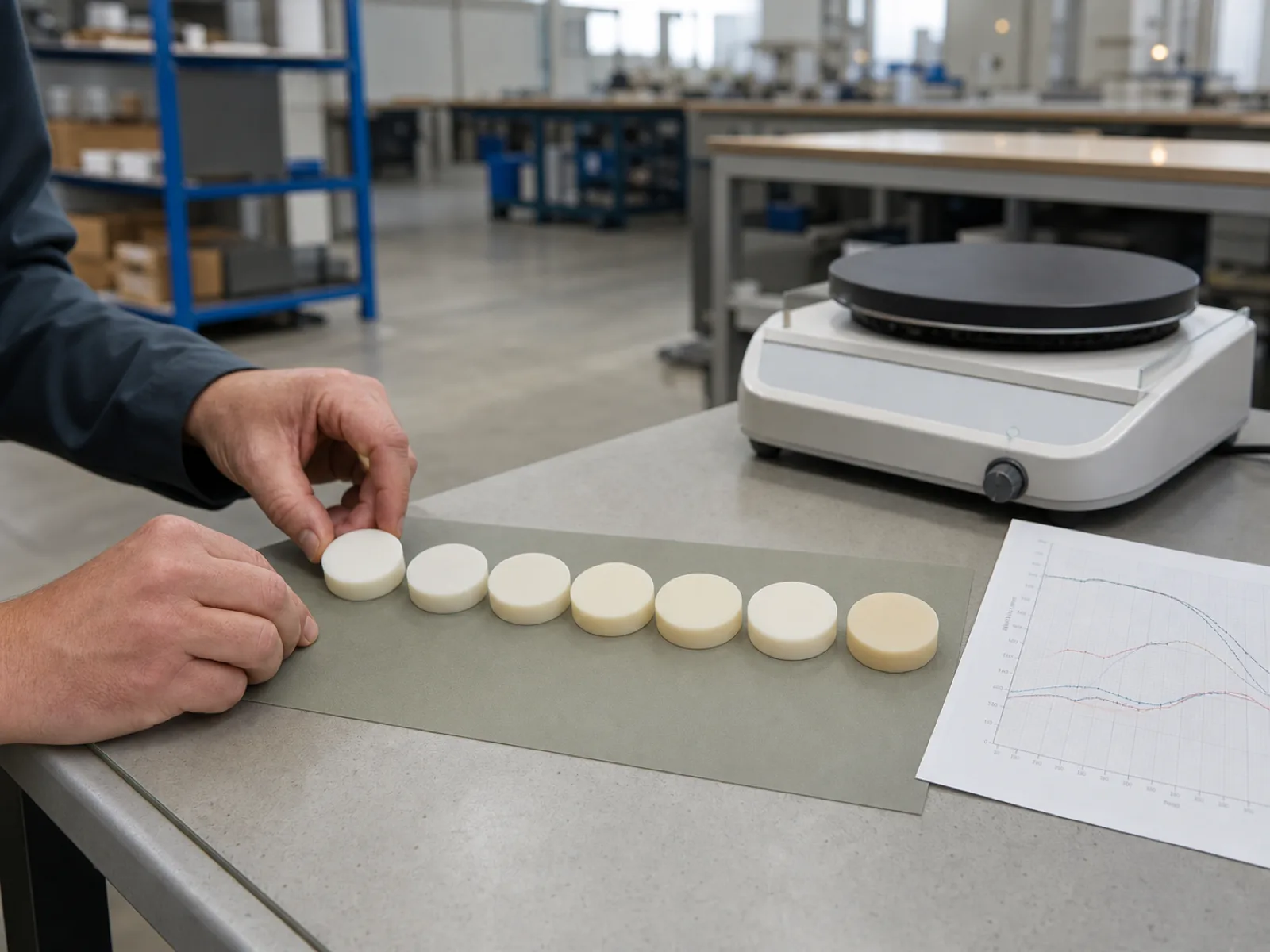 Manufacturing
 Silicone has no true melting point. As a thermoset elastomer with permanently cross-linked polymer chains, it does not liquefy on heating the way thermoplastics do — instead it holds a continuous service range of roughly -60°C to +230°C and then thermally decomposes near 315-370°C rather than melting. The widely quoted 1414°C "melting point" actually belongs to silicon, the semiconductor element, not silicone, the flexible silicon-oxygen polymer used in cookware, seals, and medical parts.
This is the engineering-desk reference for anyone who searched “silicone melting point” and needs the real answer for a spec, a data sheet, or a product decision. We cover why the melting-point question is the wrong question, the silicon-versus-silicone naming trap, the actual continuous and intermittent service ranges, the decomposition and auto-ignition thresholds, the cross-link chemistry that explains the no-melt behavior, how thermal limits are measured with DSC and TGA, what shifts the limits grade to grade, and how we pick a silicone compound for a target service temperature on OEM programs. Every number ties to a test method or a material chemistry so you can write it straight into a drawing.
Does silicone have a melting point?
No. Silicone is a thermoset, not a thermoplastic — its chains are permanently cross-linked during cure, so it cannot re-flow into a liquid. Instead of a melting point it has a continuous service ceiling near 230°C and a thermal-decomposition onset around 315-370°C, where the backbone breaks down rather than melting.
The phrase “melting point of silicone” describes something that physically does not exist. A melting point is the temperature at which a material’s ordered solid structure transitions to a disordered liquid — a property of thermoplastics like polyethylene (~130°C) or nylon (~220°C), whose chains slide freely once heated. Silicone rubber is fundamentally different. During molding, a curing reaction stitches the polymer chains together with permanent chemical cross-links. Those bonds do not release on reheating, so there is no temperature at which cured silicone pools into a liquid.
What silicone has instead is a service range bounded by two different physical events. At the cold end, a glass transition near -120°C where the rubber stiffens toward brittleness. At the hot end, thermal degradation — the siloxane backbone depolymerizing and volatilizing — beginning around 315-370°C in air. Between those two points the material stays a solid elastomer. Ask “what is silicone’s service range?” and there is a precise answer; ask “what is silicone’s melting point?” and the honest answer is that the question is built on a false premise. Our companion silicone temperature range guide walks through the day-to-day service window in kitchenware terms.
Silicon vs silicone — where the 1414°C melting-point myth comes from
Silicon (no "e") is element 14, a hard crystalline semiconductor that melts at 1414°C. Silicone (with "e") is a synthetic polymer built on a silicon-oxygen backbone with organic side groups. The 1414°C figure describes raw silicon in a chip foundry — copying it onto a silicone data sheet is the single most common thermal spec error we correct.
The two words are one letter apart and refer to completely different materials. Silicon is a stiff, gray, crystalline element used in solar cells and microchips; its 1414°C melting point1 is a real, measurable phase transition of the pure element. Silicone is a family of flexible polymers — polydimethylsiloxane (PDMS)2 and its relatives — in which silicon atoms alternate with oxygen atoms along a chain, each silicon carrying organic groups such as methyl or vinyl. That backbone is what gives silicone its heat tolerance and flexibility, but it behaves nothing like the bare element.
Search engines and AI answer boxes routinely conflate the two, and a handful of manufacturing pages have published silicone “melting points” as high as 1414°C by lifting the number straight from a silicon periodic-table entry. It is wrong by more than 1000°C. When a data sheet or supplier quotes a four-digit melting temperature for a flexible silicone part, treat it as an immediate red flag that the source does not understand the material. The correct thermal descriptors for silicone are its continuous service temperature, its intermittent spike tolerance, and its decomposition onset — never a melting point.
The naming trap has a practical cost on the buyer side. We have seen incoming drawings that call out a “melt temperature 1400°C” material note copied from a search result, which tells a factory nothing usable and forces a clarification round before quoting can even start. It also occasionally masks a more serious error: a spec writer who believes silicone melts at 1414°C may assume the material is safe at 400°C or 500°C and design a part that over-ages and fails in service. Getting the silicon-versus-silicone distinction right up front is not pedantry — it changes which grade you specify and whether the part survives its duty cycle.
| Property | Silicon (element, Si) | Silicone (polymer, e.g. VMQ) |
|---|---|---|
| Material class | Crystalline semiconductor element | Cross-linked synthetic elastomer |
| Structure | Diamond-cubic Si lattice | Si-O backbone + organic side groups |
| Melting point | 1414°C (true melt) | None — thermoset, does not melt |
| Continuous service temp | N/A (rigid solid) | -60°C to +230°C (standard VMQ) |
| Failure mode on heating | Melts to liquid silicon | Thermal decomposition ~315-370°C |
| Typical use | Chips, solar cells, alloys | Cookware, seals, tubing, medical parts |
What is silicone’s real service temperature range?
Standard platinum-cured VMQ silicone runs -60°C to +230°C continuous, with intermittent spikes to roughly 300°C tolerable for minutes. High-temperature stabilized grades extend the ceiling to about 250-280°C continuous, while fluorosilicone (FVMQ) and phenyl (PVMQ) variants trade cost for extra margin at the hot or cold end respectively.
Because silicone has no melting point, the useful thermal spec is a range with two ratings at the top: a continuous rating and an intermittent rating. The continuous rating is the temperature the part can hold for thousands of hours while keeping its mechanical properties — for standard VMQ that is 230°C. The intermittent rating is the higher temperature the part survives briefly — a few minutes to a few hours — without immediate destruction, typically 260-300°C for VMQ. The gap between them is not a safety cushion you should design into; it is a survivability figure for excursions.
Silicone service-range table by grade
| Silicone grade | Continuous service | Intermittent spike | Low-temp floor | Notes |
|---|---|---|---|---|
| Standard VMQ (methyl vinyl) | -60°C to +230°C | ~300°C (minutes) | -60°C | Default food-grade cookware and seal compound |
| High-temp VMQ (Fe/Ce oxide stabilized) | -55°C to +250-280°C | ~315°C | -55°C | Heat-stabilizer package delays reversion |
| FVMQ (fluorosilicone) | -55°C to +260°C | ~315°C | -55°C | Adds fuel/oil resistance; ~2× cost |
| PVMQ (phenyl silicone) | -100°C to +230°C | ~300°C | -100°C | Extreme cold flexibility for aerospace/cryogenic |
| Flame-retardant VMQ | -60°C to +230°C | ~300°C | -60°C | UL 94 V-0 additive package, same base ceiling |
Time-at-temperature is the factor buyers most often miss. A silicone trivet rated 230°C is not certifying that it survives 230°C once — it is certifying thousands of hours of cumulative service at that temperature. Push a 230°C-rated part to a continuous 260°C and you have not “melted” it; you have accelerated the depolymerization clock so a 10-year part fails in months. For the practical kitchenware view of these numbers, see our silicone temperature range explainer.
At what temperature does silicone decompose or burn?
Thermal decomposition of standard silicone begins around 315-370°C in air as the siloxane backbone depolymerizes, with peak breakdown in the 400-500°C band. Auto-ignition sits near 450°C. None of these thresholds is reachable in an oven, dishwasher, or cookware application — all of which stay under 290°C — so overheating failure in normal use is over-aging, not combustion.
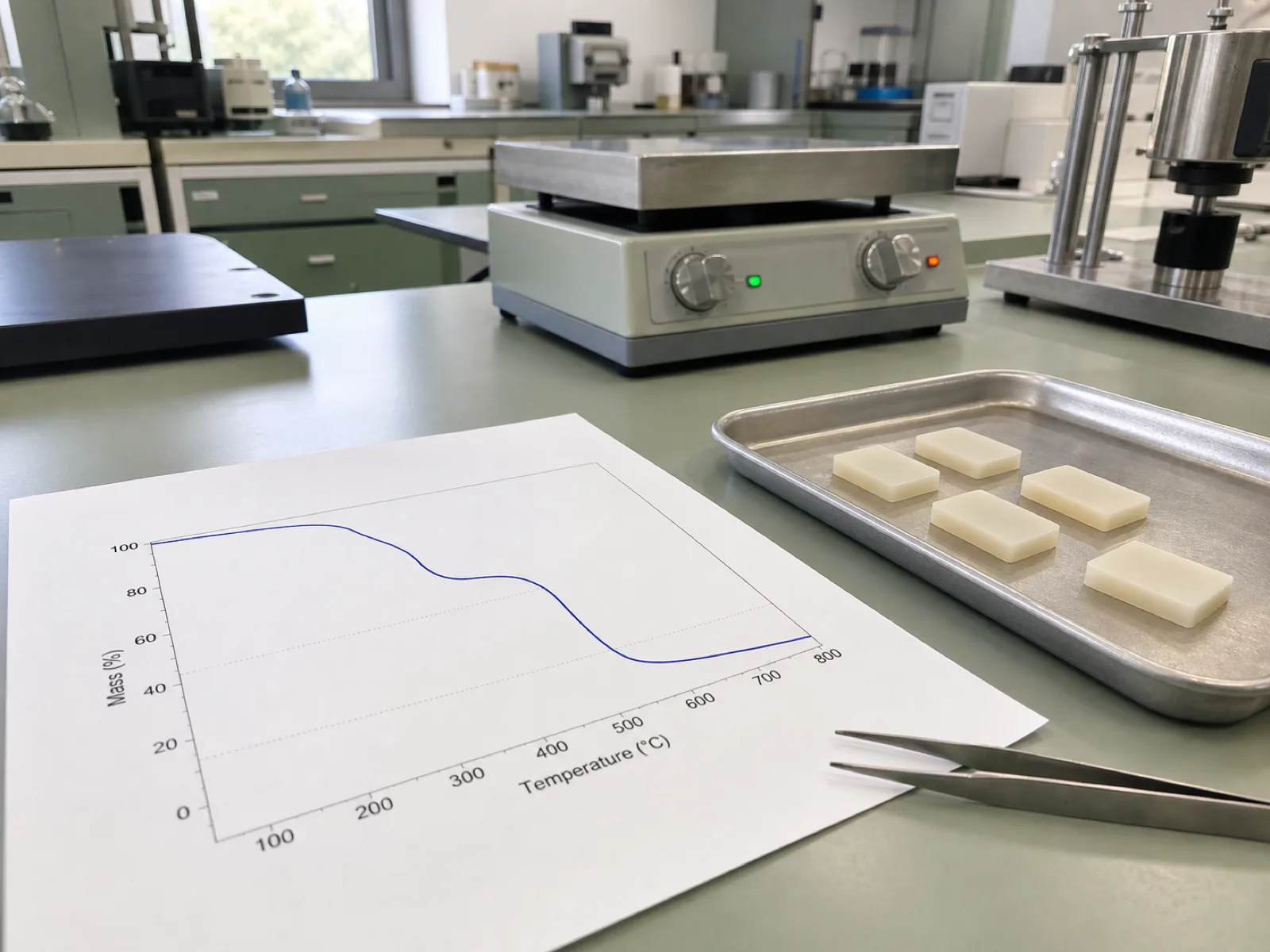
Since there is no melt, the true upper-limit events for silicone are decomposition and combustion. As temperature climbs past the service ceiling, the Si-O backbone starts to break down. Thermogravimetric analysis shows the first meaningful mass loss around 315-370°C, where low-molecular-weight cyclic siloxanes volatilize off the network. Push higher and the reaction accelerates: peak decomposition rates land in the 400-500°C range, and if enough oxygen and an ignition source are present, silicone auto-ignites near 450°C. When silicone does burn, it leaves a white silica (SiO₂) ash rather than the dripping char of a melting thermoplastic — a visual signature of a material that degraded in place instead of flowing.
Silicone thermal thresholds at a glance
| Event | Approx. temperature | What physically happens |
|---|---|---|
| Glass transition (Tg) | ~-120°C | Rubber stiffens toward brittle |
| Low-temp service floor | -60°C (VMQ) | Below this, elongation drops sharply |
| Continuous service ceiling | 230°C (VMQ) | Long-term property retention limit |
| Intermittent spike limit | ~300°C | Survivable for minutes, not hours |
| Decomposition onset | 315-370°C | Backbone depolymerizes, mass loss begins |
| Peak decomposition | 400-500°C | Rapid backbone breakdown |
| Auto-ignition | ~450°C | Combustion to silica ash + gases |
One more distinction matters for anyone reading a burn or flammability spec: silicone does not drip or flow when it fails at high heat, so it cannot spread a fire the way a melting thermoplastic can. Flame-retardant VMQ grades push this further with a UL 94 V-0 additive package that self-extinguishes without changing the base decomposition chemistry.
The practical takeaway for product designers: the decomposition threshold sits a full 85-140°C above the highest household or commercial-kitchen temperature a silicone part will ever see. A 260°C oven, a 200°C sous-vide bath, a 75°C dishwasher — all comfortably below the 315°C onset. Compliance with food-contact rules like FDA 21 CFR 177.26003 is verified at service temperature, and the decomposition band is there as engineering headroom, not as an operating target.
Why doesn’t silicone melt — the cross-link chemistry
Silicone is a thermoset: curing forms permanent chemical cross-links between polymer chains, locking them into a single network that cannot re-flow. Thermoplastics have no such bonds, so heat lets their chains slide and melt. Silicone's Si-O backbone is also unusually heat-stable, so the network holds its shape until the bonds themselves break at decomposition temperatures.
The no-melt behavior comes down to how the polymer is built. In a thermoplastic, individual chains are held together only by weak physical entanglement and secondary forces; add heat and those chains gain enough energy to slide past one another, and the solid flows into a melt. Silicone rubber is cured — during molding, a cross-linking reaction (platinum addition or peroxide) ties the chains together with strong covalent bonds. The result is effectively one giant molecule. There is no way for the chains to slide independently, so no melt phase can form. The only way to “unmake” the network is to break the covalent bonds, which is exactly what decomposition does.
Two chemistry facts stack on top of that thermoset architecture. First, the silicon-oxygen bond in the backbone is stronger and more thermally stable than the carbon-carbon bonds in organic rubbers, which is why silicone tolerates higher temperatures than most elastomers before degrading. Second, the cure system matters at the ceiling: platinum-cured silicone leaves no acidic byproducts and, once post-cured, resists reversion better than peroxide-cured silicone. Our platinum-cured vs peroxide-cured silicone guide breaks down how that choice affects the sustained-heat ceiling and outgassing.
How is silicone’s thermal behavior actually measured?
Two lab instruments characterize it. Differential scanning calorimetry (DSC) locates the glass transition near -120°C and confirms there is no melt endotherm. Thermogravimetric analysis (TGA) records mass loss versus temperature to pinpoint decomposition onset around 315-370°C. Air-oven heat aging per ASTM D573 then validates real-world durability at the rated continuous service temperature.
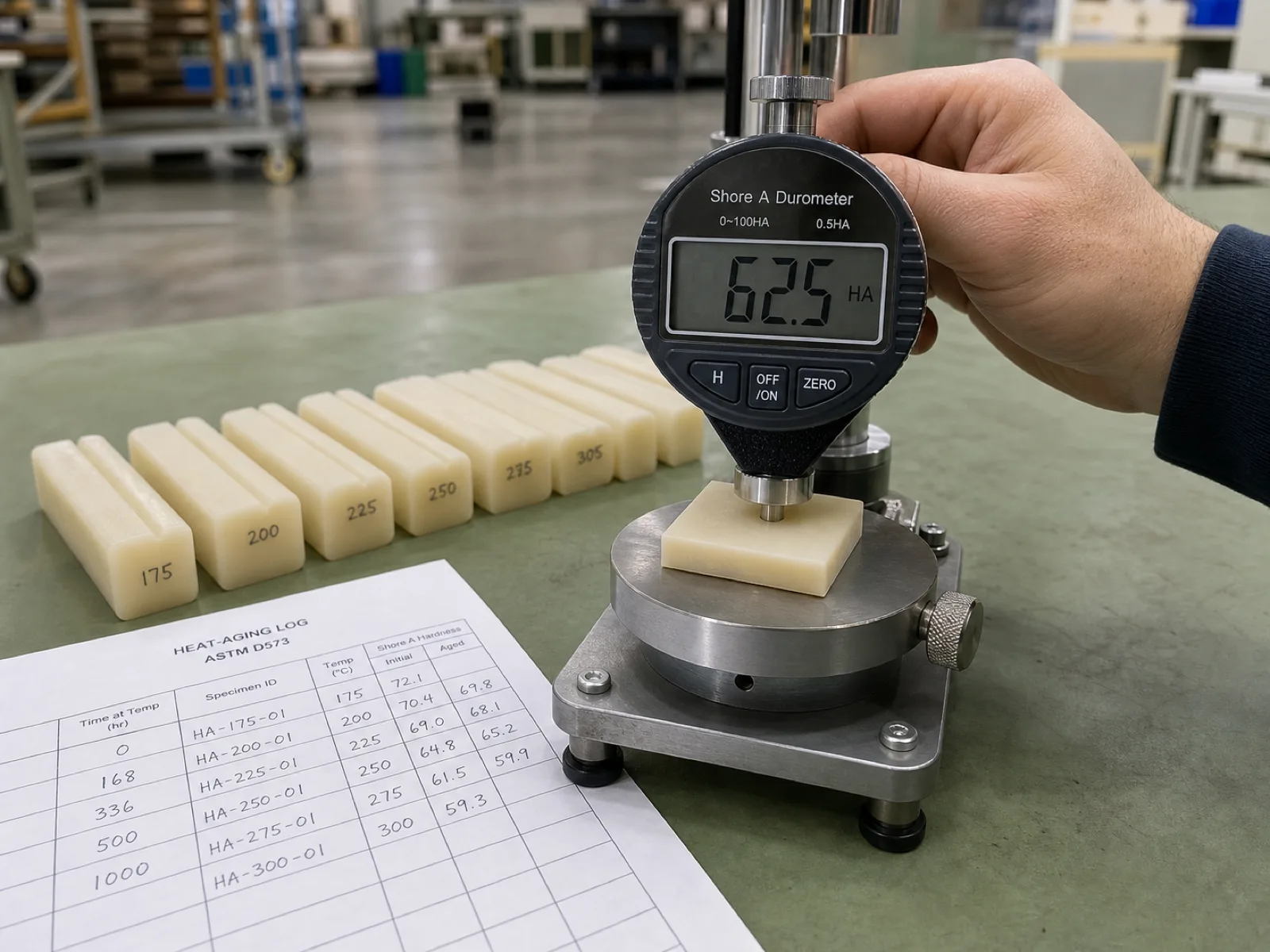
Claims about silicone’s thermal limits are only as good as the test behind them, and there are three that matter. DSC heats a milligram-scale sample and measures heat flow; on a thermoplastic it shows a sharp melting endotherm, and on silicone it shows only a glass transition and no melt peak — direct proof that there is nothing to melt. TGA heats a sample on a microbalance and plots weight against temperature; the point where the curve turns sharply downward is the decomposition onset, the closest thing silicone has to a hard upper temperature number. Air-oven aging per ASTM D5734 parks real parts at the rated temperature for a set duration, then re-tests hardness and elongation to confirm the continuous rating holds in practice.
On production programs we layer a fourth check: a compression-set test per ASTM D3955 on seals and gaskets, because a part can pass hardness aging yet still lose the recovery it needs to keep sealing near its ceiling. Durometer drift is tracked per ASTM D22406 — as silicone over-ages above its service temperature it hardens measurably, so a rising Shore A reading is an early warning of thermal over-exposure. NIST-referenced thermophysical data7 anchors the underlying phase behavior. Together these tests replace the mythical single “melting point” with a defensible thermal envelope. Cross-check hardness ranges in our Shore A hardness silicone chart.
What shifts a silicone grade’s thermal limits?
Four levers move the limits: polymer backbone (VMQ, FVMQ, PVMQ), cross-link density from the cure system, heat-stabilizer fillers such as iron or ceric oxide, and post-cure completeness. Together they shift the continuous ceiling by roughly 30-70°C and the cold floor by up to 40°C versus a plain standard compound — without ever creating a melting point.
No two silicone compounds share the same thermal envelope, and the differences are engineered on purpose. Backbone chemistry is the biggest lever: swapping methyl groups for phenyl (PVMQ) drops the cold floor toward -100°C, while adding fluorine (FVMQ) lifts fuel and heat resistance at the top. Cure and cross-link density set how tightly the network is stitched — a fuller cure resists reversion at high heat but can reduce elongation. Fillers do heavy lifting at the ceiling: iron-oxide and ceric-oxide heat stabilizers scavenge the radicals that drive backbone depolymerization, buying 20-50°C of extra continuous service. And post-cure — a 4-6 hour bake at ~200°C after molding — drives off residual volatiles and completes the network, which is the step that unlocks the full rated ceiling and clean food-contact performance.
Thermal-limit levers and their effect
| Lever | Effect on high end | Effect on low end | Typical cost impact |
|---|---|---|---|
| VMQ → FVMQ (fluorosilicone) | +20-30°C ceiling, fuel/oil resistance | Similar floor | ~1.8-2.2× |
| VMQ → PVMQ (phenyl) | Similar ceiling | Floor to -100°C | ~2.5-3.0× |
| Heat-stabilizer fillers | +20-50°C continuous | Negligible | +5-15% |
| Full post-cure vs green cure | Unlocks rated ceiling, lower outgassing | Negligible | Process time only |
| Higher cross-link density | Better heat/set resistance | Slightly stiffer in cold | Formulation-dependent |
The one lever that does not exist is anything that gives silicone a melting point. Every filler and additive shifts where decomposition and property loss begin — none of them make the material re-flow as a liquid. This is why an ASTM D20008 line call-out for silicone specifies heat-aging class and service temperature, never a melt temperature.
How do I spec a silicone grade for a target service temperature?
Start from the continuous service temperature and the dwell time, never from a melting point. Fix the highest sustained temperature the part sees, add its intermittent spikes, then pick the lowest-cost grade whose continuous rating clears the sustained figure with margin. Confirm the choice with an ASTM D573 heat-aging report on the actual compound before tooling.
The correct spec workflow inverts the way most buyers approach it. Do not ask “what temperature can this silicone take?” Ask “what is the highest temperature my part must hold, and for how long?” That sustained figure — a 232°C reflow-adjacent seal, a 180°C oven mitt, a 150°C engine-bay gasket — sets the required continuous rating. Add the intermittent spikes as a survivability check, not as the design point. Then select the cheapest grade that clears the continuous number: standard VMQ for anything at or under 230°C, a high-temp stabilized VMQ for 250-280°C, FVMQ where fuel or oil is also present.
Application-to-grade quick reference
| Application | Typical service temp | Recommended grade | Why |
|---|---|---|---|
| Bakeware, molds, oven mitts | 180-230°C | Standard platinum VMQ | Clears oven range, food-grade, lowest cost |
| Cookware seals, pressure-cooker rings | 120-200°C | Standard VMQ, Shore A 60-70 | Compression-set stability under bolt load |
| Automotive under-hood gaskets | 150-250°C | High-temp VMQ or FVMQ | Heat stabilizer + fuel resistance margin |
| Fuel/oil-contact seals | 100-260°C | FVMQ (fluorosilicone) | Resists swell VMQ cannot handle |
| Aerospace / cryogenic seals | -100°C to +200°C | PVMQ (phenyl) | Cold-flexibility floor to -100°C |
| Electrical/LED potting, keypads | -40°C to +200°C | Standard or flame-retardant VMQ | UL 94 V-0 option, dielectric stability |
On every OEM program we run, the thermal spec is validated on the actual production compound — not a data-sheet promise — through air-oven aging and, for seals, compression-set testing, all logged against the batch record under our ISO 90019 system. A silicone part rated for your service temperature ships with a heat-aging result you can put in front of your own quality team. The spec that never appears on that report is a melting point, because the material does not have one.
References
Spec your silicone program by service temperature, not a melting point
Tell us the highest sustained temperature your part must hold, its dwell time, and any intermittent spikes, and the engineering desk comes back inside 48 hours with a grade recommendation, a heat-aging test plan, and a unit-price bracket at MOQ 500 / 2,000 / 10,000. Every production compound ships with an ASTM D573 heat-aging result logged against the batch record. Start an RFQ with the engineering desk and we will match the compound to your real thermal envelope.
Footnotes
-
Silicon — Element Data, Melting Point 1414°C, PubChem, US National Library of Medicine (NIH), https://pubchem.ncbi.nlm.nih.gov/element/Silicon ↩
-
Dimethicone (Polydimethylsiloxane) — Compound Summary, PubChem, US National Library of Medicine (NIH), https://pubchem.ncbi.nlm.nih.gov/compound/Dimethicone ↩
-
21 CFR 177.2600 — Rubber Articles Intended for Repeated Use, US Food and Drug Administration, https://www.ecfr.gov/current/title-21/chapter-I/subchapter-B/part-177/subpart-C/section-177.2600 ↩
-
ASTM D573 — Standard Test Method for Rubber — Deterioration in an Air Oven, ASTM International, https://www.astm.org/d0573-04r19.html ↩
-
ASTM D395 — Standard Test Methods for Rubber Property — Compression Set, ASTM International, https://www.astm.org/d0395-18.html ↩
-
ASTM D2240 — Standard Test Method for Rubber Property — Durometer Hardness, ASTM International, https://www.astm.org/d2240-15r21.html ↩
-
NIST Chemistry WebBook — Thermophysical Property Data, US National Institute of Standards and Technology, https://webbook.nist.gov/chemistry/ ↩
-
ASTM D2000 — Standard Classification System for Rubber Products in Automotive Applications, ASTM International, https://www.astm.org/d2000-18.html ↩
-
ISO 9001:2015 — Quality Management Systems — Requirements, International Organization for Standardization, https://www.iso.org/standard/62085.html ↩
FAQ
-
At what temperature does silicone actually melt?
It doesn't. Silicone is a thermoset — its polymer chains are permanently cross-linked, so instead of melting into a liquid it stays solid until it thermally decomposes. Decomposition of standard VMQ silicone begins around 315-370°C in air. There is no melt phase, no melting point, and no pool of liquid silicone at any kitchen or industrial temperature.
-
Will silicone melt in the oven or the dishwasher?
No. Household ovens top out near 260-290°C and dishwashers run at 50-75°C — both far below silicone's ~315°C decomposition onset. Food-grade platinum-cured silicone rated to 230°C continuous handles oven and dishwasher cycles without melting, warping, or losing shape, provided the grade is genuinely food-contact silicone and not a filled thermoplastic look-alike.
-
Is silicon the same as silicone when sources quote a 1414°C melting point?
No — this is the root of most confusion. Silicon (no 'e') is the semiconductor element with a melting point of 1414°C. Silicone (with 'e') is a synthetic polymer built on a silicon-oxygen backbone. The 1414°C figure describes the raw element in a chip foundry, not the flexible elastomer in cookware, seals, or medical tubing.
-
What is the decomposition temperature of silicone rubber?
Thermogravimetric analysis shows polydimethylsiloxane begins meaningful mass loss around 315-370°C in air as the siloxane backbone depolymerizes and volatilizes. Peak decomposition rates fall in the 400-500°C band, and auto-ignition sits near 450°C. Fillers, cure system, and atmosphere shift these onsets, but no common silicone grade decomposes below roughly 300°C.
-
Does silicone release toxins when overheated?
Below its service ceiling, food-grade platinum-cured silicone is inert and releases nothing measurable. Above ~300°C sustained, thermal breakdown can liberate low-molecular-weight siloxanes and, in fire conditions near 450°C, silica ash plus combustion gases. In normal oven, cookware, and dishwasher use — all under 290°C — a properly post-cured food-grade grade stays stable and non-migrating.
-
What happens to silicone between its service ceiling and its decomposition point?
In the 230-315°C gap the material does not melt but progressively hardens, discolors, and loses elongation as post-cure over-advances and the network embrittles. Seals take permanent compression set and stop sealing; flexible parts crack. This is why the continuous rating is 230°C — the part survives higher spikes but will not keep its mechanical properties there for long.
-
Can high-temperature silicone grades run continuously at 300°C?
Not truly continuously. Specialty high-temp VMQ compounds with iron-oxide or ceric-oxide heat stabilizers extend the practical ceiling to roughly 250-280°C continuous and tolerate 300-315°C intermittently. Beyond that the depolymerization clock runs fast. For sustained 300°C-plus sealing, fluorosilicone (FVMQ) buys some margin, but many engineers move to fluoroelastomer or PTFE at that point.
-
How is silicone's thermal behavior measured in a lab?
Two instruments do the work. Differential scanning calorimetry (DSC) maps the glass-transition near -120°C and confirms there is no melt endotherm. Thermogravimetric analysis (TGA) tracks mass loss versus temperature to pinpoint the decomposition onset around 315-370°C. Air-oven heat aging per ASTM D573 then verifies real service durability at the rated continuous temperature.
-
Does the cure system change silicone's temperature limit?
Yes, at the high end. Platinum-cured (addition) silicone leaves no acidic cure byproducts and, once post-cured, holds its rated ceiling with lower outgassing. Peroxide-cured silicone can leave residues that accelerate reversion and slightly lower the sustained-heat ceiling unless fully post-cured. Both share the same ~-60°C low-temperature floor and the same fundamental no-melt behavior.
References
Authoritative sources cited in this guide
- PubChem, US National Library of Medicine (NIH). Silicon — Element Data, Melting Point 1414°C. https://pubchem.ncbi.nlm.nih.gov/element/Silicon — Confirms the 1414°C melting point belongs to elemental silicon, not the silicone polymer.
- PubChem, US National Library of Medicine (NIH). Dimethicone (Polydimethylsiloxane) — Compound Summary. https://pubchem.ncbi.nlm.nih.gov/compound/Dimethicone — Reference chemistry for the PDMS backbone that forms medical- and food-grade silicone.
- US National Institute of Standards and Technology. NIST Chemistry WebBook — Thermophysical Property Data. https://webbook.nist.gov/chemistry/ — Primary-source thermophysical reference for siloxane and silicon phase data.
- ASTM International. ASTM D573 — Standard Test Method for Rubber — Deterioration in an Air Oven. https://www.astm.org/d0573-04r19.html — The heat-aging test that validates continuous service temperature ratings.
- ASTM International. ASTM D395 — Standard Test Methods for Rubber Property — Compression Set. https://www.astm.org/d0395-18.html — Quantifies how a silicone seal loses sealing force as it approaches its thermal ceiling.
- ASTM International. ASTM D2000 — Classification System for Rubber Products in Automotive Applications. https://www.astm.org/d2000-18.html — Line call-out system that fixes heat-aging class and service temperature on a drawing.
- ASTM International. ASTM D2240 — Standard Test Method for Rubber Property — Durometer Hardness. https://www.astm.org/d2240-15r21.html — Shore A method used to track embrittlement as silicone over-ages above its ceiling.
- US Food and Drug Administration. 21 CFR 177.2600 — Rubber Articles Intended for Repeated Use. https://www.ecfr.gov/current/title-21/chapter-I/subchapter-B/part-177/subpart-C/section-177.2600 — Food-contact compliance basis for oven- and dishwasher-safe silicone claims.
- International Organization for Standardization. ISO 9001:2015 — Quality Management Systems — Requirements. https://www.iso.org/standard/62085.html — Quality system Wetop's per-batch thermal verification is certified against.
Start a custom program
Send a brief. Get an engineer’s reply in one business day.
Every Wetop program is tooled from a customer’s specification. Send a CAD file (STEP · IGES · DWG) or a written brief and we’ll reply with a mold cost estimate, price brackets at MOQ 500 / 1,000 / 5,000, and any engineering questions.