Buyer Guide · commercial intent
Silicone Muffin Cups OEM Manufacturing Guide
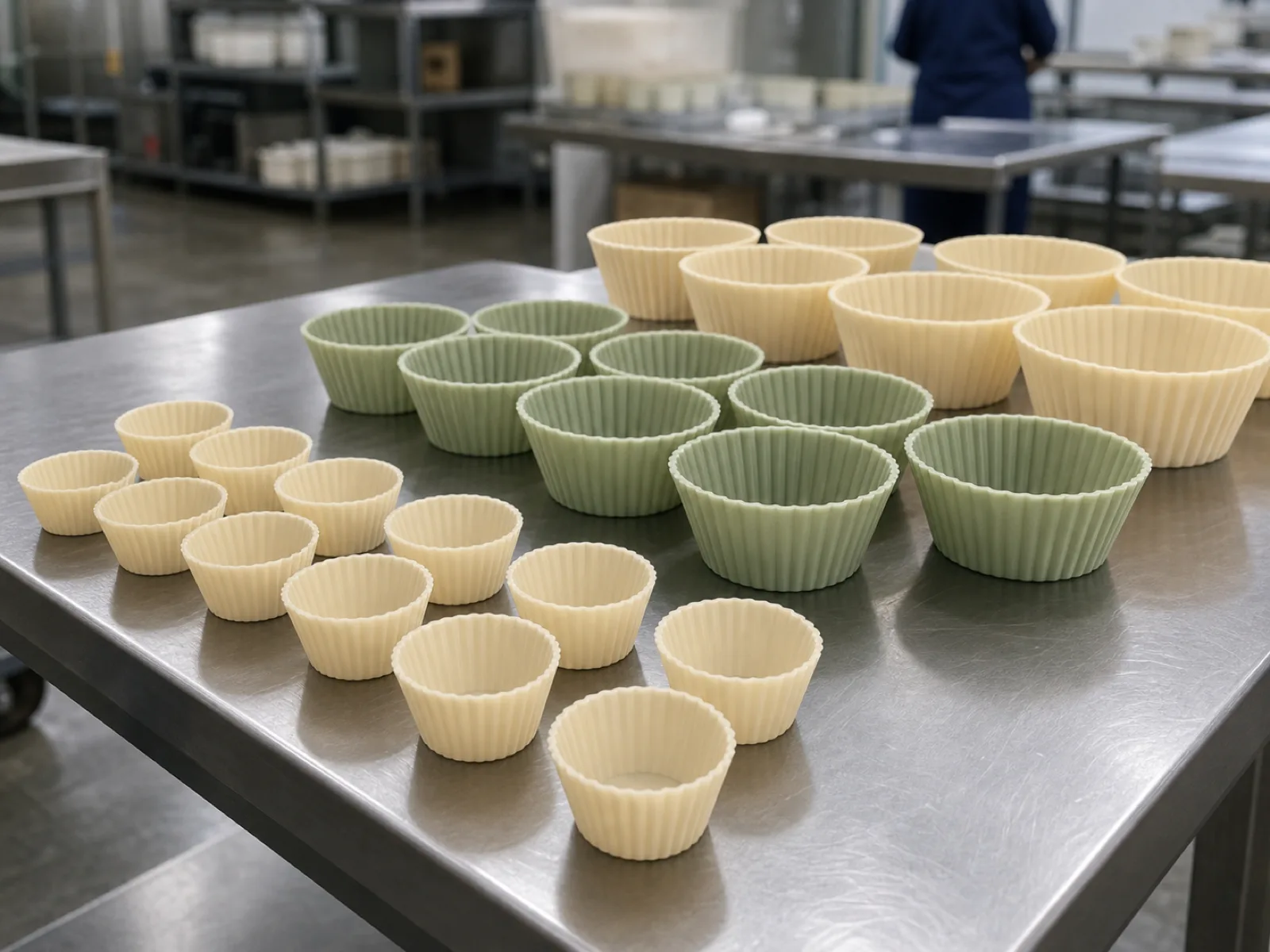 Buyer Guide
 Silicone muffin cups are reusable, platinum-cured food-grade baking liners engineered for repeated -40 °C to 230 °C use in ovens, microwaves, air fryers, and freezers. A defensible OEM program requires 21 CFR 177.2600 extractive testing, LFGB migration on the finished cup, and a documented 4-hour 200 °C post-cure — not just a compliant raw compound. This guide covers the chemistry, sizing, safety, tooling, and landed-cost math a brand needs before signing a first purchase order.
Silicone muffin cups look like a commodity — search any marketplace and you will find dozens of near-identical cream-and-pastel sets. The engineering underneath is not commodity at all: two cups that photograph the same can differ 5× in landed cost, use two entirely different cure chemistries, and hold opposite positions on food-contact compliance. This guide is written from a Dongguan factory floor — the engineering desk that runs Wetop’s platinum-cured compression cell and post-cure oven bank. Every spec, tolerance, and price below traces to a real test method or production lot record.
Key takeaways
- Only platinum-cured silicone muffin cups are safe for repeated baking; peroxide cure leaves the soapy taste buyers complain about.
- Food-grade cups need no greasing — release is inherent, not a PFAS coating.
- Standard rim diameters are 50 mm (mini) / 70 mm (standard) / 90 mm (jumbo).
- Reusable cups hit cost parity with paper liners around 18-25 bakes.
- The white-mark pinch test separates food-grade silicone from filler cups.
- MOQ starts at 500/SKU; a 24-cavity mold lands cups near $0.14-$0.22 each.
What are silicone muffin cups, and how are they made?
Silicone muffin cups are individual, reusable baking liners molded from platinum-cured polydimethylsiloxane elastomer with fumed-silica reinforcement and food-grade pigment. Each cup is compression- or LSR-molded, then post-cured for 4 hours at 200 °C to drive out residual volatiles. Unlike paper liners, they are a thermoset elastomer stable across the full -40 °C to 230 °C baking range.
A silicone muffin cup starts as a two-part platinum-catalyzed silicone gum, compounded on a two-roll mill with 20-35 phr fumed silica and a pigment master-batch. The catalyst is a Karstedt-type platinum-divinyltetramethyldisiloxane complex at 5-10 ppm loading, which cross-links the polymer through a clean hydrosilylation reaction that leaves no volatile byproducts. This is the single most important fact about a muffin cup: the cure system determines whether it is odor-neutral or whether it taints the first two dozen bakes.
The fluted-wall geometry that defines a muffin cup is not decoration. The vertical flutes do three jobs at once: they add hoop stiffness so a filled cup holds its shape, they create controlled flex points that pop the baked muffin loose on a gentle push, and they increase surface area for faster heat transfer into the batter. A well-engineered cup demolds a muffin with a single thumb press from the base — no knife, no greasing, no tearing.
The forming choice is compression molding for most muffin-cup geometries and liquid silicone rubber (LSR) injection for very high volumes or ultra-thin walls. Compression is more economical below 100k units per SKU; LSR wins on cycle time and wall-thickness consistency above that. Either way, the part is not finished when it leaves the press — the mandatory post-cure step is where a compliant cup and a cheap one diverge, a distinction covered in depth in our platinum-cured vs peroxide-cured silicone guide.
Are silicone muffin cups food-safe?
Platinum-cured silicone muffin cups are food-safe when documented against finished-part test reports: FDA 21 CFR 177.2600 extractives, LFGB migration, CPSIA lead, and a REACH SVHC screen. They contain no BPA (not a polycarbonate), no intentionally added lead or phthalates, and no PFAS. The critical qualifier is that testing must be on the finished cup, not the raw silicone gum lot.
The safety question splits into two very different claims. The first is “the material is capable of being food-safe” — true of essentially all platinum-cured silicone. The second is “this specific finished cup was tested and passed” — which is the only claim a retail buyer can act on. 21 CFR 177.26001 sets the US benchmark: n-hexane extractives ≤ 175 mg/dm² and ethanol/water extractives ≤ 8 mg/dm² measured on the completed article over 7 hours at reflux. A raw-gum FDA statement is meaningless if the finished cup was pigmented or under-post-cured differently.
The EU side runs through LFGB §30/31 under the BfR Recommendation XV2 framework for silicones, plus the umbrella EU 1935/20043 declaration of compliance. LFGB migration is tested at 100 °C for 4 hours in food simulants — 3 % acetic acid, 10 % ethanol, and an oil substitute — on the finished cup surface. A muffin cup destined for both hemispheres needs both packets, a contrast our FDA vs LFGB silicone guide breaks down test method by test method.
On the three consumer-facing fears — BPA, lead, PFAS — the engineering answers are unambiguous. Silicone is a siloxane polymer, not a polycarbonate, so BPA is chemically absent by construction. Lead comes only from pigment; food-grade master-batches run below 5 ppm against the 100 ppm CPSIA4 screen. PFAS (“forever chemicals”) are a red herring for silicone: the non-stick behavior comes from silicone’s inherently low surface energy, not from a fluoropolymer coating, so there is nothing to shed. A REACH SVHC screen5 closes the loop on phthalates and the D4/D5 siloxane oligomers currently under EU review.
What temperature range do silicone muffin cups handle?
Platinum-cured silicone muffin cups operate continuously from -40 °C to 230 °C with a 260 °C short peak. That covers freezer storage (-18 °C), microwave, all standard bake profiles (140-200 °C), and air fryers up to 200 °C. Broiler mode (275-300 °C) is out of spec — the cup will not combust but yellows and loses tear strength within 20-30 exposures.
The temperature envelope is set by the Si-O-Si backbone, which is thermally stable to roughly 260 °C in air before oxidative chain scission takes over. The practical repeated-use window for a muffin cup is -40 °C to 230 °C, which comfortably brackets every home and light-commercial baking task. A common marketing overreach is the “600 °C melt point” claim, which describes pyrolysis, not a safe use temperature — ignore it when specifying a cup.
Air fryers deserve a specific note because they are the fastest-growing failure vector. An air fryer circulates air at 180-200 °C, well within spec, but the heating element radiates far hotter. A muffin cup pushed against the element or into the top of a small basket can see localized 280 °C+ and scorch. The engineering guidance to print on packaging: keep cups centered in the basket, away from the element, and below 200 °C.
Freezer-to-oven range is the headline advantage over both paper and metal. Silicone stays flexible to -55 °C in the lab and is functionally unchanged at a home-freezer -18 °C, so a batch of batter or frozen egg bites moves straight from freezer to oven without cracking. This range is what drives the “freezer-to-oven” mini-cake and egg-bite segment that silicone muffin cups own outright.
| Environment | Temperature | Silicone muffin cup status |
|---|---|---|
| Deep freezer | -40 °C to -18 °C | In spec — stays flexible, no cracking |
| Refrigerator | 4 °C | In spec |
| Microwave | up to ~120 °C food temp | In spec |
| Standard bake | 140-200 °C | In spec — core operating band |
| Air fryer (centered) | up to 200 °C | In spec — keep off the element |
| High bake / convection | 200-230 °C | In spec — continuous limit |
| Short peak | up to 260 °C | Tolerated briefly, not continuous |
| Broiler / grill element | 275-300 °C+ | Out of spec — yellowing, tear loss |
Do you need to grease silicone muffin cups?
No — well-made silicone muffin cups release cleanly without greasing because silicone has inherently low surface energy. A light oil wipe helps only on the very first bake or with very sticky high-sugar batters. When a cup does grab the muffin, the cause is almost always a low-grade filler compound or a wall harder than Shore A 60, not a missing grease step.
The non-stick behavior of silicone is a bulk material property, not a coating. Silicone’s surface energy sits around 20-24 mN/m — far below water and most batters — so baked goods release with minimal adhesion. This is fundamentally different from a coated metal tin, where the non-stick layer is a fluoropolymer film that wears off. A silicone cup’s release performance is as durable as the cup itself because it is the same material all the way through.
Where release actually goes wrong is a design or material problem, and it is worth diagnosing correctly rather than reaching for grease:
- Too-hard wall — above Shore A 60, the wall does not flex enough to break the batter’s grip on demold. The fix is a softer compound (40-55 A), not oil.
- Filler silicone — calcium-carbonate-filled cups have a rougher, more porous surface that batter keys into. No amount of greasing fully cures this.
- High-sugar caramelization — very sweet batters caramelize at the wall and bond mechanically; a thin oil wipe genuinely helps here, and it is the one legitimate greasing case.
- Insufficient cooling — pulling a muffin while the crumb is still hot and gummy tears it. A 5-10 minute cool solves this without touching the cup.
For OEM buyers, the takeaway is that “no grease needed” is a claim you can only make honestly if the cup is genuinely food-grade platinum silicone at the right hardness. It is not something you can print on filler-loaded cups and expect to survive reviews.
What are standard silicone muffin cup sizes?
Three sizes dominate: mini at roughly 50 mm top diameter × 25 mm deep, standard at 70 mm × 35 mm, and jumbo at 90 mm × 45 mm. Fill batter to 60-70 % of cavity depth to leave headroom for dome rise. OEM buyers can specify custom rim diameters, base diameters, and fluted-wall counts against a dedicated cavity insert at new-tooling cost.
Muffin cup sizing has converged on a de-facto industry standard because it has to nest into existing metal pan cavities and match paper-liner conventions. The rim diameter is the dimension that matters for pan fit; the base diameter and depth follow from the taper. A standard cup with a 70 mm rim tapers to roughly a 50 mm base, giving the classic muffin frustum. Getting this taper right is a demold-angle decision at the tooling stage, not an afterthought.
| Size | Top (rim) Ø | Base Ø | Depth | Batter capacity | Fill line |
|---|---|---|---|---|---|
| Mini | 48-52 mm | 34-38 mm | 24-27 mm | ~30 ml | 60-70 % depth |
| Standard | 68-72 mm | 48-52 mm | 33-37 mm | ~90 ml | 60-70 % depth |
| Jumbo / Texas | 88-92 mm | 64-68 mm | 43-47 mm | ~180 ml | 60-70 % depth |
The fill line matters more than buyers expect. Overfilling past 70 % of cavity depth means the dome spills over the rim and the muffin fuses to its neighbors — the single most common consumer complaint that gets misattributed to “bad cups.” A subtle in-mold fill-line ring debossed at the 65 % mark is a cheap, high-value customization that reduces returns; it costs nothing per unit once it is in the cavity insert.
Wall thickness runs 1.2-2.0 mm for muffin cups — thinner than a full bakeware pan because each cup is small and self-supporting when nested in a pan or standing on a sheet. Rim and base dimensional tolerance follows ISO 3302-16 Class M2, which keeps a set of cups visually uniform and pan-compatible; looser tolerance produces the “one cup in the pack doesn’t fit the tin” defect.
Silicone muffin cups vs paper liners vs metal tins — cost-per-use?
Reusable silicone muffin cups reach cost-per-use parity with disposable paper liners around 18-25 bakes, then run effectively free across a 1,000-plus-cycle life. Paper liners cost less upfront and need zero cleanup but generate single-use waste. Metal tins conduct heat faster but still require a liner. Silicone's unique edge is freezer-to-oven range plus elimination of the disposable stream.
The cost comparison depends entirely on time horizon, so it is worth laying out the actual math rather than asserting a winner. A silicone cup at retail runs $0.40-$0.80 per cup; a paper liner runs $0.02-$0.04. On day one paper is 10-20× cheaper. But paper is consumed every bake, while the silicone cup is amortized across its whole life. The crossover point is where cumulative paper cost catches the one-time silicone cost.
| Factor | Silicone muffin cups | Paper liners | Metal muffin tin |
|---|---|---|---|
| Upfront cost / cavity | $0.40-$0.80 | $0.02-$0.04 | $1.00-$2.50 (tin, amortized) |
| Reusable | Yes, 1,000+ cycles | No, single use | Yes, but needs liners |
| Cost-per-use at 100 bakes | ~$0.006 | $0.02-$0.04 | liner cost + tin |
| Break-even vs paper | ~18-25 bakes | n/a | n/a |
| Freezer-to-oven | Yes | Limited | Yes (empty) |
| Greasing needed | No | No | Usually yes |
| Waste stream | None | 1 liner / bake | None |
| Dishwasher | Yes | n/a | Often not recommended |
Beyond raw cost, the decision drivers split by use case. High-frequency home bakers and meal-preppers (egg bites, muffin-tin recipes several times a week) hit break-even fast and value the zero-waste angle. Occasional bakers and anyone prioritizing grab-and-go cleanup lean paper. For an OEM brand, the strategic read is that silicone muffin cups are a lifestyle and sustainability product, not a price product — the pitch is waste reduction and freezer-to-oven versatility, and the packaging copy should carry the break-even number because it is genuinely persuasive.
What Shore A hardness is right for silicone muffin cups?
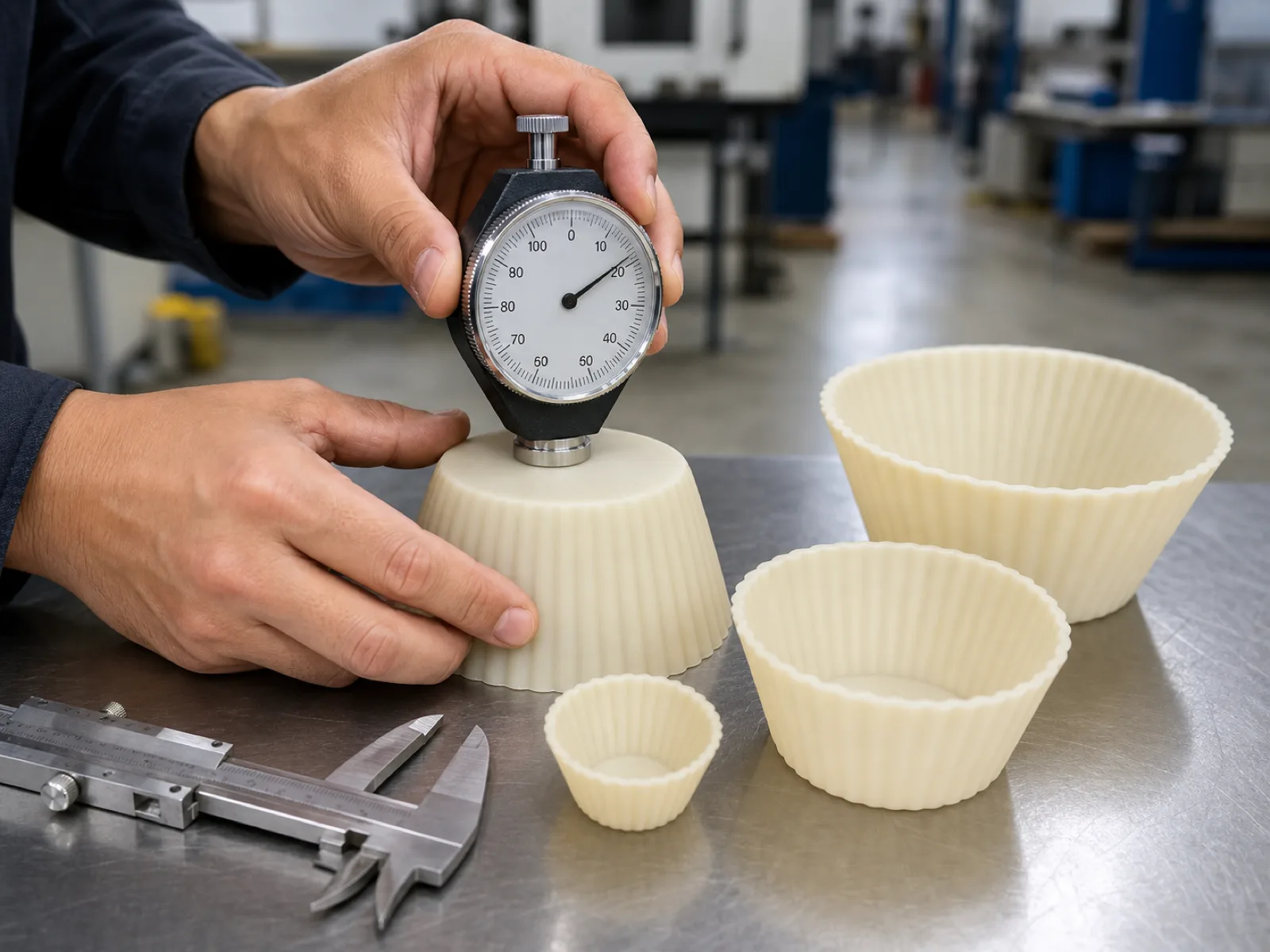
For silicone muffin cups, target Shore A 40-55 — soft enough that the fluted wall flexes to pop the muffin free, firm enough to hold shape when filled with batter. Below 40 A the cup collapses under a full load and is hard to lift; above 60 A the wall is too stiff to demold cleanly and release suffers. This is softer than deep bakeware pans, which sit at 55-65 A.
Hardness is the property that most directly governs the user experience of a muffin cup, and it is where cheap cups most often get it wrong. A muffin cup lives or dies on the demold: the wall must flex enough under a thumb press to break the seal between baked crumb and silicone. That flex is a direct function of durometer. At Shore A 45-50, a standard cup releases a muffin with one gentle push; at Shore A 65, the same cup fights back and tears the muffin’s edge.
| Cup type | Target Shore A | Wall thickness | Why |
|---|---|---|---|
| Mini cup | 40-50 A | 1.2-1.6 mm | Small load, maximum flex for easy release |
| Standard cup | 45-55 A | 1.5-1.8 mm | Balance of shape retention and demold flex |
| Jumbo cup | 50-55 A | 1.7-2.0 mm | Larger batter load needs more wall stiffness |
| Reinforced-rim cup | 45-50 A | 1.5-1.8 mm | Steel or thick-rim ring carries structural load |
Wetop applies ASTM D22407 durometer inspection in-line — three points on every 20th cup, logged to a control chart that triggers investigation at ±3 points from target. Durometer drift is the earliest warning sign of a compounding or cure problem; catching it on the QC bench is far cheaper than catching it in a customer review that says “the cups got hard and stopped releasing.” A softer, correctly-cured cup that holds its 45-50 A hardness across 1,000 cycles is the engineering signature of a quality muffin cup.
How do you spot low-grade filler silicone?
Run the pinch-and-twist white-mark test: pinch a cup wall and twist hard. Food-grade platinum silicone stays its base color; cheap calcium-carbonate-filled cups blush a white streak where the filler fractures under strain. Filler cups also smell chemical when warmed, feel oily with mold-release residue, and tear at thin fluted walls within 30-40 bake cycles.
The most common adulteration in cheap silicone housewares is loading the compound with calcium carbonate (chalk) or other mineral fillers to cut the amount of actual silicone gum. Filler is far cheaper than silicone polymer, so a heavily filled cup can undercut a food-grade cup by half — while looking identical in a product photo. The problem is that filler is not inert food-contact material: it can carry heavy-metal impurities, it raises extractable content, and it degrades the mechanical properties the cup depends on.
Four field tests separate food-grade from filler, none requiring lab equipment:
- White-mark pinch test — the definitive one. Twist a wall sharply. A white stress mark means mineral filler fracturing; a clean color means the polymer is stretching elastically as it should.
- Warm-smell test — hold a cup under hot tap water or warm it. A genuine platinum cup is odor-neutral; a filler or peroxide-cured cup releases a chemical or soapy smell.
- Oily-film test — run a finger across a new cup. Excess mold-release oil that will not wipe off signals a shop cutting corners on demold and, usually, on compound.
- Tear test at the flute — the thinnest fluted section is the weak point. Food-grade silicone has 25-40 kN/m tear strength and resists a fingernail; filler silicone tears easily.
For OEM buyers, the defense is upstream: demand finished-part 177.2600 extractive results and a total-silicone-content figure, and specify a maximum filler loading in the technical agreement. Wetop targets zero non-reinforcing filler in food-contact cups — the only “filler” in the compound is fumed silica, which is a reinforcing agent that raises tear strength rather than a chalk extender that lowers it.
How do you clean silicone muffin cups, and how long do they last?
Silicone muffin cups are dishwasher-safe and hand-wash easily; for stubborn odor, bake them empty at 120 °C for 10 minutes or soak in a baking-soda solution. A platinum-cured food-grade cup lasts 3-5 years — roughly 1,000-1,500 bake-wash cycles — before elastic recovery drops enough to affect release. End-of-life signs are permanent staining, a sticky film, hardness past Shore A 65, or base cracks.
Cleaning is genuinely low-effort, which is part of the value proposition. Silicone’s non-porous surface means most residue rinses off; the dishwasher top rack handles a full set. The one nuisance is that silicone can absorb strong odors (garlic, curry) from a previous savory bake. The fix is not scrubbing but heat or alkalinity: a short empty bake at 120 °C volatilizes trapped odor compounds, and a baking-soda soak neutralizes acidic residues. Avoid abrasive scouring pads, which scratch the surface and create odor-trapping micro-porosity.
Lifespan is a function of cure quality, not brand. A correctly post-cured platinum cup holds its hardness and elastic recovery across well over 1,000 cycles because the cross-link network is fully developed and stable. Peroxide-cured or under-post-cured cups degrade faster — they stiffen, discolor, and develop surface tack as residual volatiles continue reacting. This is why the post-cure step, invisible to the end consumer, is the true determinant of the multi-year life buyers expect.
The end-of-life indicators worth printing in care instructions: permanent brown or purple staining that will not bake or soak out, a persistent sticky film (a sign of surface degradation, not dirt), hardness climbing so that muffins stop releasing, and hairline cracks at the base radius where flex stress concentrates. A cup showing any of these has reached the end of a normal service life and should be replaced — reassuringly, that point is years away for a quality cup and months away for a filler one.
What OEM customization options exist for silicone muffin cups?
The production-proven customization options are pigment-body color (Pantone match to ΔE ≤ 2.5, no per-unit premium), in-mold base debossing for a permanent logo (0.3-0.5 mm depth), custom rim diameter and fluted-wall count against a new cavity insert, and a fill-line ring deboss. Pad printing is available for gift-set cups but fades after 40-60 dishwasher cycles, so debossing is the durable default.
Color is the cheapest and most durable customization. The pigment master-batch is dispersed into the compound at the two-roll mill stage, so the color runs uniform through the full wall thickness and cannot fade, chip, or wash off. Pantone match tolerance is ΔE ≤ 2.5 against the approved reference chip, verified under a D65 light-box at the QC station. Custom Pantone colors add only $0.01-$0.03/unit for master-batch amortization at moderate volumes — a full brand palette across a cup set is inexpensive.
In-mold debossing puts a permanent brand mark on the cup base — the one surface that does not touch batter and stays visible on a shelf. Depth of 0.3-0.5 mm with a 5° draft on the letter walls releases cleanly even at Shore A 55. Because the logo is a geometric feature rather than a coating, it survives every oven and dishwasher cycle for the life of the cup. This is the specification retail buyers ask for when a brand mark has to survive the product’s whole lifetime.
Beyond color and logo, the higher-value customizations are geometric: a custom rim diameter to fit a proprietary pan, a distinctive fluted-wall count or profile for shelf differentiation, a shaped cavity (star, heart, flower) for a themed line, and the fill-line ring that quietly reduces overfill returns. Each is a cavity-insert change at new-tooling cost, and each is the kind of detail that separates a private-label line from a generic import. For the broader menu of silicone form factors a brand might build a catalog around, our silicone bakeware OEM manufacturing guide covers pans, molds, and mats alongside cups.
MOQ, tooling, lead time, and landed cost
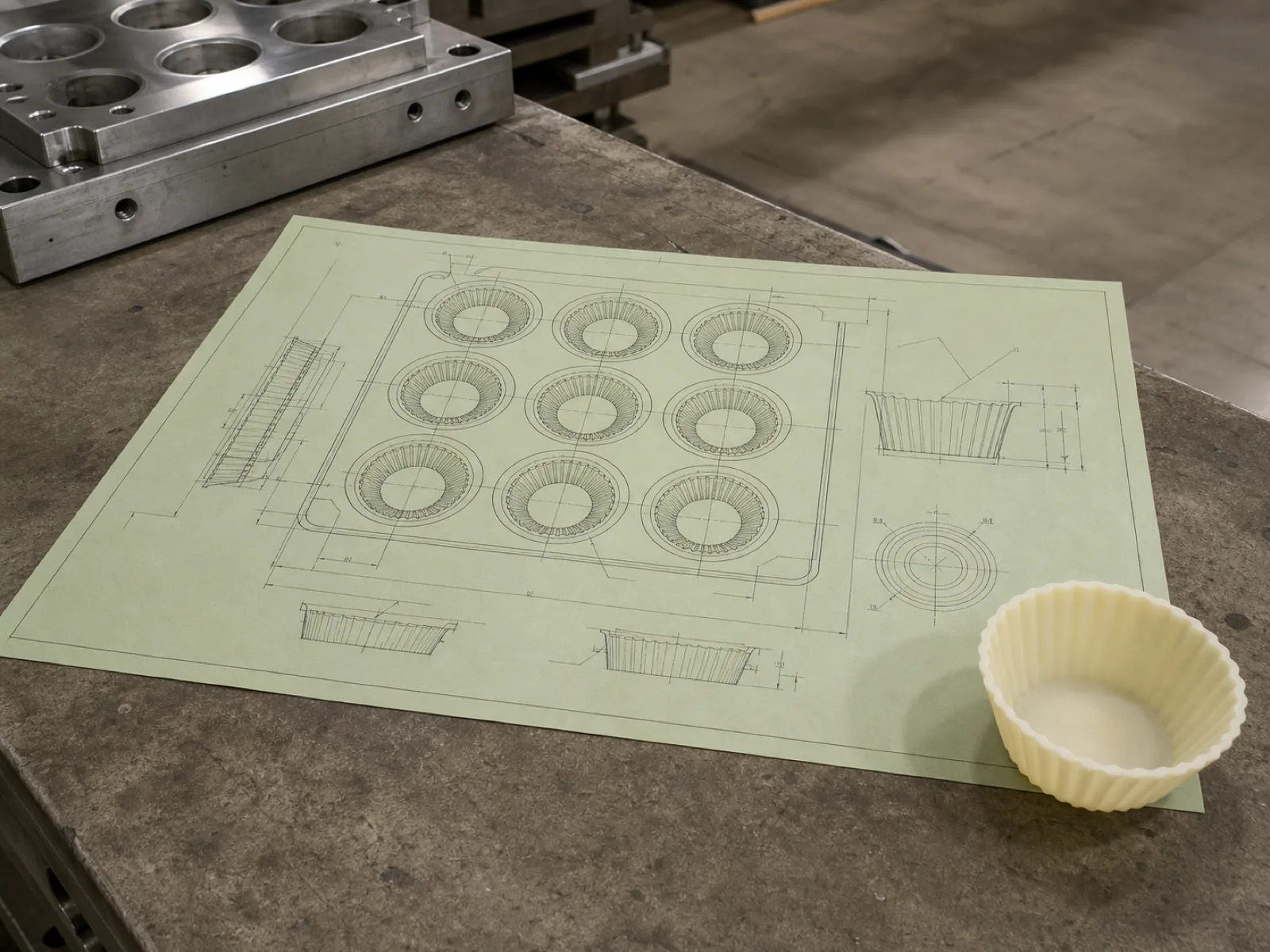
Wetop's baseline MOQ is 500 units per SKU on existing tooling. New multi-cavity muffin cup tooling runs $2,400-$5,200 for 12-24 cavities and amortizes over 30-50k units. Lead time on new tooling is 20-30 days to T1 samples plus 25-40 days mass production. Landed cost for a standard cup at 50k MOQ runs $0.14-$0.22 into LAX, inclusive of tooling amortization and FCL sea freight.
Muffin cups have friendlier tooling economics than full bakeware pans because the part is small and many cavities fit on one mold. Cavity count is the dominant cost lever: a 24-cavity mold produces 24 cups per press cycle, spreading both tooling and labor across far more units than a pan mold ever can. This is why muffin cups reach very low per-unit costs at volume.
| Program size | Cavity count | Mold cost (USD) | Amortization (USD/pc) | Sensible if MOQ ≥ |
|---|---|---|---|---|
| Pilot / test | 4-cavity | $1,400-$2,000 | $0.14-$0.20 | 500 |
| Small run | 8-cavity | $2,000-$2,800 | $0.05-$0.08 | 5,000 |
| Standard | 12-cavity | $2,400-$3,400 | $0.03-$0.05 | 15,000 |
| Volume | 24-cavity | $3,800-$5,200 | $0.015-$0.03 | 50,000 |
| High volume | 48-cavity + LSR | $8,000-$12,000 | $0.008-$0.015 | 150,000 |
The landed-cost math for a representative standard silicone muffin cup at 50k MOQ:
| Cost element | USD/unit at 50k MOQ | Notes |
|---|---|---|
| Silicone gum (platinum, food-grade) | $0.055 | ~13 g/cup at $4.20/kg |
| Pigment master-batch | $0.006 | 3 % loading, custom Pantone |
| Compounding + molding labor | $0.035 | 24-cavity, 2-shift |
| Post-cure (4 h at 200 °C) | $0.014 | Oven amortization + energy |
| QC (durometer + AQL 1.5 visual) | $0.008 | Per lot |
| Tooling amortization | $0.022 | $4,200 tool over 50k units |
| Retail set packaging | $0.030 | poly bag or box, per cup |
| FOB Yantian handling | $0.006 | Export docs + terminal |
| Sea freight FCL to LAX | $0.010 | 40’HC, mixed load |
| Landed cost | $0.186 | Ex-warehouse LAX |
Lead time for a new muffin cup program runs 60-95 days from signed PO to US warehouse: 5-7 days engineering, 20-28 days tooling, 3-5 days T1 samples, 7-14 days buyer review, 25-40 days mass production, and 22-28 days ocean transit. Repeat orders on existing tooling collapse to 45-60 days. For a full treatment of how minimums and lead times scale with cavity count, see our MOQ and lead time silicone OEM guide.
Common defects and QC gates for silicone muffin cups
The failure modes buyers should test for are sticking (wrong hardness or filler), first-bake odor (peroxide cure or skipped post-cure), white filler blooming, thin-wall tearing at the flutes, warping from over-temperature, and staining. Wetop pulls 5 cups per lot for a 20-cycle accelerated bake-wash test and runs AQL 1.5 visual inspection before container release.
Every defect on a muffin cup traces to one of three root causes: wrong compound, wrong cure, or wrong geometry. Sticking traces to a too-hard wall or filler surface. Odor and surface tack trace to peroxide cure or an incomplete post-cure. Tearing traces to under-reinforced compound or a thin-wall design flaw at the flute. Naming the root cause matters because the wrong fix — greasing a filler cup, for instance — masks the symptom without solving the problem.
The accelerated bake-wash test is the single most predictive lot-quality gate. Wetop pulls 5 cups per lot and cycles them: bake empty at 200 °C for 20 minutes, cool, dishwasher cycle at 60 °C, then inspect for hardness shift, color shift, or surface defect. Twenty accelerated cycles simulate roughly 100 real-use cycles. Pass criteria: Shore A shift ≤ ±3 points, ΔE color shift ≤ 3.0, no visible cracks, blooming, or tack.
AQL 1.5 visual inspection samples per ISO 2859-1, logged against the ISO 90018 quality system. Common reject defects: flash > 0.15 mm at the parting line, embedded contamination visible without magnification, color out of Pantone tolerance, incomplete flute formation, and missing or misplaced base debossing. The ability to hand a buyer a full per-lot dimensional and bake-wash inspection report — not just a one-time golden-sample certificate — is what separates an OEM-capable factory from a trading-company middle layer that ships whatever the sub-supplier made that week.
Where to go next
- If your program hinges on odor, taste, and food-safety, read platinum-cured vs peroxide-cured silicone for the cure-chemistry deep dive that determines whether your cups taint the first bakes.
- If your compliance packet must satisfy both US and EU retail, read FDA vs LFGB silicone for the test-method-by-test-method contrast.
- If muffin cups are one line in a broader silicone bakeware catalog, read the silicone bakeware OEM manufacturing guide for pans, molds, and mats.
Ready to run the numbers on a specific muffin cup SKU? Talk to the engineering desk — send a benchmark cup or a target size and color, and we return DFM notes, a cavity-count recommendation, and a landed-cost quote within 3 business days.
Footnotes
-
US FDA, 21 CFR 177.2600 — Rubber articles intended for repeated use. ↩
-
European Commission, Regulation (EC) No 1935/2004. ↩
-
US CPSC, CPSIA Lead Content Requirements. ↩
-
European Commission, REACH Regulation (EC) No 1907/2006. ↩
-
ASTM International, ASTM D2240 — Durometer Hardness. ↩
FAQ
-
Do silicone muffin cups need to be greased before baking?
No — food-grade platinum-cured silicone muffin cups release cleanly without greasing because silicone has inherently low surface energy. A light oil wipe helps only on the very first bake or with sticky, high-sugar batters. If a cup grabs the muffin, the cause is usually a low-grade filler compound or a wall harder than Shore A 60, not a missing grease step.
-
Are silicone muffin cups safe to use in the oven and air fryer?
Yes. Platinum-cured silicone muffin cups carry a continuous -40 °C to 230 °C service window with a 260 °C short peak, covering standard bake profiles (140-200 °C), microwave, and air fryers up to 200 °C. Keep them off the direct heating element in an air fryer and out of broiler mode (275 °C+), where the polymer yellows and loses tear strength.
-
What are standard silicone muffin cup sizes?
Three sizes dominate retail: mini at roughly 50 mm top diameter × 25 mm deep, standard at 70 mm × 35 mm, and jumbo at 90 mm × 45 mm. Fill batter to 60-70 % of cavity depth to leave headroom for dome rise. OEM buyers can specify custom rim diameters and fluted-wall counts against a new cavity insert.
-
Are reusable silicone muffin cups better than paper liners?
For cost and waste, yes — a silicone cup reaches break-even with paper around 18-25 bakes and then runs effectively free across a 1,000-plus-cycle life. Paper still wins for grab-and-go portability and zero cleanup. Metal tins conduct heat faster but need liners anyway. Silicone's advantage is freezer-to-oven range plus no single-use waste stream.
-
Why do my silicone muffin cups smell or taste like soap?
Soapy odor or taste signals a peroxide-cured or under-post-cured cup. Peroxide vulcanization leaves 2,4-DCBA acid residue; incomplete post-cure leaves volatile cyclic siloxanes (D4, D5, D6). Both outgas during the first bakes. A compliant 4-hour 200 °C post-cure drives volatiles below the 0.5 % LFGB threshold. Genuine platinum-cured cups are odor- and taste-neutral from the first use.
-
How can I tell if silicone muffin cups are low-grade filler silicone?
Run the pinch-and-twist white-mark test: pinch a wall and twist hard. Food-grade platinum silicone stays its base color; calcium-carbonate-filled cups blush a white streak where the filler fractures. Low-grade cups also smell chemical when warmed, feel slick with mold-release oil, and tear at thin fluted walls within 30-40 cycles.
-
How long do silicone muffin cups last?
A platinum-cured food-grade silicone muffin cup lasts 3-5 years of regular home use, roughly 1,000-1,500 bake-wash cycles, before the fluted walls lose enough elastic recovery to affect release. Signs of end of life are permanent staining, a sticky surface film, hardness climbing past Shore A 65, or hairline cracks at the base radius.
-
What MOQ and tooling does a silicone muffin cup OEM program need?
Wetop's baseline MOQ is 500 units per SKU on existing tooling. A new multi-cavity muffin cup mold runs $2,400-$5,200 for 12-24 cavities and amortizes cleanly over 30-50k units. Small pilot runs stay viable on a 4-6 cavity tool, but tooling cost per cup roughly triples versus a 24-cavity high-volume mold.
-
Can silicone muffin cups be custom-colored and logo-branded?
Yes. Pigment-body color is dispersed through the wall (Pantone match to ΔE ≤ 2.5) with no per-unit premium beyond master-batch amortization. In-mold debossing (0.3-0.5 mm) puts a permanent logo on the cup base that survives every dishwasher and oven cycle. Pad printing is available but fades after 40-60 dishwasher cycles, so it suits gift-set cups only.
-
Do silicone muffin cups contain BPA, lead, or PFAS?
Food-grade platinum-cured silicone contains no BPA (it is not a polycarbonate), no intentionally added lead (pigment master-batches run below 5 ppm against the 100 ppm CPSIA screen), and no PFAS — non-stick behavior is inherent to silicone, not a fluoropolymer coating. A defensible OEM packet documents each with a finished-part test report, not a raw-compound statement.
References
Authoritative sources cited in this guide
- US Food and Drug Administration (Electronic Code of Federal Regulations). 21 CFR 177.2600 — Rubber articles intended for repeated use. https://www.ecfr.gov/current/title-21/chapter-I/subchapter-B/part-177/subpart-C/section-177.2600 — Federal regulation governing extractive limits for rubber (including silicone) in repeated food-contact use — n-hexane ≤ 175 mg/dm², ethanol/water ≤ 8 mg/dm².
- German Federal Institute for Risk Assessment (BfR). BfR Recommendation XV: Silicones. https://www.bfr.bund.de/en/bfr_recommendations_on_food_contact_materials-71195.html — German framework underlying LFGB §30/31 migration tests for silicone muffin cups and baking cups.
- European Commission (EUR-Lex). Regulation (EC) No 1935/2004 on materials and articles intended to come into contact with food. https://eur-lex.europa.eu/legal-content/EN/TXT/?uri=CELEX%3A32004R1935 — Umbrella regulation setting general safety and traceability requirements for all EU food-contact materials, including reusable silicone baking cups.
- US Consumer Product Safety Commission (Electronic Code of Federal Regulations). Consumer Product Safety Improvement Act (CPSIA) — Lead Content Limits. https://www.ecfr.gov/current/title-16 — Federal lead limit of 100 ppm total content; US retail chains apply the same screen to housewares including silicone muffin cups.
- ASTM International. ASTM D2240 — Standard Test Method for Rubber Property — Durometer Hardness. https://www.astm.org/d2240-15r21.html — Shore A durometer test method Wetop applies in-line on every muffin cup lot for fluted-wall hardness verification.
- International Organization for Standardization. ISO 3302-1:2014 — Rubber — Tolerances for products, Part 1: Dimensional tolerances. https://www.iso.org/standard/59252.html — Governs dimensional tolerance classes applied to muffin cup rim diameter, wall thickness, and base flatness.
- European Chemicals Agency / European Commission (EUR-Lex). REACH Regulation (EC) No 1907/2006 — SVHC framework. https://eur-lex.europa.eu/legal-content/EN/TXT/?uri=CELEX%3A32006R1907 — Substances of Very High Concern framework screened on every silicone muffin cup compound (D4/D5 siloxanes, phthalates) for EU retail acceptance.
- International Organization for Standardization. ISO 9001:2015 — Quality Management Systems — Requirements. https://www.iso.org/standard/62085.html — Defines the documented quality management system Wetop's muffin cup lot-traceability and QC process are certified against.
Start a custom program
Send a brief. Get an engineer’s reply in one business day.
Every Wetop program is tooled from a customer’s specification. Send a CAD file (STEP · IGES · DWG) or a written brief and we’ll reply with a mold cost estimate, price brackets at MOQ 500 / 1,000 / 5,000, and any engineering questions.