Buyer Guide · commercial intent
Silicone Phone Case Manufacturer — OEM Guide
 Buyer Guide
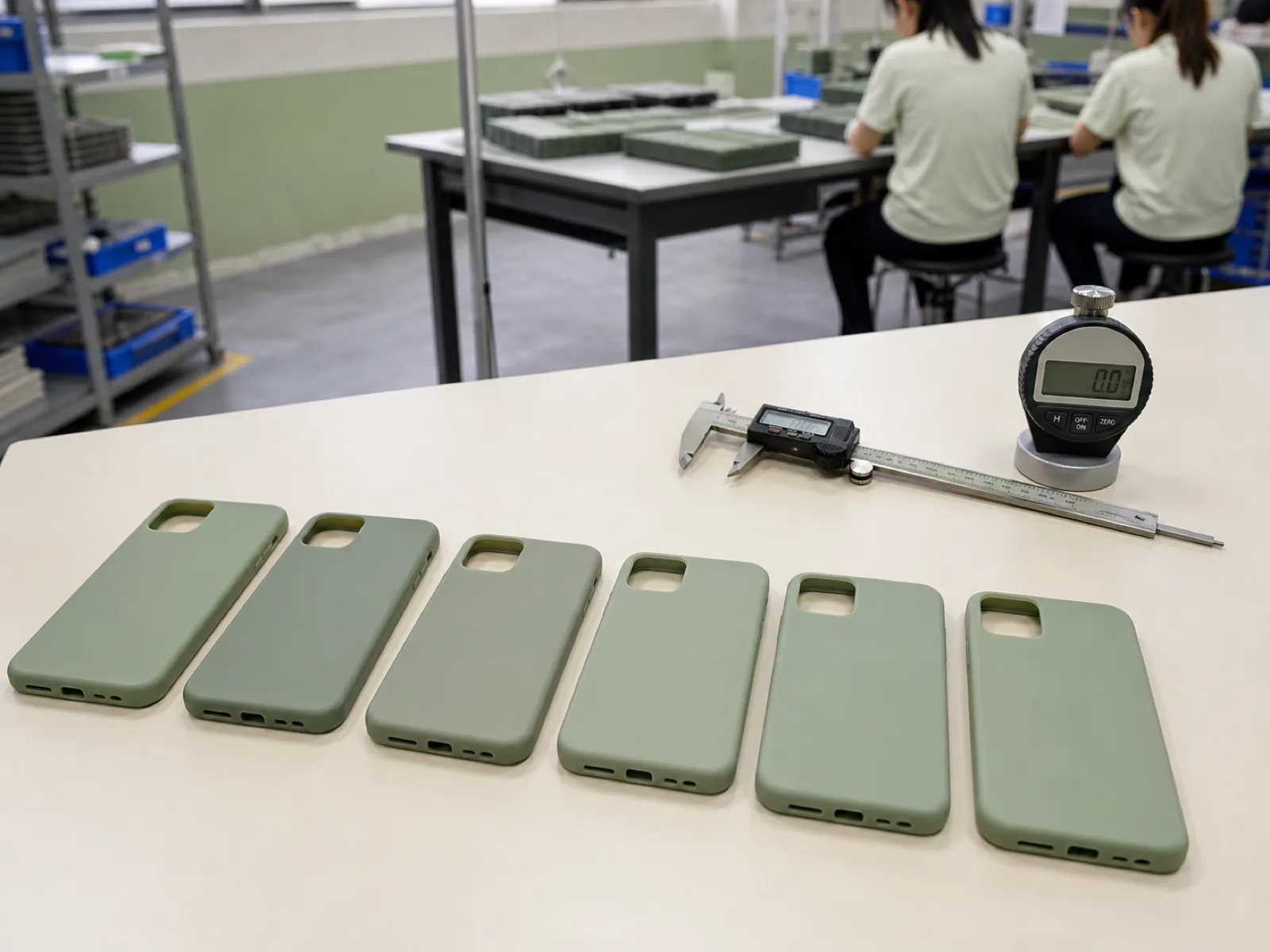
 A serious silicone phone case manufacturer runs its own compression or LSR injection presses, publishes per-batch FDA 21 CFR 177.2600 or LFGB §30/31 test reports, and quotes hardened-steel tooling at $3,000–$5,000 for an 8-cavity compression mold on a 20–25 day timeline. Anything cheaper is trading-company arbitrage on someone else's overrun. This guide walks OEM buyers through the six decisions that actually set unit cost, yield, and defect rate — from cure system to cavity count to QC gate.
Wetop Silicone is a founder-led, ISO 9001 certified silicone factory in Dongguan running one compression cell and one LSR injection cell on a 7,500 m² floor. We wrote this guide for brand-side product managers and sourcing engineers who are about to commission a custom silicone phone case program and want the same technical framing our engineering desk uses when we quote. If you are comparing quotes across three or four factories right now, the sections below map directly onto the RFQ line items you will see.
What defines a real silicone phone case manufacturer?
A real silicone phone case manufacturer owns HTV compression presses or LSR injection cells, mixes and stages its own compound, runs post-cure ovens on the floor, and can produce per-batch FDA 21 CFR 177.2600[^fda-177-2600] and LFGB §30/31[^lfgb-30-31] test reports. Trading companies pass POs downstream and cannot produce any of the three artifacts on demand.
The industry has a middleman problem. A large share of “silicone phone case factory” websites are trading companies that resell overrun from a handful of real factories in Dongguan, Shenzhen, and Xiamen. The technical difference matters because a trading company cannot negotiate cure system, Shore A, cavity count, or post-cure schedule — it can only bid on what its upstream factory happens to be running that month. That is why the same phone case model quoted through three trading companies often comes back at three unit prices with three different lead times.
Three factory-only artifacts break the ambiguity in a single video call:
- A compound intake bay where 25 kg blocks of platinum-cured HTV silicone are logged and sampled for durometer per ASTM D22401.
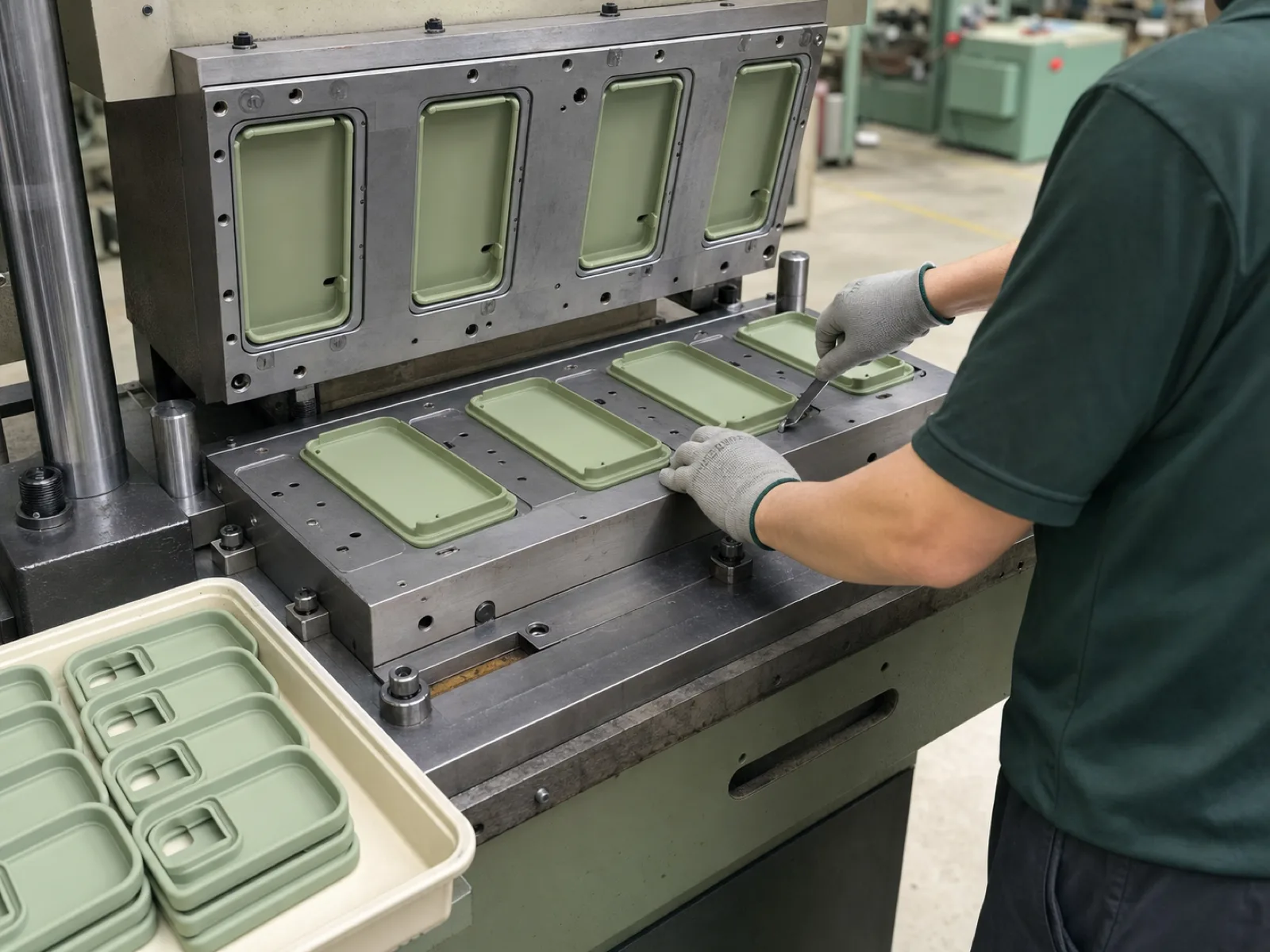
- A compression press or LSR injection cell actively running with an operator scraping flash from a real 8-cavity mold — not a stock photo of a machine.
- A post-cure oven at 200 °C (typically 4–6 hours) — the step that unlocks per-batch compliance test reporting because it drives out volatile siloxanes governed by the FDA extractables limits2.
Ask for all three on a live tour. Any factory that refuses is either a trading company or does not operate the equipment it claims to.
Compression molding vs LSR injection vs overmolding — which process?
Compression molding is the default silicone phone case process for 500–50,000 units per SKU because tooling is cheap ($3–5K), color change is a single-shot purge, and cure cycles fit an 8-cavity tool comfortably. LSR injection molding earns its higher tooling cost only above ~50,000 units per SKU, where 45–90 second cycles and full automation amortize the runner and valve-gate investment.
The three processes trade tooling capex, cycle time, and design freedom. The table below is what our engineering desk uses to steer the process decision at RFQ.
| Attribute | Compression molding (HTV) | LSR injection molding | Overmolding (silicone on TPU/PC) |
|---|---|---|---|
| Tooling cost, single model | $3,000–$5,000 (8-cavity, P20 steel) | $8,000–$15,000 (heated runners) | $10,000–$18,000 (two-station or IML) |
| Tooling lead time | 20–25 days | 30–40 days | 35–45 days |
| Cycle time per shot | 90–180 seconds | 45–90 seconds | 60–120 seconds |
| Realistic per-SKU volume floor | 500 units | 20,000 units | 5,000 units |
| Realistic per-SKU volume ceiling | ~50,000 units | Unlimited | 100,000 units |
| Color change | Single-shot purge, ~2 hours | Full runner purge, ~4–6 hours | Same as base process |
| Design freedom (undercuts, thin walls) | Moderate | High | High |
| Per-unit direct labor | Higher | Lower | Highest |
| Best-fit program | 500–50,000 pcs, single color, debossed logo | 6-figure annual volume, tight tolerance, high SKU count | Dual-material cases (rigid frame + soft grip) |
Overmolding solves a specific design brief: a rigid polycarbonate or TPU inner shell with a soft silicone outer grip band. It is not a cost-optimization choice — it costs more per unit than either single-process alternative. Specify it only when the mechanical concept requires two durometers.
For a deeper walk-through of the process economics beyond phone cases, see our silicone molding process explained guide.
How much does tooling and MOQ actually cost?
Realistic silicone phone case tooling: $3,000–$5,000 for an 8-cavity compression mold, $8,000–$15,000 for LSR injection tooling, both in hardened P20 steel with a 500,000-shot life. Realistic MOQ: 500 units per SKU on existing tooling, 1,000 units per SKU on new tooling. Below 500 units the setup and purge labor swamps the marginal silicone cost and no honest factory can hold margin.
The math on tooling amortization drives the OEM/ODM decision more than any other single number. On a $4,000 8-cavity compression mold with $0.85 direct unit cost, the amortized per-unit tooling contribution collapses fast:
| Order volume | Tool cost per unit | Direct cost per unit | Total EXW per unit |
|---|---|---|---|
| 500 | $8.00 | $0.85 | $8.85 |
| 1,000 | $4.00 | $0.85 | $4.85 |
| 5,000 | $0.80 | $0.85 | $1.65 |
| 20,000 | $0.20 | $0.85 | $1.05 |
| 50,000 | $0.08 | $0.85 | $0.93 |
| 100,000 | $0.04 | $0.85 | $0.89 |
Two conclusions fall out of the table. First, at 500 units the tooling is 90% of your unit cost, so the honest way to run a pilot is to eat that math and price the launch batch at the amortized number — not to hunt for a factory quoting $2/unit at 500 pcs (which either means the factory is subsidizing to win a bigger follow-on PO, or it’s a trading company re-labeling stock cases). Second, the marginal benefit of pushing above 20,000 units per SKU on compression tooling is small — $0.16 per unit between 20,000 and 100,000. That is where you flip the decision to LSR injection, which erases direct-labor at higher volume.
For the full MOQ economics framework across all silicone product categories, our MOQ and lead time silicone OEM guide extends this math with tier-pricing tables.
Which silicone compound and Shore A hardness for phone cases?
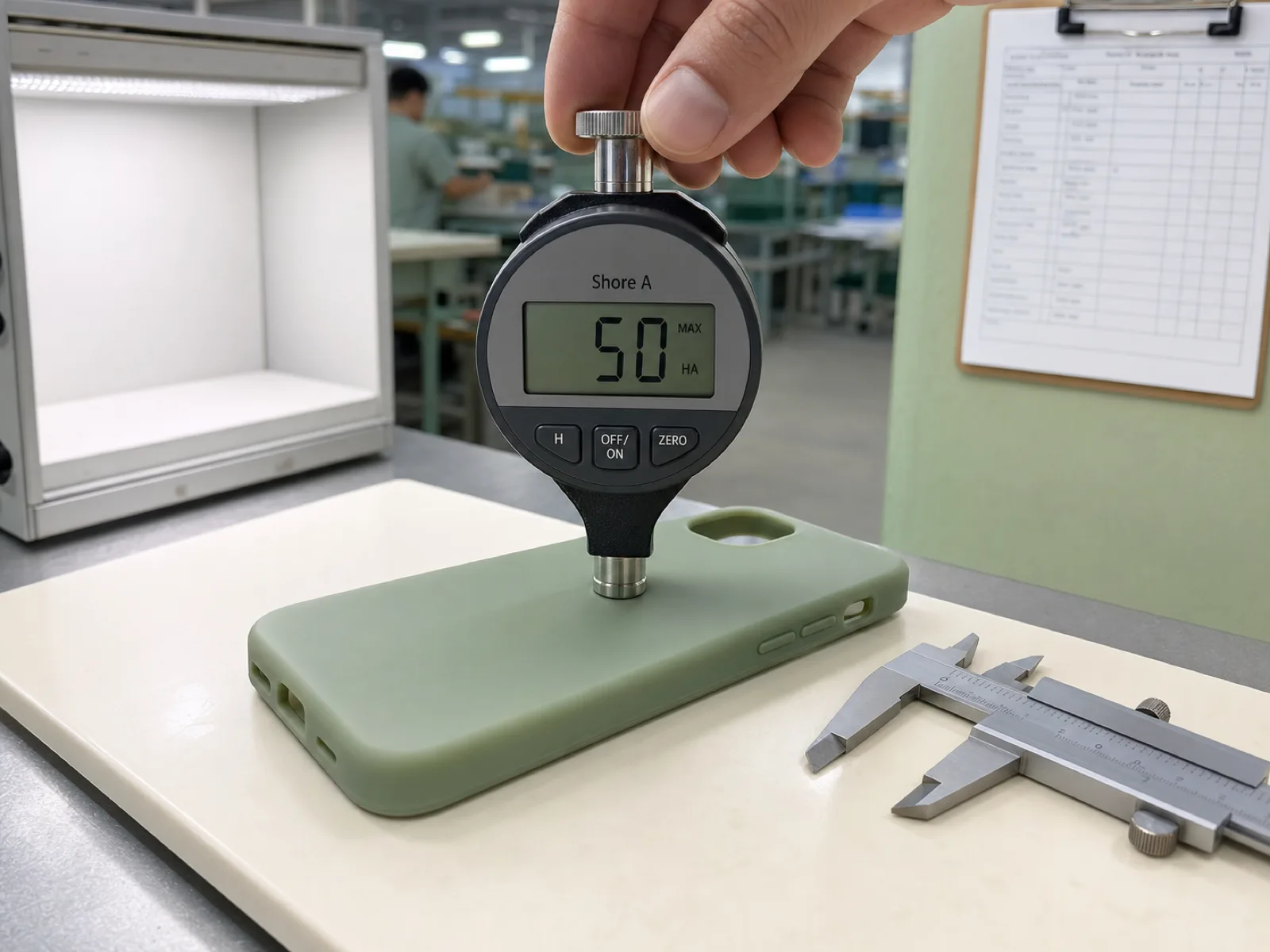
Phone cases run on platinum-cured HTV silicone at Shore A 50 as the OEM default. Shore A 40 delivers a jelly-soft hand feel but tears at button cutouts under 1.2 m drops; Shore A 60–65 holds a structured shape but loses drop damping and feels closer to hard plastic. Peroxide-cured silicone is $0.10–$0.20 cheaper per unit but yellows in 6–12 months of UV exposure.
The compound + hardness spec is the single biggest driver of both perceived quality and warranty return rate. Wetop’s default recipe for OEM phone cases is a platinum-cured HTV compound (Wacker Elastosil or Dow Silastic base) at Shore A 50, with 0.5 wt% anti-UV masterbatch on any color lighter than Pantone Cool Gray 5. That combination clears:
- Shore A hardness 50 ± 3 per ASTM D22401 on 5 random samples per lot
- Tear strength ≥ 20 kN/m Die-B per ASTM D6243 (button cutout durability)
- Elongation at break ≥ 400% (drop-shock damping)
- Post-QUV 500-hour ΔE ≤ 2.0 per ASTM G154 Cycle 14 (anti-yellowing)
- FDA 21 CFR 177.2600 extractables per lot2
- LFGB §30/31 per BfR Recommendation XV5
If a quote comes in $0.30 below the Wetop reference number at 5,000 units, ask which of the six specs above is being dropped. Usually it is the cure system (peroxide instead of platinum, which fails the yellowing spec) or the post-cure oven (skipped, which fails the extractables spec).
What surface finishing options exist and what do they cost?
In-mold debossed logos are free (paid inside tooling), single-color silk screen adds $0.05–$0.10 per unit, pad print $0.10–$0.20, laser engraving $0.08–$0.15, and anti-yellowing soft-touch coating $0.15–$0.30. Full-body Pantone match through masterbatch dyeing carries a $150–$300 masterbatch charge amortized across the run, not a per-unit adder.
Six finishing techniques cover 95% of what OEM buyers actually specify on silicone phone cases:
| Technique | Per-unit cost | Durability | Best for |
|---|---|---|---|
| In-mold deboss (0.2–0.4 mm depth) | $0.00 (tooling cost) | Lifetime | Brand logo on back or side rail |
| In-mold emboss | $0.00 (tooling cost) | Lifetime | Textured grip pattern, brand mark |
| Silk screen 1-color | $0.05–$0.10 | 12–18 months | Cost-sensitive branding |
| Pad print 2-color | $0.10–$0.20 | 12–18 months | Small multi-color logos |
| Laser engraving | $0.08–$0.15 | Lifetime | Fine text, batch codes, dark colors only |
| Soft-touch coating | $0.15–$0.30 | 24+ months | Anti-yellowing on light colors |
| Full Pantone masterbatch match | $150–$300 flat + no per-unit adder | Lifetime (through-body) | Brand-color programs |
The deboss-vs-print decision is where OEM buyers most often over-spend. If your logo is a single-color mark and you commit to one Pantone body color, deboss it into the mold and pay nothing marginal — the logo will outlive the case. Print only when you need multi-color art or when your SKU rotates through the same base mold. Our customize silicone logo — deboss, print, laser guide is the tactical extension of this section.
What QC checkpoints separate an 8.5/10 case from a warranty return?
A real silicone phone case factory runs three gates: IQC on incoming HTV compound (durometer + specific gravity + visual), IPQC every hour during the run (dimensional AQL 1.5, flash removal, deboss depth), and OQA before pack-out (drop test at 1.2 m, tear test, ΔE color check under D65). Trading companies run one visual QC at pack-out and hope for the best.
The QC discipline for silicone phone cases converges on six pass-fail thresholds we hold at Wetop and see in the compliance packets we run for Tier 2 US retail chain and top-5 sink brand programs:
- Dimensional tolerance: camera cutout ±0.15 mm, button cutout ±0.10 mm, case wall thickness ±0.10 mm — AQL 1.5 major, 4.0 minor, per ISO 2859-1 sampling.
- Drop test: 1.2 m onto concrete, 6 faces × 4 corners × 4 edges = 14 drops, zero case cracking, dummy phone survives glass-intact.
- Tear strength: Die-B specimens cut from run samples, ≥ 20 kN/m per ASTM D6243.
- Compression set: ≤ 30% after 22 hr at 70 °C (silicone’s spring-back memory).
- Color ΔE: ≤ 2.0 vs Pantone standard under D65 lightbox at OQA.
- Accelerated aging: 500 hr QUV Cycle 1 per ASTM G1544, ΔE ≤ 2.0 on white/pastel colors.
Every batch that ships against a Wetop PO carries a batch traveler with all six checkpoints logged and signed. That traveler is what turns a “silicone phone case supplier” into a defensible OEM program under an ISO 9001 QMS6.
What certifications does the finished case need for US and EU retail?
Baseline compliance stack: FDA 21 CFR 177.2600 for US skin-contact rubber, LFGB §30/31 per BfR for EU consumer contact, REACH SVHC screening for EU chemical safety, and RoHS 2011/65/EU if the case contains any magnet or metal ring. Wireless-charging cases with active electronics add FCC / CE / UKCA on the finished device — the silicone shell itself does not need radio certification.
The four-cert stack applies to plain silicone shells:
- FDA 21 CFR 177.26002 — US Food and Drug Administration limits on extractables for rubber articles in repeated contact with food or skin. Yes, it applies to phone cases marketed as skin-safe. Per-batch test report from an ILAC-accredited lab (Intertek, SGS, TÜV).
- LFGB §30/315 — EU consumer-contact framework administered by BfR. Silicone rubber tested per BfR Recommendation XV. Per-batch or annual, depending on retailer requirement.
- REACH SVHC7 — Substances of Very High Concern screening. Silicone typically clears without issue but the retailer will ask for the declaration.
- RoHS 2011/65/EU8 — Only triggers when a MagSafe ring, embedded magnet, metal camera bezel, or conductive coating is present in the SKU.
Cases with active electronics (wireless charging pads, integrated batteries, kickstand hinges with sensors) inherit the full FCC / CE / UKCA burden on the finished device. That is not a silicone shell certification — do not let a factory quote you the shell price with radio certification bundled in.
What’s the realistic timeline from PO to FOB?
New tooling PO to first-off sample: 20–25 days. Sample approval iterations: 7–15 days per round, typically 1–2 rounds. Mass production for 5,000–20,000 units on a single 8-cavity tool: 25–35 days. Total kick-off to FOB Yantian: 60–75 days on a new tool, 30–40 days on an existing tool with only a color or logo change.
The full program calendar Wetop runs for a first-time silicone phone case OEM buyer:
| Milestone | Duration | Cumulative day |
|---|---|---|
| Tooling PO, CAD sign-off | 3 days | Day 3 |
| Tool cut (P20 steel, 8-cavity) | 18–22 days | Day 21–25 |
| First-off sample shot | 1–2 days | Day 22–27 |
| Air-freight sample to buyer, review | 5–7 days | Day 27–34 |
| Revision round (typical 1–2) | 5–10 days | Day 32–44 |
| Sample re-approval | 5–7 days | Day 37–51 |
| Mass production run (10,000 units, 8-cavity, single color) | 20–25 days | Day 57–76 |
| OQA + packing | 3–5 days | Day 60–81 |
| FOB Yantian ready | — | Day 60–75 realistic |
Two shortcuts move real needles. First, if you can approve the DFM CAD review inside a week (most brands take 2–3 weeks), you compress 10–15 days off the front. Second, if you commit to a single color and single deboss on new tooling — no revision round — you save another 10–15 days. Both require the brand-side team to be decision-ready before PO, which is the discipline gap most first-time OEM programs fall into.
How do I write an RFQ that gets an honest quote back?
A quote-honest RFQ specifies six line items: phone model (down to iPhone 15 Pro Max vs iPhone 15 Pro), quantity per SKU and total SKU count, cure system (platinum vs peroxide), Shore A target ± tolerance, surface finishing (deboss vs print vs coating), and required per-batch compliance certs. Ambiguity on any of the six invites the factory to quote the cheapest version and negotiate up later.
The RFQ template we send OEM buyers who ask (five lines you can paste into an email):
- Phone model + generation (e.g., iPhone 15 Pro Max, not “iPhone 15 family”)
- SKU count and unit split (e.g., 3 colors × 5,000 units = 15,000 total)
- Compound spec (platinum-cured HTV, Shore A 50 ± 3, anti-UV masterbatch 0.5 wt%)
- Finishing spec (in-mold deboss 0.3 mm depth, back center, no print)
- Compliance packet required (FDA 21 CFR 177.2600 per lot, LFGB §30/31 annual, REACH SVHC declaration)
- Target FOB Yantian date + Incoterms (e.g., FOB by 2026-09-15, 8-cavity tooling amortized)
A factory that returns a line-item quote in the same shape is a factory. A “supplier” that returns a single-line total with no breakdown is a trading company. Send the same RFQ to three and compare — the spread on line 3 (compound spec) reveals which one is cure-swapping to hit price.
Ready to quote a program?
Wetop Silicone runs one compression cell and one LSR injection cell in Dongguan producing silicone phone cases, drying racks, drying mats, and sink grids for OEM/ODM buyers targeting Tier 2 US retail and top-5 kitchen-sink brand tiers. If you have a program in the 500–100,000 unit range and want a line-item RFQ back in 48 hours, our engineering desk is the fastest way to get real numbers. Talk to the engineering desk or download our mutual NDA if you want to share CAD before quoting.
Footnotes
-
ASTM D2240 — Standard Test Method for Rubber Property, Durometer Hardness, ASTM International. ↩ ↩2
-
21 CFR 177.2600 — Rubber Articles Intended for Repeated Use, US Food and Drug Administration. ↩ ↩2 ↩3
-
ASTM D624 — Standard Test Method for Tear Strength of Conventional Vulcanized Rubber and Thermoplastic Elastomers, ASTM International. ↩ ↩2
-
ASTM G154 — Operating Fluorescent Ultraviolet Lamp Apparatus for Exposure of Materials, ASTM International. ↩ ↩2
-
ISO 9001:2015 — Quality Management Systems — Requirements, International Organization for Standardization. ↩
-
REACH Regulation (EC) No 1907/2006 — SVHC Candidate List, European Chemicals Agency. ↩
-
Directive 2011/65/EU — Restriction of Hazardous Substances (RoHS), European Union. ↩
FAQ
-
What is the real MOQ for a custom silicone phone case OEM program?
500 units per SKU on existing tooling in a single color; 1,000 units per SKU when you commission new tooling. Below 500 the mold-setup + purge-and-color-change labor swamps the marginal silicone cost, so any factory quoting 100–300 pcs is either shipping stock cases with a printed logo or is a trading company reselling another factory's overrun.
-
How much does silicone phone case tooling actually cost?
A hardened-P20-steel 8-cavity compression mold for one phone model runs $3,000–$5,000 and takes 20–25 days from PO to first-off sample. Add $600–$1,200 per additional model sharing the same base frame. LSR injection molds start at $8,000–$15,000 per model because they require heated runners, valve gates, and tighter parting-line finish.
-
Compression molding or LSR injection for silicone phone cases — which is right?
Compression molding wins for 500–50,000 units per SKU: lower tooling, no runner scrap, single-shot color change. LSR injection wins above ~50,000 units per SKU because 45–90 second cycle times and full automation cut labor. For most consumer-electronics brand phone cases the answer is compression — LSR only pays off on cornerstone SKUs shipping 6-figure annual volume.
-
What Shore A hardness should I specify for a silicone phone case?
Shore A 50 is the OEM default and covers 90% of programs. It grips the palm, damps drop shock, holds a 0.3 mm debossed logo, and passes 1.2 m drop testing without tearing at the mute-switch cutout. Specify 40A only for ultra-soft "jelly" hand-feel programs; specify 60–65A for rigid "structured" cases that will host a hard-shell insert.
-
How do I tell a real silicone phone case factory apart from a trading company?
Ask for three artifacts: (1) a video walk-through showing HTV kneader → compression press → post-cure oven → QC bench, (2) a per-batch FDA 21 CFR 177.2600 or LFGB §30/31 test certificate matching your PO lot, and (3) the ISO 9001 certificate with a scope statement naming silicone rubber molding. Trading companies fail all three because they don't operate the equipment.
-
What certifications does a silicone phone case need for US and EU retail?
Baseline: FDA 21 CFR 177.2600 (US skin-contact rubber compliance), LFGB §30/31 per BfR (EU consumer contact), RoHS 2011/65/EU (if the case contains any metal ring or magnet), and REACH SVHC screening. Wireless-charging or MagSafe cases add FCC / CE / UKCA radio compliance on the finished device, not on the silicone shell itself.
-
What is the sample-to-mass-production timeline for a silicone phone case OEM order?
T-tooling PO to first sample: 20–25 days. Sample approval iterations: 7–15 days per revision (usually 1–2 rounds). Mass production run: 25–35 days for 5,000–20,000 units on a single 8-cavity tool. Total realistic window from kick-off to FOB Yantian: 60–75 days on a new tool, 30–40 days on an existing tool with a color change only.
-
How much does surface finishing add to per-unit cost?
Debossed-in-mold logo: $0.00 marginal (paid inside tooling). Silk-screen 1-color print: $0.05–$0.10 per case. Pad print 2-color: $0.10–$0.20. Laser engraving: $0.08–$0.15. Soft-touch coating (anti-yellowing top layer): $0.15–$0.30 per case and adds 2 days to the line. Full-body Pantone color match with masterbatch: $150–$300 masterbatch charge amortized across the run.
-
Do silicone phone cases yellow over time and how do I spec against it?
Yes — peroxide-cured silicone yellows within 6–12 months under UV; platinum-cured silicone stays color-stable 24+ months in accelerated QUV aging at ASTM G154 Cycle 1. Specify platinum cure + an anti-UV masterbatch (0.5–1.0 wt%) on any white, translucent, or pastel case. Dark colors mask the drift but the compound choice still governs mechanical retention.
References
Authoritative sources cited in this guide
- US Food and Drug Administration. 21 CFR 177.2600 — Rubber Articles Intended for Repeated Use. https://www.ecfr.gov/current/title-21/chapter-I/subchapter-B/part-177/subpart-C/section-177.2600 — Governs extractables limits for silicone in repeated skin- and food-contact articles, including phone cases marketed as skin-safe.
- International Organization for Standardization. ISO 9001:2015 — Quality Management Systems — Requirements. https://www.iso.org/standard/62085.html — Defines the documented QMS a real silicone phone case factory must operate under; scope statement should name rubber molding explicitly.
- ASTM International. ASTM D2240 — Standard Test Method for Rubber Property, Durometer Hardness. https://www.astm.org/d2240-15r21.html — The Shore A hardness test method referenced when specifying 40A / 50A / 60A silicone phone case durometer.
- ASTM International. ASTM D624 — Standard Test Method for Tear Strength of Conventional Vulcanized Rubber and Thermoplastic Elastomers. https://www.astm.org/d0624-00r20.html — Die-B tear strength method used to qualify silicone compound for button-cutout durability.
- ASTM International. ASTM G154 — Operating Fluorescent Ultraviolet Lamp Apparatus for Exposure of Materials. https://www.astm.org/g0154-16.html — The accelerated UV aging protocol Wetop runs against Cycle 1 to certify anti-yellowing claims on white and translucent phone cases.
- German Federal Institute for Risk Assessment (BfR). LFGB §30 / §31 — German Food and Feed Code Consumer-Contact Materials. https://www.bfr.bund.de/en/food_contact_materials-11631.html — EU consumer skin- and mouth-contact compliance framework tested per BfR Recommendation XV for silicone rubber.
- European Chemicals Agency. REACH Regulation (EC) No 1907/2006 — SVHC Candidate List. https://eur-lex.europa.eu/legal-content/EN/TXT/?uri=CELEX%3A32006R1907 — Substance-of-Very-High-Concern screening required for any silicone case sold in the EU, including phthalate and siloxane checks.
- European Union. Directive 2011/65/EU — Restriction of Hazardous Substances (RoHS). https://eur-lex.europa.eu/legal-content/EN/TXT/?uri=CELEX%3A02011L0065-20240801 — Applies when a silicone phone case includes metal MagSafe rings, embedded magnets, or conductive coating.
Start a custom program
Send a brief. Get an engineer’s reply in one business day.
Every Wetop program is tooled from a customer’s specification. Send a CAD file (STEP · IGES · DWG) or a written brief and we’ll reply with a mold cost estimate, price brackets at MOQ 500 / 1,000 / 5,000, and any engineering questions.