Manufacturing · informational intent
Silicone Molding — Process, Materials, and Sourcing Guide
 Manufacturing
 Silicone molding is the manufacturing process that turns raw silicone polymer — either high-consistency gum (HCR) or two-part liquid (LSR) — into a cured elastomer part inside a heated steel tool. Four production processes exist: compression, transfer, LSR injection, and extrusion; the correct choice is a function of geometry, volume, and tolerance target, not personal preference. A serious silicone-molding supplier post-cures every batch 4 hours at 200°C and can hand a buyer a DFM markup, per-batch LFGB test report, and a lot-traceable master-batch certificate before the first tool is cut.
This guide is written from the engineering desk at Wetop’s Dongguan factory. It covers how the four silicone-molding processes actually differ, what tooling really costs, the DFM rules that decide whether a first article passes, the compliance packet a US/EU retail program needs, and the defect catalog a factory has to control. It is written for sourcing engineers and category managers who are being asked to specify a silicone-molding program and want to read a quote as if they cut the tool themselves.
What is silicone molding and how does the process work?
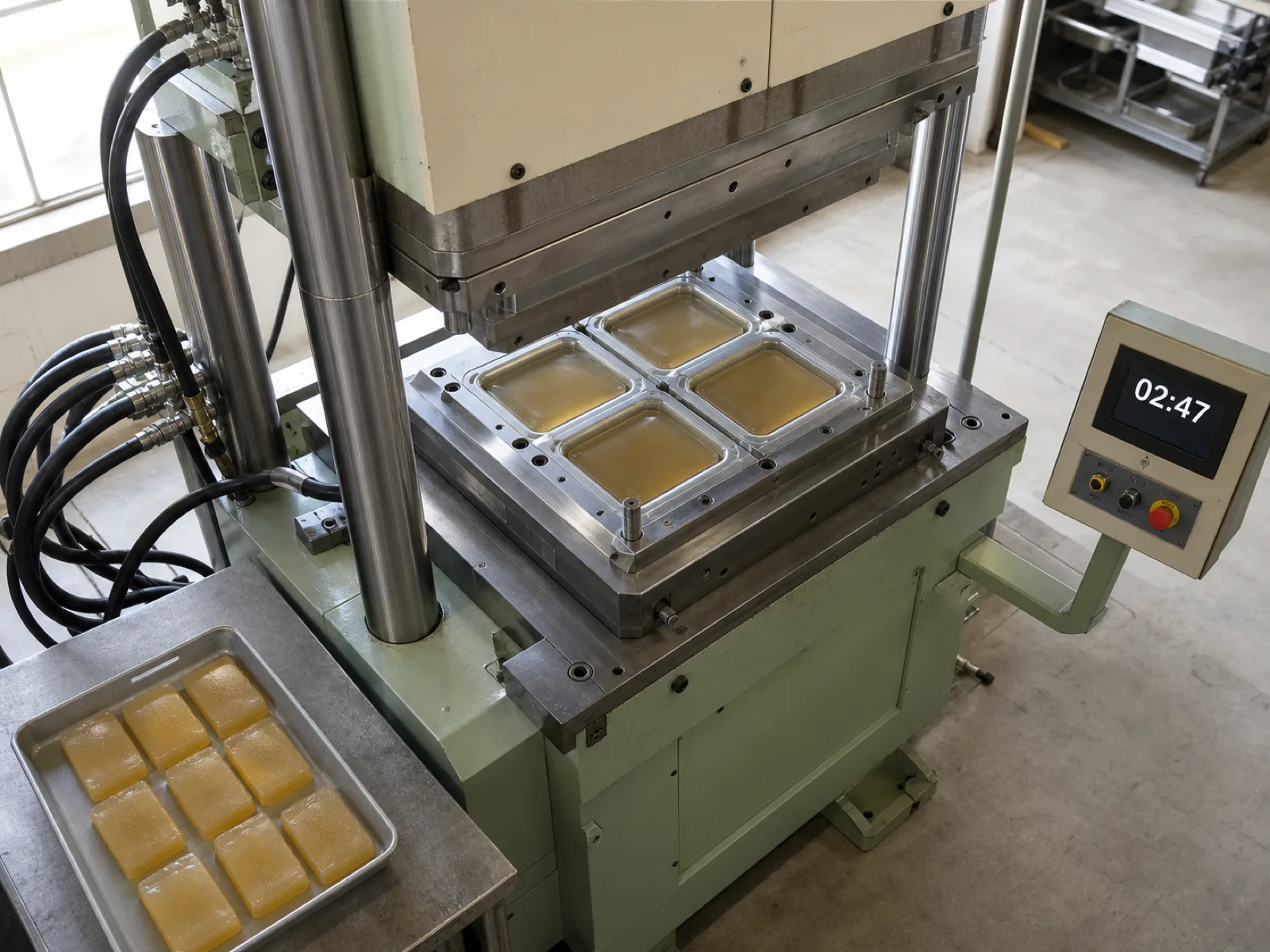
Silicone molding is a thermoset process: raw silicone (HCR gum or two-part LSR liquid) is loaded into a heated steel tool at 170-200°C, held under pressure for 60-300 seconds while the platinum or peroxide catalyst cross-links the polymer chains, and demolded as a cured elastomer part. Unlike thermoplastic injection molding, the reaction is irreversible — once cured, silicone cannot be re-melted.
The chemistry that runs across all four silicone-molding processes is the same. Polydimethylsiloxane (PDMS) chains carry vinyl or hydride reactive sites; a catalyst — a platinum complex for platinum-cure, or an organic peroxide such as 2,4-dichlorobenzoyl peroxide for peroxide-cure — triggers cross-linking under heat. The trade-offs between the two cure systems are covered in depth in the platinum-cured vs peroxide-cured silicone breakdown. Heat, pressure, and time are the three levers a molding engineer controls. Everything downstream — tolerance, surface finish, cycle time, per-part cost — is a function of how those levers are combined against a specific part geometry and volume.
The single non-negotiable step across every food-contact silicone-molding program is post-cure: a 4-hour secondary bake at 200°C in a convection oven that drives off residual silicone oligomers and, in peroxide-cure systems, organic decomposition byproducts. This step is what unlocks LFGB §30/§31 compliance per BfR Recommendation XV[^bfr-lfgb-xv]. Factories that skip post-cure save 4 hours of oven energy per batch and ship parts that fail EU premium audit. The Wetop compliance packet on any OEM program bundles post-cure as a mandatory step, not an upgrade — because a program that hits US$3.50 per piece without post-cure and one that hits US$3.60 with post-cure are not the same product from a regulatory standpoint.
How do compression, transfer, LSR injection, and extrusion silicone molding compare?
Compression molding wins on 500-50k HCR programs with low-to-medium complexity geometry. Transfer molding bridges compression and injection when the part has inserts or difficult flow paths. LSR injection wins above 50k units/year, on tight-tolerance parts, and when labor cost matters — LSR runs unattended. Extrusion covers continuous profiles (gaskets, tubing, cord stock) that molding cannot produce.
Each process trades against the other three on four axes: MOQ economics, tolerance capability, geometry freedom, and automation. The table below is the version we use at the engineering desk when triaging an inbound RFQ into the right cell.
| Process | Feedstock | MOQ break-even | Tolerance | Cycle time (3 mm section) | Tool cost (production) | Labor model |
|---|---|---|---|---|---|---|
| Compression | HCR gum sheet | 500-50k units | ±0.10 mm / ±0.3% | 120-240 sec | US$3k-15k (P20 steel) | 1 operator per press |
| Transfer | HCR gum, pre-loaded pot | 2k-30k units, over-molded parts | ±0.10 mm | 150-300 sec | US$5k-20k | 1 operator per press |
| LSR injection | Two-part liquid, pumped | 50k+ units/year | ±0.05 mm / ±0.15% | 30-60 sec | US$15k-80k (H13 + cold-runner) | Unattended, 1 operator per 4-6 machines |
| Extrusion | HCR gum, screw-fed | 1000+ meters | ±0.15 mm on ID | Continuous | US$1k-5k (die) | 1 operator per line |
The break-even calculation that decides the process is not the sticker price of the tool — it is the tool-plus-labor cost divided by the expected annual volume. LSR injection tooling costs 3-5x more than compression tooling but eliminates the operator cost per press. On a program running 200k units/year, LSR breaks even against compression inside the first six months and generates savings for the life of the tool. On a program running 5k units/year, compression is cheaper for the full amortization horizon — and re-cutting the tool as a compression tool for a proven design is cheaper than tolerance rework in an underloaded LSR cell.
Compression stays dominant on the drying rack, drying mat, sink grid category that Wetop serves for the sink-brand and housewares OEM channel. LSR is deployed on higher-tolerance sub-assemblies — silicone valve membranes, over-molded gaskets, insertable seals — where dimensional stability and unattended cycle time matter more than raw material cost.
What silicone material do I spec — HCR vs LSR vs RTV?
HCR (high-consistency rubber, gum feedstock) covers compression and transfer molding — the standard for drying racks, mats, sink grids, kitchen accessories, retail housewares. LSR (liquid silicone rubber, two-part pumped) covers automated injection — tight tolerance, high-volume, medical-adjacent parts. RTV (room-temperature vulcanizing) is a two-part pourable used for prototyping, low-volume tooling, and sealants — not a mass-production molding feedstock.
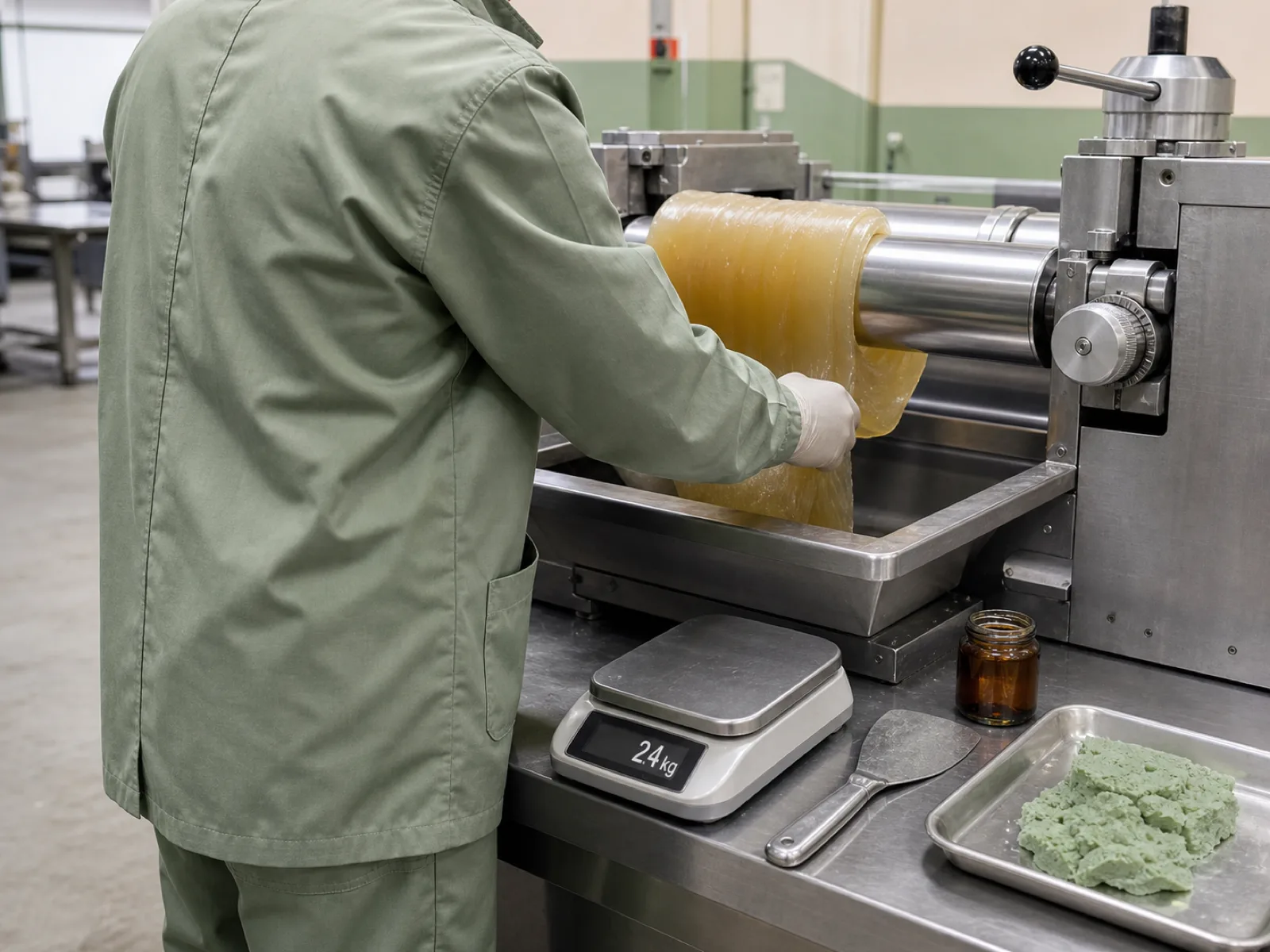
The material choice comes before the process choice. HCR arrives at the factory as a bale of translucent gum; it is milled on a two-roll mill with pigment master-batch and (for platinum-cure) the platinum catalyst added at the final pass to control pot-life. LSR arrives as two 200-liter drums — Part A carries the vinyl-terminated PDMS plus platinum catalyst, Part B carries the hydride cross-linker — and mixes 1:1 at the injection machine’s static mixer only at the point of injection. The full feedstock chemistry and handling rules for the liquid family are covered in the liquid silicone rubber (LSR) explainer.
The material spec that ships on every drawing carries five numbers a sourcing engineer should verify against ASTM D2240[^astm-d2240] for hardness and ASTM D412[^astm-d412] for tensile:
| Property | Standard HCR | Standard LSR | Test method |
|---|---|---|---|
| Shore A hardness | 40-70 | 30-70 | ASTM D2240[^astm-d2240] |
| Tensile strength | 8-11 MPa | 8-10 MPa | ASTM D412[^astm-d412] |
| Elongation at break | 400-800% | 400-700% | ASTM D412[^astm-d412] |
| Tear strength | 25-40 kN/m | 20-40 kN/m | ASTM D624 |
| Operating temperature | -40°C to 230°C | -40°C to 220°C | — |
| Linear shrink | 2.0-3.0% | 2.5-4.0% | ISO 2577 |
Shore A is the number a buyer feels first — a 40-Shore silicone drying mat compresses under a plate, a 70-Shore silicone sink grid holds a knife edge. It is also the number most commonly wrong on a competing quote, because the reading is against Shore 00 or Shore D rather than Shore A. Any quote citing “Shore A” without an ASTM D2240 reference is a document to push back on.
RTV silicone is a separate category — a room-temperature curing two-part liquid used for prototyping (Codex-generated CAD to prototype tool in 3-5 days), for producing low-volume soft-tooling for cast parts, and for sealants and encapsulants. It is not appropriate as a mass-production molding feedstock: cure time is 4-24 hours vs. minutes for heated HCR/LSR, and the mechanical properties are 30-50% lower than heat-cured silicone across every axis in the table above.
How is a silicone molding tool engineered and what does it cost?
HCR compression tools run US$3,000-15,000 in P20 or S136 steel with 200k-500k-shot life. LSR injection tools run US$15,000-80,000 in hardened H13 with a cold-runner system and deliver 1M+ shots. Tool cost is amortized across program volume — on a 5,000-unit program the tool adds US$1.20-3.00 per unit; on 50,000 units it drops under US$0.30 per unit. Ask the supplier to line-item the tool cost separately from piece price.
Steel selection is the first tool-engineering decision. P20 pre-hardened tool steel is the default for HCR compression on programs ≤ 100k lifetime volume; it machines cleanly, holds 200k-500k shots, and costs 40% less than fully hardened alternatives. S136 stainless is the upgrade for optical or high-polish surfaces and for corrosive-cure environments — retail-visible silicone parts that need Class-A finish. Hardened H13 with nitride coating is the LSR standard: LSR flows aggressively into vents and gate lands, and softer steel wears at the parting line within 100k shots.
Cavitation is the second decision — how many parts per shot. On a compression tool, 4-8 cavities is standard for the sink-grid / drying-mat size class. On an LSR tool, 8-16 cavities is typical because the automated cycle rewards the higher cavity count. The math to run against a supplier’s quote:
- Annual volume ÷ (cavities × shots-per-hour × operating-hours) = required tool count
- Tool cost × required-tool-count ÷ annual volume = tool amortization per unit
A common vendor sleight-of-hand is to quote a low tool cost against low cavitation, which raises the per-piece cycle-time cost invisibly. Wetop’s standard practice is to present two tool options side-by-side — a 4-cavity option and an 8-cavity option — so the buyer can see the trade explicitly.
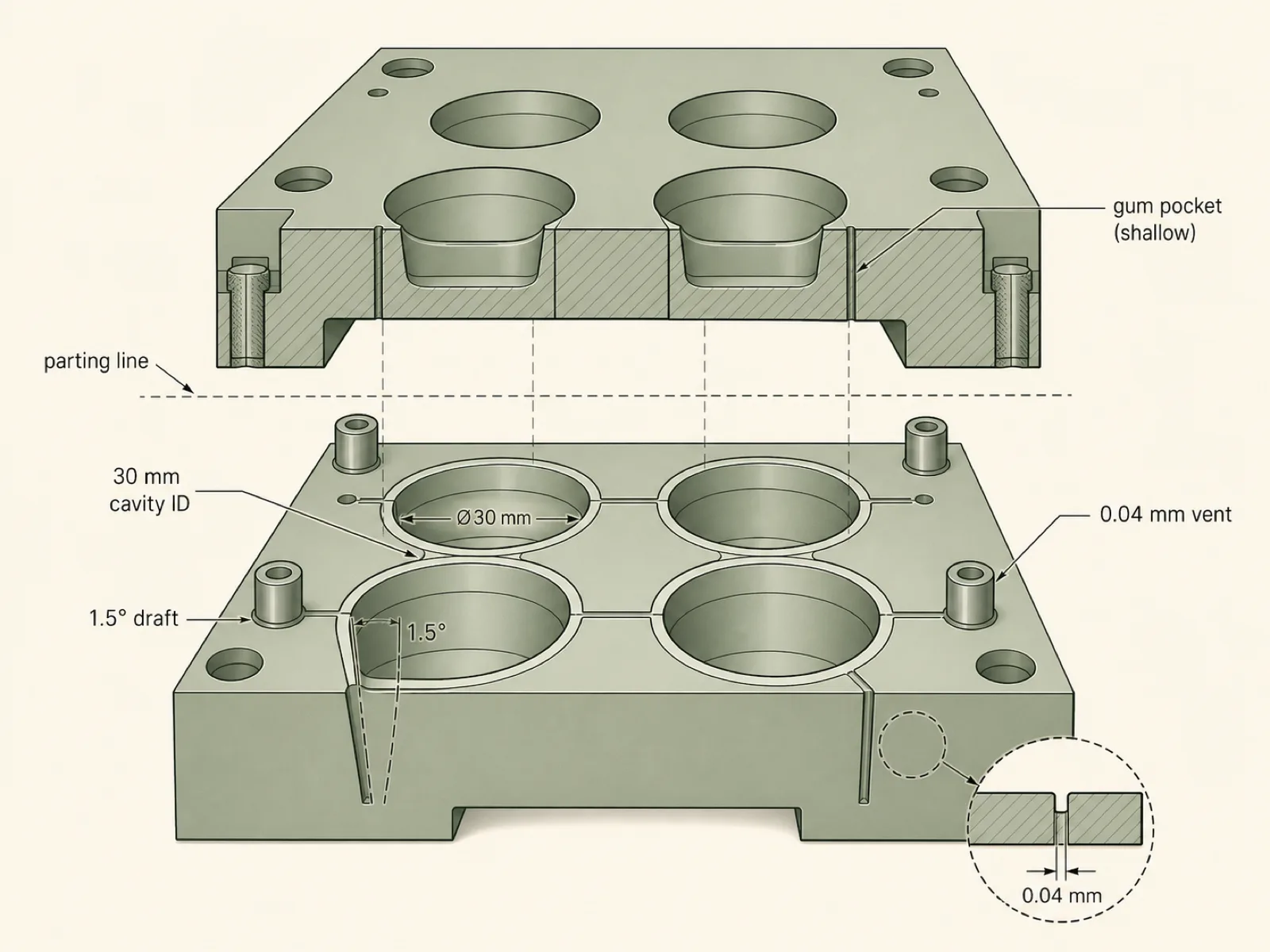
Parting-line and vent design is the third dimension. Silicone is highly compressible and forgiving on parting-line geometry compared to thermoplastics, but a vent pattern that is too tight traps air and produces the air-void defect (defect #3 in the catalog below). Vents are 0.03-0.05 mm deep on HCR and 0.01-0.02 mm on LSR — the LSR vent is a factor of 3 tighter because the two-part liquid flashes through wider vents.
What are the DFM rules for silicone molded parts?
Six DFM rules control whether a silicone molded first article passes. Wall thickness uniformity below a 3:1 ratio, radius rather than sharp corners at every intersection, 1-2° draft on vertical walls, undercuts under 15% of local wall thickness, over-mold or insert-mold prep with a mechanical key, and shrink compensation of 2-4% built into the CAD file — not calculated at the tool. A supplier's DFM markup that hits all six is the single strongest signal you have a real factory.
The wall-thickness ratio rule is the one that most first articles fail on. Silicone cures from the outside inward; a 3 mm wall next to a 0.8 mm wall on the same part cures at different rates and generates differential shrink after post-cure. The visible symptom is a warped part or a dimension that drifts on the second article after post-cure. The fix is either to redesign the part to reduce the ratio, to core-out the thick wall, or to accept a wider tolerance. A supplier who doesn’t call this out on DFM is either not measuring the ratio or is planning to blame the drift on “silicone variation.”
Sharp corners at inside intersections are a cure-stress concentration and a tear-strength failure mode. The rule is to fillet every inside corner to a radius no smaller than 50% of the local wall thickness — 0.5 mm inside radius on a 1 mm wall, 1.5 mm on a 3 mm wall. Sharp corners on outside geometry are less critical but still generate flash risk at the parting line.
Draft angle is 1-2° on vertical walls at minimum, 3° on textured surfaces. Silicone is elastic enough to strip from zero-draft features, but zero-draft accelerates parting-line wear and adds cycle time. A rectangular sink-grid frame with zero draft is 15-20% slower per cycle than the same part at 2° draft because the operator has to work the demold.
Shrink compensation is where the tool engineering meets the CAD file. Every silicone compound has a documented linear shrink coefficient (2.0-4.0%, depending on Shore A and cure system). The tool cavity is machined oversized by exactly the compound’s shrink number — not by an approximation. Miss the shrink by 0.5%, and a 100 mm dimension drifts by 0.5 mm — outside the tolerance band on any commercial-grade drawing.
Insert-molding and over-molding require a mechanical key on the insert plus a surface treatment (plasma etch or silane primer) that helps the silicone bond to the substrate. A supplier who over-molds silicone onto stainless steel without a mechanical key is relying on interfacial adhesion alone — which fails at 20-40% pull force in service and generates warranty returns.
What compliance certifications does a silicone molded part need?
For US food-contact retail: FDA 21 CFR 177.2600[^fda-177-2600] per-batch compliance and Prop 65 no-warning classification. For EU: LFGB §30/§31 per BfR Recommendation XV[^bfr-lfgb-xv] plus EU 10/2011[^eu-10-2011]. For medical-adjacent programs: USP Class VI per USP <88>[^usp-class-vi] plus ISO 10993-1[^iso-10993] biocompatibility. For PFAS-free programs: an accredited-lab non-detect PFAS report per production batch, driven by the ECHA universal restriction proposal[^echa-pfas-proposal]. Wetop's standard compliance packet ships all of the above.
The compliance packet is not a marketing document — it is a lot-traceable evidence chain a retail auditor can spot-check against production records. Every item in the packet must reference (a) the batch number of the raw material master-batch, (b) the production date-range of the finished goods lot, and (c) the accredited laboratory that ran the test (SGS, Intertek, TÜV, Eurofins are the four commonly accepted).
The five documents that ship on every Wetop OEM production lot:
- Raw material Certificate of Analysis (COA) — from the compound house, references the master-batch lot number, confirms Shore A, cure system, and PFAS non-detect status
- Per-batch FDA 21 CFR 177.2600 test report — extractables in n-hexane and water at 105°C, run against production samples pulled at the cure oven
- Per-batch LFGB §30/§31 test report — organic volatiles per BfR Recommendation XV, run against samples pulled after post-cure
- Prop 65 no-warning declaration — attests no listed chemical above the Safe Harbor level, backed by the extractables data
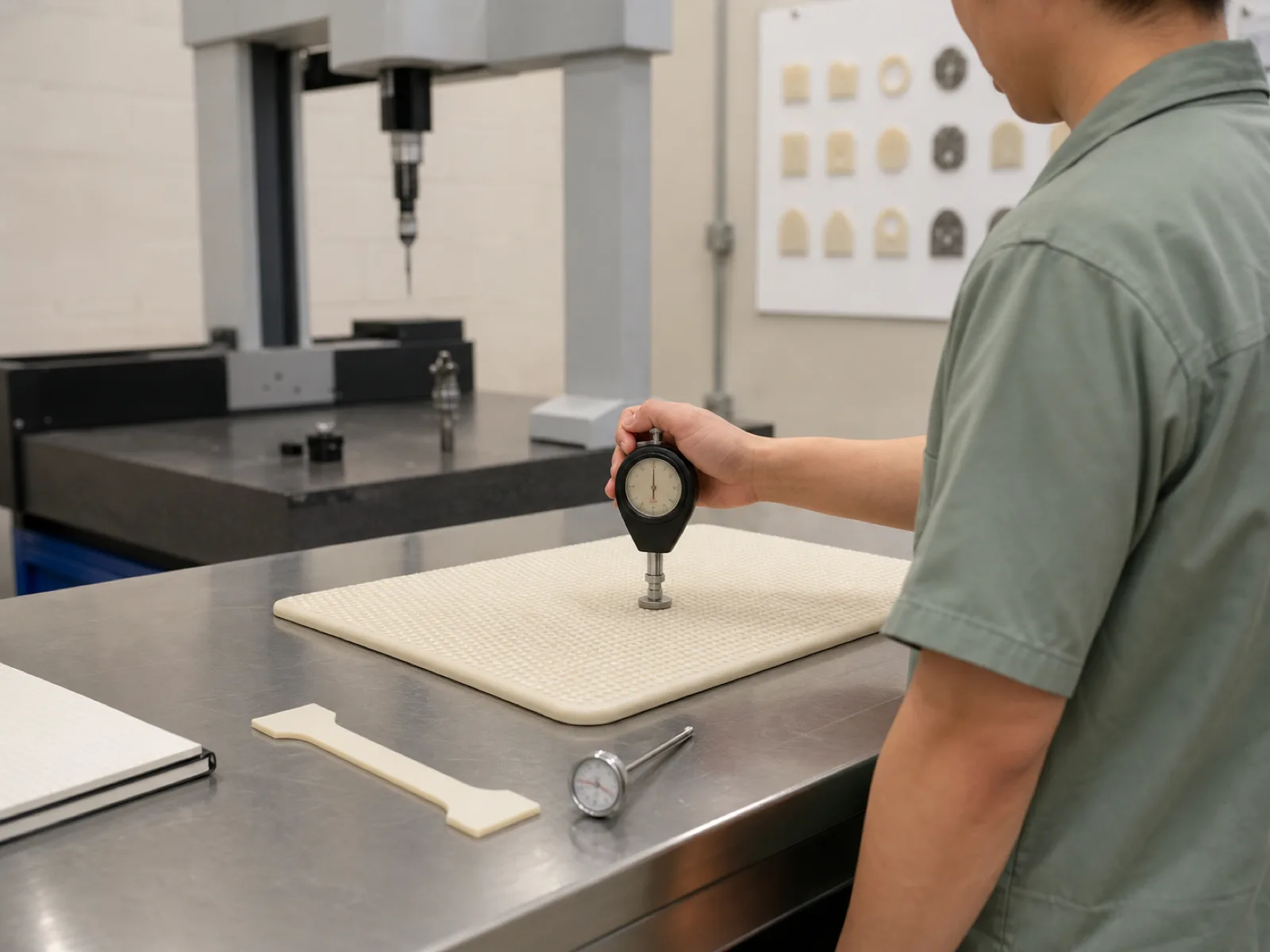
- First Article Inspection (FAI) report — dimensional CMM, Shore A durometer, tensile per ASTM D412[^astm-d412], surface finish, visual defect catalog
Medical-adjacent programs (infant feeding, wound-contact accessories, personal care) add USP <88>[^usp-class-vi] biological reactivity and ISO 10993-1[^iso-10993] biocompatibility as the sixth and seventh documents. These are the documents the retail category manager cannot generate a compliant PO without. For a side-by-side of the two food-contact regimes and where each applies, see the FDA vs LFGB silicone comparison.
What is the silicone molding QC workflow — and what defects does it catch?
A serious silicone-molding QC workflow runs at four checkpoints: incoming raw-material COA verification, in-process at the cure station (IPQC), dimensional and durometer FAI at the post-cure oven exit, and outgoing packaging inspection at AQL 1.5. This catches 90% of the five-defect failure catalog — flash, short-shot, air trap, cure inhibition, post-cure drift — before shipment. Suppliers running fewer than four checkpoints ship the defect and negotiate the return.
Wetop’s QC workflow runs 4 gate points on every OEM production lot:
- Incoming (raw material): master-batch COA verified against drawing spec; Shore A durometer of the compounded silicone measured on a slab against ASTM D2240[^astm-d2240] before the compound goes to the press
- In-process (at the cure station): cure-time and temperature logged per cycle; a first-article part from each shift pulled for dimensional check and post-cure conformance
- Post-cure exit (FAI): full dimensional CMM against the drawing tolerance band; Shore A durometer; visual defect inspection against the reference standard
- Outgoing (packaging): AQL 1.5 sampling per ANSI/ASQ Z1.4 (equivalent to ISO 2859-1); packaging integrity check; retention sample pulled for archive
The five-defect catalog the workflow is designed to catch:
- Flash at the parting line — root cause: vent clogged or clamp force undersized. Corrective action: clean vents at the shift change, verify clamp force per shot.
- Short-shot (incomplete fill) — root cause: insufficient charge weight (compression) or cold cavity (LSR). Corrective action: re-weigh charge, verify tool temperature at the four corners of the cavity.
- Air trap / gas void — root cause: vent pattern wrong or injection speed too high. Corrective action: add vents at trapped-air locations, reduce injection velocity by 15-20%.
- Cure inhibition (soft, tacky surface) — root cause: platinum catalyst poisoned by sulfur, amine, or tin residue. Corrective action: identify and eliminate the contamination source (natural rubber, condensation-cure silicone, certain plasticizers all inhibit platinum-cure).
- Post-cure dimensional drift — root cause: inconsistent oven temperature or wall-thickness ratio > 3:1. Corrective action: verify oven temperature uniformity, revisit DFM markup.
The gap between a serious factory and a trading company is not whether the defects occur — silicone molding is a physical process, defects occur. The gap is whether the factory catches the defect at IPQC or lets it ship to the FAI (or, worse, to the customer). A supplier who cannot cite the four gate points and the five-defect catalog verbatim is a supplier without a QC system.
How does the sourcing-to-production flow work on a silicone molding program?
Sourcing-to-production runs on a 45-70 day clock. Week 1: RFQ package review and DFM markup returned to buyer. Week 2-3: prototype tool cut (typically single-cavity aluminum), first samples in 7-15 days. Week 4-5: production tool cut in P20 or H13 steel. Week 6-9: pilot run of 200-500 units, PPAP-style FAI documentation, per-batch LFGB/FDA testing. Week 10: mass production release. Wetop's engineering desk owns the DFM and FAI steps directly — no intermediary trading company.
The RFQ package a buyer should send to a silicone-molding supplier is not just a CAD file. The minimum viable package carries five items:
- 3D CAD in STEP or IGES format with the finished part geometry (post-cure, at ambient temperature)
- 2D drawing with critical-to-quality (CTQ) dimensions, Shore A spec citing ASTM D2240[^astm-d2240], and tolerance band citing ISO 3302-1[^iso-3302] or DIN 7715
- Material spec (HCR or LSR, cure system, Shore A target, color Pantone)
- Compliance target (FDA 21 CFR 177.2600, LFGB, USP Class VI, PFAS-free — whichever apply)
- Annual volume forecast and MOQ — because the tool cavitation and steel selection depend on it
A buyer who sends only a CAD file will get a quote that assumes a compression tool at 4 cavities, HCR gum at Shore A 60, peroxide-cure, and no compliance testing — which is the cheapest possible answer and rarely the right one. Sending the full package back-and-forth turns a 45-day timeline into a 90-day timeline; sending the full package on the first RFQ compresses everything.
The prototype tool is where the DFM decisions from the earlier section get tested. A single-cavity aluminum prototype tool costs US$800-2,500 and turns around in 7-15 days. First samples run 5-20 pieces off the prototype tool for dimensional check, Shore A verification, and fit-form-function testing at the buyer’s end. If the DFM markup was accurate, the prototype samples clear the tolerance band on first article; if it wasn’t, the prototype tool is modified (typical 3-5 day loop) before the production tool is cut. Skipping the prototype step on a new part geometry is a false economy — the tool rework cost on a hardened production tool is 5-10x the prototype tool cost.
Pilot production runs 200-500 units on the production tool with full FAI documentation and per-batch LFGB/FDA testing. This is the step where the compliance packet ships to the buyer for approval. On approval, mass production releases; typical lead time from PO to first container is 25-35 days.
What is the cost anatomy of a silicone molded part?
A silicone molded piece cost breaks into six line items: raw material 30-45% of piece cost, tooling amortization 5-15% (varies with program volume), cycle-time × cavitation 15-25%, post-cure oven time 3-8%, secondary operations (deflashing, printing, assembly) 8-20%, packaging 2-8%. A supplier who quotes a single "unit price" without the six-line breakdown is a trading company or has never DFM'd the part — walk away. The full six-line quote anatomy is dissected in the [silicone OEM pricing structure guide](/guide/silicone-oem-pricing-structure/).
The single-largest cost variable across a silicone-molding program is raw material. Silicone compound pricing at 2026 industry rates:
| Material | Price (US$/kg, MOQ 500 kg) | Program fit |
|---|---|---|
| Peroxide-cure HCR, standard Shore A 60 | $6.50-8.50 | Baseline commodity retail |
| Platinum-cure HCR, Shore A 40-70 | $8.50-12.00 | Premium retail, PFAS-conscious programs |
| Platinum-cure LSR, food-grade | $10.00-14.00 | Injection molding, medical-adjacent |
| Platinum-cure LSR, USP Class VI | $18.00-28.00 | Infant feeding, wound-contact |
| Fluorosilicone (FVMQ) | $45.00-70.00 | Chemical/fuel-contact — not food, not standard silicone-molding |
At 30-45% of piece cost, the raw material line moves the total quote more than any other single lever. A cost-led program that trades peroxide-cure for platinum-cure on marketing grounds without a downstream retail-tier justification is 15-25% over-spec on material alone.
Tooling amortization is the second-largest variable, and the one most commonly obscured on competing quotes. The amortization math the supplier is running (or should be running):
- Tool cost ÷ (annual volume × amortization years) = per-unit tool cost
- A US$8,000 compression tool at 20,000 units/year, 2-year amortization = US$0.20 per unit
- A US$40,000 LSR tool at 200,000 units/year, 2-year amortization = US$0.10 per unit
Ask the supplier to state the amortization horizon explicitly. A 1-year amortization is aggressive and either loads the piece price or forces a re-quote if volume drops. A 3-year amortization is the most-common serious factory practice. The interplay between MOQ, tooling amortization, and per-unit price is worked through end-to-end in the MOQ and lead-time silicone OEM guide.
Cycle-time × cavitation is the labor and press-amortization line. On HCR compression, a 3 mm section runs a 3-minute cure at press with 4-8 cavities — so a 4-cavity tool produces 80 pieces/hour and an 8-cavity tool produces 160 pieces/hour. Doubling cavitation halves the cycle-time cost per piece; the tool cost goes up ~50%, so the amortization math shifts. This is the exact trade Wetop’s two-tool-option quote surfaces for the buyer.
Closing — what to ask your silicone molding supplier
Silicone molding is a mature, physical, boring, engineering-driven process. The decision that matters is not “which material” or “which process” — those fall out of the geometry, volume, and compliance target once a real DFM has been run. The decision that matters is whether the supplier can produce, on request:
- A DFM markup that names the wall-thickness ratio, the draft angles, the shrink compensation, and the tolerance band
- A per-batch LFGB §30/§31 test report against samples pulled after post-cure
- A raw-material COA that references the master-batch lot and confirms cure system, Shore A, and PFAS non-detect
- A per-tool amortization line item separate from piece price
- The five-defect catalog and the QC gate-point count without hedging
If a supplier can produce those five, the technical decision is downstream and negotiable. If they can’t, no piece-price is low enough to recover the retail-audit failure cost downstream. The full vetting playbook — including the red flags that separate a real factory from a trading front — is laid out in the sourcing silicone factory checklist.
Wetop’s engineering desk runs one compression cell (12 hydraulic presses, 200-400 ton) and one LSR injection cell (2 machines, cold-runner) on the 7,500 m² Dongguan floor. Every batch post-cures 4 hours at 200°C as standard. Every OEM program ships with the five-document compliance packet. If you are triaging a silicone-molding RFQ and want a DFM markup back within 5 business days, the fastest path is the engineering desk.
FAQ
-
What is the difference between silicone compression molding and LSR injection molding?
Compression molding loads a pre-cut HCR gum sheet into an open steel tool, closes under 200-400 tons, and cures at 170-200°C for 90-300 seconds. LSR injection molding meters a two-part liquid silicone through a cold-runner system into a closed hot mold and cures in 15-90 seconds — fully automated, ±0.05 mm tolerance capable. Compression is right for programs 500-50,000 units on HCR gum. LSR is right above ~50k units/year, on tight-tolerance geometry (medical, valves, baby feeding), and where labor cost matters — LSR runs unattended, compression requires an operator per press.
-
How much does a silicone molding tool cost?
For HCR compression: US$3,000-6,000 for a single-cavity aluminum prototype tool, US$6,000-15,000 for a 4-8 cavity P20 steel production tool. For LSR injection: US$15,000-30,000 for a single-cavity hardened H13 cold-runner tool, US$40,000-80,000 for an 8-16 cavity production tool. The tool is an amortized cost. On a 5,000-unit program the tool adds roughly US$1.20-3.00 per unit; on a 50,000-unit program it drops under US$0.30. Ask the supplier for the tool cost line-item separately from the piece price — an unbundled quote reveals whether the tool is genuinely dedicated to your program.
-
What is the typical silicone molding cycle time?
Cure time is a function of part thickness. Rule of thumb for HCR compression: 60 seconds per 1 mm of thickest wall at 175°C. A 3 mm silicone drying mat cures in ~3 minutes at press. LSR injection cures 4-6x faster — the same 3 mm section runs in 30-45 seconds because the liquid feedstock heats through faster and the two-part chemistry is faster-cross-linking. Post-cure adds a fixed 4 hours at 200°C in a batch oven and runs in parallel with the next production run — so it does not extend delivery lead time in a real factory schedule.
-
Does silicone molding require post-cure — and what happens if the factory skips it?
Yes for any food-contact, medical, or EU premium program. Post-cure is 4 hours at 200°C in a convection oven after de-mold. It drives off residual silicone oligomers and (in peroxide-cure) organic decomposition byproducts. Without post-cure, parts fail LFGB §30/§31 organic volatile extraction testing (defined by BfR Recommendation XV) and produce first-heat odor that generates retail complaints. Factories that skip post-cure save 4 hours of oven energy per batch and ship parts that fail EU audit. Wetop post-cures every batch as standard — the cost is bundled into the piece price, not a line item.
-
What are the standard silicone molding tolerances?
HCR compression molding holds ±0.10 mm on dimensions under 25 mm and ±0.3% on dimensions above (per DIN 7715 P2, the standard elastomer tolerance table). LSR injection molding holds ±0.05 mm on dimensions under 25 mm and ±0.15% above (DIN 7715 P1 or M1). Silicone shrinks 2-4% linearly during cure, so the tool is engineered oversized on CAD by exactly the compound's shrink factor. If a supplier quotes ±0.02 mm on a compression tool, they are either quoting a different measurement standard or they are wrong — walk away.
-
What is the minimum wall thickness a silicone molding process can hold?
Compression molding: 0.8 mm reliable, 0.5 mm possible with a well-vented cavity but risky on flow-length. LSR injection molding: 0.3 mm reliable, 0.15 mm on short flow-length features (valve membranes, baby-bottle nipples). The DFM rule that matters more than absolute minimum is wall-thickness uniformity — silicone cures from the outside in, so a 3 mm wall next to a 0.8 mm wall on the same part causes differential shrink and warpage. Wetop's DFM markup calls out any wall-ratio above 3:1 before tooling is cut.
-
What draft angles do silicone molded parts need for demolding?
1-2° minimum draft on all vertical walls, 3° preferred on textured surfaces. Silicone is elastic — it can be stripped from a zero-draft feature that a rigid thermoplastic could not clear. But zero-draft accelerates tool wear at the parting line and increases cycle time because the operator (compression) or robot (LSR) has to work harder to demold. Undercuts up to ~15% of the local wall thickness demold without lifters; deeper undercuts need collapsible cores or split tooling that adds US$3k-8k to tooling.
-
How is silicone molding cost quoted — and what should a real quote include?
A real silicone molding quote itemizes six lines: raw material (30-45% of piece cost, based on Shore A grade and cure system), cycle-time-per-cavity × cavitation (labor and press amortization), post-cure oven time, secondary operations (deflashing, pad-print, laser-mark, assembly), packaging, tooling amortized separately. A single-price 'unit price' with no breakdown means the supplier is a trading company or has never DFM'd the part. Wetop's standard quote format shows all six lines plus per-batch LFGB test cost so buyers can benchmark against a competing quote at the same MOQ.
-
What compliance certifications does a silicone molded part need for US and EU retail?
For US food-contact retail: FDA 21 CFR 177.2600 per-batch compliance and California Prop 65 no-warning classification. For EU: LFGB §30/§31 (per BfR Recommendation XV — silicones), plus EU 10/2011 for any component intended as a food-contact material. For medical-adjacent (infant feeding, wound-contact accessories): USP Class VI biological reactivity per USP <88>, plus ISO 10993-1 biocompatibility. For a PFAS-free program: an accredited-lab non-detect PFAS report per production batch. Wetop's compliance packet ships all of these as standard on OEM programs — not as an upgrade.
-
What are the most common silicone molding defects and their root causes?
Five defects cover 90% of the failure catalog. (1) Flash at the parting line — vent clogged or clamp force undersized. (2) Short-shot — insufficient charge weight or cold cavity. (3) Air trap / trapped-gas void — vent pattern wrong or injection speed too high. (4) Cure inhibition (soft, tacky surface) — platinum catalyst poisoned by sulfur, amine, or tin residue on tool or fixture. (5) Post-cure dimensional drift — inconsistent oven temperature or wall-thickness ratio above 3:1 designed into the part. A serious factory catches all five on first-article inspection and either re-cuts the tool or adjusts process before mass production. A trading company ships the defect through and blames it on 'variation.'
References
Authoritative sources cited in this guide
- US Food and Drug Administration (Code of Federal Regulations). 21 CFR 177.2600 — Rubber articles intended for repeated use. https://www.ecfr.gov/current/title-21/chapter-I/subchapter-B/part-177/subpart-C/section-177.2600 — The primary US regulation governing food-contact silicone (and other elastomers) intended for repeated use. Every Wetop silicone molding batch is cured to comply with the extractable limits in this section.
- German Federal Institute for Risk Assessment (BfR). BfR Recommendation XV — Silicones. https://www.bfr.bund.de/en/bfr_recommendations_on_food_contact_materials-7498.html — The technical standard behind LFGB §30/§31 organic volatile testing for silicone. Defines the 4-hour post-cure extraction limits that force every serious silicone molding program to post-cure.
- International Organization for Standardization. ISO 3302-1:2014 — Rubber — Tolerances for products — Part 1: Dimensional tolerances. https://www.iso.org/standard/62288.html — The dimensional tolerance standard used for elastomer molded parts, alongside DIN 7715. Reference this when a supplier quotes tolerances tighter than the standard permits — the number is either wrong or measured against a different standard.
- ASTM International. ASTM D2240-15 — Standard Test Method for Rubber Property — Durometer Hardness. https://www.astm.org/d2240-15r21.html — The measurement standard behind every Shore A hardness spec on a silicone molding drawing. If a quote states 'Shore A 50' without citing D2240, the reading may be against Shore 00 or Shore D and is not comparable.
- ASTM International. ASTM D412-16 — Standard Test Methods for Vulcanized Rubber and Thermoplastic Elastomers — Tension. https://www.astm.org/d0412-16r21.html — The tensile-strength and elongation-at-break test method for cured silicone. Standard silicone HCR clears 8-11 MPa tensile / 400-800% elongation on this method.
- United States Pharmacopeia. USP <88> — Biological Reactivity Tests, In Vivo. https://www.usp.org/harmonization-standards/pdg/excipients/plastic-materials — Defines USP Class VI biological reactivity classification. The default medical-grade threshold for silicone molded parts destined for infant feeding, wound-contact, or personal-care programs.
- International Organization for Standardization. ISO 10993-1:2018 — Biological evaluation of medical devices — Part 1. https://www.iso.org/standard/68936.html — The international biocompatibility standard that applies once a silicone molding program crosses the medical-adjacent threshold. Required alongside USP Class VI on any FDA 510(k) submission that includes a silicone component.
- European Commission — EUR-Lex. Commission Regulation (EU) No 10/2011 on plastic materials and articles intended to come into contact with food. https://eur-lex.europa.eu/legal-content/EN/TXT/?uri=CELEX%3A02011R0010-20200923 — The EU framework regulation for plastic and elastomer food-contact materials. Silicone parts destined for EU retail must comply alongside LFGB §30/§31.
- European Chemicals Agency (ECHA). PFAS Universal Restriction Proposal (2023). https://eur-lex.europa.eu/legal-content/EN/TXT/?uri=CELEX%3A32006R1907 — The regulatory action driving PFAS-free spec adoption on silicone molding programs. Explains why per-batch PFAS non-detect reporting is now standard on EU premium retail.
Start a custom program
Send a brief. Get an engineer’s reply in one business day.
Every Wetop program is tooled from a customer’s specification. Send a CAD file (STEP · IGES · DWG) or a written brief and we’ll reply with a mold cost estimate, price brackets at MOQ 500 / 1,000 / 5,000, and any engineering questions.