Buyer Guide · commercial intent
Silicone Reusable Food Wrap OEM Guide — Stretch Lids
What changed: First publication under v2 advanced-GEO standard — benchmarked against the top-ranking consumer-roundup pages (D.I. ORO, Sannyin, LoveGreatFinds, Consumer Silicone Products, EcoArtFulLife) and rewritten from inside the factory floor with FDA/LFGB clause citations, MOQ-tier FOB pricing, tooling cavity math, and a stretch-lid vs cling-sheet spec table that consumer coverage does not touch.
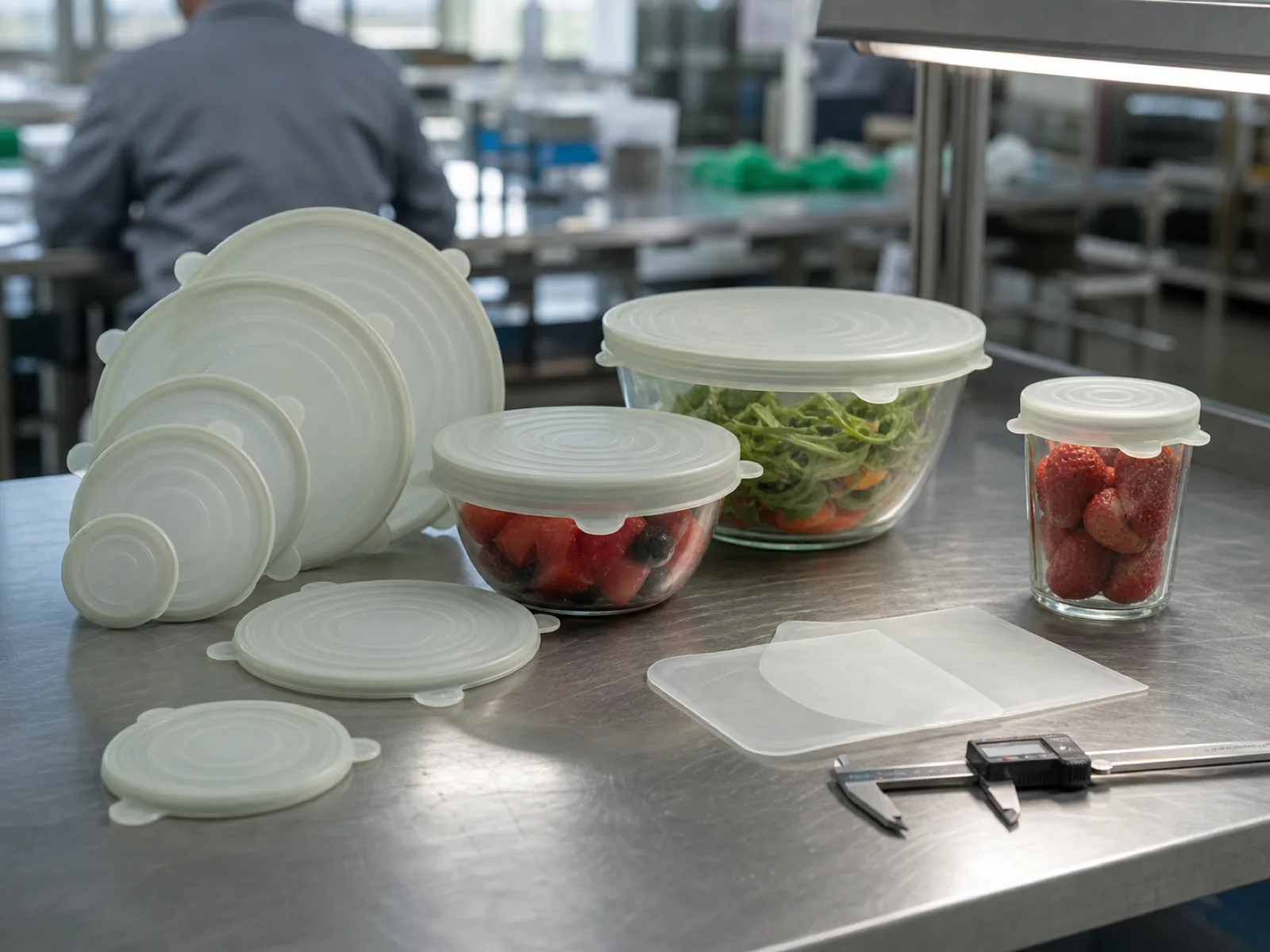 Buyer Guide
 Silicone reusable food wrap has become one of the fastest-growing housewares line extensions on the shelf — driven by plastic-cling-wrap displacement narratives, the ECHA PFAS restriction proposal reaching mainstream retail sustainability audits, and single-use plastics directives dropping PVC clamshell packaging from EU premium banners. What the retail-buyer roundup coverage does not answer is what the SKU actually is at the factory floor: two mechanically distinct formats (stretch lids and cling-film sheets), each with its own cure chemistry, tooling investment, MOQ pricing curve, and defect risk profile. This guide is the engineering reality of manufacturing that product, written from a working OEM floor for procurement, sourcing, and product development leads.
Silicone reusable food wrap ships in two OEM formats — discrete-size stretch lids (45-55 Shore A, 1.2-1.8 mm wall, compression-molded) and cling-film sheets (30-40 Shore A, 0.15-0.25 mm, LSR-injected for volume). Platinum-cured silicone is the retail-tier default; peroxide-cured requires disciplined 4-6 hour post-cure at 180-200°C to clear LFGB §30/31 per BfR Recommendation XV. FOB Yantian Q3 2026 benchmarks for a 6-piece stretch-lid set at MOQ 500 run $3.20-$4.10 platinum-cure with debossed logo, dropping to $2.05-$2.65 at 10,000 sets.
What is silicone reusable food wrap, engineered for OEM production?
Silicone reusable food wrap is a category name for two mechanically distinct SKU families — stretch lids (bowl and jar covers, discrete diameters, 1.2-1.8 mm wall, suction-lip geometry, compression-molded) and cling-film sheets (0.15-0.25 mm thin sheet, roll or square, van-der-Waals surface cling, LSR-injected at scale). Both are food-contact platinum-cured silicone per FDA 21 CFR 177.2600 and LFGB §30/31, but tooling, cost curves, and defect modes diverge.
The consumer-facing description of silicone reusable food wrap is “the plastic wrap you don’t throw away.” The engineering description is two separate product programs that happen to share a shelf category. Stretch lids are geometry-driven — a rolled suction lip grips a bowl or jar rim through a stretch-and-recover cycle, and the seal fails or holds based on wall cross-section variance measured in ±0.10 mm. Cling-film sheets are surface-driven — the sheet clings by van-der-Waals interaction against a smooth container rim, and the seal fails or holds based on surface roughness and thickness uniformity across a 30×30 cm sheet.
The two programs use different silicone grades, different tooling, different cavity counts, and different QC test rigs. A supplier that quotes a “silicone food wrap program” without asking which format first is either running a single narrow SKU or does not know the category. Every meaningful OEM decision — cure chemistry, tooling investment, MOQ tier pricing, packaging — flows from the format decision. This guide walks both branches side by side and then converges on the compliance stack and packaging decisions that are shared.
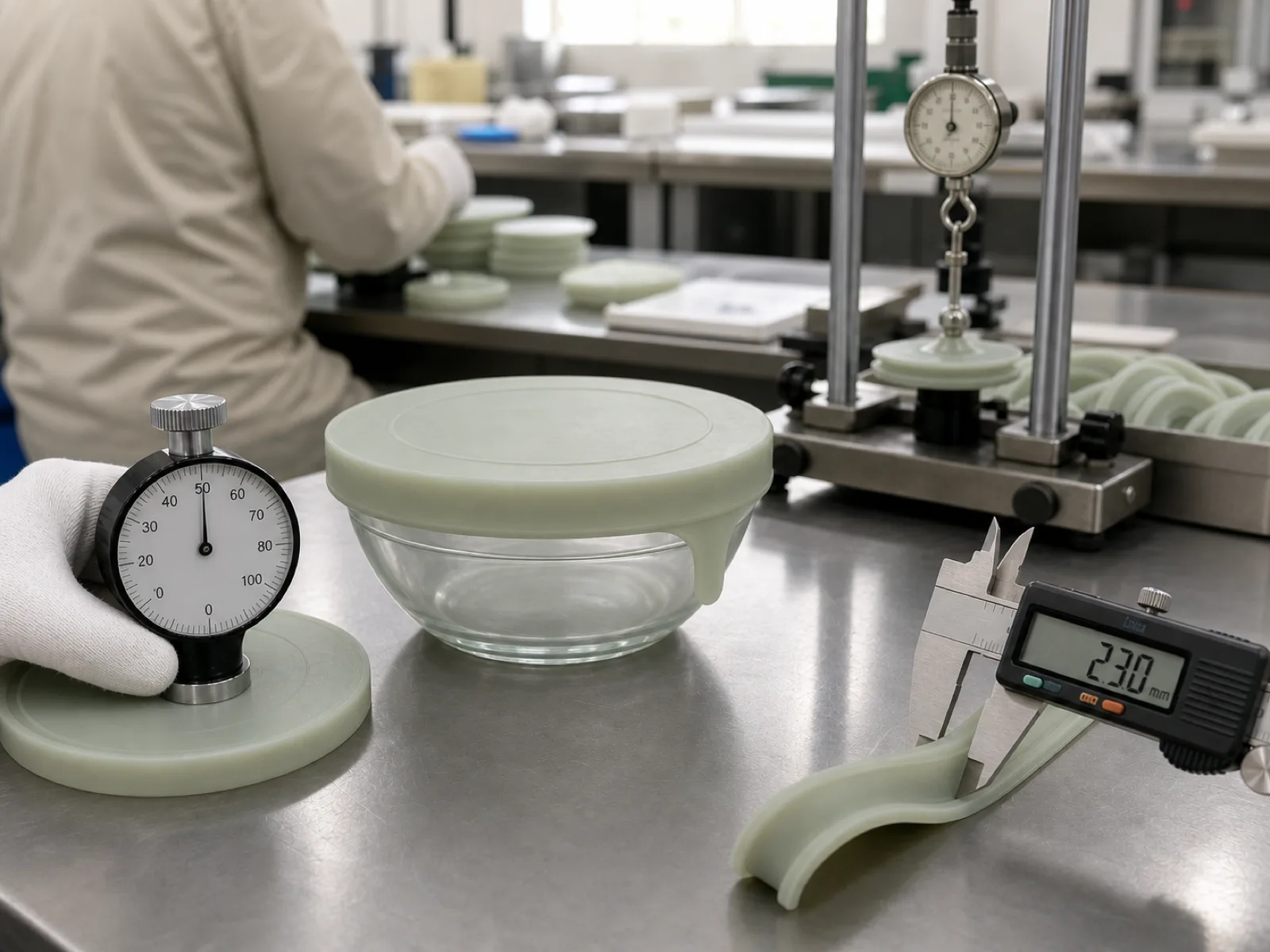
Baseline engineering spec sheet — stretch lids vs cling-film sheets
| Parameter | Stretch lids (typical retail) | Cling-film sheets (typical retail) |
|---|---|---|
| Wall thickness | 1.2-1.8 mm | 0.15-0.25 mm |
| Shore A hardness | 45-55 (ASTM D2240[^astm-d2240]) | 30-40 (ASTM D2240[^astm-d2240]) |
| Cure system | Platinum (default) | Platinum (default), LSR at scale |
| Molding process | Compression | LSR injection above 30k units/yr |
| Continuous service temperature | -40°C to 230°C | -40°C to 230°C |
| Tensile strength | ≥ 8 MPa (ASTM D412[^astm-d412]) | ≥ 5 MPa (ASTM D412[^astm-d412]) |
| Elongation at break | ≥ 350% | ≥ 250% |
| Seal mechanism | Rolled suction lip, 3-4 mm cross-section | Van-der-Waals surface cling |
| Retail SKU unit | 6-piece diameter set (2-12 inch) | 2-pack or 4-pack of 30×30 cm sheets |
| MOQ | 500 sets | 500 retail cartons |
Which cure chemistry does a retail silicone food wrap SKU actually need?
Platinum-cured silicone is the OEM default for any retail food-wrap SKU above $8 shelf-price. Peroxide-cured is a cost-cutting option at 15-25% lower FOB unit cost but requires disciplined 4-6 hour post-cure at 180-200°C to clear LFGB §30/31 organic volatile testing per BfR Recommendation XV[^bfr-lfgb-xv]. Under-post-cured peroxide product ships odor and fails EU premium retail audits.
The platinum-vs-peroxide decision is where most silicone food wrap programs get quietly downgraded during RFQ. A supplier quoting FOB unit cost 20% below the market has almost certainly moved from platinum-cure to peroxide-cure and has almost certainly truncated post-cure to make oven throughput math work. The finished product looks identical. The failure surfaces later — first-heat odor on the consumer’s first use, driving 1-star reviews and returns; or a delisting during LFGB §30/31 lot testing at retail audit.
Wetop’s default retail spec is platinum-cure with 4-hour post-cure at 180°C, logged against the master-batch lot number. The 15-25% cost delta over commodity peroxide is priced into MOQ-tier FOB. Buyers who need the peroxide-cure cost structure get the same 4-6 hour post-cure protocol and a per-batch LFGB §30/31 test report to prove the compliance envelope. What Wetop does not offer is peroxide-cure with truncated post-cure — the failure risk on retail audits is not worth the 8-12% additional cost saving. Full trade-off analysis on the platinum-cured vs peroxide-cured silicone decision guide.
What does the regulatory stack for retail food wrap actually cover?
US retail requires FDA 21 CFR 177.2600 per master-batch lot[^fda-177-2600], CA Prop 65 audit or PFAS non-detect testing, and CPSIA general certificate for child-facing SKUs. EU retail requires LFGB §30/31 per BfR Recommendation XV, EU Regulation 1935/2004[^ec-1935-2004] declaration of compliance, REACH SVHC screening, and increasingly a PFAS non-detect test given the ECHA universal restriction proposal[^echa-pfas-proposal]. Per-batch third-party reports at MOQ 500.
The retail compliance stack for silicone reusable food wrap has expanded meaningfully across 2024-2026 as sustainability audits move from marketing checkboxes to actual delisting risk. FDA 21 CFR 177.2600 has not changed — it is the same US food-contact regulation for repeated-use rubber articles it has been for decades, tested by extraction into water, 8% ethanol, and n-heptane per the listed migration protocol. What has changed is retailer audit frequency: Home Depot, Wayfair, Target housewares, and Bed Bath tier now request per-batch reports referencing a specific master-batch lot number from the last 6 months, not a single supplier-wide certificate.
LFGB §30/31 per BfR Recommendation XV[^bfr-lfgb-xv] is the EU counterpart — an organic volatile extractables test that measures residual crosslinking byproducts (2,4-dichlorobenzoic acid, cyclic siloxanes) against strict thresholds. Any peroxide-cured silicone food wrap ships this test with a per-batch post-cure log to prove the extractables envelope. Platinum-cured product clears LFGB §30/31 more forgivingly but Wetop still runs the per-batch test on retail programs to prevent an audit surprise.
The PFAS documentation demand is the newest and fastest-growing gate. The ECHA universal restriction proposal[^echa-pfas-proposal] has accelerated per-batch PFAS non-detect testing at ppb detection limits from optional to mandatory across EU premium retail, and downstream to US West Coast retail (Whole Foods, Target). Wetop ships PFAS non-detect reports from SGS, Intertek, TÜV, or Bureau Veritas as standard on retail programs. Full clause-level compliance detail on the FDA vs LFGB silicone guide.
What is the tooling investment for a silicone food wrap OEM program?
Compression-mold tooling for a stretch-lid family runs $2,800-$4,200 for a small set (2-5 inch cavities), $3,600-$5,400 for a full retail 6-diameter set (2, 4, 6, 8, 10, 12 inch), and $4,200-$6,200 for a 6-diameter set with premium suction-lip geometry. LSR injection tooling for cling-film sheets runs $8,500-$14,000 for a 16-cavity thin-wall mold. Tooling amortizes against first-order volume and transfers to buyer at payoff.
Tooling economics are where competitor content on this category disappears entirely — every top-ranking consumer-roundup page forces the buyer into an RFQ to see any number. The math is not proprietary. A compression mold for a stretch-lid family is a hardened P20 steel plate with 4-6 cavities cut for the diameter range. Cavity count is fixed by the mold plate area and the diameter of the largest lid in the set; a 40×40 cm plate accommodates the full 2-12 inch retail set at 6 cavities single-shot.
An LSR mold for cling-film sheets is a different animal. Cavity count runs 8-32 at 45-60 second cycle time, thin-wall gate geometry, cold-runner injection, and precise mold-temperature control (±2°C). Tooling investment is 3-4x higher than compression, and payback arrives around 30,000-50,000 units for a well-positioned retail SKU. Below 30,000 units per year, cling-film sheets on compression tooling are the economically correct answer despite slower cycle times.
Payback math on a stretch-lid tool at $4,200 average tooling and a $0.35-$0.55 per-unit premium over private-label at MOQ 500: breakeven arrives at ~9,000-12,000 sets of sell-through, typically inside the first two seasonal orders for a well-positioned Tier 2 US or EU retail listing. Tooling ownership transfers to the buyer once fully amortized, which protects the design against grey-market copying by the factory in year 2+. Full pricing structure on the silicone OEM pricing structure guide.
What are the CTQ inspection points and defect modes on food-wrap SKUs?
Three critical-to-quality inspection points dominate retail return rates on silicone food wrap: (1) suction-lip cross-section variance beyond ±0.10 mm on stretch lids, which collapses the seal; (2) edge flash from over-cure closing off the roll-down groove; (3) debossed logo pigment migration during 4-6 hour post-cure. AQL 2.5 sampling per ISO 2859-1[^iso-2859-1], plus a destructive 20-cycle pull-test on lot samples, catches all three pre-shipment.
The defect modes on silicone food wrap are geometry-driven rather than material-driven. On a stretch lid, the suction lip is the entire product function — a 3-4 mm inward-rolled cross-section at a 60-90° roll-under angle. When the compression cycle runs 30-45 seconds shorter than the 3-6 minute spec (a common commodity-factory shortcut to boost throughput), the silicone gum does not fully crosslink at the lip radius. The lip goes soft, the seal fails on the second-or-third use, and the SKU returns at a 15-25% rate.
Edge flash is the second defect mode. When the mold clamp pressure is a fraction low or the parting-line surface is not machined to spec, uncured silicone squeezes into the parting line and cures as a thin flash ring around the lid perimeter. Flash blocks the roll-down groove and prevents the lid from stretching onto the container rim. Consumers cannot install the lid, return the SKU, write a 1-star review. Wetop runs a 100% visual perimeter inspection per lid at demold plus a manual deflash step before the AQL 2.5 sampling gate.
Debossed logo pigment migration is the retail-tier defect that catches new suppliers by surprise. During 4-6 hour post-cure at 180-200°C, master-batch pigments in a deeply-debossed logo well can migrate and discolor. Wetop’s fix is a two-shot spec on high-visibility logo programs — the debossed logo runs a locked master-batch tuned for post-cure stability, or is filled with a silicone-ink screen print applied post-cure rather than pre-cure. Buyer’s incoming QC should run a 5-lid random check under D65 light for logo edge sharpness and color uniformity.
What packaging tier does a food-wrap SKU need to clear retail sustainability audits?
Retail-ready packaging that clears 2026 EU sustainability audits is FSC-certified kraft sleeve + recyclable mono-material PET window box, adding $0.18-$0.35 per unit. PVC clamshell packaging is EU-banned effective 2026 under the Single-Use Plastics Directive[^eu-sup-directive] and is being dropped by US retailers ahead of legal mandate. Mono-material recyclable is the retail-tier default across EU premium banners (Rewe, Carrefour, Sainsbury's).
Packaging on a silicone food wrap SKU has moved from a merchandising afterthought to a listing-eligibility gate. The EU Single-Use Plastics Directive[^eu-sup-directive] has driven Rewe, Carrefour, Sainsbury’s, and Tesco to audit for mono-material recyclability and to drop mixed-material blister packs and PVC clamshells across housewares categories. US retailers (Target, Whole Foods, and increasingly Home Depot) are moving the same direction ahead of any US federal mandate, driven by their own sustainability reporting commitments.
The three defensible packaging tiers on a retail silicone food wrap program are: (1) FSC-certified kraft sleeve + recyclable PET tray at $0.12-$0.22 per unit, clears both US and EU audits; (2) mono-material PET window box at $0.18-$0.35 per unit, premium presentation with full product visibility; (3) retail-ready case pack (12 or 24 units in a shelf-ready display tray) at $0.04-$0.09 additional per unit, cuts store-labor cost and drives preferential shelf placement. Every RFQ should specify packaging tier before FOB pricing is meaningful — a quote that does not itemize packaging is not a comparable quote.
Closing — how to move an RFQ forward
The single largest source of noise in silicone reusable food wrap RFQs is unspecified format, unspecified cure chemistry, and unspecified packaging tier. A quote that returns “$1.20 FOB Yantian” without the four locked variables (format: stretch-lid or cling-sheet; cure: platinum or peroxide; packaging: PVC clamshell, kraft sleeve, mono-PET window box, or retail-ready case pack; test-report frequency: per-batch or annual) is not comparable to another quote at $1.80 that has all four locked. The pre-flight worth doing before firing an RFQ is the sourcing silicone factory checklist — five minutes of specification discipline saves weeks of quote reconciliation.
Wetop runs stretch-lid and cling-film-sheet programs off the same 7,500 m² Dongguan floor with 500-piece MOQ, per-batch FDA 21 CFR 177.2600 + LFGB §30/31 + PFAS non-detect test reports, and mono-material recyclable retail-ready packaging as standard on retail programs. For a quote that locks all four variables against a specific spec — send an RFQ through the contact form with format, cure system, target packaging tier, and target retail shelf price, and the engineering team returns a costed spec sheet against MOQ 500, 2,000, 10,000, and 25,000 unit tiers within two business days.
FAQ
-
What is the difference between silicone stretch lids and silicone cling-film sheets for an OEM program?
Stretch lids are discrete-size, wall-cross-section parts — typically 6 diameters (2, 4, 6, 8, 10, 12 inch) with a 45-55 Shore A durometer, 1.2-1.8 mm wall, and a rolled suction lip that grips the rim of a bowl or jar. They are compression-molded from platinum-cured silicone. Cling-film sheets are thin-wall silicone sheets, 0.15-0.25 mm thickness, 30×30 cm or 40×40 cm square (or roll), 30-40 Shore A, that cling by van-der-Waals surface tension against a smooth container rim. Sheets are typically LSR-injected at high cavity count for retail unit-cost targets. The two formats share the SKU category "silicone reusable food wrap" but share almost no tooling, no unit cost curve, and no failure mode — the buyer must pick before RFQ.
-
What is the MOQ and FOB pricing for custom silicone reusable food wrap?
Wetop's MOQ is 500 units per SKU (a "unit" is a 6-piece stretch-lid set, or a 2-pack cling sheet retail carton). FOB Yantian benchmarks Q3 2026, platinum-cure with 1-color debossed logo, unbranded kraft-sleeve packaging: 6-piece stretch-lid set at 500 sets $3.20-$4.10 / 2,000 sets $2.55-$3.20 / 10,000 sets $2.05-$2.65 / 25,000 sets $1.75-$2.20. Cling-sheet 30×30 cm 2-pack retail carton at 500 pcs $1.15-$1.55 / 2,000 pcs $0.90-$1.20 / 10,000 pcs $0.75-$1.00 / 25,000 pcs $0.60-$0.85. Add $0.18-$0.35 per unit for FSC-certified retail-ready mono-material PET window box, $0.06-$0.12 per unit for pad-print or silicone-ink screen-print in place of debossed logo, $0.03-$0.08 per unit for Pantone-matched color master-batch beyond stock.
-
How long is the lead time on a silicone reusable food wrap OEM program?
New-tooling programs: 20-28 day tooling cut for a stretch-lid mold family, 25-35 day tooling for an LSR cling-sheet mold. Add 7-15 day gold sample after first-shot, then 25-35 day production for 10,000-30,000 units after PO and 30% deposit. Existing-library programs (private-label): 7-15 day sample, 25-35 day production. Add 14-18 day Yantian-to-US-West-Coast sailing, 25-32 days to US East Coast, 30-38 days to Northern Europe. Total realistic buyer-side lead from RFQ to warehouse receipt: 55-90 days for existing tooling, 90-120 days for new-tool programs. Compression-molded stretch lids ship faster than LSR-injected cling sheets because gate-scar removal and mold-cleaning cycles between colors are shorter.
-
Which regulatory certifications does a retail silicone food wrap SKU actually need?
For US retail (Home Depot, Wayfair, Target housewares, Bed Bath tier): FDA 21 CFR 177.2600 test report per master-batch lot, CA Prop 65 warning statement audit or non-detect PFAS test, plus a CPSIA general certificate of conformity when the SKU is child-facing. For EU retail (Rewe, Carrefour, Tesco, Sainsbury's): LFGB §30/31 organic volatile test per BfR Recommendation XV, EU Regulation 1935/2004 declaration of compliance, REACH SVHC screening, and increasingly a PFAS non-detect test given the ECHA universal restriction proposal. All Wetop retail programs ship per-batch third-party reports (SGS, Intertek, TÜV, Bureau Veritas) with the master-batch lot number cross-referenced in the QC packet.
-
Why is post-cure the step commodity factories skip and how does that show up in the product?
Post-cure is a 4-6 hour hold at 180-200°C in a forced-air convection oven after the initial mold cycle. It drives residual crosslinking byproducts — primarily 2,4-dichlorobenzoic acid on peroxide-cured silicone — below the BfR Recommendation XV extractables threshold that LFGB §30/31 tests measure. Commodity factories skip or truncate post-cure to save 20-30% oven energy per batch. The product ships and passes an initial visual QC, but two failure modes surface later: (1) first-heat vinegar-like odor on the consumer's first use, driving 1-star reviews and returns; (2) actual failure at LFGB §30/31 organic volatile testing during a retail audit, resulting in the SKU being delisted. Wetop logs post-cure oven temperature and dwell time against the master-batch lot number in the ISO 9001 process records, and any retail buyer's audit can request the log.
-
How do debossed, pad-print, silicone-ink screen-print, and laser-etched logos compare for durability on food-wrap SKUs?
Debossed (mold-in) logos are the retail durability default — the logo is part of the silicone geometry, cannot wear off, and adds zero per-unit cost once tooling is cut. Pad-print with silicone-compatible inks holds 200-400 dishwasher cycles before visible fade; the failure mode is edge lifting on high-flex zones near the suction lip. Silicone-ink screen-print (post-cure baked ink) holds 400-800 dishwasher cycles, better than pad-print, but requires a flat printable area at least 20×20 mm and adds $0.08-$0.15 per unit at MOQ 500. Laser-etched marking is a surface texture change with no ink — infinite dishwasher life but only visible as a matte-vs-satin contrast, so it works for factory-mark or model-code roles, not decorative branding. Retail programs above $8 shelf-price typically specify debossed logo + optional silicone-ink screen-print for a secondary color accent.
-
What thickness, Shore A hardness, and geometry actually deliver a working seal on a silicone stretch lid?
A working suction seal on a silicone stretch lid comes from three linked variables. Wall thickness 1.2-1.8 mm gives the material stretch-and-recovery envelope; below 1.0 mm the lid tears at the suction lip on the first use, above 2.0 mm it does not conform to a lightly-tapered bowl rim. Shore A 45-55 durometer gives the elastic modulus that grips smooth rims without cracking cold ceramic; the retail-default 50 Shore A tolerates ±5 duro variance per ASTM D2240. Suction lip geometry is the third variable — a 3-4 mm inward-rolled lip cross-section with a 60-90° roll-under angle. Below 60° the seal breaks under mild jostling; above 90° the lid is impossible to pull off single-handed and consumers hate it. All three variables get locked in the gold sample and inspected on 100% of production per AQL 2.5 sampling.
-
How does packaging drive landed cost and retail listing eligibility on a food-wrap SKU?
Packaging is the largest single per-unit landed-cost variable outside of the silicone itself. Legacy PVC clamshell adds $0.05-$0.10 per unit, is EU-banned effective 2026 under single-use plastics directives, and is being dropped by US retailers (Target, Whole Foods) even where legal. Mono-material recyclable PET window box adds $0.18-$0.35 per unit but preserves EU premium banner listing eligibility (Rewe, Carrefour, Sainsbury's audit for mono-material). FSC-certified kraft sleeve + recyclable PET tray adds $0.12-$0.22 per unit and clears both US and EU sustainability audits. Retail-ready case pack (12 or 24 units in a shelf-ready display tray) adds $0.04-$0.09 per unit and cuts store-labor cost, driving preferential shelf placement. Every RFQ should specify packaging tier before FOB pricing is meaningful.
-
Does a silicone reusable food wrap program actually pay off against plastic cling wrap over its service life?
The lifecycle math that survives a retail buyer's sustainability audit: a fiberglass-free platinum-cure silicone stretch lid or cling sheet displaces approximately 250-500 conventional plastic cling wrap sheets over a 24-36 month service life at typical household use frequency. At US retail shelf price of $12-24 for a 6-piece stretch-lid set vs $3-4 per 100-sheet cling-wrap box, breakeven arrives at 8-14 months of daily use. The claim is defensible in retail marketing only when the SKU carries per-batch PFAS non-detect testing and mono-material recyclable packaging — otherwise the sustainability positioning breaks under buyer sourcing due-diligence. See the [PFAS-free sustainability sourcing guide](/guide/silicone-pfas-free-sustainability/) for the documentation that retail buyers expect.
-
When does LSR injection make more sense than compression molding for a silicone food wrap program?
LSR (liquid silicone rubber) injection makes sense above roughly 30,000 units per year of the same SKU, for thin-wall parts (below 0.6 mm), and for programs where cycle-time-per-cavity dominates unit cost. Compression molding is more economical below 20,000 units, for thicker parts (above 1.0 mm), and for stretch-lid families where 6 different diameters share a single multi-cavity tool. Cling-film sheet SKUs at the 0.15-0.25 mm thickness range and >50,000-unit annual demand belong on LSR — a 16-cavity or 32-cavity LSR tool at 45-second cycle drops unit cost 25-40% below compression. Stretch-lid SKUs below 20,000 units annual demand belong on compression — the tool investment is 40-60% lower and mold-change between diameters is faster. See the [liquid silicone rubber OEM manufacturer guide](/guide/liquid-silicone-rubber-oem-manufacturer/) for the LSR trade-off in full.
References
Authoritative sources cited in this guide
- US Food and Drug Administration. 21 CFR 177.2600 — Rubber articles intended for repeated use. https://www.ecfr.gov/current/title-21/chapter-I/subchapter-B/part-177/subpart-C/section-177.2600 — The primary US food-contact regulation Wetop cures every silicone food wrap batch against, tested per master-batch lot.
- German Federal Institute for Risk Assessment. BfR Recommendation XV — Silicones. https://www.bfr.bund.de/en/bfr_recommendations_on_food_contact_materials-7498.html — The technical standard behind LFGB §30 and §31 organic volatile testing for food-contact silicone — the reason mandatory post-cure exists for peroxide-cure programs.
- International Organization for Standardization. ISO 9001:2015 — Quality Management Systems — Requirements. https://www.iso.org/standard/62085.html — The quality management system Wetop is certified against — governs batch traceability, post-cure records, and audit documentation trail.
- International Organization for Standardization. ISO 2859-1:1999 — Sampling procedures for inspection by attributes. https://www.iso.org/standard/1141.html — The sampling standard behind AQL 2.5 inspection Wetop runs pre-shipment on every stretch-lid and cling-sheet batch.
- ASTM International. ASTM D2240-15 — Standard Test Method for Rubber Property—Durometer Hardness. https://www.astm.org/d2240-15r21.html — The measurement standard behind every Shore A hardness spec Wetop quotes on food wrap and stretch lid programs.
- European Parliament and Council. Regulation (EC) No 1935/2004 — Materials intended to come into contact with food. https://eur-lex.europa.eu/legal-content/EN/TXT/?uri=CELEX%3A02004R1935-20090807 — The overarching EU framework regulation for food-contact materials — LFGB compliance sits inside this framework.
- European Chemicals Agency. PFAS Universal Restriction Proposal. https://eur-lex.europa.eu/legal-content/EN/TXT/?uri=CELEX%3A32006R1907 — The regulatory action driving PFAS non-detect specification adoption in EU premium retail and, downstream, in US retail — accelerating per-batch PFAS testing as table stakes.
- European Parliament and Council. Directive (EU) 2019/904 on Single-Use Plastics. https://eur-lex.europa.eu/legal-content/EN/TXT/?uri=CELEX%3A32019L0904 — The EU directive driving PVC clamshell replacement with mono-material recyclable retail-ready packaging on food wrap SKUs.
- ASTM International. ASTM D412 — Standard Test Methods for Vulcanized Rubber Tension. https://www.astm.org/d0412-16r21.html — The tensile-strength and elongation-at-break test method behind Wetop's stretch-lid mechanical spec.
- US Consumer Product Safety Commission. CPSIA — Consumer Product Safety Improvement Act. https://www.ecfr.gov/current/title-16 — The US framework a child-facing silicone food wrap SKU (baby-bowl-cover positioning) must certify against.
Start a custom program
Send a brief. Get an engineer’s reply in one business day.
Every Wetop program is tooled from a customer’s specification. Send a CAD file (STEP · IGES · DWG) or a written brief and we’ll reply with a mold cost estimate, price brackets at MOQ 500 / 1,000 / 5,000, and any engineering questions.