Buyer Guide · commercial intent
Silicone Rubber Gasket Specification Guide
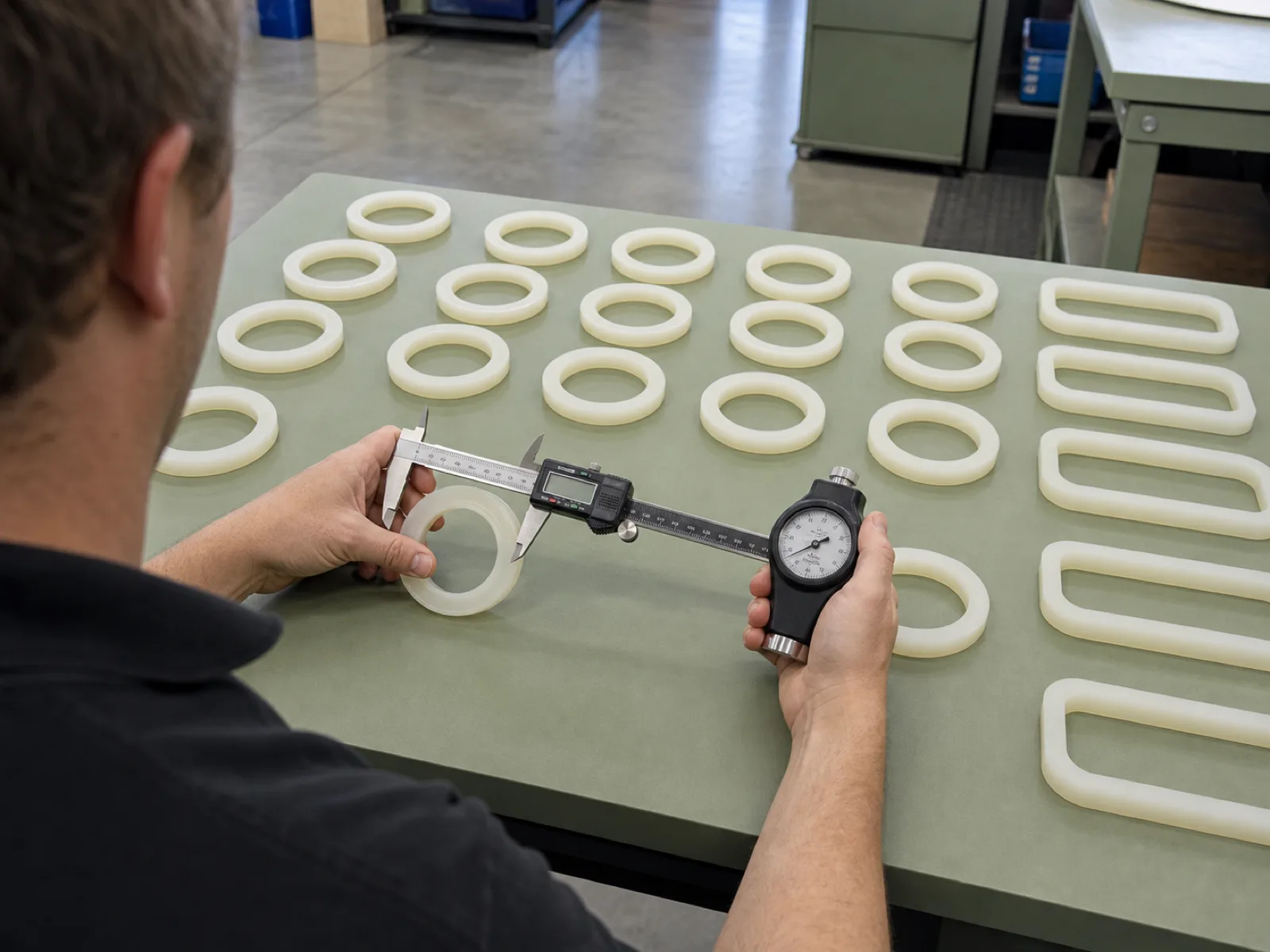 Buyer Guide
 A silicone rubber gasket is a molded or die-cut VMQ, FVMQ, or PVMQ elastomer part engineered to seal flanged or bolted joints from -60°C to +230°C with compression set under 25% per ASTM D395 Method B. Standard specification stacks Shore A 50-70 durometer, ISO 3302-1 M2 dimensional tolerance, and an ASTM D2000 line call-out that fixes hardness, heat-aging class, and compression-set class in one line. Wetop compression-molds custom silicone rubber gaskets at MOQ 500 with 35-55 day drawing-to-FAI lead time from a 7,500 m² ISO 9001 factory in Dongguan.
This guide is the engineering-desk reference for buyers writing a silicone rubber gasket specification — material grade selection (VMQ / FVMQ / PVMQ), Shore A durometer selection, ASTM D2000 line call-out decoding, compression-set target math, ISO 3302-1 tolerance grades, chemical compatibility, manufacturing-method selection between compression / die-cut / LSR, MOQ and tooling economics, and a complete RFQ checklist. Every recommendation attaches to a specific number, cert clause, or process step. If you write it into a drawing before your next RFQ, the factory will price it correctly the first pass and the FAI sample will land in your inbox in 35-55 days.
What is a silicone rubber gasket and where does it fit versus other elastomers?
A silicone rubber gasket is a compression-molded, die-cut, or injection-molded polysiloxane elastomer part that seals flanged joints against pressure, temperature, and fluid ingress. Compared to nitrile (NBR), EPDM, or fluorocarbon (FKM/Viton), silicone wins on temperature range (-60°C to +230°C), UV and ozone resistance, and food-contact certifiability — but loses on fuel/oil resistance and abrasion durability.
Silicone earns its place in the elastomer selection matrix by decoupling three properties that other rubbers force you to trade against each other: wide temperature range, food and medical safety, and long-term compression-set stability. NBR is cheaper and better on oil. FKM handles harsher chemistry above 200°C. EPDM handles water and steam better in some sanitary contexts. But no other commodity elastomer clears FDA 21 CFR 177.26001 and USP Class VI2 biocompatibility at the same time as -60°C to +230°C service.
For most gasket buyers — food-processing OEMs, kitchenware brands, medical-device contract manufacturers, HVAC and appliance builders — silicone is the answer when the spec sheet lists “food-safe” or “high-temp” or “flexible below zero.” When the spec sheet lists “diesel fuel contact” or “hydraulic oil at 150°C,” look at FVMQ (fluorosilicone) or FKM instead. Our companion guide on high-temperature silicone gasket specs covers the heat-aging math in more depth for continuous service above 200°C.
Which silicone material grade should I specify — VMQ, FVMQ, or PVMQ?
VMQ (methyl vinyl silicone) is the default for 90% of gasket applications — food-grade, -60°C to +230°C, cheapest. FVMQ (fluorosilicone) adds fluorine substituents to resist fuels, oils, and aromatic hydrocarbons that swell VMQ 30-50%. PVMQ (phenyl vinyl silicone) adds phenyl groups to push the low-temperature limit to -100°C for aerospace, cryogenic, and Arctic-service applications.
The three families are not interchangeable and the cost delta is significant. Specifying FVMQ when VMQ would work doubles material cost and stretches lead time — the base compound is a specialty grade that most Chinese factories do not stock. Specifying PVMQ when VMQ would work triples material cost and forces custom compounding for any order under 500 kg of finished parts.
Decision matrix — silicone rubber gasket material grades
| Property | VMQ (standard) | FVMQ (fluorosilicone) | PVMQ (phenyl silicone) |
|---|---|---|---|
| Continuous service temperature | -60°C to +230°C | -55°C to +260°C | -100°C to +230°C |
| Fuel / oil resistance | Poor (30-50% swell) | Excellent (< 10% swell) | Poor |
| Food contact (FDA 21 CFR 177.2600) | Yes (platinum-cured) | Yes (limited grades) | Rare |
| USP Class VI biocompatibility | Yes (medical grade) | Yes | Yes |
| Typical Shore A range | 30-80 | 40-80 | 40-80 |
| Relative material cost | 1.0× | 1.8-2.2× | 2.5-3.0× |
| Typical MOQ (compound availability) | Any | 500 kg | 200 kg (custom compound) |
Rule of thumb from the engineering desk: default to VMQ unless one of three conditions is present — (1) the sealed fluid is a petroleum-based fuel, oil, or aromatic hydrocarbon (spec FVMQ); (2) service temperature drops below -60°C (spec PVMQ); (3) a customer standard from aerospace, defense, or automotive explicitly calls out FVMQ or PVMQ by MIL-DTL, AMS, or SAE J number.
What Shore A hardness should I specify for a silicone rubber gasket?
Shore A 40-50 for low-torque static seals against rough, warped, or waved mating surfaces. Shore A 60-70 for high-torque bolted flanges and dynamic seals where extrusion resistance matters. Under 40 the gasket cold-flows under sustained load; over 70 it will not conform to flange waviness and starts leaking on the first bolt-load variance. Measured per ASTM D2240 with a Type A durometer.
Shore A hardness on a silicone rubber gasket is the single most-abused spec on the drawing. Buyers copy “Shore A 70” from a generic template because it sounds hard-wearing, then wonder why the gasket weeps at every bolt in a sheet-metal enclosure. The physics: a Shore A 70 gasket needs roughly 40% more bolt-load per linear inch of seal to achieve the same conformance depth as a Shore A 50 gasket. If the flange design cannot deliver that load — because it is sheet metal, or plastic, or thin cast aluminum — the Shore A 70 gasket will leak.
The correct question is not “how hard should the gasket be?” but “what is the surface finish and load-carrying capacity of the flange?” Rough or warped mating surfaces (Ra > 3.2 μm, or flange waviness > 0.5 mm) need soft gaskets that conform. Machined flanges (Ra < 1.6 μm) with rigid backing structure can carry harder gaskets.
Shore A selection table for silicone rubber gaskets
| Shore A | Application class | Typical use case | Sealing pressure limit |
|---|---|---|---|
| 30-40 | Ultra-soft conformance | Fabric-backed insulation seals, gap fillers | < 0.05 MPa |
| 40-50 | Low-torque static | Sheet-metal enclosures, plastic housings, oven-door lips | 0.05-0.3 MPa |
| 50-60 | Standard bolted flange | Food-processing flanges, appliance seals, sink grids | 0.3-1.0 MPa |
| 60-70 | High-torque static | Machined metal flanges, sanitary tri-clamp, pressure-cooker rings | 1.0-3.0 MPa |
| 70-80 | Extrusion-resistant | O-ring back-ups, dynamic seals on rotary shafts | > 3.0 MPa (with retention groove) |
Cross-check the compression math with our Shore A hardness silicone chart for the full deflection-vs-load curve at each durometer.
What temperature range and compression-set target should I write into the spec?
Write continuous service temperature (-60°C to +230°C for standard VMQ) plus the compression-set target at that temperature per ASTM D395 Method B. The industry ship-gate is ≤ 25% compression set at 175°C / 22 hr for a post-cured Shore A 60 platinum silicone. Peroxide-cured or unposted silicone drifts to 35-45% under the same test — enough to lose sealing pressure on a bolted joint within one heat cycle.
Compression set is the single most predictive metric of long-term sealing reliability. A gasket that starts life at 20% compression under bolt-load and takes 30% compression set will only recover to 6% of its original compressed height after unloading — meaning the joint is now 14% under-sealed and leaks on the next pressure cycle. This is why 25% compression set is the standard ship-gate. Under it, the gasket recovers enough to hold seal across thermal and pressure cycling for a 5-10 year service life.
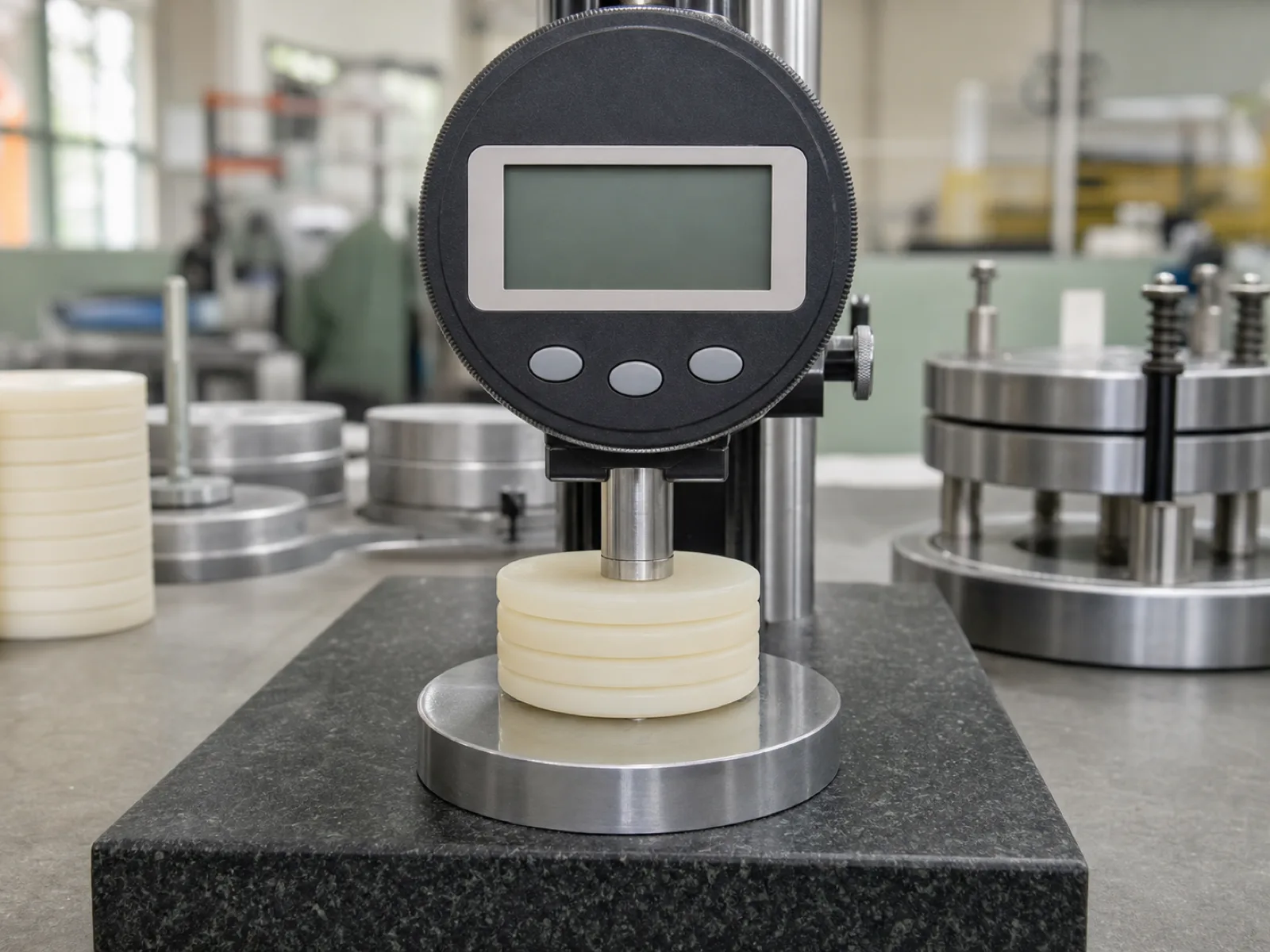
The four temperature-and-time specifications on a gasket drawing
- Continuous service temperature — the temperature the gasket sees for > 1000 hr cumulative service. Standard VMQ: 230°C ceiling.
- Intermittent temperature — spikes tolerable for < 100 hr cumulative. VMQ: 260°C.
- Peak temperature — spikes tolerable for < 30 min cumulative. VMQ: 315°C (per ASTM D5733).
- Low-temperature limit — the temperature below which the gasket glasses out and loses conformance. VMQ: -60°C. PVMQ: -100°C.
Write all four numbers into the spec, plus the target compression set at the continuous service temperature. Then the factory can compound-select and post-cure schedule correctly on the first pass.
How do I read an ASTM D2000 line call-out for a silicone rubber gasket?
ASTM D2000 is a shorthand classification that fixes rubber grade, heat-aging class, compression-set class, hardness, and tensile strength on a single line. A standard food-grade silicone gasket call-out reads M4GE705 A19 B37 EO14 F17. Decoded: SI units, quality grade 4, 175°C heat class, 25% max compression set, Shore A 70 ±5, 5 MPa tensile, plus fluid-immersion and cold-flex overrides.
D20004 compresses what would be a full-page material specification into a one-line call-out that any competent rubber factory can quote against without a phone call. Most buyers do not write D2000 call-outs because most template drawings do not require them. Writing one on the drawing signals to the factory that you know what you want, reduces RFQ back-and-forth by two rounds, and locks the material class before compound selection begins.
Worked example — M4GE705 A19 B37 EO14 F17 decoded
| Segment | Position | Meaning |
|---|---|---|
| M | Prefix | SI metric units |
| 4 | Grade number | Quality control level 4 (elevated inspection) |
| G | Type | Heat-aging class G — 70 hr at 175°C, tensile change ≤ ±30%, elongation change ≤ -50%, hardness change ≤ ±15 |
| E | Class | Compression set class E — 25% max at 175°C / 22 hr per ASTM D395 Method B |
| 7 | Hardness (Shore A / 10) | Shore A 70 ± 5 per ASTM D2240 |
| 05 | Tensile strength (MPa) | 5 MPa minimum tensile |
| A19 | Suffix | Heat resistance override — 70 hr at 200°C |
| B37 | Suffix | Compression set override — 25% max at 200°C / 22 hr |
| EO14 | Suffix | Fluid resistance — IRM 903 oil, 70 hr at 100°C, ≤ 60% volume swell |
| F17 | Suffix | Low-temperature brittleness — no fracture at -55°C per ASTM D2137 |
This one line replaces roughly 400 words of material specification prose. When the drawing carries it plus a Shore A tolerance and a dimensional tolerance grade, the RFQ moves straight to DFM review — no material clarification round required.
What tolerances can I hold on a molded silicone rubber gasket?
ISO 3302-1:2014[^iso-3302-1] class M2 (±0.10 mm on a 10 mm feature) is the default we hold on compression-molded silicone gaskets. Class M1 (±0.05 mm) is achievable on LSR injection with a hardened multi-cavity mold and matched-metal tool clamping. Die-cut sheet-stock gaskets sit at class M3 (±0.20 mm) — adequate for large flat flanges, insufficient for O-ring cross-sections or precision groove fits.
Silicone shrinks 2-4% from mold temperature to ambient because the polymer network densifies as it cools. Tolerance grades are therefore expressed as a function of feature size — a 10 mm hole and a 100 mm outside diameter cannot share the same absolute tolerance. ISO 3302-1 formalizes this into four classes (M1-M4) that scale with feature size, and specifies both molded features (across mold parting lines) and non-molded features (in one cavity half).
ISO 3302-1 tolerance grades — silicone gasket features
| Feature size | M1 (LSR high-precision) | M2 (compression standard) | M3 (die-cut / general) | M4 (loose commercial) |
|---|---|---|---|---|
| 0-4 mm | ±0.08 mm | ±0.10 mm | ±0.20 mm | ±0.40 mm |
| 4-6.3 mm | ±0.10 mm | ±0.15 mm | ±0.25 mm | ±0.50 mm |
| 10-16 mm | ±0.20 mm | ±0.25 mm | ±0.40 mm | ±0.80 mm |
| 25-40 mm | ±0.40 mm | ±0.50 mm | ±0.80 mm | ±1.60 mm |
| 100-160 mm | ±0.90 mm | ±1.20 mm | ±2.00 mm | ±4.00 mm |
Practical rule: specify M2 for compression-molded gaskets, M3 for die-cut flat gaskets, M1 for LSR injection when the drawing demands it. Do not specify M1 on a compression tool — the process cannot hold it consistently and the factory will either quote 3× on a hardened tool or silently ship M2 parts.
Compression molding vs die-cutting vs LSR injection — which method should I specify?
Die-cut sheet stock wins under 2,000 units for flat gaskets with M3 tolerances. Compression molding wins at 500-20,000 units for custom profiles, O-ring cross-sections, and thick or three-dimensional geometries. LSR injection wins above 20,000 units, for tight M1 tolerances, or when the gasket includes overmolded metal inserts or complex undercuts. Cost crossover math below.
The manufacturing method choice on a silicone rubber gasket is often forced by geometry and volume before the buyer has any input. A flat 200 mm × 300 mm sanitary flange gasket at 500 pcs annual is a die-cut part — no rational factory would tool a compression mold for it. A 40 mm O-ring at 50,000 pcs annual is an LSR injection part — no rational factory would compression-mold it. The middle ground — 500-20,000 units with a custom profile — is where compression molding dominates.
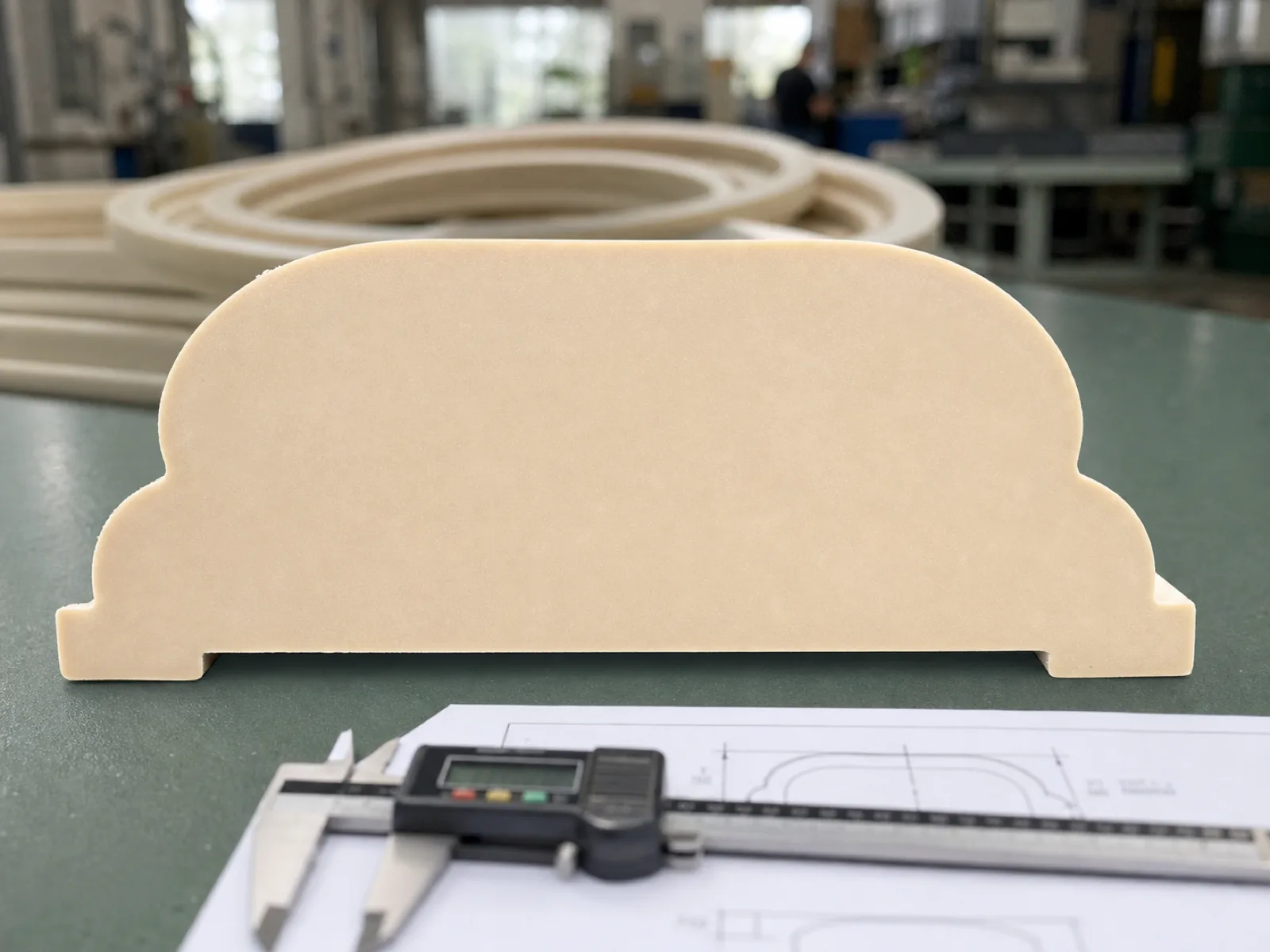
Cost-crossover math per manufacturing method
| Method | Tooling cost | Per-piece variable | Break-even volume | Best-fit profile |
|---|---|---|---|---|
| Die-cut sheet | $150-500 (steel-rule die) | $0.10-0.80 | 0-2,000 units | Flat, large outline, M3 tolerance |
| Compression molding | $2,500-6,000 (single-cavity aluminum) | $0.30-2.50 | 500-20,000 units | Custom profile, O-ring cross-section, M2 tolerance |
| LSR injection | $12,000-45,000 (multi-cavity hardened steel) | $0.15-1.20 | 20,000+ units | Complex geometry, overmolded inserts, M1 tolerance |
At MOQ 500 with a 60-day payback expectation, compression molding is the only method that closes the tooling-amortization math cleanly. Our MOQ and lead-time guide walks through the 60-day payback logic in more detail.
What is the standard MOQ, lead time, and RFQ checklist for a custom silicone rubber gasket?
MOQ 500 per SKU on compression-molded custom silicone rubber gaskets — the threshold where single-cavity tooling amortizes on a 60-day payback. Lead time is 35-55 days from drawing lock to First Article Inspection sample: 5 days DFM review, 15-25 days tool build, 7 days T0 sample, 5-10 days customer approval, 3-8 days first production run.
Below MOQ 500, either the tooling cost eats the unit price (compression) or the factory declines to quote (LSR injection). Above MOQ 500, the factory absorbs tooling into the per-piece price on the first production run and the buyer sees a landed cost that is competitive with die-cut sheet gaskets — with a proper molded profile, tighter tolerances, and per-lot certification.
RFQ checklist — what to send the factory
- Drawing — 2D PDF with dimensions and tolerances, or 3D STEP file. Dimensions with tolerances (M1/M2/M3 per ISO 3302-1).
- Material — VMQ / FVMQ / PVMQ, cure system (platinum-cured for food/medical), Shore A ± range.
- Service conditions — continuous temperature, intermittent temperature, sealed medium (name the chemistry, not just “fluid”), pressure.
- Certifications required — FDA 21 CFR 177.2600, LFGB §30/31, USP Class VI, NSF/ANSI 515, UL 94 V-0, MIL-DTL number.
- Annual volume — expected units per year, blanket-order commitment, forecast horizon.
- Color — Pantone or RAL number, ΔE tolerance target (ΔE < 2 achievable on masterbatch color).
- Packaging — bulk poly bag, individual poly bag, cleanroom-packed (Class 100,000), export carton spec.
- Documentation — Certificate of Conformity per lot, dimensional FAI report, material certification, RoHS/REACH declaration.
Feed all eight into the RFQ on the first pass and the factory quotes correctly the first time. Skip any of them and the RFQ takes two extra rounds. Wetop runs an ISO 90016 quality system that logs every one of these fields against the batch record — the certification chain is auditable at the SKU-and-lot level.
References
Talk to the engineering desk about your silicone rubber gasket program
Send a drawing plus the eight RFQ-checklist fields above and we come back inside 48 hours with a compound recommendation, tool concept, and unit-price bracket at MOQ 500 / 2,000 / 10,000. First Article Inspection sample lands in your inbox 35-55 days after drawing lock. Start an RFQ with the engineering desk or download our mutual NDA if drawings need to move under coverage before we begin.
Footnotes
-
21 CFR 177.2600 — Rubber Articles Intended for Repeated Use, US Food and Drug Administration, https://www.ecfr.gov/current/title-21/chapter-I/subchapter-B/part-177/subpart-C/section-177.2600 ↩
-
USP <88> Biological Reactivity Tests, In Vivo — Class VI Plastics, United States Pharmacopeia, https://www.usp.org/harmonization-standards/pdg/excipients/plastic-materials ↩
-
ASTM D573 — Standard Test Method for Rubber — Deterioration in an Air Oven, ASTM International, https://www.astm.org/d0573-04r19.html ↩
-
ASTM D2000 — Standard Classification System for Rubber Products in Automotive Applications, ASTM International, https://www.astm.org/d2000-18.html ↩
-
NSF/ANSI 51 — Food Equipment Materials, NSF International, https://www.ecfr.gov/current/title-21/chapter-I/subchapter-B/part-177 ↩
-
ISO 9001:2015 — Quality Management Systems — Requirements, International Organization for Standardization, https://www.iso.org/standard/62085.html ↩
FAQ
-
What is a silicone rubber gasket made of?
A silicone rubber gasket is molded or die-cut from polydimethylsiloxane elastomer — most commonly VMQ (methyl vinyl silicone) for general sealing, FVMQ (fluorosilicone) for fuel/oil contact, or PVMQ (phenyl silicone) for extreme low-temperature use. Platinum-cured VMQ at Shore A 50-70 is the default for food-contact and medical seals.
-
What temperature range does a silicone rubber gasket cover?
Standard platinum-cured VMQ handles -60°C to +230°C continuous service with intermittent spikes to +315°C for under 30 minutes per ASTM D573. FVMQ extends the ceiling to +260°C continuous; PVMQ pushes the floor to -100°C. Below or above these limits, the siloxane backbone glasses out or scissions and the gasket loses sealing pressure.
-
How do I choose Shore A hardness for a silicone gasket?
Shore A 40-50 for low-torque static seals against rough or waved surfaces (sheet-metal enclosures, plastic housings). Shore A 60-70 for high-torque bolted flanges where extrusion resistance matters. Under 40 the gasket cold-flows; over 70 it will not conform to surface irregularity and leaks under any bolt-load variance.
-
What is the difference between VMQ, FVMQ, and PVMQ silicone gasket material?
VMQ is standard silicone — cheapest, food-grade, -60°C to +230°C. FVMQ has fluorine substituents on the polymer backbone — resists fuels, oils, and aromatic hydrocarbons that swell VMQ 30-50%. PVMQ has phenyl groups — pushes the low-temperature limit to -100°C for aerospace and cryogenic use. Cost delta is roughly 1× / 2× / 2.5×.
-
How do I read an ASTM D2000 line call-out for a silicone gasket?
ASTM D2000 M4GE705 A19 B37 decodes as: M = SI metric units, 4 = grade quality level 4, G = 175°C heat-aging class, E = 25% max compression set class, 7 = 70 Shore A hardness (±5), 05 = tensile strength 5 MPa min. The A/B/EO suffixes add oil-swell and heat-resistance overrides. Full worked example in §5.
-
What tolerances can I hold on a molded silicone rubber gasket?
ISO 3302-1 M2 (±0.10 mm on a 10 mm feature) on compression-molded silicone gaskets is the default we hold at Wetop. M1 (±0.05 mm) is achievable on LSR injection with a hardened multi-cavity mold. Die-cut sheet gaskets sit at M3 (±0.20 mm) — fine for large flat flanges, insufficient for precision O-ring grooves.
-
Compression molding vs die-cutting vs LSR injection — which is right for my gasket?
Die-cut sheet stock wins under 2,000 units and for flat gaskets with generous tolerances. Compression molding wins at 500-20,000 units for custom profiles and O-ring cross-sections. LSR injection wins above 20,000 units and for complex geometries with tight tolerances or overmolded features. Cost crossover discussed in §7.
-
What is the MOQ for a custom silicone rubber gasket?
MOQ 500 per SKU on Wetop compression-molded gaskets — the floor where single-cavity tool amortizes cleanly on a 60-day payback. Die-cut sheet gaskets ship at MOQ 100 with no tooling. LSR injection programs require MOQ 2,000 to amortize the 4-8 cavity hardened mold across the first production run.
-
Is a silicone rubber gasket food-safe and FDA compliant?
Yes — platinum-cured VMQ silicone at Shore A 50-70, post-cured 4 hours at 200°C, clears FDA 21 CFR 177.2600 and LFGB §30/31 while handling -60°C to +230°C service. This is the standard grade for food-processing flange seals, sanitary tri-clamp gaskets, and beverage-line O-rings. NSF-51 adds potable-water certification for water dispensers.
-
What information do I need to send for a silicone gasket RFQ?
Send a 2D drawing with dimensions and tolerances (or a 3D STEP file), target Shore A hardness, service temperature and duration, sealed medium (chemical name, not just 'fluid'), required certifications (FDA / LFGB / USP / UL), annual volume, and MOQ tolerance. RFQ checklist template linked in the CTA below.
References
Authoritative sources cited in this guide
- ASTM International. ASTM D2000 — Standard Classification System for Rubber Products in Automotive Applications. https://www.astm.org/d2000-18.html
- ASTM International. ASTM D395 — Standard Test Methods for Rubber Property — Compression Set. https://www.astm.org/d0395-18.html
- ASTM International. ASTM D2240 — Standard Test Method for Rubber Property — Durometer Hardness. https://www.astm.org/d2240-15r21.html
- ASTM International. ASTM D573 — Standard Test Method for Rubber — Deterioration in an Air Oven. https://www.astm.org/d0573-04r19.html
- International Organization for Standardization. ISO 3302-1:2014 — Rubber — Tolerances for Products — Dimensional Tolerances. https://www.iso.org/standard/61812.html
- US Food and Drug Administration. 21 CFR 177.2600 — Rubber Articles Intended for Repeated Use. https://www.ecfr.gov/current/title-21/chapter-I/subchapter-B/part-177/subpart-C/section-177.2600
- International Organization for Standardization. ISO 9001:2015 — Quality Management Systems — Requirements. https://www.iso.org/standard/62085.html
- United States Pharmacopeia. USP <88> Biological Reactivity Tests, In Vivo — Class VI Plastics. https://www.usp.org/harmonization-standards/pdg/excipients/plastic-materials
- NSF International. NSF/ANSI 51 — Food Equipment Materials. https://www.ecfr.gov/current/title-21/chapter-I/subchapter-B/part-177
Start a custom program
Send a brief. Get an engineer’s reply in one business day.
Every Wetop program is tooled from a customer’s specification. Send a CAD file (STEP · IGES · DWG) or a written brief and we’ll reply with a mold cost estimate, price brackets at MOQ 500 / 1,000 / 5,000, and any engineering questions.