Buyer Guide · commercial intent
Silicone Suction Placemat Plate Manufacturer — OEM Guide
 Buyer Guide
 A qualified silicone placemat plate manufacturer runs 100% platinum-cured food-grade silicone to FDA 21 CFR 177.2600 and LFGB §30/31, holds 3-5 kgf suction pull on smooth high-chair trays, and ships a complete children's product compliance stack (CPSIA, ASTM F963, CPC, tracking label) with every PO. Two-piece designs cost 20-30% less but hold only 1.5-2.5 kgf and fail most Tier-A retail QA. OEM MOQ at Wetop is 500 units on stock color, 2,000 on custom Pantone, with unit prices from $1.80-3.40 depending on volume and process.
The baby-feeding aisle has professionalized fast. What was a novelty category five years ago now runs on the same specification discipline as sink-brand tabletop programs: a Tier-2 US retail chain reviewing a private-label silicone suction placemat plate expects a per-lot CoA, third-party CPSIA test data, a signed CPC, a permanent tracking label, and a suction pull-force test on the exact chair-tray material they merchandise. This guide is written for the sourcing lead, product engineer, or founder-operator who has to hand a real spec sheet to a factory and know what the answers should look like. Every number below is what our engineering desk in Dongguan actually holds on production runs — no benchmarks pulled from Alibaba listings, no “premium quality” phrasing.
What is a silicone suction placemat plate?
A silicone suction placemat plate is a one-piece platinum-cured silicone plate whose flat underside forms a continuous suction ring that grips a smooth high-chair tray. Bowl, divider walls, and mat base are molded as a single seamless part in one cavity, giving 3-5 kgf resistance to a toddler's throw-and-tip pull. Two-piece designs use a separable base and hold roughly half that force.
The category was defined by ezpz’s original Happy Mat — a divided plate + placemat molded as one piece of food-grade silicone. Everything that followed splits into two design families:
- One-piece integrated — plate, dividers, and mat base are one silicone shot. Highest suction, dishwasher-safe end-to-end, single-material CPSIA stack. This is what serious baby brands ship.
- Two-piece modular — a silicone suction base with a removable bowl (bamboo, PP, or a second silicone piece). Cheaper per unit, easier to hand-wash the bowl, but half the pull force and a multi-material compliance package.
A retail buyer choosing between them is really choosing between suction reliability and cost. For a Tier-A brand or a Home-Depot-tier private label, one-piece is the only defensible choice; for entry-price Amazon SKUs the two-piece math sometimes works.
What food-grade material specs does a silicone placemat plate need?
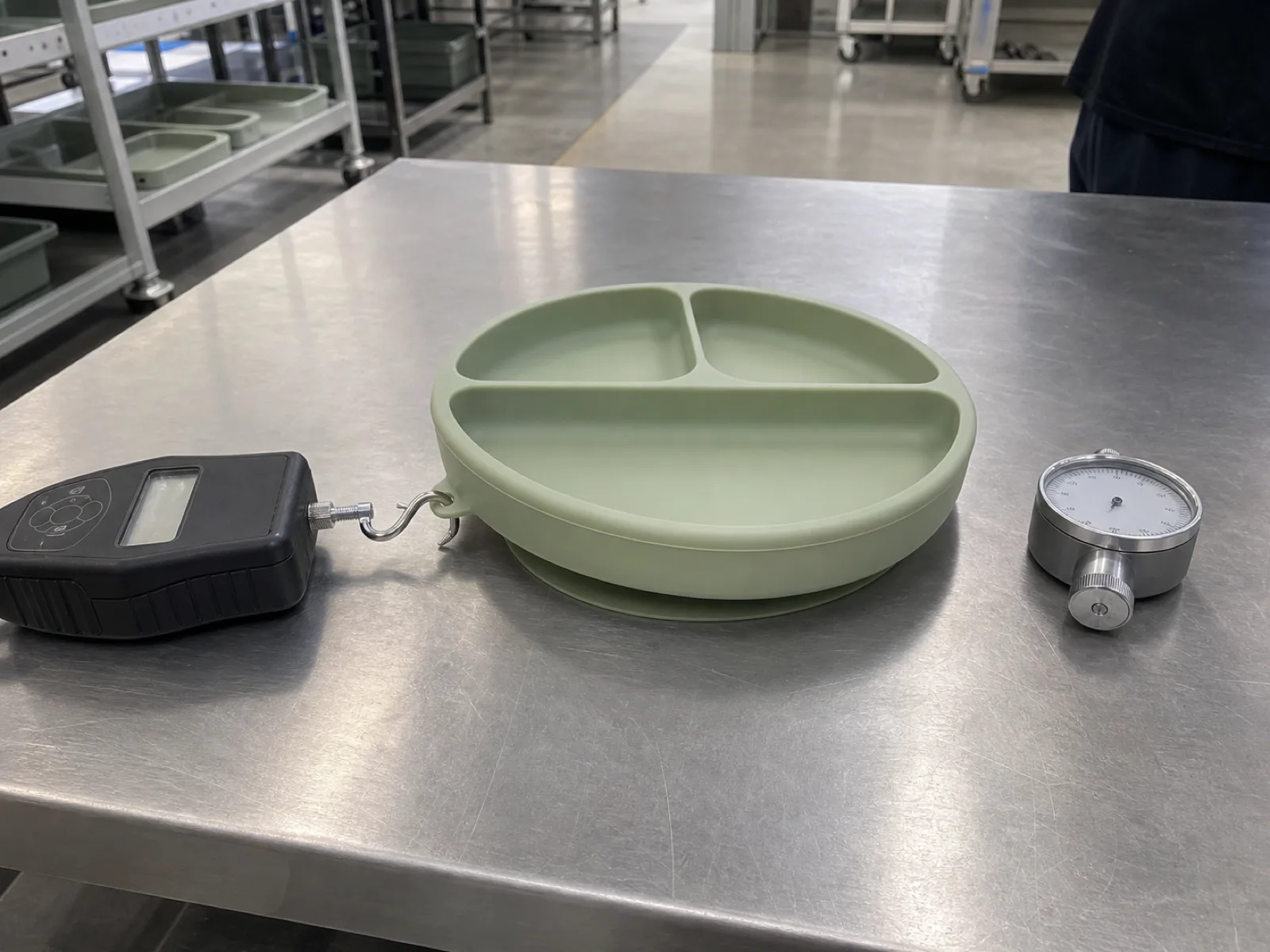
A children's silicone suction placemat plate must be molded from 100% platinum-cured food-grade silicone, cleared to FDA 21 CFR 177.2600 and LFGB §30/31, with 4-hour minimum post-cure to strip residual volatiles. Peroxide-cured compounds without post-cure typically fail extractables and can leave a metallic aftertaste. Shore A hardness runs 45-60 for a soft-feel bowl body and 55-65 for the suction lip.
Material stack we run on baby-line SKUs, referenced against the primary standards[^fda-177-2600] [^eu-1935-2004]:
| Property | Target | Test method |
|---|---|---|
| Cure system | Platinum (addition-cure) | Supplier CoA + FTIR spot check |
| Base compound | Food-grade LSR or HCR, virgin | FDA 21 CFR 177.2600 |
| Shore A (bowl body) | 45-60 | ASTM D2240[^astm-d2240] |
| Shore A (suction lip) | 55-65 | ASTM D2240 |
| Tensile strength | ≥ 8 MPa | ASTM D412 |
| Elongation at break | ≥ 400% | ASTM D412 |
| Post-cure | 200 °C × 4 h minimum | Internal SOP + LFGB extractables |
| Working temperature | -40 °C to 230 °C | Continuous service |
| Lead content | < 90 ppm substrate | CPSIA §101[^cpsia-101] |
| Total phthalates | < 0.1% | CPSIA §108[^cpsia-108] |
| PFAS | Non-detect | AB 1200 declaration |
Peroxide-cured compounds are cheaper by roughly $0.80-1.20/kg but throw a peroxide-decomposition byproduct (dicumyl residue) that has to be post-cured out. Skipping post-cure to save four hours of oven time is the single most common quiet failure mode on cheap Alibaba supply — the plate tests fine on first sample, then fails LFGB after a lot changes.
How does suction actually work, and what pull force should you specify?
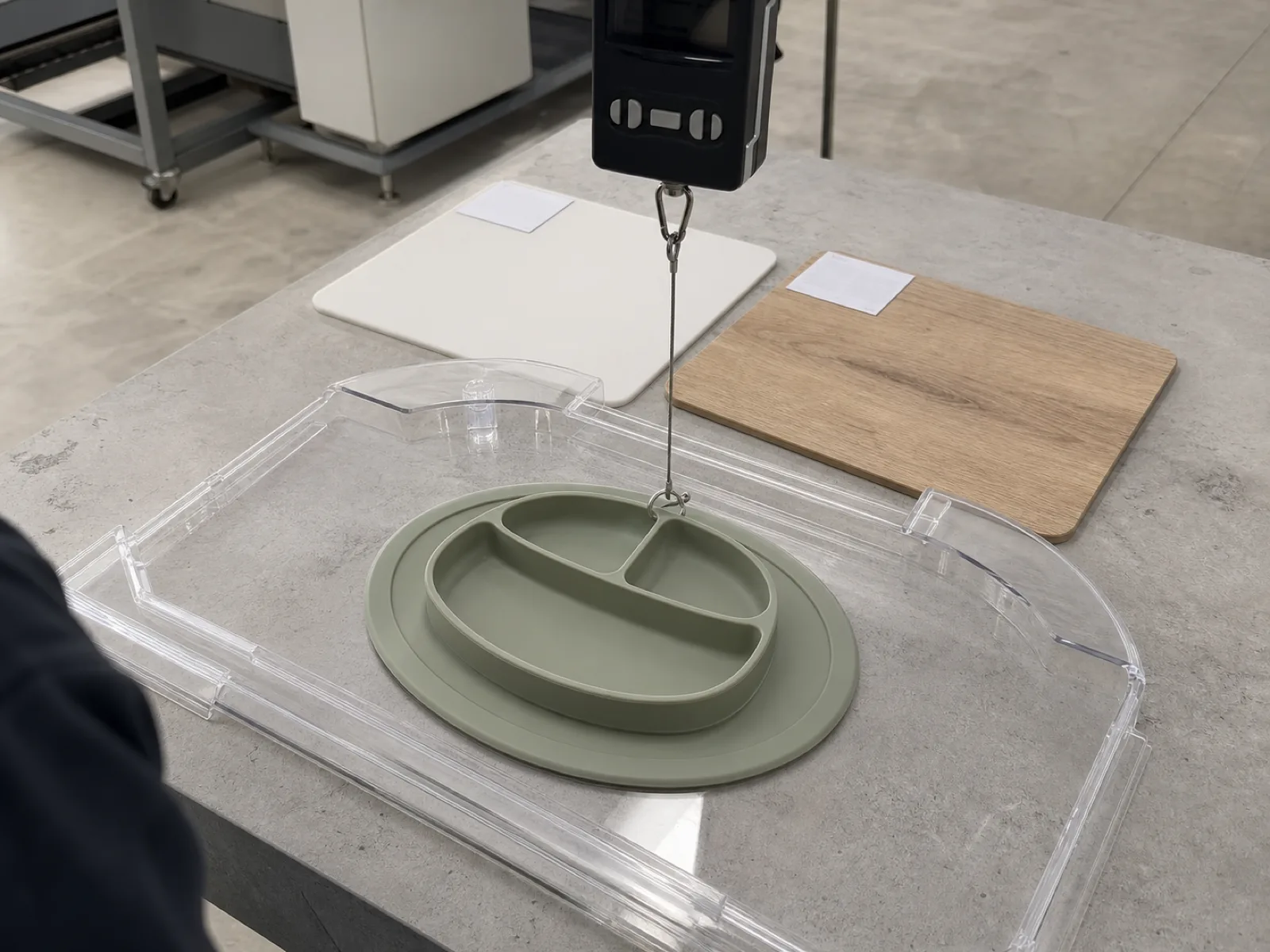
Suction on a silicone placemat plate is an air-seal problem, not a friction problem. A continuous lip pressed against a smooth non-porous surface creates a partial vacuum; the pull force needed to break that vacuum is what a retail buyer measures with a straight-pull force gauge. Tier-A US baby brands specify 3.5 kgf minimum on smooth acrylic or PP high-chair trays at 23 °C. Amazon private-label typically accepts 2.5 kgf.
The physics is simple: force to break the seal = (atmospheric pressure) × (sealed area) × (seal efficiency). What varies between a factory-A and factory-B plate is seal efficiency, and that comes from three tunable parameters:
- Lip radius — too sharp and it tears micro-air-channels; too rounded and the seal never fully engages. Sweet spot is a 0.8-1.2 mm radius on a 60 Shore A compound.
- Lip continuity — any parting-line flash, sink mark, or knit line across the lip is a leak path. Compression molding leaves flash that must be die-cut; LSR injection with cold-runner tooling flashes zero.
- Dual-seal geometry — a single outer lip fails on any tabletop with grain. A concentric inner ring 40-50 mm inside the outer lip creates a second seal zone, so if the outer lip breaks contact on a wood-grain valley, the inner ring still holds.
Test method we run on every first article: calibrated Imada digital force gauge, straight-up pull at 100 mm/min, three surfaces (acrylic, PP, oak), three temperatures (5 °C fridge / 23 °C ambient / 65 °C post-wash), three plates per lot. Buyers who copy their spec from an Amazon listing without a defined test surface end up disputing every QC report — always name the surface. See our MOQ and lead time guide for how these test cycles fold into the sampling schedule.
What children’s product compliance stack does a US buyer need?
A US-sold silicone suction placemat plate for children under 12 needs six documents on file before shipment: CPSIA §101 lead-in-substrate report, CPSIA §108 phthalate report, ASTM F963 mechanical & small-parts test, FDA 21 CFR 177.2600 food-contact report, a signed Children's Product Certificate (CPC) citing a CPSC-accepted third-party lab, and a permanent tracking label per §103. Amazon and Walmart both block listings without this stack.
The stack, in the order buyers usually forget them:
| # | Document | Standard | Frequency | Who signs |
|---|---|---|---|---|
| 1 | Lead content report | CPSIA §101[^cpsia-101] | Per compound (annual) | CPSC-accepted lab |
| 2 | Phthalate report | CPSIA §108[^cpsia-108] | Per compound (annual) | CPSC-accepted lab |
| 3 | Mechanical & small parts | ASTM F963[^astm-f963] | Per SKU + design change | CPSC-accepted lab |
| 4 | Food-contact test | FDA 21 CFR 177.2600[^fda-177-2600] | Per compound (annual) | Any FDA-recognized lab |
| 5 | Children’s Product Certificate (CPC) | CPSIA §102 | Per SKU + PO | Importer of record |
| 6 | Permanent tracking label | CPSIA §103[^cpsc-tracking-labels] | Every unit | Factory |
The tracking label is the one that trips new brands: it must be permanent (not a hangtag), legible for the life of the product, and encode manufacturer, location, production date, and batch code. On silicone, that means in-mold debossing — an ink stamp will not survive dishwasher cycles. We cut it into the tool at DFM, not after. For a full walkthrough of what “children’s product compliance” actually means at the compound level, cross-reference our is silicone safe explainer and the FDA-vs-LFGB primer.
Compression or LSR — which molding process fits a silicone placemat plate program?
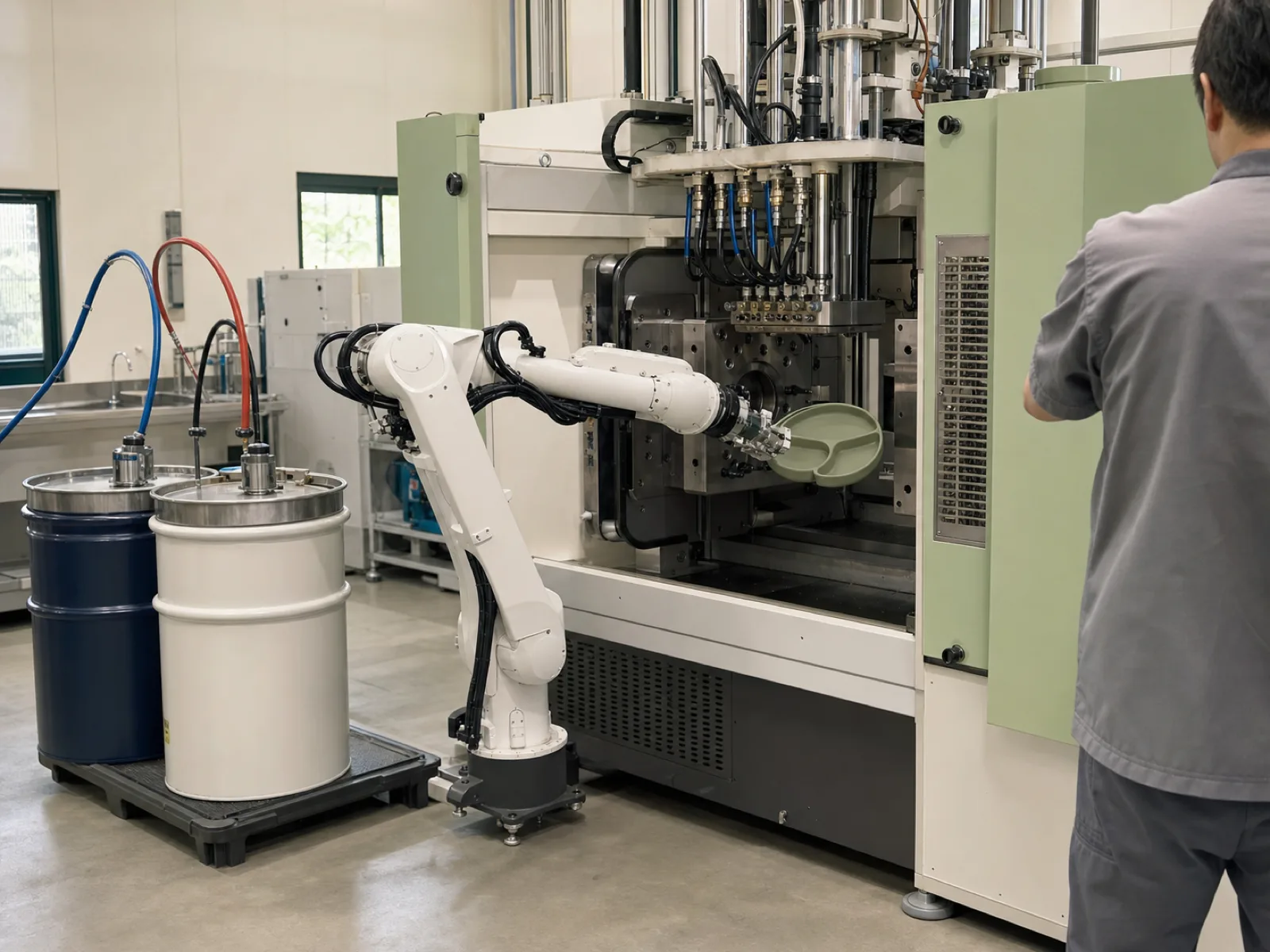
LSR (liquid silicone rubber) injection molding is the correct choice for silicone suction placemat plate programs above 20,000 units per SKU per year — it delivers ±0.05 mm tolerance, flash-free suction lip, fully automatic cycle, and better Pantone consistency. HCR compression molding wins on tooling cost and on shorter runs under 10,000 units. Both use the same platinum-cured food-grade base compound and both clear FDA 21 CFR 177.2600.
Side-by-side, holding all else equal on a 220 g one-piece placemat plate:
| Parameter | LSR injection | HCR compression |
|---|---|---|
| Tooling cost (single-cavity) | $4,200-6,800 | $1,800-2,800 |
| Tool life (shots) | 250,000-500,000 | 80,000-120,000 |
| Cycle time | 60-90 s | 180-240 s |
| Dimensional tolerance | ±0.05 mm | ±0.15 mm |
| Suction lip flash | Zero (cold runner) | Requires die-cut trim |
| Automation | Full (robot demold) | Semi (manual load) |
| Scrap rate | 1-2% | 4-6% |
| Unit cost @ 10k | Baseline | -15 to -25% |
| Break-even volume | > 20,000 units/year | Below 10,000 |
For a founder-run brand launching one SKU at 2,000 units to test conversion, compression is almost always the right call. For a Tier-2 retail private label committing to 30,000 units per year across three SKUs, LSR pays back the tooling premium inside the first PO. The Wetop capabilities page lists what we run on each cell.
What does OEM tooling, MOQ, and unit pricing actually look like?
OEM tooling for a one-piece silicone suction placemat plate runs $4,200-6,800 (LSR) or $1,800-2,800 (compression), amortized across the first two POs. MOQ at Wetop is 500 units per SKU on stock color and existing shape, 2,000 units on custom Pantone. Unit price bands on a 220 g one-piece plate: $2.90-3.40 at 500, $2.40-2.90 at 2,000, $2.10-2.60 at 10,000, $1.80-2.20 at 30,000 (LSR).
Real numbers from recent quotes. All prices are FOB Yantian, exclude packaging beyond a stock polybag, and assume platinum-cured 55-60 Shore A base compound:
| Volume (units) | LSR unit price | Compression unit price | Notes |
|---|---|---|---|
| 500 | $3.10-3.40 | — (compression MOQ 1,000) | Stock color, existing tool |
| 1,000 | $2.70-3.00 | $2.20-2.50 | Stock color |
| 2,000 | $2.40-2.90 | $1.95-2.35 | Custom Pantone available |
| 10,000 | $2.10-2.60 | $1.70-2.10 | Retail-ready polybag +$0.12 |
| 30,000 | $1.80-2.20 | $1.50-1.90 | Gift box +$0.35-0.55 |
Add-on line items buyers routinely miss when comparing quotes:
- Color master-batch: $180-320 per Pantone, one-time. Rolls into COGS at ~$0.02/unit at 10k volume.
- In-mold deboss for tracking label + brand mark: $220-420 per tool insert, one-time.
- Retail-ready polybag with UPC + FBA polybag warning: $0.10-0.14/unit.
- Full-color gift box (SBS 350gsm, 4c print, sleeve or two-piece): $0.35-0.90/unit at 10k, $0.22-0.55 at 30k.
- Third-party CPSIA + F963 test package: $850-1,400 per SKU, one-time.
- FDA 21 CFR 177.2600 report: $380-580 per compound, annual.
Watch the silicone OEM pricing structure guide for how each of these lines gets negotiated inside a full RFP.
What does the QC and testing protocol on a shipment look like?
Every production lot of a silicone suction placemat plate at Wetop ships with a per-lot Certificate of Analysis covering dimensional, durometer, and suction-pull readings across 5 randomly-pulled units per 1,000-unit sub-lot, plus a 30-cycle accelerated dishwasher test on 3 units per lot. AQL 1.5 major / 4.0 minor governs the visual inspection. Failure on any dimension triggers a full sub-lot re-inspection at factory cost.
The nine QC gates we hold on a baby-plate program:
- Incoming compound COA — durometer, tensile, elongation, ash content matched to spec.
- First article dimensional — CMM-verified against 2D drawing, ±0.05 mm (LSR) / ±0.15 mm (compression).
- Suction pull-force test — three surfaces × three temperatures, calibrated Imada gauge.
- Drop test — modeled on EN 14350 baby-feeding drop protocol, 750 mm onto sealed concrete.
- Tear strength — die C per ASTM D624, ≥ 25 kN/m.
- Compression set — 22 h at 175 °C, ≤ 25% recovery loss.
- Dishwasher aging — 30 cycles at 75 °C, dimensional + pull-force retest.
- Color ΔE — D65 light box, ΔE ≤ 1.5 vs Pantone reference chip.
- Visual + parting-line inspection — AQL 1.5 / 4.0 under 500-lux D65.
Every finding lands in a shared Google Drive folder with photo evidence per sub-lot before container release. Buyers on their first Wetop program typically ask to bring a third-party inspector (SGS, TÜV, or their own QA) on the pre-shipment audit — we welcome it and cover the factory-side coordination fee for programs above 10,000 units.
FAQ
Is silicone safe for baby plates, and what certifications does a manufacturer need?
Platinum-cured food-grade silicone is safe for baby-plate use when the finished part clears FDA 21 CFR 177.2600 (US), LFGB §30/31 (EU), CPSIA lead and phthalate limits, ASTM F963 mechanical hazards, and California Prop 65[^ca-prop65]. A qualified silicone placemat plate manufacturer ships a Certificate of Conformance, a per-lot CoA, a third-party children’s product test report, and a signed Children’s Product Certificate (CPC) — peroxide-cured silicone without a 4-hour post-cure typically fails 177.2600 extractables.
What suction pull force should a baby silicone plate hold?
Retail-grade baby silicone suction plates hold 3-5 kgf on a smooth acrylic or PP high-chair tray at 23 °C. Tier-A US baby brands specify 3.5 kgf minimum in the buyer specification; Amazon private-label typically accepts 2.5 kgf. Suction pull is measured with a calibrated force gauge pulling straight up at 100 mm/min per an internal test method modeled on ASTM D429 pull-off. Textured or wood surfaces cut pull force by 40-60% regardless of design — this is a table-surface constraint, not a factory defect.
Compression molding or LSR injection molding — which is better for a silicone suction placemat plate?
LSR injection molding is better for high-volume programs above 20,000 units per SKU per year, giving ±0.05 mm tolerance, fully automatic cycle, flash-free suction lip, and higher gloss consistency for Pantone color matching. HCR compression molding wins on tooling cost ($1,800-2,800 vs $4,200-6,800), on runs under 10,000 units, and on divided-compartment plates where a large single cavity is more forgiving. Both use the same food-grade platinum-cured base compound.
What is the MOQ and OEM pricing for a custom silicone suction placemat plate?
Wetop’s OEM MOQ is 500 units per SKU on a stock color and existing shape and 2,000 units on custom Pantone (color master-batch minimum). Unit price bands on a 200-250 g one-piece placemat plate: $2.90-3.40 at 500 units, $2.40-2.90 at 2,000, $2.10-2.60 at 10,000, $1.80-2.20 at 30,000 (LSR) — compression runs 15-25% lower per unit but with slightly higher scrap. Custom tooling amortizes across the first two POs.
What is the difference between one-piece and two-piece silicone suction placemat plates?
A one-piece silicone suction placemat plate is molded as a single platinum-cured silicone part with bowl and base integrated — no seams, dishwasher-safe end-to-end, 3-5 kgf pull. A two-piece design has a silicone suction base and a separable bowl (bamboo, PP, or a second silicone piece). Two-piece plates cost 20-30% less per unit but hold only 1.5-2.5 kgf, fail more retail QA drop tests, and complicate the CPSIA testing stack because each material needs independent lead and phthalate certificates.
What compliance documents does a US baby brand need from a silicone suction placemat plate manufacturer?
For US retail sale of a children’s product under 12 years old, the buyer needs: (1) CPSIA §101 lead-in-substrate report (<90 ppm), (2) CPSIA §108 phthalate report on any accessible flexible component (<0.1%), (3) ASTM F963 mechanical & small-parts test, (4) FDA 21 CFR 177.2600 food-contact report, (5) a signed Children’s Product Certificate (CPC) issued by the importer citing a CPSC-accepted third-party lab, (6) a permanent tracking label per §103 (production batch code, factory ID). Amazon and Walmart both require this stack pre-listing.
How does a silicone suction plate stay stuck on a wooden or textured high-chair tray?
It usually doesn’t — and no material change fixes it, because suction depends on air seal, not friction. The fix is base geometry: a continuous 4-6 mm outer lip with a concentric inner ring creates two sequential seal zones, so if the outer lip breaks contact on a wood grain, the inner ring still holds. Wetop’s engineering desk tunes the lip radius and the inner-ring diameter to the target surface in the DFM review. A flat-disc base fails on wood 90% of the time; a dual-lip base holds 60-70% of the time on lightly textured wood.
How long does silicone suction placemat plate tooling and first article take?
New LSR steel tooling for a one-piece placemat plate takes 25-30 days to cut (P20 or 2344 steel, 250,000-shot rated) plus 7-10 days for T0 → T1 → first article approval. First mass-production run at 10k units takes another 25-30 days. Compression tooling is faster — 15-18 days to cut, but shorter tool life (100,000-shot rated). Existing-tooling reorders ship in 30-35 days at 10k units including QC, CoA generation, and retail-ready packaging.
Is a silicone suction placemat plate dishwasher-safe and how does that affect QC?
Platinum-cured, fully post-cured silicone survives 500+ dishwasher cycles at 65 °C without dimensional drift or color fade below ΔE 1.5. The QC gate is a 30-cycle accelerated dishwasher test at 75 °C with dimensional check and 24-hour dry-recovery pull-force retest — a suction lip that took a compression set during high-temp wash drops 25-40% pull force and fails retail spec. Peroxide-cured plates without post-cure typically fail this test around cycle 12.
What is a silicone suction placemat plate and how is it different from a regular baby plate?
A silicone suction placemat plate is a one-piece platinum-cured silicone plate with an integrated flat placemat base whose underside forms a continuous suction ring that grips smooth tabletops and high-chair trays. Unlike a regular baby plate that sits loose, the suction lip creates a partial vacuum that resists a toddler’s throw-and-tip pull — typically 3-5 kgf on a one-piece design. Two-piece designs use a removable silicone base with a plastic or bamboo bowl and hold roughly half the pull force.
Talk to the engineering desk
If you are spec’ing a silicone suction placemat plate program — new brand launch, private label for a Tier-2 chain, or a redesign of an existing SKU that keeps failing dishwasher aging — send us the drawing, target retail surface, and expected annual volume. We return a DFM review with lip-geometry recommendations, tooling quote for both LSR and compression routes, and a full compliance-document schedule within five business days. Request a quote or read the sourcing-a-silicone-factory checklist before you send the RFP.
FAQ
-
What is a silicone suction placemat plate and how is it different from a regular baby plate?
A silicone suction placemat plate is a one-piece platinum-cured silicone plate with an integrated flat placemat base whose underside forms a continuous suction ring that grips smooth tabletops and high-chair trays. Unlike a regular baby plate that sits loose, the suction lip creates a partial vacuum that resists a toddler's throw-and-tip pull — typically 3-5 kgf on a one-piece design. Two-piece designs use a removable silicone base with a plastic or bamboo bowl and hold roughly half the pull force.
-
Is silicone safe for baby plates, and what certifications does a manufacturer need?
Platinum-cured food-grade silicone is safe for baby-plate use when the finished part clears FDA 21 CFR 177.2600 (US), LFGB §30/31 (EU), CPSIA lead and phthalate limits, ASTM F963 mechanical hazards, and California Prop 65. A qualified silicone placemat plate manufacturer ships a Certificate of Conformance, a per-lot CoA, a third-party children's product test report, and a signed Children's Product Certificate (CPC) — peroxide-cured silicone without a 4-hour post-cure typically fails 177.2600 extractables.
-
What suction pull force should a baby silicone plate hold?
Retail-grade baby silicone suction plates hold 3-5 kgf on a smooth acrylic or PP high-chair tray at 23 °C. Tier-A US baby brands (ezpz-tier, Busy Baby-tier) specify 3.5 kgf minimum in the buyer specification; Amazon private-label typically accepts 2.5 kgf. Suction pull is measured with a calibrated force gauge pulling straight up at 100 mm/min per an internal test method modeled on ASTM D429 pull-off. Textured or wood surfaces cut pull force by 40-60% regardless of design — this is a table-surface constraint, not a factory defect.
-
Compression molding or LSR injection molding — which is better for a silicone suction placemat plate?
LSR (liquid silicone rubber) injection molding is better for high-volume programs above 20,000 units per SKU per year, giving ±0.05 mm tolerance, fully automatic cycle, flash-free suction lip, and higher gloss consistency for Pantone color matching. HCR compression molding wins on tooling cost ($1,800-2,800 vs $4,200-6,800), on runs under 10,000 units, and on divided-compartment plates where a large single cavity is more forgiving. Both use the same food-grade platinum-cured base compound.
-
What is the MOQ and OEM pricing for a custom silicone suction placemat plate?
Wetop's OEM MOQ is 500 units per SKU on a stock color and existing shape and 2,000 units on custom Pantone (color master-batch minimum). Unit price bands on a 200-250 g one-piece placemat plate: $2.90-3.40 at 500 units, $2.40-2.90 at 2,000, $2.10-2.60 at 10,000, $1.80-2.20 at 30,000 (LSR) — compression runs 15-25% lower per unit but with slightly higher scrap. Custom tooling amortizes across the first two POs.
-
What is the difference between one-piece and two-piece silicone suction placemat plates?
A one-piece silicone suction placemat plate is molded as a single platinum-cured silicone part with bowl and base integrated — no seams, dishwasher-safe end-to-end, 3-5 kgf pull. A two-piece design has a silicone suction base and a separable bowl (bamboo, PP, or a second silicone piece). Two-piece plates cost 20-30% less per unit but hold only 1.5-2.5 kgf, fail more retail QA drop tests, and complicate the CPSIA testing stack because each material needs independent lead and phthalate certificates.
-
What compliance documents does a US baby brand need from a silicone suction placemat plate manufacturer?
For US retail sale of a children's product under 12 years old, the buyer needs: (1) CPSIA §101 lead-in-substrate report (<90 ppm), (2) CPSIA §108 phthalate report on any accessible flexible component (<0.1%), (3) ASTM F963 mechanical & small-parts test, (4) FDA 21 CFR 177.2600 food-contact report, (5) a signed Children's Product Certificate (CPC) issued by the importer citing a CPSC-accepted third-party lab, (6) a permanent tracking label per §103 (production batch code, factory ID). Amazon and Walmart both require this stack pre-listing.
-
How does a silicone suction plate stay stuck on a wooden or textured high-chair tray?
It usually doesn't — and no material change fixes it, because suction depends on air seal, not friction. The fix is base geometry: a continuous 4-6 mm outer lip with a concentric inner ring creates two sequential seal zones, so if the outer lip breaks contact on a wood grain, the inner ring still holds. Wetop's engineering desk tunes the lip radius and the inner-ring diameter to the target surface in the DFM review. A flat-disc base fails on wood 90% of the time; a dual-lip base holds 60-70% of the time on lightly textured wood.
-
How long does silicone suction placemat plate tooling and first article take?
New LSR steel tooling for a one-piece placemat plate takes 25-30 days to cut (P20 or 2344 steel, 250,000-shot rated) plus 7-10 days for T0 → T1 → first article approval. First mass-production run at 10k units takes another 25-30 days. Compression tooling is faster — 15-18 days to cut, but shorter tool life (100,000-shot rated). Existing-tooling reorders ship in 30-35 days at 10k units including QC, CoA generation, and retail-ready packaging.
-
Is a silicone suction placemat plate dishwasher-safe and how does that affect QC?
Platinum-cured, fully post-cured silicone survives 500+ dishwasher cycles at 65 °C without dimensional drift or color fade below ΔE 1.5. The QC gate is a 30-cycle accelerated dishwasher test at 75 °C with dimensional check and 24-hour dry-recovery pull-force retest — a suction lip that took a compression set during high-temp wash drops 25-40% pull force and fails retail spec. Peroxide-cured plates without post-cure typically fail this test around cycle 12.
References
Authoritative sources cited in this guide
- US Food and Drug Administration. 21 CFR 177.2600 — Rubber articles intended for repeated use. https://www.ecfr.gov/current/title-21/chapter-I/subchapter-B/part-177/subpart-C/section-177.2600
- US Consumer Product Safety Commission. CPSIA Section 101 — Children's Products Containing Lead. https://www.ecfr.gov/current/title-16
- US Consumer Product Safety Commission. CPSIA Section 108 — Prohibition of Children's Toys and Child Care Articles Containing Certain Phthalates. https://www.ecfr.gov/current/title-16
- ASTM International. ASTM F963-23 — Standard Consumer Safety Specification for Toy Safety. https://www.astm.org/f0963-23.html
- US Consumer Product Safety Commission. CPSIA Section 103 — Tracking Labels for Children's Products. https://www.ecfr.gov/current/title-16
- European Union — EUR-Lex. Regulation (EC) No 1935/2004 on materials intended to come into contact with food. https://eur-lex.europa.eu/legal-content/EN/TXT/?uri=CELEX%3A32004R1935
- ASTM International. ASTM D2240 — Standard Test Method for Rubber Property — Durometer Hardness. https://www.astm.org/d2240-15r21.html
- International Organization for Standardization. ISO 9001:2015 — Quality Management Systems — Requirements. https://www.iso.org/standard/62085.html
- California Office of Environmental Health Hazard Assessment (OEHHA). California Proposition 65 — The Safe Drinking Water and Toxic Enforcement Act. https://oehha.ca.gov/proposition-65
Start a custom program
Send a brief. Get an engineer’s reply in one business day.
Every Wetop program is tooled from a customer’s specification. Send a CAD file (STEP · IGES · DWG) or a written brief and we’ll reply with a mold cost estimate, price brackets at MOQ 500 / 1,000 / 5,000, and any engineering questions.