Comparison · commercial intent
Silicone vs Plastic Dog Bowl: Which Is Safer?
 Comparison
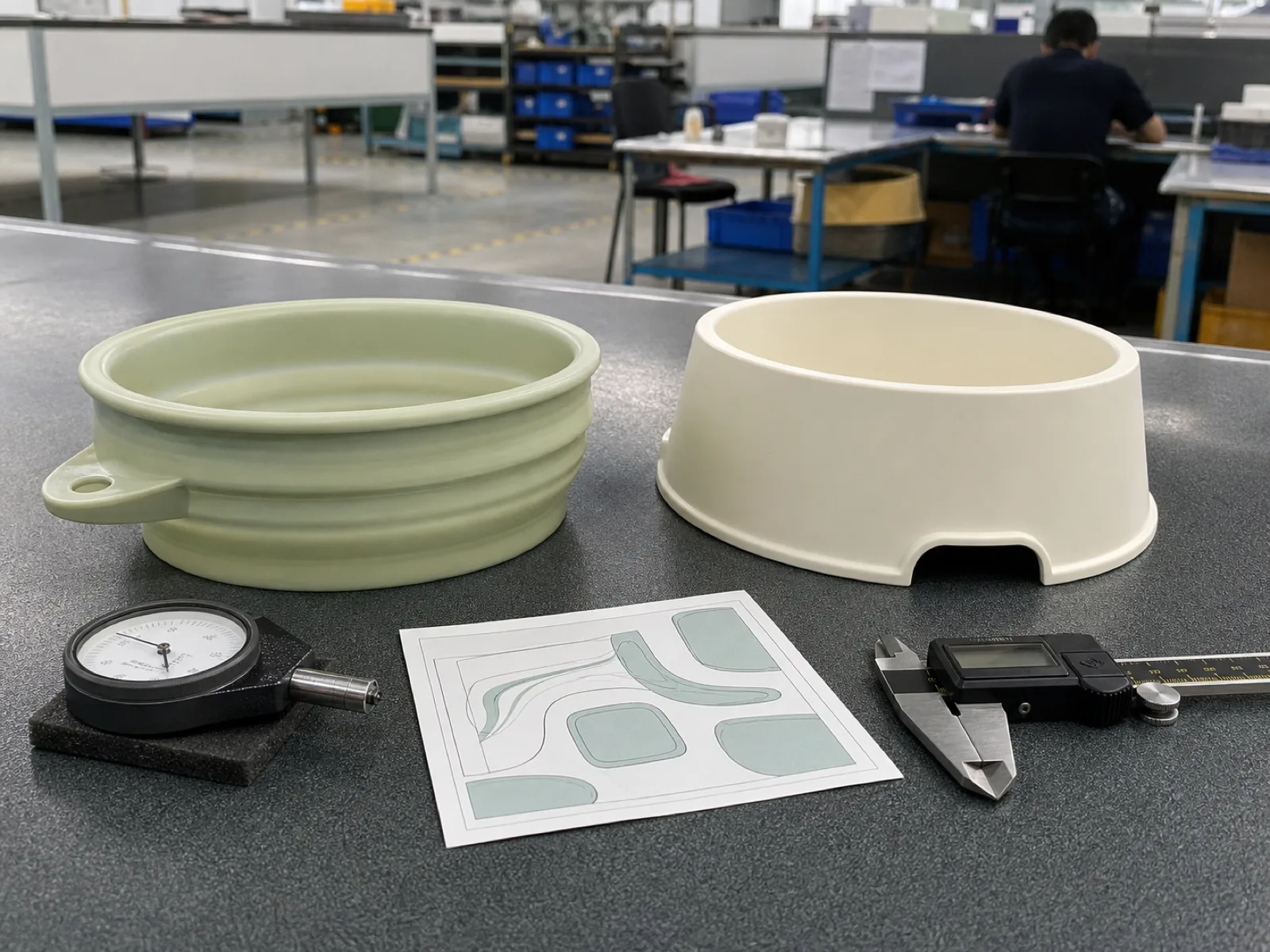
 A silicone dog bowl and a plastic dog bowl do the same job with very different materials, and the difference matters for a dog's health. Food-grade silicone is chemically inert, non-porous, and stable from -40 °C to 230 °C; common pet plastics can leach BPA, phthalates, or melamine and scratch into grooves that harbor bacteria. Silicone wins on safety, hygiene, heat tolerance, lifespan, and collapsible travel, while plastic still wins on unit cost and rigid tall form factors.
This guide is written for pet brands, private-label buyers, and product-development leads deciding whether to build a bowl line around food-grade silicone, plastic, or both. It replaces the one-sided marketing most search results serve up with the numbers a spec sheet actually needs: a head-to-head material table, the specific chemicals at issue, a hygiene comparison grounded in biofilm science, temperature and durability data, an honest “when plastic still wins” section, and the food-grade certifications and OEM economics that separate a defensible product from a marketplace-commodity one.
Silicone vs plastic dog bowl — which is the safer material?
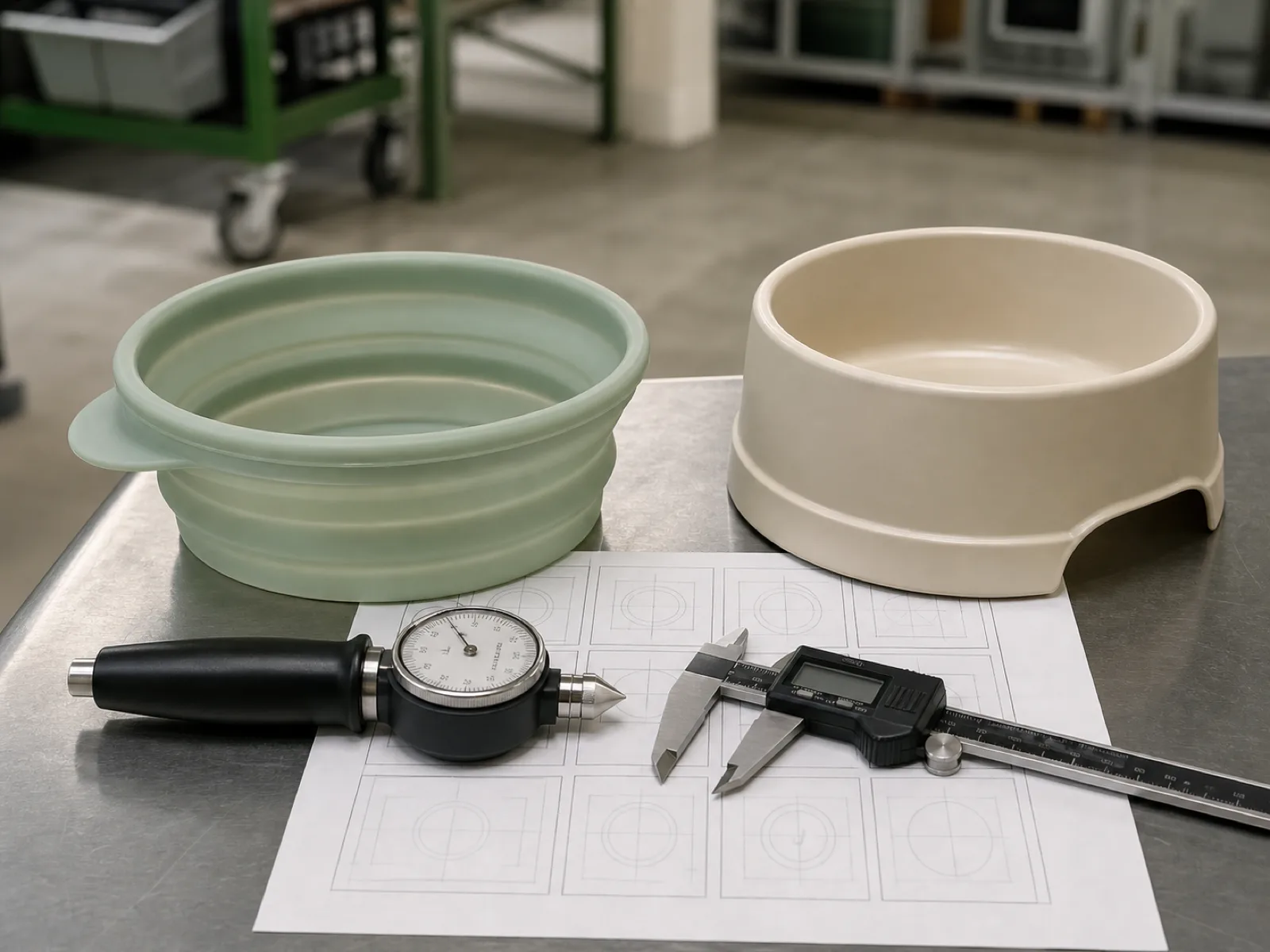
Food-grade silicone is the safer material for most dog bowls. It is chemically inert, non-porous, and free of BPA, phthalates, and melamine, and it tolerates boiling for sterilization. Common pet plastics can leach plasticizers and scratch into bacteria-harboring grooves as they wear. Plastic still wins on raw unit cost and rigid tall form factors, but on health-relevant metrics silicone leads.
Safety in a feeding bowl comes down to two questions: what can migrate out of the material into food and water, and what can grow on the surface. Food-grade platinum-cured silicone answers both cleanly — it is a fully cured elastomer with no free plasticizers to migrate and a non-porous surface that gives bacteria nowhere to colonize. Plastic answers both with an asterisk: the resin may contain migratable additives, and the surface scratches into micro-grooves that shelter biofilm. This is why veterinary and consumer guidance increasingly steers owners away from worn plastic bowls, and the is-silicone-safe-for-dogs materials breakdown covers the compound-level detail behind that recommendation.
The head-to-head below is the comparison competitor pages leave out. Note that “plastic” is not one material — PP (polypropylene), PET, and melamine resin behave differently — but the pattern holds: food-grade silicone leads on the health-relevant axes, plastic leads on cost and rigidity.
| Attribute | Food-grade silicone | Plastic (PP / PET / melamine) |
|---|---|---|
| Chemical leaching | None (inert, no plasticizers) | Possible BPA / phthalate / melamine |
| Surface porosity | Non-porous | Scratches into porous grooves |
| Temperature range | -40 °C to 230 °C | Warps / crazes with heat |
| Dishwasher / boil safe | Yes, any cycle + boil | Often top-rack only |
| Shatter risk | None (flexible) | Can crack or shatter |
| Typical lifespan | 3-5+ years | 6-12 months (mid-tier) |
| Collapsible form | Yes (folds flat) | No (rigid) |
| Unit cost | Higher | Lower |
For a brand, the read is not “silicone always wins” — it is that silicone owns the hygiene- and health-forward segment and the travel segment, while plastic keeps the budget-rigid segment. The rest of this guide quantifies each row so a product team can place each SKU on the right material with evidence, not vibes.
What chemicals can leach from plastic dog bowls that silicone doesn’t?
Depending on the resin, plastic dog bowls can leach bisphenol A (BPA), phthalate plasticizers, or — in melamine-resin bowls — melamine and formaldehyde, especially as the bowl ages, scratches, or holds warm or acidic food. Food-grade silicone is a fully cured elastomer with no free plasticizers, so it contributes none of these migrants and stays chemically stable across its full temperature range.
The leaching risk is resin-specific, not universal to all plastic, and an honest comparison names the mechanism rather than fear-mongering. BPA is a building block and additive associated with some polycarbonate and older plastics; the US NIEHS documents its endocrine-relevant exposure pathway, and while many bowls are now labeled BPA-free, “BPA-free” often means a substitute bisphenol, not zero migratable additive. Phthalates are plasticizers used to soften certain plastics and can migrate into fats and oils in food. Melamine bowls — the dense, decorated “ceramic-look” plastic — can release melamine and formaldehyde when they contact hot or acidic food, which is why melamine dinnerware is widely flagged as not microwave-safe.
| Migrant of concern | Where it comes from | Silicone status | Aggravated by |
|---|---|---|---|
| Bisphenol A (BPA) | Some polycarbonate / additives | Absent | Heat, wear, age |
| Phthalate plasticizers | Softened plastics | Absent (no plasticizer) | Fats, oils, heat |
| Melamine / formaldehyde | Melamine-resin bowls | Absent | Hot / acidic food, microwave |
| Additive breakdown products | Aging / UV-degraded plastic | Absent | Scratching, sunlight |
Food-grade silicone sidesteps the entire category because its performance does not depend on a plasticizer that can leave the matrix — the polymer is cross-linked and the platinum-cured grade leaves no reactive residue. That inertness is the substance behind marketing words like “non-toxic,” and it is testable: extractables and migration data referenced against the ISO 10993 framework, plus clearance under FDA 21 CFR 177.2600, turn the claim into a document a buyer can audit rather than a slogan on a hangtag.
Which harbors more bacteria — a scratched plastic bowl or silicone?
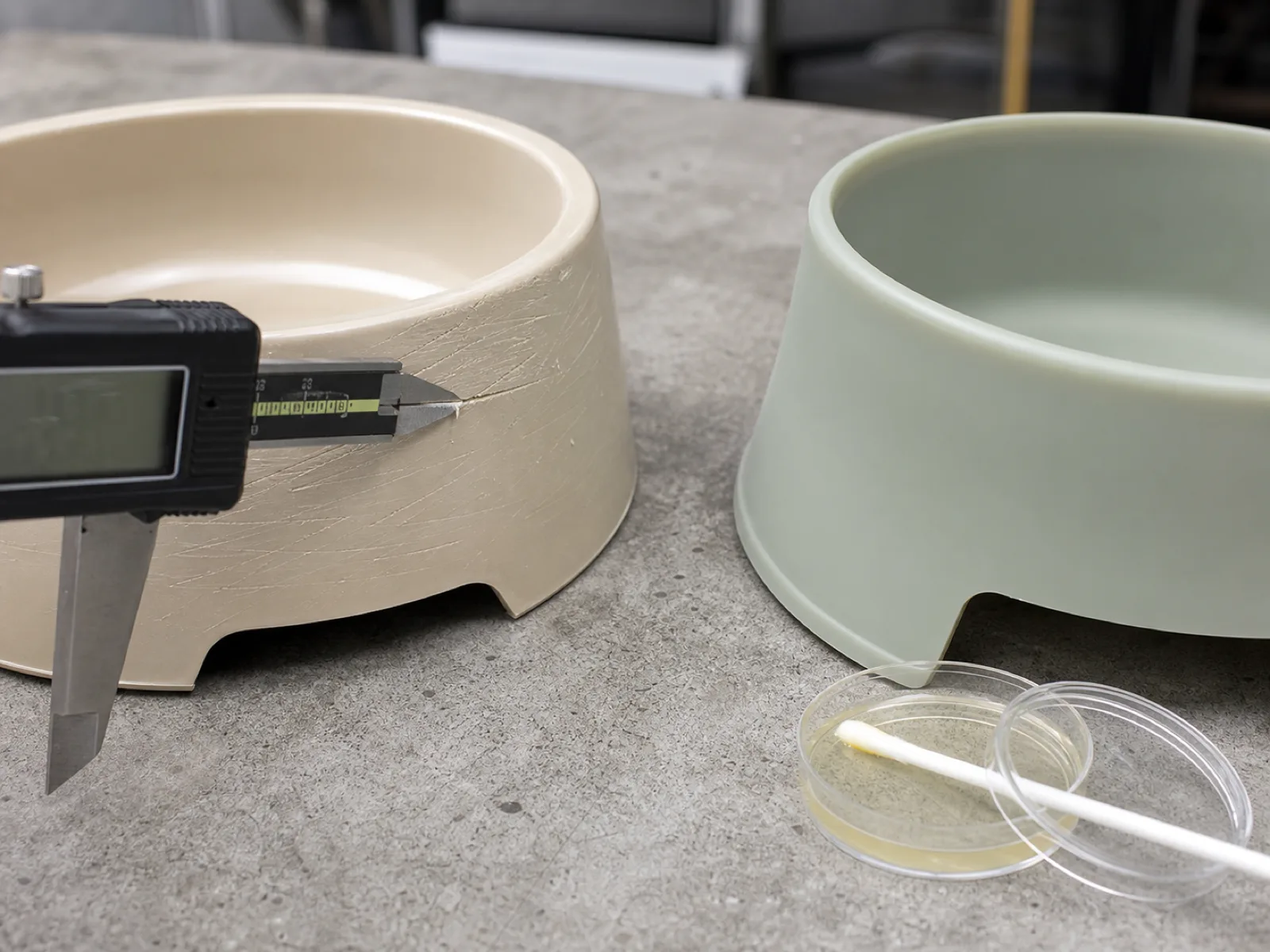
Scratched plastic bowls harbor far more bacteria. Every scratch from daily eating and washing is a micro-groove that shelters residue and lets biofilm build where rinsing can't reach — dog bowls rank among the most bacteria-heavy items in a home. Non-porous platinum-cured silicone resists scratching and has no pore structure, so residue sits on the surface and rinses away, and the bowl tolerates boiling to sterilize.
Bacterial harborage is a surface-condition problem, and it gets worse with the age of a plastic bowl, not better. A new plastic bowl is smooth; a six-month-old one is a field of fine scratches from kibble abrasion, tooth contact, and scrubbing. Each groove is a shelter where food residue and moisture persist and biofilm — a bacterial community bonded to the surface — matures beyond what a quick rinse removes. Public-health hygiene guidance is consistent that non-porous, scratch-resistant surfaces are dramatically easier to sanitize than porous or damaged ones, and the peer-reviewed literature on polymer feeding surfaces documents how scratched plastic accelerates colonization.
| Hygiene factor | Food-grade silicone | Plastic dog bowl |
|---|---|---|
| Surface after 6 months use | Smooth, scratch-resistant | Scratched, grooved |
| Biofilm shelter | None (non-porous) | Grows in scratches |
| Rinse-clean effectiveness | High (surface residue only) | Falls as scratches deepen |
| Boil sterilization | Yes (holds to 230 °C) | No — most plastics deform |
| Dishwasher sanitize cycle | Yes, any rack | Often warps on hot cycles |
| Linked to canine chin acne | Rarely | Commonly cited cause |
There is a specific canine-health angle here: “plastic dish dermatitis,” or contact irritation on the chin, is frequently traced to bacteria in a scratched plastic bowl pressing against a dog’s skin at every meal. Because a silicone bowl resists scratching and can be boiled or run through a sanitizing dishwasher cycle, it closes the loop the way a fast-cleaning silicone slow feeder does — the surface that is easy to sterilize is the surface that actually stays clean in a real household.
How do silicone and plastic dog bowls compare on temperature and cleaning?
Food-grade silicone is stable from roughly -40 °C to 230 °C, so a silicone dog bowl is dishwasher-safe on any cycle, microwave-safe for warming food, freezer-safe for frozen treats, and can be boiled to sterilize. Most rigid pet plastics are top-rack dishwasher-safe at best and warp, craze, or leach faster with heat. The heat tolerance gap is what makes silicone genuinely sanitizable.
Temperature range is not a spec-sheet trophy — it is the property that decides whether an owner can actually sanitize the bowl. Sterilizing means heat: a hot dishwasher cycle, boiling water, or a steam pass. Food-grade silicone shrugs all of these off because it stays dimensionally and chemically stable across a band that spans freezer to oven, verified against the compound’s rated range. Rigid pet plastics live in a much narrower window; heat is exactly what makes them warp, cloud (craze), and — for resins with migratable additives — leach faster, so the manufacturer restricts them to gentle cycles that clean but do not truly sanitize.
| Property | Food-grade silicone | Plastic dog bowl |
|---|---|---|
| Working temperature range | -40 °C to 230 °C | Resin-limited, narrow |
| Dishwasher | Any cycle | Top-rack / gentle only |
| Microwave (warm food) | Yes | Melamine no; PP limited |
| Freezer (frozen treats) | Yes, stays flexible | Can crack when cold |
| Boiling to sterilize | Yes | No — deforms |
| Behavior under heat | Stable | Warps, crazes, leaches faster |
The practical consequence for cleaning is that silicone lets an owner choose the most aggressive sanitizing method available and use it as often as they like, while plastic quietly caps the household at whatever cycle won’t ruin the bowl. That is why a silicone bowl’s hygiene advantage compounds over time: the material that tolerates heat is the material that gets sterilized, and the material that gets sterilized is the one that stays safe between the daily scratches described above.
Which lasts longer — a silicone or plastic dog bowl?
A molded silicone dog bowl lasts longer — typically 3-5+ years — because it cannot shatter and resists the scratching, staining, and cracking that retire plastic. A mid-tier plastic bowl is usually replaced every 6-12 months once it is scratched, stained, and chewed. Over a multi-year window one silicone bowl replaces several plastic bowls, so its cost-per-year generally beats plastic despite the higher sticker price.
Durability is a failure-mode question, and plastic and silicone fail differently. A plastic bowl degrades through three routes: it scratches (which drives the hygiene problem), it cracks or shatters when dropped or chewed, and it stains and clouds as the surface ages under UV and hot food. A molded silicone bowl has none of these as primary failure modes — it flexes instead of shattering, resists surface scratching, and its tear strength (governed by tension methods like ASTM D412) lets it survive chewing and drops that would crack a rigid bowl. Its practical retirement is measured in years of daily use.
| Durability factor | Food-grade silicone | Plastic dog bowl |
|---|---|---|
| Shatter on drop | No (flexes) | Possible, especially when cold |
| Scratch accumulation | Low | High, progressive |
| Staining / clouding | Minimal | Common with age and heat |
| Chew resistance | High (tears rarely) | Cracks / fragments |
| Typical service life | 3-5+ years | 6-12 months (mid-tier) |
| Failure signal | Rare tearing if abused | Scratches, cracks, stains |
The lifespan gap converts directly into total cost of ownership. A silicone bowl that survives four years replaces roughly four-to-eight mid-tier plastic bowls over the same period. Even when the silicone unit’s shelf price is higher, cost-per-year usually favors silicone once scratch-and-crack-driven replacement is counted — and that is a claim a brand can substantiate with a lifespan figure rather than vague “durable” language. It is the same total-cost-of-ownership story that reframes MOQ math on any molded product; the MOQ and lead-time breakdown shows how per-unit cost settles once volume spreads the tooling.
When does a plastic dog bowl still make sense?
Plastic still makes sense for the lowest-cost rigid SKUs and for tall, self-supporting shapes — elevated feeders, deep water crocks, large-capacity bowls — where silicone's flexibility would require a rigid frame or a much thicker, more expensive wall. For a budget starter bowl or a big rigid form where hygiene is managed by frequent replacement, injection-molded plastic is cheaper per unit and structurally simpler.
A balanced comparison has to name where plastic legitimately wins, because pretending otherwise costs a brand credibility with sophisticated buyers. Plastic’s two real advantages are unit cost and rigidity. Injection-molded PP is inexpensive at volume, so a value-tier bowl or a giveaway SKU pencils out better in plastic. And because plastic is rigid, it self-supports at tall heights and large diameters — an elevated diner, a 2-liter water crock, or a deep-walled bowl holds its shape without help, whereas an all-silicone version at that size needs a rigid base or a thick wall that erodes the cost and adds material.
| Scenario | Better material | Why |
|---|---|---|
| Lowest-cost value SKU | Plastic | Cheaper per unit at volume |
| Tall elevated feeder | Plastic (or hybrid) | Self-supports without a frame |
| Deep / large water crock | Plastic (or hybrid) | Rigidity at large volume |
| Collapsible travel bowl | Silicone | Folds flat, springs back |
| Hygiene-forward / sensitive dog | Silicone | Non-porous, boil-sterilizable |
| Microwave / freezer use | Silicone | Full temperature range |
| Chew-prone / drop-prone home | Silicone | Won’t shatter |
The mature answer for a product line is often a hybrid: a rigid plastic or stainless base or frame with a food-grade silicone insert or mat for the food-contact surface — the dog eats off inert, non-porous silicone while plastic provides the cheap structure. That pattern captures silicone’s health advantage where it counts (the surface touching food) and plastic’s cost advantage where it doesn’t (the structure). Deciding that split SKU by SKU, rather than declaring one material universally superior, is what separates an engineering-led range from a marketing one.
What food-grade certifications must a pet brand specify?
Specify FDA 21 CFR 177.2600 (US food-contact rubber) and LFGB (the stricter EU/German food-contact standard) on the drawing, and require platinum-cured compound rather than peroxide-cured. For bowls marketed on biocompatibility, ISO 10993 extractables data is the defensible reference. Always require a compound Certificate of Compliance citing the clause plus lot traceability — never accept a bare "food-grade" claim with no document behind it.
Certification is where a private-label buyer protects the brand from a recall, and the discipline is the same whether the bowl is silicone or plastic: name the standard on the drawing and require the document that proves it. For a silicone dog bowl, “platinum-cured” is the load-bearing phrase — addition-cure silicone leaves no peroxide byproducts and clears skin- and food-contact extractables testing that a cheaper peroxide-cured or filler-loaded compound can fail. The two food-contact standards that matter for a US-plus-EU launch are federal and European, and they are not interchangeable.
| Standard | Scope | What it proves | Applies to |
|---|---|---|---|
| FDA 21 CFR 177.2600 | US food-contact rubber | Compound cleared for repeated food contact | US market |
| LFGB (§30/31) | EU / German food contact | Stricter migration + sensory testing | EU market |
| ISO 10993 | Biocompatibility / extractables | Inertness data for “safe” claims | Marketing substantiation |
| ASTM D2240 | Durometer hardness | Shore A wall spec (40-70) is met | Manufacturing QC |
| ISO 9001 | Quality management system | Documented, repeatable process | Supplier audit |
The certification bundle a serious buyer requires is a compound Certificate of Compliance citing the applicable clause, a food-contact migration or extractables report, and lot traceability from batch to carton. The FDA vs LFGB clause breakdown explains which standard belongs on which market’s drawing and why LFGB’s per-batch sensory and migration testing is the stricter gate. Skipping this step is the single most common way a low-cost bowl becomes a liability — a bowl that “looks food-grade” is not a bowl with a test report behind it.
Silicone vs plastic dog bowl — cost and OEM manufacturing economics
Both silicone and plastic dog bowls are molded, so both carry tooling; the cost gap is compound and cure system, not the presence of a mold. Silicone compound and cure cost more per unit than commodity PP, which is why plastic wins the budget tier. But silicone's multi-year lifespan and premium positioning support a higher retail price and lower replacement rate, changing the margin math beyond raw unit cost.
The manufacturing economics surprise buyers who assume plastic is cheaper for a structural reason — it is not. A silicone bowl and a plastic bowl are both produced from a machined steel cavity; the mold cost is comparable at similar complexity. The unit-cost difference comes from the material and the process: platinum-cured silicone compound is more expensive than commodity polypropylene, and silicone molding (compression or LSR injection) runs a curing cycle. That is a real per-piece premium, and it is why the lowest-price rigid SKU still belongs in plastic.
| Cost factor | Food-grade silicone | Plastic dog bowl |
|---|---|---|
| Tooling (steel mold) | Comparable at equal complexity | Comparable |
| Compound cost / kg | Higher (platinum silicone) | Lower (commodity PP) |
| Cycle / cure | Curing step adds time | Fast injection cycle |
| Unit cost at volume | Higher | Lower |
| Retail price supported | Premium | Value to mid |
| Replacement rate | Low (3-5+ yr) | High (6-12 mo) |
| MOQ (Wetop) | 500 pcs/SKU | Molded, similar structure |
Where silicone recovers the margin is on the sell side: a hygiene- and travel-forward silicone bowl commands a premium retail price, and its long lifespan is a marketing asset rather than a cost. For a brand, the decision is a portfolio one — put the volume value SKU in plastic, put the differentiated hygiene, travel, and sensitive-dog SKUs in food-grade silicone, and price each to its material story. Wetop molds the silicone side at MOQ 500 pcs/SKU with a 7-25 day first sample, and we will tell you plainly when a rigid form is better served by plastic or a hybrid.
Wetop’s silicone pet-bowl OEM position
Wetop is a platinum-cured silicone specialist — we mold custom food-grade silicone dog bowls, collapsible travel bowls, lick mats, and slow feeders, not commodity plastic bowls. MOQ is 500 pcs/SKU on new tooling with a 7-25 day first sample from our Dongguan factory, molded under ISO 9001 from FDA 21 CFR 177.2600 / LFGB compound at a Shore A you specify. If a SKU is genuinely better in plastic, we say so.
Our specialization is the molded silicone side of a pet-bowl program, and that focus is why we can hold a food-contact spec lot after lot. We mold collapsible travel bowls that fold flat and spring back, non-porous feeding bowls for hygiene-forward and sensitive-dog lines, lick mats, and silicone inserts for hybrid plastic-or-stainless bases — each from platinum-cured compound with full FDA 21 CFR 177.2600 and LFGB documentation and lot traceability. We tune wall hardness (typically Shore A 40-70 for bowls) and Pantone-match color to the brand, and every batch clears the post-cure step that unlocks per-batch food-contact test reports.
If your line is silicone — a collapsible travel bowl, a boil-safe feeding bowl marketed on hygiene, a frozen-treat mold, or a silicone insert for a rigid base you source elsewhere — we quote from a sketch or a 3D file within one business day, including compound recommendation, durometer, unit price at 500 / 5,000 / 50,000 pcs, tooling amortization, and sample lead time. And if a tall rigid feeder is better in plastic or a hybrid, we will tell you rather than oversell the material.
Request a custom silicone dog bowl quote with your target shape, capacity, Shore A wall hardness, color (Pantone), branding method, and order volume — we return a compound recommendation, tooling plan, and price schedule within one business day from the engineering desk in Dongguan.
FAQ
-
Is a silicone dog bowl better than a plastic one for my dog's health?
For most dogs, yes. Food-grade silicone is chemically inert and non-porous, so it does not leach BPA or phthalates and does not develop the scratched grooves where bacteria colonize in worn plastic. Plastic bowls are also linked to canine acne — contact irritation on the chin from a scratched, bacteria-laden surface. Silicone's non-porous surface and easy sterilization make it the lower-risk choice, provided the compound is genuinely platinum-cured and cleared under FDA 21 CFR 177.2600.
-
Do plastic dog bowls leach chemicals into food and water?
Some can. Depending on the resin, plastic pet bowls may release bisphenol A (BPA), phthalate plasticizers, or, in melamine-resin bowls, melamine and formaldehyde — especially as the bowl ages, scratches, or holds warm or acidic food. Food-grade silicone contains none of these plasticizers and is stable across its full temperature range, which is why hygiene-forward pet brands migrate wet-food and water SKUs to silicone.
-
Why do plastic dog bowls hold more bacteria than silicone?
Plastic scratches with daily use, and each scratch is a micro-groove that shelters bacteria from rinsing and lets biofilm build. Dog bowls are consistently among the most bacteria-heavy items in a home. Non-porous platinum-cured silicone resists scratching and has no internal pore structure, so residue sits on the surface and rinses away instead of colonizing grooves. Silicone also tolerates boiling and dishwasher sanitizing that degrades many plastics.
-
Can silicone dog bowls go in the dishwasher, microwave, and freezer?
Yes. Food-grade silicone is stable from roughly -40 °C to 230 °C, so a silicone dog bowl is dishwasher-safe on any cycle, microwave-safe for warming food, freezer-safe for frozen treats, and can be boiled to sterilize. Many rigid pet plastics are only top-rack dishwasher-safe at best and warp, craze, or leach faster when heated, which is a real limitation for owners who want to sanitize with heat.
-
How long does a silicone dog bowl last compared to a plastic one?
A molded silicone dog bowl typically lasts 3-5+ years because it cannot shatter, and it resists the scratching, staining, and cracking that retire plastic bowls. A mid-tier plastic bowl is often replaced every 6-12 months once it is scratched, stained, and chewed. Over a multi-year window one silicone bowl replaces several plastic bowls, so its cost-per-year usually beats plastic despite a higher sticker price.
-
Are collapsible silicone dog bowls good for travel?
Yes — this is the use case silicone wins outright. A silicone travel bowl folds flat to a fraction of its height, clips to a leash or bag, and springs back to a watertight bowl in seconds, then rinses clean and dries fast. Rigid plastic cannot collapse, so a plastic travel bowl takes full volume in a pack. For hiking, car trips, and daily walks, collapsible food-grade silicone is the category standard.
-
When is a plastic dog bowl still the better choice?
Plastic still makes sense for the lowest-cost rigid SKUs and for tall, self-supporting shapes like elevated feeders or deep water crocks, where silicone's flexibility would need a rigid frame or a thicker wall. For a budget starter bowl or a large rigid form where hygiene is managed by frequent replacement, injection-molded plastic is cheaper per unit. The honest split is budget-rigid to plastic, hygiene- and travel-forward to silicone.
-
What food-grade certifications should a silicone dog bowl have?
Specify FDA 21 CFR 177.2600 (US food-contact rubber) and LFGB (the stricter EU/German food-contact standard) on the drawing, and require platinum-cured (addition-cure) compound rather than peroxide-cured. For bowls marketed on biocompatibility, ISO 10993 extractables data is the defensible reference. Always require a compound Certificate of Compliance citing the clause plus lot traceability — not a generic 'food-grade' claim with no document behind it.
-
What is the MOQ and lead time for a custom silicone dog bowl?
A silicone dog bowl is molded, so it carries tooling: Wetop's MOQ is 500 pcs/SKU on new tooling with a 7-25 day first sample from our Dongguan factory. A plastic bowl is also molded, so its economics are similar in structure — the difference is compound cost and cure system, not the presence of a mold. We quote unit price at 500 / 5,000 / 50,000 pcs plus tooling amortization within one business day.
References
Authoritative sources cited in this guide
- US Food and Drug Administration. 21 CFR 177.2600 — Rubber articles intended for repeated use. https://www.ecfr.gov/current/title-21/chapter-I/subchapter-B/part-177/subpart-C/section-177.2600 — The federal food-contact rule that a food-grade silicone dog bowl compound is molded to clear.
- US Food and Drug Administration. FDA — Food Ingredients & Packaging (Food Contact Substances). https://www.fda.gov/food/food-ingredients-packaging — US regulatory framework governing materials that contact pet and human food, including bowls.
- US National Institute of Environmental Health Sciences (NIH). Bisphenol A (BPA) — Health Effects and Exposure. https://www.niehs.nih.gov/health/topics/agents/sya-bpa — Primary-source basis for the BPA-leaching concern that applies to some plastic bowls, not to silicone.
- International Organization for Standardization. ISO 10993-1 — Biological Evaluation of Medical Devices, Part 1. https://www.iso.org/standard/68936.html — The biocompatibility/extractables framework referenced when a silicone bowl is marketed on inertness.
- ASTM International. ASTM D2240 — Standard Test Method for Rubber Property—Durometer Hardness. https://www.astm.org/d2240-15r21.html — The Shore A durometer method used to spec a silicone dog bowl wall at 40-70.
- US Centers for Disease Control and Prevention. Handwashing and Surface Hygiene Guidance. https://www.cdc.gov/hygiene/about/index.html — Public-health basis for why non-porous surfaces are easier to sanitize than scratched, porous plastic.
- US National Library of Medicine (PubMed). PubMed — Biofilm Formation on Polymer Surfaces and Pet Feeding Bowls. https://pubmed.ncbi.nlm.nih.gov/ — Peer-reviewed literature on bacterial biofilm on scratched plastic feeding surfaces, the hygiene axis here.
- International Organization for Standardization. ISO 9001:2015 — Quality Management Systems — Requirements. https://www.iso.org/standard/62085.html — The quality-system standard Wetop's silicone dog bowl production is certified against.
Start a custom program
Send a brief. Get an engineer’s reply in one business day.
Every Wetop program is tooled from a customer’s specification. Send a CAD file (STEP · IGES · DWG) or a written brief and we’ll reply with a mold cost estimate, price brackets at MOQ 500 / 1,000 / 5,000, and any engineering questions.