Multi-venue hospitality group · Multi-Category · Bar-mat + drip-mat contract OEM
Hospitality group · bar mat + drip mat OEM
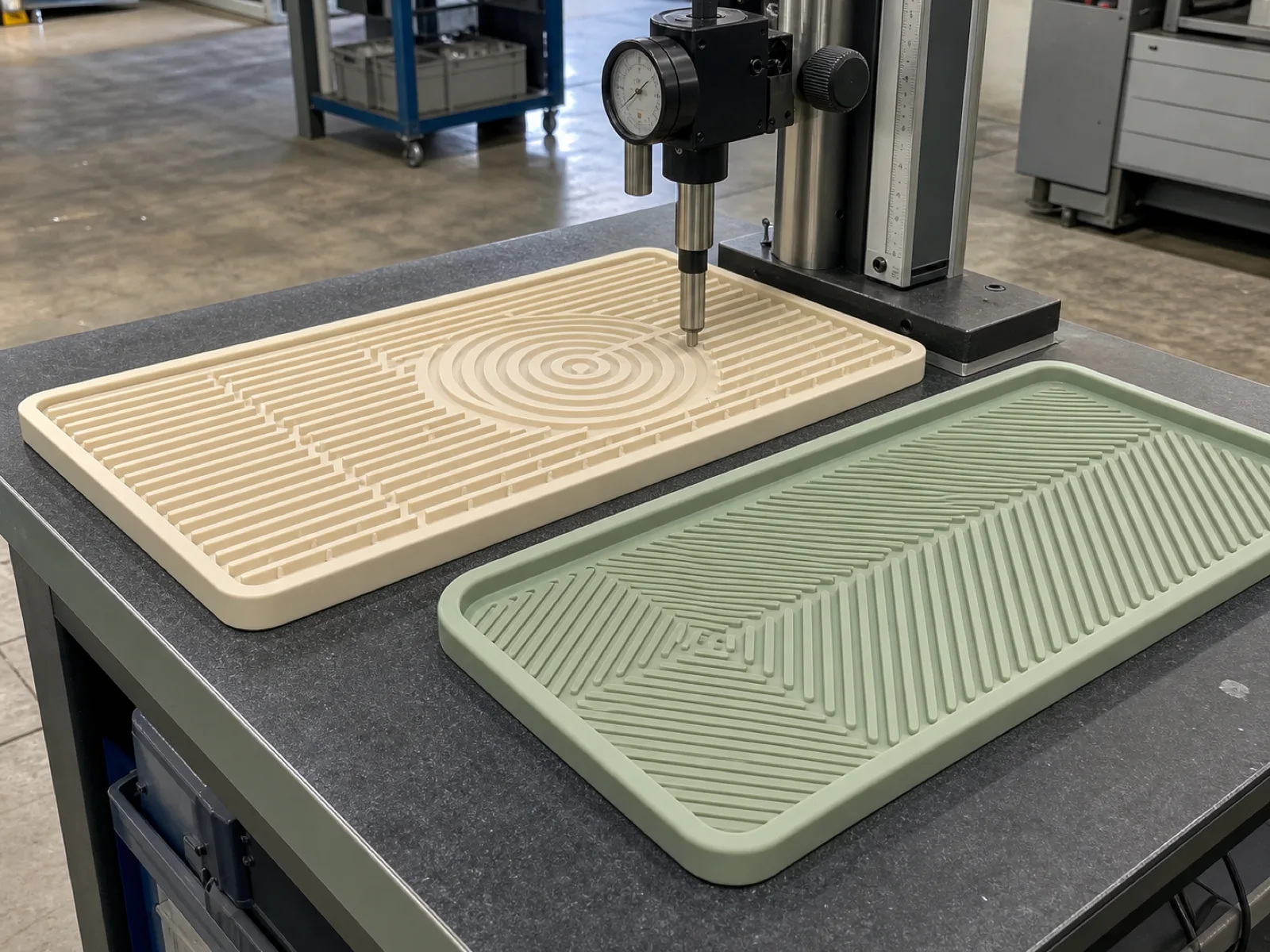
Both product families were re-engineered from a failure post-mortem, not a catalog. The marketplace mats were not cheap silicone — they were the wrong compound and the wrong cure system for a commercial-warewasher duty cycle, and no vendor could name either. Fixing that started with a durometer, a spectrophotometer, and a recut tool.
Why marketplace bar mats crack at 5 months
Marketplace bar mats crack because they are typically peroxide-cured silicone loaded with calcium-carbonate filler to cut raw-material cost. The filler raises hardness cheaply but embrittles the matrix, and peroxide-cure volatile residuals accelerate that embrittlement under repeated 82°C warewasher cycling plus sanitizer exposure. Cracks start at the rib roots within 4-6 months.
The group’s post-mortem sample told the whole story before any lab work. The failed mats had cracked precisely at the base of each drainage rib — the highest-stress radius on the part — and the fracture faces were chalky rather than clean, the signature of a heavily filled compound. Under a commercial warewasher, a bar mat sees an 82°C sanitize rinse followed by rapid cooling, dozens of times a week, while quaternary-ammonium and chlorine sanitizers attack any residual-rich surface. Peroxide-cured silicone carries volatile decomposition residuals unless it is post-baked; combined with a filler load that was there to hit a price point, the mats had no chance of a multi-year service life.
This is the anti-marketplace argument in one part. A vendor that cannot tell you the cure system and filler content of the compound it is shipping cannot defend the part against a known thermal-cycling failure mode. The group had been buying on a photo and a price, and paying for it twice a year in replacement and in a mismatched back bar.
How we re-specified both families
We moved both the deep-well bar service mat and the low-profile drip mat to low-filler platinum-cured silicone at Shore A 70 ±5 per ASTM D2240. Platinum cure leaves no volatile residuals, so the embrittlement pathway disappears; dropping the calcium-carbonate filler restores matrix toughness. Shore 70A gives dimensional stability under stacking without losing the non-slip grip a bar mat needs.
The hardness target was the first argument with the buyer’s instinct. Softer silicone — 55-60A — feels more “premium” in the hand and grips aggressively, but at bar-mat wall thickness it curls at the perimeter under heat and holds a set when stacked wet. Firmer than 75A loses the compliant non-slip behavior that keeps glassware from walking on a wet bar. Shore A 70 ±5 was the defensible middle: stable enough to hold a raised perimeter through a warewasher cycle, compliant enough to grip. The number is keyed to ASTM D2240 durometer method, called out by revision year so the per-lot test reports are cross-comparable.
Material and cure were locked to platinum LSR for a second reason beyond embrittlement: the light colorway. The group wanted a cream/sage line for its brighter venues alongside the charcoal back-bar standard, and peroxide residuals fluoresce and yellow light colorways under UV and continuous heat within a shelf cycle. Platinum cure is the only defensible choice for a light-colored mat that lives under bar lighting and goes through a hot warewasher daily. For the broader trade-off between the two cure systems, our platinum-cured vs peroxide-cured silicone guide maps where each one belongs.
The scrapped-and-restarted drainage tool
First-article bar mats passed hardness, color, and compression-set checks but failed the one test that matters behind a bar: they did not drain. The drainage channels had been cut flat, so water pooled in the wells instead of running to the sump. We scrapped the first tool block and recut it with a 2° channel slope draining to a relocated corner sump.
A bar service mat is a drainage device first and a non-slip surface second. Its job is to catch spillage, ice melt, and rinse water and move it to a sump the bartender empties, keeping the bar surface dry and the glassware footing clean. The first tool block reproduced the visible geometry of a good bar mat — deep wells, ribbed floor, raised perimeter — but treated the channel floor as flat because the drawing did too. On the bench it looked correct. Filled with water, it held a film in every well and drained nothing.
Recutting a tool block is not a cost anyone wants to eat mid-program, and there was a cheaper path: ship the flat-floor mats and let gravity and evaporation do their imperfect best. We scrapped the block instead. The recut added a 2° slope across each channel floor draining toward a single relocated corner sump, plus a slightly deepened sump well so the mat holds standing water until it is intentionally emptied rather than sloshing it back onto the bar. That restart is the reason the production mats drain clean — and it is the kind of decision a vendor optimizing only for unit price does not make. The geometry logic behind bar-mat drainage is expanded in our silicone bar mat OEM manufacturing guide; the thinner sloped-channel logic for the drip mat is in the silicone drip mat OEM guide.
Compression set: the spec behind stacking wet mats
Bar and drip mats get stacked wet and hot behind the bar and in the warewasher rack, so recovery — not just hardness — decides whether the raised perimeter and drainage geometry survive. We held compression set under 20% per ASTM D395 Method B after 22 h at 175°C, well inside the point where a stacked mat would take a permanent set and stop draining.
Hardness measures resistance to indentation at a single moment; compression set measures whether a part returns to shape after a sustained load at temperature. For a bar mat the second property is the operationally important one, because the real-world load case is a stack of six wet mats sitting in a warm dish pit overnight. A compound that reads a perfect 70A on the durometer but takes a 35% compression set will come out of that stack with flattened ribs and a slumped perimeter — geometry gone, drainage gone. The low-filler platinum LSR held under 20% set, verified per ASTM D395 Method B, the constant-deflection method used on food-contact and food-adjacent elastomers.
Color discipline across 40-plus venues
Both colorways were mixed in master-batch — pigment dispersed into the silicone gum before molding, not surface-coated — and spectrophotometer-verified to ΔE ≤ 1.0 per production lot. Master-batch color runs molecularly uniform through the part, so an abraded or trimmed edge shows the same shade as the surface, and back-bar mats read as one brand system across every venue.
The mismatched-back-bar complaint was a real cost, not an aesthetic footnote. When a group runs 40-plus venues and mats arrive in slightly different greys from batch to batch, the back bar photographs inconsistently and the brand looks unmanaged. Marketplace color tolerance typically runs ±2-3 ΔE, loose enough to be visible side by side. Holding ΔE ≤ 1.0 per lot — spectrophotometer-checked against a fixed reference, color-cert filed per batch — is what let the group standardize the cream and sage lines as a controlled brand element rather than a variable. The same master-batch discipline we run on retail color programs is documented in the peer multi-color trivet program, where the tolerance argument decided the whole bid.
Program specs and results
| Parameter | Bar service mat | Drip / drainboard mat |
|---|---|---|
| Cure system | Platinum LSR | Platinum LSR |
| Shore A hardness | 70 ±5 (ASTM D2240) | 65 ±5 (ASTM D2240) |
| Colorways | Charcoal · cream · sage | Charcoal · cream · sage |
| Color tolerance | ΔE ≤ 1.0 per lot | ΔE ≤ 1.0 per lot |
| Wall / rib geometry | Ribbed floor, raised perimeter, 2° channel slope to corner sump | Low-profile sloped channels |
| Heat-deflection range | −40°C to 230°C continuous | −40°C to 230°C continuous |
| Compression set | < 20% (ASTM D395 Method B, 22 h @ 175°C) | < 22% (ASTM D395 Method B) |
| Molding | Multi-cavity compression | LSR injection |
| Sampling | ISO 2859-1 AQL 1.5 major / 4.0 minor per lot | ISO 2859-1 AQL 1.5 major / 4.0 minor per lot |
| Program volume | ~120,000 units/yr, both families combined | — |
The 18-month operating record is the outcome that matters to the group’s finance team. The marketplace bar mats had been failing at 4-6 months and driving roughly twice-yearly replacement across every venue. The re-specified platinum-LSR mats have run 18 months of daily warewasher cycling across the pilot venues with zero rib-root cracking reported — the single failure mode that had defined the old program. Replacement churn on the bar-mat line dropped to a single 18-month cycle, and because both families share a color standard and a QA discipline, the group folded a coaster-runner SKU into the same tooling philosophy without reopening a bid. Every lot ships against ISO 2859-1 AQL 1.5 major / 4.0 minor sampling, so the consistency is documented, not assumed.
Related program and reading
The multi-color color-tolerance mechanics on this program mirror our peer retail-chain multi-color trivet case study, where master-batch ΔE discipline decided a five-vendor bid. For the drainage and durometer engineering behind service mats specifically, the silicone bar mat OEM manufacturing guide is the deeper reference.
Sourcing a bar-mat, drip-mat, or coaster program that has to survive a commercial warewasher — and want a factory that can name the cure system and filler content it ships? Talk to the engineering desk through our contact page. We quote MOQ from 500 pieces per SKU out of one silicone plant in Dongguan, and the spec conversation starts before any tooling is cut.
Sourcing a similar program?
Get a CAD review and quote in one business day.
MOQ 500 per SKU. Samples in 7-25 days. We can share a more detailed reference (under NDA) for an adjacent program. Email inquiry@wetopsilicone.com or use the form.