Buyer Guide · commercial intent
Silicone Drip Mat OEM Guide — Bar, Cafe & Hospitality Specs
 Buyer Guide
 The silicone drip mat category on the US SERP is dominated by Amazon bar-mat resellers, Alibaba trading-company listings, and promotional-product distributors pad-printing logos on stock inventory. What’s missing is the B2B engineering reality of running a truly custom-tooled hospitality drip mat program — raised-edge containment geometry, Shore A envelope for commercial traffic, commercial-dishwasher validation data, retail and NSF-adjacent compliance stacks, and honest landed-cost math. This guide is that reality, written from inside a working OEM factory floor for hospitality distributors, coffee and cocktail brand OEM programs, group purchasing organizations, and private-label programs sourcing 500-50,000 piece bulk orders.
A silicone drip mat is a raised-edge molded PDMS tray 6-12 mm thick with 3-5 mm containment lip and cross-hatched drainage channels, Shore A 60-70, cured under compression at 170-190°C and post-cured 4-6 hours at 180-200°C to survive 500 commercial dishwasher cycles at 65-75°C wash and 82°C sanitize rinse. For B2B OEM programs, MOQ 500 pieces per SKU delivers per-batch FDA 21 CFR 177.2600 plus LFGB §30/31 plus PFAS non-detect test reports. FOB Yantian for a 600 mm × 100 mm bar-rail drip mat runs $3.80-$5.20 at 500 pieces, dropping to $2.10-$2.90 at 5,000 pieces.
What is a silicone drip mat, engineered for hospitality OEM production?
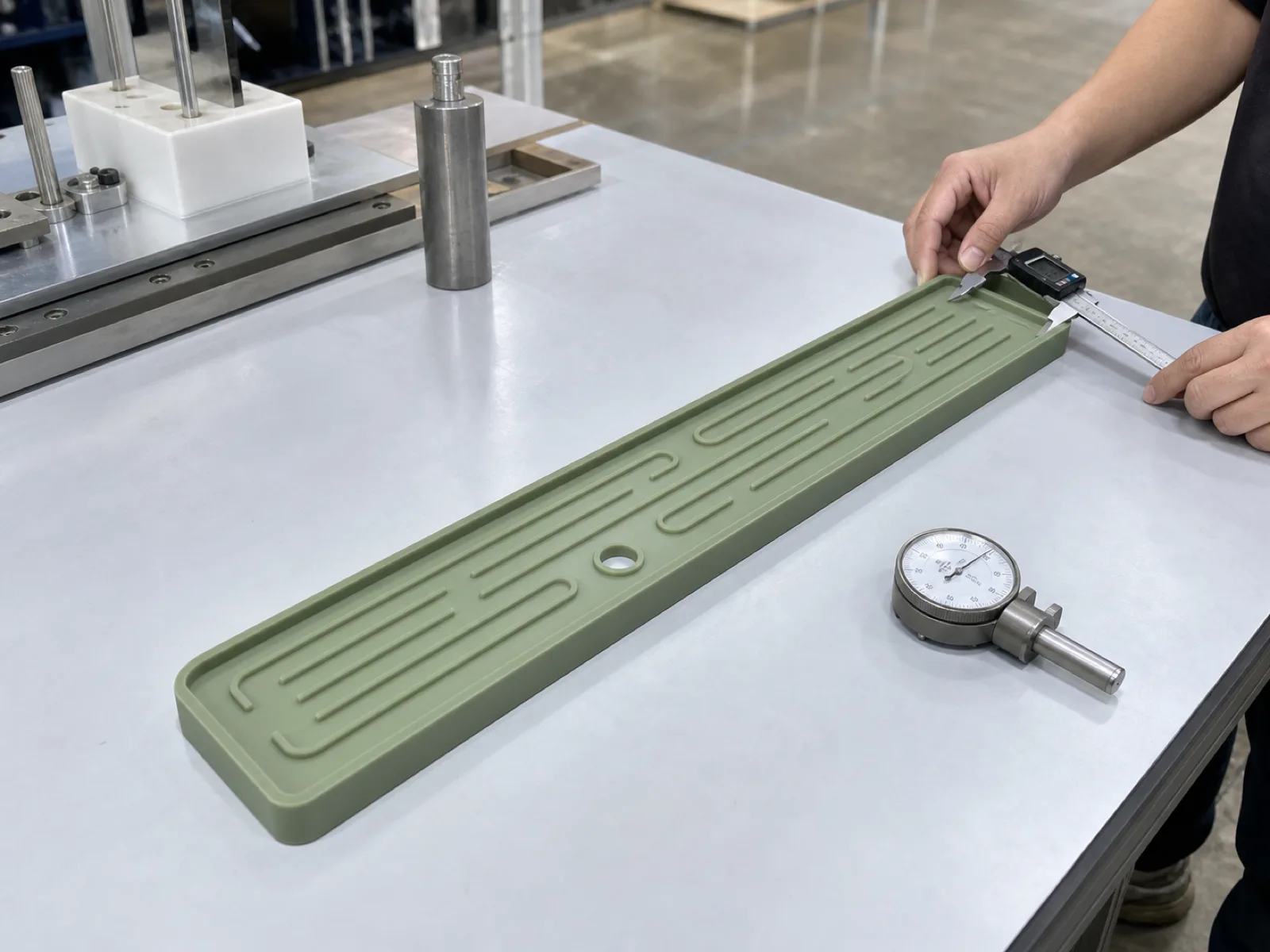
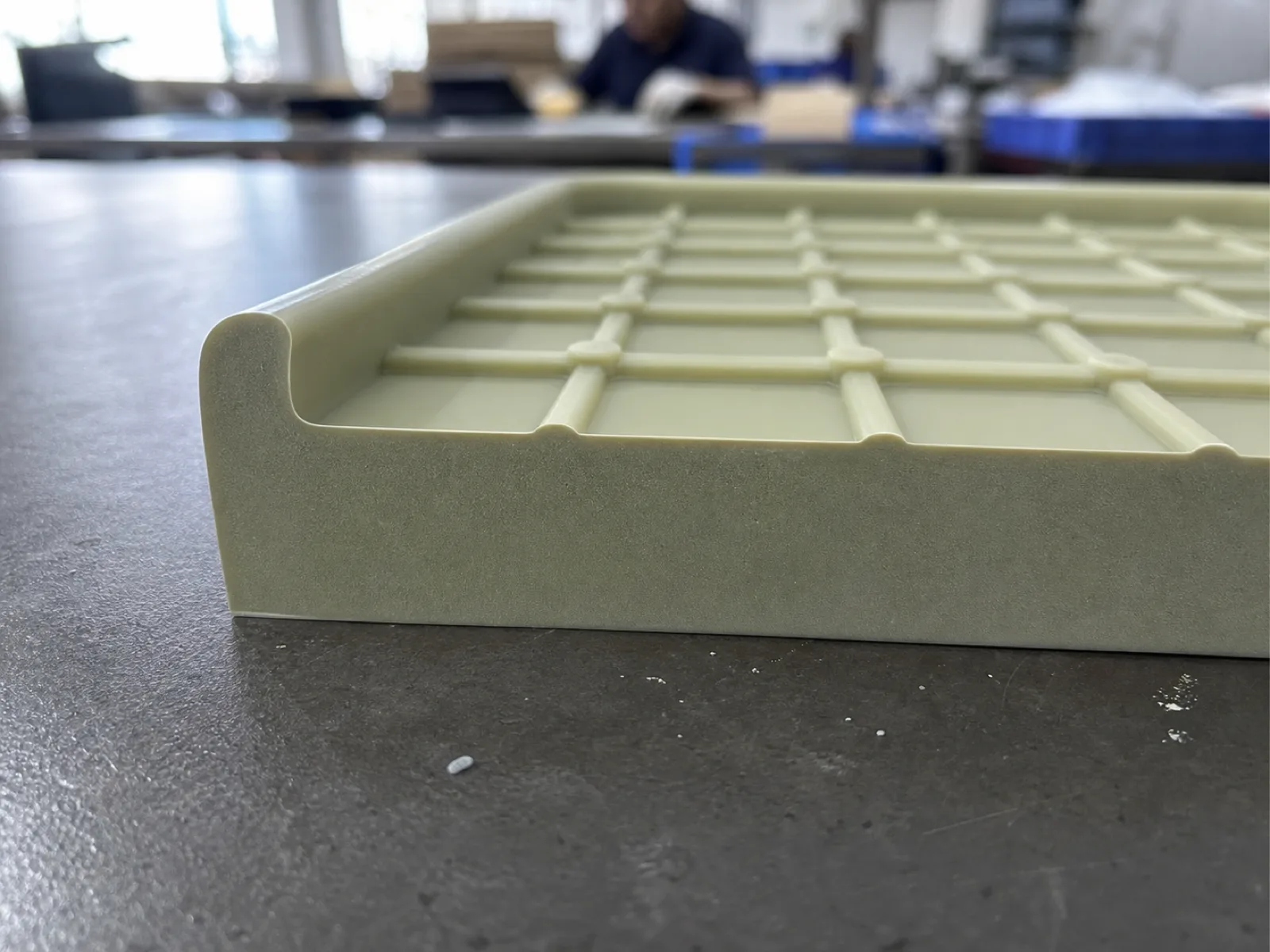
A silicone drip mat is a molded PDMS tray with a raised perimeter lip that contains spilled beverage and condensation between service intervals — Shore A 60-70 per ASTM D2240[^astm-d2240], 6-12 mm base thickness plus 3-5 mm lip, cross-hatched drainage grid on the top surface. Cured under compression at 170-190°C with a mandatory 4-6 hour post-cure at 180-200°C. Continuous service temperature -40°C to 230°C, dishwasher rated to 500 commercial cycles at 65-75°C wash plus 82°C sanitize rinse. What separates a drip mat from a flat bar mat or a coaster is the perimeter lip and the drainage geometry.
The drip mat category confuses first-time buyers because Amazon and Alibaba listings collapse three distinct product classes — bar drip mats, coasters, and dish-drying mats — under one search term. On the factory floor these are three separate SKUs with different molds, different durometers, and different secondary process steps. A bar drip mat at 600 mm × 100 mm × 8 mm base + 4 mm lip weighs 300-400 grams and requires a two-plate compression mold with side-parting features on the lip. A coaster at 100 mm × 4 mm weighs 25-35 grams and runs a simple flat compression mold. A dish-drying mat at 500 mm × 350 mm × 6 mm weighs 800-1,000 grams and runs a large-cavity mold with perforation cores. Same PDMS chemistry, three different manufacturing setups. Sourcing them from one supplier saves on freight consolidation but requires three separate tooling budgets.
Baseline engineering spec sheet
| Parameter | Bar rail | Espresso station | Back-of-house drying |
|---|---|---|---|
| Length × width | 600-900 × 80-120 mm | 200-300 × 150-200 mm | 400-600 × 300-400 mm |
| Base thickness | 6-10 mm | 8-12 mm | 5-8 mm |
| Raised lip height | 3-5 mm | 4-6 mm | 3-5 mm (or perforated flat) |
| Drainage grid depth | 2-3 mm | 4-6 mm | 8-12 mm perforation |
| Shore A hardness | 65-70 | 60-65 | 55-60 |
| Tensile strength | ≥ 7.0 MPa | ≥ 7.0 MPa | ≥ 6.5 MPa |
| Elongation at break | ≥ 300% | ≥ 300% | ≥ 250% |
| Continuous service temp | -40°C to 230°C | -40°C to 230°C | -40°C to 230°C |
| Cure system | Platinum (preferred) | Platinum (mandatory) | Platinum or peroxide + post-cure |
| Post-cure cycle | 4-6 h at 180-200°C | 4-6 h at 180-200°C | 4-6 h at 180-200°C |
| Test methods | ASTM D2240[^astm-d2240], D412[^astm-d412] | ASTM D2240, D412 | ASTM D2240, D412 |
Which cure system should I spec on a silicone drip mat — platinum or peroxide?
Platinum-cure for any hospitality program subject to commercial dishwasher cycling at 200-400 cycles per year, and for any drip mat spec targeting LFGB or EU premium hospitality. Peroxide-cure with mandatory 4-6 hour post-cure is acceptable for consumer retail bar mats at 12-40 residential cycles per year and $8-20 shelf price. Platinum runs 12-18% higher per unit but removes first-heat odor risk, PFAS process-aid verification burden, and clears LFGB §30/31 per BfR Recommendation XV[^bfr-lfgb-xv] more reliably batch-to-batch across the commercial cycle envelope.
Both cure systems use the same PDMS polymer backbone. The catalyst that triggers crosslinking is where they diverge — platinum for platinum-cure, organic peroxide (typically dicumyl peroxide or 2,4-dichlorobenzoyl peroxide) for peroxide-cure — and that catalyst choice cascades into byproduct chemistry, first-heat odor risk, per-unit cost, and dishwasher-cycle durability. Under-post-cured peroxide-cure drip mats develop a tacky surface bloom between commercial cycle 150-250 as low-molecular-weight silicone volatiles migrate to the surface under repeated thermal exposure — the failure mode behind most “the mat feels sticky after six months” hospitality return complaints. The full engineering framework lives on our platinum-cured vs peroxide-cured silicone guide.
Cost delta at bulk MOQ tiers (600 mm × 100 mm bar-rail spec)
| Cure system | 500 pcs | 1,000 pcs | 5,000 pcs | 10,000 pcs |
|---|---|---|---|---|
| Peroxide-cure (post-cured, PFAS-free process aid verified) | $3.30-$4.40 | $2.50-$3.30 | $1.80-$2.50 | $1.40-$1.95 |
| Platinum-cure (LSR or premium HCR) | $3.80-$5.20 | $2.90-$3.90 | $2.10-$2.90 | $1.60-$2.30 |
| Delta | +15-18% | +16-18% | +16-17% | +14-18% |
Numbers are FOB Yantian, Q3 2026 benchmarks, 600 mm × 100 mm bar-rail drip mat at 8 mm base + 4 mm lip, PDMS at Shore A 65, matte finish, single-color debossed logo. Pantone-matched master-batch adds $0.08-$0.14 per unit.
Which certifications does a silicone drip mat program need for hospitality retail?
The mandatory stack for US hospitality is FDA 21 CFR 177.2600[^fda-177-2600] (food-contact article), ISO 9001:2015[^iso-9001] (factory quality system), per-batch PFAS non-detect testing, and commercial-dishwasher cycle validation. Some hospitality group purchasing organizations request NSF/ANSI 51[^nsf-51] in tender language; most accept the FDA plus LFGB stack as equivalent documentation. EU premium hospitality adds LFGB §30/31[^bfr-lfgb-xv] and REACH under EU 1935/2004[^ec-1935-2004]. California retail adds Prop 65 warning screening. PFAS-free specification is table-stakes for EU shipments given the ECHA universal restriction proposal[^echa-pfas-proposal].
Retail-channel hospitality drip mat programs treat silicone drip mats as food-contact articles even though the primary contact is spilled beverage and condensation rather than direct food preparation, because the mat surface accumulates food residue during service and goes through commercial dishwasher sanitation cycles. That regulatory reading forces the same FDA, LFGB, and PFAS documentation stack the industry applies to baking mats, drying mats, and coasters. NSF-51 is the certification hospitality buyers most commonly ask about — sourced through NSF International as a per-formulation program at $8,000-$15,000 upfront plus annual audit — but roughly 90% of hospitality distributor programs accept FDA 21 CFR 177.2600 plus LFGB §30/31 plus per-batch PFAS as equivalent. Confirm the tender-language requirement before assuming NSF-51 is mandatory.
Tier-specific documentation depth
| Hospitality tier | FDA 177.2600 | LFGB §30/31 | ISO 9001 | PFAS | NSF-51 | Additional |
|---|---|---|---|---|---|---|
| Consumer retail bar mat ($8-25 shelf) | Required | Recommended | Required | Required | Not needed | Prop 65 label |
| US hospitality distributor (bar/cafe) | Required | Recommended | Required | Required | Case-by-case | Dishwasher validation |
| US premium hospitality (fine-dining/craft) | Required | Required | Required | Required | Case-by-case | Dishwasher validation |
| EU retail (all tiers) | Required | Required | Required | Required | Not standard | REACH declaration |
| Hospitality GPO / national chain | Required | Required | Required | Required | Often required | Chain-specific audit |
| Commercial-kitchen back-of-house | Required | Recommended | Required | Required | Often required | Sanitation validation |
Full breakdown on our FDA vs LFGB silicone decoder.
Which decoration method — debossed, laser-etched, pad print, or silk-screen?
Debossed logo is the hospitality default because the mark is mold-integrated and survives service life indefinitely under 200-400 commercial dishwasher cycles per year with zero abrasion risk. Laser-etched is the premium alternative for softer surface visual and 300-500+ cycle durability on darker Pantone base colors where debossed contrast is insufficient. Pad print and silk-screen with corona pre-treatment survive 150-300 residential cycles but fade or delaminate under 80-200 commercial cycles — appropriate for consumer retail bar mats, not for hospitality distributor programs.
The decoration method choice on hospitality drip mats cascades into decoration durability, tooling cost, MOQ threshold, and hospitality-return-complaint risk. Bar and coffee brand OEM programs where the drip mat carries the brand identity at point-of-service cannot ship pad-printed or silk-screened logos into commercial dishwasher environments without generating warranty complaints inside the first six months of service. Silicone’s low surface energy makes it hostile to ink adhesion without a corona or plasma pre-treatment step — and that pre-treatment is the cost line most trading-company middlemen skip to hit a headline unit price on B2B marketplace listings.
Decoration method comparison (hospitality service life)
| Method | Commercial dishwasher cycles | MOQ impact | Cost add per piece | Tooling / setup |
|---|---|---|---|---|
| Debossed (mold-integrated) | Indefinite | None (base) | Included in base | +$400-$900 mold modification |
| Laser-etched brand mark | 300-500+ cycles | None | +$0.10-$0.18 | +$300-$500 program setup |
| Pad print, silicone-compatible ink + corona | 100-200 cycles | 500-pc minimum | +$0.08-$0.14 per color | +$220-$400 plate set |
| Silk-screen, silicone-compatible ink + corona | 80-150 cycles | 500-pc minimum | +$0.10-$0.16 per color | +$260-$450 screen set |
| Silk-screen ink, no pre-treatment | Under 40 cycles | Any | +$0.05-$0.10 per color | +$150-$300 screen set |
| Multi-color LSR co-injection | Indefinite | 2,000-pc minimum | +$0.35-$0.60 | LSR mold $12,000+ |
Full decoration method deep-dive on our customize silicone logo guide.
MOQ tiers and FOB Yantian pricing for silicone drip mats bulk
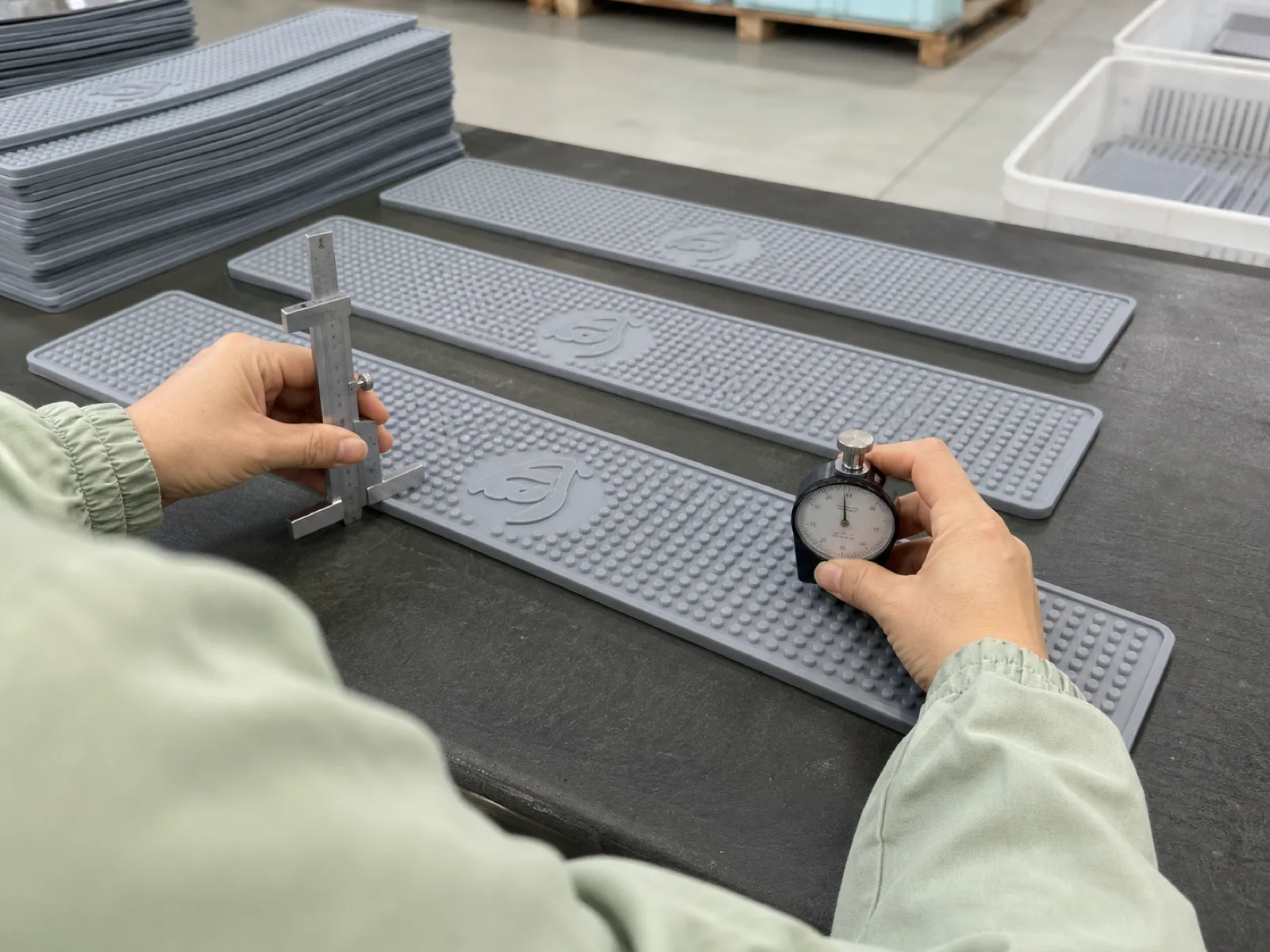
Wetop's MOQ is 500 pieces per SKU — the real breakeven where per-batch FDA plus LFGB plus PFAS test-report cost amortizes into a hospitality-distributor-competitive per-unit price. FOB Yantian Q3 2026 for a 600 mm × 100 mm bar-rail platinum-cure drip mat at 8 mm base + 4 mm lip, Shore A 65, matte finish, single-color debossed logo: 500 pcs $3.80-$5.20 / 1,000 pcs $2.90-$3.90 / 5,000 pcs $2.10-$2.90 / 10,000 pcs $1.60-$2.30 / 20,000+ pcs $1.30-$1.90. Tooling for a new drip mat shape runs $1,800-$2,800 sample mold, $4,500-$7,500 mass-production mold — higher than coaster tooling because the raised-edge geometry requires side-parting mold features.
The MOQ math on hospitality silicone drip mats bulk is not arbitrary and it doesn’t scale down. Below 500 pieces the combined per-batch third-party test cost dominates the unit economics — a 200-piece run amortizes $4-$7 of test cost onto every piece, immediately disqualifying the SKU from a hospitality distributor’s target landed price. Above 500 pieces the test amortization drops to $0.16-$0.28 per piece at 5,000. Suppliers advertising 100-piece “custom” drip mat MOQs on B2B marketplaces are pad-printing on stock bar mats out of a Guangdong warehouse — the mold and the raised-edge geometry are not actually custom to your program. The full MOQ economics logic is on our real factory MOQ math guide.
Full MOQ-tier FOB Yantian pricing (Q3 2026)
| Volume tier | Bar rail 600×100 mm | Espresso 250×175 mm | BOH drying 500×350 mm | Pantone master-batch add |
|---|---|---|---|---|
| 500 pcs | $3.80-$5.20 | $1.90-$2.60 | $5.20-$7.00 | +$0.10-$0.16 |
| 1,000 pcs | $2.90-$3.90 | $1.45-$1.95 | $4.00-$5.30 | +$0.08-$0.14 |
| 2,500 pcs | $2.40-$3.20 | $1.20-$1.60 | $3.30-$4.40 | +$0.07-$0.12 |
| 5,000 pcs | $2.10-$2.90 | $1.05-$1.45 | $2.90-$3.90 | +$0.06-$0.10 |
| 10,000 pcs | $1.60-$2.30 | $0.80-$1.15 | $2.20-$3.10 | +$0.05-$0.08 |
| 20,000+ pcs | $1.30-$1.90 | $0.65-$0.95 | $1.80-$2.60 | Quote |
Prices exclude retail-ready polybag, hospitality-distributor-specific certification fees, and destination-country duties. Add $0.06-$0.12 per piece for debossed brand mark on an unbranded base; $0.10-$0.18 for laser-etched.
Landed-cost worked example — 5,000 pcs bar-rail drip mats to US distributor warehouse
| Line item | Cost | Note |
|---|---|---|
| FOB Yantian, platinum-cure, 600×100 mm, 8 mm base, debossed logo | $2.10-$2.90/pc | Retail-ready polybag included |
| Ocean freight LCL to US West Coast (14-18 day sailing) | $0.12-$0.18/pc | 800-1,000 kg total shipment |
| US customs duty, HTS 3926.90.99 at 5.3% | $0.11-$0.15/pc | Applied to FOB value |
| Customs broker and delivery to distributor warehouse | $0.06-$0.09/pc | Standard US LCL clearance |
| Total landed DDP US West Coast distributor | $2.39-$3.32/pc | Excluding Prop 65 sticker |
| Total landed DDP US East Coast distributor | $2.45-$3.40/pc | Sailing 25-32 days, higher freight allocation |
At 10,000+ pieces the shipment moves into full container load territory and drops ocean freight per-piece by 30-50% relative to LCL rates. Full pricing structure detail on the silicone OEM pricing structure guide.
Tooling — sample mold, mass-production mold, and who owns the tool
Tooling for a new custom silicone drip mat shape runs $1,800-$2,800 for a single-cavity compression sample mold and $4,500-$7,500 for a 2-4 cavity mass-production mold on P20 hardened steel. Drip mat tooling runs 2-3× coaster tooling because the raised-edge lip requires side-parting features on the two-plate mold. Mold lifespan is 300,000-1,000,000 shots with proper maintenance. Wetop amortizes tooling against the first 5,000-10,000 pieces rather than billing separately. The buyer owns the tool once fully amortized; NDA-locked drawings from day one.
Drip mat tooling is more expensive per cavity than coaster tooling because the perimeter lip and drainage grid geometry require more complex mold surfaces. The lip demands a side-parting feature so the finished mat releases cleanly without dragging the lip against a straight-pull demolding path. The drainage grid demands EDM’d cavity-face texture at 2-3 mm depth and 8-12 mm pitch, which adds 20-40 hours to mold-cutting time versus a flat coaster cavity. Cavity count is typically lower on drip mat molds (2-4 cavities versus 4-8 for coasters) because the larger part footprint constrains press-bed real estate.
Tooling investment by process choice
| Process | Tooling cost | Cavities | Dimensional tolerance | Best for |
|---|---|---|---|---|
| Compression, single cavity sample | $1,800-$2,800 | 1 | ±0.15 mm | Sample validation, 500-1,000 pc pilot |
| Compression, 2 cavity production | $4,500-$6,000 | 2 | ±0.15 mm | 500-5,000 pc programs |
| Compression, 4 cavity production | $6,000-$7,500 | 4 | ±0.15 mm | 5,000-20,000 pc programs |
| LSR injection, 2-4 cavity | $12,000-$22,000 | 2-4 | ±0.08 mm | Multi-durometer soft-edge, 20,000+ pc |
Wetop cuts tooling in-house rather than sub-contracting, which shortens the RFQ-to-sample loop by 7-14 days and keeps CTQ mold-surface decisions in the same building as the compression press that will run the mold. Tool ownership transfers to the buyer once amortization completes; the mold is stored on-site with an NDA-locked drawing package. Full tooling economics on our silicone OEM pricing structure guide, and the MOQ-and-lead-time envelope on our MOQ and lead time silicone OEM guide.
Compression molding or LSR injection — the process decision for drip mats
Compression molding for standard bar-rail, espresso, and BOH drip mats at $1-$5 landed unit cost — tooling $1,800-$7,500, ±0.15 mm tolerance, fits 92-95% of hospitality drip mat bulk programs. LSR injection for multi-durometer soft-edge grip (Shore A 40 lip over Shore A 65 body for premium bar mats that don't slide on wet stainless), tight tolerance (±0.08 mm), or multi-color drip decoration — tooling jumps to $12,000-$22,000 but per-unit cost drops at 20,000+ volumes and part-to-part consistency is significantly higher.
For drip mats specifically, roughly 92% of hospitality bulk programs run compression molding because drip mat geometry (flat tray with raised lip and drainage grid) sits inside the compression sweet spot and volume rarely justifies the LSR tooling investment. LSR wins premium programs where multi-durometer construction is spec-critical — a soft Shore A 40 grip rim molded over a firm Shore A 65 body, so the mat holds position on a wet stainless bar top without the bartender repositioning it every 20 minutes. That soft-over-firm construction is only achievable through LSR co-injection; compression molding cannot execute the two-durometer bond in a single press cycle.
Cycle time and throughput on drip mat programs
| Process | Cycle time per shot | Cavities | Daily throughput per press |
|---|---|---|---|
| Compression, 600×100 mm bar-rail 8 mm | 6-9 min | 2-4 | 250-800 pcs |
| Compression, 250×175 mm espresso 10 mm | 5-7 min | 4-6 | 500-1,500 pcs |
| Compression, 500×350 mm BOH drying 6 mm | 7-10 min | 2 | 150-400 pcs |
| LSR injection, 600×100 mm bar-rail | 45-90 sec | 2-4 | 2,000-4,500 pcs |
Full manufacturing detail on the capabilities page.
Hospitality tier positioning — bar rail, espresso station, back-of-house, QSR
Hospitality tier is a geometry and durometer question layered on top of documentation depth. Bar rail runs 600-900 mm × 80-120 mm, Shore A 65-70, 8 mm base with 4 mm raised lip, aimed at cocktail-service traffic. Espresso station runs 200-300 mm × 150-200 mm with deeper 4-6 mm drainage grid to contain puck knock-off residue. BOH drying runs 400-600 mm × 300-400 mm at Shore A 55-60 with 8-12 mm perforations. QSR condiment/sauce station runs 250-350 mm × 200-250 mm at Shore A 65 with shallow 2-3 mm containment lip. Same PDMS chemistry, four spec envelopes.
The four anonymized program archetypes below represent the most common shapes of hospitality silicone drip mat bulk work Wetop runs from the Dongguan floor.
Bar rail cocktail-service program ($8-25 shelf, $2.10-$3.20 landed). 600 mm × 100 mm × 8 mm base + 4 mm lip, Shore A 65-70, platinum-cure with 4-hour post-cure at 200°C, single-color debossed brand mark, matte finish. FDA 21 CFR 177.2600, LFGB §30/31 case-by-case, per-batch PFAS. Volume 2,000-15,000 pieces per drop for regional hospitality distributor. Retail-ready polybag with header card.
Espresso station coffee-brand OEM ($10-18 shelf, $1.05-$1.85 landed). 250 mm × 175 mm × 10 mm base + 5 mm lip with 4 mm cross-hatched drainage grid, Shore A 60-65, platinum-cure mandatory (steam-wand rinse water thermal cycling), debossed coffee-brand mark. FDA plus LFGB plus PFAS. Volume 5,000-30,000 pieces per drop for coffee-chain private-label programs.
Back-of-house dish-drying and transfer program ($15-30 shelf, $3.20-$4.60 landed). 500 mm × 350 mm × 6 mm with 10 mm perforated flow-through pattern, Shore A 55-60, platinum-cure or peroxide-cure with 4-hour post-cure. Volume 1,500-8,000 pieces per drop for commercial-kitchen equipment distributor. Larger footprint drives higher freight allocation and tooling amortization.
QSR condiment and sauce station program ($5-12 shelf, $0.90-$1.60 landed). 300 mm × 200 mm × 6 mm base + 3 mm shallow lip, Shore A 65, peroxide-cure with 4-hour post-cure acceptable at this tier, single-color debossed logo. FDA plus per-batch PFAS. Volume 10,000-50,000 pieces per drop for national QSR-chain group purchasing organization. Highest volume, tightest cost target.
FAQ
Answered above in the frontmatter FAQ block. If your program falls outside these archetypes — larger dimensions, different service-temperature envelope, multi-durometer construction, unique certification tender language — contact Wetop engineering with your RFQ and we’ll return a first-cut spec sheet, tooling estimate, and MOQ-tier FOB Yantian pricing inside two business days.
Ready to run the RFQ?
Wetop’s Dongguan floor runs 60 employees across 7,500 m² with in-house tooling, compression and LSR injection molding, documented 4-6 hour post-cure ovens per batch, and ISO 9001:2015 quality management on every hospitality silicone drip mat bulk program. Send your spec — dimensions, Shore A target, raised-edge geometry, decoration method, hospitality tier, target landed cost, target volume — through the contact form and William Zhuo’s engineering team will return a first-article-quality sample within 7-15 days on existing tooling, or 21-35 days on new tooling. NDA-locked drawings from day one, batch-specific FDA and LFGB test reports per master-batch lot, and freight consolidation across all three product lines — drip mats, coasters, and drying mats — under one commercial invoice.
References
FAQ
-
What is the real MOQ for a custom silicone drip mat and why 500 pieces?
The real MOQ for a custom-tooled silicone drip mat is 500 pieces per SKU. Below 500 pieces the combined per-batch third-party test cost — FDA 21 CFR 177.2600 extractables at $350-$500, LFGB §30/31 at $450-$650 if the program targets EU or premium US retail, and PFAS non-detect at $180-$280 — pushes the finished unit cost above the hospitality distributor's target landed price. Above 500 pieces the amortization drops from roughly $1.96 per piece at 500 to $0.20 per piece at 5,000. Suppliers advertising 100-piece "custom" drip mat MOQs are pad-printing logos on stock bar mats out of a Guangdong warehouse — the mold, the durometer, and the drainage geometry are not actually custom to your program, and you inherit no batch-specific compliance documentation. For a 600 mm × 100 mm bar-rail drip mat at Shore A 65 with debossed logo, Wetop's real OEM 500-piece MOQ delivers full FDA plus LFGB plus PFAS test report per master-batch lot and NDA-locked tooling drawings.
-
How much does a custom silicone drip mat cost per piece in bulk at 500 vs 5,000 vs 10,000 pieces?
FOB Yantian Q3 2026 for a 600 mm × 100 mm bar-rail silicone drip mat at 8 mm thickness, Shore A 65, matte finish, single-color debossed logo, platinum-cure: 500 pieces $3.80-$5.20 per unit, 1,000 pieces $2.90-$3.90, 2,500 pieces $2.40-$3.20, 5,000 pieces $2.10-$2.90, 10,000 pieces $1.60-$2.30, 20,000+ pieces $1.30-$1.90. Peroxide-cure with post-cure runs 12-18% lower per piece at the same volume tier. Smaller espresso-station drip mats at 200 mm × 150 mm scale down by surface-area ratio, roughly $1.10-$1.60 at 5,000 pieces. Larger back-of-house drying mats at 500 mm × 350 mm run $3.20-$4.60 at 5,000 pieces. Add $0.08-$0.14 per piece for Pantone-matched master-batch, $0.06-$0.12 for debossed brand mark on an unbranded base, $0.10-$0.18 for laser-etched logo on premium hospitality SKUs.
-
What thickness, hardness, and edge geometry should we spec for a bar rail silicone drip mat?
Bar rail drip mats for cocktail-service traffic run 6-10 mm base thickness with a 3-5 mm perimeter raised lip and cross-hatched drainage grid on the top surface. Shore A 65-70 durometer per ASTM D2240 gives enough edge stiffness that the lip does not deflect flat when a bartender presses down while shaking a mixing tin, and enough grip that the mat does not slide on a wet bar top. The raised lip needs to contain 30-80 mL of accumulated spill — the empirical rule is 50 mL per linear meter of bar rail across a busy service window. Cross-hatched top-surface channels run 2-3 mm deep at 8-12 mm pitch and drain accumulated spill toward the bar-side edge where staff empty at shift change. Undermat geometry is textured or weighted (not suction cups — suction fails on damp bar tops). Consumer retail bar mats at $12-30 shelf price can drop to Shore A 55-60 at 5-7 mm because the residential use case sees an order of magnitude less traffic than commercial hospitality.
-
How does a silicone drip mat survive a commercial dishwasher versus a residential dishwasher?
Commercial dishwasher cycles run 65-75°C wash + 82°C sanitize rinse (NSF-adjacent sanitation temperature) with high-alkalinity detergent at 300-800× residential frequency across a mat's service life — a busy hospitality mat sees 200-400 cycles per year versus 12-40 for a home mat. Platinum-cured silicone with mandatory 4-6 hour post-cure at 180-200°C holds Shore A hardness within ±3 points and dimensional stability within 1.5% across 500 cycles; under-post-cured peroxide-cured silicone fails on edge softening between cycle 150-250 and develops the tacky surface bloom that generates hospitality-return complaints. The failure mode traces to low-molecular-weight silicone volatiles that were not driven off during production — the same failure mode LFGB §30/31 organic volatile testing per BfR Recommendation XV is designed to catch. For hospitality bulk programs Wetop specs platinum-cure with documented 4-hour post-cure at 200°C on every batch, tied to the master-batch lot number on the FDA and LFGB test report.
-
Does a silicone drip mat need NSF certification for use in commercial kitchens or bars?
NSF/ANSI 51 (food equipment materials) is the certification most hospitality buyers ask about, but silicone drip mats sit in a certification gray zone. Silicone bar mats and drip mats are typically classified as food-contact articles under FDA 21 CFR 177.2600 rather than as NSF-51 food-equipment materials, because the mat contacts spilled beverage and condensation rather than direct food preparation. Most hospitality buyers accept FDA 21 CFR 177.2600 plus LFGB §30/31 plus per-batch PFAS non-detect testing as the equivalent documentation stack. NSF-51 certification is available through NSF International as a per-formulation test program ($8,000-$15,000 upfront, annual audit) — Wetop can source NSF-51 certified master-batch when a specific hospitality group purchasing organization requires it in the tender language, but 90% of hospitality distributor programs accept the FDA plus LFGB stack. Confirm the specific certification language in the buyer's RFQ before assuming NSF-51 is required.
-
Which decoration method survives 200-400 dishwasher cycles per year on a hospitality silicone drip mat?
Ranked by durability under commercial dishwasher cycling: (1) Debossed logo, mold-integrated, survives service life indefinitely because the mark is a physical impression in the silicone body — zero abrasion risk, zero ink chemistry. (2) Laser-etched brand mark, 300-500+ cycles, minor edge softening at the 500-cycle mark but visually acceptable through a 2-3 year commercial service life. (3) Pad print with silicone-compatible ink and corona pre-treatment, 150-300 cycles before fade or edge delamination — appropriate for consumer retail bar mats at 12-40 cycles per year but generates warranty complaints on hospitality programs. (4) Silk-screen ink without corona pre-treatment, under 50 cycles — the failure mode behind "the logo washed off my bar mat" hospitality return complaints. For coffee-brand and cocktail-brand bulk OEM programs where the drip mat is part of the brand identity at point-of-service, debossed is the retail default; laser-etched is the premium alternative on darker Pantone base colors where debossed contrast is insufficient.
-
How do bar drip mats, espresso station drip mats, and back-of-house drying mats differ in spec?
Three separate spec envelopes serving three different service moments. Bar rail drip mats run 600-900 mm × 80-120 mm at Shore A 65-70, 6-10 mm base + 3-5 mm raised lip, cross-hatched drainage grid, targeted at cocktail-service traffic on hardwood or stainless bar tops. Espresso station drip mats run 200-300 mm × 150-200 mm at Shore A 60-65, 8-12 mm thickness with deeper 4-6 mm drainage grid to contain espresso puck knock-off residue and steam-wand rinse water — the deeper grid matters because espresso residue is denser than beer or cocktail spill. Back-of-house drying and dish-transfer mats run 400-600 mm × 300-400 mm at Shore A 55-60, 5-8 mm with larger perforations (8-12 mm) to let dish water drain through onto the counter for cloth wipe-down. A single drip mat SKU cannot serve all three; hospitality distributors typically stock 3-5 spec variants covering bar rail, espresso, and BOH plus a QSR condiment/sauce station variant.
-
What is the landed cost of hospitality silicone drip mats bulk shipped DDP to a US distributor warehouse?
Worked example for 5,000 pieces of 600 mm × 100 mm bar-rail silicone drip mat, platinum-cure at Shore A 65, 8 mm thickness, debossed logo, retail-ready polybag: FOB Yantian $2.10-$2.90 per piece. Ocean freight LCL 800-1,000 kg total shipment at $0.12-$0.18 per piece West Coast (14-18 day sailing), or $0.18-$0.26 per piece East Coast (25-32 days). US customs duty at HTS 3926.90.99 rate 5.3% on the FOB value, roughly $0.11-$0.15 per piece. Customs broker and delivery to distributor warehouse $0.06-$0.09 per piece. Retail-ready polybag baked into FOB. Total landed DDP US West Coast distributor warehouse at 5,000 pieces: approximately $2.39-$3.23 per piece; East Coast $2.45-$3.40 per piece. At 10,000+ pieces the shipment moves into full container load territory and drops ocean freight per-piece by 30-50% versus LCL rates.
-
How do we tell a real silicone drip mat factory from a trading company on a B2B marketplace?
Four tells. First, an unedited 2-3 minute walkthrough video showing compression presses and post-cure ovens under production load with the current date visible — trading companies deflect this request or send stock footage. Second, batch-specific FDA and LFGB test reports referencing a master-batch lot number from the last 90 days, matched against the post-cure oven log for the same lot. Third, an ISO 9001 certificate whose scope explicitly names silicone molding and whose validity you can verify on the issuing body's public register (SGS, TÜV, Bureau Veritas, DNV). Fourth, direct payment to the factory's legal entity that matches the exporter name on the commercial invoice — trading companies invoice through a Hong Kong or third-country intermediary that breaks chain-of-custody on any downstream hospitality return dispute. The full sourcing framework lives on our [sourcing silicone factory checklist](/guide/sourcing-silicone-factory-checklist/).
-
How long does it take to go from RFQ to distributor warehouse on a hospitality silicone drip mat bulk order?
Realistic total is 55-90 days from RFQ receipt to US distributor warehouse on a standard 5,000-20,000 piece hospitality silicone drip mat bulk order. Breakdown: RFQ engineering review 1-2 business days, sample production on existing tooling 7-15 days (or 21-35 days if new mold cut required for a custom raised-edge geometry — drip mat tooling takes longer than coaster tooling because the perimeter lip requires side-parting features on the two-plate mold), PO plus 30% deposit and material procurement 5-10 days, production run 25-35 days for 5,000-20,000 pieces including compression molding, mandatory 4-6 hour post-cure at 180-200°C, secondary decoration, and retail packaging, pre-shipment AQL 2.5 inspection per ISO 2859-1 overlapping production 3-5 days, final 70% balance and shipping documentation 2-3 days, then 14-18 day Yantian-to-US-West-Coast sailing (25-32 days East Coast, 30-38 days Northern Europe). Suppliers quoting 25-30 day cold-start-to-warehouse are compressing steps — usually the post-cure or the pre-shipment inspection.
References
Authoritative sources cited in this guide
- US Food and Drug Administration. 21 CFR 177.2600 — Rubber articles intended for repeated use. https://www.ecfr.gov/current/title-21/chapter-I/subchapter-B/part-177/subpart-C/section-177.2600 — The primary US food-contact regulation Wetop tests every silicone drip mat batch against, per master-batch lot.
- German Federal Institute for Risk Assessment. BfR Recommendation XV — Silicones. https://www.bfr.bund.de/en/bfr_recommendations_on_food_contact_materials-7498.html — The technical standard behind LFGB §30 and §31 organic volatile testing — the reason mandatory 4-6 hour post-cure exists on every hospitality drip mat batch.
- International Organization for Standardization. ISO 9001:2015 — Quality Management Systems — Requirements. https://www.iso.org/standard/62085.html — The quality management standard Wetop is certified against — governs batch traceability, post-cure records, and audit trail for every hospitality drip mat program.
- International Organization for Standardization. ISO 2859-1:1999 — Sampling procedures for inspection by attributes. https://www.iso.org/standard/1141.html — The sampling standard behind AQL 2.5 pre-shipment inspection on every silicone drip mat bulk shipment.
- ASTM International. ASTM D2240-15 — Standard Test Method for Rubber Property — Durometer Hardness. https://www.astm.org/d2240-15r21.html — The measurement standard behind every Shore A hardness spec Wetop quotes on silicone drip mats.
- ASTM International. ASTM D412 — Standard Test Methods for Vulcanized Rubber — Tension. https://www.astm.org/d0412-16r21.html — The tensile and elongation test method used on every batch check on silicone drip mats.
- NSF International. NSF/ANSI 51 — Food Equipment Materials. https://www.ecfr.gov/current/title-21/chapter-I/subchapter-B/part-177 — The food-equipment-materials certification some hospitality group purchasing organizations require in tender language for commercial-kitchen silicone drip mats.
- European Parliament and Council. Regulation (EC) No 1935/2004 — Materials intended to come into contact with food. https://eur-lex.europa.eu/legal-content/EN/TXT/?uri=CELEX%3A02004R1935-20090807 — The overarching EU framework regulation for food-contact materials — LFGB drip mat compliance sits inside this framework.
- European Chemicals Agency. PFAS Universal Restriction Proposal. https://eur-lex.europa.eu/legal-content/EN/TXT/?uri=CELEX%3A32006R1907 — The regulatory action driving PFAS-free specification adoption on silicone drip mat bulk programs shipping into EU premium hospitality.
Start a custom program
Send a brief. Get an engineer’s reply in one business day.
Every Wetop program is tooled from a customer’s specification. Send a CAD file (STEP · IGES · DWG) or a written brief and we’ll reply with a mold cost estimate, price brackets at MOQ 500 / 1,000 / 5,000, and any engineering questions.