Buyer Guide · commercial intent
Silicone Bar Mat OEM Manufacturing Guide — Specs, Certs, MOQ
 Buyer Guide
 The silicone bar mat category on the US SERP is dominated by hospitality-supply catalog listings selling stock ribbed mats at $12-18 shelf and by promotional-product resellers pad-printing spirits-brand logos on generic rubber mats. What’s missing is the B2B engineering reality of running a truly custom-tooled bar mat program for spirits brands, hospitality groups, restaurant chains, and private-label distributors — cure chemistry, decoration durability data, MOQ economics, commercial-dishwasher survivability, and full landed-cost math. This guide is that reality, written from inside a working OEM factory floor for buyers sourcing 500-50,000 piece bulk orders of branded silicone bar service and spill mats.
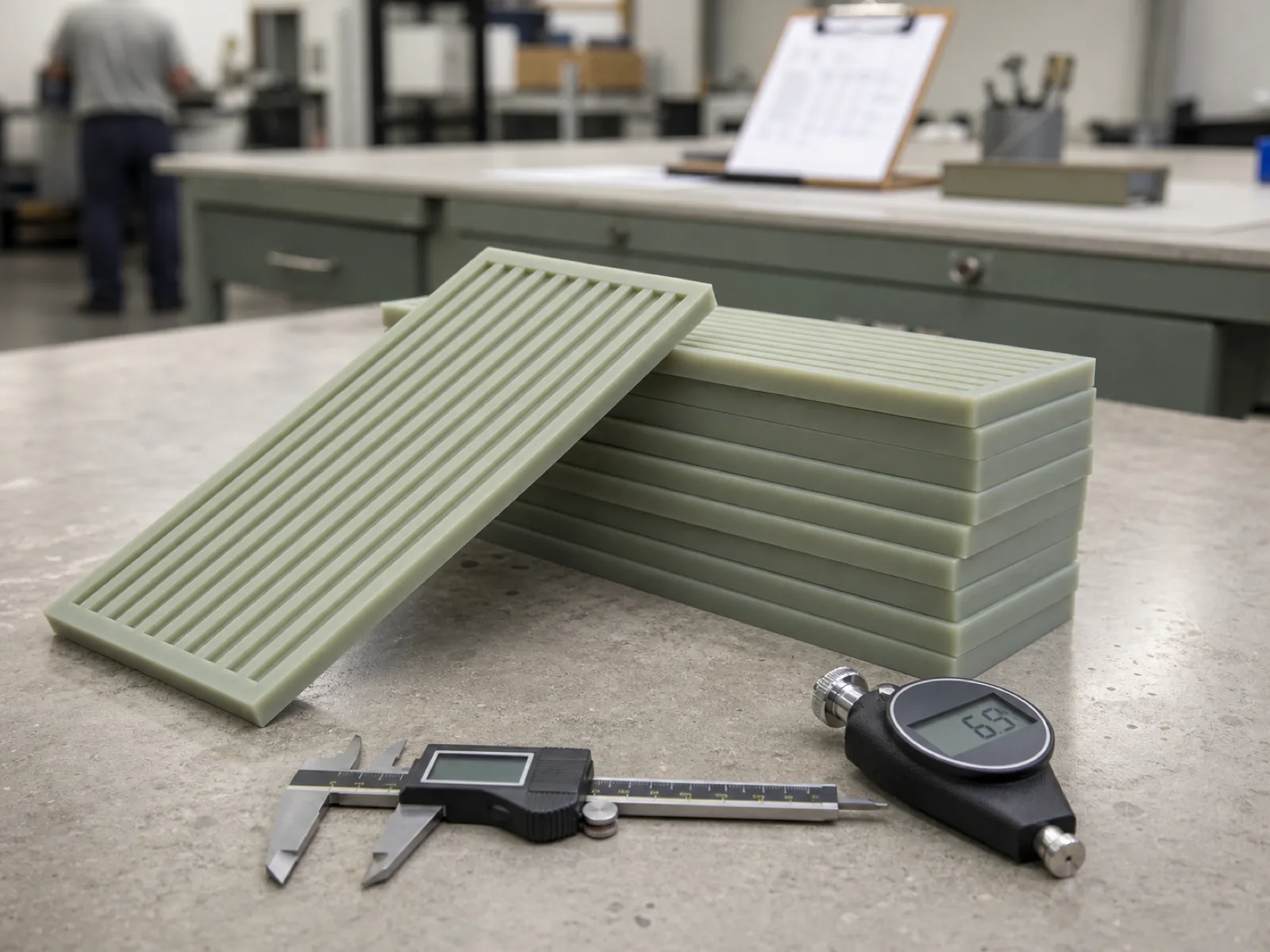
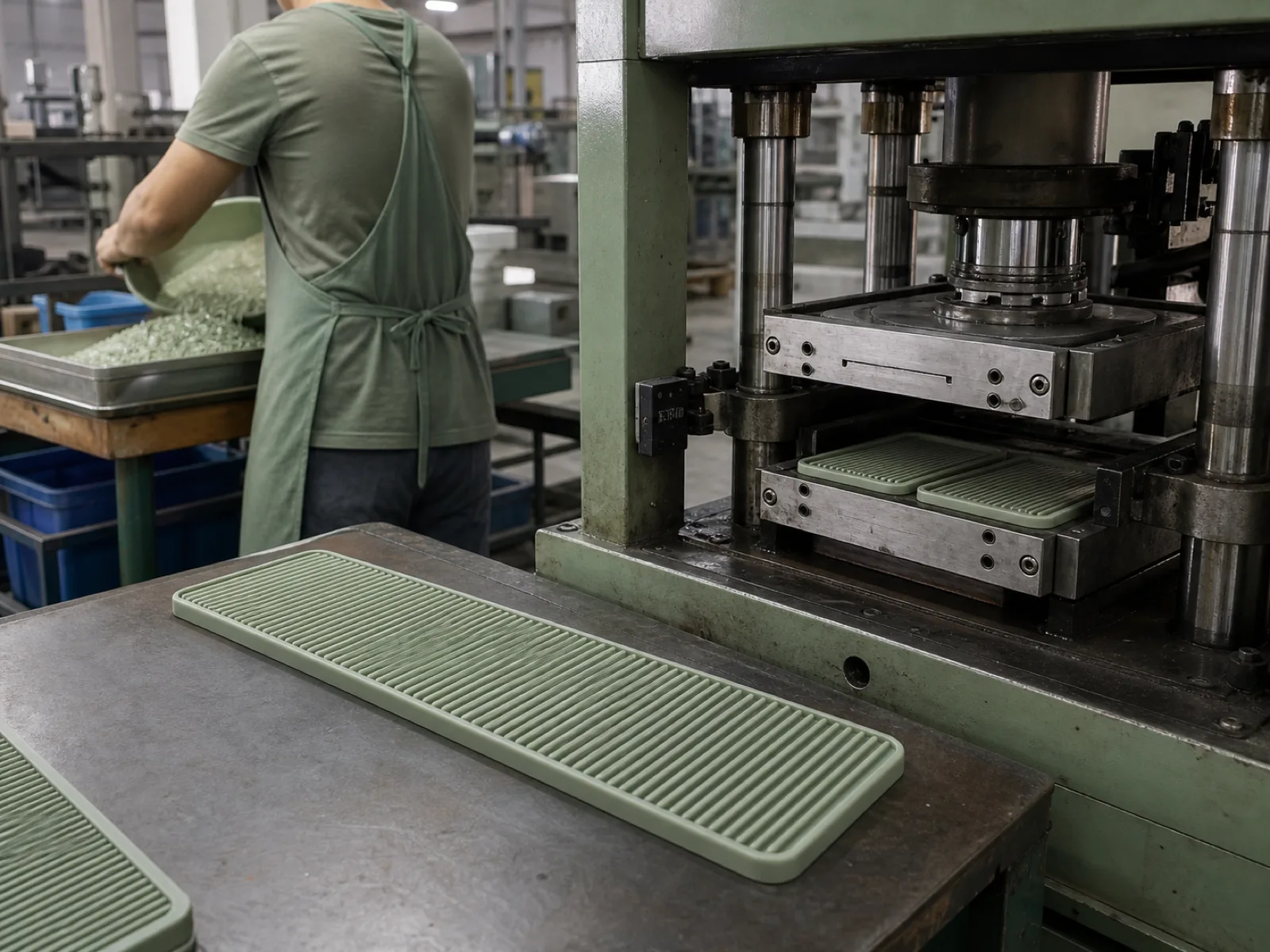
A silicone bar mat is a molded PDMS tray 8-12 mm thick with 3-6 mm raised drip ribs, Shore A 55-70, cured under compression at 160-200°C and post-cured 4-6 hours at 180-200°C to clear LFGB §30/31 organic volatile testing per BfR Recommendation XV. For B2B OEM programs, MOQ 500 pieces per SKU unlocks per-batch FDA 21 CFR 177.2600 plus LFGB plus PFAS non-detect test reports. FOB Yantian for a standard 18x3 inch platinum-cure branded bar mat with debossed logo runs $3.20-$4.60 at 500 pieces and $1.80-$2.60 at 5,000 pieces, with realistic RFQ-to-US-warehouse lead time of 55-85 days.
What is a silicone bar mat and where does it fit in the bar workflow?
A silicone bar mat is a ribbed molded PDMS tray at Shore A 55-70 per ASTM D2240[^astm-d2240], 8-12 mm total thickness with 3-6 mm raised drip ribs, continuous service temperature -40°C to 230°C. It sits on the bar top as a customer-facing service mat, inside the speed rail as a bottle-cushioning work mat, on the glass-drying rack, or under keg drip trays. Standard footprints are 12x3, 18x3, and 24x3 inches with custom geometry available at 500-pc MOQ. The ribbed structure drains condensation and spilled beverage away from bottle bases and glassware.
The bar mat category confuses first-time OEM buyers because four related product families share the “bar mat” label — customer-facing service mats on top of the bar, back-of-bar spill mats inside the speed rail, glass-drying mats on the drainboard, and keg drip trays under draft lines — each with a slightly different geometry, thickness, and durometer target. A spirits-brand promotional program typically targets the top-of-bar service mat SKU where the debossed brand logo faces the customer. A hospitality-group restaurant chain typically sources a matched set of service + spill mats plus glass-drying mats in a coordinated brand color. A distributor-tier promotional program often sources only the top-of-bar service mat, decorated with any of thirty different spirits logos on the same base geometry.
Baseline engineering spec sheet
| Parameter | Standard range | Test method |
|---|---|---|
| Footprint (inches) | 12x3, 18x3, 24x3 (custom above 500 pcs) | Digital caliper |
| Total thickness | 8-12 mm (retail typical: 10 mm) | Digital caliper, 5-point sampling |
| Drip rib height | 3-6 mm (retail typical: 4-5 mm) | Digital caliper on cavity feature |
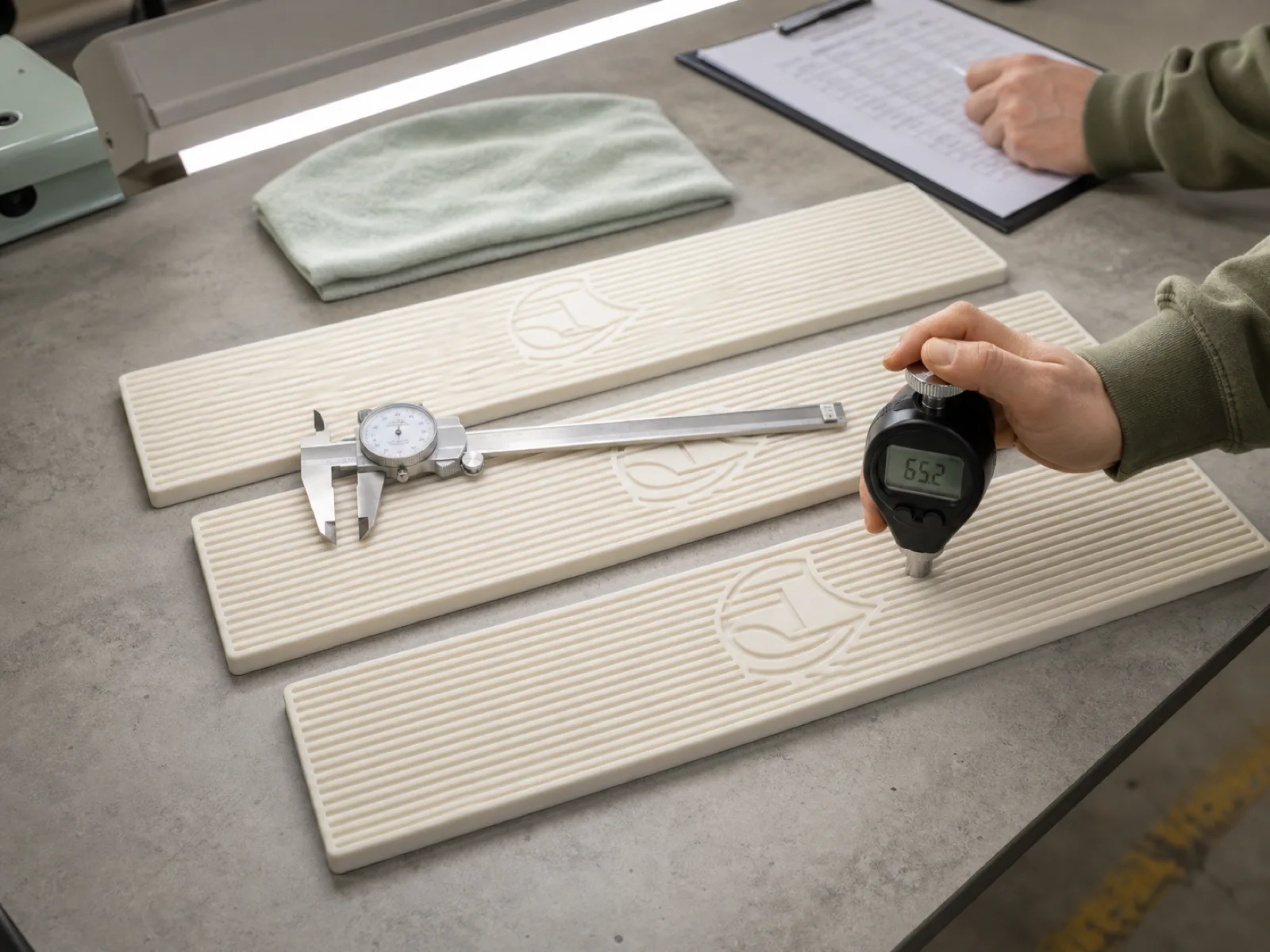
| Shore A hardness | 55-70 (bar service typical: 60-65) | ASTM D2240[^astm-d2240] |
| Tensile strength | ≥ 6.5 MPa | ASTM D412 |
| Elongation at break | ≥ 250% | ASTM D412 |
| Continuous service temperature | -40°C to 230°C | Manufacturer spec + LFGB thermal cycling |
| Peak short-exposure temperature | 260°C | LFGB extractables at peak |
| Cure system | Platinum (LSR/HCR) or peroxide (HCR) | Master-batch lot certificate |
| Cure temperature at press | 160-200°C | Press log |
| Post-cure cycle | 4-6 h at 180-200°C | Batch oven log |
| Surface finish | Matte / semi-gloss | Mold surface + secondary process |
Silicone vs rubber vs PVC bar mat — which one wins on commercial durability and hygiene?
Silicone wins across thermal range, staining resistance, hygiene, and service life — the four axes bar operators actually track. Silicone holds -40°C to 230°C continuous; PVC softens above 60°C, natural rubber degrades above 90°C. Silicone is chemically inert to citrus, alcohol, coffee, and wine; PVC absorbs each and permanently stains inside 30-90 days. Silicone is intrinsically non-porous and clears NSF/ANSI 51[^nsf-51]; PVC and rubber require additive stacks that fail food-contact regulations at bar-mat structural thickness. Service life under nightly commercial dishwasher wash: silicone 4-7 years, rubber 12-24 months, PVC 6-12 months.
Bar mat buyers frequently benchmark silicone against rubber and PVC purely on landed unit cost — where PVC undercuts silicone 40-60% and rubber undercuts silicone 15-25% — without pricing in the true service-life delta and the retail-return risk profile. A $2.40 silicone mat that lasts 5 years against a $1.10 PVC mat that lasts 10 months carries a 5.7x lower total cost of ownership on a 5-year comparison window, and that’s before pricing in the reputational cost of a stained, cracked, or delaminating branded mat under a spirits company’s logo on a customer-facing bar top.
Material comparison for commercial bar service
| Property | Platinum-cure silicone | Natural rubber (SBR/EPDM) | PVC / TPE |
|---|---|---|---|
| Continuous service temperature | -40°C to 230°C | -20°C to 90°C | -10°C to 60°C |
| Peak short-exposure | 260°C | 110°C | 70°C |
| Chemical resistance (citrus, alcohol, coffee, wine) | Excellent, inert | Fair, sulfur additive interaction | Poor, absorbs and stains |
| Food-contact regulation clearance | FDA 21 CFR 177.2600 + LFGB §30/31 native | Requires additive workarounds | Requires plasticizer workarounds |
| Non-porous surface | Yes, native | No, requires seal coat | Partial, plasticizer bloom |
| UV resistance | Excellent | Poor, chalks in 12-18 months | Fair, yellows in 18-24 months |
| Commercial-dishwasher survival | Indefinite (4-7+ years) | 12-24 months | 6-12 months |
| Recyclable at end of service | Yes, silicone scrap stream | Limited, additive contamination | Difficult, PVC waste stream |
| Landed unit cost (18x3 mat, 5k pcs) | $1.80-$2.60 | $1.50-$2.10 | $1.10-$1.60 |
| 5-year total cost of ownership | $1.80-$2.60 | $6.00-$9.00 | $8.50-$14.00 |
The 5-year TCO row is the number that closes the material decision for hospitality-group and restaurant-chain buyers. Spirits-brand promotional programs frequently accept PVC because the mat is a giveaway and the reputational risk sits with the bar operator, not the brand. Hospitality-group and restaurant-chain buyers own both the mat and the reputational exposure, so silicone wins on real math. Full compound-chemistry framework on the platinum-cured vs peroxide-cured silicone guide.
Which certifications does a silicone bar mat program need for retail and hospitality?
Mandatory US stack is FDA 21 CFR 177.2600[^fda-177-2600] (food-contact), ISO 9001:2015[^iso-9001] (factory quality system), per-batch PFAS non-detect testing, and California Prop 65 warning screening[^prop-65]. EU stack adds LFGB §30/31 per BfR Recommendation XV[^bfr-lfgb-xv] and REACH under EU 1935/2004[^ec-1935-2004]. Restaurant-chain and hospitality-group buyers frequently add NSF/ANSI 51[^nsf-51] food-equipment materials as a spec-line minimum for commercial-kitchen deployment. Every tier of retail positioning adds documentation depth, not manufacturing complexity.
Bar mats sit inside the food-contact regulatory envelope because spilled beverage, condensation, glass rinse, and repeated wet-cleaning cycles put the mat surface in direct contact with food and drink — the same regulatory reading applied to coasters, baking mats, and utensils. US mass retail and any restaurant-chain purchase order require FDA 21 CFR 177.2600 test reports per master-batch lot; EU import triggers a customs hold under the EU Rapid Alert System without LFGB documentation. Full FDA-versus-LFGB decoder on our FDA vs LFGB silicone guide.
Tier-specific documentation depth
| Buyer tier | FDA 177.2600 | LFGB §30/31 | ISO 9001 | PFAS | NSF/ANSI 51 | Additional |
|---|---|---|---|---|---|---|
| Distributor promotional bulk ($1.50-$3.00 landed) | Required | Optional | Required | Recommended | Optional | Prop 65 label |
| Spirits-brand promotional program | Required | Recommended | Required | Required | Optional | Brand-audit packet |
| US mass retail ($10-18 shelf) | Required | Recommended | Required | Required | Optional | Prop 65 label |
| Hospitality group / restaurant chain | Required | Recommended | Required | Required | Required | Commercial-dishwasher validation |
| EU retail (all tiers) | Required | Required | Required | Required | Optional | REACH declaration |
| Premium spirits brand (EU-launched) | Required | Required | Required | Required | Optional | REACH + PFAS statement |
Which decoration method survives commercial dishwashers on branded silicone bar mats?
Debossed logo is the only decoration that survives indefinite commercial service because the mark is mold-integrated with no ink or coating to abrade. Laser-etched brand marks survive 400-600+ cycles at 65-82°C wash under NSF/ANSI 3 dish-machine conditions. Pad print with silicone-compatible ink and corona pre-treatment survives 150-300 cycles; silk-screen without pre-treatment fails inside 50 cycles — the failure mode behind most branded bar mat complaints on distributor-tier programs. Multi-color drip decoration requires LSR co-injection tooling at $8,500-$15,000 and only justifies economics above 5,000 pcs.
The decoration decision on branded silicone bar mats cascades into service-life durability, complaint volume, and long-term brand equity for spirits companies and hospitality groups. Bar mat programs get decorated more heavily than coaster programs because the surface area is 6-10x larger and the customer-facing visibility is higher, which raises the stakes on getting the decoration method right. Silicone’s low surface energy makes it hostile to ink adhesion without a corona or plasma pre-treatment step — and pre-treatment is the cost line most trading-company middlemen skip to hit a headline unit price. Full decoration method deep-dive on our customize silicone logo guide.
Decoration method comparison for silicone bar mats
| Method | Durability (commercial dishwasher cycles) | MOQ impact | Cost add per piece | Tooling / setup |
|---|---|---|---|---|
| Debossed (mold-integrated) | Indefinite | None (base) | Included in base | +$300-$600 mold modification |
| Laser-etched brand mark | 400-600+ cycles | None | +$0.10-$0.22 | +$300-$500 program setup |
| Pad print, silicone-compatible ink + corona | 150-300 cycles | 500-pc minimum | +$0.08-$0.16 per color | +$220-$400 plate set |
| Silk-screen, silicone-compatible ink + corona | 100-200 cycles | 500-pc minimum | +$0.10-$0.18 per color | +$280-$450 screen set |
| Silk-screen ink, no pre-treatment | Under 50 cycles | Any | +$0.06-$0.10 per color | +$150-$280 screen set |
| Multi-color drip (LSR co-injection) | Indefinite | 5,000-pc minimum | +$0.30-$0.55 | LSR mold $8,500-$15,000 |
MOQ tiers and FOB Yantian pricing for silicone bar mats
Wetop's MOQ is 500 pieces per SKU — the retail-defensible breakeven where per-batch FDA plus LFGB plus PFAS test-report cost amortizes into a hospitality-competitive per-unit price. FOB Yantian Q3 2026 for standard 18x3 inch platinum-cure custom silicone bar mats at 10 mm, Shore A 65, matte finish, single-color debossed logo: 500 pcs $3.20-$4.60 / 1,000 pcs $2.40-$3.40 / 2,500 pcs $2.00-$2.90 / 5,000 pcs $1.80-$2.60 / 10,000 pcs $1.40-$2.10 / 20,000+ pcs $1.15-$1.75. Tooling runs $1,800-$3,200 sample mold, $4,500-$7,800 mass-production mold on P20 hardened steel.
The MOQ economics on silicone bar mats compress harder than on coasters because the per-piece material cost is 4-6x higher (a 10 mm ribbed bar mat consumes 220-440 g of platinum-cure PDMS versus 15-30 g for a coaster) and the per-batch test-report cost stays fixed. Below 500 pieces the combined third-party test cost (~$800-$1,400 across FDA plus LFGB plus PFAS) still dominates unit economics, but the material cost floor bites harder at low volume — a 200-piece run of 18x3 inch mats amortizes $4-$7 of test cost onto a piece that already carries $1.20-$1.80 of raw compound. That combination immediately disqualifies the SKU from a hospitality-group price target. Above 500 pieces the test amortization drops rapidly and the material cost bulk-purchase discounts stack. Full MOQ math on our real factory MOQ math guide, and the tooling-and-lead-time envelope on our MOQ and lead time silicone OEM guide.
Full MOQ-tier FOB Yantian pricing (18x3 inch × 10 mm, Q3 2026)
| Volume tier | Peroxide-cure post-cured | Platinum-cure LSR/HCR | Pad print add per color | Pantone master-batch add |
|---|---|---|---|---|
| 500 pcs | $2.70-$3.90 | $3.20-$4.60 | +$0.14-$0.18 | +$0.12-$0.16 |
| 1,000 pcs | $2.00-$2.90 | $2.40-$3.40 | +$0.12-$0.16 | +$0.10-$0.14 |
| 2,500 pcs | $1.70-$2.40 | $2.00-$2.90 | +$0.10-$0.14 | +$0.08-$0.12 |
| 5,000 pcs | $1.50-$2.20 | $1.80-$2.60 | +$0.08-$0.16 | +$0.07-$0.11 |
| 10,000 pcs | $1.15-$1.75 | $1.40-$2.10 | +$0.07-$0.14 | +$0.06-$0.09 |
| 20,000+ pcs | $0.95-$1.45 | $1.15-$1.75 | Quote | Quote |
Prices exclude retail-ready polybag with header card ($0.08-$0.14 per piece fully assembled), retailer-specific certification fees, and destination-country duties. 12x3 inch mats scale to ~0.70x the 18x3 price; 24x3 inch mats scale to ~1.28x. 12 mm heavy-service mats scale to ~1.18x the 10 mm price.
Landed-cost worked example — 5,000 pcs 18x3 inch mats to US warehouse
| Line item | Cost | Note |
|---|---|---|
| FOB Yantian, platinum-cure, 10 mm, 18x3 inch, debossed logo | $1.80-$2.60/pc | Retail-ready polybag included |
| Ocean freight LCL to US West Coast (14-18 day sailing) | $0.14-$0.22/pc | Based on 1,650-1,800 kg total shipment |
| US customs duty, HTS 3926.90.99 at 5.3% | $0.10-$0.14/pc | Applied to FOB value |
| Customs broker and delivery to warehouse | $0.10-$0.15/pc | Standard US LCL clearance |
| Prop 65 warning sticker (California retail only) | $0.005/pc | Applied at 3PL or origin |
| Total landed DDP US warehouse (West Coast) | $2.15-$3.12/pc | Excluding California Prop 65 sticker |
| Total landed DDP US warehouse (East Coast) | $2.32-$3.34/pc | Sailing 25-32 days, higher freight allocation |
At 10,000+ pieces the freight allocation moves into full-container-load territory and drops ocean freight per-piece by 30-45% relative to LCL rates. Full pricing structure detail on the silicone OEM pricing structure guide.
Tooling for custom silicone bar mats — sample mold, mass-production mold, and tool ownership
Tooling for a new silicone bar mat cavity runs $1,800-$3,200 for a single-cavity compression sample mold and $4,500-$7,800 for a 2-4 cavity mass-production mold on P20 hardened steel. Mold lifespan is 300,000-1,000,000 shots — comfortably longer than the 200,000-shot practical program limit at typical retail volumes. Bar mat tooling costs 2-4x more than coaster tooling because the ribbed drainage geometry requires deeper cavity relief and tighter EDM finishing on rib walls. Wetop amortizes tooling into the first 5,000-10,000 pieces rather than a separate NRE line; the buyer owns the tool at amortization complete with NDA-locked drawings.
Bar mat tooling economics are dominated by two design-driven cost drivers: cavity count (throughput scaling — 2 to 4 cavities is the sweet spot for a 5,000-20,000 piece program) and cavity-face finishing (matte texture EDM’d into the cavity for a soft anti-reflective bar-top look, or polished for semi-gloss finish). Rib geometry pushes tooling cost higher than flat-part tooling because deeper cavity relief requires more steel removal, and rib walls need consistent EDM finish to prevent silicone shear during demolding. Wetop cuts tooling in-house, keeping mold-surface decisions in the same building as the compression press that will run the mold — shortening the RFQ-to-sample loop by 7-14 days versus factories that sub-contract mold work.
Tooling investment by process choice
| Process | Tooling cost | Cavities | Dimensional tolerance | Best for |
|---|---|---|---|---|
| Compression, single cavity sample | $1,800-$3,200 | 1 | ±0.10 mm | Sample validation, 500-1,000 pc pilot |
| Compression, 2 cavity production | $4,500-$6,200 | 2 | ±0.10 mm | 1,000-8,000 pc programs |
| Compression, 4 cavity production | $6,000-$7,800 | 4 | ±0.10 mm | 5,000-20,000 pc programs, throughput-critical |
| LSR injection, 2-4 cavity | $10,500-$18,000 | 2-4 | ±0.05 mm | Multi-durometer soft-edge, multi-color drip, 10,000+ pcs |
Compression molding or LSR injection — process decision for bar mats
Compression molding for standard ribbed bar mats at $1.15-$4.60 landed unit cost — tooling $1,800-$7,800, ±0.10 mm tolerance, fits 90-95% of silicone bar mat bulk programs. LSR injection reserved for multi-durometer construction (a soft grip Shore A 40 skirt over a firm Shore A 65 body for anti-slide performance on wet bars), multi-color drip decoration, or high-volume programs above 15,000 pcs where cycle-time savings amortize the higher tooling investment. The decision is program economics driven by volume and spec envelope, not manufacturing pride.
For bar mats specifically, ~90% of bulk OEM programs run compression molding because the ribbed geometry sits inside compression’s tolerance envelope and typical program volume rarely justifies the LSR tooling step-up. LSR wins programs where design differentiation depends on multi-durometer construction (premium hospitality-group SKUs with a soft rubberized outer skirt that grips the bar top harder than a single-durometer mat) or where multi-color drip decoration is the design centerpiece for a spirits-brand launch. Full manufacturing detail on the capabilities page.
Cycle time and throughput on bar mat programs
| Process | Cycle time per shot | Cavities | Daily throughput per press |
|---|---|---|---|
| Compression, 10 mm 18x3 mat | 6-8 min | 2-4 | 300-1,000 pcs |
| Compression, 12 mm 24x3 mat | 7-10 min | 2 | 200-600 pcs |
| LSR injection, 10 mm 18x3 mat | 60-90 sec | 2-4 | 2,000-5,000 pcs |
Buyer archetype breakdown — spirits brand, hospitality group, distributor promotional
Three buyer archetypes cover 90% of the silicone bar mat bulk market. Spirits-brand promotional programs prioritize debossed logo fidelity and Pantone-matched brand color; hospitality groups and restaurant chains prioritize commercial-dishwasher survivability and matched service+spill+glass-drying sets; distributor-tier promotional bulk optimizes for landed unit cost at $1.50-$3.00 to hit a giveaway price point. The manufacturing floor is identical across archetypes; documentation depth, decoration method, and Shore A envelope differentiate.
Spirits-brand promotional program (Tier 1-2 spirits company, brand-audit-gated). 18x3 inch top-of-bar service mat, 10 mm, Shore A 65, platinum-cure PDMS, debossed brand mark with Pantone-matched brand color master-batch. FDA 21 CFR 177.2600 plus per-batch PFAS non-detect plus REACH statement for European market compatibility. Program volume 10,000-50,000 pieces distributed across bar accounts over 12-24 months. Retail-ready polybag with brand-consistent header card. Landed DDP US warehouse $2.15-$3.40. Anonymized composite: a Tier-1 US bourbon brand’s on-premise promotional program shipping 25,000 pieces per year across three brand variants, each variant a single-tool cavity swap on the same 18x3 base geometry.
Hospitality group / restaurant chain (Top-50 US restaurant group, spec-driven procurement). Matched set — 18x3 top-of-bar, 12x3 speed rail spill mat, and 20x5 inch glass-drying mat — all at Shore A 60-65, 10 mm, platinum-cure, in a coordinated matte cream or matte navy brand color with debossed venue logo. Full stack: FDA 21 CFR 177.2600, LFGB §30/31, ISO 9001:2015, per-batch PFAS non-detect, NSF/ANSI 51[^nsf-51], and commercial-dishwasher cycle validation report. Volume 5,000-20,000 sets per drop across group. Landed DDP US warehouse $2.80-$4.10 per SKU.
Distributor-tier promotional bulk ($1.50-$3.00 landed). 12x3 inch or 18x3 inch top-of-bar service mat, 8-10 mm, Shore A 55-60, peroxide-cure with mandatory post-cure, single-color debossed or pad-printed logo (30+ spirits logos on the same base geometry). FDA 21 CFR 177.2600 plus per-batch PFAS. Program volume 5,000-30,000 pieces per drop. Landed DDP US warehouse $1.50-$2.80. Anonymized composite: a US on-premise promotional-product distributor shipping 40,000 pieces across 12 spirits-brand variants on rolling 6-month campaigns.
Packaging, export logistics, and container loadability for silicone bar mat bulk
Retail-ready packaging default is polybag with printed header card at $0.08-$0.14 per piece fully assembled. Master carton is a 5-ply corrugated at 400x300x300 mm holding 30-50 mats depending on geometry. Container loadability from Yantian is 40,000-55,000 pieces per 20-foot container and 82,000-115,000 pieces per 40-foot high-cube depending on mat footprint. FCL freight from Yantian to US West Coast is $2,800-$4,200 per 40HC container Q3 2026, dropping per-piece freight from LCL rates by 30-45% at 10,000+ piece programs.
Packaging design cascades into retail readiness, freight per-piece, and unpacking labor at the receiving warehouse. Distributor-tier promotional programs typically ship in bulk polybag without header cards to minimize per-piece packaging cost. Spirits-brand and hospitality programs ship retail-ready with printed header cards, sometimes shrink-wrapped 2-packs or 3-packs, and packing efficiency drops as a result — often 25-30 pieces per master carton versus 40-50 in bulk polybag mode. HTS classification is 3926.90.99 for the mat at 5.3% US duty; header-card packaging classifies separately as paperboard printed matter but doesn’t move the entered value materially.
FAQ
What is the actual difference between a silicone bar service mat and a silicone bar spill mat?
Both terms describe the same product family — ribbed silicone trays that sit on a bar top or inside a speed rail to catch drips, drain glassware, and cushion bottle placement. Bartenders and equipment buyers use the terms interchangeably. The engineering spec envelope is identical: 8-12 mm total thickness, 3-6 mm raised drip ribs, Shore A 55-70 durometer, standard footprints 12x3, 18x3, and 24x3 inches with custom footprints available above 500 pcs MOQ. Some catalog vendors reserve “service mat” for the top-of-bar customer-facing SKU and “spill mat” for the back-of-bar work SKU, but the material spec, cure system, and compliance stack are the same. Where the product genuinely diverges is glass-drying mats (flat with no ribs, drainage handled by texture) and keg drip trays (deeper wall, integrated drain fitting) — separate spec envelopes worth engineering separately.
Silicone vs rubber vs PVC bar mat — which one wins on durability and hygiene for commercial bar use?
Silicone wins on all four axes that matter to a bar operator: thermal range, staining, hygiene, and service life. Silicone holds -40°C to 230°C continuous versus PVC’s 60°C soft point and rubber’s 90°C serviceable ceiling — a hot glass or bar-back sanitizer cycle at 82°C is well inside silicone’s envelope and cooks the surface of PVC. Silicone is chemically inert to citrus acid, alcohol at 40% ABV and above, coffee tannins, red wine polyphenols, and bitters compound — the four hardest bar staining agents. PVC absorbs each of them within 30-90 days of daily service and shifts color permanently. Rubber survives the chemistry but degrades under UV from bar-back lighting and dries out into a chalky surface inside 18 months. Silicone is intrinsically non-porous and clears NSF/ANSI 51 food-equipment materials for commercial kitchens; PVC and natural rubber both require plasticizer or sulfur-vulcanization additives that fail food-contact regulations at the levels needed for structural integrity in a 10 mm bar mat. Service life at a busy bar with nightly commercial dishwasher wash: silicone 4-7 years, rubber 12-24 months, PVC 6-12 months.
What are the standard sizes for silicone bar mats and what tolerance should I hold at Wetop's factory?
Standard footprints are 12x3, 18x3, and 24x3 inches (305x76, 457x76, 610x76 mm) with 8-12 mm total height and 3-6 mm raised drip ribs. Custom footprints are available at 500 pcs MOQ. Length tolerance is ±1.5 mm on cut edges and ±0.10 mm on mold-integrated features per ASTM D2000 rubber articles tolerance grade. Rib height tolerance is ±0.15 mm — tighter than length because rib height controls drainage flow rate and glassware stability. Corner radius is typically 6-8 mm to prevent snag on bartender aprons. Weight per piece: 12x3 inch mat at 10 mm ≈ 220 g, 18x3 ≈ 330 g, 24x3 ≈ 440 g. Wetop holds ±5% weight tolerance batch-to-batch as a proxy for master-batch dispersion consistency — the number that catches under-cured or over-cured batches before they leave the post-cure oven.
Do silicone bar mats need FDA and LFGB certification if they only contact glass bottoms, not the drink itself?
Yes for any retail or restaurant-chain program. FDA and EU regulators treat silicone bar mats as food-contact articles under 21 CFR 177.2600 and LFGB §30/31 because spilled beverage, condensation, and repeated wet-cleaning cycles put the mat surface in the food-contact exposure envelope — the same regulatory reading that applies to coasters and baking mats. US mass retail (BBB tier, Home Depot, Wayfair) and any restaurant-chain purchase order require FDA 21 CFR 177.2600 test reports per master-batch lot plus ISO 9001:2015 factory certification and per-batch PFAS non-detect testing. EU retail adds LFGB §30/31 per BfR Recommendation XV and a REACH declaration under EU 1935/2004. Restaurant-chain and hospitality-group buyers frequently add NSF/ANSI 51 food-equipment materials as a spec-line minimum. Bar mats crossing a physical retail shelf or major online marketplace (Amazon, Wayfair) in the US will fail the retailer’s onboarding audit without the FDA report, and any European Union import will trigger a customs hold under the EU Rapid Alert System for non-food products without the LFGB documentation.
Which logo decoration method survives commercial dishwasher cycles on branded silicone bar mats?
Ranked by durability under commercial dishwasher cycles at 65-82°C wash and 82°C final rinse per NSF/ANSI 3 dish-machine standard: (1) Debossed logo, mold-integrated, survives indefinitely because the mark is a physical impression in the silicone body with no ink or coating to abrade. This is the only decoration Wetop specs on premium spirits-brand and hospitality-group bar mat programs. (2) Laser-etched brand mark, 400-600+ cycles, minor edge softening at the 500-cycle mark. (3) Pad print with silicone-compatible ink and corona pre-treatment, 150-300 cycles before fade or delamination. (4) Silk-screen ink with pre-treatment, 100-200 cycles. (5) Silk-screen ink without corona or plasma pre-treatment, under 50 cycles — the failure mode behind most “the logo washed off inside two months” complaints on distributor-tier promotional bar mats. Multi-color drip decoration for design-forward SKUs requires LSR co-injection tooling at $8,500-$15,000 and only makes economic sense above 5,000 pcs per SKU.
How much does tooling cost for a custom silicone bar mat and what is the mold lifespan?
Tooling for a new custom silicone bar mat cavity runs $1,800-$3,200 for a single-cavity compression sample mold and $4,500-$7,800 for a 2-4 cavity mass-production mold on P20 hardened steel. Mold lifespan is 300,000-1,000,000 shots with proper maintenance — comfortably longer than the 200,000-shot practical program limit at typical retail volumes. Bar mat tooling costs 2-4x more than coaster tooling because the ribbed drainage geometry requires deeper cavity relief and tighter EDM finishing on the rib walls. Wetop cuts tooling in-house rather than sub-contracting mold work, which shortens the RFQ-to-sample loop by 7-14 days and keeps critical mold-surface decisions (rib texture, matte-versus-satin cavity finish) in the same building as the compression press that will run the mold. Wetop amortizes tooling against the first 5,000-10,000 pieces rather than billing it as a separate NRE line, then transfers tool ownership to the buyer with NDA-locked drawings held on-site.
What is the landed cost of custom silicone bar mats shipped DDP to a US warehouse at 5,000 pieces?
Worked example for 5,000 pieces of 18x3 inch platinum-cure custom silicone bar mats at 10 mm thickness, Shore A 65, debossed logo, retail-ready polybag with header card: FOB Yantian $1.80-$2.60 per piece. Ocean freight LCL 1,650-1,800 kg total shipment at $0.14-$0.22 per piece to US West Coast (14-18 day sailing), or $0.22-$0.34 per piece to US East Coast (25-32 days). US customs duty at HTS 3926.90.99 rate 5.3% on the FOB value, roughly $0.10-$0.14 per piece. Customs broker and delivery to warehouse $0.10-$0.15 per piece. Total landed DDP US warehouse at 5,000 pieces West Coast: approximately $2.15-$3.12 per piece. Add California Prop 65 warning label sticker at $0.005 per piece if selling into California retail channels. At 10,000+ pieces the freight allocation moves into full-container-load territory and drops ocean freight per-piece by 30-45% relative to LCL.
Can silicone bar mats survive commercial dishwashers and what temperature range are they rated for?
Yes. Platinum-cure silicone bar mats at Shore A 55-70 with mandatory 4-6 hour post-cure at 180-200°C survive commercial dishwashers indefinitely across the NSF/ANSI 3 spec envelope: 60-82°C wash cycle, 82°C final sanitizing rinse, chlorine or quat sanitizer contact, and 3-6 minute total cycle time. Continuous service temperature is -40°C to 230°C with peak short-exposure at 260°C — well outside the thermal envelope of any commercial dishwasher. The failure mode to watch for is not thermal degradation but decoration failure: silk-screen ink or pad print without corona pre-treatment fades or delaminates inside 50-300 cycles, generating the retail complaint most often mistaken for the mat itself failing. Debossed and laser-etched marks are the only decorations that survive the full service life of the mat under commercial-dishwasher conditions.
How do we tell a real silicone bar mat factory from a trading company reselling on B2B marketplaces?
Four tells separate real factories from trading-company middlemen on anonymous B2B marketplace listings. First, an unedited 2-3 minute walkthrough video showing compression presses, post-cure ovens, and QC benches under production load with the current date visible on a wall clock or newspaper — trading companies deflect this request or send stock footage. Second, batch-specific FDA 21 CFR 177.2600 and LFGB test reports referencing a master-batch lot number from the last 90 days, matched against the post-cure oven log for the same lot — trading companies produce generic reports from an unrelated recent factory batch that don’t tie to your order. Third, an ISO 9001:2015 certificate whose scope explicitly names silicone molding, verifiable on the issuing body’s public register (SGS, TÜV, Bureau Veritas, DNV, DEKRA). Fourth, direct payment to the factory’s legal entity that matches the exporter name on the commercial invoice and bill of lading — trading companies invoice through a Hong Kong or third-country intermediary that breaks chain-of-custody on any downstream compliance dispute. The full framework lives on our sourcing silicone factory checklist.
What is the realistic RFQ-to-warehouse lead time on a custom branded silicone bar mat bulk order?
Realistic total is 55-85 days from RFQ receipt to US warehouse receipt on a standard 5,000-20,000 piece custom silicone bar mat bulk order. Breakdown: RFQ engineering review 1-2 business days, sample production on existing tooling 7-15 days (or 21-35 days if new mold cut required for a custom shape), PO plus 30% deposit and master-batch procurement 5-10 days, production run 25-35 days for 5,000-20,000 pieces including compression molding, mandatory 4-6 hour post-cure at 180-200°C, secondary decoration process, and retail packaging, pre-shipment AQL 2.5 inspection per ISO 2859-1 overlapping production 3-5 days, final 70% balance and shipping documentation 2-3 days, then 14-18 day Yantian-to-US-West-Coast sailing (25-32 days East Coast, 30-38 days Northern Europe). Suppliers quoting 25-30 day cold-start-to-warehouse are compressing steps — usually the post-cure step or pre-shipment inspection, and both failures surface downstream as retail returns or LFGB test-report re-runs.
Closing — sourcing a custom silicone bar mat program
The silicone bar mat category rewards buyers who spec at the engineering level rather than at the catalog level. The four decisions that determine program success — cure system, decoration method, MOQ tier, and factory verification — sit inside numbers and clauses, not marketing language. If you’re sourcing a 500-50,000 piece branded silicone bar mat bulk program for a spirits brand, hospitality group, restaurant chain, or promotional distribution, send the spec sheet and target volume to Wetop’s engineering desk. Standard turnaround on RFQ engineering review is 1-2 business days with per-piece FOB pricing across the full MOQ tier ladder, tooling estimate, and lead-time envelope.
Next step: Request a quote from the engineering desk with your spec sheet, target volume, decoration method, and destination market. We’ll return per-piece FOB pricing, tooling estimate, and compliance packet outline within 1-2 business days.
FAQ
-
What is the actual difference between a silicone bar service mat and a silicone bar spill mat?
Both terms describe the same product family — ribbed silicone trays that sit on a bar top or inside a speed rail to catch drips, drain glassware, and cushion bottle placement. Bartenders and equipment buyers use the terms interchangeably. The engineering spec envelope is identical: 8-12 mm total thickness, 3-6 mm raised drip ribs, Shore A 55-70 durometer, standard footprints 12x3, 18x3, and 24x3 inches with custom footprints available above 500 pcs MOQ. Some catalog vendors reserve "service mat" for the top-of-bar customer-facing SKU and "spill mat" for the back-of-bar work SKU, but the material spec, cure system, and compliance stack are the same. Where the product genuinely diverges is glass-drying mats (flat with no ribs, drainage handled by texture) and keg drip trays (deeper wall, integrated drain fitting) — separate spec envelopes worth engineering separately.
-
Silicone vs rubber vs PVC bar mat — which one wins on durability and hygiene for commercial bar use?
Silicone wins on all four axes that matter to a bar operator: thermal range, staining, hygiene, and service life. Silicone holds -40°C to 230°C continuous versus PVC's 60°C soft point and rubber's 90°C serviceable ceiling — a hot glass or bar-back sanitizer cycle at 82°C is well inside silicone's envelope and cooks the surface of PVC. Silicone is chemically inert to citrus acid, alcohol at 40% ABV and above, coffee tannins, red wine polyphenols, and bitters compound — the four hardest bar staining agents. PVC absorbs each of them within 30-90 days of daily service and shifts color permanently. Rubber survives the chemistry but degrades under UV from bar-back lighting and dries out into a chalky surface inside 18 months. Silicone is intrinsically non-porous and clears NSF/ANSI 51 food-equipment materials for commercial kitchens; PVC and natural rubber both require plasticizer or sulfur-vulcanization additives that fail food-contact regulations at the levels needed for structural integrity in a 10 mm bar mat. Service life at a busy bar with nightly commercial dishwasher wash: silicone 4-7 years, rubber 12-24 months, PVC 6-12 months.
-
What are the standard sizes for silicone bar mats and what tolerance should I hold at Wetop's factory?
Standard footprints are 12x3, 18x3, and 24x3 inches (305x76, 457x76, 610x76 mm) with 8-12 mm total height and 3-6 mm raised drip ribs. Custom footprints are available at 500 pcs MOQ. Length tolerance is ±1.5 mm on cut edges and ±0.10 mm on mold-integrated features per ASTM D2000 rubber articles tolerance grade. Rib height tolerance is ±0.15 mm — tighter than length because rib height controls drainage flow rate and glassware stability. Corner radius is typically 6-8 mm to prevent snag on bartender aprons. Weight per piece: 12x3 inch mat at 10 mm ≈ 220 g, 18x3 ≈ 330 g, 24x3 ≈ 440 g. Wetop holds ±5% weight tolerance batch-to-batch as a proxy for master-batch dispersion consistency — the number that catches under-cured or over-cured batches before they leave the post-cure oven.
-
Do silicone bar mats need FDA and LFGB certification if they only contact glass bottoms, not the drink itself?
Yes for any retail or restaurant-chain program. FDA and EU regulators treat silicone bar mats as food-contact articles under 21 CFR 177.2600 and LFGB §30/31 because spilled beverage, condensation, and repeated wet-cleaning cycles put the mat surface in the food-contact exposure envelope — the same regulatory reading that applies to coasters and baking mats. US mass retail (BBB tier, Home Depot, Wayfair) and any restaurant-chain purchase order require FDA 21 CFR 177.2600 test reports per master-batch lot plus ISO 9001:2015 factory certification and per-batch PFAS non-detect testing. EU retail adds LFGB §30/31 per BfR Recommendation XV and a REACH declaration under EU 1935/2004. Restaurant-chain and hospitality-group buyers frequently add NSF/ANSI 51 food-equipment materials as a spec-line minimum. Bar mats crossing a physical retail shelf or major online marketplace (Amazon, Wayfair) in the US will fail the retailer's onboarding audit without the FDA report, and any European Union import will trigger a customs hold under the EU Rapid Alert System for non-food products without the LFGB documentation.
-
Which logo decoration method survives commercial dishwasher cycles on branded silicone bar mats?
Ranked by durability under commercial dishwasher cycles at 65-82°C wash and 82°C final rinse per NSF/ANSI 3 dish-machine standard: (1) Debossed logo, mold-integrated, survives indefinitely because the mark is a physical impression in the silicone body with no ink or coating to abrade. This is the only decoration Wetop specs on premium spirits-brand and hospitality-group bar mat programs. (2) Laser-etched brand mark, 400-600+ cycles, minor edge softening at the 500-cycle mark. (3) Pad print with silicone-compatible ink and corona pre-treatment, 150-300 cycles before fade or delamination. (4) Silk-screen ink with pre-treatment, 100-200 cycles. (5) Silk-screen ink without corona or plasma pre-treatment, under 50 cycles — the failure mode behind most "the logo washed off inside two months" complaints on distributor-tier promotional bar mats. Multi-color drip decoration for design-forward SKUs requires LSR co-injection tooling at $8,500-$15,000 and only makes economic sense above 5,000 pcs per SKU.
-
How much does tooling cost for a custom silicone bar mat and what is the mold lifespan?
Tooling for a new custom silicone bar mat cavity runs $1,800-$3,200 for a single-cavity compression sample mold and $4,500-$7,800 for a 2-4 cavity mass-production mold on P20 hardened steel. Mold lifespan is 300,000-1,000,000 shots with proper maintenance — comfortably longer than the 200,000-shot practical program limit at typical retail volumes. Bar mat tooling costs 2-4x more than coaster tooling because the ribbed drainage geometry requires deeper cavity relief and tighter EDM finishing on the rib walls. Wetop cuts tooling in-house rather than sub-contracting mold work, which shortens the RFQ-to-sample loop by 7-14 days and keeps critical mold-surface decisions (rib texture, matte-versus-satin cavity finish) in the same building as the compression press that will run the mold. Wetop amortizes tooling against the first 5,000-10,000 pieces rather than billing it as a separate NRE line, then transfers tool ownership to the buyer with NDA-locked drawings held on-site.
-
What is the landed cost of custom silicone bar mats shipped DDP to a US warehouse at 5,000 pieces?
Worked example for 5,000 pieces of 18x3 inch platinum-cure custom silicone bar mats at 10 mm thickness, Shore A 65, debossed logo, retail-ready polybag with header card: FOB Yantian $1.80-$2.60 per piece. Ocean freight LCL 1,650-1,800 kg total shipment at $0.14-$0.22 per piece to US West Coast (14-18 day sailing), or $0.22-$0.34 per piece to US East Coast (25-32 days). US customs duty at HTS 3926.90.99 rate 5.3% on the FOB value, roughly $0.10-$0.14 per piece. Customs broker and delivery to warehouse $0.10-$0.15 per piece. Total landed DDP US warehouse at 5,000 pieces West Coast: approximately $2.15-$3.12 per piece. Add California Prop 65 warning label sticker at $0.005 per piece if selling into California retail channels. At 10,000+ pieces the freight allocation moves into full-container-load territory and drops ocean freight per-piece by 30-45% relative to LCL.
-
Can silicone bar mats survive commercial dishwashers and what temperature range are they rated for?
Yes. Platinum-cure silicone bar mats at Shore A 55-70 with mandatory 4-6 hour post-cure at 180-200°C survive commercial dishwashers indefinitely across the NSF/ANSI 3 spec envelope: 60-82°C wash cycle, 82°C final sanitizing rinse, chlorine or quat sanitizer contact, and 3-6 minute total cycle time. Continuous service temperature is -40°C to 230°C with peak short-exposure at 260°C — well outside the thermal envelope of any commercial dishwasher. The failure mode to watch for is not thermal degradation but decoration failure: silk-screen ink or pad print without corona pre-treatment fades or delaminates inside 50-300 cycles, generating the retail complaint most often mistaken for the mat itself failing. Debossed and laser-etched marks are the only decorations that survive the full service life of the mat under commercial-dishwasher conditions.
-
How do we tell a real silicone bar mat factory from a trading company reselling on B2B marketplaces?
Four tells separate real factories from trading-company middlemen on anonymous B2B marketplace listings. First, an unedited 2-3 minute walkthrough video showing compression presses, post-cure ovens, and QC benches under production load with the current date visible on a wall clock or newspaper — trading companies deflect this request or send stock footage. Second, batch-specific FDA 21 CFR 177.2600 and LFGB test reports referencing a master-batch lot number from the last 90 days, matched against the post-cure oven log for the same lot — trading companies produce generic reports from an unrelated recent factory batch that don't tie to your order. Third, an ISO 9001:2015 certificate whose scope explicitly names silicone molding, verifiable on the issuing body's public register (SGS, TÜV, Bureau Veritas, DNV, DEKRA). Fourth, direct payment to the factory's legal entity that matches the exporter name on the commercial invoice and bill of lading — trading companies invoice through a Hong Kong or third-country intermediary that breaks chain-of-custody on any downstream compliance dispute. The full framework lives on our [sourcing silicone factory checklist](/guide/sourcing-silicone-factory-checklist/).
-
What is the realistic RFQ-to-warehouse lead time on a custom branded silicone bar mat bulk order?
Realistic total is 55-85 days from RFQ receipt to US warehouse receipt on a standard 5,000-20,000 piece custom silicone bar mat bulk order. Breakdown: RFQ engineering review 1-2 business days, sample production on existing tooling 7-15 days (or 21-35 days if new mold cut required for a custom shape), PO plus 30% deposit and master-batch procurement 5-10 days, production run 25-35 days for 5,000-20,000 pieces including compression molding, mandatory 4-6 hour post-cure at 180-200°C, secondary decoration process, and retail packaging, pre-shipment AQL 2.5 inspection per ISO 2859-1 overlapping production 3-5 days, final 70% balance and shipping documentation 2-3 days, then 14-18 day Yantian-to-US-West-Coast sailing (25-32 days East Coast, 30-38 days Northern Europe). Suppliers quoting 25-30 day cold-start-to-warehouse are compressing steps — usually the post-cure step or pre-shipment inspection, and both failures surface downstream as retail returns or LFGB test-report re-runs.
References
Authoritative sources cited in this guide
- US Food and Drug Administration. 21 CFR 177.2600 — Rubber articles intended for repeated use. https://www.ecfr.gov/current/title-21/chapter-I/subchapter-B/part-177/subpart-C/section-177.2600 — The primary US food-contact regulation Wetop tests every silicone bar mat batch against, per master-batch lot.
- German Federal Institute for Risk Assessment. BfR Recommendation XV — Silicones. https://www.bfr.bund.de/en/bfr_recommendations_on_food_contact_materials-7498.html — The technical standard behind LFGB §30 and §31 organic volatile testing on silicone bar mats — the reason mandatory 4-6 hour post-cure exists in every batch process.
- International Organization for Standardization. ISO 9001:2015 — Quality Management Systems — Requirements. https://www.iso.org/standard/62085.html — The quality management standard Wetop is certified against — governs batch traceability, post-cure records, and audit trail for every custom silicone bar mat program.
- International Organization for Standardization. ISO 2859-1:1999 — Sampling procedures for inspection by attributes. https://www.iso.org/standard/1141.html — The sampling standard behind AQL 2.5 pre-shipment inspection on every silicone bar mat bulk shipment.
- ASTM International. ASTM D2240-15 — Standard Test Method for Rubber Property — Durometer Hardness. https://www.astm.org/d2240-15r21.html — The measurement standard behind every Shore A hardness spec Wetop quotes on custom silicone bar mats.
- ASTM International. ASTM D2000 — Standard Classification System for Rubber Products in Automotive Applications. https://www.astm.org/d2000-18.html — The rubber-articles classification framework governing dimensional tolerance grades on ribbed compression-molded bar mat geometry.
- NSF International. NSF/ANSI 51 — Food Equipment Materials. https://www.ecfr.gov/current/title-21/chapter-I/subchapter-B/part-177 — The food-equipment materials standard many restaurant-chain and hospitality-group buyers require on silicone bar mat specs for commercial-kitchen deployment.
- European Parliament and Council. Regulation (EC) No 1935/2004 — Materials intended to come into contact with food. https://eur-lex.europa.eu/legal-content/EN/TXT/?uri=CELEX%3A02004R1935-20090807 — The overarching EU framework regulation for food-contact materials — LFGB silicone bar mat compliance sits inside this framework.
- California Office of Environmental Health Hazard Assessment. California Proposition 65 — Safe Drinking Water and Toxic Enforcement Act. https://oehha.ca.gov/proposition-65 — The California warning-label requirement any silicone bar mat program selling into California retail or hospitality channels must screen against.
- European Chemicals Agency. PFAS Universal Restriction Proposal. https://eur-lex.europa.eu/legal-content/EN/TXT/?uri=CELEX%3A32006R1907 — The regulatory action driving PFAS-free specification adoption on silicone bar mat programs shipping into EU premium retail and hospitality channels.
Start a custom program
Send a brief. Get an engineer’s reply in one business day.
Every Wetop program is tooled from a customer’s specification. Send a CAD file (STEP · IGES · DWG) or a written brief and we’ll reply with a mold cost estimate, price brackets at MOQ 500 / 1,000 / 5,000, and any engineering questions.