Tier 2 US home-improvement retail chain caliber · Multi-Category · Private-label silicone trivet program, 4 SKUs, single retail buyer, DDP
Silicone Trivet OEM for a US Home Chain — 4 SKUs, Platinum
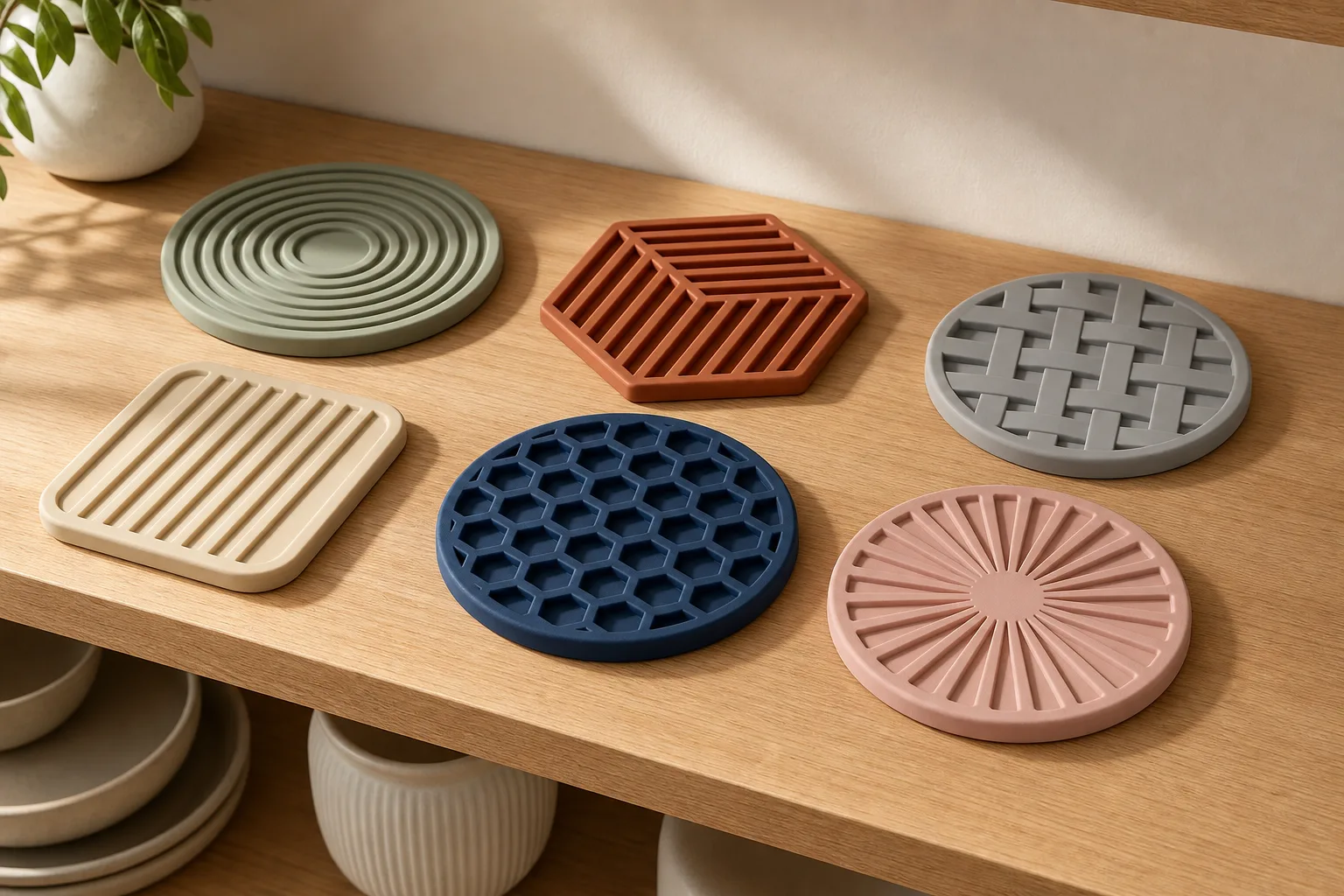
Why this program was really about compliance, not price
The buyer's RFQ read as a price shootout but was actually a compliance-and-continuity shootout. Three cheaper bidders quoted peroxide-cure HCR without addressing post-bake volatiles, which would have failed LFGB §21 sensory testing on the ivory and sage colorways within one production cycle. Landed cost, not per-piece cost, was the real number.
The 18% DDP savings the buyer needed came from three levers: cure-system selection matched to colorway, shared 4-cavity compression tooling amortized across the blended 45,000-piece annual run, and a single-pass compliance dossier that eliminated retest cycles. Any one of the three missing turns the math into a losing bid. For the mechanics of that unit-cost math, see our silicone OEM pricing structure breakdown.
At a retail-tier private-label program, the failure modes that matter are not the ones RFQ pricing captures. LFGB §21 Kat.15 is anchored in BfR Recommendation XV on silicones, which sets extraction limits and sensory-neutrality requirements that peroxide-residual silicone routinely trips within one shelf cycle. FDA 21 CFR 177.2600 (eCFR) governs the repeated-use extraction thresholds. The buyer’s audit protocol tests against both. Bidders quoting per-piece prices without accounting for how their cure system interacts with those two regulations were, in effect, quoting on a product that would not clear audit.
Cure-system decision: platinum vs peroxide, mapped by SKU
Platinum-cure LSR was locked in for the ivory and sage colorways because platinum leaves zero volatile residuals — no post-bake, no yellowing, no LFGB sensory failure. Peroxide-cure HCR was retained on the two dark colorways where raw-material savings of ~US$0.11/kg survived the post-bake energy penalty. The split saved the buyer ~US$0.12/unit blended.
Peroxide residuals fluoresce and yellow under UV and continuous heat exposure — the failure mode is invisible at first-article and shows up 60-90 days into retail shelf life. Platinum-cure LSR eliminates the residual pathway entirely. The full trade-off with tooling costs, cycle times, and food-contact implications is in our platinum-cured vs peroxide-cured silicone guide.
The economic decision is not “platinum is always better.” Peroxide-cure HCR still wins on raw-material cost per kilogram, and on dark colorways where residual yellowing is invisible against the base pigment, the raw savings survive the post-bake energy penalty. The engineering discipline is knowing which SKU gets which cure system, and defending the split against a procurement team who wants a single-material story. On this program, the split was defensible because both cure systems clear the same food-contact regulations under the FDA 21 CFR 177.2600 framework — the split affects unit cost and shelf-life aesthetics, not compliance status.
Compliance stack: single dossier, four regulations, zero retest
The dossier covered FDA 21 CFR 177.2600 (repeated-use rubber), LFGB §21 Kat.15 (silicone food contact), EC 1935/2004 (EU framework regulation), and California Prop 65 in one submission. Batch-level test reports at ISO 2859-1 AQL 1.5 major / 4.0 minor cleared the buyer's third-party lab on first pass, eliminating the 2-3 week retest cycles most peroxide bidders would have hit.
REACH SVHC was screened against the ECHA Candidate List current at PO date; the declaration of compliance was reissued with each SVHC list update inside the 3-year run. Our take on why FDA and LFGB are not interchangeable — a mistake three of the five bidders had built into their quotes — is in our FDA vs LFGB silicone explainer.
The EU framework regulation on food-contact materials, EC 1935/2004, requires a written declaration of compliance for every food-contact article on the EU market. Retailers that sell into both US and EU channels (which most Tier 2 US home-improvement chains do) audit for the EU declaration alongside the FDA reports, so the dossier has to bundle both regulations from day one. California Prop 65 is technically a state law but functions as a de facto national compliance floor because most retail programs cannot economically ship a Prop-65-non-compliant SKU only to non-California states. Our reference against the OEHHA Prop 65 list was screened at every SVHC update cycle to catch the substances that appear on both lists.
Sampling discipline was locked to ISO 2859-1 at AQL 1.5 major / 4.0 minor — the retail-tier sampling standard the buyer’s third-party lab was already calibrated against. Cross-lab comparability was baked in from the sampling plan up.
Shore A, thickness, and heat-deflection spec table
All four SKUs specified Shore A 65 ±5 per ASTM D2240, wall thickness 5.0 mm ±0.2 mm at the trivet body and 7.5 mm ±0.3 mm at the load-bearing ribs, and continuous heat-deflection range of −40 °C to 230 °C. Compression set per ASTM D395 Method B held under 25% after 22 hours at 175 °C, well inside the buyer's spec of 30% maximum.
| SKU | Colorway | Cure | Shore A | Body thickness | Rib thickness | Heat range |
|---|---|---|---|---|---|---|
| TRV-01 | Ivory | Platinum LSR | 65 ±5 | 5.0 mm ±0.2 | 7.5 mm ±0.3 | −40 °C to 230 °C |
| TRV-02 | Sage | Platinum LSR | 65 ±5 | 5.0 mm ±0.2 | 7.5 mm ±0.3 | −40 °C to 230 °C |
| TRV-03 | Charcoal | Peroxide HCR | 65 ±5 | 5.0 mm ±0.2 | 7.5 mm ±0.3 | −40 °C to 230 °C |
| TRV-04 | Terracotta | Peroxide HCR | 65 ±5 | 5.0 mm ±0.2 | 7.5 mm ±0.3 | −40 °C to 230 °C |
Deep dive on why 65A landed as the sweet spot for trivet grip-versus-durability, and how thickness maps to heat-deflection headroom, is in our silicone temperature range explainer. Shore A durometer measurements are keyed to ASTM D2240, which specifies the indenter geometry, dwell time, and correction for temperature drift; compression set was verified per ASTM D395 Method B, the constant-deflection method used on food-contact elastomers. Both standards are called out by document number in the buyer’s supplier quality manual, so the test reports had to reference the exact revision year of each standard current at PO date.
Molding decision: compression vs LSR injection, mapped by cure system
The two platinum-cure light-colorway SKUs ran on LSR injection with cold-runner tooling; the two peroxide-cure dark-colorway SKUs ran on compression molding with pre-formed HCR sheet stock. LSR injection tooling cost roughly 2.2x compression tooling per SKU but delivered ~40% shorter cycle time and near-zero flash at the color-change transitions. The blended tooling capex still cleared the 18%-under-target line because volume was concentrated in the two peroxide SKUs.
The molding-technology split mirrored the cure-system split. LSR injection is the natural pairing for platinum-cure two-component silicone at mid-volume; compression molding is the natural pairing for peroxide-cure HCR at mid-volume because the pre-formed sheet stock consumes less press energy per part. Trying to force all four SKUs onto one molding technology — a common request from procurement teams trying to simplify supplier onboarding — would have blown either the tooling capex (all-LSR) or the cycle time (all-compression) past the target line. The technology split is what makes the unit-cost math work.
Tooling economics: shared 4-cavity block with SKU-swappable inserts
A shared 4-cavity P20 compression tool block with SKU-swappable inserts amortized tooling cost across the blended 45,000 pcs/yr program instead of billing per-SKU. Tooling ran in the US$8-12k range per insert set versus US$28-35k for four independent single-cavity LSR tools. The amortization delta was the mechanism that let the DDP unit cost clear the buyer's 18%-under target.
For the underlying math on how MOQ tier, tooling amortization, and cavity count trade off at 500 / 1,000 / 5,000 / 10,000-unit brackets, see our real factory MOQ math breakdown. The shared-block approach also concentrated maintenance cycles: one P20 block, one polishing schedule, one venting-optimization pass, rather than four independent maintenance calendars competing for the same tooling engineer’s Monday morning. Small operational wins compound over a 3-year program.
Lead time: 11-day first article, 28-day production, DDP Yantian
First-article approval landed 11 days after PO (T0 + 4 tooling insert cut, T0 + 7 first-shot sampling, T0 + 11 buyer sign-off). Full production cycle ran 28 days PO-to-DDP into the buyer's Southern California DC via Yantian port, matched against the buyer's 30-day inventory-turn spec. FOB Yantian and DDP Los Angeles options were quoted; the buyer chose DDP for landed-cost predictability.
Standard sampling and production windows across our full program mix are documented in the silicone OEM MOQ and lead time guide. On this program, the 28-day PO-to-DDP window has held across nine reorder cycles without slip — the operational reason is that the shared 4-cavity block never leaves the press bay, so setup time for each new PO drops to a color-change and vent-clean rather than a full tooling install.
Retail-tier fit: what Home Depot / Wayfair / Target-caliber QA actually requires
Retail-tier QA at the Home Depot / Wayfair / Target / BBB / Tesco / Carrefour caliber requires batch-level FDA and LFGB reports keyed to production lot, not one-time type-approval. In-house lab capability at the OEM (Shore A, tensile, tear, compression set, extraction) is the audit gate that separates bidders. Documentation continuity across a 3-year private-label program is where most Asia-based bidders lose the second reorder.
Retail chain compliance manuals rarely spell this out at RFQ stage — the batch-level requirement surfaces at first-audit and kills bidders who quoted assuming type-approval reports would carry the program. Our positioning on this is expanded in the private-label silicone kitchen products playbook. US retailer product-safety expectations are outlined at a general level in the US Consumer Product Safety Commission’s Regulatory Robot, which most Tier 2 chains use as the baseline overlay on their private-label quality manuals.
Supplier audit checklist buyers can hand to procurement
The five audit items that separate real factories from trading desks: ISO 9001:2015 certificate with valid transition date; batch-level FDA 21 CFR 177.2600 and LFGB §21 test reports issued in the last 12 months; in-house lab with Shore A durometer, tensile tester, and compression-set oven; documented ISO 2859-1 AQL sampling plan on every lot; and named engineering lead reachable outside sales channels for spec disputes.
Ask for the actual certificate PDFs, not the certificate numbers. Cross-check the ISO 9001 certificate against the issuing body’s public registry. The full 12-item audit list — including tooling ownership, corrective-action logs, and RFQ-to-first-article workflow — is in our sourcing silicone factory checklist. The ISO 9001:2015 standard itself specifies the corrective-action documentation trail that a real quality management system produces; asking for two random corrective-action records from the past 12 months separates certified factories from certificate-holders in about 30 seconds.
What the program extended into
The buyer's second-year expansion added two adjacent silicone housewares SKUs — a sink grid and a drying mat — under the same private-label bundle, on the same compliance dossier, using the same batch-level QA discipline. Neither adjacent category went back to open RFQ. The single-pass compliance clearance on the trivet program was the mechanism that shifted the buyer from RFQ-driven sourcing to incumbent-preferred sourcing on the private-label kitchen bundle.
That extension pathway — trivet program to sink grid to drying mat — is the private-label bundling mechanic we run repeatedly with retail-chain buyers. For teams evaluating whether a program of this shape fits their sourcing model, our capabilities overview or a direct engineering conversation is the fastest path in. NDA templates are pre-approved and standard — see our NDA process — and other structural cases like this one are in our case-studies index.
Sourcing a similar program?
Get a CAD review and quote in one business day.
MOQ 500 per SKU. Samples in 7-25 days. We can share a more detailed reference (under NDA) for an adjacent program. Email inquiry@wetopsilicone.com or use the form.