Buyer Guide · commercial intent
CPAP Mask Cushion Silicone — OEM Sourcing Guide
What changed: First publication under the v3 anti-navel-gazing standard — benchmarked against LSR-supplier CPAP pages (YHLSR, Green Silicones, NEWTOP) and rewritten with the component-vs-device regulatory distinction, ISO 10993 clause citations, durometer-to-seal-comfort data, LIM cold-runner process detail, and an over-mold-vs-snap-fit assembly matrix those pages omit.
 Buyer Guide
 A CPAP mask cushion is the soft silicone skin-seal component of a CPAP mask, molded from platinum-cured liquid silicone rubber (LSR) to hold a leak-free seal against facial skin under 4-20 cmH2O of blower pressure. It is an OEM component — not a finished medical device — so a silicone factory certifies it to material-level biocompatibility (USP Class VI, ISO 10993-5 and -10) while the device brand owns the finished-mask 510(k) clearance. The defensible cushion spec is a dual-durometer LSR design: a soft Shore A 10-25 sealing membrane on a firmer 30-50 body, molded by liquid injection to ±0.05 mm, cleaned nightly for a 2-4 week consumable life.
Buyers searching “cpap mask cushion silicone” split into two groups, and this guide serves both. Device brands and their contract manufacturers arrive with a mask architecture, a target seal geometry, and a regulatory checklist — they need a component supplier who understands the ISO 10993 skin-contact panel and the difference between a food-grade certificate and medical biocompatibility. Distributors and product managers arrive earlier and need to understand why the cushion is LSR, what durometer seals without leaking, and where the component supplier’s responsibility stops and the device OEM’s 510(k) begins. It is written from inside a Dongguan LSR molding floor, benchmarked against ISO 10993-1[^iso-10993-1], USP <88>[^usp-88], and ISO 3302-1[^iso-3302-1] — not against a marketing brochure that name-drops “medical grade” without a clause behind it.
Is a CPAP mask cushion silicone a finished medical device or an OEM component?
A CPAP mask cushion is a silicone component, not a finished device. The factory molds the soft skin-seal part from platinum-cured LSR and certifies it to material-level biocompatibility — USP Class VI and ISO 10993-5/-10. The finished mask is a Class II device the brand clears with the FDA under 21 CFR 807. A component supplier cannot sell you device clearance.
This distinction is the single most important thing an OEM buyer gets right or wrong, so it leads the guide. The regulatory model has two layers:
- Component layer (the factory’s job). The silicone cushion is a material part. A qualified supplier delivers the cushion molded to drawing, plus a biocompatibility packet proving the material is safe for repeated intact-skin contact: USP <88> Class VI[^usp-88], ISO 10993-5 cytotoxicity[^iso-10993-5], and ISO 10993-10 irritation/sensitization[^iso-10993-10], each referencing the actual production compound lot. That is the ceiling of what a silicone factory can and should certify.
- Device layer (the brand’s job). The finished CPAP mask — cushion + frame + headgear + elbow + vent — is a Class II medical device. Clearing it for the US market means a 510(k) premarket notification under 21 CFR 807[^fda-807], owned by the brand or its contract manufacturer, with the finished-device biological evaluation organized per ISO 10993-1[^iso-10993-1]. The component test reports are inputs to that submission — they are not the submission.
The trap on marketplace listings and thin supplier pages is the phrase “FDA approved silicone CPAP cushion.” A standalone cushion is not, and cannot be, FDA-cleared as a device — clearance attaches to a finished device with a defined intended use. When a supplier claims otherwise, they either do not understand the regulatory model or are hoping you do not. What a defensible partner says instead is: “here is the USP Class VI and ISO 10993 packet against this compound lot, and a Certificate of Analysis that supports your device submission.” That is the honest, useful answer.
Why is liquid silicone rubber (LSR) the default material for CPAP mask cushions?
LSR is the CPAP-cushion default because liquid injection molding holds ±0.03-0.05 mm on the thin sealing membrane, cures in 25-60 seconds with near-zero flash, and clears USP Class VI on standard platinum-cured formulations. HCR compression cannot hold the membrane tolerance, and TPE gels take a compression set and absorb skin oil over a year of nightly wear.
The material shortlist for a facial skin-seal narrows fast:
Liquid silicone rubber (LSR) — the answer. A two-part, 1:1 platinum-cured (addition-cure) system pumped from drums, metered, mixed, and injected into a heated steel mold where it cures in seconds. It flows into thin, complex sealing-membrane geometries that a firmer compound cannot fill, holds precision tolerance, leaves no peroxide by-products, and passes the ISO 10993 skin-contact panel cleanly. The -50 to +200°C range gives it the sterilization and cleaning headroom the daily-wash lifecycle demands. For the cure-chemistry rationale behind “platinum only,” see the platinum-cured vs peroxide-cured silicone guide.
High-consistency rubber (HCR) — disqualified for the membrane. HCR is gum-stock silicone shaped by compression or transfer molding. It makes fine gaskets and tubing, but it cannot reliably hold the ±0.05 mm thin-wall tolerance a leak-free sealing lip needs, and the process is manual and flash-heavy. Some low-volume cushion prototypes are HCR; volume production is LSR.
TPE / silicone gel — feels soft, fails the year. Thermoplastic-elastomer and gel cushions feel plush on day one but take a permanent compression set over months of nightly clamping, yellow and stiffen as they absorb facial sebum, and lack silicone’s temperature and cleaning headroom. They show up on cost-driven masks and are the reason some seals “go hard” within months.
| Property | Platinum-cured LSR | HCR (compression) | TPE / silicone gel |
|---|---|---|---|
| Thin-membrane tolerance | ±0.03-0.05 mm | ±0.15-0.30 mm | ±0.10-0.20 mm |
| Cycle / cure time | 25-60 s, automated | 3-8 min, manual | fast, but sets over time |
| Biocompatibility path | USP Class VI clean | achievable, more variable | grade-dependent |
| Compression set (1 yr wear) | Low | Low | High — seal hardens |
| Skin-oil / sebum aging | Slow | Slow | Fast — yellows/stiffens |
| Service temp range | -50 to +200°C | -50 to +200°C | ~-30 to +80°C |
What Shore A hardness makes a CPAP cushion seal without leaking?
A CPAP cushion is a dual-durometer part, not a single hardness. The outer sealing membrane that touches facial skin runs Shore A 10-25 so it drapes without pressure points; the structural body that holds geometry against blower pressure runs Shore A 30-50. A single soft durometer flutters and balloons under pressure; a single firm one red-marks the face and leaks on side-sleepers.
Durometer is where cushion comfort is engineered, and the naive answer — “make it soft” — is wrong. A CPAP blower pushes 4-20 cmH2O into the mask; the cushion has to stay sealed against that pressure while the head moves through a night of sleep. The two competing requirements are resolved by zoning the hardness:
| Cushion zone | Shore A target | Job | Failure if wrong |
|---|---|---|---|
| Sealing membrane (skin contact) | 10-25A | Drape and conform to facial contour, distribute contact force | Too firm → red marks, seal breaks on head turn |
| Cushion body / spring wall | 30-50A | Hold seal geometry, resist balloon under blower pressure | Too soft → flutters, balloons, leaks at pressure |
| Frame-bond flange (over-mold) | 40-60A | Bond to rigid frame, transfer clamp load | Too soft → tears at the bond line |
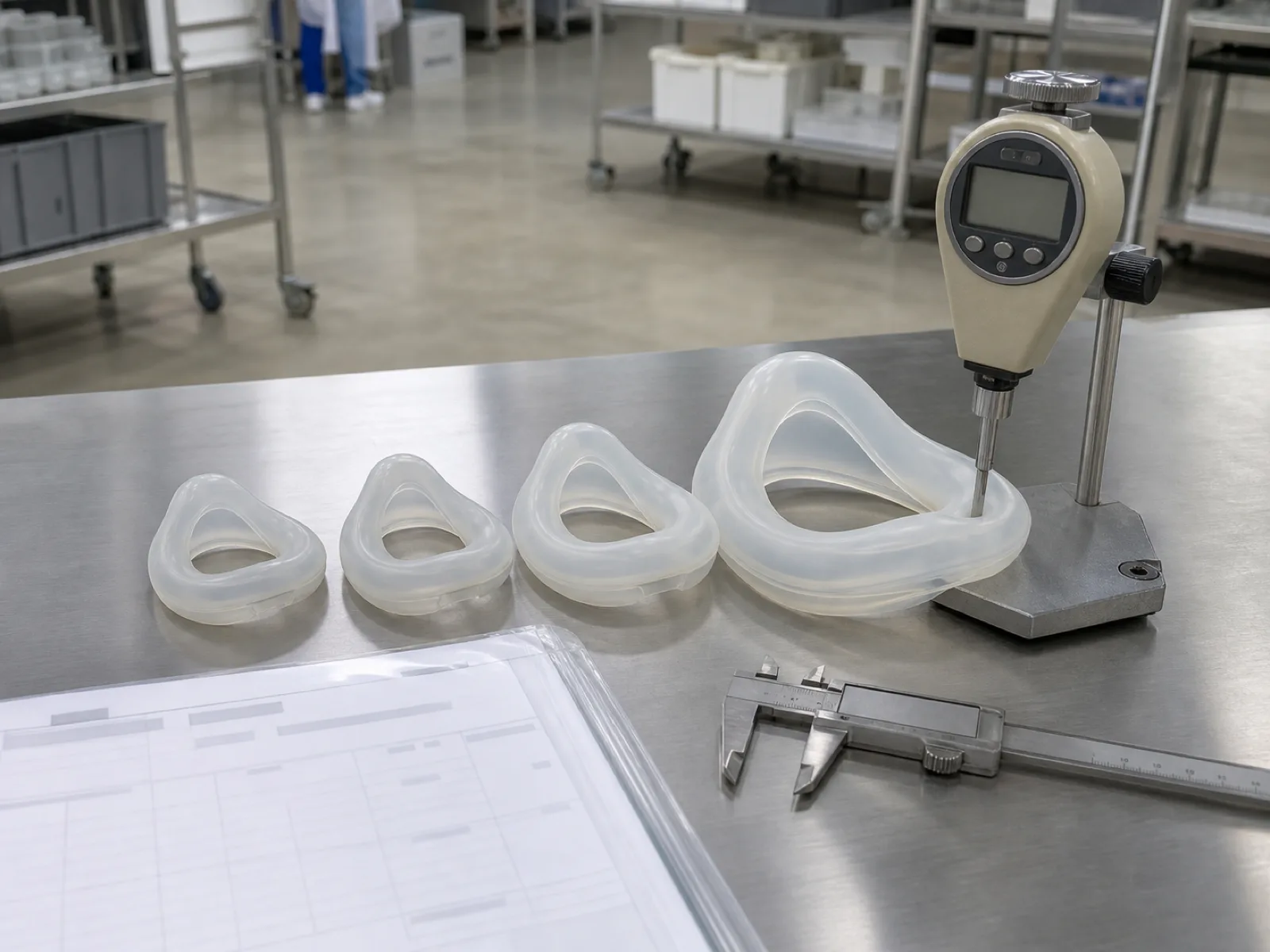
Two ways to build the gradient in production. A graded-durometer single-shot uses one LSR grade whose geometry (thin membrane, thicker ribbed body) delivers the effective softness gradient — cheapest, and adequate for many nasal cushions. A two-shot / over-mold of two LSR grades injects a soft membrane grade onto a firmer body grade for a true material gradient — used on premium full-face and pillow masks where seal performance is the selling point. The durometer targets are verified on both zones with a Shore A durometer per ASTM D2240[^astm-d2240]; the cured material’s tensile and tear are checked per ASTM D412[^astm-d412] because a soft membrane still has to survive a user tugging it off the frame nightly.
How are CPAP mask cushions molded — the liquid injection molding (LIM) process?
CPAP cushions are made by liquid injection molding (LIM): two-part LSR is metered 1:1, static-mixed, injected through a cold-runner into a heated steel mold at 150-180°C, and cured in 25-60 seconds before automated demolding. Cold-runner tooling keeps the runner unheated so no material cures or wastes in the feed system — critical for thin, high-cavitation cushion tools.
The LIM cell, step by step, is what separates a real LSR molder from a job shop:
- Metering and mixing. Part A (vinyl-PDMS + Pt catalyst) and Part B (PDMS + hydride cross-linker) are pumped from drums at a precise 1:1 ratio, plus optional pigment and self-lubricating additive, through a static mixer. Ratio drift is the first thing that ruins cure — a metering pump under closed-loop control is non-negotiable.
- Cold-runner injection. The mixed LSR injects through a temperature-controlled cold-runner block that stays cool while the mold cavity is hot. This means the LSR only cures inside the cavity — no cured slug in the runner, no sprue waste, and clean color changes. For a multi-cavity cushion family tool, cold-runner is what makes the economics work.
- Heated-mold cure. The steel mold sits at 150-180°C. The thin sealing membrane cures in 25-45 seconds; a thicker full-face body takes 45-60 seconds. Cure time is driven by the thickest wall, which is why cushion wall design is a cost lever, not just a comfort lever.
- Demold and de-flash. LSR’s low viscosity and precision tooling give near-flash-free parts; automated or manual demolding lifts the cushion off cores designed for the soft geometry to release without tearing.
- Post-cure (conditional). Platinum-cured LSR often needs no post-cure for skin contact, but drug-path or low-VOC grades get a 2-4 hour / 200°C post-bake to drive volatiles below the target — relevant if the program adds ISO 18562 breathing-gas-pathway testing[^iso-18562-1].
The tolerance the process holds is governed by ISO 3302-1[^iso-3302-1]: class E1 precision (±0.05 mm on the thin membrane wall) is realistic and is what a seal needs, because a 0.1 mm wall drift measurably changes seal force. Over-molding the cushion onto a rigid frame adds an insert-load step — the frame is placed in the mold before injection — which lengthens cycle time and raises tooling cost but eliminates the assembly leak path discussed next.
How is the LSR cushion joined to the rigid mask frame — over-mold vs snap-fit vs adhesive?
Three architectures. Over-molding injects LSR directly onto the rigid frame for a hermetic bond with no adhesive and no leak path — best seal, highest tooling cost, non-replaceable cushion. Snap-fit molds a silicone bead that clips onto the frame, making the cushion a user-replaceable consumable at the cost of a micro-leak path. Medical-adhesive bonding is the middle option with adhesive-qualification overhead.
The assembly choice is a business-model decision as much as an engineering one, because most CPAP brands run a razor-and-blades model where the replaceable cushion is recurring revenue:
| Architecture | Seal integrity | Cushion replaceable? | Tooling cost | Key risk |
|---|---|---|---|---|
| Over-mold onto frame | Highest — chemical/mechanical bond, no leak path | No — cushion + frame is one part | Highest (insert-load tool) | Reject scraps the frame too |
| Snap-fit (molded bead/groove) | Good — depends on bead design | Yes — user-swappable consumable | Moderate | Micro-leak path at clip interface |
| Medical-adhesive bond | Good — depends on adhesive line | Sometimes (service-replaceable) | Moderate + adhesive qual | Adhesive must clear ISO 10993-5 |
Over-molding is chosen when seal performance is the product story and the cushion is not meant to be swapped — the LSR bonds to a treated polycarbonate or nylon frame during injection. The cost: a molding reject scraps the rigid frame with it, and the buyer cannot sell replacement cushions.
Snap-fit is the mainstream consumer-CPAP choice because it turns the cushion into a 2-4 week consumable — the recurring-revenue engine. The engineering price is a mechanical interface between a soft silicone bead and a rigid groove, which is a potential micro-leak path that has to be designed and leak-tested, not assumed.
Medical-adhesive assembly bonds a separately molded cushion to the frame with a cytotoxicity-cleared adhesive. It avoids the over-mold tooling cost but adds an adhesive-qualification burden — the adhesive is now in the skin/breathing path and must clear ISO 10993-5[^iso-10993-5] in its own right.
What biocompatibility tests must a CPAP mask cushion silicone pass?
A CPAP cushion is a limited-duration, repeated, intact-skin-contact component under ISO 10993-1. The core panel is ISO 10993-5 cytotoxicity, ISO 10993-10 irritation and skin sensitization, and USP <88> Class VI as the material baseline. Because the cushion sits in the breathing-gas path, some programs add ISO 18562 particulate, VOC, and leachable testing on top.
The categorization drives the panel. Per ISO 10993-1[^iso-10993-1], a CPAP cushion is surface-contacting, intact skin, limited/prolonged repeated exposure — a comparatively low-risk contact category, but “low risk” is not “no testing.” The defensible panel:
| Test | Standard | What it proves | When required |
|---|---|---|---|
| Cytotoxicity (in vitro) | ISO 10993-5[^iso-10993-5] | Material extract does not kill cells | Always — first-tier screen |
| Irritation | ISO 10993-10[^iso-10993-10] | No skin irritation on repeated contact | Always for facial-skin contact |
| Skin sensitization | ISO 10993-10[^iso-10993-10] | No allergic-sensitization response | Always for repeated skin contact |
| Biological reactivity | USP <88> Class VI[^usp-88] | Material-baseline biocompatibility | Material qualification baseline |
| Breathing-gas pathway | ISO 18562[^iso-18562-1] | Particulate / VOC / leachables in gas path | Program-dependent (many CPAP OEMs add) |
Two rules that separate a real packet from a claim. First, cite the compound lot, not the compound family — a report on “generic 40A LSR” does not cover the specific pigmented, additive-loaded compound in your cushion. Second, watch report age — biocompatibility reports older than 3-5 years should be re-qualified. The component supplier owns these material-level reports; the device OEM assembles them, plus its own finished-device testing, into the ISO 10993-1 biological evaluation that supports the 510(k). For the full six-test breakdown behind the USP Class VI designation, see the USP Class VI biocompatibility guide.
Why is FDA 21 CFR 177.2600 not enough — food-grade vs the device pathway?
FDA 21 CFR 177.2600 governs food-contact rubber — it is the baseline most silicone factories already hold for kitchenware, and it says nothing about skin sensitization, breathing-gas leachables, or device suitability. A CPAP interface is a Class II device requiring 510(k) clearance under 21 CFR 807, with USP Class VI and the ISO 10993 skin panel on the material. Food-grade is not medical evidence.
This is the most expensive misunderstanding in medical-silicone sourcing, so it gets its own section. Here is exactly what each certificate does and does not cover:
- FDA 21 CFR 177.2600 — “Rubber articles intended for repeated use” in food contact[^fda-177-2600]. It sets extractable limits for food-contact hygiene. It is real, and a competent silicone factory holds it, but it is a food standard. It does not test skin sensitization, does not address inhaled leachables, and has nothing to say about device intended use. A factory that answers “is this safe for a CPAP mask?” with a 177.2600 or LFGB certificate is answering a different question.
- USP <88> Class VI + ISO 10993-5/-10 — the material biocompatibility evidence for skin contact. This is the layer a food-grade cert does not touch.
- 21 CFR 807 / 510(k) — the device clearance for the finished mask[^fda-807], owned by the brand. This is the layer no material certificate can substitute for.
The practical buyer test: ask a prospective cushion supplier “what certifications does your cushion carry for medical use?” A food-only answer (177.2600, FDA food-grade, LFGB) means they are a kitchenware factory reaching into a vertical they do not understand. A defensible answer names USP Class VI and the ISO 10993 skin panel against a compound lot, and correctly states that the finished-device 510(k) is the brand’s responsibility. The difference between food-grade and medical-grade silicone is not a marketing gradient — it is a different test battery and a different regulatory owner.
How does cleaning and sterilization affect a silicone CPAP cushion over its life?
Platinum-cured silicone survives the daily-cleaning regimen — roughly 365 warm-water-and-soap wet-dry cycles a year plus diluted-vinegar or CPAP-wipe disinfection — without hardening or cracking, and its -50 to +200°C range tolerates occasional boiling or dishwasher sanitizing. The real aging driver is skin-oil and sebum absorption over 6-12 months, which slowly stiffens the sealing membrane and sets the replacement cadence.
Cleaning is where the material choice pays off across the service life:
- Daily home care. Warm water + mild, unscented soap, air-dry. The cushion sees ~365 wet-dry cycles a year; platinum-cured LSR shrugs these off with no dimensional change.
- Periodic disinfection. Diluted white vinegar soak or a commercial CPAP wipe weekly. Silicone tolerates both; TPE gels haze and stiffen.
- Occasional heat sanitizing. Top-rack dishwasher or a brief boil — silicone’s temperature range absorbs this without deforming, which PVC and TPE cushions cannot claim.
- The aging mechanism that ends the cushion’s life. Facial sebum and skin oil slowly diffuse into the silicone over months, plasticizing then stiffening the thin sealing membrane. The seal that was compliant on day one gradually loses drape — a material-physics fact, not a defect. Specifying a low-extractables platinum LSR slows oil uptake and extends comfortable seal life.
This aging is exactly why cushions are sold as consumables rather than lifetime parts, which flows straight into the sizing and replacement economics.
How are CPAP cushions sized, and how often are they replaced?
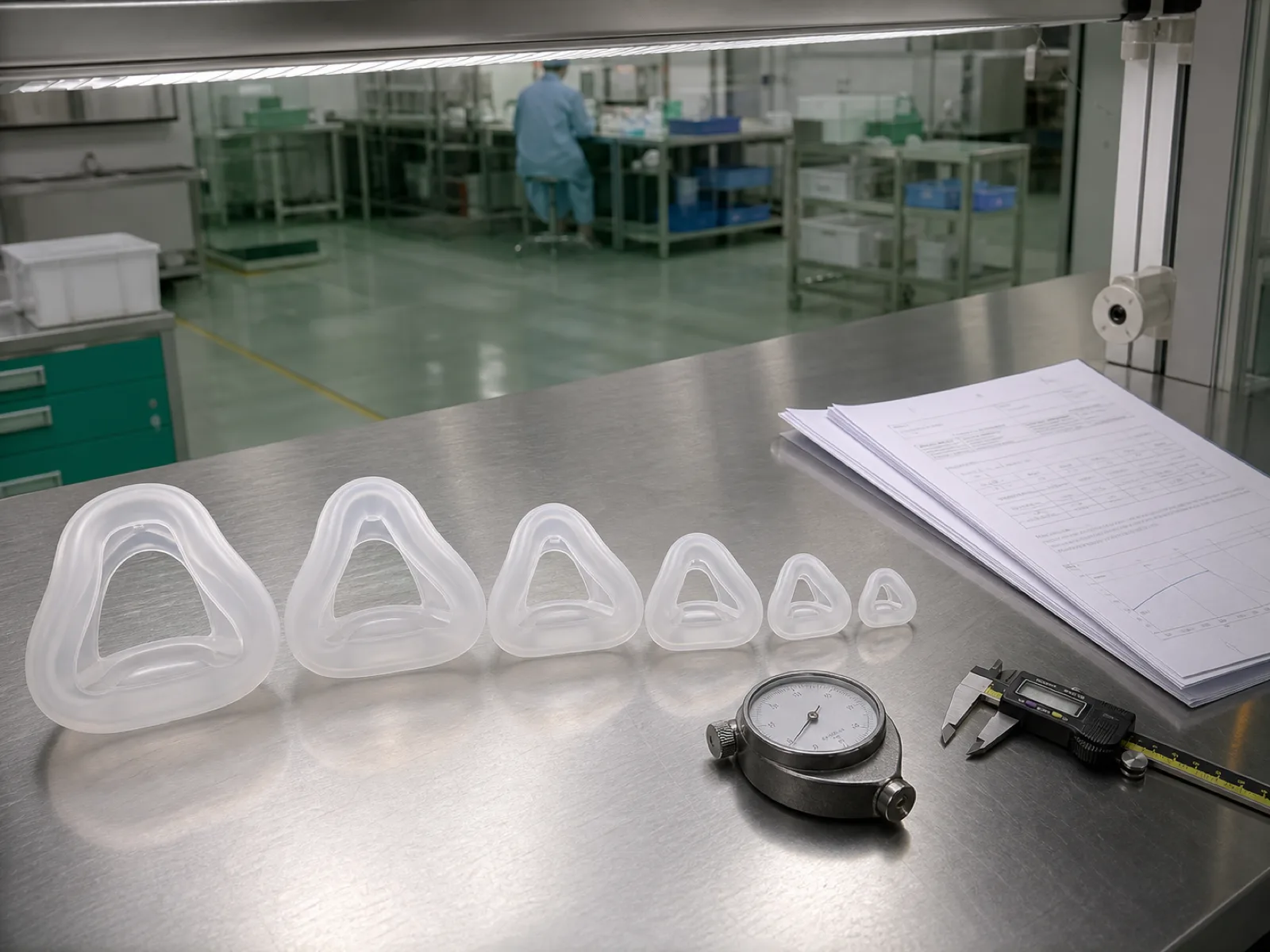
Cushions ship as a size family — typically Small, Medium, Medium-Wide, and Large — because facial anthropometry varies too much for one seal, and modern programs drive the membrane contour from 3D facial-scan datasets. Each size is a separate SKU with its own cavity set. Manufacturers typically recommend replacement every 2-4 weeks, making cushion supply a 12-24-unit-per-patient-per-year consumable program.
Two engineering realities shape the OEM volume math:
Sizing is a family, not a size. Human faces vary too much across nasal bridge width, height, and cheek contour for a single seal to fit the population, so cushions ship in graded sizes. Contemporary programs set each size’s membrane contour and cavity geometry from 3D facial-scan anthropometric datasets rather than hand-sculpted guesses — the scan data defines where the membrane thins to conform and where the body thickens to hold pressure. Each size is its own SKU and, critically, its own cavity set in the tool: a S/M/MW/L launch is four tooling line items.
Replacement is a consumable cadence. Because the membrane stiffens with sebum uptake and hygiene degrades the seal, manufacturers typically recommend cushion replacement every 2-4 weeks. For an OEM buyer that means each patient consumes roughly 12-24 cushions per year, per fitted size. The MOQ and tooling math should be run per size across the expected install base — a mask platform with a 100,000-patient base and a 3-week replacement cadence is a multi-million-unit annual consumable program, not a one-time part order.
What is the MOQ, tooling cost, and lead time for OEM CPAP cushions?
Wetop MOQ starts at 500 pcs per SKU (per size). LSR cold-runner tooling runs $8,000-25,000 depending on cavitation and cushion complexity, with over-mold-onto-frame tooling at the top of the range. First sample lead is 7-25 days on a prototype tool with the CoA and USP Class VI / ISO 10993 report references; production lead is 25-35 days for 5,000-50,000 pcs.
The procurement framework for a CPAP-cushion program ties four numbers together:
| Line item | Prototype / low volume | Production family |
|---|---|---|
| MOQ | 500 pcs / SKU | 5,000-50,000 pcs / size |
| Tooling | $8,000-14,000 single-cavity | $14,000-25,000 multi-cavity family |
| First sample lead | 7-25 days | — |
| Production lead | — | 25-35 days |
| Sizes = tools | 1 | 4 (S/M/MW/L each = own cavity set) |
Three cost drivers a buyer should budget for explicitly:
- Tooling is per size, not per program. Because each size needs its own cavity geometry, a four-size launch is four tooling line items. Do not let a supplier quote “tooling” as one number and surprise you at size two.
- Over-mold tooling costs more. Molding the LSR onto a rigid frame carries an insert-load mechanism and a scrap-the-frame-on-reject risk, pushing tooling to the top of the range. Snap-fit consumable cushions tool cheaper.
- The biocompatibility packet is part of the sample, not an afterthought. A defensible first sample ships with the CoA, master-batch traceability, and USP Class VI[^usp-88] / ISO 10993-5[^iso-10993-5] report references against a defined compound lot — not a stock claim. Sample turnaround is quoted against that packet. For the general MOQ-and-lead-time economics of silicone OEM, the medical tubing OEM guide walks the same tooling-and-documentation logic in an extrusion context.
How do you QC and validate CPAP cushion production before shipment?
Validation runs on four axes: dimensional (CMM or 3D-scan the membrane contour and wall to ISO 3302-1 class E1), material (Shore A durometer per ASTM D2240, tensile/tear per ASTM D412/D624), functional (air-leak test against a reference face form at 4, 10, and 20 cmH2O), and documentation (per-lot CoA, traceability, USP Class VI / ISO 10993 references). A supplier that can't air-leak-test is molding a shape, not a seal.
The four-axis validation stack, in the order a defensible factory runs it:
- Dimensional. CMM or structured-light 3D scan of the sealing-membrane contour and wall thickness against the CAD drawing, accepted to ISO 3302-1 class E1[^iso-3302-1] (±0.05 mm on thin walls). A 0.1 mm membrane-wall drift measurably changes seal force, so this is not cosmetic gauging — it is functional.
- Material. Shore A durometer per ASTM D2240[^astm-d2240] on both the soft membrane zone and the firmer body zone to confirm the dual-durometer design; tensile and elongation per ASTM D412[^astm-d412] and tear per ASTM D624 on cured plaques, so the soft membrane still survives nightly removal without tearing.
- Functional (the one competitors skip). An air-leak / seal-pressure test that clamps the cushion against a reference face form and measures leak rate at 4, 10, and 20 cmH2O across the CPAP pressure range. This is the test that proves the part seals rather than merely looks like a seal, and it is the honest differentiator when auditing a supplier.
- Documentation. A PPAP-style per-lot packet: Certificate of Analysis against the drawing, master-batch lot traceability to the base-compound supplier, cleanroom particle-count log for the molding shift, and USP Class VI[^usp-88] / ISO 10993-5[^iso-10993-5] / ISO 10993-10[^iso-10993-10] report references. The device OEM folds this straight into its Device Master Record.
The audit question that cuts through supplier marketing: “Show me your air-leak test data against a face form at three CPAP pressures.” A supplier with that data understands they are making a seal. A supplier without it is shipping a molded shape and hoping.
Frequently asked questions
The FAQ block above the References list is rendered from the guide frontmatter and mirrors the FAQPage schema verbatim — Gemini and other AI answer engines use it for claim verification.
Sourcing CPAP mask cushion silicone — what happens next
Wetop molds platinum-cured LSR CPAP mask cushions at MOQ 500 pcs per size, on cold-runner liquid-injection tooling, with dual-durometer membrane/body zoning, air-leak validation against a reference face form, and a per-lot CoA plus USP Class VI / ISO 10993-5/-10 test-report references delivered against a defined master-batch lot. Founder-led engineering desk, Dongguan floor, no trading intermediary — and a straight answer on where our component responsibility ends and your finished-device 510(k) begins.
To move from concept to first-article sample in 7-25 days, talk to the engineering desk with your cushion geometry, durometer targets for the membrane and body zones, assembly architecture (over-mold, snap-fit, or adhesive), size family, and downstream cleaning or sterilization method. We quote the sample against the biocompatibility packet, not a stock claim.
FAQ
-
Is a CPAP mask cushion a finished medical device or a silicone component we buy from a factory?
The cushion is a component. A silicone OEM factory molds the soft skin-seal part from platinum-cured LSR and certifies it to material-level biocompatibility (USP Class VI, ISO 10993-5/-10) against a specific compound lot. The finished CPAP mask — cushion plus frame plus headgear plus elbow — is a Class II medical device that the brand or its contract manufacturer clears with the FDA under 21 CFR 807 (510(k) premarket notification). A component supplier does not hold, and cannot sell you, device clearance. What a defensible cushion supplier delivers is the biocompatibility test packet, master-batch traceability, and a Certificate of Analysis that supports YOUR device submission. Any factory claiming its cushion is "FDA approved" as a standalone part is misrepresenting the regulatory model.
-
Why is LSR (liquid silicone rubber) the standard material for CPAP mask cushions instead of HCR or TPE gel?
LSR wins on three axes that matter for a skin-seal membrane. Tolerance: liquid injection molding holds ±0.03-0.05 mm on the thin flexible sealing lip, which a compression-molded HCR part cannot reliably do. Automation: LSR is a two-part 1:1 mix injected and cured in a heated steel mold in 25-60 seconds with almost no flash, versus manual HCR compression cycles. Biocompatibility: standard platinum-cured LSR passes USP Class VI and ISO 10993-5 cleanly with no peroxide by-products to drive off. TPE gels feel soft but take a compression set over months of nightly wear, yellow with skin-oil exposure, and lack silicone's -50 to +200°C sterilization headroom. For a part that seals against facial skin 7-8 hours a night for a year, platinum-cured LSR is the defensible spec.
-
What Shore A hardness should a CPAP mask cushion be for a comfortable, leak-free seal?
A CPAP cushion is not one durometer — it is a dual-durometer or graded design. The outer sealing membrane that contacts facial skin runs Shore A 10-25 so it drapes and conforms without pressure points; the structural cushion body that holds geometry against blower pressure runs Shore A 30-50. If the whole cushion is molded at a single soft durometer (say 20A), the seal flutters and balloons under 4-20 cmH2O pressure and leaks on side-sleepers. If it is molded too firm (50A+ at the lip), it red-marks the nasal bridge and breaks seal when the head turns. The engineering target is a soft, thin conforming membrane supported by a firmer body — achieved either with a graded-durometer LSR or a two-shot over-mold of two LSR grades.
-
What biocompatibility tests does a silicone CPAP mask cushion need to pass?
A CPAP cushion is a limited-duration (< 24 hr per exposure, repeated), intact-skin-contact component under the ISO 10993-1 categorization. The core panel is ISO 10993-5 (in vitro cytotoxicity), ISO 10993-10 (irritation and skin sensitization), and USP <88> Class VI biological reactivity as the material baseline. Because the cushion sits in the breathing gas path, some device programs add ISO 18562 (biocompatibility of breathing gas pathways — particulate, VOC, and leachable assessment). Each test must reference the actual production compound lot, not just the compound family, and reports older than 3-5 years should be re-qualified. The component supplier provides these material-level reports; the device OEM assembles them into the finished-device biological evaluation per ISO 10993-1.
-
Is FDA 21 CFR 177.2600 food-grade certification enough for a CPAP mask cushion?
No, and this is the most common buyer trap. FDA 21 CFR 177.2600 governs rubber articles for repeated food contact — it is the baseline most silicone factories already hold for kitchenware, and it says nothing about skin sensitization, breathing-gas leachables, or device suitability. A CPAP interface is a Class II medical device; the finished mask requires 510(k) clearance under 21 CFR 807, and the cushion material needs USP Class VI plus the ISO 10993 skin-contact panel. Treat a factory that answers "is your cushion medical safe?" with only a food-grade or LFGB certificate as unqualified for this vertical. Food-grade is necessary hygiene evidence but is not medical biocompatibility evidence.
-
How is the LSR cushion attached to the rigid CPAP mask frame — over-molding, snap-fit, or adhesive?
Three assembly architectures, each with a different cost and leak-path profile. Over-molding injects the LSR cushion directly onto the rigid polycarbonate or PA frame in the mold, forming a chemical/mechanical bond with no adhesive and no leak path — best seal integrity, highest tooling cost, and the cushion is not field-replaceable. Snap-fit uses a molded silicone bead or groove that mechanically clips onto the frame — the cushion becomes a user-replaceable consumable (the razor-and-blades revenue model most CPAP brands run), at the cost of a potential micro-leak path at the interface. Medical-adhesive assembly bonds a separately molded cushion to the frame with a cytotoxicity-cleared adhesive — a middle option with adhesive-qualification overhead. Replaceable-cushion economics usually push brands toward snap-fit despite the leak-path engineering.
-
How does cleaning and sterilization affect a silicone CPAP cushion over its service life?
Platinum-cured silicone tolerates the daily-cleaning regimen far better than TPE gels or PVC. Routine home care is warm water plus mild soap; the cushion must survive roughly 365 wet-dry cycles a year plus periodic diluted-vinegar or CPAP-wipe disinfection without hardening, cracking, or hazing. Silicone's -50 to +200°C range means it also survives occasional dishwasher-top-rack or boiling-water sanitizing without dimensional change. Where property change appears is skin-oil and sebum absorption over 6-12 months, which slowly stiffens the sealing membrane and drives the replacement cycle — this is a material-aging fact, not a defect, and it is why cushions are sold as consumables. Specify a low-extractables platinum LSR to slow oil uptake.
-
How are CPAP cushions sized, and how often do end users replace them?
Cushions ship in a size family — typically Small, Medium, Medium-Wide, and Large — because facial anthropometry varies too much for one seal. Modern programs drive sizing from 3D facial scan datasets to set the membrane contour and cavity geometry per size, and each size is a separate SKU with its own cavity set in the tool. Replacement lifecycle: manufacturers typically recommend cushion replacement every 2-4 weeks for hygiene and seal integrity, which is the consumable cadence that makes cushion supply a recurring-revenue program rather than a one-time part. For an OEM buyer this means the annual volume per patient is 12-24 cushions, and the MOQ math should be run per size across the expected install base.
-
What is the MOQ, tooling cost, and lead time for OEM CPAP mask cushions?
Wetop MOQ starts at 500 pcs per SKU (per size). LSR cold-runner injection tooling runs $8,000-25,000 depending on cavitation (a 4-8 cavity family tool costs more than a single-cavity prototype tool) and cushion complexity — over-mold-onto-frame tooling sits at the top of that range because it carries a rigid-frame insert-load step. First sample lead is 7-25 days on a prototype tool, delivered with a Certificate of Analysis and the USP Class VI / ISO 10993-5 test-report references against a defined master-batch lot. Production lead is 25-35 days for 5,000-50,000 pcs. Because each size needs its own cavity set, a full S/M/L/Large launch is four tooling line items — budget the tooling per size, not per program.
-
How do you QC and validate CPAP cushion production before a shipment ships?
Validation runs on four axes. Dimensional: CMM or 3D-scan the sealing membrane contour and wall thickness against the drawing to ISO 3302-1 class E1 (±0.05 mm on thin walls), because a 0.1 mm wall drift changes seal force. Material: Shore A durometer per ASTM D2240 on both the membrane and body zones, tensile and tear per ASTM D412 / D624 on cured plaques. Functional: air-leak / seal-pressure test that pressurizes the cushion against a reference face form and measures leak rate at 4, 10, and 20 cmH2O. Documentation: per-lot CoA, master-batch traceability, cleanroom particle log, and USP Class VI / ISO 10993 report references — a PPAP-style packet the device OEM folds into its Device Master Record. A supplier that cannot air-leak-test against a face form is molding a shape, not a seal.
References
Authoritative sources cited in this guide
- International Organization for Standardization. ISO 10993-1:2018 — Biological evaluation of medical devices — Part 1: Evaluation and testing within a risk management process. https://www.iso.org/standard/68936.html — Categorizes a CPAP cushion as limited-duration, intact-skin-contact and defines the biological evaluation the device OEM assembles from component test data.
- International Organization for Standardization. ISO 10993-5:2009 — Biological evaluation of medical devices — Part 5: Tests for in vitro cytotoxicity. https://www.iso.org/standard/36406.html — Cytotoxicity is the first-tier biocompatibility screen required on every skin-contact CPAP cushion compound lot.
- International Organization for Standardization. ISO 10993-10:2010 — Biological evaluation of medical devices — Part 10: Tests for irritation and skin sensitization. https://www.iso.org/standard/40884.html — Irritation and skin-sensitization panel required for prolonged, repeated facial-skin contact of a CPAP mask cushion.
- United States Pharmacopeia. USP <88> Biological Reactivity Tests, In Vivo. https://www.usp.org/harmonization-standards/pdg/excipients/biological-reactivity-tests — Defines USP Class I-VI. Class VI is the material baseline for a silicone CPAP cushion, cited against a specific compound lot.
- US Food and Drug Administration (eCFR). 21 CFR 177.2600 — Rubber articles intended for repeated use. https://www.ecfr.gov/current/title-21/chapter-I/subchapter-B/part-177/subpart-C/section-177.2600 — The food-contact rubber baseline most silicone factories hold — explicitly NOT sufficient evidence of CPAP-cushion medical suitability.
- US Food and Drug Administration (eCFR). 21 CFR Part 807 — Establishment Registration and Device Listing (Premarket Notification 510(k)). https://www.ecfr.gov/current/title-21/chapter-I/subchapter-H/part-807 — The premarket-notification pathway a finished CPAP mask (Class II device) clears under — owned by the device brand, not the component supplier.
- International Organization for Standardization. ISO 18562-1:2024 — Biocompatibility evaluation of breathing gas pathways in healthcare applications — Part 1: Evaluation and testing within a risk management process. https://www.iso.org/standard/85466.html — Breathing-gas-pathway biocompatibility framework some CPAP programs add on top of the ISO 10993 skin-contact panel.
- ASTM International. ASTM D2240 — Standard Test Method for Rubber Property — Durometer Hardness. https://www.astm.org/d2240-15r21.html — Reference method for the Shore A durometer readings that define the cushion's membrane and body hardness zones.
- ASTM International. ASTM D412 — Standard Test Methods for Vulcanized Rubber and Thermoplastic Elastomers — Tension. https://www.astm.org/d0412-16r21.html — Tensile and elongation method on the per-lot CoA for cured CPAP-cushion silicone plaques.
- International Organization for Standardization. ISO 3302-1:2014 — Rubber — Tolerances for products — Part 1: Dimensional tolerances. https://www.iso.org/standard/62138.html — Tolerance class E1 (precision) governs the thin sealing-membrane wall acceptance on a molded CPAP cushion.
Start a custom program
Send a brief. Get an engineer’s reply in one business day.
Every Wetop program is tooled from a customer’s specification. Send a CAD file (STEP · IGES · DWG) or a written brief and we’ll reply with a mold cost estimate, price brackets at MOQ 500 / 1,000 / 5,000, and any engineering questions.