Buyer Guide · commercial intent
Custom Silicone Phone Case Manufacturer — OEM Guide
 Buyer Guide
 A custom silicone phone case manufacturer that ships to premium retail delivers one thing: a liquid-silicone-rubber (LSR) case molded to ±0.05 mm cutout tolerance, 45-55 Shore A hardness, insert-molded microfiber lining, and a defensible MIL-STD-810G Method 516.6 drop-test report — all at 500-piece MOQ per SKU per Pantone-matched color. The useful specification is not "premium silicone phone case" — it is a compound choice (LSR vs HTV), a device-tier tolerance stack, a lining bonding method, and a compliance packet (FDA 21 CFR 177.2600, REACH SVHC, California Proposition 65) tied to the production lot code. Wetop molds custom silicone phone cases on our platinum-cure LSR and HTV compression lines in Dongguan with the same batch-traceability discipline we run on sink-brand OEM programs — every case ships with a per-lot test report and a device-fit sign-off against the actual production device.
Phone-case retail is one of the most punishing categories in silicone consumer goods. A 0.1 mm camera-bezel drift becomes a 2-star Amazon review within 48 hours; a lining that delaminates in month three becomes a chargeback; a clear case that yellows at week six becomes a returns cascade that pulls the SKU off Prime. This brief is written for the sourcing lead, product engineer, or founder building or refreshing a custom silicone phone case lineup — not for the buyer comparing cases at MSRP. Every claim below carries a number, a standard clause reference, or a process spec Wetop’s engineering desk will hold against a purchase order and a device-fit audit.
Should a custom silicone phone case use LSR or solid HTV silicone?
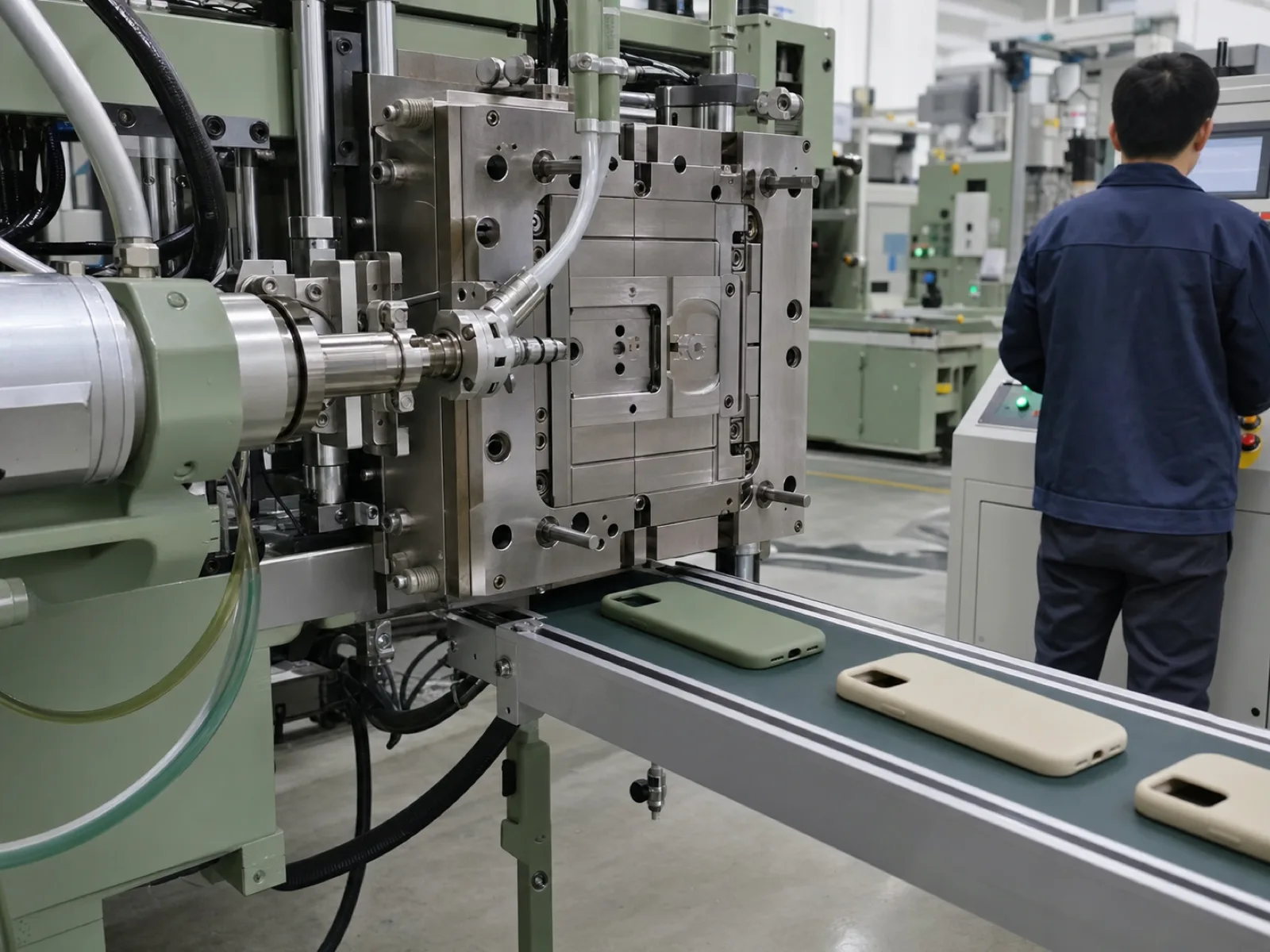
LSR (liquid silicone rubber, two-part platinum-cured) is the correct compound for premium retail cases — ±0.05 mm cutout tolerance, 30-50 second automated cycle, no visible parting line, no yellowing across a 24-month shelf life[^astm-g154]. Solid HTV (high-temperature vulcanized) silicone compression molding is 25-35 % cheaper per unit at MOQ 500-2,000 but tolerates ±0.15 mm cutout drift — acceptable for value retail, not for flagship-device fit.
The compound decision drives every downstream engineering choice. LSR arrives as two-part A/B drums, meters through a static mixer, and injects into a heated mold at 180-200 °C1 where cure completes in 30-90 seconds. The process is fully automated, holds tight tolerances across the tool life, and produces cases with no visible parting line — the visual quality retail buyers describe as “premium first-party feel.” HTV silicone arrives as a pre-mixed gum, is calendared into billets, and compression-molded at 170-200 °C for 3-6 minutes per shot. The process is cheaper per shot, tolerates less-skilled operators, but leaves a faint parting line and drifts ±0.15 mm after cavity wear.
For flagship-device programs (iPhone Pro, Galaxy Ultra, Pixel Pro) the answer is always LSR — the camera bezel and mute-switch alignment require the ±0.05 mm tolerance and the visual quality requires the no-parting-line finish. For value-retail programs on older device models sold at 6-10 USD MSRP, HTV compression cuts the landed cost enough to matter, and the ±0.15 mm tolerance is fine for basic cutouts. Wetop runs both cells in-house — the choice is a target-price and target-device decision, not a factory constraint. For the underlying cure-chemistry deep dive, see the platinum vs peroxide cure guide.
| Attribute | LSR injection molding | HTV compression molding |
|---|---|---|
| Cavity tolerance | ±0.05 mm | ±0.15 mm |
| Cycle time per shot | 30-50 seconds | 3-6 minutes |
| Parting line visible | No | Faint on shoulder |
| Best-fit device tier | Flagship Pro / Ultra | Standard / older models |
| Cost per unit at 5,000 vol | 2.20-3.40 USD | 1.60-2.30 USD |
| Aluminum tooling cost | 2,500-6,000 USD | 1,500-4,000 USD |
| Steel tooling cost | 8,000-18,000 USD | 4,500-9,000 USD |
| Cavity life (aluminum) | 80,000-120,000 cycles | 30,000-50,000 cycles |
| Cavity life (steel) | 500,000+ cycles | 250,000+ cycles |
| Yellowing on clear formulation | None at 24 mo (with HALS) | Faint at 12-18 mo |
What Shore A hardness gives the best grip and shock absorption?
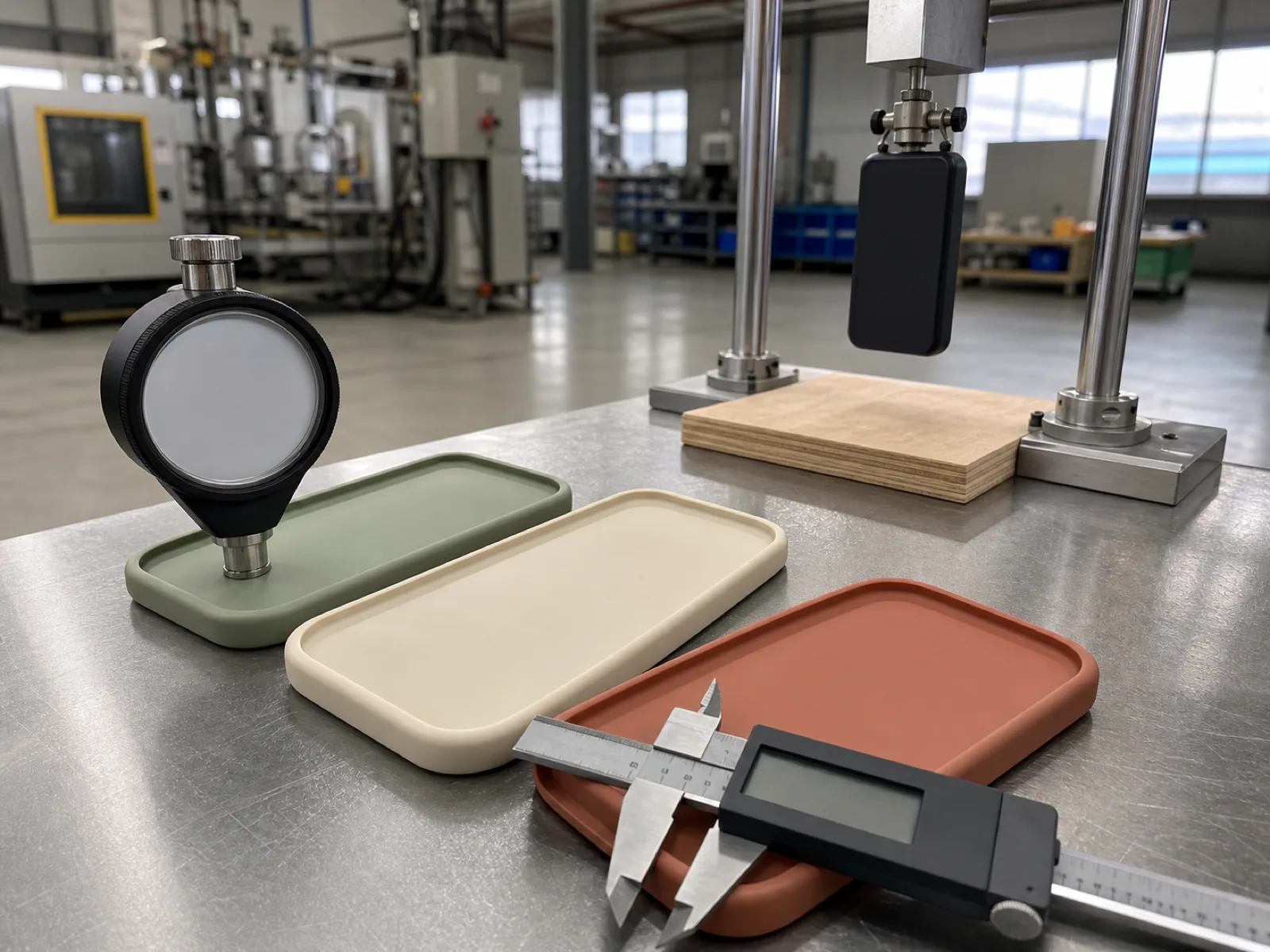
45-55 Shore A[^astm-d2240] is the phone-case working window. 45 A delivers the tactile grip most buyers describe as premium; 50 A holds shape on thin-wall Pro formats; 55 A suits rugged and MagSafe hybrid formats. Below 40 A the case stretches on installation and loses camera-bezel alignment within weeks; above 60 A shock absorption drops and the phone glass cracks on a 1.2 m drop instead of the case absorbing impact.
Shore A hardness is measured per ASTM D22402 with a Type A durometer indenter loaded 15 seconds on a specimen ≥ 6 mm thick. On a phone case the reading matters at two locations: the corner impact zone (where drop energy converts to compression strain) and the button covers (where the tactile-click feel gets specified). A 45 A corner absorbs a 1.2 m drop across 4-6 mm of controlled compression; a 60 A corner transmits most of the impact energy through to the phone chassis and cracks the glass.
The 45-55 A window is a shock-absorption window, not a marketing choice. Below 40 A the compound stretches during installation and holds a permanent deformation that walks the camera bezel off-center by 0.2-0.4 mm within 30 days of daily removal. Above 60 A the tensile modulus climbs high enough that the case behaves like hard plastic — buyers describe it as “clunky,” and the drop-test outcome measurably worsens on a 200 g modern phone. Wetop’s engineering baseline: 45 A for standard cases, 50 A for thin-wall Pro Max formats where shape retention matters, 55 A on rugged hybrid formats where the LSR wraps around a polycarbonate frame.
| Case format | Bite-zone hardness | Wall thickness (corner) | Wall thickness (edge) | Drop-test target |
|---|---|---|---|---|
| Slim standard case | 45 Shore A | 1.2 mm | 0.9 mm | 1.2 m onto plywood |
| Thin-wall Pro Max | 50 Shore A | 1.2 mm | 0.8 mm | 1.2 m onto plywood |
| Rugged / hybrid | 55 Shore A | 2.0 mm | 1.5 mm | 1.8 m onto concrete |
| MagSafe compatible | 50 Shore A | 1.5 mm | 1.0 mm | 1.2 m onto plywood |
| Card-holder wallet | 50 Shore A | 1.5 mm | 1.2 mm | 1.2 m onto plywood |
How tight are camera, port, and button cutout tolerances?
For flagship devices (iPhone 16 Pro, Galaxy S24 Ultra, Pixel 9 Pro): camera bezel and mute switch ±0.05 mm, USB-C and speaker grille ±0.10 mm, lanyard hole and non-functional edges ±0.15 mm. LSR injection holds the ±0.05 mm tolerance across the tool life; HTV compression drifts to ±0.15 mm after 30,000-50,000 cycles as cavity edges wear. First-article inspection runs against a calibrated CMM plus a device-fit check on the actual production device.
The camera bezel is the tolerance-critical feature on every modern flagship. Apple’s iPhone Pro camera module protrudes 4-5 mm from the back glass and sits inside a machined ring; a case cutout that lands 0.1 mm off-center reads as visibly misaligned and generates the “camera bump doesn’t fit” review pattern. The mute switch on the iPhone side rail is similarly punishing — a 0.1 mm cutout drift stiffens the switch action or covers the ring/silent indicator. The Galaxy S24 Ultra S Pen silo, the Pixel 9 Pro camera bar, and the USB-C port on all three require the same discipline.
Wetop’s first-article process for every new phone case tool: cut cavity → mold T1 samples (10 units) → dimensional inspection on the CMM against the CAD model → device-fit check with the actual production device (buttons, camera, ports, wireless charging pad if MagSafe) → return to tool for gate/vent/cavity revision if any measurement lands outside the tolerance stack → repeat until 10/10 T1 samples clear the CMM report and the device-fit sign-off. Typical: 1-2 revision cycles on complex Pro / Ultra formats, zero revisions on basic slim cases.
| Feature | Tolerance | Reason |
|---|---|---|
| Camera bezel cutout | ±0.05 mm | Visual alignment against machined phone ring |
| Mute switch cutout | ±0.05 mm | Switch action stiffness + ring/silent visibility |
| USB-C / Lightning port | ±0.10 mm | Third-party cable compatibility (thick heads) |
| Speaker grille pattern | ±0.10 mm | Sound throughput + visual symmetry |
| Volume / power buttons | ±0.08 mm | Tactile click feel |
| MagSafe / Qi ring | ±0.10 mm | Wireless charging alignment |
| Lanyard hole | ±0.15 mm | Non-functional cosmetic |
| Overall case wall thickness | ±0.08 mm | Uniform grip feel |
How does the microfiber lining bond to the silicone case?
Insert-molded — the microfiber liner is die-cut, placed in the cavity before injection, and the LSR bonds mechanically and chemically to the fiber matrix during cure. Adhesive-bonded lining (glued in post-mold) fails at 200-400 wear cycles under thumb-sweat exposure; insert-molded lining survives 5,000+ cycles per MIL-STD-810G Method 507.6[^mil-std-810g] humidity aging. Insert-mold adds 8-12 seconds per shot.
The microfiber lining serves two functions: it prevents the silicone from pulling paint or oleophobic coating off the phone back over time, and it dampens the “silicone squeak” against the phone chassis. Both functions collapse the moment the lining delaminates. Adhesive-bonded lining is the failure mode: a factory die-cuts the liner, molds the case blank, then applies a solvent-based contact adhesive and presses the liner into the cured shell. The bond holds for 4-6 weeks of light use, then delaminates at the corners under thumb sweat and heat cycling. That failure pattern drives most of the 2-star reviews on cases sold at 8-15 USD MSRP.
Insert molding solves the problem chemically. The liner enters the cavity before injection; the LSR flows around and into the fiber matrix during cure; the platinum-catalyzed hydrosilylation reaction cross-links both to itself and to any hydroxyl or hydrogen bond sites on the microfiber. The result is a bonded interface with peel strength ≥ 8 N/cm — higher than the tear strength of the microfiber itself, meaning the fiber fails before the bond does. Wetop qualifies insert-molded lining against MIL-STD-810G Method 507.63 humidity-aging (240 hours at 60 °C / 95 % RH) plus 5,000 wear cycles on a Taber abrasion rig; the bond holds across the full protocol.
What compliance packet does a US and EU retail phone case need?
Skin-contact silicone phone cases need FDA 21 CFR 177.2600[^fda-177-2600] (repeated-use food-contact), LFGB §30/31[^lfgb-30-31] (German food-contact best practice), REACH SVHC[^echa-reach] declaration for EU, and California Proposition 65[^ca-prop-65] documented negative results for CA retail. All tests run at a third-party lab (Intertek, SGS, Bureau Veritas, TÜV) against the finished production lot — not the raw compound.
Phone cases are not food-contact articles, but retail buyers require the same food-contact compliance packet because the case sits in a pocket next to lipstick, gum, and cash, and the buyer’s compliance lead does not want a surprise. FDA 21 CFR 177.2600 is the US repeated-use rubber standard1 — it establishes overall migration limits under water, aqueous, and fatty-food simulants. LFGB §30/31 is the German equivalent4, adds an organoleptic (odor/taste) test, and is treated by most global buyers as the higher-bar standard. REACH SVHC5 requires an annual declaration confirming the compound contains no substances of very high concern above 0.1 % weight. California Proposition 656 requires either a warning label or documented negative results on 900+ listed chemicals.
Wetop’s compliance packet on every custom phone case shipment: per-lot FDA 21 CFR 177.2600 migration report, per-lot LFGB §30/31 report, annual REACH SVHC declaration signed by the compound supplier, Proposition 65 declaration on file, RoHS 3 (2015/863/EU) declaration, and a material safety data sheet keyed to the compound batch. All reports come from a CPSC-accepted third-party lab, tied to the production lot code, retained for seven years per ISO 9001 batch-traceability7. For the underlying FDA vs LFGB decision framework, see the FDA vs LFGB guide — the same packet logic applies to skin-contact accessories.
What drop-test protocol qualifies a “military-grade” phone case?
MIL-STD-810G Method 516.6[^mil-std-810g] is the industry benchmark cited on 95 % of "military-grade drop protection" phone case listings — 26 drops from 1.22 m onto 18 mm steel-backed plywood, covering all six faces plus 12 edges and 8 corners of the phone-plus-case assembly. A 45-55 Shore A LSR case with 1.2 mm minimum corner wall passes all 26 drops on a modern glass phone. Rugged formats add drops from 1.8 m onto concrete.
MIL-STD-810G3 is a US Department of Defense environmental test standard, not a phone-case standard. Method 516.6 (shock) is the relevant test for drop-protection claims; Method 507.6 (humidity) qualifies the microfiber lining bond as discussed above. The 26-drop protocol covers a full geometric permutation of the phone-plus-case assembly — buyers who accept only the 6-face or 4-corner subset get a weaker qualification and see field failures on edge impacts.
Wetop’s drop-test engineering baseline: 1.2 mm minimum wall on all corners of standard cases, 1.5 mm on Pro Max formats to compensate for the higher moment arm on the longer chassis, 2.0 mm on rugged/hybrid formats, and internal air-cushion ribs (3-4 mm rib height) on any case sold with the 1.8 m or 3.0 m drop rating. The ribs deform elastically during impact and dissipate the shock across a wider surface area than a solid wall — this is the mechanism behind branded “AirCushion” or “impact-absorbing corner” marketing claims. Any drop-test report Wetop delivers is signed by a third-party lab with video documentation of all 26 drops; internal engineering drop-tests use a calibrated fall rig against 18 mm plywood on a concrete floor and get logged with a phone chassis inspection after every drop.
What is the MOQ, tooling cost, and full landed-cost math?
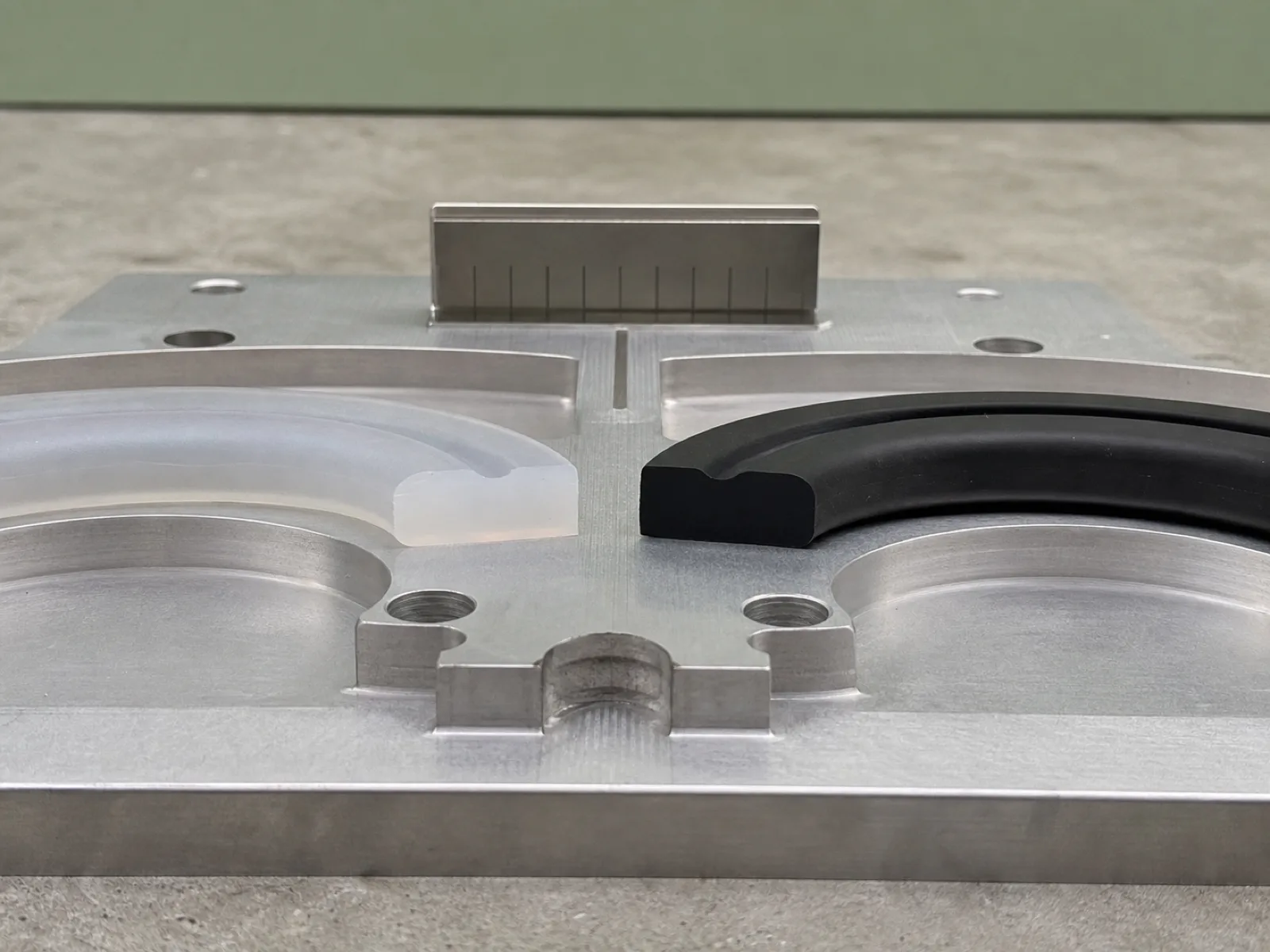
Wetop's MOQ is 500 pieces per SKU per Pantone-matched color. LSR aluminum tooling runs 2,500-6,000 USD per device model; 20-30 day tool lead time; 10-15 day sample cycle to T1. Full landed cost for US destinations at 5,000-unit LSR volume: 2.40-4.80 USD per unit including tooling amortization, unit cost, sea freight, and 25 % Section 301 duty. Steel tooling amortizes below 0.50 USD per unit past 20,000 lifetime volume.
The MOQ math for a first-year private-label launch usually resolves to aluminum LSR tooling on the first device model and a switch to steel once the SKU family breaks through 25,000 lifetime units. Aluminum LSR holds ±0.05 mm for 80,000-120,000 cycles before cavity edge wear begins; steel LSR holds the same tolerance for 500,000+ cycles. For color-only variants on a proven shape, one tool with three color runs hits the aggregate 1,500-piece minimum without additional tooling cost — color changeover is a 4-6 hour cavity clean and requalification cycle.
Landed cost math for a US destination at 5,000-unit LSR volume, standard slim case, aluminum tooling amortized: unit cost 2.20-3.40 USD FOB Shenzhen + sea freight 0.08-0.12 USD per unit (LCL 40-foot container) + 25 % Section 301 duty on HTS 3926.90.99 → 2.85-4.40 USD landed at US warehouse before FBA prep. Add 0.15-0.25 USD for FBA prep (poly bag, FNSKU label, master carton) → 3.00-4.65 USD fully landed. Steel tooling amortization on the same 5,000 units adds roughly 1.60-3.60 USD per unit; steel makes sense only past 15,000-20,000 lifetime volume. For the underlying pricing structure, see the OEM pricing structure guide and the MOQ and lead time guide.
| Line item | LSR aluminum tooling | LSR steel tooling | HTV compression aluminum |
|---|---|---|---|
| Tool cost per device model | 2,500-6,000 USD | 8,000-18,000 USD | 1,500-4,000 USD |
| Tool lead time | 20-30 days | 30-45 days | 15-25 days |
| T1 sample after tool cut | 7-10 days | 7-10 days | 5-7 days |
| Sample iteration cycles | 1-2 rounds typical | 1-2 rounds typical | 1-3 rounds typical |
| Unit cost at 5,000 vol (FOB) | 2.20-3.40 USD | 1.80-2.80 USD | 1.60-2.30 USD |
| Cavity life | 80,000-120,000 cycles | 500,000+ cycles | 30,000-50,000 cycles |
| Tolerance held | ±0.05 mm | ±0.05 mm | ±0.15 mm |
| Break-even lifetime volume | Under 15,000 units | Past 20,000 units | Under 8,000 units |
What customization does an OEM phone case actually support at 500-piece MOQ?
At 500-piece MOQ per SKU per color, Wetop includes Pantone-matched masterbatch (ΔE ≤ 1.5), in-mold debossed logo, laser-marked lot code inside the case, insert-molded microfiber lining, and retail-ready packaging (kraft box, blister, or Amazon FBA prep with FNSKU barcode). Two-shot LSR overmolding (soft grip + firm frame) adds 1,000 pieces to the MOQ per color combination. Silk-screen graphics and multi-color Pantone patterns available above 1,000 pieces per design.
Pantone match on LSR runs a slightly wider palette than food-contact silicone — the compound library includes solids, translucents, saturated jewel tones, and glow-in-the-dark formulations that stay within LFGB §30/314 and REACH SVHC5 limits. Wetop’s qualified LSR palette covers roughly 1,400 Pantone chips across the muted-neutral and saturated-color spectrum a modern phone-case brand typically uses; ΔE ≤ 1.5 in D65 light-box comparison on solids and ΔE ≤ 2.0 on saturated colors is the standard delivery. Clear and translucent LSR takes an anti-yellowing HALS additive and clears ASTM G1548 24-month accelerated UV testing with no visible tint shift.
In-mold debossed logo is engraved into the cavity — no post-mold operation, no adhesive, no chipping risk — and costs nothing at the piece level once tooling is cut. Laser-marked lot code goes inside the case at 2-3 mm character height in an unobtrusive location, providing full batch traceability from lot code through cure log, post-cure log, and third-party test report. Silk-screen graphics for multi-color patterns run at 0.15-0.30 USD per unit above 1,000 pieces per design. Retail-ready packaging Wetop supports in-house: printed kraft box or window box with the buyer’s artwork, poly bag with barcode, master carton with shipping labels, and Amazon FBA prep including FNSKU labels and case-pack quantities matching the buyer’s ASIN listing. For the customization-method deep dive, see the logo customization guide.
References
The engineering positions above trace to the following standards and regulatory sources:
Ready to spec a custom silicone phone case program?
If you’re building a new custom silicone phone case lineup — or refreshing an existing one that keeps returning on lining delamination, clear-back yellowing, or camera-bezel drift — Wetop’s engineering desk will draft the cavity layout, cure profile, cutout tolerance stack, and full FDA/LFGB/REACH/Prop 65 compliance packet against your target device model, hardness spec, and retail channel. Send the brief through the contact form with target device model (iPhone / Galaxy / Pixel + generation), format (slim / Pro / rugged / MagSafe / wallet), Pantone color, target volume, and destination markets, and expect a drafted engineering drawing plus tooling quote within three business days. For the underlying material and process decisions, the platinum vs peroxide cure guide, the logo customization guide, and the MOQ and lead time guide are the three companion reads.
Footnotes
-
21 CFR 177.2600 — Rubber articles intended for repeated use. US Food and Drug Administration. https://www.ecfr.gov/current/title-21/chapter-I/subchapter-B/part-177/subpart-C/section-177.2600 ↩ ↩2
-
ASTM D2240 — Standard Test Method for Rubber Property — Durometer Hardness. ASTM International. https://www.astm.org/d2240-15r21.html ↩
-
MIL-STD-810G — Environmental Engineering Considerations and Laboratory Tests. US Department of Defense. https://www.nist.gov/standardsgov ↩ ↩2
-
German LFGB §30 and §31 — Requirements for Food-Contact Materials. German Federal Ministry of Food and Agriculture. https://www.gesetze-im-internet.de/lfgb/__30.html ↩ ↩2
-
REACH — Regulation (EC) No 1907/2006. European Chemicals Agency. https://eur-lex.europa.eu/legal-content/EN/TXT/?uri=CELEX%3A32006R1907 ↩ ↩2
-
California Proposition 65 — Safe Drinking Water and Toxic Enforcement Act of 1986. California OEHHA. https://oehha.ca.gov/proposition-65 ↩
-
ISO 9001:2015 — Quality Management Systems — Requirements. International Organization for Standardization. https://www.iso.org/standard/62085.html ↩
-
ASTM G154 — Operating Fluorescent Ultraviolet Lamp Apparatus for UV Exposure of Nonmetallic Materials. ASTM International. https://www.astm.org/g0154-23.html ↩
FAQ
-
Should a custom silicone phone case use LSR or solid silicone?
For premium retail (Amazon Prime, boutique DTC, Apple-adjacent accessory brands) use liquid silicone rubber (LSR) — the ±0.05 mm cutout tolerance is what iPhone Pro camera bezels and mute-switch cutouts require to look and feel like a first-party case. For value retail at 6-10 USD MSRP, solid HTV silicone compression molding cuts unit cost 25-35 % and holds ±0.15 mm tolerance, which is fine for basic models. Wetop runs both processes in-house — the choice comes down to target device tier and retail price point, not factory constraint.
-
What Shore A hardness is best for a silicone phone case?
45-55 Shore A is the working window for phone cases. 45 A gives the tactile grip and shock absorption most buyers describe as premium; 55 A holds shape better on thin-wall Pro Max formats but feels harder in the hand. Below 40 A the case stretches on installation and loses camera-bezel alignment within weeks; above 60 A shock absorption drops sharply and the case cracks the phone glass on a 1.2 m drop instead of absorbing the impact. Wetop's default: 45 A on standard cases, 50 A on thin-wall Pro formats, 55 A on rugged / MagSafe hybrid formats.
-
How tight are camera and port cutout tolerances on an OEM silicone phone case?
For flagship devices (iPhone 16 Pro, Galaxy S24 Ultra, Pixel 9 Pro): camera bezel and mute switch ±0.05 mm, USB-C and speaker grille ±0.10 mm, lanyard hole and non-functional edges ±0.15 mm. LSR injection molding holds ±0.05 mm across the tool life; HTV compression drifts to ±0.15 mm after 30,000-50,000 cycles as cavity edges wear. Wetop pulls first-article dimensional reports on every new tool against a calibrated CMM (coordinate measuring machine) plus a device-fit check on the actual production device.
-
What is the MOQ and tooling cost for a custom silicone phone case?
Wetop's MOQ is 500 pieces per SKU per Pantone-matched color. LSR aluminum tooling runs 2,500-6,000 USD per device model with a 20-30 day lead time; production steel LSR tooling runs 8,000-18,000 USD with a 30-45 day lead time and holds 500,000+ cycles. HTV compression aluminum tooling runs 1,500-4,000 USD. Sample-approval cycle is 10-15 days to T1. Full landed timeline: 6-9 weeks from brief to bulk shipment on aluminum LSR; 9-12 weeks on steel.
-
Can Wetop match Pantone colors on a custom silicone phone case?
Yes — Pantone match to ΔE ≤ 1.5 on solid colors and ΔE ≤ 2.0 on saturated colors in D65 light-box comparison. LSR takes Pantone masterbatch cleanly with no color shift across cure; HTV compression compounds run a slightly narrower saturation range but hit the same ΔE targets. Multi-color combinations are supported via two-shot LSR (soft base + firm accent zone) or via post-mold silk-screen for graphics. Full Pantone chip library is validated against LFGB §30/31 and REACH SVHC declarations for skin-contact use.
-
How does the microfiber lining bond to a silicone phone case?
Insert-molded — the microfiber liner is die-cut, placed in the cavity before injection, and the LSR bonds mechanically and chemically to the fiber matrix during cure. Adhesive-bonded lining (glued in after molding) fails at 200-400 wear cycles under thumb-sweat exposure; insert-molded lining survives 5,000+ cycles per MIL-STD-810G Method 507.6 humidity aging. The insert-mold cycle adds 8-12 seconds per shot but produces a defensible delamination-free product for the life of the case.
-
What drop-test qualification does a custom silicone phone case need?
MIL-STD-810G Method 516.6 is the industry benchmark — 26 drops from 1.22 m onto 18 mm steel-backed plywood, covering all six faces plus 12 edges and 8 corners of the phone-plus-case assembly. A properly engineered LSR case at 45-55 Shore A with 1.2 mm minimum wall thickness on corners passes all 26 drops with a modern glass phone. Wetop's engineering baseline: 1.5 mm corner wall on Pro Max formats, 1.2 mm on standard formats, and internal air-cushion ribs on any case sold with 'military-grade drop protection' marketing claims.
-
Are custom silicone phone cases FDA, LFGB, and Prop 65 compliant?
Yes — platinum-cured food-grade silicone rubber clears FDA 21 CFR 177.2600 (repeated-use food contact), LFGB §30/31 (German food-contact migration), REACH SVHC declaration, and California Proposition 65 (no listed carcinogens or reproductive toxicants). Skin-contact phone cases inherit the same compliance packet even though they are not food-contact — retail buyers require the packet in writing. Wetop delivers per-lot third-party test reports from Intertek, SGS, or Bureau Veritas tied to the production lot code.
-
How do you prevent yellowing on clear or translucent silicone phone cases?
Yellowing on clear cases is a UV-oxidation failure of the compound, not the cure. Wetop uses a UV-stabilized clear LSR grade with hindered amine light stabilizer (HALS) additives plus a 4-6 hour post-cure at 200 °C to drive off residual cyclosiloxanes. Result: no visible yellowing at 24 months in benchtop QUV testing (ASTM G154 Cycle 1). Cheaper clear silicone (peroxide cure, no HALS, skipped post-cure) yellows visibly within 4-8 weeks under normal daylight exposure — this is the top return driver on Amazon clear-case listings.
-
Who owns the tooling and IP on a custom silicone phone case OEM program?
The buyer owns the tooling outright once tooling is paid in full and the T1 sample is signed off. Wetop stores the tool under the buyer's part number with a photographed shelf-location record; on request we ship the tool to another facility at cost. Buyer-supplied CAD, artwork, and packaging IP stay with the buyer under NDA. Any device-fit engineering Wetop performs (cavity layout, ejection strategy, gate location) is delivered as part of the tooling package with clear IP assignment written into the tooling agreement — no dual-use, no re-selling under a house brand.
References
Authoritative sources cited in this guide
- US Food and Drug Administration. 21 CFR 177.2600 — Rubber articles intended for repeated use. https://www.ecfr.gov/current/title-21/chapter-I/subchapter-B/part-177/subpart-C/section-177.2600 — The federal migration-limits regulation Wetop's platinum-cured LSR clears for skin-contact and incidental food-contact phone case use.
- US Department of Defense. MIL-STD-810G — Environmental Engineering Considerations and Laboratory Tests. https://www.nist.gov/standardsgov — The military test standard Method 516.6 (shock/drop) and Method 507.6 (humidity aging) that consumer phone case brands cite as 'military-grade drop protection.'
- ASTM International. ASTM D2240 — Standard Test Method for Rubber Property — Durometer Hardness. https://www.astm.org/d2240-15r21.html — The Shore A hardness test protocol that specifies the 45-55 A engineering window for phone case shock absorption and grip feel.
- ASTM International. ASTM G154 — Operating Fluorescent Ultraviolet Lamp Apparatus for UV Exposure of Nonmetallic Materials. https://www.astm.org/g0154-23.html — The accelerated UV weathering protocol used to validate anti-yellowing performance on clear and translucent LSR phone cases against 24-month field exposure.
- European Chemicals Agency (ECHA). REACH — Registration, Evaluation, Authorisation and Restriction of Chemicals (Regulation EC 1907/2006). https://eur-lex.europa.eu/legal-content/EN/TXT/?uri=CELEX%3A32006R1907 — The EU chemicals regulation governing SVHC declarations required on any silicone consumer product entering the EU retail channel.
- California Office of Environmental Health Hazard Assessment (OEHHA). California Proposition 65 — Safe Drinking Water and Toxic Enforcement Act of 1986. https://oehha.ca.gov/proposition-65 — The California listed-chemicals disclosure law requiring warning labels or documented negative results on consumer products sold into the California retail channel.
- International Organization for Standardization. ISO 9001:2015 — Quality Management Systems — Requirements. https://www.iso.org/standard/62085.html — The documented QMS Wetop's compression and LSR injection lines are certified against, including batch traceability and lot-code retention for retail-channel accessory programs.
- German Federal Ministry of Food and Agriculture (BMEL). German LFGB §30 and §31 — Requirements for Food-Contact Materials. https://www.gesetze-im-internet.de/lfgb/__30.html — The German food-contact standard whose migration and organoleptic clauses set best-practice compliance for skin-contact silicone consumer goods including phone cases.
Start a custom program
Send a brief. Get an engineer’s reply in one business day.
Every Wetop program is tooled from a customer’s specification. Send a CAD file (STEP · IGES · DWG) or a written brief and we’ll reply with a mold cost estimate, price brackets at MOQ 500 / 1,000 / 5,000, and any engineering questions.