Buyer Guide · commercial intent
How to Select a Medical Silicone Manufacturer
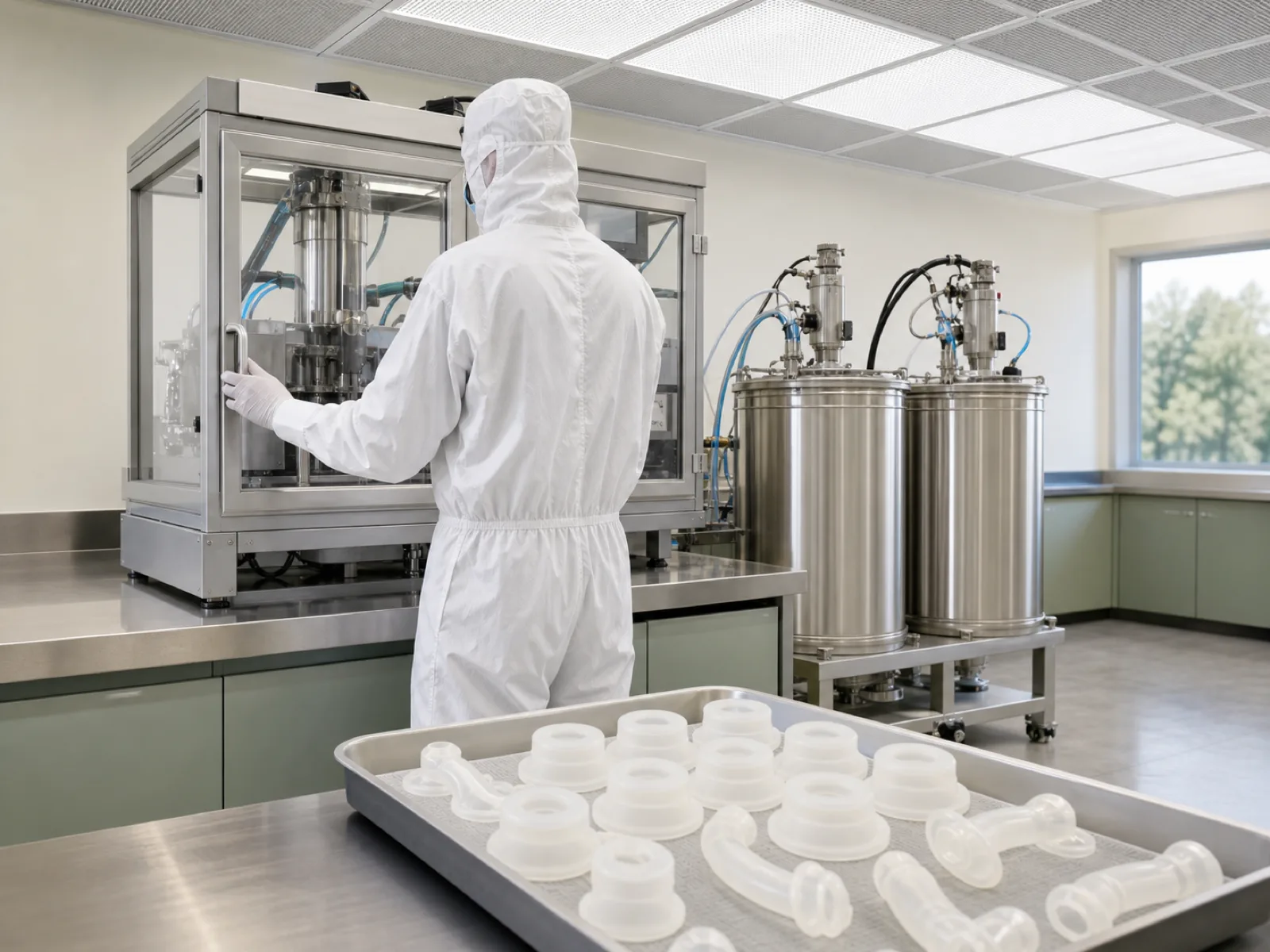 Buyer Guide
 A medical silicone manufacturer is a factory operating an ISO 13485 quality system, molding platinum-cured LSR or HCR compounds that carry USP Class VI and ISO 10993-1 qualifications, inside an ISO 14644 Class 7 or Class 8 cleanroom. Selection turns on three axes — device risk class, contact category and duration, and sterilization method — not on marketing brochures. This guide reduces the decision to an eight-artifact audit checklist buyers can run before a site visit.
Medical device buyers arrive with different vocabularies depending on where they sit — R&D talks in ISO 10993 chapters, Quality reads ISO 13485 clause numbers, Sourcing wants MOQ and lead time, Regulatory needs the 510(k) support letter. A qualified silicone supplier answers all four fluently, and the answers reconcile. This guide is written from the engineering desk of a factory that runs both platinum-cured LSR injection cells and HCR compression cells — the same taxonomy a Protolabs or Trelleborg medical program applies, framed for buyers running their first medical silicone program or auditing a second-source candidate.
What qualifies a manufacturer as “medical silicone”?
A medical silicone manufacturer is one that operates an ISO 13485:2016 quality management system[^iso-13485], molds compounds carrying USP Class VI[^usp-88] and ISO 10993-1[^iso-10993-1] qualifications, and produces inside an ISO 14644-1 cleanroom class matched to the device's risk classification[^iso-14644-1]. Absent any one of these three, the "medical" label is marketing, not qualification.
The distinction matters because the phrase “medical grade silicone” is not a regulatory term — it is a supplier-declared descriptor. What regulators recognize is the underlying qualification stack. USP Class VI qualifies the raw compound through cytotoxicity, systemic toxicity, intracutaneous reactivity, and (for short-duration implantation) muscle-implant tests. ISO 10993-1 sits above USP: it qualifies the finished device in its intended clinical context, requiring a biological evaluation plan matched to contact category (surface, external-communicating, implant) and contact duration (limited under 24 hours, prolonged 24 hours to 30 days, long-term over 30 days).
ISO 13485 sits above both — it is the quality system standard that turns a compound qualification into a device-history-file-ready manufacturing record. A factory holding ISO 9001 alone can produce excellent silicone; it cannot produce it under a QMS that supports FDA 510(k) or EU MDR submissions1 without significant remediation. Reviewing the ISO 13485 certificate scope — the specific product families and processes it covers — is the first hard filter in supplier selection.
The scope statement is where audit traps hide. A certificate that reads “manufacture of silicone rubber products” is not equivalent to one that reads “design, manufacture, and testing of silicone components for medical devices, including molding under controlled environmental conditions.” The first describes a general-purpose factory that happens to hold the certification; the second describes a factory whose QMS is validated for the specific processes your device relies on. Ask for the scope statement verbatim before a site visit — if it does not name “medical device components” and the manufacturing process (LSR injection, HCR compression, cleanroom molding), the supplier is at best an ISO 9001 factory using ISO 13485 as a marketing prefix.
A fourth qualification layer — often overlooked in first RFQs — is Master File participation. A silicone compound supplier that maintains a Type III Device Master File (DMF) or Type V DMF with FDA CDRH accelerates the buyer’s 510(k) preparation by letting the buyer reference the master file through a letter of authorization rather than re-submitting all compound composition and testing data. Not every compound has a DMF, and not every molder can pass that letter through cleanly. Ask on the RFQ whether the intended compound has an active DMF and whether the molder has processed a Letter of Authorization in the last twelve months.
How do ISO 10993 biological evaluation categories work?
ISO 10993-1 classifies devices by contact type — surface, external-communicating, or implant — and by contact duration — limited (<24h), prolonged (24h-30d), or long-term (>30d)[^iso-10993-1]. The matrix determines which test panel applies: a surgical-instrument grip (surface, limited) needs cytotoxicity, sensitization, and irritation; a long-term implant needs the full panel including genotoxicity, chronic toxicity, and carcinogenicity.
Understanding the matrix is what separates a buyer who can quote for a supplier accurately from one who over- or under-scopes the RFQ. Contact category and duration are combined into a table (ISO 10993-1 Table A.1) that pre-declares which endpoints require testing. A silicone tubing set in a peristaltic drug pump that touches blood for 8 hours is “external-communicating, limited” — cytotoxicity, sensitization, irritation, systemic toxicity, and material-mediated pyrogenicity. Add hemolysis and hemocompatibility because the contact is with circulating blood. Compare that to a silicone knee-brace liner (surface, prolonged): cytotoxicity, sensitization, irritation — one column, three tests.
Suppliers that maintain a “biocompatibility platform” have ISO 10993 test reports covering the common compound families ahead of any specific device program, which means your device-specific testing only fills the incremental gaps rather than restarting from cytotoxicity. Ask for the platform coverage matrix — a real one lists compound codes, test endpoints completed, report dates, and testing laboratories. The FDA’s guidance on ISO 10993-12 is the current operational interpretation and supersedes the 1995 Blue Book memo #G95-1.
The 2020 revision of the FDA guidance also flagged a shift buyers still under-appreciate: chemical characterization (ISO 10993-18) is increasingly required in lieu of running full animal panels for repeat-testing of similar devices. A qualified supplier can hand you a GC-MS and LC-MS chemical fingerprint of the compound extract, which — combined with a toxicological risk assessment — often satisfies FDA’s biocompatibility endpoint questions faster and cheaper than de-novo in-vivo testing. Suppliers who cannot produce a chemical characterization report will push you toward the older, slower, and more expensive testing pathway.
The endpoints matrix scales sharply with implant duration. A limited-exposure surface-contact device needs three endpoints; a long-term implantable device needs eleven, including chronic toxicity (up to 26 weeks in animal models), reproductive/developmental toxicity, and carcinogenicity assessment. The cost differential is roughly a factor of ten and the timeline differential is roughly a factor of six. Get the contact category and duration nailed before writing the biocompatibility test plan into the RFQ — misclassifying a “prolonged” device as “limited” is a common cause of 510(k) additional-information requests.
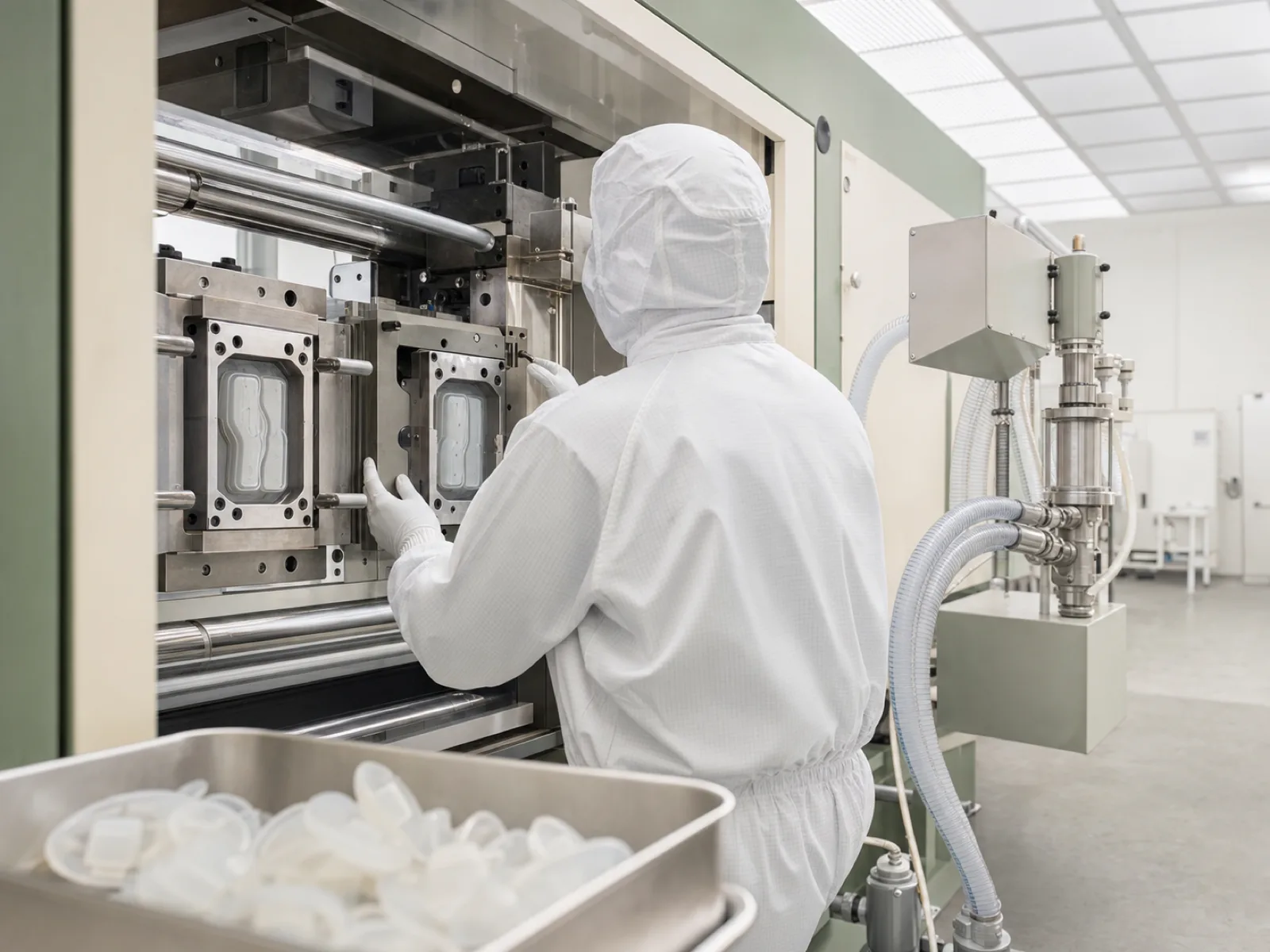
What cleanroom class is required — ISO 14644 Class 7 or Class 8?
ISO 14644-1 Class 7 (352,000 particles ≥0.5 µm/m³) is the minimum practical class for sterile-packaged medical silicone[^iso-14644-1]. Class 8 (3.52 million particles/m³) is acceptable for external-contact, non-sterile components. Class 5 or 6 is reserved for aseptic-fill and implantable-precursor operations — most silicone molders subcontract those steps to specialists.
The industry shorthand — “10,000 class” for ISO 7 and “100,000 class” for ISO 8 — comes from the retired US Federal Standard 209E and remains common on cleanroom drawings. The practical decision follows the device risk pathway. If the finished silicone component enters the sterile barrier and is packaged in Tyvek or foil, Class 7 is the floor because particle burden translates directly into bioburden going into terminal sterilization. If the component is a non-sterile external accessory — a mask cushion, a stethoscope diaphragm — Class 8 is defensible and materially cheaper to operate.
The audit question is not “what class does your cleanroom hold?” It is “what class do you run production at, verified how often?” ISO 14644-2 requires classification testing at intervals no greater than 6 months for Class 7 in operation. Ask for the last two test reports and the corrective action log for any excursion. Compressed-air quality (ISO 8573-1 Class 2 water, oil, and particles) and gowning SOPs (bunny suit for Class 7, lab coat plus hairnet minimum for Class 8) are the next-tier evidence.
Cleanroom operating cost is the reason inexperienced buyers over-specify. A Class 7 cleanroom for silicone molding costs approximately three times a Class 8 cleanroom to build and roughly twice to operate on a per-square-meter basis, driven by air-changes-per-hour (60+ for Class 7 vs. 20 for Class 8), HEPA filter loading, and gowning throughput. Those costs pass through to unit price on medium-volume programs. If your device is external-contact and non-sterile, insisting on Class 7 out of caution burns 15-25% of unit price for zero regulatory benefit. Buyers who match cleanroom class to device risk classification — Class I devices to Class 8, Class II devices with sterile packaging to Class 7 — hit the price-performance frontier competitors don’t.
The other cleanroom variable buyers miss is the transfer path from molding to secondary processes. A cleanroom cell that produces beautiful molded parts, then transfers them across a non-controlled corridor to a packaging or assembly cell, has broken the controlled environment chain. Verify the continuous-cleanroom path from molding through inspection, deflashing (if applicable), and packaging on a physical walkthrough. Suppliers that break the chain and rely on double-bagging to “recover” have a QMS gap that will surface in an FDA Form 483 audit.
Platinum-cured LSR vs. peroxide-cured HCR — which for medical?
Platinum-cured liquid silicone rubber (LSR) is the modern default for medical devices because the platinum catalyst leaves no volatile by-products. Peroxide-cured HCR is usable but requires a mandatory 4-hour post-cure at 200 °C to volatilize dichlorobenzoic acid residues, without which the compound fails ISO 10993-5 cytotoxicity. LSR runs automated in cleanroom cells; HCR needs a compression-molding compromise on particle control.
The cure-chemistry decision cascades into cleanroom design, cycle economics, and biocompatibility documentation. LSR is metered from two-part drums into a heated tool at 180-210 °C with cycle times of 15-90 seconds depending on wall thickness — the process is closed-loop and produces no flash-cut waste that carries into the cleanroom. HCR is a preformed blank compression-molded into a heated tool for 3-8 minutes with a manual load-unload; the compression press and the operator interface are hard to isolate in a Class 7 environment. Our detailed comparison of the two cure systems sits in the platinum-cured vs. peroxide-cured silicone guide.
For implantable and drug-contact devices, LSR is nearly universal. For external-contact medical components — respiratory masks, surgical-instrument grips, patient-monitoring straps — either chemistry works if the post-cure discipline is present. Cost-per-part on medium volumes (10,000-100,000 units/year) typically favors LSR once tooling is amortized; HCR wins on very low volumes or very large parts.
The tooling investment cascade is the second decision axis. LSR tools cost 1.5-2.5× a comparable HCR compression tool because the injection cavity must handle 6-8 MPa clamp pressure with sub-millisecond gate control and hardened runner systems for the two-part mix. A 16-cavity LSR production tool for a mask cushion runs $45,000-90,000; the same geometry in HCR compression runs $18,000-35,000. Amortization crosses over around 40,000-80,000 units, which is where medical program planners either commit to LSR up front or start on HCR and plan a tooling transition when volume ramps.
Compound cost is the third axis and moves opposite tooling cost. Medical-grade LSR compounds run $22-45/kg depending on Shore A and specialty additives (X-ray opaque, radiopaque, self-lubricating); medical HCR compounds run $14-28/kg. On a 30-gram device, the compound-cost delta is roughly $0.50 per unit — meaningful on high volumes, negligible on prototype builds. Add cure-cycle labor: LSR cycles at 15-90 seconds fully automated; HCR cycles at 3-8 minutes with operator load-unload. On labor-adjusted total cost, LSR is cheaper above 20,000 units per year for parts under 50 grams — the threshold below which most medical program managers should not be defaulting to HCR out of habit.
What sterilization methods work with medical silicone?
Steam autoclave at 121-134 °C is silicone's easiest match — thousands of cycles with negligible property change. Gamma at 25-50 kGy retains >90% tensile per ASTM F1980 accelerated aging[^astm-f1980]. Ethylene oxide requires ISO 10993-7 residual testing (EO ≤4 mg, ECH ≤9 mg per device for limited exposure)[^iso-10993-7]. E-beam is faster than gamma but penetration-limited to thin sections.
Sterilization compatibility is where a lot of silicone specifications quietly break. Autoclave is the friendliest — platinum-cured LSR at Shore A 50-70 will run 2,000+ autoclave cycles at 134 °C with under 5% tensile loss, which is why reusable surgical instrument grips default to silicone. Gamma radiation is the industry workhorse for single-use sterile devices; 25 kGy is the minimum sterility assurance level (SAL 10⁻⁶) validated dose, and modern platinum-cured formulations tolerate 50 kGy for double-safety-margin protocols with post-irradiation tensile retention above 90%.
EtO is compatible chemically but operationally heavy: ISO 10993-7 mandates residual limits enforced through GC-headspace testing on each production lot, and silicone’s gas-diffusion characteristics require longer aeration than thermoplastic devices. E-beam offers throughput advantages over gamma (minutes vs. hours per pallet) but electron penetration limits it to devices with wall thickness under approximately 5 mm. Buyers should specify sterilization method in the RFQ — silicone hardness and durometer tolerances after sterilization are compound-specific and belong on the drawing.
The property-change dataset to request from a candidate supplier is compound-specific, not chemistry-general. A qualified supplier hands you a table showing tensile strength (MPa), elongation at break (%), and Shore A hardness before sterilization, after single-dose sterilization, and after accelerated aging equivalent to two-year shelf life. On a well-formulated platinum-cured LSR Shore A 50, gamma at 25 kGy should retain tensile above 8.5 MPa (versus 9.5 MPa unirradiated), elongation above 550% (versus 620%), and hardness within Shore A ±2 points. If the supplier’s data shows post-gamma tensile below 7 MPa or elongation below 450%, the compound is at the edge of the design envelope and the buyer should specify a different compound family or a lower irradiation dose.
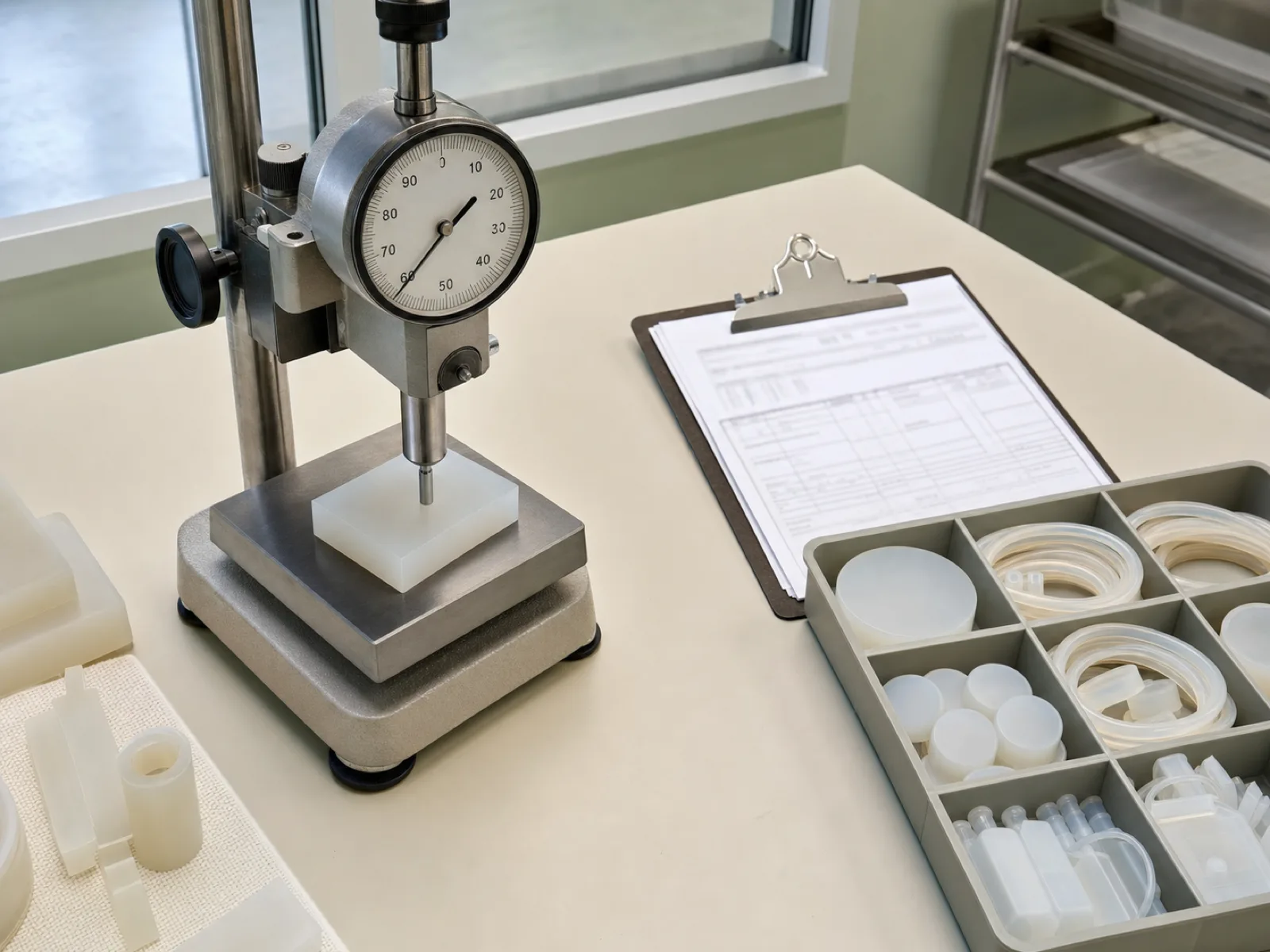
How does E&L testing work for drug-contact silicone?
Extractables and leachables testing (E&L) profiles compounds that migrate from silicone under exaggerated (extractable) and use (leachable) conditions. It is mandated for drug-contact devices under USP <1663>/<1664>[^usp-1663] and ICH Q3D, for combination products, and for implantable devices >30 days. GC-MS and LC-MS produce a compound list; a threshold-of-toxicological-concern (TTC) assessment ranks risk.
For a silicone tubing or seal that contacts a drug product, E&L is a lot-level, batch-traceable dataset — not a one-time qualification. The supplier extracts sample sections with defined solvents (aqueous, ethanolic, hexane or heptane) at specified temperatures and durations, characterizes the extract via GC-MS and LC-MS, and delivers a compound identification with concentration. A toxicologist then compares each identified compound to the TTC (1.5 µg/person/day for compounds without genotoxic alerts) or a substance-specific limit.
The gap that surprises first-time buyers: LSR compounds vary in their extractables profile even within “USP Class VI” families. A supplier that runs the same base compound family across dozens of drug-contact programs has amortized extractables characterization; a supplier that treats E&L as your problem does not have platform data. Ask for a redacted E&L report on a comparable geometry before signing an NDA to review yours in detail.
What does the ISO 13485 documentation package look like?
A qualified supplier delivers a Device History File (DHF) contribution and a Device Master Record (DMR) input covering material identity, incoming inspection, process parameters, in-process controls, final release testing, and change control. The buyer's regulatory team folds these into the 510(k) or MDR technical file. Expect 3-5 business days to compile the packet on a qualified compound family.
Under ISO 13485:2016 clause 7.5.1, the manufacturer maintains process validation for any process whose output cannot be verified by subsequent monitoring — molding is that process by default. What the buyer receives (or should receive) is the IQ/OQ/PQ summary for the specific cell producing the device, tied to the compound lot certificate of analysis, tied to the operator training record. When a change is proposed — different compound lot supplier, different mold cavity replacement, different cure temperature — the Product Change Notification (PCN) system flags it to the buyer under a contractual timeline (typically 60-90 days notice on Class II devices).
Two audit red flags: a supplier that cannot produce a DHF contribution template on request, and a supplier that treats PCN as “we’ll let you know” rather than a documented SOP with defined change categories. Our companion guide on food-grade vs. medical-grade silicone covers the regulatory gap between the two categories in detail.
A third red flag that surfaces on paper review before a site visit: a supplier whose ISO 13485 audit reports over the last three cycles show only “Minor” nonconformities. Medical-device auditing is not a hotel review; a factory operating a mature QMS will have a handful of Minor findings per audit cycle documented alongside their corrective actions. Zero findings across three cycles suggests either a certification body that runs light audits or a supplier that has not been subject to critical scrutiny. Ask for the last three surveillance audit summaries and the corrective action closure records — the pattern is more informative than the absence of findings.
Change control is the operational discipline that turns a compliant supplier into a defensible one. Under 21 CFR 820.70(a), the buyer as legal manufacturer bears responsibility for supplier changes that affect device performance. The PCN SOP defines who classifies a change as major or minor, which triggers buyer notification, which triggers buyer sign-off, and which the supplier can implement autonomously. A defensible SOP names the change categories explicitly: raw material substitution (major), tooling replacement (major), process parameter change beyond validated range (major), cavity replacement within validated tooling (minor), and packaging supplier substitution (minor with buyer notification). The 60-day notice window is FDA guidance-aligned; anything shorter shifts risk to the buyer.
Supplier audit checklist — the four artifacts
A defensible medical silicone supplier audit tests four artifacts: the ISO 13485 certificate scope, a redacted Device History File for a comparable device, a lot-level extractables report, and a Product Change Notification SOP. Physical site visit confirms cleanroom class in operation, gowning discipline, and compound segregation. Anything less is a marketing tour.
The audit is less about the site visit theater than about which documents the supplier volunteers versus which have to be pulled with a wrench. Table 1 below is the artifact-by-artifact checklist we run when qualifying a peer factory.
| Audit artifact | What to check | Pass criteria |
|---|---|---|
| ISO 13485 certificate | Scope covers your device family | Scope statement names the process (LSR injection / HCR compression / cleanroom molding) and product category (e.g., implantable / non-implantable / drug-delivery components) |
| Redacted DHF | Design controls, DMR, validation | Complete IQ/OQ/PQ summary; process capability data (Cpk ≥1.33 on critical dimensions); operator training records tied to specific cell |
| E&L report | Compound × geometry × conditions | Recent (within 24 months); GC-MS and LC-MS peaks identified; TTC assessment attached |
| PCN SOP | Change categories and notification timelines | Documented major/minor change taxonomy; 60-90 day notice on major changes; 30 days on minor; buyer sign-off gate |
| Cleanroom particle report | ISO 14644-2 classification test | Within last 6 months for Class 7; 12 months for Class 8; corrective action log for any excursion |
| Compound COA | Per-lot certificate | Traceable to compound supplier lot; USP Class VI declaration; heavy metals ≤ RoHS limits; volatile content ≤ compound spec |
MOQ, lead time, and prototype builds — the commercial layer
MOQ for medical-grade external-contact silicone components on existing tooling starts at 500 units per SKU. Prototype LSR runs of 20-100 units support design verification and 510(k) submission builds. First-article inspection (FAI) lead time is 4-6 weeks including tooling qualification. Production lead time on a qualified tool is 25-40 days FOB.
The commercial layer is where medical silicone diverges from consumer-grade OEM. Prototype tooling for LSR runs is typically aluminum-cavity, 20-cavity single-drop, and produces the 20-100 units a buyer needs for design verification, biocompatibility test articles, and clinical trial supply. That tooling is not production tooling — it validates the design but is retired or referenced when the program moves to hardened steel multi-cavity tools for production. Our commercial-terms guide at MOQ and lead time for silicone OEM covers the sequencing and price cascade.
Timelines that buyers should hard-code in a program plan: 3-4 weeks for prototype tooling, 4-6 weeks for design verification builds and biocompatibility testing article delivery, 8-12 weeks for production tooling fabrication and IQ/OQ/PQ validation, then production lead time of 25-40 days per lot. Regulatory review (510(k) response cycles, MDR technical file review) sits in parallel and is the usual gating path.
Price bands that buyers should benchmark against on the sourcing sheet, expressed as unit price FOB Shenzhen or Yantian on qualified compounds:
| Volume tier | External-contact non-sterile | External-contact sterile | Prototype / DV build |
|---|---|---|---|
| 500-2,000 units | $2.80-6.40/unit | $4.20-9.80/unit | $18-45/unit (aluminum tool) |
| 2,000-10,000 units | $1.60-3.80/unit | $2.40-5.60/unit | n/a |
| 10,000-50,000 units | $0.95-2.20/unit | $1.40-3.30/unit | n/a |
| 50,000+ units | $0.55-1.40/unit | $0.80-2.10/unit | n/a |
The bands assume a 20-60 gram part in Shore A 40-70 platinum-cured LSR, single-color, no overmolding, no printed logo. Overmolding onto a plastic substrate adds 25-40% to unit price. Multi-color inserts add 30-50%. Pantone-matched color-matching for brand-consistent devices adds a one-time color-lab fee of $600-1,500 and a $0.05-0.12/unit master-batch surcharge. If a supplier quotes materially below these bands on a first RFQ, ask specifically which compound (name it) and which cleanroom class the quote assumes — the gap usually hides in one of those two variables.
Where Wetop Silicone sits in the medical program landscape
Wetop's medical program footprint covers external-contact, non-implantable silicone components — mask cushions, drainage tubing external segments, patient-monitoring straps, surgical instrument grips — molded under ISO 9001 with ISO 13485 documentation package support. We route implantable and drug-contact programs to partner factories operating implantable-precursor cleanroom cells.
The honest boundary: Wetop operates a Class 8 cleanroom-adjacent cell qualified for external-contact medical silicone; we do not currently hold Class 5/6 aseptic-fill or implantable-precursor certification. Buyers with programs matching our footprint get platinum-cured LSR molding, USP Class VI compound sourcing, ISO 10993-1 platform data for the compound family, DHF contribution documentation, and PCN discipline under a signed quality agreement. Buyers with implantable or drug-contact programs get a straight referral to a peer factory better matched to the risk class — the founder-led engineering desk does not stretch scope for revenue.
Ready to run the audit checklist against a candidate supplier for your device program? Talk to the engineering desk with your ISO 10993 contact category, duration, and sterilization method — we return a supplier fit assessment within one business day. If Wetop is not the right factory, we say so and point to who is.
Footnotes
-
Regulation (EU) 2017/745 on Medical Devices. European Commission. https://eur-lex.europa.eu/legal-content/EN/TXT/?uri=CELEX:02017R0745-20230320 ↩
-
Use of International Standard ISO 10993-1 — Guidance for Industry and Food and Drug Administration Staff. US FDA CDRH. https://www.fda.gov/regulatory-information/search-fda-guidance-documents/use-international-standard-iso-10993-1-biological-evaluation-medical-devices-part-1-evaluation-and ↩
FAQ
-
What certifications must a medical silicone manufacturer hold?
At minimum, ISO 13485:2016 for the quality system and ISO 9001:2015 as its foundation. The raw silicone compound must carry USP Class VI qualification (USP <87> cytotoxicity, USP <88> systemic injection, intracutaneous, and implantation) and, for finished-device use, ISO 10993-1 biological evaluation covering the relevant contact category and duration. For US market entry, the manufacturer must support the buyer's FDA 510(k) or PMA package with material identification, biocompatibility, and manufacturing information.
-
What is the difference between USP Class VI and ISO 10993?
USP Class VI qualifies the raw polymer through cytotoxicity, systemic toxicity, intracutaneous reactivity, and (in short-term) implantation tests on standardized extracts. ISO 10993-1 qualifies the finished device in its intended use — contact type, duration, and clinical scenario. USP Class VI is necessary but not sufficient for implantable or blood-contact devices; ISO 10993 series testing on the final geometry is required.
-
Do I need an ISO Class 7 or Class 8 cleanroom for medical silicone molding?
ISO 14644-1 Class 7 (352,000 particles ≥0.5 µm/m³ = 10,000 ft³) is standard for sterile-packaged and implantable-precursor components. Class 8 (3.52 million particles/m³ = 100,000 ft³) is acceptable for external-contact, non-sterile components — surgical instrument grips, external drainage tubing, patient-contact overmolds. Match the class to your device's ISO 13485 risk classification, not to marketing pressure.
-
Can peroxide-cured HCR silicone be used for medical devices?
Peroxide-cured HCR is used in some medical applications, but it requires a mandatory 4-hour post-cure at 200 °C to volatilize cure by-products (2,4-dichlorobenzoic acid from DBP catalysts). Without post-cure, the compound will fail ISO 10993-5 cytotoxicity. Platinum-cured LSR is the modern default for medical because it produces no volatile by-products and is fully automated in cleanroom cells.
-
Which sterilization methods are compatible with medical silicone?
Gamma radiation up to 50 kGy retains >90% tensile strength on platinum-cured silicone (per ASTM F1980 accelerated aging). Ethylene oxide (EtO) is compatible but requires ISO 10993-7 residual testing (EO ≤4 mg, ECH ≤9 mg per device). Steam autoclave at 121-134 °C is silicone's easiest match — thousands of cycles with negligible property change. E-beam is faster than gamma but limited to thin sections due to penetration depth.
-
What is the MOQ for medical grade silicone OEM production?
Wetop's MOQ for medical-grade external-contact components on existing tooling starts at 500 units per SKU. Prototype LSR runs of 20-100 units are available for design verification and 510(k) submission builds, quoted separately. Implantable-precursor programs are project-scoped — MOQ discussed after DHF review because tooling amortization changes with cleanroom cell dedication.
-
How does a supplier support my FDA 510(k) submission?
The supplier provides a compliance packet: ISO 13485 certificate with matching scope, material data sheets, USP Class VI test certificates, ISO 10993 test reports for the compound family, a Device Master File letter of authorization (if applicable), and manufacturing process description. For predicate-device silicone equivalence claims, the supplier confirms compound chemistry match. Expect 3-5 days to compile a full packet on an existing qualified compound.
-
What are extractables and leachables (E&L) tests and when do I need them?
Extractables are compounds that migrate from silicone under exaggerated conditions (solvents, heat, time); leachables migrate under actual use conditions. E&L is required for drug-contact devices (per ICH Q3D and USP <1663>/<1664>), combination products, and any implantable >30 days. The supplier runs GC-MS and LC-MS on device extracts, delivers a threshold-of-toxicological-concern (TTC) risk assessment, and lot-level data if drug interaction is a factor.
-
What does a defensible medical silicone supplier audit look like?
A defensible audit reviews four artifacts. First, the ISO 13485 certificate scope — does it cover your device type? Second, a redacted Device History File (DHF) for a comparable device — does the supplier own the design or just mold to your print? Third, a lot-level extractables report — is data traceable to a specific batch? Fourth, a Product Change Notification (PCN) SOP — how are you told when compound or process changes?
References
Authoritative sources cited in this guide
- International Organization for Standardization. ISO 10993-1:2018 — Biological evaluation of medical devices — Part 1: Evaluation and testing within a risk management process. https://www.iso.org/standard/68936.html — The master framework for biological evaluation; defines contact categories (surface / external-communicating / implant) and durations (limited <24h / prolonged 24h-30d / long-term >30d).
- International Organization for Standardization. ISO 13485:2016 — Medical devices — Quality management systems — Requirements for regulatory purposes. https://www.iso.org/standard/59752.html — The quality system standard every medical silicone manufacturer must operate under; scope on the certificate must cover the buyer's device type.
- International Organization for Standardization. ISO 14644-1:2015 — Cleanrooms and associated controlled environments — Part 1: Classification of air cleanliness by particle concentration. https://www.iso.org/standard/53394.html — Defines cleanroom classes; Class 7 = 352,000 particles ≥0.5 µm/m³ (Fed Std 209E Class 10,000).
- United States Pharmacopeia. USP <88> Biological Reactivity Tests, In Vivo — Class VI. https://www.usp.org/harmonization-standards/pdg/general-chapters/biological-reactivity-tests — The compendial method that produces the 'USP Class VI' qualification cited on medical silicone compound data sheets.
- US Food and Drug Administration, Center for Devices and Radiological Health. Use of International Standard ISO 10993-1 — FDA Guidance for Industry and FDA Staff. https://www.fda.gov/regulatory-information/search-fda-guidance-documents/use-international-standard-iso-10993-1-biological-evaluation-medical-devices-part-1-evaluation-and — FDA's operational interpretation of ISO 10993-1 for US 510(k) and PMA submissions; supersedes the 1995 Blue Book memo #G95-1.
- International Organization for Standardization. ISO 10993-7:2008/AMD 1:2019 — Ethylene oxide sterilization residuals. https://www.iso.org/standards.html — Sets EO residual limits (≤4 mg/device for limited exposure, ≤60 mg/device cumulatively) that gate EtO-sterilized silicone devices.
- ASTM International. ASTM F1980-21 — Standard Guide for Accelerated Aging of Sterile Barrier Systems and Medical Devices. https://www.astm.org/f1980-21.html — The accelerated-aging protocol used to demonstrate that gamma-sterilized silicone retains mechanical properties over shelf life.
- United States Pharmacopeia. USP <1663> Assessment of Extractables Associated with Pharmaceutical Packaging/Delivery Systems. https://www.usp.org/chemical-medicines/general-chapters — The extractables framework for silicone in drug-contact use; paired with USP <1664> for leachables.
- European Commission. Regulation (EU) 2017/745 on Medical Devices (MDR). https://eur-lex.europa.eu/legal-content/EN/TXT/?uri=CELEX:02017R0745-20230320 — The EU regulatory regime replacing MDD 93/42/EEC; sets material declaration and technical file requirements for silicone components in Class I-III devices.
Start a custom program
Send a brief. Get an engineer’s reply in one business day.
Every Wetop program is tooled from a customer’s specification. Send a CAD file (STEP · IGES · DWG) or a written brief and we’ll reply with a mold cost estimate, price brackets at MOQ 500 / 1,000 / 5,000, and any engineering questions.