Manufacturing · commercial intent
Liquid Silicone Rubber Manufacturer — OEM Guide
 Manufacturing
 A liquid silicone rubber manufacturer runs a two-part platinum-cured silicone through automated cold-runner injection tooling, curing in a heated cavity in 10-90 seconds to produce flash-free parts holding ±0.05 mm tolerance. Body-safe intimate wellness OEM programs require the factory to layer ISO 10993 biocompatibility, USP Class VI clearance, FDA 21 CFR 177.2600 food-contact certification, and ISO Class 8 cleanroom cavitation on top of an ISO 9001 quality management system. This guide walks buyers through the material qualification, tooling economics, cleanroom classification, and vendor red-flag checklist to qualify an LSR OEM factory in a single audit pass.
The rest of this guide is a working document for buyer QA, engineering, and sourcing teams evaluating a liquid silicone rubber manufacturer for a body-safe wellness OEM program. Every claim carries a cert code, a spec number, or a process detail. Where a topic deserves its own deep dive — molding process, cure system chemistry, MOQ economics — the cross-links point to the standalone guide.
What is a liquid silicone rubber manufacturer and how does LSR molding work?
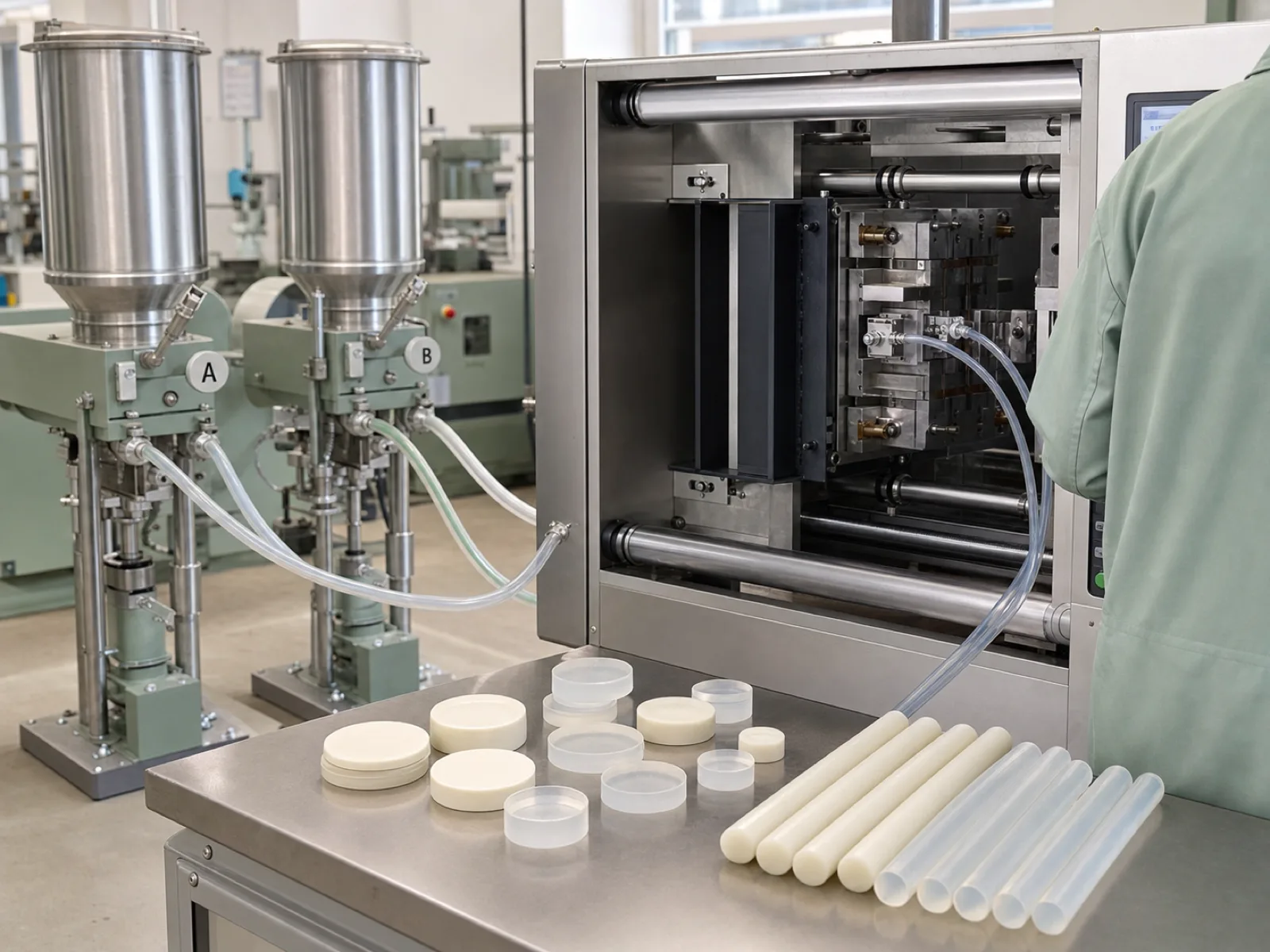
A liquid silicone rubber manufacturer meters a two-part platinum-cured LSR resin (a 1:1 A/B ratio) through a chilled cold-runner into a heated mold cavity at 160-200 °C, where the elastomer cures in 10-90 seconds. The process is fully automated, flash-free, and holds ±0.05 mm tolerance — economics competitive with thermoplastic injection above 20,000 shots per year.
LSR (liquid silicone rubber) is a low-viscosity two-part platinum-cured silicone elastomer. Part A carries the vinyl-functional polymer and reinforcing silica. Part B carries the platinum catalyst and the hydride crosslinker. When A and B are metered 1:1 and heated, a platinum-catalyzed hydrosilylation reaction crosslinks the network in seconds — no peroxide byproducts, no post-cure required for most food-contact grades1.
The reference architecture on the factory floor:
- Drum unloaders press Part A and Part B from 200-litre pails, feeding a chilled metering pump.
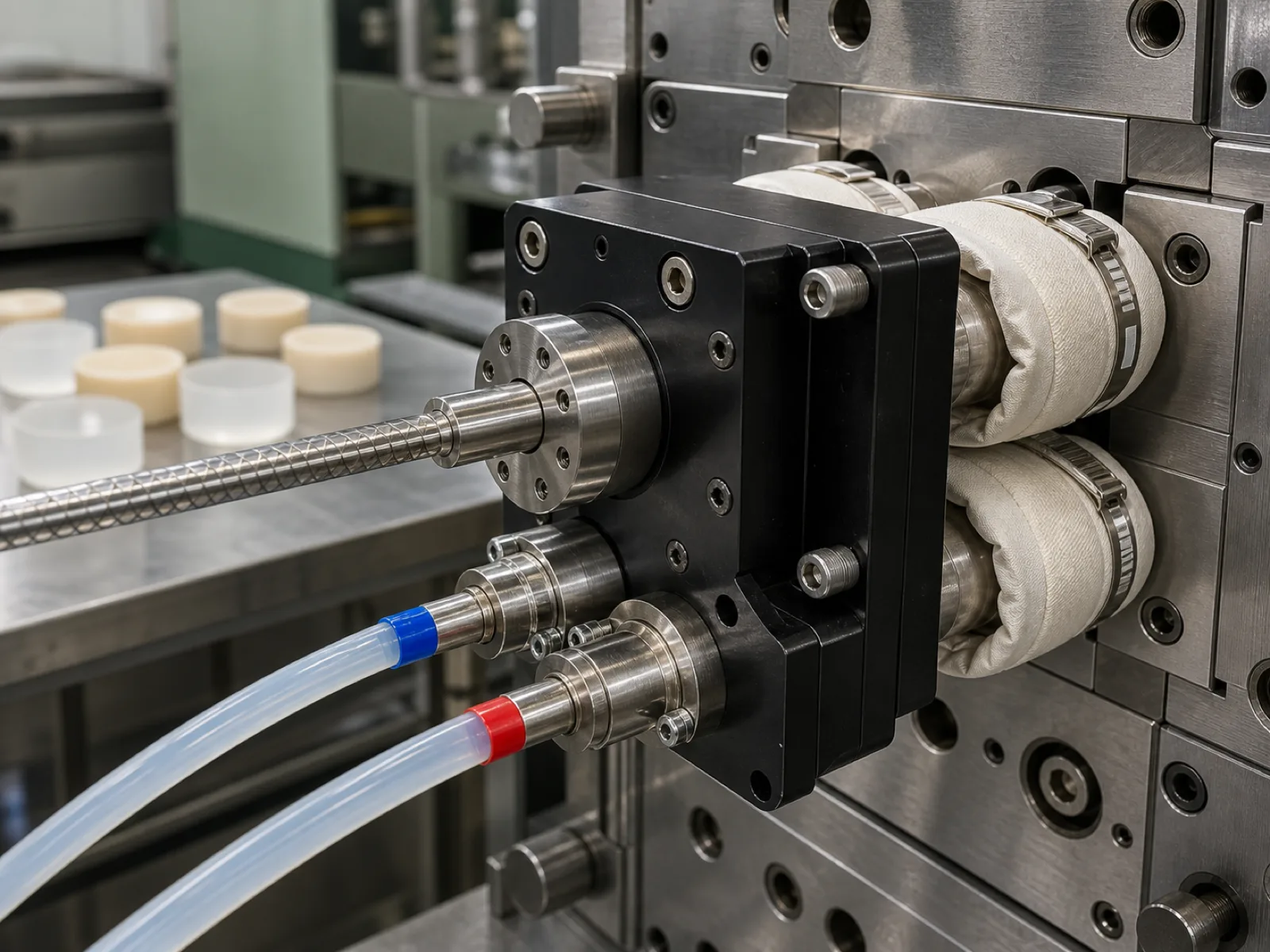
- Static mixer blends the A/B stream immediately before the tool — dwell time in the mixed state is under 90 seconds to prevent cure in the runner.
- Cold-runner manifold holds the mixed LSR at 15-25 °C right up to the gate.
- Heated tool cavity at 160-200 °C crosslinks the shot in 10-90 seconds depending on wall section.
- Automated demold — LSR does not shrink onto steel like thermoplastic; parts release with a compressed-air kiss.
For a plain-English walkthrough of the LSR chemistry and where it sits versus HCR silicone rubber, see /guide/what-is-liquid-silicone-rubber-lsr-explained/. For the broader compression / injection / extrusion landscape, see /guide/silicone-molding-process-explained/.
Which medical-grade LSR resin grades should a body-safe OEM factory be qualified to run?
A body-safe LSR OEM factory should be qualified to run at least three of the five major medical-grade LSR resin families: Elkem Silbione LSR, Dow SILASTIC Q7 healthcare-grade, Wacker Elastosil LR 3003 / 5040 series, Momentive Silopren LSR 27xx / 47xx, and Shin-Etsu KE-2000 medical grades. Every incoming lot must ship with a supplier COA referencing ISO 10993 and USP Class VI test data.
Buyers should ask for the supplier COA on the specific resin lot quoted — not the generic datasheet. A factory that cannot produce lot-linked biocompatibility data on request is not a qualified body-safe LSR manufacturer.
| Resin family | Grade examples | Shore A range | Key certification stack | Typical use |
|---|---|---|---|---|
| Elkem Silbione LSR | 4000, 4360, 7060, 7080 | 20-80 | ISO 10993-5/10, USP Class VI, FDA 177.2600 | Body-safe wellness, medical seals |
| Dow SILASTIC | Q7-4720, MDX4-4210, LC series | 20-70 | ISO 10993, USP Class VI, EU 10/2011 | Long-term implant, healthcare tubing |
| Wacker Elastosil | LR 3003, LR 3040, LR 5040, LR 3070 self-bonding | 5-80 | ISO 10993-5/10, USP Class VI | Overmolded assemblies, baby-care |
| Momentive Silopren | LSR 2745, 2770, 4770 | 40-70 | ISO 10993, USP Class VI | Sealing, gaskets, closures |
| Shin-Etsu KE-series | KE-2000, KE-2090-40/60/70 | 30-70 | ISO 10993, USP Class VI | Medical membranes, valves |
Body-safe wellness OEM programs typically default to Elkem Silbione LSR 4000-series for skin-contact, or Wacker Elastosil LR 3070 self-bonding when the SKU is an overmolded thermoplastic assembly.
What LSR physical properties matter for body-safe wellness OEM?
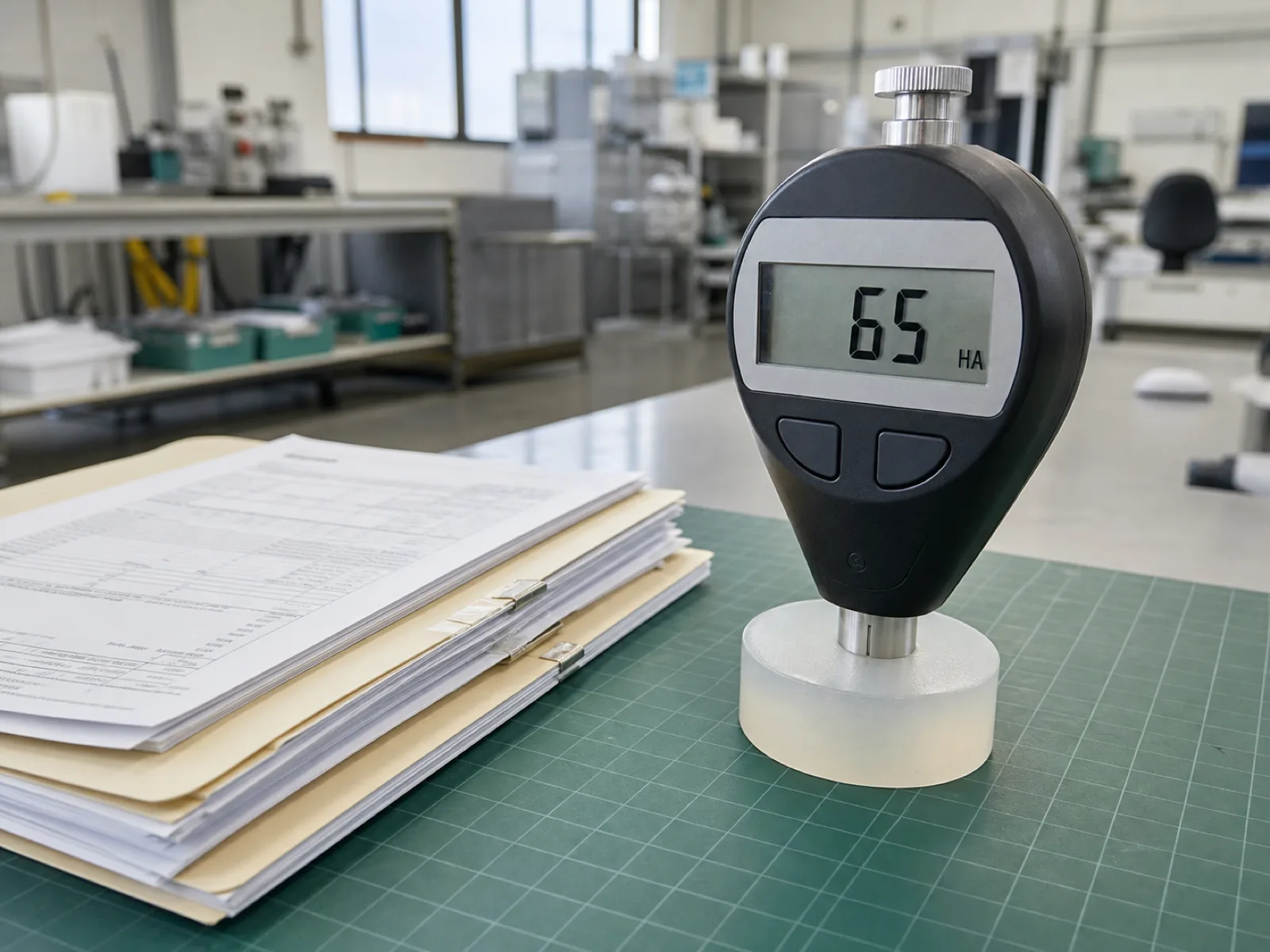
Medical-grade LSR delivers Shore A durometer 5-80, tensile strength 6-11 MPa, elongation at break up to 1000 %, tear strength 15-40 kN/m, and service temperatures from -55 °C to 260 °C. Compression set at 175 °C for 22 hours stays below 25 % on standard formulations — the elasticity retention that lets an overmolded seal or grip survive a 5-year duty cycle without permanent deformation.
The property table below is the working reference for buyer engineering:
| Property | Typical range (medical-grade LSR) | Test method |
|---|---|---|
| Shore A durometer | 5 to 80 | ASTM D2240 |
| Tensile strength | 6-11 MPa (870-1600 psi) | ASTM D412 |
| Elongation at break | 400-1000 % | ASTM D412 |
| Tear strength (Die B) | 15-40 kN/m | ASTM D624 |
| Compression set (22h @ 175 °C) | 15-25 % | ASTM D395 |
| Service temperature | -55 °C to 260 °C (-67 °F to 500 °F) | — |
| Dielectric strength | 20-25 kV/mm | ASTM D149 |
| Water absorption (24h) | < 1.0 % | ASTM D570 |
| Density | 1.05-1.20 g/cm³ | ASTM D792 |
For a broader comparison of temperature ratings across silicone families, see /guide/silicone-temperature-range-explained/.
What certifications does a body-safe LSR OEM program require?
Body-safe LSR OEM stacks five certification layers: ISO 10993-5 cytotoxicity[^iso-10993-5], ISO 10993-10 irritation and skin sensitization[^iso-10993-10], USP Class VI biocompatibility[^usp-class-vi], FDA 21 CFR 177.2600 food-contact clearance[^fda-177-2600], and REACH SVHC + phthalate-free declaration[^echa-reach]. ISO 13485[^iso-13485] medical-device QMS sits above the baseline ISO 9001 factory system for the most rigorous programs.
Buyers frequently mistake ISO 10993 as a single test — it is a family of 20+ parts. For skin-contact body-safe OEM, the minimum viable panel is Parts 5 (cytotoxicity), 10 (irritation and sensitization), and 18 (chemical characterization — extractables and leachables)2. Mucosal-contact SKUs add Part 23 (irritation on mucosa) and Part 11 (systemic toxicity) when the exposure envelope justifies it.
A qualified factory keeps the full certification packet organized by resin lot in a documented library, not stapled to sales quotes. The packet must reproduce on demand within 24 hours — that response time is a load-bearing signal in vendor qualification.
For the platinum-cured / peroxide-cured cure-system decision that anchors this whole certification path, see /guide/platinum-cured-vs-peroxide-cured-silicone/.
What cleanroom classification does an LSR injection cell need?
The baseline for skin-contact body-safe LSR OEM is ISO 14644-1 Class 8 (formerly Class 100,000) cleanroom molding[^iso-14644-1] — airborne particles ≥ 0.5 µm capped at 3,520,000 per m³. Implantable LSR components step up to Class 7 (Class 10,000, 352,000 particles per m³). The cleanroom envelope must cover the press, post-cure oven exit, deflash bench, and primary packaging cell as one continuous controlled space.
| ISO 14644-1 class | Legacy Fed Std 209E | ≥ 0.5 µm particles per m³ | Typical LSR OEM use |
|---|---|---|---|
| Class 7 | Class 10,000 | 352,000 | Implantable medical LSR components |
| Class 8 | Class 100,000 | 3,520,000 | Skin-contact wellness, medical closures |
| Uncontrolled | — | > 10,000,000 | Non-body-contact industrial LSR only |
A common vendor red flag: a Class 8 press cell with the primary packaging bench sitting in an uncontrolled shop floor. Particulate contamination on the packaged part is functionally identical to particulate at the mold gate — the buyer QA team catches this on the incoming inspection audit and rejects the shipment.
How does LSR overmolding onto thermoplastics and metal work in a body-safe assembly?
LSR overmolds onto polycarbonate, PBT, nylon 66, PPS, and 304/316 stainless inserts using a self-bonding LSR grade — Elkem Silbione RTV 4460, Dow SILASTIC with primer, or Wacker Elastosil LR 3070. The substrate loads into the LSR tool cavity, the platinum-cured elastomer injects around it, and the assembly cures in one shot with peel strength above 4 N/mm on a validated substrate-primer-LSR system.
Overmolding is where LSR earns its OEM margin — a validated overmolded assembly eliminates a downstream bonding operation and every associated defect mode. The engineering call the factory owes the buyer is a documented substrate compatibility test on the specific plastic resin grade the buyer will supply. Two PBT resins from different suppliers can bond differently to the same LSR grade because the plasticizer package differs.
The typical LSR overmolding flow:
- Substrate injection-molded upstream (buyer-supplied or in-house).
- Substrate loaded manually or by robot into the LSR cavity, seated on locating pins.
- Cold-runner delivers mixed LSR around the substrate at 15-25 °C.
- Cavity heats to 170-190 °C and cures the LSR in 20-60 seconds.
- Robot demolds the assembly; automated vision inspection confirms fill.
- Post-cure oven at 200 °C for 2-4 hours drives off residual VOCs and locks the bond.
What are realistic MOQ, tooling cost, and lead time bands for LSR OEM?
A qualified LSR OEM factory quotes 500 units per SKU minimum. Prototype tooling (single-cavity, aluminum) runs USD 4,000-8,000 in 3-4 weeks. Production cold-runner steel tooling with 2-8 cavities runs USD 12,000-45,000 in 5-7 weeks. Validated production lead time is 4-8 weeks after tool sign-off, including IQ/OQ/PQ and first-article inspection with a documented FAI report.
| Program stage | Deliverable | Typical range | Lead time |
|---|---|---|---|
| DFM review | Mold-flow, gate location, parting line | USD 500-1,500 (often waived at tool commitment) | 5-7 days |
| Prototype tool | 1-cavity, aluminum, no cold-runner | USD 4,000-8,000 | 3-4 weeks |
| T0-T3 sample rounds | 3 iteration passes on the prototype tool | Included in tool cost | 2-3 weeks total |
| Production tool | 2-8 cavity, hardened steel, cold-runner | USD 12,000-45,000 | 5-7 weeks |
| IQ/OQ/PQ validation | Installation, operational, performance qualification package | USD 3,500-9,000 | 3-4 weeks |
| First-article inspection | Documented FAI report with dimensional + material COA | USD 800-2,000 | 5-7 days |
| Validated production | First carton to buyer QA | — | 4-8 weeks after PQ close |
For the deeper MOQ math (why 500 exists at the process level, not the marketing level), see /guide/real-factory-moq-the-math/. For OEM pricing structure — where the tool cost sits versus per-unit cost — see /guide/silicone-oem-pricing-structure/. For lead-time expectations across silicone families, see /guide/moq-and-lead-time-silicone-oem/.
What quality-system infrastructure does a body-safe LSR OEM factory need?
The infrastructure stack: ISO 9001:2015 QMS baseline, ISO 13485 preferred layer, documented IQ/OQ/PQ per tool and per cell, lot-traceable batch records tying resin lot to finished-goods carton, per-lot COA including Shore A / tensile / cure state, per-lot biocompatibility packet on request, and a documented change-control procedure so a resin-lot swap does not silently reset the validation state.
The change-control procedure is what separates a competent LSR OEM factory from a marginal one. When Elkem ships a new lot of Silbione 4360, the factory must document that the new lot has been characterized against the existing validated envelope — same durometer, same cure kinetics, same extractables profile. If any parameter drifts, the factory pauses production and re-validates. Without this discipline, buyer QA finds silent property drift six months into a program and traces it back to an undocumented resin lot change.
What are the vendor red flags for a liquid silicone rubber manufacturer?
Disqualifying red flags: no cold-runner on the LSR cell, no cleanroom envelope around the press, no ISO 10993 or USP Class VI reports on the specific resin grade quoted, no per-lot COA on incoming resin, no IQ/OQ/PQ package on the tool and cell, no documented post-cure procedure for skin-contact grades, and no lot-traceable batch record tying resin lot to finished-goods carton.
The buyer audit checklist for a body-safe LSR OEM factory:
- Cold-runner system on every LSR press cell — no open sprue, no hot-runner substitute.
- Cleanroom classification documented — ISO 14644-1 Class 8 minimum, with monthly particle-count logs.
- Material qualification library — supplier COAs, ISO 10993 reports, USP Class VI reports organized by resin lot.
- IQ/OQ/PQ package — installation, operational, and performance qualification records per tool and per cell.
- Batch record traceability — resin lot number ties to a specific press cell, a specific shift, a specific carton.
- Change-control procedure — resin lot swap triggers documented re-characterization before production continues.
- First-article inspection report — dimensional CMM data plus material COA plus extractables data on the FAI carton.
- Post-cure oven capacity — 200 °C oven cycle for 2-4 hours available for every body-safe lot, logged per cycle.
- Deflash and inspection bench inside the cleanroom envelope — not staged in an uncontrolled adjacent space.
- Documented supplier audit — the factory has audited its own resin, primer, and packaging suppliers within the last 24 months.
For a broader OEM-factory qualification checklist that spans compression, LSR, and extrusion cells, see /guide/sourcing-silicone-factory-checklist/.
How does Wetop qualify a body-safe LSR OEM program?
Wetop runs an LSR injection cell alongside its compression cells on a 7,500 m² floor in Dongguan. Every body-safe program passes a documented five-gate qualification: material COA on incoming resin, cleanroom-cavitated shot on the LSR press, per-lot post-cure at 200 °C, dimensional and Shore A QC on every FAI carton, and lot-traceable batch record from resin drum to shipped carton.
The engineering desk handles the documentation packet directly with buyer QA — supplier COA, resin lot certificate, ISO 10993 reports, USP Class VI reports, FDA 21 CFR 177.2600 clearance, REACH SVHC screening, phthalate-free declaration, IQ/OQ/PQ records, and FAI report. Every packet ships in one PDF bundle, indexed to the lot number on the carton label. Buyer QA does not have to chase the paperwork through email threads.
Frequently asked questions
The FAQ block below mirrors the frontmatter FAQ list verbatim so the FAQPage JSON-LD schema matches the visible content — this parity is what AI answer engines cross-check when deciding whether to cite a source.
Ready to qualify an LSR OEM factory for a body-safe program?
Send the engineering desk a signed mutual NDA (available at /nda/) and the target durometer, target volume, and target certification stack. We return a documented DFM review, a tool cost quote with a 5-7 week production tool lead time, and a certification packet template within seven business days. Start the conversation at /contact/.
Footnotes
FAQ
-
What is a liquid silicone rubber manufacturer and how does LSR molding differ from compression molding?
A liquid silicone rubber manufacturer runs a two-part platinum-cured silicone through automated injection tooling — a chilled cold-runner meters equal parts A and B resin into a heated cavity where the elastomer cures in 10-90 seconds. Unlike HCR compression molding, which loads pre-formed uncured slugs by hand, LSR injection is fully automated, holds ±0.05 mm tolerance, produces flash-free parts with no post-trim, and clears USP Class VI biocompatibility on standard formulations.
-
Which medical-grade LSR resin grades should a body-safe OEM factory be qualified to run?
A qualified factory should be able to run Elkem Silbione LSR 4000 and 7000 series, Dow SILASTIC MDX4-4210 and Q7 healthcare-grade LSR, Wacker Elastosil LR 3003 and 5040 series, Momentive Silopren LSR 27xx and 47xx, and Shin-Etsu KE-2000 and KE-2090 medical grades. Every batch must arrive with a supplier COA that references the specific resin lot against ISO 10993 and USP Class VI test data.
-
What certifications does a liquid silicone rubber manufacturer need for body-safe intimate wellness OEM programs?
Body-safe intimate wellness OEM requires ISO 10993-5 cytotoxicity, ISO 10993-10 irritation and skin sensitization, USP Class VI biocompatibility, FDA 21 CFR 177.2600 food-contact clearance, REACH SVHC screening, RoHS declaration, phthalate-free certification, and a documented ISO 9001 quality management system. ISO 13485 medical-device QMS is optional but often preferred by wellness brands that also carry Class II device SKUs.
-
What cleanroom classification does an LSR injection molding cell need for skin-contact products?
The industry baseline for skin-contact intimate wellness OEM is ISO 14644-1 Class 8 (formerly Class 100,000) cleanroom molding, which caps airborne particles ≥ 0.5 µm at 3,520,000 per m³. Implantable LSR components step up to Class 7 (Class 10,000). The cleanroom envelope must cover the injection press, post-cure oven exit, deflash bench, and primary packaging cell — a Class 8 press with a Class 100,000 packaging room is not a qualified system.
-
How do cold-runner systems change LSR injection tooling cost and cycle economics?
Cold-runner systems chill the A/B mix before it enters the heated cavity, so there is no cured runner waste per shot — a two-cavity LSR tool with cold-runner drops per-part material cost 8-14 % versus a hot-runner or open-sprue design. Cold-runner tools cost USD 3,000-8,000 more than a bare hot-runner tool but pay back within 40,000-80,000 shots on medical-grade resin priced USD 22-48 per kg.
-
What are realistic MOQ, tooling cost, and lead time bands for an LSR OEM program?
A qualified LSR OEM factory quotes 500 units per SKU minimum for a validated body-safe program. Prototype tooling (single-cavity, aluminum) runs USD 4,000-8,000 in 3-4 weeks; production cold-runner steel tooling with 2-8 cavities runs USD 12,000-45,000 in 5-7 weeks. Validated production lead time is 4-8 weeks after tool sign-off, including IQ/OQ/PQ and first-article inspection.
-
How does overmolding LSR onto thermoplastics and metal work in a body-safe OEM assembly?
LSR overmolds onto polycarbonate, PBT, nylon 66, and 304/316 stainless inserts using a self-bonding LSR grade (Elkem Silbione RTV 4460, Dow SILASTIC 4-4210 with primer, or Wacker Elastosil LR 3070). The substrate is loaded into the LSR tool cavity, the platinum-cured elastomer is injected around it, and the assembly cures in one shot. Peel strength should exceed 4 N/mm on a validated substrate-primer-LSR system.
-
What red flags disqualify a liquid silicone rubber manufacturer during vendor audit?
Disqualifying red flags: no cold-runner system on the LSR cell, no cleanroom cavitation around the press, no documented ISO 10993 or USP Class VI test reports on the specific resin grade quoted, no per-lot COA on incoming resin, no IQ/OQ/PQ validation package for the tool and cell, no documented deflash and post-cure procedure for skin-contact grades, and no lot-traceable batch record that ties resin lot to finished-goods carton.
-
What extractables and leachables testing should a body-safe LSR OEM program carry?
For skin-contact body-safe LSR, a competent factory delivers ISO 10993-18 chemical characterization extractables data (using ethanol, saline, and hexane extraction per method), plus VOC testing per FDA guidance on cured silicone articles. Peroxide-cured LSR grades additionally require post-cure to drive off residual 2,4-dichlorobenzoic acid — platinum-cured grades avoid this problem entirely, which is why body-safe OEM specs platinum-cured LSR exclusively.
References
Authoritative sources cited in this guide
- International Organization for Standardization. ISO 10993-5:2009 — Biological evaluation of medical devices — Part 5: Tests for in vitro cytotoxicity. https://www.iso.org/standard/36406.html — Defines the cytotoxicity test protocol every body-safe LSR grade must clear before OEM production.
- International Organization for Standardization. ISO 10993-10:2010 — Biological evaluation of medical devices — Part 10: Tests for irritation and skin sensitization. https://www.iso.org/standard/40884.html — Skin-contact and mucosal-contact wellness OEM programs must clear this irritation and sensitization panel.
- International Organization for Standardization. ISO 14644-1:2015 — Cleanrooms and associated controlled environments — Part 1: Classification of air cleanliness by particle concentration. https://www.iso.org/standard/53394.html — Defines the ISO Class 7 and Class 8 cleanroom particle-count limits referenced throughout the medical LSR industry.
- United States Pharmacopeia. USP <88> Biological Reactivity Tests, In Vivo (Class VI). https://www.usp.org/harmonization-standards/pdg/excipients/class-vi-biological-reactivity — Class VI is the most demanding USP biocompatibility tier and is the standard buyers request for body-safe LSR.
- US Food and Drug Administration. 21 CFR 177.2600 — Rubber articles intended for repeated use. https://www.ecfr.gov/current/title-21/chapter-I/subchapter-B/part-177/subpart-C/section-177.2600 — Baseline food-contact clearance also cited by body-safe OEM programs as an incoming-material qualification.
- International Organization for Standardization. ISO 13485:2016 — Medical devices — Quality management systems — Requirements for regulatory purposes. https://www.iso.org/standard/59752.html — Preferred QMS layer above ISO 9001 for LSR OEM factories serving medical-device and premium wellness brands.
- European Chemicals Agency. REACH Regulation (EC) No 1907/2006 — Registration, Evaluation, Authorisation and Restriction of Chemicals. https://eur-lex.europa.eu/legal-content/EN/TXT/?uri=CELEX%3A32006R1907 — SVHC screening required for LSR OEM shipments into the EU; body-safe programs specify phthalate-free by declaration.
- International Organization for Standardization. ISO 10993-18:2020 — Biological evaluation of medical devices — Part 18: Chemical characterization of medical device materials within a risk management process. https://www.iso.org/standard/64750.html — Governs extractables and leachables (E&L) characterization on cured LSR articles.
- US National Library of Medicine (PubMed). Biocompatibility of silicone elastomers used in medical devices — literature review. https://pubmed.ncbi.nlm.nih.gov/26766421/ — Peer-reviewed evidence base for the biocompatibility profile of platinum-cured silicone rubber.
Start a custom program
Send a brief. Get an engineer’s reply in one business day.
Every Wetop program is tooled from a customer’s specification. Send a CAD file (STEP · IGES · DWG) or a written brief and we’ll reply with a mold cost estimate, price brackets at MOQ 500 / 1,000 / 5,000, and any engineering questions.