Comparison · commercial intent
Silicone Baking Cups vs Paper: The OEM Buyer's Guide
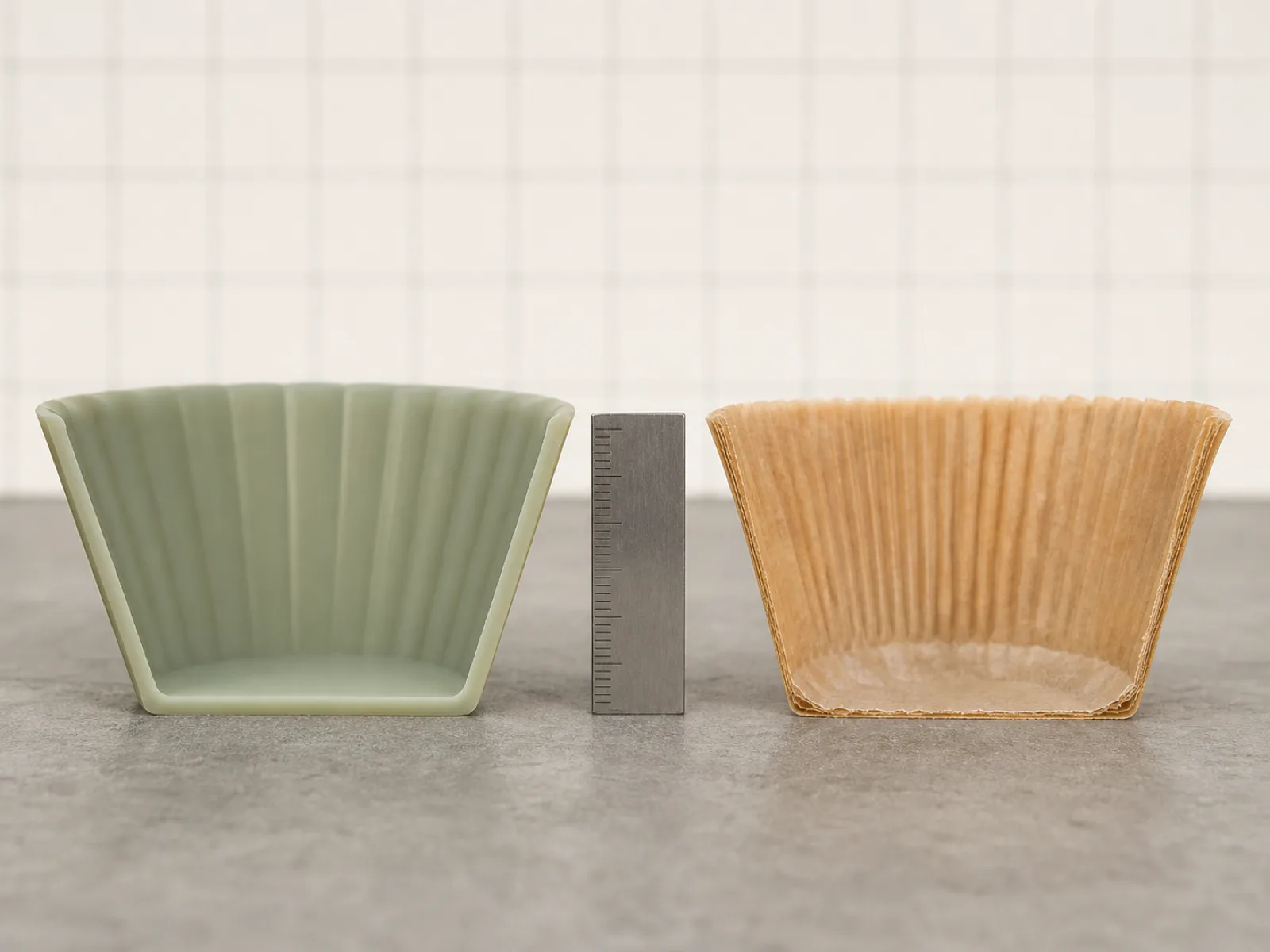 Comparison
 Silicone baking cups outperform paper liners on reusability, temperature range, and food-contact defensibility — but only when the silicone is platinum-cured, post-baked, and specified at the right Shore A hardness. Paper still wins on unit cost for high-volume commercial bakeries running single-use workflows. For retail OEM buyers building a private-label SKU aimed at home cooks who bake 40+ times a year, silicone crosses the total-cost breakeven inside the first season.
This guide is written for the sourcing manager or product developer who has to defend a retail SKU to a category buyer at Home Depot, Wayfair, Tesco, or an equivalent tier — not for a home baker choosing between two Amazon listings. We cover the material science, the compliance paperwork, the OEM economics, and the six defects that determine whether your program survives a chargeback audit.
Silicone vs paper baking cups: which one belongs on your retail shelf?
Silicone belongs on retail shelves aimed at reusable-kitchen buyers and gift sets; paper belongs in the pantry aisle and commercial food-service channels. The decision is not about which material is "better" — it is about which buyer walks into that aisle and whether your margin structure supports a 500-set MOQ silicone SKU or a 100,000-count paper reorder cadence.
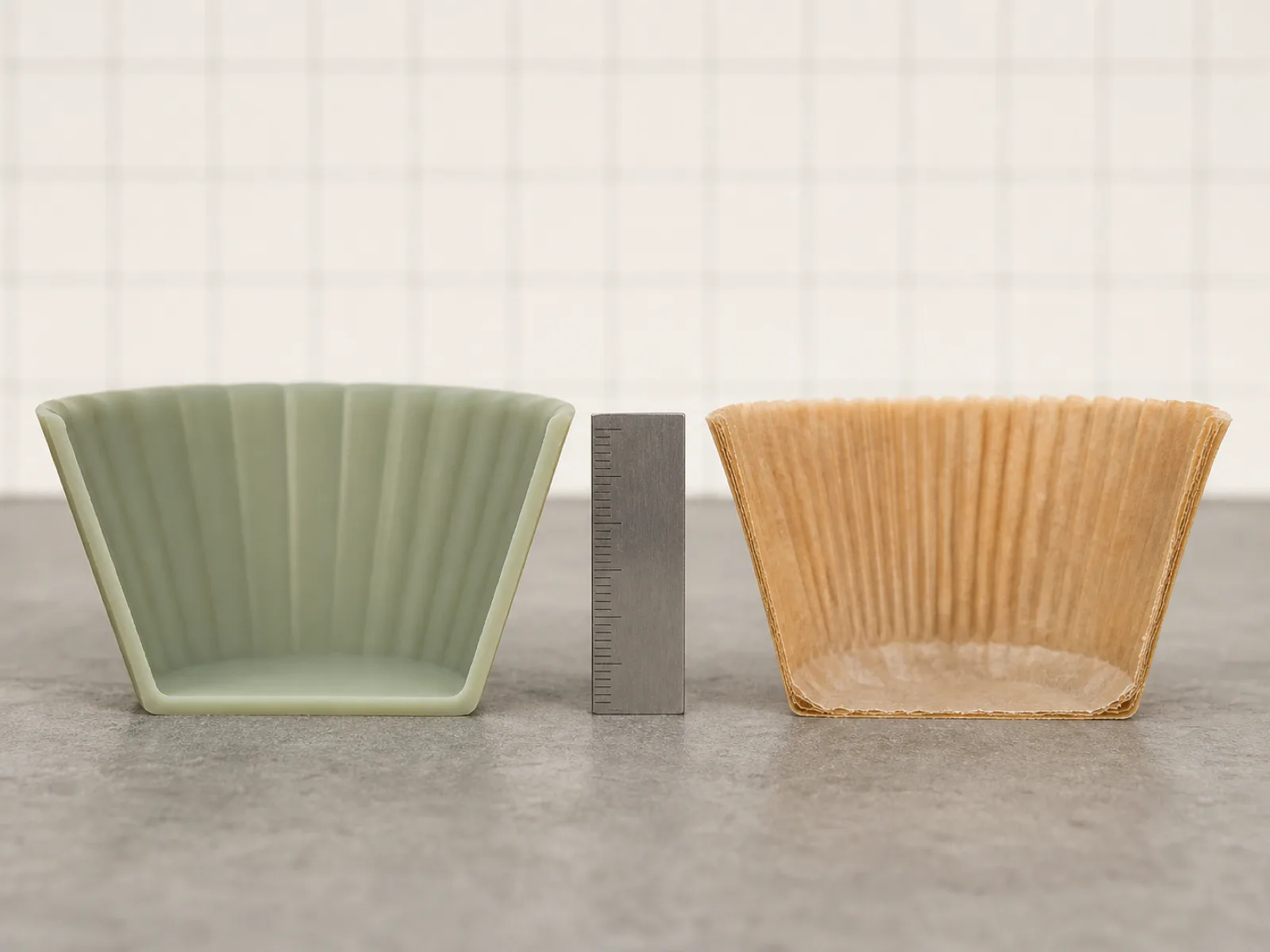
Silicone baking cups are molded, cured, and post-baked elastomer articles designed for 1,000+ reuse cycles. Paper liners are die-cut, pleated, grease-proofed cellulose disks designed for single use. The two products share a shelf category but almost nothing else — different supply chains, different compliance regimes, different retail margin math.
For a Tier-2 US or EU retail chain, the silicone SKU typically lands at $6–$12 wholesale for a 12-pack and carries a 55–65% gross margin. The paper SKU lands at $1.20–$2.80 wholesale for a 100-count and carries a 30–40% margin but ten times the reorder velocity. Which one you build depends on your channel — not on which material tests better in a lab.
Material science: platinum-cured silicone vs grease-proofed paper
Platinum-cured silicone is a chemically inert elastomer that cross-links via a Karstedt catalyst with zero residue; grease-proofed paper is cellulose treated with fluorinated or silicone-based coatings whose composition varies by mill. The safety argument for silicone is that its finished chemistry is knowable and constant. The safety argument for paper depends entirely on which coating your mill used this quarter.
Platinum-cured (also called addition-cured) food-grade silicone uses a platinum-Karstedt complex to catalyze vinyl-hydride cross-linking. The reaction is stoichiometric, produces no by-products, and leaves the cured elastomer at Shore A 40–70 with tear strength above 25 kN/m. Peroxide-cured silicone uses 2,4-dichlorobenzoyl peroxide and leaves acidic residues — cheaper, but rejected by every retail chain that runs a post-cure VOC extractable panel.
Paper cupcake liners rely on one of three coatings: silicone-based release layers (dominant in the US), fluorinated grease-proofing (historically PFAS, now phased out under EPA pressure), or vegetable-parchment sulfuric-acid treatment (European premium tier). All three qualify under FDA 21 CFR 176.170 for food contact, but the specific compound is rarely disclosed on the retail SKU. For an OEM buyer under Prop 65 scrutiny, silicone offers a cleaner audit trail. See our companion analysis of platinum-cured vs peroxide-cured silicone for the extractable data.
| Property | Platinum-cured silicone | Peroxide-cured silicone | Parchment paper |
|---|---|---|---|
| Temperature range | -40 °C to 230 °C | -40 °C to 200 °C | -20 °C to 205 °C |
| Reusability | 1,000+ cycles | 300–600 cycles | Single use |
| Food-contact standard | FDA 177.2600, LFGB §30/§31 | FDA 177.2600 (with post-cure) | FDA 176.170 |
| Post-cure residue | None | 2,4-DCBA acid | Coating-dependent |
| Wholesale cost / 12-pack equivalent | $6–$12 | $5–$10 | $1.20–$2.80 (100ct) |
| Yellowing under UV | None | Faint at 6 months | N/A |
Temperature range and cooking performance
Silicone baking cups hold a stable -40 °C to 230 °C service window that covers freezer, refrigerator, microwave, conventional oven, and top-rack dishwasher without dimensional change. Paper liners carbonize between 205 °C and 220 °C depending on coating and lose grease resistance above 190 °C once fats penetrate the cellulose fiber.
The practical consequence is that silicone survives the same batch of muffins going from freezer batter storage to a 200 °C oven without any pre-conditioning. Paper liners fail this workflow — the transition from freezer humidity to oven heat softens the grease coating and causes the batter to grip the fiber. Retail category buyers testing your sample against a professional-baker workflow will notice this within one afternoon.
Silicone’s thermal conductivity (0.20 W/m·K) is roughly 3× that of paper (0.06 W/m·K). In practice, this means a silicone-lined muffin bakes 2–4 minutes faster than a paper-lined muffin at the same oven temperature. Your recipe cards and packaging insert should carry this note — it prevents the top-of-funnel Amazon review that reads “overbaked, one star.”
FDA, LFGB, and the compliance paperwork retail buyers actually check
US retail chains require FDA 21 CFR 177.2600 test reports, a Prop 65 letter, and a CPSIA lead statement. EU chains require LFGB §30/§31 with BfR Recommendation XV testing and an EU 10/2011 overall migration certificate. These are six separate documents — a supplier who bundles them as "food-grade certificate" is signaling they have not read the regulations.
FDA 21 CFR 177.2600 is the operative rule for rubber articles intended for repeated food contact. It sets extractable limits for aqueous (chloroform-soluble extractives ≤ 20 mg/in² after 7 hours) and fatty foods (≤ 175 mg/in² after 7 hours). A legitimate report from an ISO 17025 accredited lab (SGS, Intertek, TÜV, Eurofins) runs 8–15 pages with named test methods. A one-page “certificate of compliance” is a warning sign — for a full walkthrough of the two regimes see FDA vs LFGB silicone.
LFGB §30/§31 references BfR Recommendation XV, which specifies volatile matter content ≤ 0.5% after 4 hours at 200 °C. This is why post-cure is not optional for the EU market — un-post-cured silicone fails BfR XV volatiles even if the base compound is food-grade. Every Wetop food-contact production run includes a 200 °C × 4-hour post-cure with lot-level volatiles documentation.
OEM economics: MOQ, tooling, and unit cost breakdown
Stock-cavity silicone baking cups start at a 500-set MOQ with no tooling investment; custom-shape cups require $1,200–$3,500 in cavity tooling and a 3,000-set MOQ to keep the amortized tooling under $1.20 per set. Paper liner MOQs start at 50,000 pieces and require no tooling — but no meaningful differentiation either.
The three cost drivers for a silicone OEM program are compound cost (55–65% of unit cost at $8–$14 per kg for platinum-cured food-grade), tooling amortization (0% for stock, 8–15% for custom over the first order), and labor (12–18% depending on post-cure and QC intensity). Freight from Yantian to LA/LB adds $0.35–$0.60 per set at current FCL rates for a 12-pack.
| Order profile | MOQ | Tooling | FOB Yantian cost / 12-set | Lead time |
|---|---|---|---|---|
| Stock round, no logo | 500 sets | $0 | $4.20 | 25 days |
| Stock round, debossed logo | 500 sets | $180 (deboss plate) | $4.55 | 30 days |
| Stock round, Pantone match | 500 sets | $0 | $4.80 | 30 days |
| Custom shape, single cavity | 3,000 sets | $1,800 | $5.10 | 45 days |
| Custom shape, Pantone + logo | 3,000 sets | $2,400 | $5.75 | 55 days |
For the tooling and MOQ math applied across our product mix see real factory MOQ: the math. For logo customization tradeoffs — deboss vs print vs laser — see customize silicone logo: deboss, print, laser.
Total cost of ownership: silicone vs paper over a season
A retail buyer who bakes 40 times per year crosses the silicone breakeven inside one season at typical wholesale pricing. A commercial bakery running 200 muffins per day never crosses it — the labor to hand-wash silicone dominates the material cost math. Your channel positioning has to match the actual use frequency of the buyer walking down the aisle.
At $8.00 wholesale for a 12-pack silicone set (retail $16–$22) versus $3.00 for a 100-count paper pack (retail $5.99), the silicone cup costs $0.67 per cavity and the paper liner costs $0.03. Silicone breaks even at 22 bakes per cavity — well under one season for the target home-kitchen buyer, well over the useful life of a paper-liner reorder cycle for a commercial account.
The environmental math is more nuanced than most retail marketing claims. Silicone is not compostable and does not enter the standard recycling stream — end-of-life for a 12-pack is landfill. A 1,000-cycle silicone cup replaces roughly 1,000 paper liners and their coatings, which is a net waste reduction of 92% by mass, but the messaging should be honest: “reduces single-use waste” is defensible; “sustainable” is not.
Quality defects: what QC catches and where it catches them
Six defects dominate silicone baking cup rejection: bloom (white surface haze from unreacted vinyl), filler migration (cheap silica leaving a dusty residue), thin-wall tears (below 1.0 mm cavity design), incomplete cure (Shore A drift), color drift beyond Delta-E 2.0, and post-cure yellowing on peroxide stock. Each has a specific inspection point in the process, and skipping one guarantees the next one shows up in the retail chargeback.
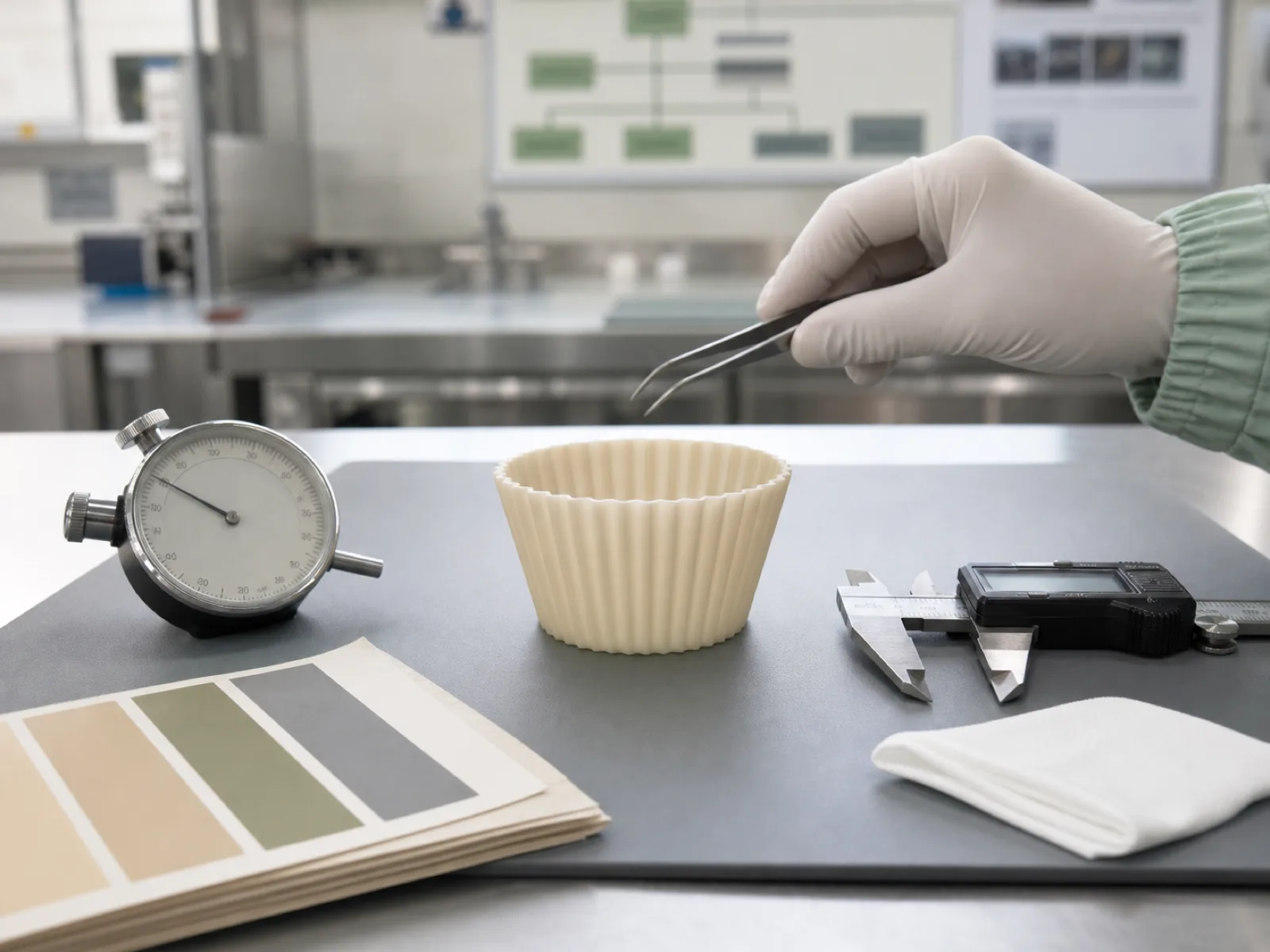
Wetop’s QC plan for baking cup production catches these at four gates: material inbound (compound viscosity and platinum content), demold (visual bloom and dimensional check per ISO 3302-1), post-cure exit (VOC panel and Shore A per ASTM D2240), and 24-hour aging (color drift and haze). AQL 1.0 major defects, 2.5 minor defects — this is the plan we run for retail programs and it is documented in every shipment file.
The two defects retail buyers care most about are bloom and staining, because they are the ones the end consumer photographs and returns. Both trace back to under-cure and under-post-cure. A factory that quotes 20% under market on platinum-cured silicone is almost always cutting these two steps — the compound cost is not compressible below a floor. See our sourcing silicone factory checklist for the eight questions that surface this before the deposit is wired.
Specifying a private-label SKU: the five decisions that matter
Five specifications separate a defensible retail SKU from a commodity import: Shore A hardness (40–60), wall thickness (1.2–1.8 mm), Pantone color reference (Solid Coated), logo method (deboss preferred over silk print for durability), and post-cure protocol (200 °C for 4 hours minimum). Everything else is packaging and price.
Shore A 40 is soft and flexible but shows batter grip on demold; Shore A 60 is firm and demolds cleanly but transmits shape less forgivingly. Shore A 50 is the retail sweet spot for a mixed-use home cup. Wall thickness below 1.2 mm risks tear at the corner radius after 200+ cycles; above 1.8 mm the cup feels overbuilt and the retail material cost rises without a perceived quality signal.
Deboss (recessed logo) survives 1,000+ dishwasher cycles; silk-print pigment on food-contact surfaces requires food-approved ink (limited Pantone range) and wears within 100 cycles. Laser marking is a mid-tier option — permanent, but visible only at oblique light angles. For retail-facing branding, deboss on a curved sidewall is the durable and defensible choice.
Sourcing red flags: what to reject before the sample lands
Reject any supplier who cannot name their catalyst (platinum-Karstedt vs peroxide), who bundles compliance as a single "food-grade certificate," who quotes below $4.00 FOB for a debossed 12-pack, or whose post-cure step is not documented in the process flow. These four checks eliminate 80% of the unusable quotes without ever running a sample.
The two supply-chain patterns to avoid are the trading-desk model (a middleman who has never seen the factory and quotes a compound they cannot specify) and the bulk-fill silicone practice (cutting food-grade compound with cheap silica to hit a price target — legal in isolation, but it fails BfR volatiles and stains under turmeric). Neither shows up in a factory audit unless you know to ask for the compound SDS by lot.
Independent, founder-led factories with 6–15 years of continuous operation and a documented ISO 9001 quality system are the defensible sourcing pattern. If you want to compare that pattern against the Alibaba-marketplace model without me naming names, the mechanism is straightforward: a marketplace listing that is not backed by a factory audit report from an ISO 17025 lab is a lead-generation page, not a supplier.
When paper still wins
Paper wins in three scenarios: commercial bakeries where hand-washing labor exceeds material cost, gift-with-purchase packaging where the liner is the vessel and not the reusable article, and disposable catering formats where post-event cleanup is the whole point. In these channels, silicone is the wrong material — not because it fails, but because the buyer's workflow does not reward reusability.
The category question for a retail OEM buyer is not “which is better” but “which channel is my program built for.” A grocery-aisle SKU sold at $2.99 for 100 counts and a home-goods-aisle SKU sold at $18.99 for a reusable 12-pack are not competitors — they are different products serving different buyers. Build the one your margin structure and channel access can defend, and cite this guide when the buyer asks why.
Working with Wetop on a silicone baking cup program
If you are evaluating a private-label silicone baking cup SKU for the 2027 category reset — or replacing an incumbent supplier whose bloom rate is bleeding your chargeback line — we can quote a stock 12-set at 500 MOQ with a debossed logo inside 48 hours, or scope a custom-shape tooling program with Pantone match and post-cure documentation inside a week. All quotes include FDA 21 CFR 177.2600, LFGB §30/§31, and EU 10/2011 documentation by lot.
William Zhuo — Engineering Lead, Wetop Silicone. Dongguan, China. ISO 9001 certified since 2008.
FAQ
-
Are silicone baking cups safer than paper for repeated oven use?
Yes, when the silicone is platinum-cured and certified to FDA 21 CFR 177.2600 and LFGB §30/§31. Paper liners depend on grease-proof coatings under FDA §176.170 whose formulation varies by mill and can include PFAS in older stock. Platinum-cured silicone is inert up to 230 °C and does not shed fibers or migrate coatings into batter.
-
What is the MOQ for private-label silicone baking cups?
Wetop's MOQ is 500 sets for a stock round or square cavity in one Pantone color with a debossed logo. Custom shapes (hearts, hexagons, brand-specific geometry) require a dedicated cavity tool at $1,200–$3,500 and a 3,000-set MOQ to amortize tooling under $1.20 per set.
-
How many bakes does a silicone cupcake liner survive before it fails?
A properly cured Shore A 50 cup with 1.2–1.5 mm walls survives 1,000+ oven cycles at 180 °C without tear or bloom. Failure modes at end-of-life are corner tears from utensil abuse, not thermal fatigue. We stress-test 32 cups per lot to 500 cycles as part of the ISO 9001 sample plan.
-
Can you match a Pantone color exactly on food-grade silicone?
We match Solid Coated Pantone within Delta-E 2.0 using food-contact-approved masterbatch pigments compliant with EU 10/2011 and FDA §178.3297. Neons and fluorescent Pantones are the exception — they require non-food-approved organic pigments and we will not run them on food-contact SKUs.
-
What certifications do US and EU retail chains actually require?
US retail (Home Depot, Wayfair, BBB tier) expects FDA 21 CFR 177.2600 test reports, Prop 65 letter, and a CPSIA lead statement. EU retail (Tesco, Carrefour tier) requires LFGB §30/§31 with BfR XV testing, EU 10/2011 overall migration limit certificates, and REACH SVHC declaration. We supply all six document types per shipment.
-
Do silicone baking cups need to be greased before use?
No. A correctly cured platinum silicone surface has a release energy below 25 mJ/m² — batter demolds cleanly at Shore A 45–55 hardness. If a supplier tells you their cups need greasing, they have either under-cured the batch or added excessive silica filler to lower cost.
-
Are silicone baking cups dishwasher-safe and stain-resistant?
Yes to dishwasher-safe on the top rack up to 75 °C. Stain resistance depends on cure quality — under-cured silicone absorbs tomato-based, turmeric, and beet pigments. Post-cured platinum silicone at 200 °C for 4 hours resists staining at commercial-kitchen levels. We include post-cure in every food-contact production order.
-
How do I verify a silicone factory is not selling me peroxide-cured stock as platinum?
Ask for the catalyst SDS (platinum shows a Karstedt complex; peroxide shows 2,4-dichlorobenzoyl peroxide), request a post-cure VOC extractable panel, and inspect the cured surface for a faint yellow tint — peroxide silicone yellows, platinum stays neutral. Cost delta is 12–18%; there is no legitimate reason a food-contact quote hides this.
References
Authoritative sources cited in this guide
- U.S. Food and Drug Administration. 21 CFR 177.2600 — Rubber articles intended for repeated use. https://www.ecfr.gov/current/title-21/chapter-I/subchapter-B/part-177/subpart-C/section-177.2600
- U.S. Food and Drug Administration. 21 CFR 176.170 — Components of paper and paperboard in contact with aqueous and fatty foods. https://www.ecfr.gov/current/title-21/chapter-I/subchapter-B/part-176/subpart-C/section-176.170
- German Federal Institute for Risk Assessment (BfR). BfR Recommendation XV: Silicones. https://www.bfr.bund.de/en/bfr_recommendations_on_food_contact_materials-7498.html
- European Commission. Commission Regulation (EU) No 10/2011 on plastic materials and articles intended to come into contact with food. https://eur-lex.europa.eu/legal-content/EN/TXT/?uri=CELEX%3A02011R0010-20200923
- ASTM International. ASTM D2240 — Standard Test Method for Rubber Property — Durometer Hardness. https://www.astm.org/d2240-15r21.html
- International Organization for Standardization. ISO 3302-1:2014 Rubber — Tolerances for products — Part 1: Dimensional tolerances. https://www.iso.org/standards.html
- United States Pharmacopeia. USP <88> Biological Reactivity Tests, In Vivo — Class VI. https://www.usp.org/harmonization-standards/pdg/excipients/plastic-packaging
- U.S. Environmental Protection Agency. PFAS in Food Packaging — EPA fact sheet. https://www.epa.gov/pfas
Start a custom program
Send a brief. Get an engineer’s reply in one business day.
Every Wetop program is tooled from a customer’s specification. Send a CAD file (STEP · IGES · DWG) or a written brief and we’ll reply with a mold cost estimate, price brackets at MOQ 500 / 1,000 / 5,000, and any engineering questions.