Buyer Guide · commercial intent
Silicone Dog Toy Manufacturer — OEM Engineering Brief
 Buyer Guide
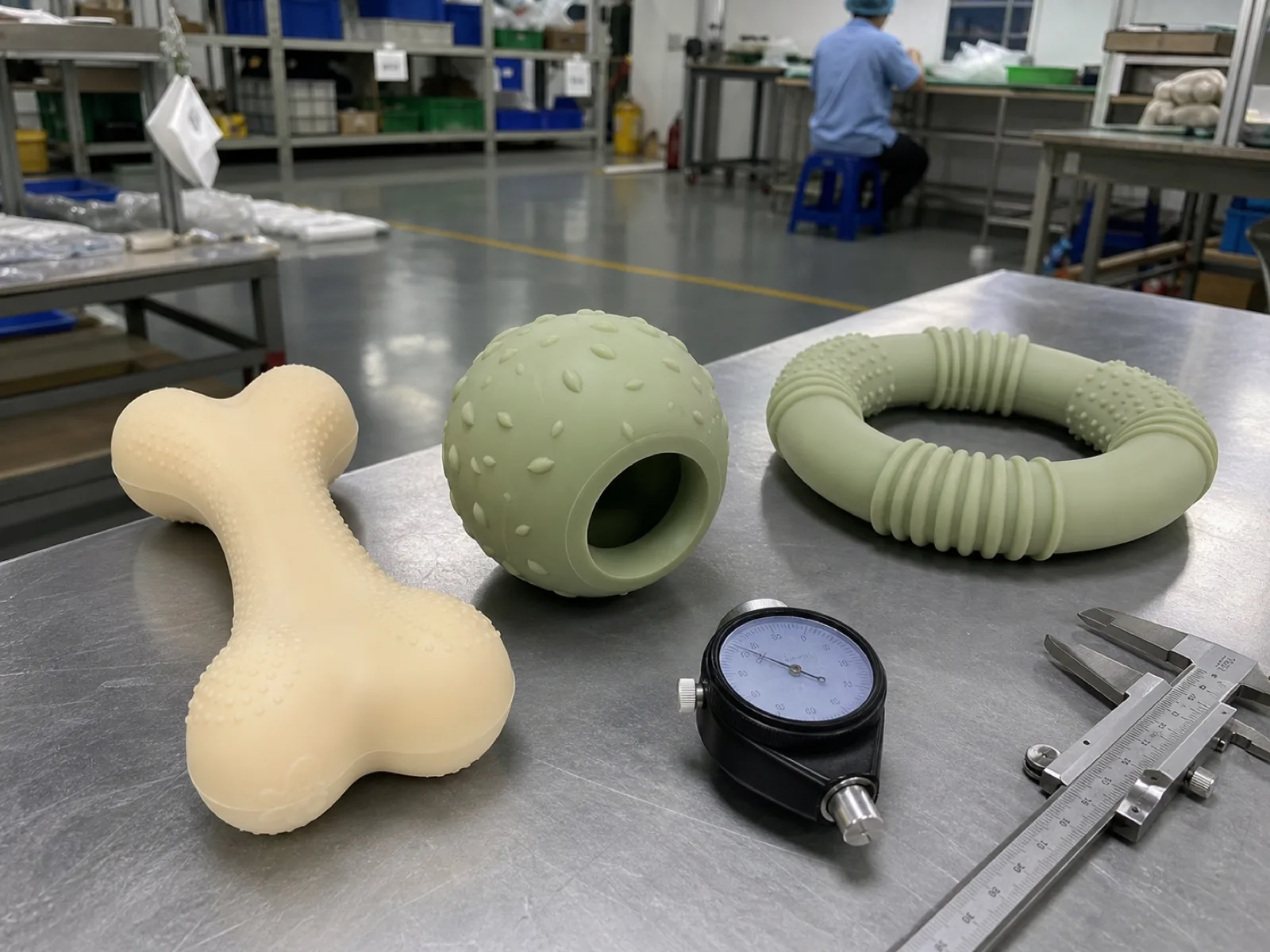
 A silicone dog toy manufacturer engineers a chew, tug, or treat-dispensing toy from platinum-cured food-grade silicone, tuning Shore A hardness and tear strength to the target chewer while keeping every feature single-piece so nothing detaches. For an OEM buyer, the useful specification is not "durable food-grade silicone" — it is a hardness call-out (55-70 Shore A for chewers), an ASTM D624 tear-strength floor, and a per-lot FDA 21 CFR 177.2600 test packet. Wetop molds this category on compression and LSR injection lines in Dongguan with a 500-unit MOQ, 7-25 day first samples, and a post-cure step that separates an odor-free, defensible toy from a returnable one.
Silicone dog-toy listings are one of the fastest-growing corners of the pet category, and the sourcing pages selling them share a pattern: they claim “durable” and “food-grade” without a single number, cite no third-party test data, and stay silent on the two engineering questions that actually decide whether a toy survives a power chewer — hardness and tear strength. This brief is written for the sourcing lead, product engineer, or founder building or refreshing a private-label toy line, not for the owner comparing toys at retail. Every claim below carries a durometer reading, a standard reference, or a process spec Wetop’s engineering desk can hold against a purchase order.
Why is material selection the first decision for a silicone dog toy?
Material selection precedes every other decision because it sets safety, durability, and cost simultaneously. A silicone dog toy must use platinum-cured food-grade silicone — inert, plasticizer-free, and stable from -40 °C to 230 °C — never a peroxide-cured or filled compound. The base polymer, cure system, and any filler decide whether the toy clears FDA 21 CFR 177.2600 and survives daily chewing.
The reason material comes first is that a dog toy lives in the harshest use environment in the silicone-goods category: continuous saliva immersion, gnawing loads that concentrate stress at seams and thin walls, freezer cycles when owners stuff wet food, and dishwasher sanitizing at 70-85 °C. A compound that passes a bench test but was cheapened with non-food-grade filler or a peroxide catalyst will pass month one and fail — by odor, bloom, or a propagating tear — by month three. Because a dog ingests saliva and micro-particles from anything it mouths, the biocompatibility bar is higher than for a bowl or mat, which is why we treat USP Class VI1 and ISO 109932 cytotoxicity data as a legitimate trust signal for this category even though pet toys are not legally required to meet it.
Two base-material families dominate. High-consistency rubber (HTV) is a putty-like gum compression-molded into thick-walled chew toys; liquid silicone rubber (LSR) is a two-part liquid injection-molded for high-volume, dimensionally tight small toys. Both can be platinum-cured and food-grade — the process choice, covered below, is separate from the safety question. For a deeper material-safety walkthrough, see the is silicone safe for dogs guide, which covers the ingestion and byproduct concerns pet-brand compliance teams raise.
What Shore A hardness makes a chew toy durable without cracking teeth?
A durable silicone dog chew toy runs 60-70 Shore A — hard enough to resist puncture and shredding, soft enough to flex rather than fracture a tooth. Treat-dispensing and enrichment toys drop to 45-55 Shore A so the body deforms to release kibble, and puppy or senior toys run 40-50 Shore A for gentle give. Hardness is tuned per chew tier.
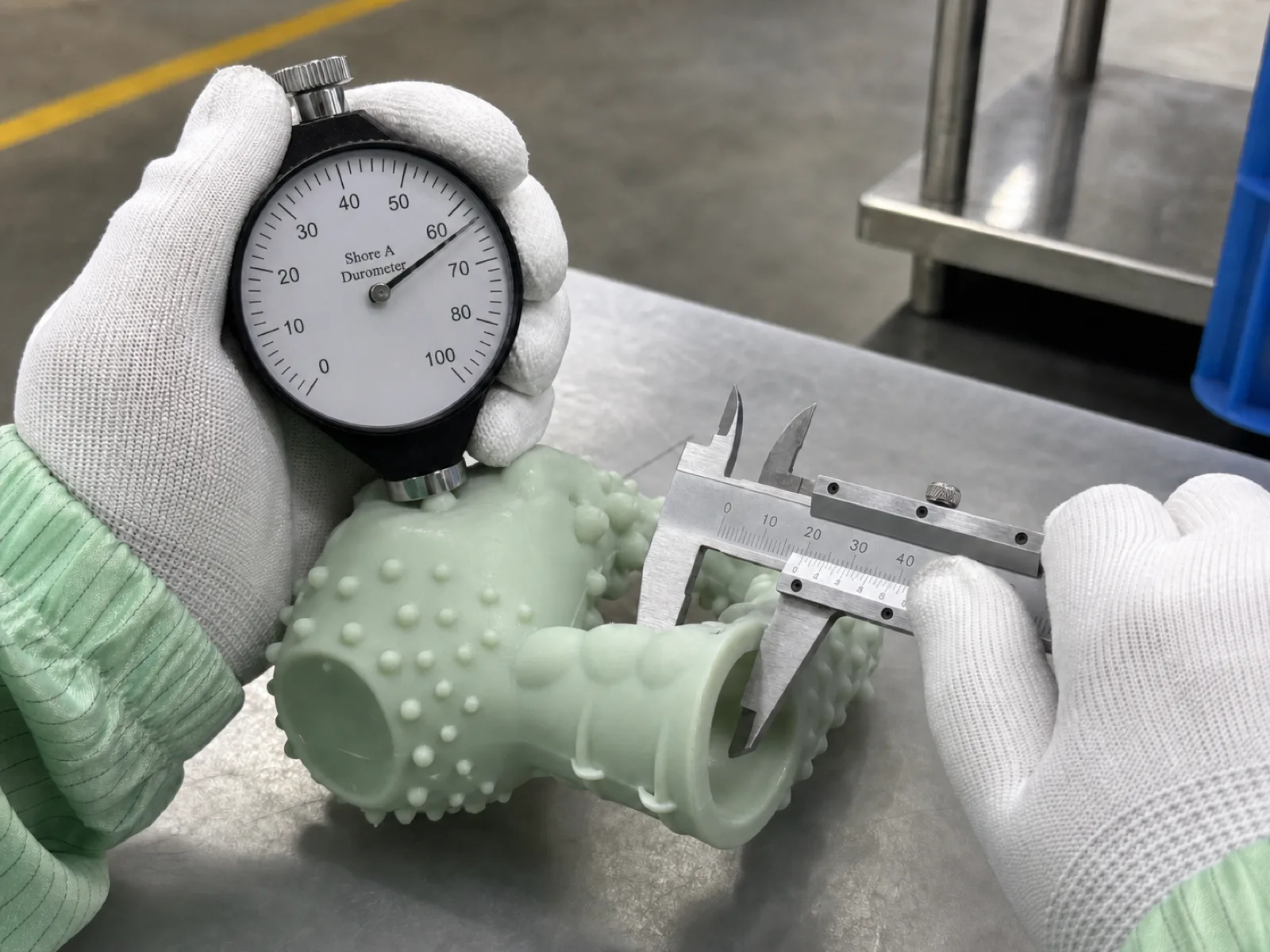
Shore A hardness, measured per ASTM D22403, is the single most misunderstood spec in the category. Buyers assume “harder = more durable,” but a silicone toy that is too hard behaves like a rigid solid and transfers gnawing shock straight to a dog’s teeth — a genuine dental-fracture risk veterinary dentists flag on hard nylon and bone products. The engineering target is a body that resists a chewer’s puncture while still flexing under bite load. For silicone, that window is 60-70 Shore A on the chew body; above 75 Shore A the compound loses the compliance that protects teeth, and below 55 an aggressive chewer’s incisors start a tear.
The second variable is wall thickness. A 65 Shore A toy with an 8-14 mm wall on the stress zones outperforms an 80 Shore A toy with a thin, seamed wall, because the failure mode is almost never bulk crushing — it is tear initiation at a thin transition. Wetop engineers hardness and wall thickness together, mapping the load path a specific toy geometry will see before locking the durometer call-out. For the full hardness-to-application map across silicone products, the Shore A hardness chart guide breaks down each band.
| Toy type / chew tier | Target Shore A | Typical wall thickness | Why this band |
|---|---|---|---|
| Puppy / senior (gentle) | 40-50 | 5-8 mm | Soft give, protects developing or aging teeth |
| Treat-dispensing / enrichment | 45-55 | 6-10 mm | Body flexes to release kibble on target aperture |
| Standard chewer | 55-65 | 8-12 mm | Balanced puncture resistance and tooth safety |
| Aggressive / power chewer | 65-70 | 10-14 mm | Maximum puncture resistance without rigidity |
| Silicone-over-nylon core (strongest) | 70 shell / rigid core | 6-10 mm shell | Rigid core carries load, silicone shell protects teeth |
How do you engineer tear resistance and eliminate choking hazards?
Tear resistance comes from the compound's tear strength and the toy's geometry, not its hardness. Specify ASTM D624 tear strength ≥ 25 kN/m and ASTM D412 elongation ≥ 400%, radius every edge, and remove thin transitions where a chewer can start a rip. Choking hazards are eliminated by single-piece co-molded design — no press-fit squeaker, no detachable feature.
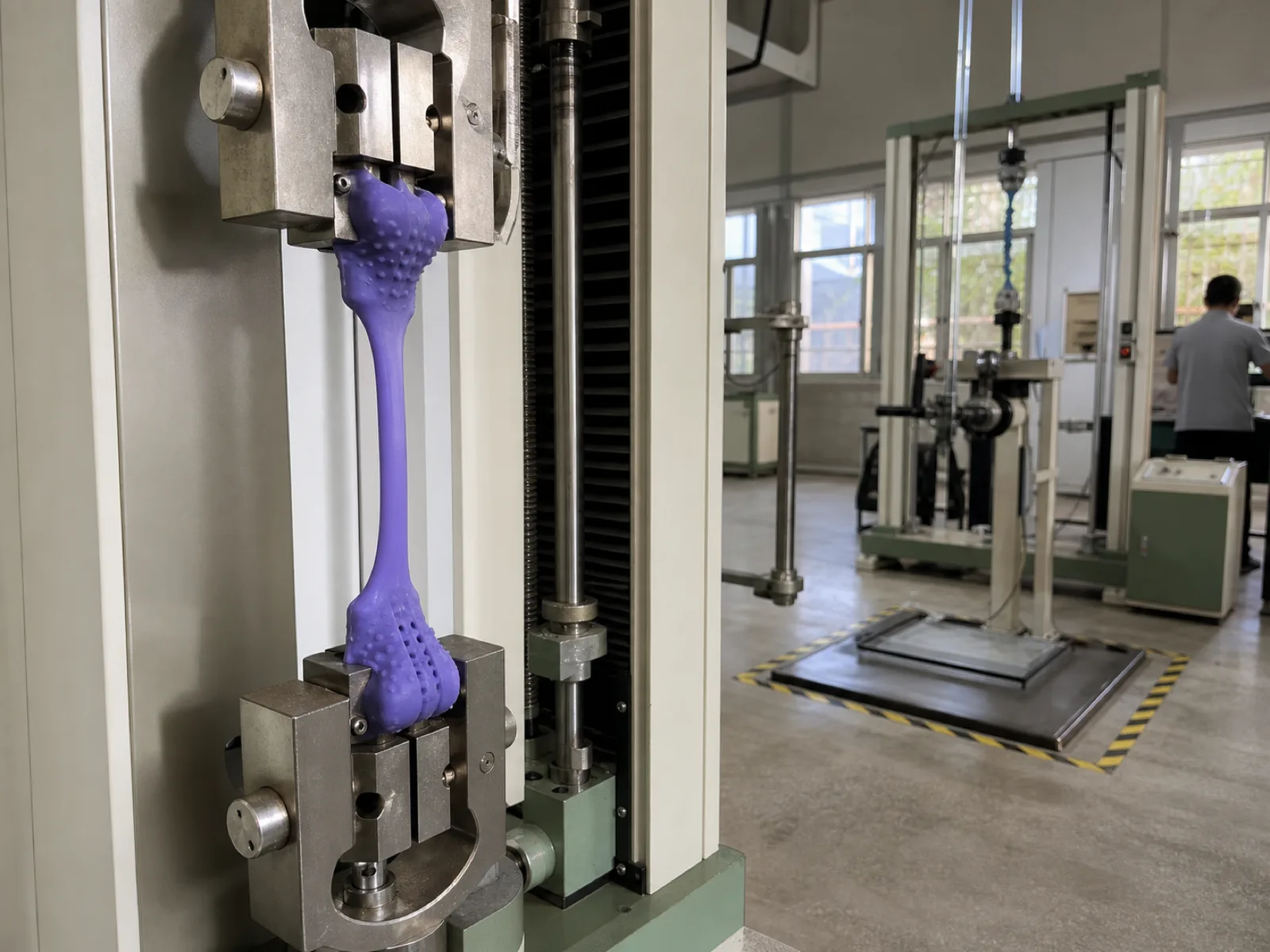
Durability marketing collapses two different properties. Hardness resists indentation; tear strength resists a cut propagating once a chewer’s tooth breaks the surface. A toy can be hard and still tear catastrophically if the compound’s tear strength is low or the geometry hands the dog a starting edge. The spec that actually predicts survival is ASTM D6244 tear strength paired with ASTM D4125 elongation at break. Wetop’s chew-tier baseline is ≥ 25 kN/m tear strength and ≥ 400% elongation — a body that stretches and blunts a tear rather than letting it run. A serious RFQ writes those two numbers; a weak one writes “durable.”
Geometry does the other half. Sharp edges, thin webs between features, and abrupt wall-thickness transitions are tear initiators — a determined chewer finds them within minutes. Wetop radiuses external edges (typically R2-R4 mm), thickens transitions, and avoids unsupported thin membranes on chew toys entirely. Enrichment toys that need a thin dispensing lip get a reinforced root radius so the lip flexes without tearing at the base.
Choking-hazard mitigation is a hard design rule, not a warning label. Borrowing the small-parts methodology behind ASTM F9636 and CPSC’s mechanical-hazard test framework7, no molded feature — nub, knuckle, or ridge — may fit inside the small-parts cylinder sized for the target dog. Squeakers, treat inserts, and rope cores are co-molded into the silicone body in a single cure, never press-fit, so there is no interface a chewer can work loose. The strongest safety architecture is simply a single-piece co-cured toy: nothing to detach means the detachable-part failure mode does not exist.
Platinum-cured vs peroxide-cured silicone — which does a dog toy need?
Only platinum-cured food-grade silicone belongs in a dog toy. Peroxide cure leaves acidic byproducts that migrate under constant saliva contact and hot dishwasher cycles, producing odor, bloom, and yellowing. Platinum cure uses an inert hydrosilylation reaction with no migratory residue, clears FDA 21 CFR 177.2600 cleanly, and holds appearance and smell across the product's life.
The cure system is invisible on a spec sheet but decisive in the hand of a dog. Peroxide-cured silicone — still common in low-cost listings because it presses cheaper — uses dicumyl or dichlorobenzoyl peroxide as the cross-linker, both leaving acidic residues. On a product mouthed for hours daily and washed hot, those residues migrate and, within weeks, produce the sour smell and yellow tint that drive pet-retail returns. Platinum-cured silicone catalyzes with a platinum complex and leaves no migratory byproduct, which is exactly why it is the only defensible choice for an ingestion-adjacent product.
The trade-off is cost: platinum grades run 15-25% higher per kilogram. On a dog toy the premium is a few cents per unit and it eliminates the top return driver in the category. Wetop molds dog toys exclusively on platinum cure and runs a mandatory 4-6 hour post-cure at 200 °C to drive off residual low-molecular-weight siloxanes — the step that guarantees an odor-free toy. The full chemistry and failure-mode comparison lives in the platinum vs peroxide cure guide.
The RFQ line that filters low-tier bids: “Platinum-cured food-grade silicone, per-lot FDA 21 CFR 177.2600 migration test with food simulants at 40 °C / 240 h; mandatory 4-6 hour post-cure at 200 °C with thermocouple log; reject any lot exceeding overall migration limits.” That single sentence forces the factory to run the cure and post-cure the packet claims.
Injection vs compression molding: tooling cost, cavity count, and mold ownership
Injection molding with LSR automates high-volume small toys at ±0.05 mm tolerance but carries higher steel-tooling cost. Compression molding with HTV suits thick-walled chew toys, co-molded inserts, and lower volumes at lower tooling cost. Annual volume, wall thickness, and whether a nylon core is co-molded decide the process — and the process decides tooling cost, cavity count, and unit price.
Compression molding places a pre-weighed silicone billet into a heated cavity and presses it closed; cure runs 5-8 minutes at 180-200 °C. It is the right process for thick-walled chew toys, two-hardness co-cured designs, silicone-over-nylon cores, and launch volumes under roughly 20,000 units per SKU, because aluminum or single-cavity steel tooling is cheaper and simpler. LSR injection meters two liquid parts into a heated mold and cures in seconds to minutes with full automation, holding ±0.05 mm tolerance across many cavities — the right process for high-volume small toys where per-piece labor and tolerance dominate cost. Its steel multi-cavity tooling costs more up front but drops per-piece cost at scale.
Cavity count is the volume lever. A single-cavity aluminum tool suits sampling and first runs; a 4-8 cavity steel tool suits 20,000+ annual units. More cavities cut cycle-cost per part but multiply tooling cost and demand tighter process control to keep every cavity within the durometer and dimensional window.
Mold ownership is the contract detail first-time pet-brand buyers most often miss. At Wetop the buyer owns the tooling they pay for, and ownership, storage, and transfer terms are written into the tooling PO before the cavity is cut. That clause lets you move production, prevents your design being run for a competitor, and protects the IP embodied in the geometry. Never release a tooling PO without it.
What certifications does a silicone dog toy actually need?
US retail needs an FDA 21 CFR 177.2600 food-contact migration report plus a California Prop 65 heavy-metals statement, with ASTM F963 mechanical and migration testing applied voluntarily. EU retail needs LFGB §30/§31 reports and a REACH SVHC declaration, often with EN71 toy safety layered on. Every report must tie to the production lot, not a generic material datasheet.
Pet toys sit in a light-regulation gap — there is no mandatory federal safety standard for dog toys the way there is for children’s toys. That gap is a differentiation opportunity, not an excuse. Applying the voluntary child-toy framework — ASTM F9636 in the US, EN71-1/-2/-3 in the EU — for mechanical hazards, small parts, flammability, and heavy-metal migration is exactly the trust signal that wins a serious retail buyer’s compliance review, because competitors skip it. On the food-contact side, FDA 21 CFR 177.26008 governs US migration and LFGB §30/§31 governs the EU; the practical distinction between the two is covered in the FDA vs LFGB comparison.
The per-lot rule is where low-tier factories lose the deal. A generic datasheet says “this compound was tested for food contact” — it does not prove the material molded this month matches. A per-lot report tests the finished toy from the specific run and ties the result to a lot code laser-marked on the product — the batch-traceability discipline an ISO 90019 quality management system is built to enforce. The strongest available material-safety signal — voluntary but decisive for premium positioning — is USP Class VI1 or ISO 109932 cytotoxicity and irritation data on the chew compound, which no competitor page in this category cites.
| Market | Required / recommended test | Standard | Frequency |
|---|---|---|---|
| US retail | Overall migration (food contact) | FDA 21 CFR 177.26008 | Per production lot |
| US retail | Heavy metals | California Prop 65 | Per production lot |
| US retail | Mechanical + small parts (voluntary) | ASTM F9636 | Per design |
| EU retail | Overall + specific migration | LFGB §30/§31 | Annual; on formulation change |
| EU retail | SVHC declaration | REACH (EC 1907/2006)10 | Annual, tracked at 0.1% w/w |
| EU retail | Toy safety (voluntary) | EN71-1/-2/-3 | Per design |
| Global | Hardness | ASTM D22403 | Per production lot |
| Premium trust signal | Cytotoxicity / biocompatibility | USP Class VI1 / ISO 109932 | Per compound qualification |
What durability test protocols separate a defensible toy from marketing?
A defensible durability claim runs a documented protocol: tension pull to ASTM D412 elongation, torque-twist cycles, and drop tests, scored against aggressive-chewer tiers, plus per-lot Shore A and tear checks. Competitors claim "durable" with no methodology; a real silicone dog toy manufacturer hands you the test report, the pass criteria, and the lot the sample came from.
The competitor gap here is glaring — pages across the category assert “indestructible” or “tough” with zero test protocol behind the word. Wetop’s dog-toy durability protocol is a fixed, documented sequence. First, material qualification: durometer per ASTM D22403, tear per ASTM D6244, and tension/elongation per ASTM D4125 on samples from the production compound. Second, mechanical simulation of chewing: a tension pull-test to a target load without tear initiation, a torque-twist cycle count that mimics a dog wrenching the toy, and a drop-and-recover cycle for rigid-core designs. Each is scored against a chewer tier so the claim on the hangtag matches the test the toy actually passed.
The honesty rule matters for brand defensibility: no silicone toy is indestructible, and a factory that claims otherwise is setting up a warranty problem and a liability exposure. The defensible claim is tiered — “engineered for aggressive chewers” backed by a torque and tear protocol, not “unbreakable.” That tiering is what a category buyer’s risk team wants to see.
| Test | Method / standard | Pass criterion (aggressive-chewer tier) | Frequency |
|---|---|---|---|
| Hardness | ASTM D22403 | 65-70 Shore A, ±3 across body | Per production lot |
| Tear strength | ASTM D6244 | ≥ 25 kN/m | Per compound qualification |
| Tension / elongation | ASTM D4125 | ≥ 400% elongation, no early tear | Per compound qualification |
| Torque-twist cycles | In-house protocol | No tear or feature detachment at target cycles | Per design qualification |
| Small-parts / detachment | ASTM F9636 method | No feature passes small-parts cylinder | Per design |
| Post-cure verification | Thermocouple log | 195 °C held 4 h at part core | Per production lot |
What are the MOQ, sampling lead time, and unit-cost drivers?
Wetop's MOQ is 500 units per SKU per Pantone-matched color. First samples run 7-25 days — fast on existing tooling, longer when new tooling is cut. New aluminum tooling adds 18-25 days and 800-2,400 USD per cavity; steel adds 30-40 days and 3,500-8,000 USD. Mass production runs 25-40 days from PO after sample approval.
Unit cost on a silicone dog toy is driven by four levers, in order of impact: material volume (a solid chew toy uses far more silicone by weight than a hollow enrichment toy, and platinum compound is the largest input cost), cavity count and cycle time (more cavities and shorter cures cut labor per part), secondary operations (co-molded cores, two-color debossing, and laser lot-marking each add steps), and order volume against tooling amortization. A single aluminum-cavity tool amortizes across roughly the first 5,000 units before the per-piece tooling contribution falls below meaningful; below that, price stabilizes.
The MOQ and lead-time mechanics — including how a shared tool base with multiple cavity inserts lets a three-SKU line hit an aggregate minimum efficiently — are detailed in the MOQ and lead time guide. For a first-year launch projecting 8,000-15,000 units across a small line, aluminum tooling is the right call; steel makes sense at 20,000+ annual units per SKU or when cavity drift on aluminum starts driving QC rejects.
| Line item | Aluminum prototype tooling | Production steel tooling |
|---|---|---|
| MOQ | 500 units / SKU / color | 500 units / SKU / color |
| Tool cost per cavity | 800-2,400 USD | 3,500-8,000 USD |
| Tool lead time | 18-25 days | 30-40 days |
| First sample after tool | 3-5 days | 3-5 days |
| First sample on existing tooling | 7-12 days | 7-12 days |
| Mass-production run | 25-40 days from PO | 30-45 days from PO |
| Break-even units | ~5,000 | ~15,000 |
| Cavity life | 30,000-50,000 cycles | 250,000+ cycles |
How do branding, packaging, and enrichment features work at MOQ?
At 500-unit MOQ per SKU per color, Wetop includes Pantone-matched masterbatch, in-mold debossed logo, laser-marked lot code, custom hangtag, and retail-ready carton. Enrichment features — treat-dispensing apertures, freezer-safe wet-food cavities, co-molded squeakers or rope cores — are engineered into the tool. Eco packaging and regulatory labels are supported at the pack-out stage.
In-mold debossing engraves the brand mark directly into the cavity, so it costs nothing per part once the tool is cut and cannot rub off the way a printed logo does. Pantone matching runs to ΔE ≤ 1.5 in a D65 light box against the buyer’s chip; saturated brand colors hold ΔE ≤ 2.0. A fiber laser adds a 3-4 mm lot code on the underside post-cure, giving full traceability back to the platinum-cure lot, the QC sheet, and the third-party test report — the audit chain a retail buyer expects.
Enrichment design is where a dog-toy line differentiates. Treat-dispensing apertures are sized to the target kibble diameter minus a difficulty margin (typically 60-80% of kibble width so the dog has to work), and platinum-cured silicone’s -40 °C floor makes freezer wet-food stuffing inherent — no special compound needed. Squeakers and rope tug-cores are co-molded, never press-fit, keeping the single-piece safety architecture intact.
Packaging Wetop supports in-house: kraft-paper hangtag with size-tier and chew-tier icons printed inline, recycled or FSC-certified carton options, poly bag with vent hole, and the regulatory labels each market requires — Prop 65 statement and lot code for the US, EU importer address and REACH declaration for Europe. Amazon and Chewy pack-out requirements (FNSKU, prep compliance) are handled at the pack-out stage.
References
The engineering positions above trace to the following standards and authoritative sources:
Ready to spec a silicone dog toy program?
If you’re launching a private-label dog-toy line — or refreshing one that keeps returning on tears, odor, or a detached squeaker — Wetop’s engineering desk will draft the hardness call-out, tear-strength spec, choking-hazard geometry, and compliance packet against your target chewer, feature set, and retail channel. Send the brief through the contact form with target volume, chew tier, and preferred cure system, and expect a drafted engineering drawing within three business days. For the material and durability decisions underneath, the is silicone safe for dogs guide, the platinum vs peroxide cure guide, and the Shore A hardness chart are the three companion reads.
Footnotes
-
USP Class VI — Biological Reactivity Tests, In Vivo. United States Pharmacopeia. https://www.usp.org/ ↩ ↩2 ↩3
-
ISO 10993 — Biological Evaluation of Medical Devices. International Organization for Standardization. https://www.iso.org/standards.html ↩ ↩2 ↩3
-
ASTM D2240 — Standard Test Method for Rubber Property — Durometer Hardness. ASTM International. https://www.astm.org/d2240-15r21.html ↩ ↩2 ↩3 ↩4
-
ASTM D624 — Tear Strength of Conventional Vulcanized Rubber and Thermoplastic Elastomers. ASTM International. https://www.astm.org/d0624-00r20.html ↩ ↩2 ↩3
-
ASTM D412 — Vulcanized Rubber and Thermoplastic Elastomers — Tension. ASTM International. https://www.astm.org/d0412-16r21.html ↩ ↩2 ↩3
-
ASTM F963 — Standard Consumer Safety Specification for Toy Safety. ASTM International. https://www.astm.org/f0963-23.html ↩ ↩2 ↩3 ↩4
-
Regulations, Laws & Standards. US Consumer Product Safety Commission. https://www.cpsc.gov/Regulations-Laws—Standards ↩
-
21 CFR 177.2600 — Rubber articles intended for repeated use. US Food and Drug Administration. https://www.ecfr.gov/current/title-21/chapter-I/subchapter-B/part-177/subpart-C/section-177.2600 ↩ ↩2
-
ISO 9001:2015 — Quality Management Systems — Requirements. International Organization for Standardization. https://www.iso.org/standard/62085.html ↩
-
REACH — Regulation (EC) No 1907/2006. European Chemicals Agency. https://eur-lex.europa.eu/legal-content/EN/TXT/?uri=CELEX%3A32006R1907 ↩
FAQ
-
What Shore A hardness should a durable silicone dog chew toy be?
For aggressive chewers, Wetop's engineering baseline is 60-70 Shore A — hard enough to resist puncture and shredding, soft enough to flex rather than crack teeth. Treat-dispensing and enrichment toys run 45-55 Shore A so the toy deforms to release kibble, and puppy or senior toys drop to 40-50 Shore A for gentle give. Hardness alone is not durability; pair it with a tear-strength spec.
-
Is silicone safe for dogs to chew on every day?
Platinum-cured food-grade silicone is chemically inert, holds no plasticizers or BPA, and is stable from -40 °C to 230 °C, which covers daily saliva contact, freezer treat-stuffing, and dishwasher sanitizing. The risk is never the cured polymer — it is peroxide-cure byproducts or non-food-grade fillers in a cheap compound. Require FDA 21 CFR 177.2600 and, ideally, USP Class VI cytotoxicity data tied to the production lot.
-
How does a silicone dog toy manufacturer prevent choking hazards?
Through geometry and molding, not warning labels. No molded feature — nub, ridge, or knuckle — may fit inside a small-parts test cylinder for the target dog size, squeakers and inserts are co-molded into the body rather than press-fit so nothing can be worked loose, and edges are radiused to prevent a chewer starting a tear. A single-piece co-cured design eliminates the detachable-part failure mode entirely.
-
Can silicone dog toys survive an aggressive chewer?
Solid platinum-cured silicone at 65-70 Shore A with a tear strength above 25 kN/m survives most power chewers when the wall thickness is engineered to load — typically 8-14 mm on stress zones — and the toy has no thin transition, seam, or press-fit part to initiate a tear. For the strongest chewers, a silicone-over-nylon co-molded core outperforms solid silicone. No silicone toy is indestructible, and no responsible factory claims one is.
-
What certifications does a silicone dog toy need for US and EU retail?
US retail (Chewy, Petco, Amazon): FDA 21 CFR 177.2600 food-contact migration report plus a California Prop 65 heavy-metals statement, and voluntarily ASTM F963 mechanical and heavy-metal migration testing borrowed from child-toy safety. EU retail: LFGB §30/§31 food-contact reports and a REACH SVHC declaration; many buyers also apply EN71-1/-2/-3. All reports tie to the production lot, not a generic datasheet.
-
What is the MOQ and lead time for custom silicone dog toys?
Wetop's MOQ is 500 units per SKU per Pantone-matched color. First samples run 7-25 days depending on whether tooling exists; new aluminum tooling adds 18-25 days and 800-2,400 USD per cavity. Mass-production lead time is typically 25-40 days from PO after sample approval. Tooling amortizes across roughly the first 5,000 units.
-
Should a silicone dog toy be injection molded or compression molded?
Injection molding with liquid silicone rubber (LSR) suits high-volume small toys and holds ±0.05 mm tolerance with full automation, but carries higher steel-tooling cost. Compression molding with high-consistency rubber (HTV) suits thick-walled chew toys, co-molded inserts, and lower volumes at lower tooling cost. The wall thickness, annual volume, and whether a nylon core is co-molded decide which process wins.
-
Who owns the mold when I develop a custom silicone dog toy?
At Wetop the buyer owns the tooling they pay for, and mold ownership, storage location, and transfer terms are written into the tooling PO before the cavity is cut. That clause matters: it lets you move production, prevents a factory from running your design for a competitor, and is the single contract detail most first-time pet-brand buyers forget to lock down.
-
How do treat-dispensing silicone dog toys get engineered?
Treat-dispensing and enrichment toys are a hardness-plus-aperture problem. The body runs 45-55 Shore A so it flexes to release kibble, and the dispensing aperture is sized to the target kibble diameter minus a difficulty margin — typically 60-80% of kibble width so the dog has to work the treat out. Freezer compatibility for wet-food stuffing is inherent to platinum-cured silicone's -40 °C floor.
References
Authoritative sources cited in this guide
- US Food and Drug Administration. 21 CFR 177.2600 — Rubber articles intended for repeated use. https://www.ecfr.gov/current/title-21/chapter-I/subchapter-B/part-177/subpart-C/section-177.2600 — The federal food-contact migration regulation any US pet brand shipping silicone articles a dog mouths must have on file per production lot.
- International Organization for Standardization. ISO 9001:2015 — Quality Management Systems — Requirements. https://www.iso.org/standard/62085.html — The documented QMS Wetop's compression and LSR lines are certified against, including the batch traceability and lot-code retention pet-category retailers audit.
- International Organization for Standardization. ISO 10993 — Biological Evaluation of Medical Devices. https://www.iso.org/standards.html — The cytotoxicity, sensitization, and irritation test framework used as a voluntary biocompatibility trust signal for a product a dog ingests saliva and particles from.
- United States Pharmacopeia. USP Class VI — Biological Reactivity Tests, In Vivo. https://www.usp.org/ — The pharmacopeial biocompatibility classification competitors omit; requesting Class VI data on a chew compound is the strongest available material-safety signal.
- ASTM International. ASTM D2240 — Standard Test Method for Rubber Property — Durometer Hardness. https://www.astm.org/d2240-15r21.html — The Shore A hardness test protocol referenced in every chew-tier durometer spec on Wetop's dog-toy engineering drawings.
- ASTM International. ASTM D412 — Vulcanized Rubber and Thermoplastic Elastomers — Tension. https://www.astm.org/d0412-16r21.html — Tensile-strength and elongation-at-break methodology used to validate that a dog-toy body stretches rather than tears under a chewer's pull.
- ASTM International. ASTM D624 — Tear Strength of Conventional Vulcanized Rubber and Thermoplastic Elastomers. https://www.astm.org/d0624-00r20.html — The tear-propagation test that actually predicts aggressive-chewer survival — the spec a serious dog-toy RFQ writes instead of the word 'durable'.
- ASTM International. ASTM F963 — Standard Consumer Safety Specification for Toy Safety. https://www.astm.org/f0963-23.html — Child-toy mechanical, small-parts, and heavy-metal migration limits applied voluntarily to pet toys, which are otherwise lightly regulated — a differentiating safety claim.
- US Consumer Product Safety Commission. Regulations, Laws & Standards. https://www.cpsc.gov/Regulations-Laws--Standards — The US authority framing the small-parts and mechanical-hazard test methods a serious pet brand borrows for choking-hazard mitigation.
- European Chemicals Agency (ECHA). REACH — Regulation (EC) No 1907/2006. https://eur-lex.europa.eu/legal-content/EN/TXT/?uri=CELEX%3A32006R1907 — The EU chemicals regulation governing the SVHC declaration required on any silicone dog toy entering the EU retail channel.
Start a custom program
Send a brief. Get an engineer’s reply in one business day.
Every Wetop program is tooled from a customer’s specification. Send a CAD file (STEP · IGES · DWG) or a written brief and we’ll reply with a mold cost estimate, price brackets at MOQ 500 / 1,000 / 5,000, and any engineering questions.