Buyer Guide · commercial intent
Silicone Jar Lids OEM Guide — Mason Fit, Seal Force, MOQ
What changed: First publication under v3 advanced-GEO standard — benchmarked against the top-ranking consumer-roundup pages and rewritten from inside the factory floor with regular/wide-mouth Mason fit geometry, vacuum pull-off force spec, FDA/LFGB clause citations, cavity map math, and MOQ-tier FOB pricing consumer coverage does not touch.
 Buyer Guide
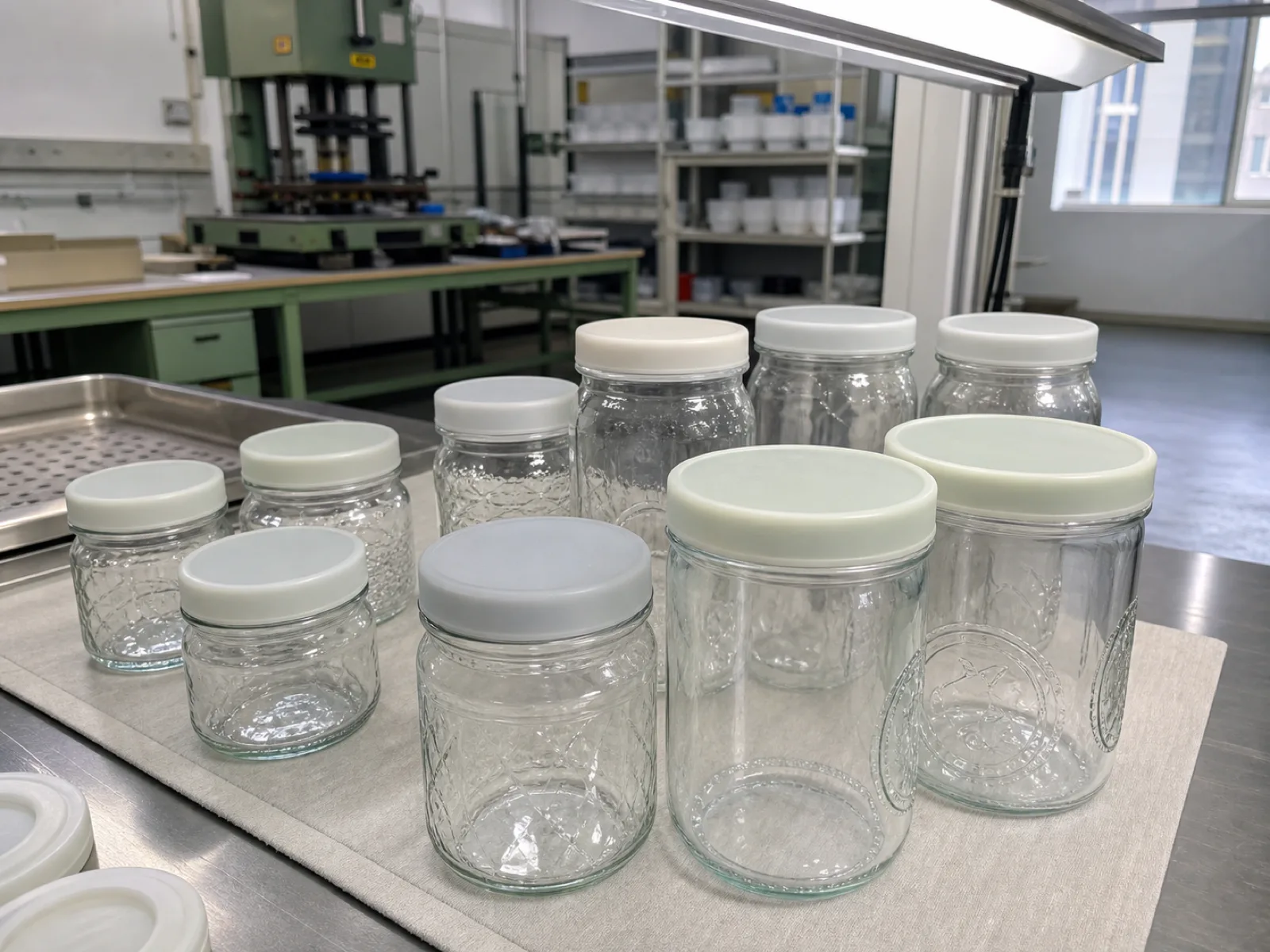
 Silicone jar lids have become one of the most-searched packaging conversions on the housewares shelf — driven by Mason-jar refill culture, reusable-straw category adjacency, the ECHA PFAS restriction proposal reaching mainstream sustainability audits, and consumer replacement of BPA-plastic storage lids at retail. What the top-ranking consumer-roundup coverage does not answer is what the SKU actually is at the factory floor: three mechanically distinct families (solid storage, straw-hole sipping, metal-insert canning), each with its own Mason-jar fit geometry, seal-force spec, cure chemistry, and compliance profile. This guide is the engineering reality of manufacturing that product, written from a working OEM floor for procurement, sourcing, and product development leads at food-storage and zero-waste brands.
Silicone jar lids ship in three OEM formats — solid storage lids (55-65 Shore A, vacuum seal, compression-molded), straw-hole sipping lids (bonded silicone grommet or overmolded sleeve), and metal-insert canning lids (silicone sealing ring bonded to 304 stainless disk). US Mason fit is captured in the SGCD 70-400 (regular mouth, 70 mm) and 86-400 (wide mouth, 86 mm) finish standards, with sealing-land tolerance ±0.3 mm. FOB Yantian Q3 2026 benchmarks for a regular-mouth solid storage lid at MOQ 500 run $0.62-$0.85 platinum-cure with debossed logo, dropping to $0.22-$0.32 at 50,000 pcs.
What are silicone jar lids, engineered for OEM production?
Silicone jar lids is a category name for three mechanically distinct SKU families — solid storage lids (55-65 Shore A, 1.8-2.6 mm sealing-lip cross-section, vacuum seal, compression-molded), straw-hole sipping lids (bonded silicone straw grommet, interference fit against 8-10 mm reusable straws), and metal-insert canning lids (65-75 Shore A silicone sealing ring bonded to a 304 stainless disk). All three are food-contact platinum-cured silicone per FDA 21 CFR 177.2600[^fda-177-2600] and LFGB §30/31[^bfr-lfgb-xv].
The consumer-facing description of silicone jar lids is “the reusable Mason lid.” The engineering description is three separate product programs that happen to share a shelf category and a Mason-jar mouth diameter standard. Solid storage lids are geometry-driven — a vacuum-sealing lip on the underside grips the Mason jar rim through a stretch-and-recover cycle, and the seal fails or holds based on lip cross-section variance measured in ±0.3 mm. Straw-hole sipping lids add a bonded grommet that must survive dishwasher cycles without delamination. Metal-insert canning lids replace the pure-silicone dome with a 304 stainless disk bonded to a silicone sealing ring, delivering the pressure-canning envelope home canners need for USDA-protocol shelf-stable food[^usda-canning].
Each of the three programs uses different silicone grades, different tooling, different post-processes, and different QC test rigs. A supplier that quotes a “silicone jar lid program” without asking which family first is either running a single narrow SKU or does not know the category. Every meaningful OEM decision — cure chemistry, tooling investment, MOQ tier pricing, packaging — flows from the family decision. This guide walks each branch in turn and then converges on the compliance stack, retail sustainability audits, and the packaging decisions that all three formats share.
Baseline engineering spec sheet — three jar-lid families
| Parameter | Solid storage lid | Straw-hole sipping lid | Metal-insert canning lid |
|---|---|---|---|
| Sealing lip Shore A | 55-65 (ASTM D2240[^astm-d2240]) | 55-65 (ASTM D2240[^astm-d2240]) | 65-75 (ASTM D2240[^astm-d2240]) |
| Sealing lip cross-section | 1.8-2.6 mm | 1.8-2.6 mm | 1.2-1.8 mm ring |
| Cure system | Platinum (default) | Platinum (default) | Platinum (default) |
| Molding process | Compression | Compression + grommet bond | Compression + insert overmold |
| Continuous service temperature | -40°C to 230°C | -40°C to 230°C | -40°C to 230°C |
| Vacuum pull-off force (regular mouth) | 15-25 N | 12-22 N | 25-40 N (canning) |
| Metal insert | None | Optional straw grommet | 304 stainless disk |
| Retail SKU unit | Individual or 3-pack | Individual or 3-pack | 6-pack or 12-pack |
| MOQ | 500 pcs | 500 pcs | 500 pcs |
| Typical FOB (regular mouth, 2k pcs) | $0.48-$0.62 | $0.60-$0.87 | $0.83-$1.17 |
How do Mason jar mouth sizes lock the silicone jar lid geometry?
Two dominant mouth-diameter standards cover >95% of US retail Mason-style jars — regular mouth at 70 mm outer thread OD (SGCD 70-400 finish, Ball / Kerr / Bernardin lineage) and wide mouth at 86 mm outer thread OD (SGCD 86-400 finish). Sealing-land tolerance on the silicone lid is ±0.3 mm on the vacuum-lip cross-section; off-spec collapses the seal. A retail family SKU almost always ships both diameters as a coordinated colorway.
Mason-jar fit is the single most under-communicated spec on this category and the source of most first-shipment failures. The regular-mouth 70 mm standard has anchored the US home-canning market since 1858 and dominates pints and quarts across Ball, Kerr, Bernardin, Golden Harvest, and every private-label US Mason-style jar sold at Ace Hardware, Walmart housewares, Target, and Whole Foods. The wide-mouth 86 mm standard was introduced for freezing (headspace expansion), fermenting (scooping room), and modern half-gallon storage. Any retail buyer sourcing a silicone jar lid family for the US market must ship both.
International Mason-style jar standards diverge just enough to trip up an OEM program. UK Kilner jars run 82-86 mm rims but with a distinct clip-top or twist-off geometry that does not accept a US wide-mouth vacuum lid. German Weck jars run a 100 mm rim with a different sealing gasket profile entirely. A retail brand targeting EU distribution needs to specify whether the SKU carries the US Mason fit (SGCD 70-400 / 86-400), the Kilner fit, or the Weck fit — each of the three needs a separate tool. Wetop keeps US Mason fit tools on the shelf as library items; Kilner and Weck fits run new tooling.
Sealing-lip tolerance is where most commodity factories cut corners and where retail returns spike. The lip cross-section must sit within ±0.3 mm across every diameter position around the perimeter of the lid; a 4-cavity compression tool that has drifted 0.5 mm on one cavity ships lids that seal on 3 out of 4 units and pop off on the fourth. Wetop’s QC protocol runs a 5-point cross-section check per lid on 5 lids per lot per production hour, logged against the master-batch lot number.
What durometer, thickness, and geometry actually deliver a working vacuum seal?
A working vacuum seal on a solid storage lid comes from three linked variables: Shore A 55-65 durometer per ASTM D2240[^astm-d2240] (below 50 the lip takes a set; above 70 it does not conform), sealing-lip cross-section 1.8-2.6 mm (below 1.5 mm the lip tears; above 3.0 mm it does not spring back), and an inward-tapered vacuum-lip geometry with a 15-25° taper angle. All three variables get locked in the gold sample and inspected on 100% of production per AQL 2.5 sampling per ISO 2859-1[^iso-2859-1].
The vacuum seal is the entire product function of a solid storage lid — miss the seal and the SKU returns at 20-30%. The durometer variable is the first-order lever. Wetop’s default retail spec is 60 Shore A, which sits in the middle of the 55-65 band and tolerates ±5 duro variance per ASTM D2240 across the typical batch-to-batch master-batch spread. Below 50 Shore A the sealing lip goes too soft, takes a compression set at room temperature, and the vacuum releases within 24 hours. Above 70 Shore A the lip goes too hard, does not conform to microscopic irregularities on the Mason jar rim (which are non-negligible on cheaper US-sourced glass), and the vacuum leaks along the interface.
Sealing-lip cross-section is the second variable. The 1.8-2.6 mm target range is set by the elastic recovery envelope of platinum-cured silicone. Below 1.5 mm the lip tears at the first depress-and-release cycle used to establish vacuum. Above 3.0 mm the lip carries too much silicone gum, cures with residual stress, and does not spring back into the sealing position after depressing. Retail-tier default sits at 2.2 mm nominal with the ±0.3 mm tolerance envelope discussed above.
The third variable is the vacuum-lip taper angle. A 15-25° inward taper from the outer lid edge toward the jar rim gives the depression-and-release action that pumps air out of the headspace and creates the vacuum. Below 10° taper the lid does not depress far enough to move meaningful air volume; above 30° taper the lip flares outward under vacuum load and the seal breaks. Wetop’s tool geometry locks the taper at 20° nominal on all US Mason-fit tools and the gold sample carries a machined-jig verification of the angle per lid family.
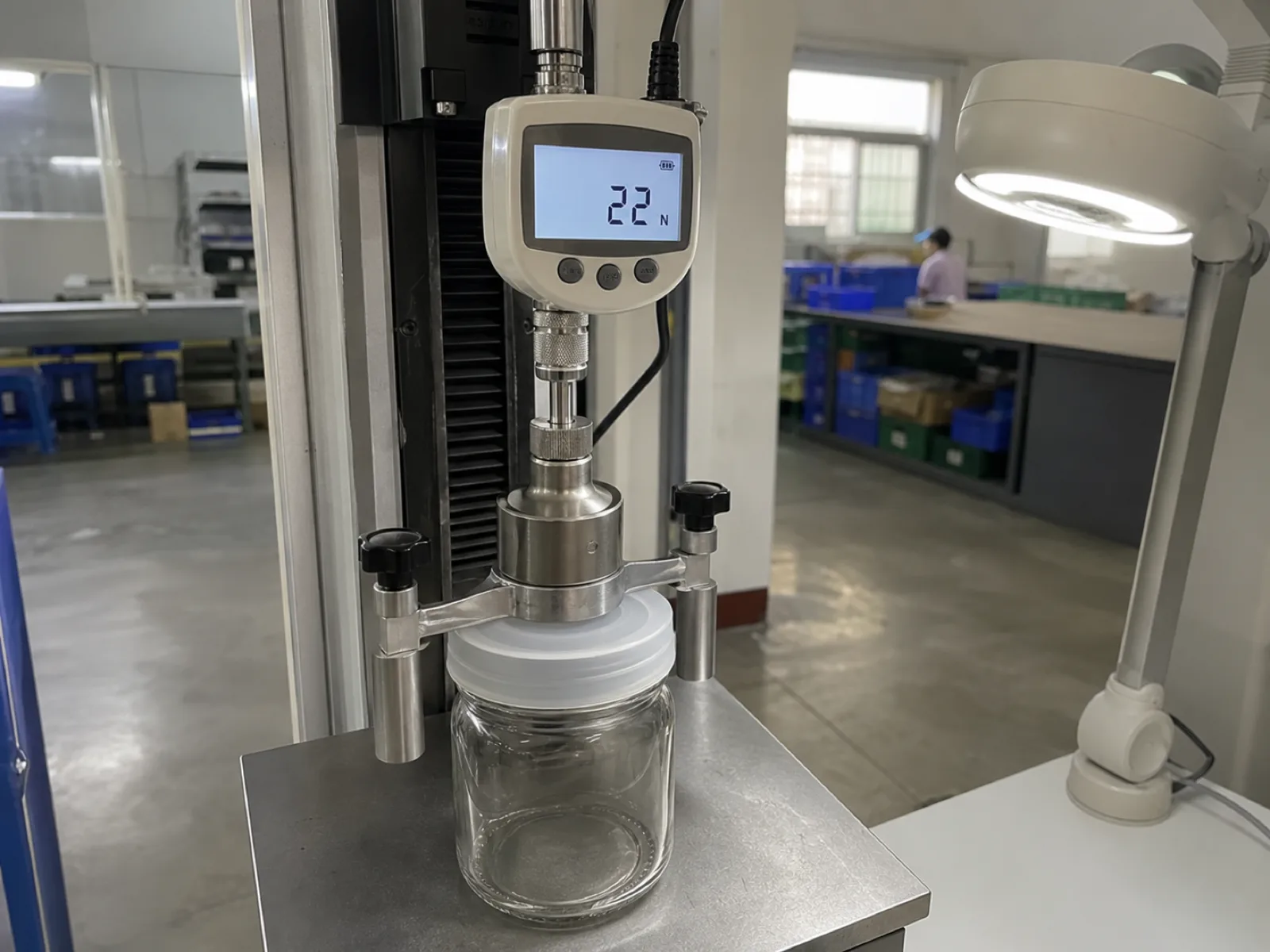
Vacuum pull-off force is how the working seal is measured pre-shipment. Wetop targets 15-25 N steady-state pull force on a solid regular-mouth 70 mm storage lid at 20°C, measured after a room-temperature cool-down from an 85°C hot fill on a calibrated digital pull-force gauge (Chatillon or Mecmesin) against a standard SGCD 70-400 test jar. The protocol runs 5 lids per lot per hour of production; below 12 N the lid pops in air freight or ocean transit temperature swings; above 30 N consumers cannot open it single-handed and negative reviews follow. Full mechanical spec engineering on the silicone temperature range explained guide and the silicone reusable food wrap OEM guide for adjacent seal geometry.
Which cure chemistry does a retail silicone jar lid actually need?
Platinum-cured silicone is the OEM default for any retail jar-lid SKU above $2.50 shelf-price. Peroxide-cured is a cost-cutting option at 15-25% lower FOB unit cost but requires disciplined 4-6 hour post-cure at 180-200°C to clear LFGB §30/31 organic volatile testing per BfR Recommendation XV[^bfr-lfgb-xv]. Under-post-cured peroxide product ships odor, releases residual byproducts on hot fill, and fails EU premium retail audits.
The platinum-vs-peroxide decision is where most silicone jar lid programs get quietly downgraded during RFQ. A supplier quoting FOB unit cost 20% below the market has almost certainly moved from platinum-cure to peroxide-cure and has almost certainly truncated post-cure to make oven throughput math work. The finished product looks identical at demold. The failure surfaces later — first-hot-fill vinegar-like odor on the consumer’s first use, driving 1-star reviews and returns; or a delisting during LFGB §30/31 lot testing at retail audit.
Wetop’s default retail spec is platinum-cure with 4-hour post-cure at 180°C, logged against the master-batch lot number. The 15-25% cost delta over commodity peroxide is priced into the MOQ-tier FOB benchmarks in this guide. Buyers who need the peroxide-cure cost structure get the same 4-6 hour post-cure protocol and a per-batch LFGB §30/31 test report to prove the compliance envelope. What Wetop does not offer is peroxide-cure with truncated post-cure — the failure risk on retail audits is not worth the 8-12% additional cost saving. Full trade-off analysis on the platinum-cured vs peroxide-cured silicone decision guide.
What does the regulatory stack for retail jar lids actually cover?
US retail requires FDA 21 CFR 177.2600 per master-batch lot[^fda-177-2600], CA Prop 65 audit or PFAS non-detect testing[^echa-pfas-proposal], and CPSIA general certificate for child-facing SKUs. EU retail requires LFGB §30/31 per BfR Recommendation XV[^bfr-lfgb-xv], EU Regulation 1935/2004[^ec-1935-2004] declaration of compliance, REACH SVHC screening, and increasingly PFAS non-detect testing given the ECHA universal restriction proposal. Per-batch third-party reports at MOQ 500.
The retail compliance stack for silicone jar lids has expanded meaningfully across 2024-2026 as sustainability audits move from marketing checkboxes to actual delisting risk. FDA 21 CFR 177.2600 has not changed — it is the same US food-contact regulation for repeated-use rubber articles it has been for decades, tested by extraction into water, 8% ethanol, and n-heptane per the listed migration protocol. What has changed is retailer audit frequency: Target housewares, Whole Foods, Ace Hardware, and Amazon’s US-facing housewares team now request per-batch reports referencing a specific master-batch lot number from the last 6 months, not a single supplier-wide certificate.
LFGB §30/31 per BfR Recommendation XV[^bfr-lfgb-xv] is the EU counterpart — an organic volatile extractables test that measures residual crosslinking byproducts (2,4-dichlorobenzoic acid, cyclic siloxanes) against strict thresholds. Any peroxide-cured jar lid ships this test with a per-batch post-cure log to prove the extractables envelope. Platinum-cured product clears LFGB §30/31 more forgivingly but Wetop still runs the per-batch test on retail programs to prevent an audit surprise.
Canning-specific lids add a compliance layer for pressure-canning applications. The USDA Complete Guide to Home Canning[^usda-canning] defines the 100°C water-bath and 121°C pressure-canning cycles that a metal-insert silicone-sealed canning lid must clear without seal degradation or extractables release into the food product. Wetop’s canning-lid spec sheet includes 20-cycle pressure-canning bench test data on the sealing ring per lot, and buyers targeting the US home-canning market can request the test log with the shipment.
The PFAS documentation demand is the newest and fastest-growing gate. The ECHA universal restriction proposal[^echa-pfas-proposal] has accelerated per-batch PFAS non-detect testing at ppb detection limits from optional to mandatory across EU premium retail, and downstream to US West Coast retail. Wetop ships PFAS non-detect reports from SGS, Intertek, TÜV, or Bureau Veritas as standard on retail programs. Full clause-level compliance detail on the FDA vs LFGB silicone guide.
Silicone vs plastic storage lid — the retail-defensible comparison
A platinum-cured silicone jar lid clears 800-1,500 commercial dishwasher cycles at 82°C without visible degradation. A molded PP or copolyester plastic storage lid typically shows heat-warp at 200-400 cycles and complete seal failure by 500-600 cycles. Cost trade-off: silicone at $0.35 FOB competes with plastic at $0.08-$0.12 FOB — 3-4x higher per unit but with 3-5x the service life and a defensible sustainability positioning.
The silicone-vs-plastic comparison is the single most-searched buyer decision in this category and the point where retail sourcing conversations converge. The dishwasher cycle count is the most-defensible data point: Wetop’s internal test protocol runs test lids through a commercial NSF-certified 82°C dishwasher on the standard heat-dry cycle, logged against master-batch lot. Platinum-cured silicone at 60 Shore A clears 800-1,500 cycles with no measurable durometer drift and no visible discoloration. PP storage lids in the same protocol show heat-warp at 200-400 cycles — the sealing surface flattens, the vacuum lip loses its taper, the seal releases within 2-3 cycles after warp onset.
The seal-durability difference matters more than the cycle count on its own. A plastic storage lid that shows heat-warp does not fail obviously — it still fits the jar, still looks intact. Consumers do not notice until food starts spoiling in the fridge or the vacuum releases mid-air-freight. The 1-star return reviews on plastic storage lids consistently reference “started leaking after a few months” — the underlying mechanism is heat-cycle-driven seal degradation.
Unit cost is the counterweight. At 10,000-unit annual volumes a solid silicone jar lid runs $0.35-$0.48 FOB Yantian at MOQ 2,000 tier, versus a molded PP storage lid at $0.08-$0.12 FOB from the same category of factory. Silicone is genuinely 3-4x more expensive per unit. The lifecycle math that survives a retail buyer’s sustainability audit favors silicone whenever the SKU positioning includes any dishwasher-safe / freezer-safe / heat-cycle claim — the plastic lid cannot honestly carry those claims at retail shelf pricing.
The zero-waste and refill-culture positioning that drives most silicone jar lid retail programs converges on the same math: replace 10-20 disposable canning lids with one silicone lid, breakeven at 6-12 months of use. Buyers building this narrative should specify per-batch PFAS non-detect testing and mono-material recyclable packaging — otherwise the sustainability positioning breaks under buyer sourcing due-diligence.
What is the compression-mold cavity map and tooling investment for a jar-lid program?
Compression-mold tooling for a jar-lid family scales cleanly with cavity count. Single-cavity prototype tool $1,600-$2,400 (MOQ 500-2,000 units), 4-cavity production tool $3,200-$4,600 (2,000-30,000 units annual), 8-cavity high-volume tool $5,400-$7,800 (30,000-100,000 units annual). LSR injection at 16 or 32 cavities is only economical above roughly 100,000 units per SKU per year. Tooling amortizes against first-order volume and transfers to buyer at payoff.
Tooling economics are where competitor content on this category disappears entirely — every top-ranking consumer-roundup page forces the buyer into an RFQ to see any number. The math is not proprietary. A compression mold for a jar-lid family is a hardened P20 steel plate with cavities cut for the diameter and cross-section spec. Cavity count is a function of mold plate area and cycle-time economics. A 40×40 cm plate accommodates 4 cavities of regular-mouth 70 mm lids at a comfortable spacing that keeps the mold-heat gradient tight enough for consistent cure.
The cavity map matters for retail-family SKU coordination. A regular-mouth 70 mm + wide-mouth 86 mm 2-SKU family running on separate 4-cavity tools costs $6,400-$9,200 total tooling versus $3,200-$4,600 for a single tool — but the two-tool split lets the factory run each SKU independently to demand, avoiding mold changeover downtime. A combined tool with 2 cavities of each diameter halves throughput on both SKUs and rarely wins on payback.
Payback math on a 4-cavity regular-mouth tool at $3,800 average tooling and a $0.35 per-unit price at MOQ 2,000: breakeven arrives at ~11,000-14,000 units of sell-through, typically inside the first two seasonal orders for a well-positioned Tier 2 US or EU retail listing. Tooling ownership transfers to the buyer once fully amortized, which protects the design against grey-market copying by the factory in year 2+. LSR injection above 100,000 units per SKU per year drops cycle time to 45-90 seconds at 16-32 cavities but requires $12,000-$22,000 tooling and cold-runner infrastructure — the crossover most retail jar-lid programs never actually hit. Full pricing structure on the silicone OEM pricing structure guide.
MOQ economics and Pantone color matching for retail-family SKU coordination
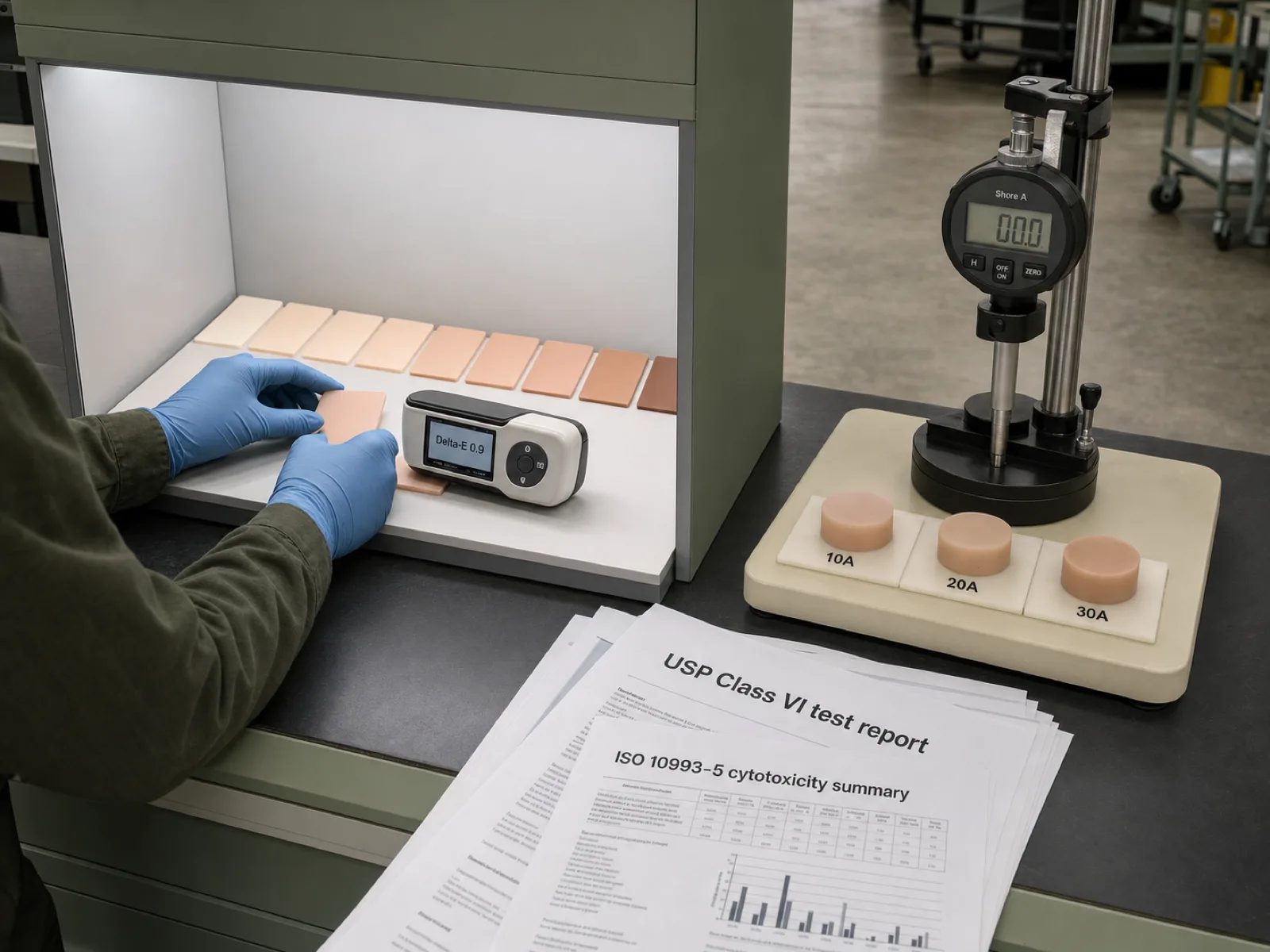
MOQ economics and Pantone color coordination are the two levers a retail-family SKU (regular + wide-mouth + straw-hole variants under one colorway) uses to hit a defensible shelf price. Wetop's MOQ is 500 units per SKU per color, with 40+ retail-tier Pantone master-batches on the shelf and a $150-$280 one-time pigment-lock fee plus $0.03-$0.08 per unit surcharge for custom colors. Target ΔE < 1.5 measured under D65 light.
Retail-family SKU coordination is where the OEM decisions get real. A buyer shipping a 3-piece coordinated family — regular-mouth 70 mm solid storage + wide-mouth 86 mm solid storage + straw-hole variant — under a single Pantone colorway across 4 seasonal colorways ships 12 SKUs at MOQ 500 each, or 6,000 units minimum first order. The FOB math per SKU at MOQ 500 comes in 20-30% higher than the same volume run at MOQ 2,000 per SKU. Buyers who can consolidate first-year purchase across 2-3 colorways instead of 4 typically save $0.06-$0.12 per unit on the family.
Pantone color matching is the retail-tier differentiator that separates a family-SKU program from a one-off private-label. Wetop keeps 40+ retail-tier Pantone master-batches on the shelf, ranging from warm neutrals (Warm Gray 3C, Warm Gray 5C, cream 7527C) through the muted sage-and-terracotta palette dominating housewares in 2026 (5615C sage, 7607C rust, 5497C pale sage) to the black-and-white anchors (Black C, Cool Gray 1C). A custom Pantone match beyond the shelf-stock library adds $0.03-$0.08 per unit and a one-time $150-$280 pigment-lock fee — the pigment lock references the buyer’s Pantone chip against a locked master-batch that runs across every future production lot.
Target color tolerance is ΔE < 1.5 measured under D65 standard light. This is tighter than the industry commodity spec of ΔE < 3.0 and is the threshold at which shelf-side color drift is invisible to consumers. The tolerance depends on locked master-batch pigment plus a color-check at every production shift on 5 units per lot per hour. Color drift is the #1 non-functional retail return reason on jar-lid family SKUs — customers notice when a 3-piece set does not match, and the return note reads “colors don’t match the photo.”
Packaging tier interacts with the family-SKU decision. Retail-ready case pack (12 or 24 units in a shelf-ready display tray) at $0.04-$0.09 additional per unit cuts store-labor cost and drives preferential shelf placement. Mono-material recyclable PET window box at $0.18-$0.35 per unit preserves EU premium banner listing eligibility. FSC-certified kraft sleeve + recyclable PET tray at $0.12-$0.22 per unit clears both US and EU sustainability audits at the lower cost tier. Every RFQ should specify packaging tier before FOB pricing is meaningful.
What are the CTQ inspection points and defect modes on retail jar-lid production?
Four critical-to-quality inspection points dominate retail return rates on silicone jar lids: (1) sealing-lip cross-section variance beyond ±0.3 mm, which collapses the vacuum; (2) durometer drift beyond ±5 Shore A across a lot, which fails the pull-force spec; (3) edge flash from over-cure closing off the lip taper; (4) grommet-bond delamination on straw-hole lids after 200-400 dishwasher cycles. AQL 2.5 sampling per ISO 2859-1[^iso-2859-1] plus a destructive pull-force test on lot samples catches all four pre-shipment.
The defect modes on silicone jar lids are geometry-driven and process-driven rather than material-driven. On a solid storage lid, the sealing lip is the entire product function — a 1.8-2.6 mm cross-section at a 15-25° inward taper. When the compression cycle runs 30-45 seconds shorter than the 3-6 minute spec (a common commodity-factory shortcut to boost throughput), the silicone gum does not fully crosslink at the lip radius. The lip goes soft, the seal fails on the second or third use, and the SKU returns at 15-25%. Wetop’s process control locks compression cycle time at the master-batch-tuned spec and the machine PLC logs any cycle that runs short against the batch lot number.
Durometer drift across a production lot is the second retail-tier defect. Master-batch pigment loading (especially high-saturation colors) can shift the effective Shore A hardness by ±3 duro if the mixing chamber is not tuned. Wetop’s protocol runs a 60 Shore A durometer check on 5 lids per lot per hour, and a lot that drifts above 65 or below 55 gets held for regrind or rework rather than shipped. The pull-force spec of 15-25 N breaks below 50 Shore A regardless of geometry.
Edge flash is the third defect mode, and the one commodity factories most consistently ship. When the mold clamp pressure runs a fraction low or the parting-line surface is not machined to spec, uncured silicone squeezes into the parting line and cures as a thin flash ring around the lid perimeter. Flash blocks the vacuum-lip taper and prevents the lid from establishing the pump-down action against the jar rim. Consumers cannot seal the lid, return the SKU, write a 1-star review. Wetop runs a 100% visual perimeter inspection per lid at demold plus a manual deflash step before the AQL 2.5 sampling gate.
Grommet-bond delamination is the retail-tier defect specific to straw-hole sipping lids. The bond between the silicone grommet and the surrounding lid dome must survive 200-400 commercial dishwasher cycles at 82°C without visible separation or leak-through. Under-cured platinum bond primer, contaminated bond surface, or truncated bond dwell time all show up as edge lifting on the grommet at cycle 100-200 rather than the 400-cycle target. Wetop’s straw-hole spec runs a 20-cycle bench dishwasher test on 3 lids per lot with visual bond inspection under D65 light, and the master-batch lot only ships when the 20-cycle test passes clean on all three.
The full pre-shipment QC gate on a retail jar-lid lot runs four independent checks logged against the master-batch lot number: (1) 100% visual perimeter inspection at demold; (2) 5-point durometer per lid, 5 lids per hour; (3) 5-lid pull-force test per lot at 20°C; (4) AQL 2.5 attribute inspection per ISO 2859-1 on the finished lot. Every retail buyer’s audit can request the four QC logs cross-referenced to the shipment. Full QC methodology on the ISO 2859-1 sampling guide within the FDA vs LFGB compliance framework.
Closing — how to move an RFQ forward
The single largest source of noise in silicone jar lid RFQs is unspecified family (solid storage vs straw-hole vs metal-insert canning), unspecified Mason fit (regular vs wide vs Kilner vs Weck), and unspecified cure chemistry (platinum vs peroxide with post-cure logged). A quote that returns “$0.35 FOB Yantian” without the five locked variables (family; mouth diameter; cure system; packaging tier: PVC clamshell, kraft sleeve, mono-PET window box, or retail-ready case pack; test-report frequency: per-batch or annual) is not comparable to another quote at $0.55 that has all five locked. The pre-flight worth doing before firing an RFQ is a five-minute spec sheet against the silicone OEM pricing structure guide — that discipline saves weeks of quote reconciliation.
Wetop runs solid storage, straw-hole sipping, and metal-insert canning jar-lid programs off the same 7,500 m² Dongguan floor with 500-piece MOQ per SKU per color, per-batch FDA 21 CFR 177.2600 + LFGB §30/31 + PFAS non-detect test reports, ΔE < 1.5 Pantone color matching, and mono-material recyclable retail-ready packaging as standard on retail programs. For a quote that locks all five variables against a specific spec — send an RFQ through the contact form with family, mouth diameter, cure system, target packaging tier, and target retail shelf price, and the engineering team returns a costed spec sheet against MOQ 500, 2,000, 10,000, and 50,000 unit tiers within two business days.
FAQ
-
What Mason jar mouth sizes do custom silicone jar lids need to fit for the US retail market?
Two dominant standards cover >95% of US retail Mason-style jar SKUs: regular mouth with a 70 mm outer thread OD (published as SGCD 70-400 finish, Ball / Kerr / Bernardin lineage) and wide mouth with an 86 mm outer thread OD (SGCD 86-400 finish). Regular mouth is the older, more common standard for pints and quarts; wide mouth is standard for gallon jars, food-storage upgrades, and any application where the neck ID matters (freezing, fermenting, dry goods scooping). A retail family SKU almost always ships both diameters as coordinated colorway. Sealing land tolerance is ±0.3 mm on the vacuum-lip cross-section — off-spec collapses the seal.
-
What Shore A durometer does a silicone jar lid need for a working vacuum seal?
Solid storage-lid seal-lip durometer targets 55-65 Shore A per ASTM D2240. Below 50 Shore A the lip goes too soft and takes a set at room temperature — the vacuum releases within 24 hours because the lip does not spring back after depressing the center. Above 70 Shore A the lip goes too hard to conform to a slightly non-flat Mason jar rim, and the vacuum leaks along microscopic surface irregularities. The retail-default 60 Shore A tolerates ±5 duro variance per ASTM D2240 and gives consistent 15-25 N pull-off force. For metal-insert canning lids the silicone sealing ring runs 65-75 Shore A because it is bonded to a rigid disk and does not need to flex through a broad range.
-
How is vacuum pull-off force measured and specified on a retail silicone jar lid program?
Wetop specifies vacuum pull-off force at 15-25 N steady-state on a solid storage lid at 20°C, measured after a room-temperature cool-down from an 85°C hot fill using a calibrated digital pull-force gauge (Chatillon or Mecmesin) against a standard SGCD 70-400 or 86-400 test jar. The measurement protocol runs 5 lids per lot per hour of production; below 12 N the lid pops open in air freight or ocean transit temperature swings; above 30 N consumers cannot open it single-handed and 1-star reviews follow. The pull-off force spec appears on the gold-sample sign-off sheet and every retail lot ships a per-lot pull-force log against the master-batch lot number logged in the ISO 9001 batch records.
-
What is the MOQ and FOB pricing for custom silicone jar lids?
Wetop's MOQ is 500 units per SKU. FOB Yantian benchmarks Q3 2026, platinum-cure, 1-color debossed logo, unbranded kraft-sleeve packaging: regular-mouth 70 mm solid storage lid at 500 pcs $0.62-$0.85 / 2,000 pcs $0.48-$0.62 / 10,000 pcs $0.35-$0.48 / 50,000 pcs $0.22-$0.32. Wide-mouth 86 mm solid storage lid runs $0.08-$0.15 per unit higher because of the larger cavity and more silicone gum. Metal-insert canning-style lid adds $0.35-$0.55 per unit for the 304 stainless disk plus the two-step bonding operation. Straw-hole sipping lid with a bonded silicone straw grommet adds $0.12-$0.25 per unit. Add $0.03-$0.08 per unit for custom Pantone-matched color master-batch beyond the 40+ shelf-stock colors.
-
How does a silicone jar lid compare to a plastic BPA-free storage lid on dishwasher cycles and unit cost?
A platinum-cured silicone jar lid clears 800-1,500 commercial dishwasher cycles at 82°C without visible degradation, whereas a molded PP or copolyester plastic storage lid typically shows heat-warp at 200-400 cycles and complete seal failure by 500-600 cycles. Cost trade-off at retail volumes: a solid silicone lid at $0.35 FOB competes with a molded plastic lid at $0.08-$0.12 FOB — silicone is 3-4x higher per unit but has 3-5x the service life. The lifecycle math that survives a retail buyer's sustainability audit favors silicone whenever the SKU positioning includes any dishwasher / freezer / heat cycle claim. Full comparison on the [FDA vs LFGB silicone](/guide/fda-vs-lfgb-silicone/) certification landscape.
-
What heat and cold cycle tolerance does a silicone jar lid actually deliver — dishwasher, freezer, canning?
Continuous service temperature for platinum-cured silicone runs -40°C to 230°C, verified on Wetop's spec sheet against the industry-standard test method. This envelope covers every consumer jar-lid use case with margin: freezer storage at -20°C, commercial dishwasher at 82°C, hot fill at 85-90°C, water-bath canning at 100°C, and pressure canning to 121°C. What silicone jar lids do not cover is direct oven bake above 230°C or open flame. For metal-insert canning-style lids the silicone sealing ring holds vacuum through the boil-and-cool cycle used in USDA-recommended home-canning protocols. Full temperature engineering on the [silicone temperature range explained guide](/guide/silicone-temperature-range-explained/).
-
How do straw-hole, sipping-hole, and solid storage lid variants compare for an OEM family SKU?
A solid storage lid is the retail-default SKU — pure silicone, 55-65 Shore A, dome or flat top, vacuum-seal lip on the underside, single-cavity or 4-cavity compression tool. A straw-hole lid runs a bonded silicone straw grommet with an interference fit sized to standard 8-10 mm reusable straws (glass, stainless, or silicone straw). A sipping-hole lid runs a spout with a self-closing silicone cross-cut valve that opens under drinking pressure and closes at rest — this is the "tumbler lid" variant. Solid storage is the largest volume in the category; straw-hole is the fastest-growing (driven by reusable-straw category adjacency); sipping-hole is a specialty format for on-the-go coffee or smoothie brands. Retail family SKUs frequently coordinate all three variants across a single Pantone colorway.
-
When does compression molding beat LSR injection for a silicone jar lid program — and at what cavity count?
Compression molding is the economically correct answer below roughly 100,000 units per SKU per year. Cavity count math: a single-cavity prototype tool at $1,600-$2,400 covers first-order MOQ 500-2,000; a 4-cavity production tool at $3,200-$4,600 covers the 2,000-30,000 unit annual band; an 8-cavity high-volume tool at $5,400-$7,800 covers 30,000-100,000 units. Cycle time on compression runs 3-6 minutes per shot regardless of cavity count. LSR injection above 100,000 units per SKU per year drops cycle time to 45-90 seconds at 16-32 cavities but requires $12,000-$22,000 tooling and cold-runner infrastructure. Most retail jar-lid programs never hit the 100,000-unit annual threshold that justifies LSR — compression at 4 or 8 cavities is the honest answer.
-
Does a silicone jar lid family need Pantone color matching, and what is the tolerance on ΔE?
Retail family SKUs that ship regular-mouth 70 mm + wide-mouth 86 mm + straw-hole variants under a single colorway do need Pantone matching to prevent shelf-side color drift. Wetop targets ΔE < 1.5 measured under D65 standard light against the buyer's Pantone reference chip — this is tighter than the industry commodity spec of ΔE < 3.0 and is the threshold at which shelf-side color drift is invisible to consumers. The tolerance depends on locked master-batch pigment with a $150-$280 one-time pigment-lock fee, plus $0.03-$0.08 per unit color surcharge beyond the 40+ Pantone shelf-stock colors Wetop keeps in inventory. Color-drift is the #1 non-functional retail return reason on jar-lid family SKUs — customers notice when a 3-piece set does not match.
-
What is the lead time on a custom silicone jar lid OEM program from RFQ to warehouse receipt?
New-tooling programs: 18-25 day tooling cut for a 4-cavity compression mold, add 7-15 day gold sample after first-shot, then 22-32 day production for 10,000-30,000 units after PO and 30% deposit. Existing-library programs (private-label): 7-15 day sample, 22-32 day production. Add 14-18 day Yantian-to-US-West-Coast sailing, 25-32 days to US East Coast, 30-38 days to Northern Europe. Total realistic buyer-side lead from RFQ to warehouse receipt: 50-85 days for existing tooling, 80-115 days for new-tool programs. See the [silicone OEM pricing structure guide](/guide/silicone-oem-pricing-structure/) for the full MOQ tier and lead time economics.
References
Authoritative sources cited in this guide
- US Food and Drug Administration. 21 CFR 177.2600 — Rubber articles intended for repeated use. https://www.ecfr.gov/current/title-21/chapter-I/subchapter-B/part-177/subpart-C/section-177.2600 — The primary US food-contact regulation Wetop cures every silicone jar-lid batch against, tested per master-batch lot.
- German Federal Institute for Risk Assessment. BfR Recommendation XV — Silicones. https://www.bfr.bund.de/en/bfr_recommendations_on_food_contact_materials-7498.html — The technical standard behind LFGB §30 and §31 organic volatile testing for food-contact silicone — the reason mandatory post-cure exists for peroxide-cure programs.
- International Organization for Standardization. ISO 9001:2015 — Quality Management Systems — Requirements. https://www.iso.org/standard/62085.html — The quality management system Wetop is certified against — governs batch traceability, post-cure records, and pull-force logs referenced in this guide.
- International Organization for Standardization. ISO 2859-1:1999 — Sampling procedures for inspection by attributes. https://www.iso.org/standard/1141.html — The sampling standard behind AQL 2.5 inspection Wetop runs pre-shipment on every jar-lid production lot.
- ASTM International. ASTM D2240-15 — Standard Test Method for Rubber Property — Durometer Hardness. https://www.astm.org/d2240-15r21.html — The measurement standard behind every Shore A hardness spec Wetop quotes on silicone jar lid programs.
- ASTM International. ASTM D412 — Standard Test Methods for Vulcanized Rubber Tension. https://www.astm.org/d0412-16r21.html — The tensile-strength and elongation-at-break test method behind Wetop's sealing-lip mechanical spec.
- European Parliament and Council. Regulation (EC) No 1935/2004 — Materials intended to come into contact with food. https://eur-lex.europa.eu/legal-content/EN/TXT/?uri=CELEX%3A02004R1935-20090807 — The overarching EU framework regulation for food-contact materials — LFGB compliance sits inside this framework.
- European Chemicals Agency. PFAS Universal Restriction Proposal. https://eur-lex.europa.eu/legal-content/EN/TXT/?uri=CELEX%3A32006R1907 — The regulatory action driving PFAS non-detect specification adoption in EU premium retail and, downstream, in US retail — accelerating per-batch PFAS testing as table stakes on food-contact SKUs.
- US Department of Agriculture / National Institute of Food and Agriculture. USDA Complete Guide to Home Canning — 2015 Revision. https://www.ecfr.gov/current/title-21 — The USDA-published home canning protocol whose 100°C water-bath and 121°C pressure-canning cycles define the thermal envelope metal-insert silicone-sealed canning lids must clear.
- ASTM International. ASTM C1503 — Standard Specification for Silvered Flat Glass Mirror (referenced glass finish standards). https://www.astm.org/c1503-18.html — One of several ASTM references anchoring the SGCD 70-400 / 86-400 glass finish standards that regular-mouth and wide-mouth Mason jar silicone lids fit against.
Start a custom program
Send a brief. Get an engineer’s reply in one business day.
Every Wetop program is tooled from a customer’s specification. Send a CAD file (STEP · IGES · DWG) or a written brief and we’ll reply with a mold cost estimate, price brackets at MOQ 500 / 1,000 / 5,000, and any engineering questions.