Buyer Guide · commercial intent
Silicone Keypad OEM Guide — Design, Actuation, Compliance
What changed: First publication for the silicone-keypad keyword. Existing SERP is dominated by generic 7-step design pages with zero regulatory citations and vague MOQ language; this guide answers the same buyer questions with named CFR sections, published actuation-force math, and honest 500-piece MOQ tooling economics from the compression-mold floor.
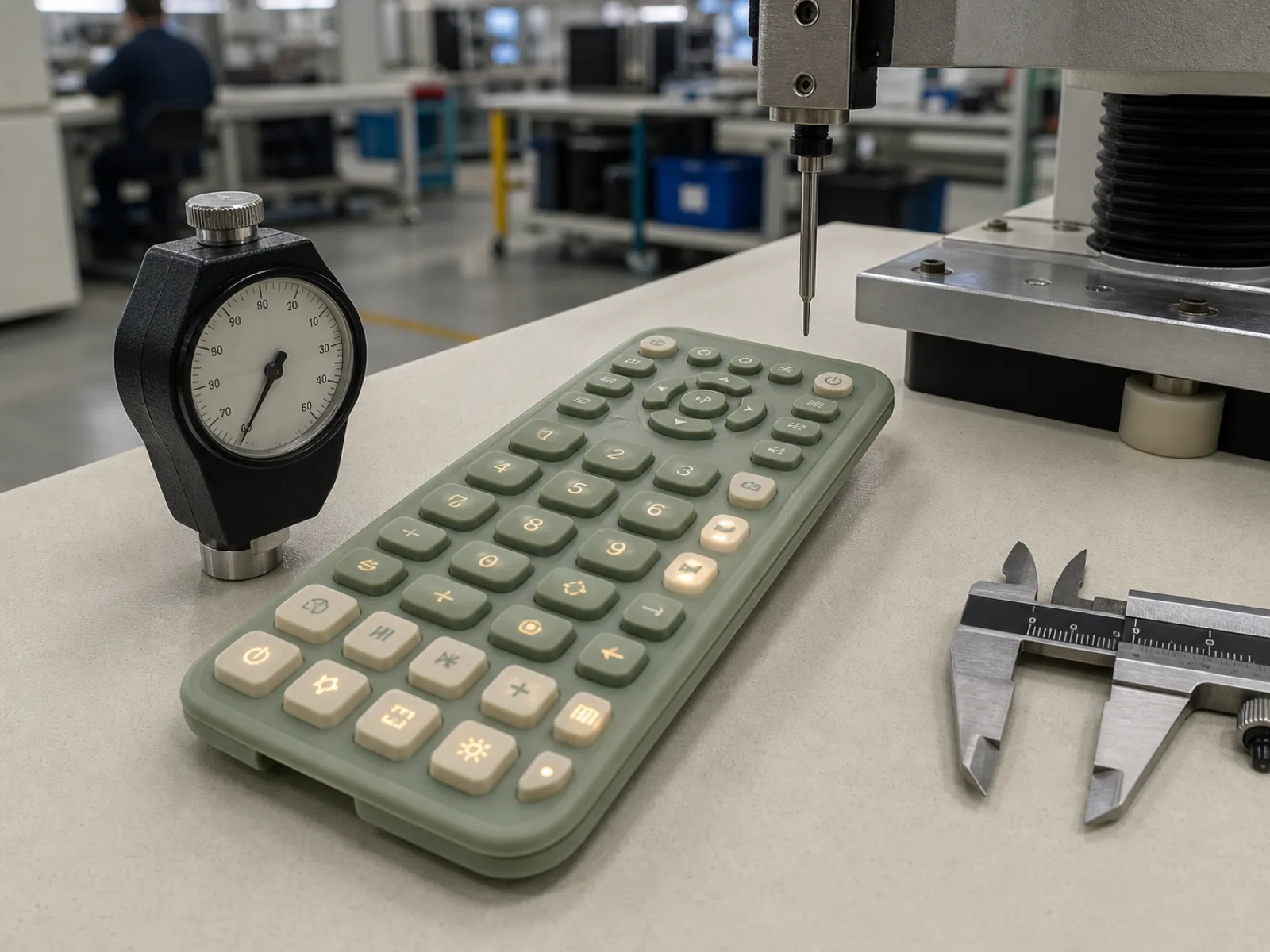 Buyer Guide
 The silicone keypad category on the English-language SERP is dominated by generic seven-step design pages that mention FDA and LFGB in passing without naming a single CFR section, quote MOQs of “contact us,” and never publish an actuation-force number or a snap-ratio band that a device engineer can design against. This guide is the B2B sourcing reality of manufacturing a silicone rubber keypad — one-piece compression-molded elastomer with integrated domes, web walls, conductive contacts, and legends — written from inside a Dongguan compression cell for medical device firms, industrial-controller brands, automotive tier-1s, and consumer-electronics OEMs.
A silicone keypad is a one-piece compression-molded silicone elastomer part with integrated key domes, web walls, conductive contacts, and legends — durometer 50-70 Shore A, service temperature -40°C to 230°C, actuation life 1-5 million cycles on standard carbon-pill contacts. Peak actuation force lives on web-wall geometry (30-45° angle, ~0.020 inch diaphragm) with a target 80-150 g peak and 40-60% snap ratio for 10-15 mm keys. MOQ 500 pieces per SKU on standard compression tooling; single-cavity P20 mold $2,800-$4,500, 4-cavity $8,500-$14,000, LSR injection $18,000-$35,000, prototype 7-15 days and production 35-50 days FOB Yantian.
What is a silicone keypad, and how is it engineered for OEM production?
A silicone keypad is a one-piece compression-molded elastomer part — polydimethylsiloxane at Shore A 50-70 per ASTM D2240[^astm-d2240] — that integrates key domes, web-wall diaphragms, conductive contacts, and legends into a single flexible part. Service temperature -40°C to 230°C, actuation life 1-5 million cycles on carbon-pill contacts. Unlike membrane keypads (stacked polyester + adhesive laminates) or mechanical keypads (individual metal-and-plastic switches), the entire user-input surface is a single molded silicone part bonded to a PCB.
The category confuses first-time device engineers because the visible object looks simple — a rubber sheet with buttons — while the engineering underneath spans four discrete disciplines: elastomer chemistry, mechanical actuation, conductive-contact physics, and printed-graphics durability. Get one wrong and the keypad ships with a mushy feel, drifting contact resistance, or legends that wipe off in the field.
Silicone keypads dominate four device categories because they are the only technology that delivers tactile snap, IP66/IP67 sealing, and 1-5 million actuation cycles at low tooling cost:
- Consumer remote controls. Set-top boxes, streaming devices, smart-home controllers, universal remotes.
- Industrial control panels. Machine HMIs, motor controllers, process-control terminals, safety-panel entry pads.
- Medical devices. Patient monitors, infusion pumps, ultrasound units, portable diagnostic scanners.
- Automotive HMI. Steering-wheel switches, center-stack climate controls, telematics keypads, fleet-vehicle input panels.
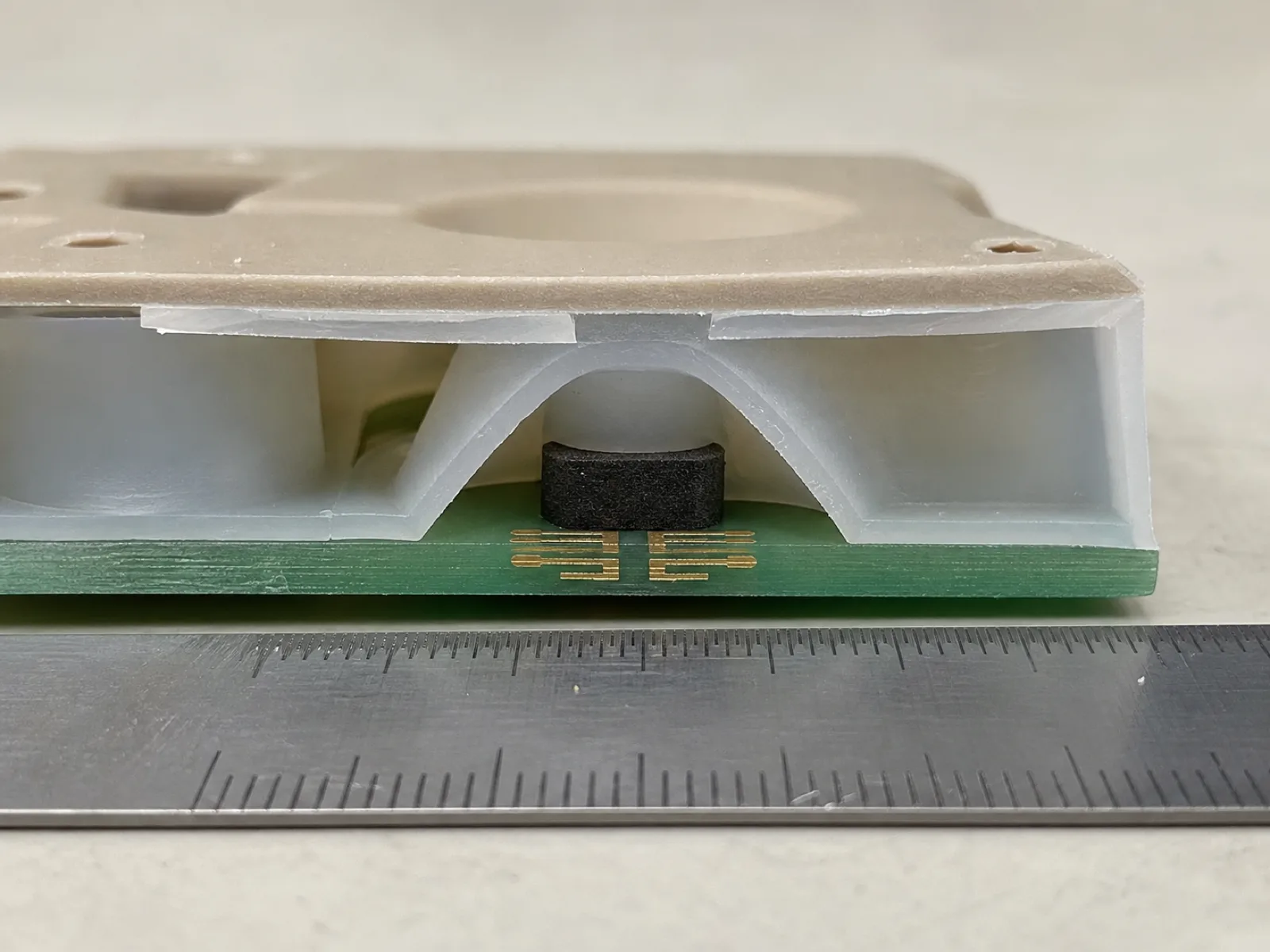
Baseline engineering spec sheet
| Parameter | Standard range | Test method |
|---|---|---|
| Base durometer | 50-70 Shore A | ASTM D2240[^astm-d2240] |
| Tensile strength | ≥ 6.0 MPa | ASTM D412[^astm-d412] |
| Elongation at break | ≥ 250% | ASTM D412[^astm-d412] |
| Peak actuation force (10-15 mm keys) | 80-150 g | Load-cell rig, 5 mm/min crosshead |
| Snap ratio (return / peak) | 40-60% | Same load-cell log |
| Actuation life | 1-5 million cycles | Pneumatic striker at 3-5 Hz |
| Contact resistance (carbon pill) | < 100 Ω logic level, < 500 mΩ switching | 4-wire Kelvin at low current |
| Continuous service temperature | -40°C to 230°C | Manufacturer spec + IEC test |
| Post-cure cycle | 4-6 h @ 180-200°C | Batch oven log |
| Cure system | Peroxide-cure HCR default; LSR for tight tolerance | Master-batch lot certificate |
Which silicone material and durometer should I spec for a keypad?
Peroxide-cured HCR (high-consistency rubber) at Shore A 50-70 is the compression-molded default — cost-effective, tactile snap tunable via web-wall geometry, and post-cured 4-6 hours at 180-200°C to clear volatile extractables. LSR (liquid silicone rubber, platinum-cured, injection-molded) is the choice for programs above 50 k annual volume where ±0.05 mm dimensional tolerance, faster cycle times, and medical-device biocompatibility drive the economics. Fluorosilicone gets called out only for fuel-contact or aggressive-solvent industrial applications.
Material selection on a silicone keypad program is a three-axis decision: base polymer (HCR or LSR, occasionally fluorosilicone), durometer (Shore A 50-70), and cure system (peroxide or platinum). Get all three right and the rest of the program — actuation force, contact resistance, legend durability — becomes a set of solvable engineering problems. Get one wrong and no amount of geometry rework saves the tool.
Durometer decision drives tactile feel
Softer silicone (Shore A 40-50): mushy feel, low peak force, high snap ratio — used for oversized keys on set-top-box remotes where finger fatigue matters. Standard (Shore A 50-60): the sweet spot that wins 70% of programs — crisp feel, 80-120 g peak force achievable with standard web-wall geometry, 1-3 million cycle life on carbon pills. Harder (Shore A 60-70): stiffer feel, higher peak force (120-200 g), longer cycle life on the diaphragm itself but harder to hit a snap ratio above 45%.
Cure-system decision drives compliance path
Peroxide-cured HCR default for industrial control, consumer remotes, and cost-driven automotive programs. Platinum-cured LSR default for medical device housings clearing USP Class VI[^usp-88] or ISO 10993-5[^iso-10993-5], for tighter dimensional programs, and for any application where a first-heat odor complaint would trigger a return. The cure decision cascades into every downstream compliance layer — full decision matrix on our platinum-cured vs peroxide-cured silicone guide.
Temperature envelope
Standard silicone keypad service temperature is -40°C to 230°C, verified on continuous exposure. That envelope covers every consumer, industrial, medical, and automotive keypad application except turbine-adjacent or engine-bay HMIs — those move to fluorosilicone or PEEK-substrate designs. Wetop qualifies material against IEC 60068-2 thermal-shock protocols and logs the batch pre and post cycle.
Key geometry engineering — web walls, diaphragms, and dome shape
Actuation force lives on the web-wall geometry, not the material. Web-wall angle at 30-45° from horizontal, diaphragm thickness at 0.020 inch (0.5 mm), and dome height of 1.5-3.0 mm are the three variables that set peak force. Cone-shaped domes deliver the highest peak force with tightest snap ratio; bell-shaped domes are the retail default; double-cone (cone-on-cone) shapes deliver the longest tactile travel for premium medical and automotive HMI programs.
The most common mistake on a first-time silicone-keypad drawing is spec’ing an actuation-force target without spec’ing the web-wall geometry to hit it. The compound house then guesses, the mold gets cut, and the first article comes back with peak force 40 g off the target. That triggers a re-cut, which costs three weeks and $2,000-$4,000 in mold rework.
The three geometry variables
Web-wall angle. The angle of the sloped wall between the dome top and the base plate — 30-45° for standard keys, steeper (45-55°) for higher peak force, shallower (25-35°) for lighter touch. The wall buckles under finger pressure, producing the tactile snap. Wall angle sets 60-70% of the actuation-force number before any other variable enters.
Diaphragm thickness. The thickness of the collapsed wall material — typically 0.020 inch (0.5 mm) for standard keys. Thicker diaphragm raises peak force linearly; thinner drops it. Below 0.015 inch the wall tears under repeated actuation; above 0.030 inch the snap ratio collapses.
Dome height. The vertical distance from the base plate to the dome top — 1.5-3.0 mm for standard keys. Taller dome delivers longer tactile travel and better perceived quality; shorter dome fits thinner devices at the cost of tactile feel.
Dome-shape families
| Dome shape | Peak force range | Snap ratio typical | Best use |
|---|---|---|---|
| Bell (single-arc) | 80-150 g | 40-55% | Consumer remotes, retail default |
| Cone (linear-slope) | 120-200 g | 50-65% | Industrial controllers, higher-force feel |
| Double-cone (cone-on-cone) | 100-180 g | 45-60% | Premium medical / automotive HMI |
| Flat-top (chiclet) | 60-120 g | 35-50% | Consumer electronics, low-profile keypads |
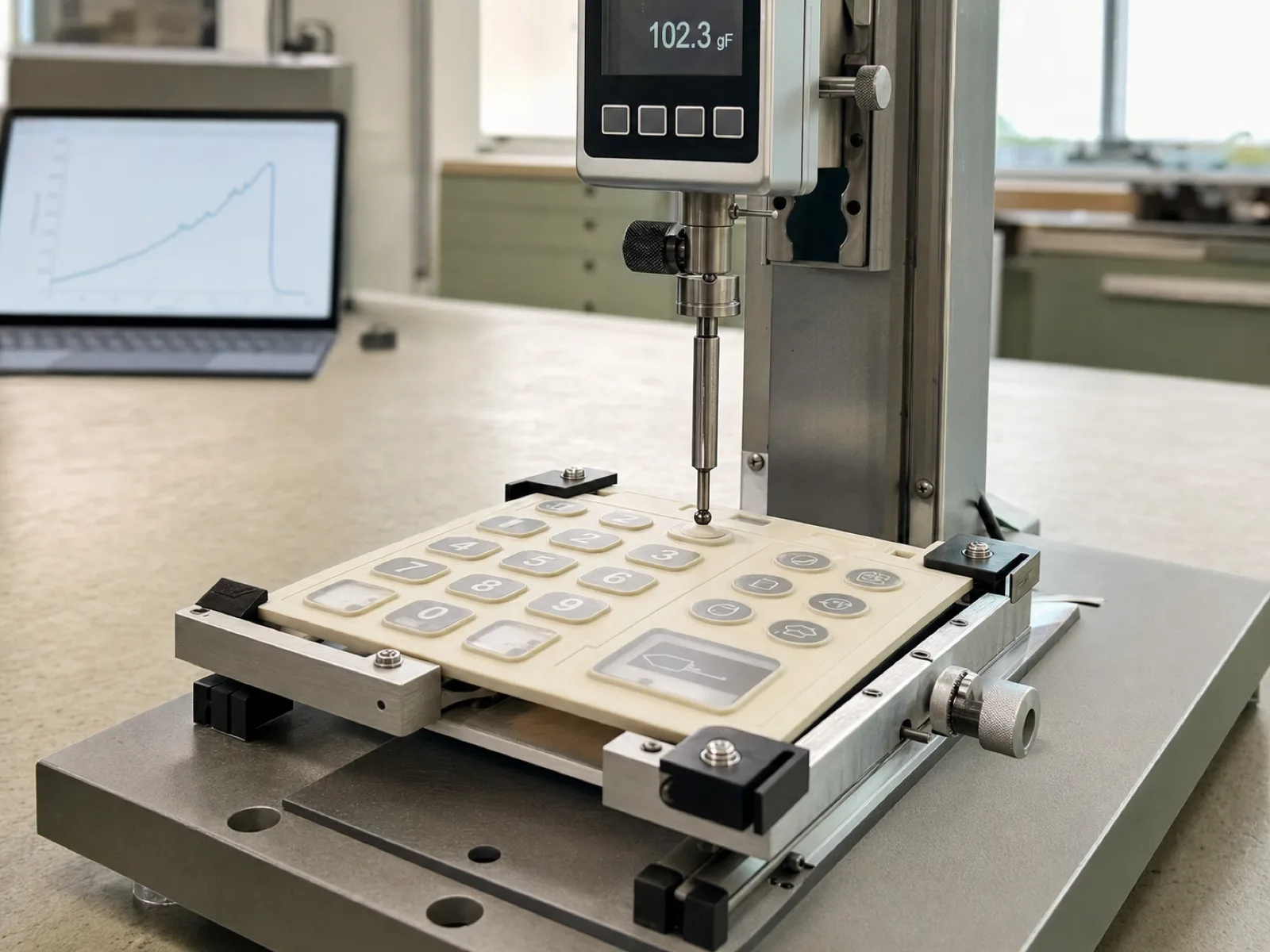
Conductive-contact technology — carbon pill, printed ink, gold pill, metal dome
Four contact options cover 99% of silicone keypad programs. Printed carbon ink (200 k-500 k cycles, lowest cost) for consumer remotes. Molded carbon pill inserts (1 M-3 M cycles) for industrial controllers. Gold-plated pill inserts (3 M-5 M cycles) for medical devices. Metal snap-domes bonded on the PCB with silicone actuator overlay (3 M-10 M cycles, crispest tactile) for premium medical and high-reliability automotive. Contact-resistance target < 100 Ω for logic-level circuits, < 500 mΩ for switching current.
The conductive-contact decision is where a program’s cycle-life number meets its bill-of-materials number. Under-spec the contact and the keypad fails at 300 k cycles when the buyer’s spec says 2 million; over-spec it and the unit cost doubles for no measurable field benefit.
Contact technology ranked by cost and cycle life
Printed carbon ink. Screen-printed conductive elastomer applied to the underside of each key dome, cured with the keypad. Lowest tooling cost — no pill-insert mold cavities required. Cycle life 200 k-500 k. Contact resistance drift 30-80 Ω over life. Use case: sub-$5 consumer remote control, low-actuation-frequency home appliance.
Molded carbon pill. A discrete carbon-loaded silicone puck (typically 3-6 mm diameter, 0.6-1.0 mm thick) placed into the mold cavity before compression and bonded into the key dome during cure. Cycle life 1-3 million. Contact resistance drift 20-50 Ω over life. Use case: industrial controller, medical peripheral, mid-tier automotive HMI. The retail default across the majority of Wetop keypad programs.
Gold-plated carbon pill. Same puck geometry as carbon pill but with a gold-plated top surface (typically 0.5-2 μm gold over nickel strike). Cycle life 3-5 million. Contact resistance drift < 10 Ω over life. Use case: medical device where any contact drift creates a false-input safety event, or high-vibration automotive.
Metal snap-dome under silicone. A stainless-steel snap-dome bonded on the PCB with the silicone keypad acting as tactile shape and IP66/IP67 seal only. Delivers the crispest tactile feel and the tightest snap-ratio band (typically 55-65%). Cycle life 3-10 million. Use case: premium medical device UI (patient monitors, ultrasound controls), high-reliability defense/aerospace HMI.
Contact-resistance targets
| Circuit type | Target | Measurement |
|---|---|---|
| Logic-level (5V CMOS / TTL) | < 100 Ω | 4-wire Kelvin, low current |
| Switching (12-24V, mA range) | < 500 mΩ | 4-wire Kelvin at test current |
| Analog sensor (μA level) | < 50 Ω | Guarded low-current bridge |
| Safety-critical (medical alarm, auto brake) | < 10 Ω with drift < 5 Ω | Continuous log through cycle-life test |
Surface treatments, coatings, and legend graphics
Bare silicone abrades legends within 5-20 k wipes without a top coat. Matte polyurethane (PU) is the industrial default clearing 100 k-300 k alcohol wipes. Epoxy top coat clears similar cycles with harder feel. Parylene C conformal coat clears 500 k+ cycles and adds chemical resistance for medical and lab environments. Legend graphics options: silk-screen (pad print) under PU is the retail default, laser-etch through opaque coating exposes translucent silicone for backlit designs, plastic key caps for premium automotive HMI aesthetics.
Surface durability is where cheap keypad programs die in the field. A no-top-coat silicone keypad looks fine at factory acceptance and reads “cost-optimized” on the BOM. Then the buyer’s device ships into a hospital ward or a machine-shop floor where the operator wipes it with isopropyl alcohol every shift, and legends start disappearing at week three.
Coating decision matrix
| Coating | Alcohol-wipe life | Feel | Best use |
|---|---|---|---|
| No coat (bare silicone) | 5 k-20 k | Tacky | Prototype only, sub-$3 sacrificial remotes |
| Matte PU top coat | 100 k-300 k | Smooth, non-glossy | Industrial, medical peripheral, retail remotes |
| Epoxy top coat | 100 k-500 k | Harder, glossier | Automotive HMI, high-durability industrial |
| Parylene C conformal | 500 k+ | Slight surface texture | Medical device housings, lab equipment |
Legend graphics techniques
Silk-screen (pad print) under top coat. Multi-color Pantone-matched legends printed onto the silicone before the PU top coat locks them in. Wipe life inherits from the top coat (100 k-300 k). Retail default.
Laser etch through opaque coating. A dark PU top coat is applied over translucent silicone; a CO₂ or fiber laser then etches the legend, exposing the translucent silicone underneath. When the keypad is backlit, the etched legend glows. Standard on premium remotes, medical device UIs, and any night-visible automotive interface. Wetop lasers with a spec’d 200-500 μm cut width and verifies edge sharpness on a metrology scope.
Plastic key caps bonded on silicone. ABS or PC key caps molded separately, then bonded onto the silicone dome for a hard-plastic-key aesthetic with silicone tactile feel. Automotive HMI standard. Adds $0.15-$0.40 per key to unit cost.
Backlit translucent windows. The silicone in the legend area molded at 40-60% light transmission, verified on a spectrophotometer. Backlight uniformity target ΔL < 15% across all lit legends measured on a photometer. LED-under-key placement is the standard for keys ≥ 12 mm; edge-lit light-guide film (LGF) is the choice for thinner devices or full-perimeter backlighting.
Regulatory and compliance path — FDA, USP, ISO 10993, RoHS, REACH, UL, IP
The compliance stack depends on the device category, not the keypad itself. Consumer remote: FDA 21 CFR 177.2600[^fda-177-2600] (food adjacencies) + RoHS + REACH[^echa-reach]. Industrial control: RoHS + REACH + UL 94 flame rating + IP66/IP67 sealed-panel test. Medical device: USP Class VI[^usp-88] or ISO 10993-5[^iso-10993-5] + ISO 10993-10[^iso-10993-10] + IEC 60601-1[^iec-60601-1] EMC. Automotive HMI: RoHS + REACH + IATF 16949 factory scope + OEM-specific validation. Every layer adds a test report to the compliance packet; the manufacturing does not change.
The regulatory work on a silicone keypad program breaks into three sequential efforts: material qualification (does the base silicone clear the standard?), part-level qualification (does the finished keypad pass biocompatibility, flame, or sealing?), and device-level qualification (does the final device pass EMC, ESD, and safety?). Wetop owns the first two; the customer’s certification lab handles the third.
Compliance stack by device category
| Device category | Material | Part-level | Device-level |
|---|---|---|---|
| Consumer remote | FDA 21 CFR 177.2600[^fda-177-2600] | — | RoHS + REACH[^echa-reach] |
| Consumer kitchen appliance | FDA + LFGB | — | RoHS + REACH + UL |
| Industrial control panel | — | UL 94 V-0 flame | IP66/IP67 + IEC 60947 |
| Medical device (skin-contact) | USP Class VI[^usp-88] or ISO 10993-5[^iso-10993-5] | ISO 10993-10[^iso-10993-10] irritation | IEC 60601-1[^iec-60601-1] + IEC 61000-4-2[^iec-61000-4-2] |
| Automotive HMI | — | RoHS + REACH | IATF 16949 + OEM validation |
| Defense / aerospace | MIL-STD material | MIL-STD flame + shock | MIL-STD EMC + environmental |
The three test reports that come with every Wetop keypad batch
- Material certificate — master-batch lot number, durometer, tensile, elongation, cure system, post-cure log.
- First-article inspection report (FAIR) — dimensional layout, force-curve on 5 sampled keys, contact-resistance on 5 sampled keys, legend adhesion.
- Environmental / life-cycle report — thermal cycling, 500-hour humidity, ESD immunity, cycle-life to spec (or partial-life extrapolation for programs above 1 million cycles).
Life-cycle testing and qualification — 1 to 5 million actuations
Four life-cycle tests qualify a silicone keypad for production. Strike/cycle life (1-5 million actuations on automated pneumatic striker at 3-5 Hz with load-cell logging), environmental (500 hours at 85°C / 85% RH), ESD immunity per IEC 61000-4-2[^iec-61000-4-2] at ±8 kV contact / ±15 kV air, and drop test per IEC 60068-2-31 on final assembly. Actuation-curve drift over life allowed: ±20% peak force, ±10 percentage points snap ratio. Contact-resistance drift: ≤ 50 Ω for carbon-pill, ≤ 10 Ω for gold-plated.
The cycle-life test is where under-spec’d tools get caught. A keypad hits the buyer’s 2-million-cycle target on the master sample, then five keys drift 60 g out of band at 800 k cycles because the diaphragm thickness on those specific cavities is 0.017 inch instead of the drawing’s 0.020 inch. That is a mold rework, not a compound rework — and the only way to find it is to run the full cycle-life test on production-cavity samples, not on prototype-cavity samples.
Actuation-curve drift verification protocol
| Cycle count | Test |
|---|---|
| 0 (baseline) | Load-cell peak + snap, 5 keys |
| 100 k | Same |
| 500 k | Same |
| 1 M | Same + contact resistance re-check |
| 3 M | Same |
| 5 M (end of test) | Full re-verification + visual on legend and coating |
Allowable drift: peak force within ±20% of baseline, snap ratio within ±10 percentage points, contact resistance drift under 50 Ω for carbon pill or 10 Ω for gold-plated. Any key falling outside triggers a root-cause analysis on the mold cavity, the master-batch lot, and the compression-press cycle time.
Tooling economics, MOQ, and lead-time reality
Wetop's MOQ is 500 pieces per SKU on standard compression tooling. Tooling bands FOB Yantian, Q3 2026: single-cavity P20 hardened steel compression mold $2,800-$4,500 for a 40-key layout, 4-cavity $8,500-$14,000 (drops per-piece cost 40-55%), LSR injection $18,000-$35,000 for tighter tolerance and higher volume. Prototype 7-15 days on existing tooling, first article 21-35 days on a new tool, production 35-50 days for 5,000-20,000 pieces. PPAP submission adds 21-30 days on automotive or medical.
The MOQ number matters less than what the MOQ buys. A 500-piece run on a properly sized single-cavity compression mold with per-batch post-cure log, load-cell force verification, contact-resistance sample plan, and pre-shipment AQL 2.5 inspection costs more per unit than a 500-piece run on a shared multi-tenant mold with no post-cure — because the second option ships product that fails compliance testing at the buyer’s certification lab and generates a full mold-rework charge downstream.
Tooling cost bands
| Mold type | Layout | Tooling cost | Cycle time | Best for |
|---|---|---|---|---|
| Single-cavity P20 compression | 40-key | $2,800-$4,500 | 4-6 min | Prototype, 500-5 k annual volume |
| 4-cavity P20 compression | 40-key | $8,500-$14,000 | 4-6 min | 5 k-30 k annual volume |
| 8-cavity P20 compression | 40-key | $15,000-$24,000 | 5-8 min | 30 k-100 k annual volume |
| LSR injection (single-cavity) | 40-key | $18,000-$28,000 | 45-90 sec | Medical or tight-tolerance |
| LSR injection (multi-cavity) | 40-key | $28,000-$55,000 | 60-120 sec | 100 k+ annual volume |
Lead-time reality
- Prototype on existing tooling — 7-15 days sample, cost typically absorbed against production PO.
- First article on new compression tool — 21-35 days including mold design, cut, T1 sample, force-curve verification, and dimensional layout.
- Production 5-20 k pieces — 35-50 days after PO and 30% deposit, plus post-cure and inspection.
- PPAP submission (automotive / medical) — 21-30 days on top for full dimensional layout, PSW, material certification, and process-capability data.
- Sailing — 14-18 days Yantian to US West Coast, 25-32 days East Coast, 30-38 days Northern Europe.
Total realistic lead from RFQ to warehouse receipt on a new keypad program: 75-120 days. Any factory quoting 30 days cold-start-to-warehouse is either running on an existing customer’s tool (unlikely to survive audit) or compressing post-cure and inspection.
The MOQ math and where the 500-piece floor comes from is broken down further on our real factory MOQ math guide and silicone OEM pricing structure.
Application-specific design rules — medical, automotive, industrial, consumer
The four application families each impose different lock-in constraints. Medical: USP Class VI or ISO 10993 biocompatibility, IP66/IP67 sealed panel, alcohol-wipe survival to 500 k cycles. Automotive: IATF 16949 factory scope, thermal cycling -40°C to +85°C, UV resistance, OEM-specific validation packet. Industrial: UL 94 V-0 flame, IP66/IP67 sealing, chemical resistance to solvent list, EMC to IEC 61000. Consumer: cost optimization, retail packaging, RoHS + REACH baseline.
The generic 7-step design guides all four applications as if they share a specification — they do not. Each device family has one hard constraint that dictates cure system, contact technology, and coating from the first drawing.
Medical device keypads
Hard constraint: biocompatibility and alcohol-wipe survival. Default configuration: platinum-cured LSR at Shore A 50-60, gold-plated carbon pill contacts (or metal snap-dome under silicone for premium UIs), parylene C conformal coat, USP Class VI[^usp-88] or ISO 10993-5[^iso-10993-5] + ISO 10993-10[^iso-10993-10] test package. IEC 60601-1[^iec-60601-1] EMC on the final device is the customer’s certification lab — Wetop supplies part-level test coupons and dimensional data.
Automotive HMI keypads
Hard constraint: thermal cycling and OEM validation. Default configuration: peroxide-cured HCR at Shore A 55-65 or LSR at Shore A 50-60 for higher-volume programs, molded carbon pill contacts (gold for safety-critical), epoxy top coat, plastic key caps for premium tier. Thermal cycling -40°C to +85°C for 1000 cycles minimum. Wetop’s ISO 9001[^iso-9001] scope covers silicone molding for automotive tier-2 supply; IATF 16949 add-on for tier-1 programs on request.
Industrial control panel keypads
Hard constraint: UL flame rating and IP sealing. Default configuration: peroxide-cured HCR at Shore A 60-70, molded carbon pill contacts, matte PU top coat, UL 94 V-0 flame-retardant master-batch. Sealed-panel IP66/IP67 rating on the finished device. NEMA 4X where wash-down survival matters. Chemical resistance to a solvent list (kitchen cleaners, machine coolants, medical disinfectants) verified on a coupon-immersion test.
Consumer remote and appliance keypads
Hard constraint: cost. Default configuration: peroxide-cured HCR at Shore A 55-65, printed carbon ink or low-cost molded carbon pill contacts, matte PU top coat with pad-printed legends, RoHS + REACH[^echa-reach] declaration. Retail packaging blister or paperboard integrated into the shipping plan.
The Wetop engineering desk — DFM review and RFQ workflow
A production-ready silicone keypad RFQ includes eight items: 2D drawing, 3D CAD, target actuation force and snap ratio with tolerance bands, contact-resistance and cycle-life target, environmental spec, legend graphics and backlight, regulatory scope, and expected annual volume. Send that package and Wetop returns a costed quote and a DFM review from William Zhuo's engineering desk in 2-3 business days. The DFM identifies web-wall angle, diaphragm thickness, and cavity-layout risks before the mold gets cut.
The DFM review is where a Wetop keypad program diverges from a trading-company keypad program. A trader passes the drawing to a molder, adds a margin, and quotes. A factory reads the drawing, runs the actuation-force math, checks the cavity layout against the annual volume, flags the coating spec against the wear-life target, and returns a review that either confirms the design or proposes 2-4 changes that save the buyer a re-cut.
The DFM checklist Wetop runs on every incoming keypad drawing
- Web-wall angle vs peak-force target — does the geometry match the force? If not, propose an angle change and requote force curve.
- Diaphragm thickness callout — is it on the drawing? If not, add 0.020 inch default and flag for customer confirmation.
- Cavity count vs annual volume — is the tool right-sized? Undersized tool means overtime shifts and per-unit cost drift; oversized tool means capital wasted.
- Coating spec vs wear-life target — does the top coat clear the alcohol-wipe cycle count? If not, propose upgrade to PU or parylene.
- Contact-resistance target vs contact technology — is the pill spec’d for the circuit? Under-spec triggers field failures.
- Regulatory scope on drawing — every compliance line-item cited to the actual standard, not “food safe” or “medical grade” marketing language.
- Backlight uniformity target — if backlit, is ΔL callout on the drawing? Photometer plan on file?
- Post-cure requirement — 4-6 h @ 180-200°C called out? Wetop runs it on every batch anyway; the callout matters for the audit trail.
Named DFM review is signed by William Zhuo — founder and engineering lead — on the returned RFQ. That signature is on the record for the life of the program.
FAQ
The FAQ block below renders from the frontmatter — questions cover keypad-specific engineering, compliance, tooling, and factory-vetting decisions.
Ready to source a silicone keypad?
Send drawings, target force curve, and annual volume to the Wetop engineering desk. William Zhuo’s team returns a costed quote plus a written DFM review in 2-3 business days. MOQ 500 pieces per SKU, prototype 7-15 days, production 35-50 days FOB Yantian.
FAQ
-
What is a silicone keypad and how does it differ from a membrane keypad or mechanical keypad?
A silicone keypad is a one-piece compression-molded silicone rubber part with integrated key domes, web-wall diaphragms, conductive contacts, and legends — the entire user-input surface is molded and post-cured as a single flexible elastomer part, then bonded to a PCB in the final device. A membrane keypad is a stacked flexible-printed-circuit sandwich (polyester + adhesive + copper traces + graphic overlay) with no tactile dome. A mechanical keypad uses individual metal-and-plastic switches (Cherry MX, Kailh, tact switches). Silicone keypads deliver tactile snap feel with sealing to IP66/IP67, moderate cycle life (1-5 million actuations), and low tooling cost — the reason they dominate remote controls, industrial control panels, medical devices, and automotive HMI (human-machine interface) surfaces.
-
What actuation force and snap ratio should I spec on a silicone keypad?
For 10-15 mm diameter round keys the standard target is 80-150 g peak actuation force with a 40-60% snap ratio (return force divided by peak force). Peak force under 60 g feels mushy; over 180 g feels stiff and causes finger fatigue. Snap ratio under 30% feels dead (no tactile confirmation); over 65% feels clicky and increases return-key noise. Tolerance band on peak force is ±15-25 g per key across a mold, verified on a load-cell rig with 5 mm/min crosshead speed. The variable that drives both numbers is web-wall angle (typically 30-45° from horizontal) and diaphragm thickness (~0.020 inch / 0.5 mm). Material durometer plays a secondary role — 50 Shore A dome + geometry beats 70 Shore A dome + wrong geometry every time.
-
Which conductive-contact technology should I use for a silicone keypad — carbon pill, printed carbon ink, or metal dome?
Printed carbon ink (screen-printed conductive elastomer applied to the dome underside) is the lowest tooling cost and works for 200 k-500 k cycle life at consumer-remote-control shelf pricing. Molded carbon pill inserts (a discrete conductive silicone puck bonded into each key dome during molding) hit 1 M-3 M cycles at typical industrial-controller pricing. Gold-plated pill inserts reach 3 M-5 M cycles for medical / high-reliability applications. Metal dome under a silicone actuator (a stainless snap-dome bonded on the PCB, with the silicone keypad only providing tactile shape and sealing) delivers the crispest tactile feel and 3 M-10 M cycles — the standard for premium medical device UIs. Contact resistance target: under 100 Ω for logic-level (5V CMOS/TTL), under 500 mΩ for higher-current switching or sensitive analog inputs.
-
Which surface treatments and coatings do I need on a silicone keypad, and how do I test wear resistance?
Bare silicone is inherently tacky and abrades legends over 5-20 k wipes without a top coat. The three production coatings, in order of durability: matte polyurethane (PU) top coat clears 100 k-300 k alcohol wipes and is the industrial/consumer default; epoxy top coat clears similar cycles with harder feel; parylene C conformal coat clears 500 k+ cycles and adds chemical resistance for medical device or lab environments. Verification is an alcohol-wear test (isopropyl-soaked cotton pad, 250 g load, oscillating rig at 60 cycles/min) counting cycles to legend disappearance. Buyers should spec the coating and the wear-test cycle count together — a coating without a cycle count on the drawing gets swapped for a cheaper formulation at the compound house.
-
How do I spec legend graphics and backlighting on a silicone keypad — silk screen, laser etch, or translucent windows?
Silk-screen (pad print) legend under a PU top coat is the retail default: low cost, 100 k+ wipe life, any Pantone color, no backlight. Laser-etch through an opaque top coat exposes translucent silicone underneath — the backlit night-legend look on premium remotes and medical devices, needs a light source under the keypad. Plastic key caps bonded onto the silicone dome deliver hard-plastic-key aesthetics with silicone tactile feel — automotive HMI standard. Backlighting spec matters as much as the legend itself: uniformity target ΔL < 15% across a lit legend measured on a photometer, LED-under-key placement or edge-lit light-guide film (LGF) depending on device thickness. Backlit designs need the silicone in the legend window at 40-60% light transmission — verified on a spectrophotometer against the master-batch sample.
-
What certifications does a silicone keypad need for medical device, automotive, or industrial applications?
Medical device keypad housings: USP Class VI biocompatibility (USP <88> extract testing) or the broader ISO 10993-5 (cytotoxicity) and ISO 10993-10 (irritation and sensitization), plus IEC 60601-1 EMC for the final device. Automotive HMI: RoHS + REACH baseline, IATF 16949 factory quality (or ISO 9001:2015 with automotive scope), plus OEM-specific validation (Ford WSS-M, GM GMW). Industrial control: UL 94 V-0 or V-1 flame rating, NEMA 4X or IP66/IP67 sealed-panel testing, and IEC 60947-5-1 (switching devices). Consumer remote controls typically clear at FDA 21 CFR 177.2600 (food-contact adjacencies for kitchen-adjacent remotes), RoHS, and REACH only. The compliance packet depth doubles between consumer and medical, not the manufacturing.
-
What life-cycle testing does a silicone keypad need to pass, and how do we verify actuation curve stability over 1-5 million cycles?
The four life-cycle tests are strike/cycle life (1-5 million actuations on an automated pneumatic striker at 3-5 Hz with load-cell logging), environmental (500 hours at 85°C / 85% RH followed by re-verification of peak force and snap ratio), ESD (per IEC 61000-4-2, ±8 kV contact / ±15 kV air discharge), and drop test (IEC 60068-2-31 for the final assembly). Actuation-curve stability verification: pull 5 keys at cycles 0, 100 k, 500 k, 1 M, 3 M, 5 M and log peak force + snap ratio on the load-cell rig — allowable drift is ±20% peak force, ±10 percentage points on snap ratio. Contact-resistance drift over the same cycles: ≤ 50 Ω increase from baseline for carbon-pill inserts, ≤ 10 Ω for gold-plated pills.
-
What is the MOQ, tooling cost, and lead time for a custom silicone keypad from a factory like Wetop?
Wetop's MOQ is 500 pieces per SKU on standard compression tooling. Tooling cost bands FOB Yantian, Q3 2026: single-cavity P20 hardened steel compression mold $2,800-$4,500 for a 40-key layout, 4-cavity mold $8,500-$14,000 (drops per-piece cost 40-55%), LSR injection mold $18,000-$35,000 for programs above 50 k annual volume where dimensional tolerance and cycle time matter. Lead time: 7-15 days for a prototype sample on existing tooling, 21-35 days for a first article on a new tool, 35-50 days for production of 5,000-20,000 pieces. PPAP-level (Production Part Approval Process) submission for automotive or medical adds 21-30 days for full dimensional layout, force-curve data, and material certification package.
-
How do we tell a real silicone-keypad factory from a trading company on Alibaba or a broker reselling a Guangdong molder?
Four checks catch 95% of trading companies. First: ask for a 2-3 minute unedited video of the compression press and post-cure oven mid-cycle with the day's date visible on a shift board — a broker will send you their supplier's marketing video, and the date won't match. Second: ask for the last three months of ISO 9001 internal audit records showing silicone-molding scope, and cross-check that the audit certificate is registered to the factory's business license, not a trading LLC. Third: ask for a first-article inspection report (FAIR) from any keypad program in the last 90 days with actuation-force curves and contact-resistance data — traders don't have the load-cell rig. Fourth: ask which durometer measurement standard the factory uses on incoming raw silicone (correct answer: ASTM D2240 with a calibrated Type A durometer, calibration certificate current). A trader will hesitate; a factory will send the calibration cert same day.
-
What should a silicone-keypad RFQ package include so the factory can quote without four rounds of back-and-forth?
A production-ready silicone-keypad RFQ carries eight items: (1) 2D drawing with overall dimensions, key layout, and key diameters, (2) 3D CAD file (STEP or IGES) for the mold designer, (3) target peak actuation force and snap ratio with tolerance bands (e.g. 100 ± 20 g peak, 50 ± 10% snap ratio), (4) contact-resistance target and cycle-life target (e.g. < 100 Ω through 2 million cycles), (5) environmental spec (temperature range, humidity, IP rating if sealed panel, chemical exposure list), (6) legend graphics — silk screen or laser etch, Pantone colors, backlight yes/no with uniformity target, (7) regulatory scope (FDA / USP / RoHS / REACH / UL 94 / medical device class if applicable), (8) expected annual volume and preferred cavity count. Send that package and Wetop returns a costed quote in 2-3 business days, not two weeks.
References
Authoritative sources cited in this guide
- US Food and Drug Administration. 21 CFR 177.2600 — Rubber articles intended for repeated use. https://www.ecfr.gov/current/title-21/chapter-I/subchapter-B/part-177/subpart-C/section-177.2600 — The primary US food-contact regulation Wetop tests silicone keypad material against when the keypad ships into a kitchen-adjacent or food-service device.
- International Organization for Standardization. ISO 10993-5:2009 — Biological evaluation of medical devices — Tests for in vitro cytotoxicity. https://www.iso.org/standard/36406.html — The cytotoxicity test method for medical-device silicone keypads — Wetop supplies material and part-level test coupons per this method.
- International Organization for Standardization. ISO 10993-10:2010 — Biological evaluation of medical devices — Tests for irritation and skin sensitization. https://www.iso.org/standard/40884.html — The skin-contact biocompatibility test for keypad housings on hand-held medical devices.
- United States Pharmacopeia. USP <88> — Biological Reactivity Tests, In Vivo. https://www.usp.org/harmonization-standards/pdg/excipients/plastic-materials — USP Class VI biocompatibility — the traditional US-market alternative to ISO 10993 for medical-device silicone keypad qualification.
- International Organization for Standardization. ISO 9001:2015 — Quality Management Systems — Requirements. https://www.iso.org/standard/62085.html — The factory quality-management standard Wetop is certified against — governs keypad batch traceability, force-curve logs, and audit trail.
- ASTM International. ASTM D2240-15 — Standard Test Method for Rubber Property — Durometer Hardness. https://www.astm.org/d2240-15r21.html — The durometer test standard behind every Shore A hardness spec Wetop quotes on silicone keypad programs.
- ASTM International. ASTM D412 — Standard Test Methods for Vulcanized Rubber and Thermoplastic Elastomers — Tension. https://www.astm.org/d0412-16r21.html — The tensile and elongation test standard used to verify the mechanical envelope of keypad silicone before mold release.
- International Electrotechnical Commission. IEC 60601-1 — Medical electrical equipment — General requirements for basic safety and essential performance. https://webstore.iec.ch/publication/2603 — The safety framework that governs any silicone keypad shipping on a medical electrical device.
- International Electrotechnical Commission. IEC 61000-4-2 — Electromagnetic compatibility — Electrostatic discharge immunity test. https://webstore.iec.ch/publication/4189 — The ESD immunity test method Wetop's keypad designs verify against — typically ±8 kV contact / ±15 kV air discharge.
- European Chemicals Agency. REACH — Registration, Evaluation, Authorisation and Restriction of Chemicals. https://eur-lex.europa.eu/legal-content/EN/TXT/?uri=CELEX%3A32006R1907 — The EU chemical framework any silicone keypad shipping into the EU must declare against — including SVHC candidate-list screening.
Start a custom program
Send a brief. Get an engineer’s reply in one business day.
Every Wetop program is tooled from a customer’s specification. Send a CAD file (STEP · IGES · DWG) or a written brief and we’ll reply with a mold cost estimate, price brackets at MOQ 500 / 1,000 / 5,000, and any engineering questions.