Buyer Guide · commercial intent
Silicone Menstrual Cup Manufacturer — OEM Guide
 Buyer Guide
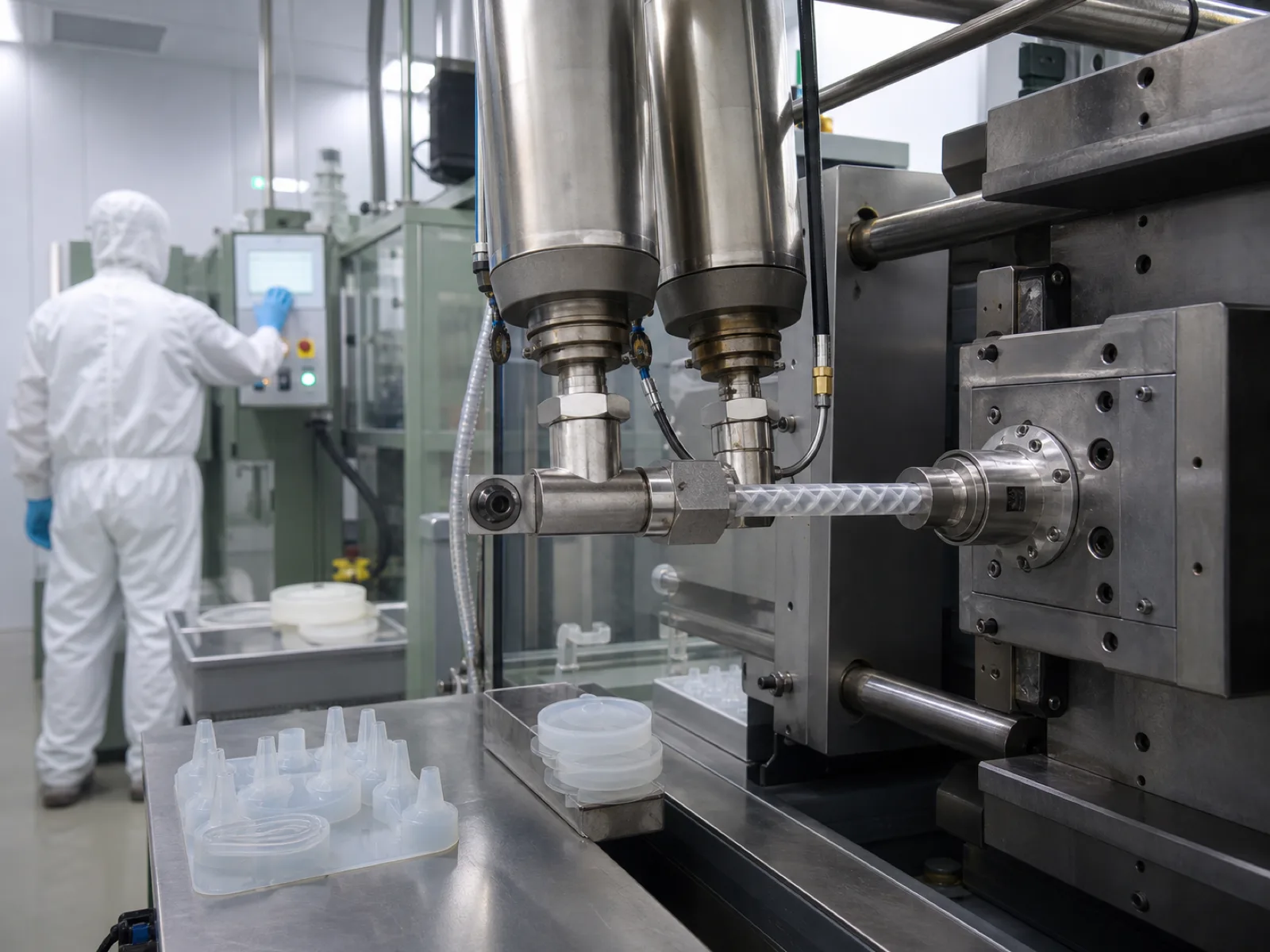
 A silicone menstrual cup manufacturer competent for private-label OEM work runs platinum-cured LSR inside ISO Class 8 cleanrooms and holds ISO 13485 medical-device QMS certification, not just ISO 9001. The finished cup is an FDA Class II device under 21 CFR 884.5435 — the brand is the submitter of record for 510(k) clearance, and the factory supplies a device master file, full ISO 10993 biocompatibility panel, and per-lot certificates of analysis. Typical OEM programs open at 5,000-unit pilot MOQ on USD 4,500-8,500 single-cavity steel tooling, scaling to unit costs of USD 0.48-0.72 above 100,000 units per year.
This guide is written for intimate wellness brand owners evaluating a silicone menstrual cup manufacturer for a private-label program. Every claim below is anchored to a specific standard clause or Tier-1 authority — because sourcing a finished medical device from a contract manufacturer is not a food-contact silicone RFQ. Get the compliance stack wrong and the brand cannot legally launch. Get it right and the OEM cost stack lands in a range that supports a healthy retail price at a defensible unit margin. We cover material grade, regulatory pathway, cleanroom class, tooling, MOQ, sterilization, and the dossier the brand must collect from the factory before first shipment.
What silicone grade does a compliant menstrual cup manufacturer use?
A compliant silicone menstrual cup manufacturer uses platinum-cured liquid silicone rubber (LSR) at Shore A 40-70 durometer, tested to USP <88> Class VI and the full ISO 10993 biocompatibility panel[^usp-88][^iso-10993-1]. Peroxide-cured HCR is disqualified because its DCBA and benzoic acid cure by-products fail ISO 10993-10 sensitization testing for mucosal contact.
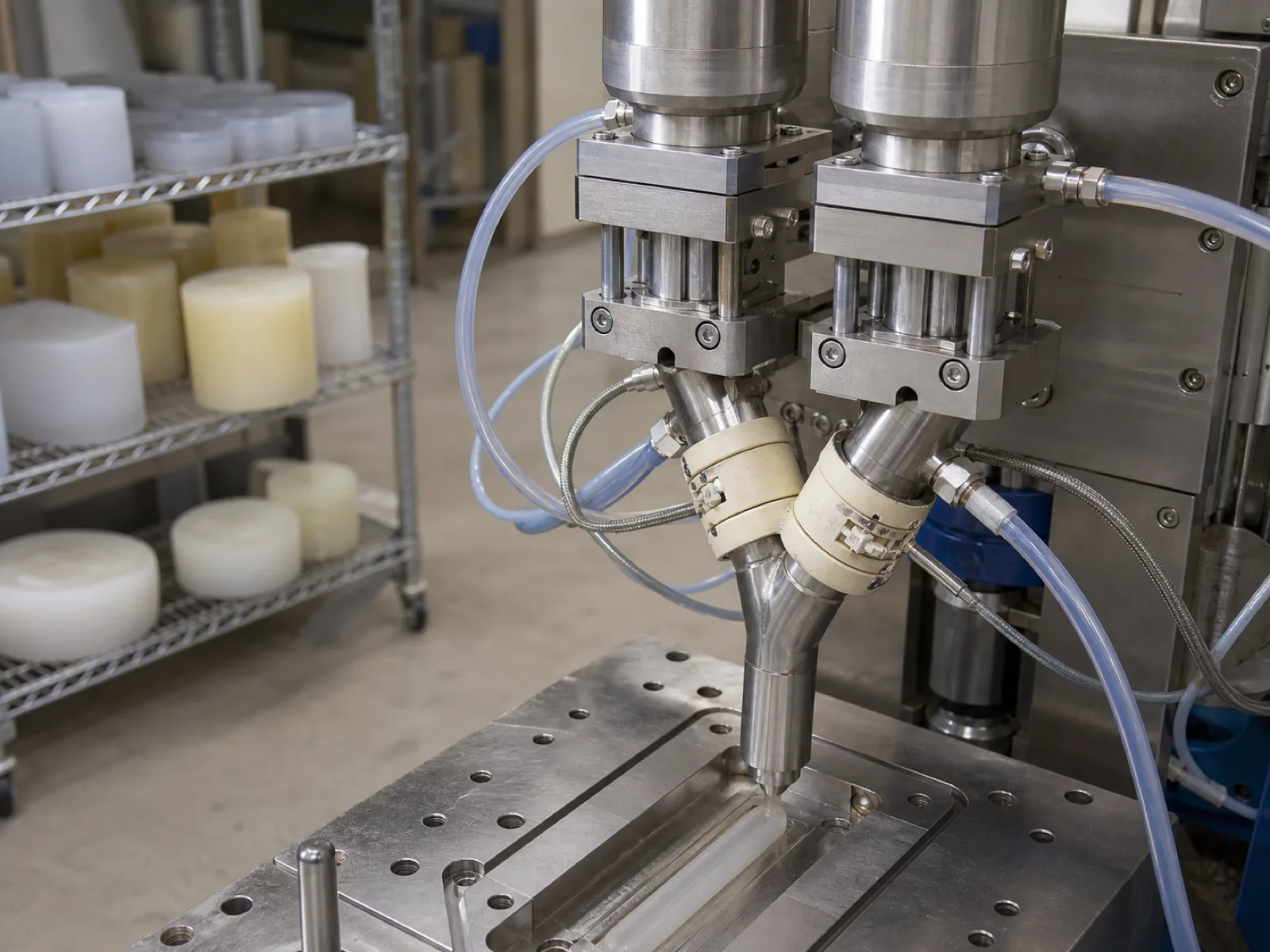
The material choice is the first fork in the decision tree, and the wrong branch invalidates every downstream cost. LSR (liquid silicone rubber) is a two-part addition-cure system: Part A carries the platinum catalyst, Part B carries the SiH crosslinker, and the two are metered 1:1 through a static mixer directly into a heated mold. Cure completes in 15-90 seconds at 175-200 °C with no by-products — only the polymer network and the desired part.
Peroxide-cured HCR (high-consistency rubber) cures via a benzoyl-peroxide or DCBP initiator that decomposes into benzoic acid and dichlorobenzoic acid. Those residuals must be extracted by long post-cure cycles (4-6 h at 200 °C), and even then trace amounts remain — enough to trigger sensitization responses in the ISO 10993-10 guinea pig maximization test. This is why every FDA-cleared menstrual cup on the US market is platinum-cure. For the fuller cure-system contrast, our platinum-cured vs peroxide-cured silicone guide walks through the chemistry and QC implications.
| Base LSR resin | Supplier | Shore A | USP Class VI | ISO 10993 tested by supplier |
|---|---|---|---|---|
| SILASTIC Q7-4735 / 4750 | Dow | 35-50 | Yes | Yes (partial panel) |
| ELASTOSIL LR 3003/40 | Wacker | 40-70 | Yes | Yes |
| Silopren LSR 2745 | Momentive | 40-70 | Yes | Yes |
| KE-2090 series | Shin-Etsu | 30-70 | Yes | Yes |
Supplier-level biocompatibility testing does not substitute for finished-device testing — the brand’s dossier requires ISO 10993 results run on the cured cup, because pigments, mold-release, post-cure protocol, and sterilization all change the extractables profile. Buyers should verify the OEM understands this distinction.
Is the OEM’s ISO 9001 enough, or does the factory need ISO 13485?
ISO 9001 alone is not sufficient. A silicone menstrual cup manufacturer producing for regulated markets (US, EU, UK, Canada, Australia) must hold ISO 13485:2016 medical-device QMS certification[^iso-13485]. ISO 13485 adds design control, risk management to ISO 14971[^iso-14971], UDI traceability, and CAPA discipline that ISO 9001 does not require of a general manufacturer.
ISO 9001 is a horizontal quality management standard — process discipline, corrective action, management review, customer satisfaction. It’s the operative certification for a silicone drying rack or gasket factory. Medical devices need more: documented design controls, formal risk management, unique device identification (UDI) traceability, sterilization validation records, complaint handling tied to regulatory reporting, and change control that triggers biocompatibility re-testing when materials or process parameters drift.
Buyers evaluating a silicone menstrual cup manufacturer should require:
- ISO 13485:2016 certificate — current, from a notified-body-recognized certification body (BSI, TÜV SÜD, SGS, DEKRA, DNV)
- FDA establishment registration (FDA Form 2891) if the factory will be listed as manufacturer of record
- MDSAP audit report if the brand is regulated in Canada / Australia / Brazil / Japan
- Risk management file per ISO 14971 covering the specific cup platform, not a generic template
Wetop Silicone’s engineering team supports OEM programs at the drying rack / mat / grid category under ISO 9001 discipline; menstrual cup and other Class II mucosal-contact device programs require ISO 13485-certified partners. Buyers should verify the certificate matches the finished-device product family before signing a supply agreement.
What is the FDA regulatory pathway for a private-label menstrual cup?
In the US, a menstrual cup is a Class II medical device under 21 CFR 884.5435 requiring 510(k) premarket notification[^cfr-884-5435]. The brand of record submits the 510(k) as the specification developer; the silicone menstrual cup manufacturer supplies the device master file (DMF), ISO 10993 reports, sterilization validation, and CoAs. In the EU, the same device is Class IIa under MDR Rule 5[^eu-mdr-2017-745] requiring notified body assessment.
The 510(k) route requires demonstrating substantial equivalence to a legally-marketed predicate device — the DivaCup (K122772), Lena Cup (K180858), and Saalt Cup (K190584) are common predicates. The submission covers device description, intended use, biocompatibility, sterilization, shelf life, mechanical performance, and clinical data (usually literature-based, not new studies). FDA review takes 90-180 days from acceptance.
Two regulatory patterns brands typically pick:
Pattern A — Brand as manufacturer of record. The brand holds the 510(k), FDA establishment registration, and quality system responsibility. The silicone menstrual cup manufacturer is a “contract manufacturer” listed in the FDA registration. The brand controls the label, IFU, and post-market surveillance. The OEM supplies a DMF (device master file) letter of authorization that FDA can reference during review without disclosing the OEM’s proprietary formulations to the brand.
Pattern B — OEM as manufacturer of record. The OEM holds the 510(k) as a private-label supplier; multiple brands source the same underlying cup under their own labels. Faster time-to-market for small brands but the brand does not control the design.
Pattern A is standard for brands planning to build long-term equity. The DMF mechanism is critical — it lets the OEM protect trade-secret formulation and process while giving FDA the evidence needed to clear the device.
For EU launch, MDR requires a notified body assessment (BSI 2797, TÜV SÜD 0123, DEKRA 0344 are common choices), a technical file per Annex II, post-market clinical follow-up plan, and UDI registration in EUDAMED. UKCA is functionally MDR-equivalent post-Brexit. Neither the FDA 510(k) nor MDR certificate is a certification of the material itself — it certifies the finished device as marketed. This is a frequent misunderstanding: buyers see “medical-grade silicone” on a raw-material CoA and assume the finished cup is FDA-cleared. It is not. Our food-grade vs medical-grade silicone guide walks through what each certification actually covers at the material level.
What biocompatibility panel does a menstrual cup have to pass?
A menstrual cup is a mucosal-contact device with prolonged exposure per ISO 10993-1 (24 h to 30 days). The required panel: cytotoxicity, sensitization, irritation, material-mediated pyrogenicity, systemic toxicity, sub-acute/sub-chronic toxicity, genotoxicity, and chemical characterization[^iso-10993-1]. Full panel at an ISO 17025-accredited lab: USD 45,000-85,000, 12-18 weeks.
ISO 10993-1 (2018 revision) drives biocompatibility endpoint selection via a device classification matrix. The two axes are nature of contact and duration of contact. A menstrual cup is category B (mucosal contact) with contact duration in category C (prolonged, >24 h). That combination triggers a specific set of sub-standards:
| Endpoint | Sub-standard | Typical cost (USD) | Duration |
|---|---|---|---|
| Cytotoxicity | ISO 10993-5 (MEM elution, agar diffusion) | 2,500-4,000 | 3-4 weeks |
| Sensitization | ISO 10993-10 (GPMT or LLNA) | 6,500-9,500 | 8-10 weeks |
| Irritation / intracutaneous | ISO 10993-23 | 3,500-5,500 | 4-6 weeks |
| Material-mediated pyrogenicity | ISO 10993-11 (rabbit) | 3,000-4,500 | 3-4 weeks |
| Acute systemic toxicity | ISO 10993-11 | 4,000-6,000 | 4-6 weeks |
| Sub-acute / sub-chronic toxicity | ISO 10993-11 (14-28 day) | 15,000-25,000 | 10-14 weeks |
| Genotoxicity | ISO 10993-3 (Ames, mouse lymphoma, micronucleus) | 10,000-15,000 | 8-12 weeks |
| Chemical characterization | ISO 10993-18 (extractables + leachables) | 8,000-14,000 | 6-10 weeks |
Chemical characterization (10993-18) is the most-often-underestimated cost — it drives a targeted extractables/leachables study using GC-MS, LC-MS, and ICP-MS on the finished cup after sterilization. Regulators increasingly ask for this before accepting a reduced animal-testing rationale under 10993-1’s risk-based approach.
Buyer note: the OEM’s supplier-level test reports on the base LSR are inputs, not substitutes, for finished-device testing. Pigment master-batches, post-cure protocol, mold-release residuals, and sterilization by-products all shift the extractables profile. The brand must budget for a full panel on the cured, sterilized, market-configuration device.
What cleanroom and process controls does menstrual cup molding require?
LSR injection molding of a menstrual cup runs inside an ISO 14644-1 Class 8 cleanroom with a Class 7 laminar zone at the mold face[^iso-14644-1]. Class 8 caps airborne particles ≥0.5 µm at 3,520,000 per m³. Molding, demolding, deflashing, primary inspection, and pouch sealing all occur inside controlled zones; post-cure and secondary sterilization run in a validated adjacent area.
Class 8 (formerly Federal Standard 209E Class 100,000) is the operative minimum for finished-device manufacture of a mucosal-contact device. Class 7 is the target zone directly at the LSR injection nozzle and mold parting line, where particle deposition on a hot silicone surface would embed permanently. Gowning is standard bunny-suit protocol: hair cover, mask, coverall, dedicated cleanroom shoes, powder-free nitrile gloves changed at defined intervals.
Process controls a serious silicone menstrual cup manufacturer runs and documents:
- Injection parameters — barrel temperature (25-40 °C for LSR), mold temperature (175-200 °C), injection pressure (400-1500 bar), hold pressure, cycle time — logged per shot with SPC control limits
- Post-cure — 4 h at 200 °C for volatile extraction, validated by TGA (thermogravimetric analysis) and extractables testing
- Dimensional QC — CMM check on rim thickness (±0.05 mm), stem length, cup diameter, air-release hole placement at defined AQL (typically 1.0 or 1.5)
- Visual AQL — 100% surface inspection under D65 lighting for flash, sink marks, contamination, color variation
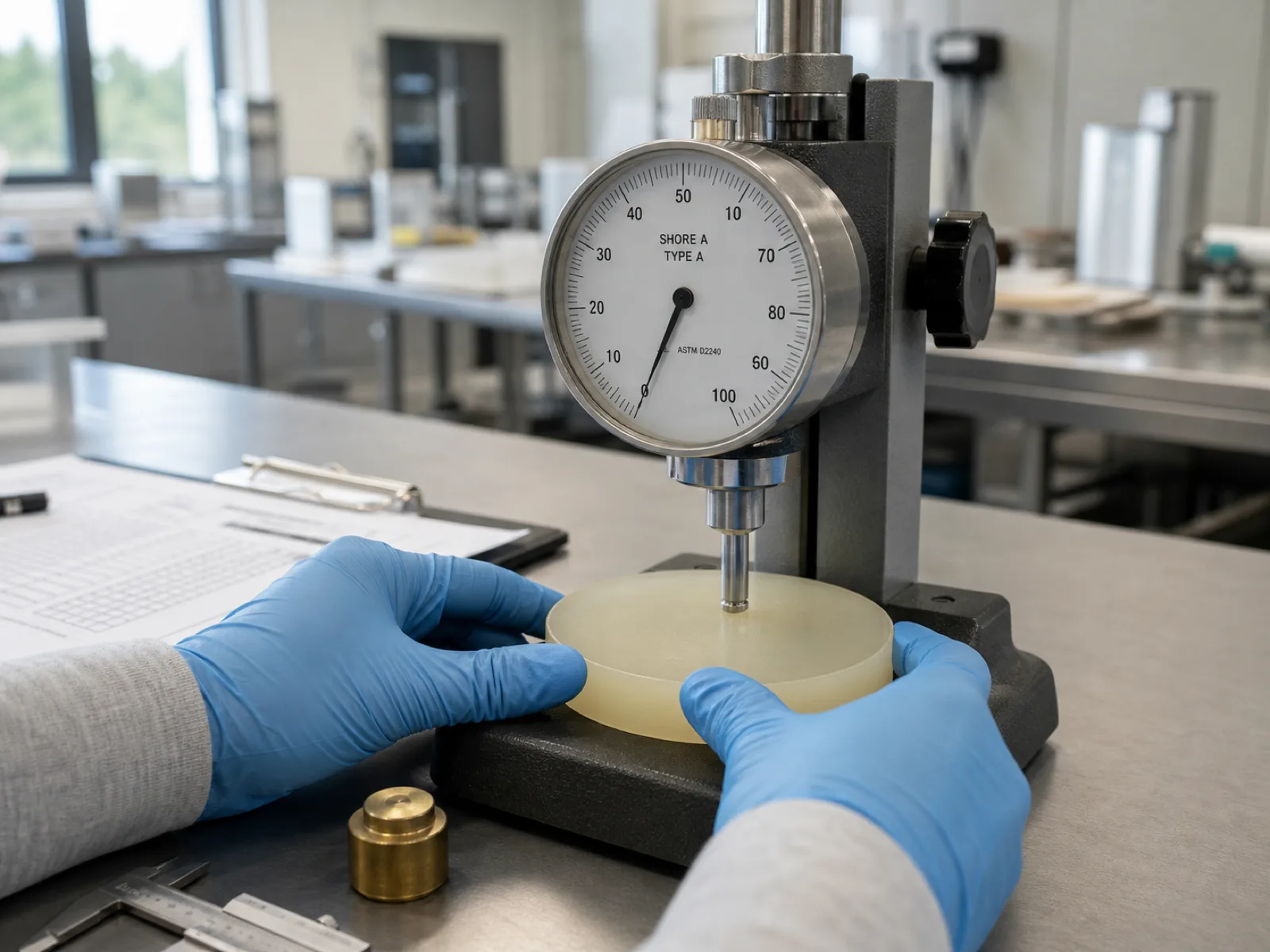
- Durometer verification — Shore A test on witness samples every 500 shots
- Traceability — cavity ID and lot code laser-etched or debossed into the cup; UDI-compliant per FDA 21 CFR 830
What are the MOQ, tooling cost, unit price, and lead time bands?
Typical OEM MOQ is 5,000-10,000 units per SKU per size for pilot; 25,000+ for mass production. Single-cavity hardened steel LSR tooling runs USD 4,500-8,500 per size and takes 35-45 days from PO to first shot. Multi-cavity 4-cav tools for 100k+/month volume run USD 15,000-28,000. Unit cost bands: USD 0.85-1.40 (5-10k), 0.65-0.95 (25k+), 0.48-0.72 (100k+) FOB Shenzhen.
The cost stack for a private-label menstrual cup program:
| Item | Small pilot (5,000) | Standard (25,000) | Mass (100,000) |
|---|---|---|---|
| Tooling (per size, single-cav) | USD 4,500-8,500 | USD 4,500-8,500 | USD 15,000-28,000 (4-cav) |
| Unit cost, cup only | 0.85-1.40 | 0.65-0.95 | 0.48-0.72 |
| Sterile pouch + seal | 0.18-0.28 | 0.14-0.22 | 0.11-0.18 |
| IFU printing (color, folded) | 0.12-0.20 | 0.09-0.15 | 0.07-0.12 |
| Retail carton (litho-print) | 0.35-0.55 | 0.28-0.42 | 0.22-0.35 |
| ISO 10993 panel (one-time) | 45,000-85,000 | 45,000-85,000 | 45,000-85,000 |
| Sterilization validation | 12,000-18,000 | 12,000-18,000 | 12,000-18,000 |
Lead time timeline for a new program:
- Weeks 0-2 — RFQ, NDA, design freeze, material selection
- Weeks 2-8 — tooling design, T1 sampling (3D-printed hand-poured for form check)
- Weeks 8-13 — steel tool cutting, T2 sampling (first shots off production tool)
- Weeks 13-17 — biocompatibility panel initiation (parallel with tool qualification)
- Weeks 17-31 — biocompatibility completion + FDA 510(k) preparation
- Weeks 31-40 — 510(k) submission and review
- Weeks 40-45 — pilot production run
- Weeks 45-52 — mass production and first shipment
Brands should budget 9-12 months from PO to first sellable inventory in the US, primarily gated by biocompatibility and 510(k) timing, not by manufacturing. For deeper reading on how MOQ math scales at 5k / 25k / 100k tiers on LSR programs generally, see our real factory MOQ guide.
What sterilization route and how is it validated?
Three validated routes: steam autoclave (121 °C, 15-30 min) for reusable cups the end user re-sterilizes; gamma irradiation at 25 kGy typical dose validated per ISO 11137-1[^iso-11137-1] for presterile shipment in sealed pouches; and ethylene oxide (EO) per ISO 11135 with residuals tested per ISO 10993-7. Route choice drives packaging design and shelf-life claims.
Most reusable menstrual cups on the US market ship non-sterile in a cloth pouch, with an IFU instructing the user to boil for 5-10 minutes before first use and between cycles. The manufacturer validates that the cup material and dimensional stability survive repeated autoclave cycles — typically 200-300 cycles without degradation, verified by accelerated aging per ASTM F1980.
Presterile pouched shipments (increasingly common as a premium retail offering) use gamma irradiation. The manufacturer’s sterilization validation must include:
- Bioburden testing per ISO 11737-1 on unsterilized product
- Dose-setting per ISO 11137-2 (Method 1 or VDmax)
- Dose audit quarterly per ISO 11137-1
- Material compatibility study (platinum-cured LSR handles gamma well up to 50 kGy without significant Shore A shift; peroxide-cured HCR does not)
- Aging study (accelerated + real-time) supporting the shelf-life claim
Ethylene oxide is a third option but the residual EO and ECH (ethylene chlorohydrin) testing per ISO 10993-7 adds cost and complexity, and post-EO aeration extends manufacturing lead time by 5-10 days. Most modern menstrual cup programs choose gamma over EO for presterile.
What dossier must the brand collect from the OEM before first ship?
For US 510(k), EU MDR, and UKCA, the brand must collect from the silicone menstrual cup manufacturer: DMF with letter of authorization, ISO 10993 finished-device reports, USP Class VI on the base LSR, sterilization validation, ISO 13485 certificate, per-lot CoA, ISO 14971 risk file, and technical file inputs for MDR Annex II. Missing any of these blocks legal market release.
The dossier is not a single document — it’s a document control system the brand builds up as the program advances. Below is the minimum checklist a brand’s regulatory affairs lead should treat as gate criteria before authorizing first commercial shipment.
Design phase deliverables from OEM:
- Device master file (DMF) — either the OEM submits a Type III DMF to FDA and provides the brand a letter of authorization to reference, or the OEM shares the DMF content directly under a Quality Agreement
- Material composition disclosure — LSR grade, pigment master-batch, mold-release residuals, cure catalyst residuals
- Manufacturing process description — cleanroom class, cycle parameters, post-cure protocol, sterilization method
- Risk management file per ISO 14971 covering manufacturing-side risks
Qualification phase deliverables:
- ISO 10993 biocompatibility test reports on the finished device (all endpoints in the ISO 10993-1 matrix)
- Extractables and leachables study (ISO 10993-18)
- Sterilization validation report (if presterile)
- Accelerated aging study supporting shelf-life claim per ASTM F1980
- Mechanical testing (compression recovery, tear strength, cyclic fatigue for reusable cups)
Production phase deliverables (per lot):
- Certificate of analysis with cavity ID, cure batch, LSR lot, sterilization batch (if presterile)
- SPC data on critical dimensions
- Visual AQL results at ISO 2859-1 sampling
- Deviation reports and CAPA records
Regulatory-body-facing deliverables:
- ISO 13485 certificate (renewed annually)
- FDA establishment registration (Form 2891) if OEM is manufacturer of record
- MDSAP audit report for multi-country coverage
- Notified body audit report inputs for EU MDR
The brand’s regulatory affairs function owns assembling these into the 510(k) submission, the MDR technical file, and the post-market surveillance system. The OEM’s job is to keep every document evergreen — dated, versioned, controlled, and available on request. A silicone menstrual cup manufacturer that cannot produce any of the above on 48-hour notice is not ready for regulated-market work.
Where Wetop Silicone fits in the intimate wellness OEM stack
Wetop Silicone runs platinum-cured LSR injection molding and compression molding at ISO 9001 discipline for kitchenware, drying mats, sink grids, and industrial silicone parts — not ISO 13485 finished medical devices. Brands sourcing menstrual cups should verify ISO 13485 certification before signing; brands sourcing peripheral silicone accessories, storage pouches, or non-body-contact intimate wellness parts can source directly from Wetop.
We publish this guide because intimate wellness brand owners are frequently under-served by generic Alibaba listings and over-charged by contract-manufacturer brokers with no manufacturing depth. The material science, cleanroom class, and dossier rigor are the same disciplines we apply to food-contact silicone under 21 CFR 177.2600 and LFGB §30/31 — but the operative certifications for a finished intra-vaginal device are ISO 13485 and 510(k), not ISO 9001 and food-contact. Sourcing the wrong tier of factory is the single most common cause of failed launches in this category.
If you are building the peripheral parts of an intimate wellness product line — silicone storage cases, sterilization pouches, foldable cups (non-body-contact), applicator components — the Wetop engineering desk can quote directly. If you are building the primary menstrual cup itself, we can point you to certified partners in our network. Talk to us at our contact page with your program brief, target market (US / EU / UK / global), MOQ tier, and target ship date, and we’ll route the RFQ appropriately.
References
FAQ
-
What silicone grade does a menstrual cup manufacturer use?
A compliant menstrual cup manufacturer uses platinum-cured (addition-cure) LSR at Shore A 40-70, tested to USP <88> Class VI and the full ISO 10993 biocompatibility panel. Common base resins are Dow SILASTIC Q7-4735/4750, Wacker ELASTOSIL LR 3003, Momentive Silopren LSR 2745, or Shin-Etsu KE-2090. Peroxide-cured HCR is not acceptable — its cure by-products (benzoic acid, DCBA) fail sensitization testing under ISO 10993-10 for mucosal contact devices.
-
Does a silicone menstrual cup need FDA 510(k) clearance?
Yes. In the US, menstrual cups are Class II medical devices under 21 CFR 884.5435, requiring 510(k) premarket notification. The brand of record is the submitter; the silicone menstrual cup manufacturer supplies supporting evidence — device master file (DMF) letter of authorization, ISO 10993 biocompatibility reports, sterilization validation, design history file inputs, and per-lot certificate of analysis.
-
Is ISO 9001 enough or does the OEM factory need ISO 13485?
ISO 9001 alone is not sufficient for finished-device manufacture. A silicone menstrual cup manufacturer producing for brands sold in the US, EU, UK, Canada, or Australia should hold ISO 13485:2016 medical device QMS certification. ISO 13485 adds design control, risk management (ISO 14971), UDI traceability, and CAPA discipline that ISO 9001 does not require. Buyers negotiating supply for FDA-registered brands should require ISO 13485 evidence before signing.
-
What cleanroom class is required for menstrual cup molding?
ISO 14644-1 Class 8 (formerly Class 100,000) is the operative minimum for LSR injection molding of intra-vaginal devices. Class 8 caps airborne particles at 3,520,000 particles ≥0.5 µm per m³. A serious silicone menstrual cup manufacturer runs the injection cell, demolding, deflashing, and primary packaging inside Class 8, with a laminar Class 7 zone at the mold face. Post-cure ovens, secondary sterilization (autoclave, gamma, or ethylene oxide), and sterile pouch sealing occur in a controlled adjacent zone.
-
What is the biocompatibility test panel for a menstrual cup?
Per ISO 10993-1, a menstrual cup is a mucosal-contact device with prolonged exposure (>24 h to 30 days). The required panel: cytotoxicity (ISO 10993-5), sensitization (10993-10), irritation (10993-23), material-mediated pyrogenicity (10993-11), systemic toxicity (10993-11), sub-acute/sub-chronic toxicity (10993-11), genotoxicity (10993-3), implantation (10993-6, in some cases waived), and chemical characterization (10993-18). Full panel run at ISO 17025 lab: USD 45,000-85,000, 12-18 weeks.
-
What is the MOQ and tooling cost for a private-label menstrual cup?
Typical MOQ from a silicone menstrual cup manufacturer is 5,000-10,000 units per SKU per size for pilot runs, 25,000+ for mass production. Single-cavity hardened steel LSR tooling runs USD 4,500-8,500 per size and takes 35-45 days from PO to first shot. Multi-cavity (4-cav) tools for 100k+/month volume run USD 15,000-28,000. Wetop's OEM program supports 5,000-unit pilots on single-cavity tooling to de-risk pre-launch — see our [MOQ and lead time guide](/guide/moq-and-lead-time-silicone-oem/) for the math on smaller runs.
-
How is a silicone menstrual cup sterilized before shipment?
Three validated routes. Steam autoclave (121 °C, 15-30 min) is used for reusable cups shipped in a cloth pouch — the end user re-sterilizes between cycles. Gamma irradiation (25 kGy typical dose) is used when the cup ships in a sealed sterile pouch as a single-use or presterile-reusable device — validated per ISO 11137. Ethylene oxide (EO) at ISO 11135 conditions is a third option but leaves residuals requiring aeration and testing per ISO 10993-7.
-
What custom variants can an OEM offer without new tooling?
Formulation-change (no new tool): color via medical-grade pigment master-batch (Pantone-matched, ΔE ≤ 2.0), firmness at Shore A 40 / 50 / 65 / 70, translucency level, and post-cure duration. Tooling-change (new steel): capacity/size (small/large/A/B), rim diameter and thickness, stem geometry, air-release hole pattern, and internal ridging. Logo debossing on the stem base is a mold-insert change (USD 350-600). Wetop's [logo customization guide](/guide/customize-silicone-logo-deboss-print-laser/) covers the debossing tolerance limits.
-
What regulatory dossier must a brand collect from the OEM?
For US 510(k), EU MDR Class IIa, and UKCA: (1) Device master file (DMF) with letter of authorization to reference, (2) ISO 10993 biocompatibility reports on the finished device, (3) USP Class VI certificate on the base LSR, (4) sterilization validation report if presterile, (5) ISO 13485 certificate of the OEM facility, (6) FDA establishment registration of the OEM (if listed as manufacturer of record), (7) per-lot certificate of analysis, (8) risk management file per ISO 14971, (9) design history file inputs, (10) technical file summary for MDR Annex II compliance.
References
Authoritative sources cited in this guide
- US Food and Drug Administration. 21 CFR 884.5435 — Menstrual cup. https://www.ecfr.gov/current/title-21/chapter-I/subchapter-H/part-884/subpart-F/section-884.5435 — US device classification (Class II) and 510(k) premarket notification requirement for menstrual cups sold in the US.
- International Organization for Standardization. ISO 10993-1:2018 — Biological evaluation of medical devices — Part 1: Evaluation and testing within a risk management process. https://www.iso.org/standard/68936.html — Defines the biocompatibility endpoint matrix used to select which sub-standards a menstrual cup must be tested against.
- International Organization for Standardization. ISO 13485:2016 — Medical devices — Quality management systems — Requirements for regulatory purposes. https://www.iso.org/standard/59752.html — The QMS standard that applies to a silicone menstrual cup manufacturer producing finished devices for regulated markets.
- United States Pharmacopeia. USP <88> Biological Reactivity Tests, In Vivo — Class VI. https://www.usp.org/harmonization-standards/pdg/excipients/plastic-materials — Class VI is the highest biological reactivity tier — the baseline material-level test cited on medical-grade silicone raw material CoAs.
- International Organization for Standardization. ISO 14644-1:2015 — Cleanrooms and associated controlled environments — Part 1: Classification of air cleanliness by particle concentration. https://www.iso.org/standard/53394.html — Cleanroom class definitions; ISO Class 8 is the operative minimum for LSR injection molding of a mucosal contact device.
- International Organization for Standardization. ISO 11137-1:2006 — Sterilization of health care products — Radiation — Part 1: Requirements for development, validation and routine control. https://www.iso.org/standard/33952.html — Gamma sterilization validation used for presterile menstrual cups shipped in sealed pouches.
- International Organization for Standardization. ISO 14971:2019 — Medical devices — Application of risk management to medical devices. https://www.iso.org/standard/72704.html — Risk management framework the OEM's design history file must satisfy for MDR and 510(k) technical documentation.
- European Commission. Regulation (EU) 2017/745 on medical devices. https://eur-lex.europa.eu/eli/reg/2017/745/oj — EU MDR classification rules; menstrual cups fall under Class IIa (Rule 5, mucosal contact) and require notified body conformity assessment.
Start a custom program
Send a brief. Get an engineer’s reply in one business day.
Every Wetop program is tooled from a customer’s specification. Send a CAD file (STEP · IGES · DWG) or a written brief and we’ll reply with a mold cost estimate, price brackets at MOQ 500 / 1,000 / 5,000, and any engineering questions.