Buyer Guide · commercial intent
Silicone Remote Control Cover OEM Guide — Specs, MOQ
What changed: First publication for the silicone-remote-control-cover keyword. The current SERP is dominated by Alibaba buyer-guides and generic sleeve catalogs with zero regulatory citations, no tooling cost transparency, and no IR-transmission specs. This guide answers the same buyer questions with named CFR sections, published Shore A and elongation math, and honest 500-piece MOQ tooling economics from the compression-mold floor.
 Buyer Guide
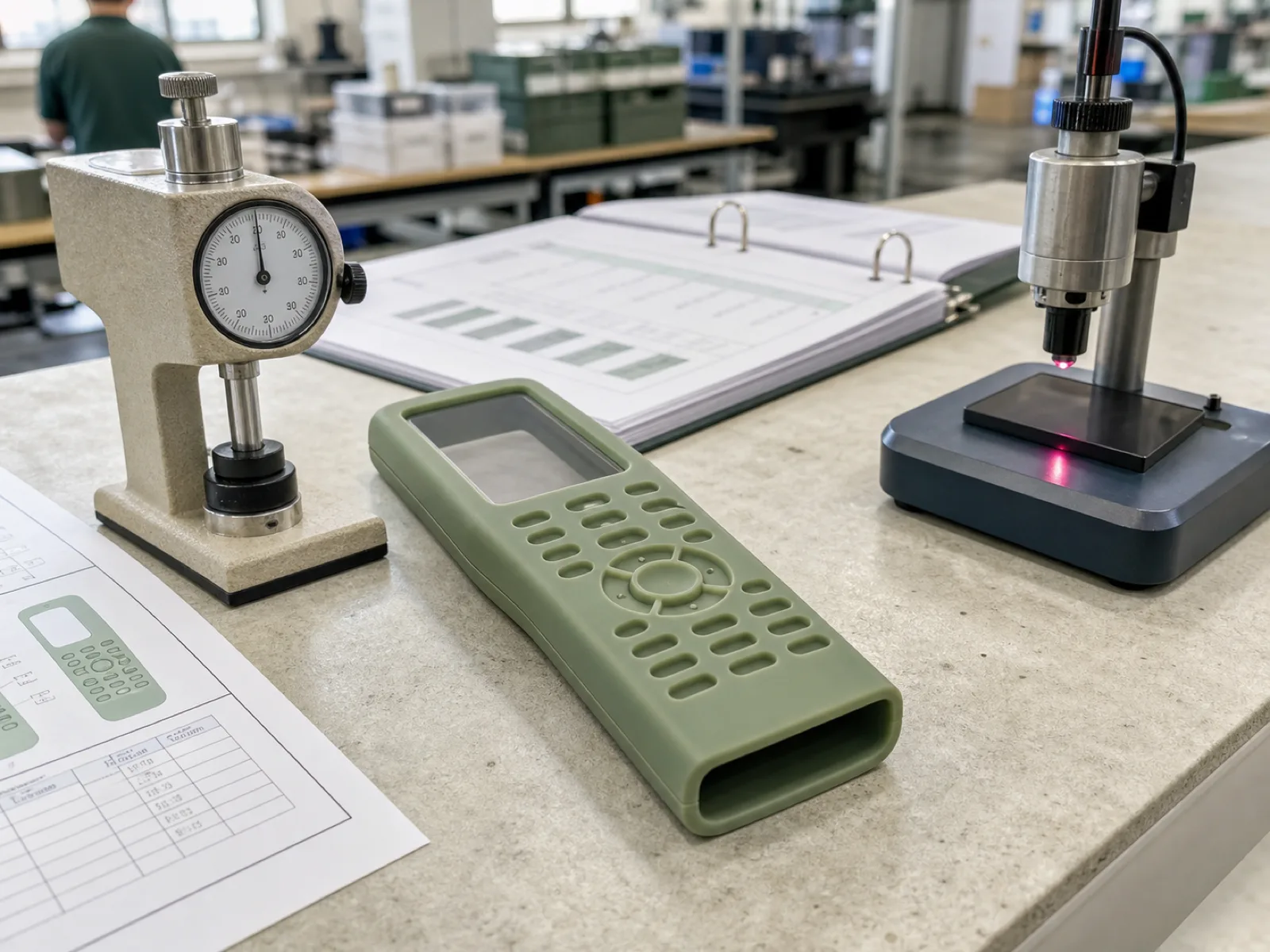
 A silicone remote control cover is a one-piece molded silicone sleeve that snap-fits over a TV, streaming, or medical remote to protect it from drops, spills, and abrasion. Correctly specified covers hold Shore A 30-50, elongation-at-break above 500%, and IR-window transmission above 92% at 940 nm. Wetop tools custom sleeves at MOQ 500 with 55-85 day first-program lead time from CAD-in-hand.
Buyers land on this page because the stock universal sleeves in their category do not fit, do not certify, or do not survive the second retail cycle. This guide walks the seven decisions that separate a program that ships clean at 10 k units from a program that gets pulled off the shelf for IR range complaints or yellowing after six weeks: material grade, hardness and elongation, IR-window geometry, tool architecture, MOQ economics, process choice, and QC protocol. The numbers are the same numbers on our compression-mold floor and our LSR cell in Dongguan today.
How a silicone remote control cover is actually built
A silicone remote control cover is a single-piece platinum-cured silicone shell — no seams, no bonded assemblies, no rigid inserts — molded to snap over a specific remote body with cutouts for the IR window, button wells, battery door, and any status LEDs. The shell stretches during installation and relaxes into a friction fit, held by silicone's high elongation (500%+ per ASTM D412[^astm-d412]) and geometric interference at the battery-door lip.
The part starts life as either a HCR (high-consistency rubber) preform loaded into a heated compression mold or a two-part LSR (liquid silicone rubber) injected into a cold-runner tool. Cure temperature runs 170-200°C, cure time 90-180 seconds for HCR compression and 25-90 seconds for LSR injection. After demold, parts move through post-cure (4 hours at 200°C for medical-grade to drive off residual peroxide or platinum-cure by-products), flash trimming, silk-screen or laser-etch decoration if specified, and final AQL inspection per ANSI/ASQ Z1.4[^ansi-asq-z14].
The geometry that matters:
| Feature | Typical spec | Why it matters |
|---|---|---|
| Overall wall thickness | 0.8-1.8 mm | Below 0.8 mm tears during install; above 1.8 mm feels bulky and adds material cost |
| IR-window wall | 0.8-1.2 mm, no pigment | Anything thicker or pigment-loaded drops 940 nm transmission below 92% |
| Button-well wall | 1.2-1.6 mm | Preserves tactile actuation force without softening the click |
| Battery-door lip interference | 0.3-0.5 mm | Holds the sleeve on the remote without tearing after 500 install-remove cycles |
| Corner radius | ≥ 1.5 mm | Reduces stress concentration and prevents tear initiation at drop-impact points |
Material grade: platinum-cured LSR vs peroxide-cured HCR vs generic blend
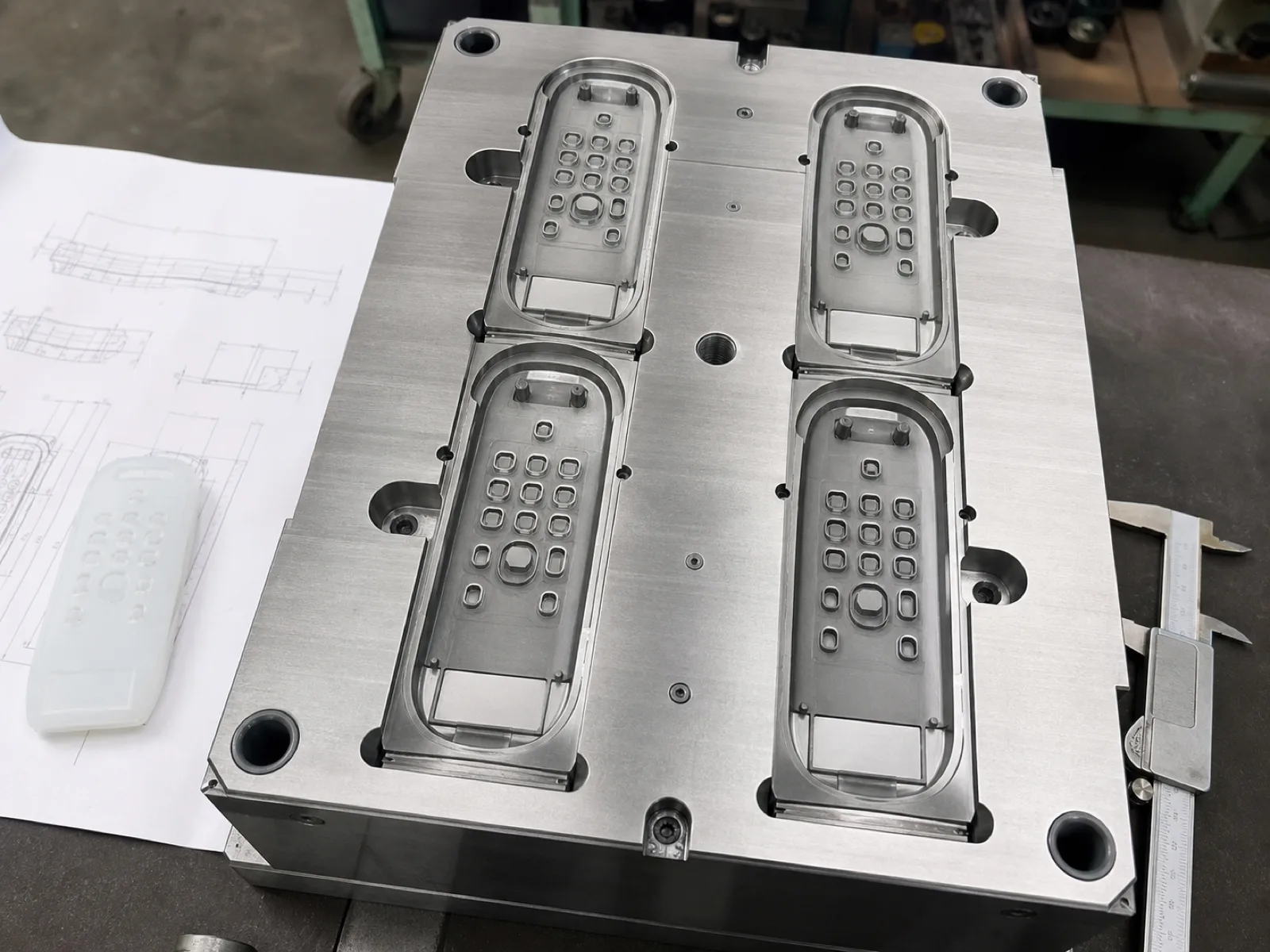
Material grade decides regulatory scope, color stability, and off-gassing behavior. Platinum-cured LSR clears FDA 21 CFR 177.2600[^fda-177-2600] and LFGB cleanly with no post-cure required for food-contact adjacency; peroxide-cured HCR needs a 4-hour post-cure at 200°C to drive off peroxide residues; generic blends off-gas, yellow under UV within 3-6 months, and fail RoHS[^rohs-2011-65] pigment audits.
The three grades, ranked by cost and compliance:
| Grade | Cure chemistry | Typical use | Regulatory clearance | Cost index |
|---|---|---|---|---|
| Platinum-cured LSR (medical/food) | Pt catalyst addition-cure | Medical remotes, retail food-adjacent | FDA CFR 177.2600, LFGB, USP Class VI, ISO 10993-5[^iso-10993-5] | 2.5-3.5× |
| Platinum-cured HCR | Pt catalyst addition-cure | Premium retail, hospitality | FDA CFR 177.2600, LFGB, RoHS, REACH[^echa-reach] | 1.5-2.0× |
| Peroxide-cured HCR | Peroxide free-radical cure | Standard consumer electronics | FDA CFR 177.2600 with post-cure, RoHS | 1.0× |
| Generic blend (fillers + peroxide) | Peroxide, cost-optimized | Discount retail, no-name Amazon | None reliably; RoHS often fails on cadmium pigments | 0.6-0.8× |
The generic blend is where cheap Amazon sleeves come from. Common failure modes we see when buyers send us competitor samples: yellowing after 3-6 months under indoor UV, sticky surface bloom after 12 months (silicone oil migration from under-cured elastomer), Shore A drift of 8-15 points after 18 months (residual peroxide continuing to crosslink at ambient), and heavy-metal exceedances on RoHS retests when pigment-house documentation was not verified. Wetop does not quote programs on generic-blend silicone — the compliance liability is too high and the repeat-order rate is too low.
Universal-fit vs model-specific tooling
Universal-fit sleeves use a one-tool, one-SKU design that stretches to fit ~70% of mainstream TV / streaming remote body sizes; model-specific tooling cuts a precise sleeve for one target remote at a time. Universal-fit is right below 3 k units total across all target remotes; model-specific pays back above 5 k units per SKU because per-piece cost drops under $0.15 and button-well precision reaches ±0.15 mm instead of ±0.5 mm.
The tooling economics, at Q3 2026 Yantian prices:
| Tool architecture | Tool cost | Cavity count | Unit cost at 5k | Unit cost at 20k | Break-even vs next tier |
|---|---|---|---|---|---|
| Universal-fit compression, 1-cavity | $800-$1,200 | 1 | $0.95-$1.35 | $0.85-$1.20 | — |
| Universal-fit compression, 4-cavity | $2,000-$3,000 | 4 | $0.55-$0.75 | $0.45-$0.60 | 3,500 pieces |
| Model-specific compression, 4-cavity | $2,500-$4,000 | 4 | $0.60-$0.80 | $0.48-$0.62 | 5,000 pieces |
| Model-specific LSR injection, 4-cavity | $8,000-$18,000 | 4 | $0.85-$1.10 | $0.42-$0.58 | 30,000 pieces |
| Two-shot LSR (colored body + clear IR window) | $15,000-$28,000 | 2-4 | — | $0.55-$0.75 | 50,000 pieces + single-shot IR window advantage |
Model-specific tooling requires a STEP or IGES CAD file of the target remote (or a physical remote sample we 3D-scan in-house), a target Shore A and elongation spec, IR-window dimensions and location, button count and layout, battery-door dimensions, and any RGB / status-LED windows. DFM review takes 2-4 business days; a signed DFM report goes back before tool cut.
Manufacturing process: compression vs LSR injection vs two-shot
Compression molding is the right choice for programs below 30 k annual volume: low tooling, forgiving of design changes, 90-180 second cycle. LSR injection wins above 30 k units per year: 25-90 second cycle, ±0.05 mm tolerance, 60-80% less flash-cleanup labor, and full automation. Two-shot LSR (also called dripping or turntable gating) shoots a clear IR-window into a colored body in one cycle — eliminates the ink or bonding step that fails at 6-12 months in the field.
Cycle-time and unit-cost comparison at 10,000 annual units:
| Process | Tool cost | Cycle time | Labor per part | Flash cleanup | Unit cost |
|---|---|---|---|---|---|
| Compression, 4-cavity | $2,500-$4,000 | 120-180 s | 45-60 s | 15-25 s | $0.55-$0.85 |
| LSR injection, 4-cavity | $8,000-$14,000 | 40-60 s | 8-15 s | 3-8 s | $0.65-$0.95 |
| Two-shot LSR, 2-cavity | $15,000-$22,000 | 60-90 s | 12-20 s | 4-10 s | $0.85-$1.20 |
The two-shot process is worth the tooling premium the moment a buyer requires a mid-body clear IR window with a colored body. The alternative — molding a through-hole and bonding a clear silicone lens with adhesive — fails at 6-12 months in the field: the adhesive line yellows first, then the lens separates during install-remove cycles, and warranty returns spike. Two-shot molding runs one continuous silicone-to-silicone crosslink at the interface with no adhesive.
Color, logo, finish, and legend options
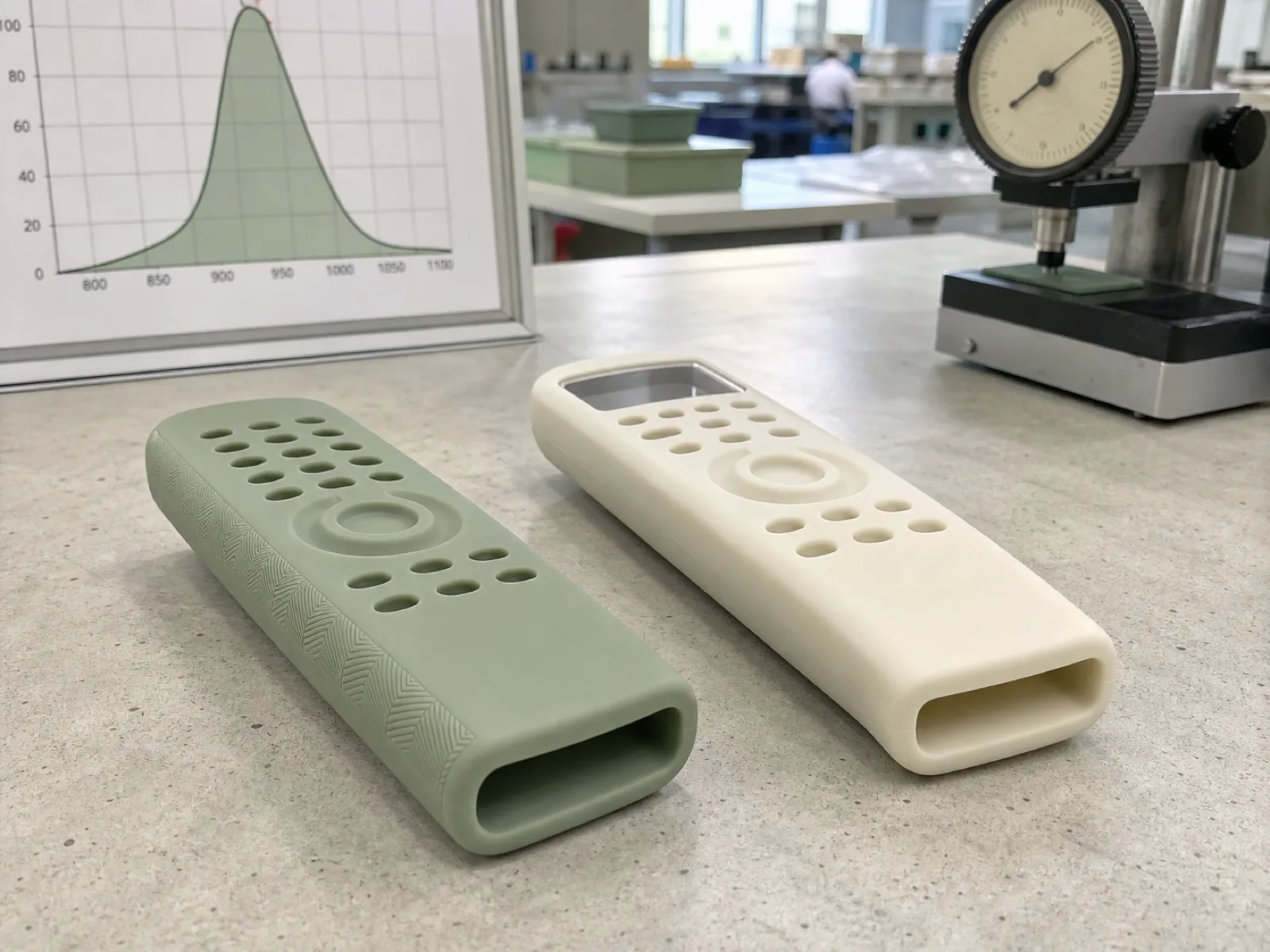
Color runs on Pantone-matched masterbatch dispersion targeting ΔE ≤ 1.5 against a signed chip, verified on a spectrophotometer. Logo options rank by durability: debossed (permanent, zero per-piece cost), laser-etch (permanent, backlit-look), silk-screen with PU top coat (100 k+ alcohol-wipe cycles), silk-screen without top coat (5-20 k wipes — cheap Amazon default). Glow-in-the-dark pigment holds 4-8 hours of afterglow after light exposure.
The five decoration choices and their tradeoffs:
| Method | Durability | Cost per pc | Notes |
|---|---|---|---|
| Debossed logo in mold | Permanent | $0.00 | Tool cost only; zero ongoing per-piece cost; no color |
| Laser-etch through opaque top skin | Permanent | $0.05-$0.12 | Exposes translucent silicone; backlit-legend look |
| Silk-screen with PU top coat | 100k-300k alcohol wipes | $0.06-$0.14 | Retail default; any Pantone color |
| Silk-screen without top coat | 5k-20k wipes | $0.03-$0.06 | Cheap Amazon default; fails alcohol-wipe QC |
| In-mold decoration (IMD film) | Permanent, photo-quality | $0.15-$0.30 | Premium hospitality / consumer electronics |
Antimicrobial additive (silver-ion or zinc-pyrithione) adds $0.10-$0.20/pc and clears ISO 22196[^iso-22196] test for ≥ 99% bacterial reduction against S. aureus and E. coli — a hard requirement on cruise-ship, hotel, and hospital call-remote programs.
Certifications, compliance, and UV stability
Compliance scope depends on the end market. Retail consumer electronics: FDA CFR 177.2600, RoHS, REACH SVHC. European retail: LFGB § 30 LMBG additional. Hospitality: retail stack plus ISO 22196 antimicrobial data if the claim is on-pack. Medical device: ISO 10993-5 and ISO 10993-10 or USP Class VI. Certificate renewals happen every 12-24 months as SVHC candidate lists update.
The compliance matrix by end market:
| End market | Required certs | Renewal cycle | Typical test-report cost |
|---|---|---|---|
| US retail (Best Buy, Amazon private-label) | FDA 177.2600, RoHS, REACH SVHC | 24 months | $600-$1,200 |
| EU retail | FDA + LFGB § 30, RoHS, REACH | 24 months | $900-$1,600 |
| Hospitality (hotels, cruise) | Retail + ISO 22196 (if antimicrobial claim) | 12 months on antimicrobial | +$400-$800 |
| Medical device housing | ISO 10993-5 + -10, USP Class VI, IEC 60601-1 (device-level) | 24 months on material, per-device on IEC | $2,500-$5,000 |
| Children’s product | Retail + CPSIA phthalate (8 phthalates), lead ≤ 90 ppm | 24 months | +$500-$900 |
UV stability is the compliance test buyers forget. Silicone’s UV stability comes from the polymer backbone (Si-O bonds are inherently UV-stable), but pigment choice can wreck the story: chrome-based yellows and reds degrade under UV in 6-12 months, cadmium-based pigments both yellow and fail RoHS heavy-metal audits, and non-encapsulated organic dyes migrate to the surface within 3-6 months. Wetop specs iron-oxide and titanium-dioxide pigment systems for warranty-critical programs — inorganic, UV-stable, RoHS-clear, and color-fast for 24-36 months of indoor UV exposure.
MOQ, tooling amortization, and unit-price math
Wetop MOQ is 500 pieces per SKU on standard compression tooling. Tool cost amortizes across the first production run: at 500 units, tooling contributes $1.60-$3.60 per piece; at 5 k units, $0.16-$0.36 per piece; at 30 k units, $0.03-$0.06 per piece. This is why unit price drops non-linearly across volume tiers — the tool cost gets spread thin as volume scales.
Unit-price bands FOB Yantian at Q3 2026, for a 4-cavity compression-molded universal-fit sleeve on platinum-cured HCR:
| Order quantity | Tooling contribution | Material + process | Total unit price |
|---|---|---|---|
| 500 pcs | $1.60-$3.60 | $0.55-$0.85 | $2.15-$4.45 (tooling front-loaded; repeat orders drop 60-70%) |
| 3,000 pcs | $0.27-$0.60 | $0.52-$0.78 | $0.79-$1.38 |
| 10,000 pcs | $0.08-$0.18 | $0.45-$0.68 | $0.53-$0.86 |
| 30,000 pcs | $0.03-$0.06 | $0.38-$0.58 | $0.41-$0.64 |
| 100,000 pcs | $0.01-$0.02 | $0.28-$0.45 (LSR line) | $0.29-$0.47 |
The economic pattern: on a first-time 500-piece program, tooling looks expensive because it front-loads. Repeat orders on the same tool drop to material + process only, so the second 500-piece run lands at $0.55-$0.85 per piece. Our /guide/real-factory-moq-the-math/ guide walks the full math on why MOQ 500 is a real floor and not a marketing number.
QC protocol: the four gates that separate a factory from a broker
Wetop runs four QC gates on every silicone remote-cover lot: incoming raw-material CoA verification against ASTM D2240[^astm-d2240] Shore A durometer, in-process AQL 1.5 sampling on button-well and wall-thickness dimensions per ANSI/ASQ Z1.4[^ansi-asq-z14], final IR-transmission test at 940 nm on a photodiode rig against a ≥ 92% target, and third-party lab reports (SGS / Intertek / TÜV) on FDA / LFGB / RoHS renewed every 12-24 months.
The four gates in detail:
Gate 1 — Incoming raw material. Every drum of silicone base and every masterbatch batch gets CoA (Certificate of Analysis) review plus in-house Shore A verification on a calibrated Type A durometer. Calibration certificate is available on request and stays under 90 days old. Any drum failing the ±3 Shore A CoA-vs-measured band gets quarantined and returned to the compound house.
Gate 2 — In-process AQL 1.5. During production, every 100th part off the mold gets pulled and measured against a documented critical-dimension list: overall length and width, wall thickness at 6 measurement points, button-well diameters, IR-window opening, and battery-door lip interference. ANSI/ASQ Z1.4 AQL 1.5 acceptance sampling — reject one critical defect, quarantine the lot for 100% inspection.
Gate 3 — Final IR + fit test. Every lot ships with a functional test: 100% IR-transmission verification at 940 nm on a photodiode rig against a bare-air reference (target ≥ 92%), plus a 100-sample fit-and-actuation test on the target remote (or a golden-sample master where the target remote is proprietary). Result: an IR-transmission histogram and a pass/fail actuation report go into the shipping documentation.
Gate 4 — Third-party compliance renewal. SGS, Intertek, or TÜV lab reports on FDA CFR 177.2600, LFGB § 30, RoHS, and REACH SVHC get renewed every 12-24 months against updated candidate lists. Reports are shared as PDFs to buyers on request and cross-checked against the sample batch code on the CoA.
Reject a factory that cannot answer Gate 1 and Gate 4 questions in writing within 24 hours. Reject any factory that offers “IR-transparent silicone” without a photodiode transmission spec at 940 nm.
The RFQ package that gets a costed quote back in 3 business days
A production-ready silicone remote-cover RFQ carries seven items: STEP or IGES CAD of the target remote, target Shore A and elongation, IR-window location and transmission target, decoration spec, regulatory scope, expected annual volume, and packaging spec. Send the full package and Wetop returns a costed quote with DFM feedback in 2-3 business days; miss items and the RFQ bounces for clarification.
The seven items:
- CAD of the target remote — STEP, IGES, or X_T. Screenshots and dimensioned drawings work but slow the DFM review by 3-5 days.
- Target Shore A and elongation — e.g. Shore A 40 ± 5, elongation ≥ 500%, tensile ≥ 8 MPa.
- IR-window spec — location, opening dimensions, and required transmission (default ≥ 92% at 940 nm).
- Decoration — Pantone color, logo method (debossed / laser-etch / silk-screen with PU coat), finish (matte / satin / gloss), any glow-in-the-dark or antimicrobial requirement.
- Regulatory scope — FDA + LFGB + RoHS + REACH (retail default), plus ISO 22196 or ISO 10993 if applicable.
- Expected annual volume — drives tool architecture and process choice (compression vs LSR vs two-shot).
- Packaging — poly bag, insert card, retail blister, master carton dimensions and carton-marking spec.
Wetop returns: a costed quote at three volume tiers (500 / 3,000 / 10,000 or scaled to the buyer’s number), a DFM report flagging any wall-thickness, button-well, or IR-window issues, a tooling cost with cavity-count recommendation, a lead-time breakdown from CAD-in-hand to first container, and a sample plan for the first-article approval cycle.
Ready to move a silicone remote control cover program off stock sleeves and onto tooling? Send the CAD and the seven-item RFQ package to our engineering desk via the contact form and we return a costed quote in 2-3 business days. If you are earlier in the evaluation — comparing HCR vs LSR, checking whether your annual volume clears the LSR break-even, or working through the FDA / LFGB compliance stack — the guides linked above answer each of those questions with the same numbers we work to on the mold floor.
FAQ
-
What is a silicone remote control cover and why do buyers order custom ones instead of stock sleeves?
A silicone remote control cover (also called a silicone remote sleeve or silicone remote case) is a one-piece molded silicone rubber shell that snap-fits over an IR or RF remote — TV remotes, streaming sticks, set-top boxes, projectors, ceiling-fan controllers, hospital call remotes, hotel-room controllers. Custom orders happen when a stock universal sleeve does not fit the target device (button layout, IR-window location, or overall dimensions mismatch), when the buyer needs Pantone-matched brand colors, silk-screen or laser-etched logos, glow-in-the-dark accents, antimicrobial additives for hospitality and healthcare, or when compliance scope requires FDA 21 CFR 177.2600 and LFGB material documentation that no-name sleeves cannot supply. Custom tooling starts at $800-$1,800 for a universal-fit mold and $2,500-$4,000 for a model-specific mold at MOQ 500 pieces.
-
What Shore A hardness and elongation should a silicone remote control cover be specified at?
For stretch-over-the-remote installation the standard target is Shore A 30-50 with elongation-at-break ≥ 500% and tensile strength ≥ 8 MPa (verified per ASTM D412). Shore A under 25 tears during installation; over 55 refuses to stretch over the battery-door lip and buyers get returns. The 30-50 band delivers a stable snap-fit that survives 500+ install-remove cycles without tearing at the corners — the failure mode that kills warranty margins. Wall thickness across the body typically runs 0.8-1.8 mm; battery-door and IR-window walls run 0.8-1.2 mm; button wells run 1.2-1.6 mm to preserve tactile actuation without softening the click.
-
How do we keep IR signal pass-through working through a silicone remote control cover?
Three variables control IR-window performance at 940 nm: wall thickness in front of the LED, silicone base grade (clear platinum-cured LSR wins), and pigment/filler load in the front window (must be near-zero). Standard spec: 0.8-1.2 mm wall, no colorant in the IR-window zone (mold-in a clear window into a colored body via two-shot / dripping process, or leave a molded through-hole and bond a clear IR lens), and zero titanium-dioxide load in the window area. Verified transmission target ≥ 92% at 940 nm on a photodiode rig against a bare-air reference. Anything below 80% and the remote's effective range drops from 8 m to under 3 m — the number one field complaint.
-
Which is better for a silicone remote control cover — LSR injection molding or HCR compression molding?
HCR (high-consistency rubber) compression molding is the right choice below 30 k annual volume: tooling is $800-$4,000, cycle time is 90-180 seconds, and unit cost lands $0.35-$1.20 depending on cavity count. LSR (liquid silicone rubber) injection molding is the right choice above 30 k annual volume: tooling is $8,000-$18,000, cycle time drops to 25-90 seconds, dimensional tolerance tightens from ±0.10 mm to ±0.05 mm, and flash cleanup labor drops by 60-80%. Two-shot LSR (for a clear IR-window bonded to a colored body in one shot) tools at $15,000-$28,000 but eliminates a bonding step. See our platinum-cured vs peroxide-cured comparison in [/guide/platinum-cured-vs-peroxide-cured-silicone/](/guide/platinum-cured-vs-peroxide-cured-silicone/) for the material chemistry breakdown.
-
What is the MOQ and unit price for a custom silicone remote control cover from a factory like Wetop?
MOQ is 500 pieces per SKU on a single-cavity compression tool. Indicative unit price bands FOB Yantian, Q3 2026: at 500 pieces $0.85-$1.40/pc (tooling amortized), at 3,000 pieces $0.55-$0.85/pc on a 4-cavity compression mold, at 10,000 pieces $0.35-$0.55/pc on an 8-cavity compression or single-cavity LSR mold, at 30,000+ pieces $0.22-$0.35/pc on multi-cavity LSR tooling. Add $0.03-$0.08/pc for silk-screen logo, $0.05-$0.12/pc for laser-etch legend, $0.06-$0.14/pc for glow-in-the-dark pigment, and $0.10-$0.20/pc for antimicrobial additive package. Individual polybag + insert card packaging runs $0.06-$0.12/pc.
-
What is the lead time from RFQ to first production shipment for a silicone remote cover program?
Standard lead time on a new SKU: DFM (design for manufacturability) review 2-4 business days after receiving the STEP/IGES CAD and target remote sample, tooling cut 15-22 days for compression, 25-35 days for LSR, first-article sample 7-15 days after tool completion, sample approval 5-10 days on the buyer side, production run 20-30 days for 5,000-20,000 pieces after PO. Total elapsed clock: 55-85 days from CAD-in-hand to a container leaving Yantian on a first-time program; 25-40 days on a repeat order. Air freight sample shipment adds 3-5 days; sea freight to US West Coast adds 14-18 days. Full lead-time math is in our [/guide/moq-and-lead-time-silicone-oem/](/guide/moq-and-lead-time-silicone-oem/) guide.
-
How do we customize color, logo, and finish on a silicone remote control cover?
Color: Pantone-matched masterbatch dispersion (target ΔE ≤ 1.5 against a signed Pantone chip), colors verified on a spectrophotometer. Logo options: silk-screen (pad print) with a PU or epoxy top coat (100 k+ alcohol-wipe cycles), laser-etch through an opaque outer skin exposing translucent silicone underneath (backlit-legend look, permanent, no wear), debossed logo in the tool (zero cost per piece after tooling amortization, no ink required). Finish: matte (Ra 0.8-1.6 μm) is the default and hides fingerprints; satin (Ra 0.4-0.8 μm) is a mid-gloss retail look; high-gloss (Ra < 0.2 μm) shows every dust particle and buyers regret it. Glow-in-the-dark strontium-aluminate pigments hold luminescence for 4-8 hours after light exposure. Full color/logo methodology in [/guide/customize-silicone-logo-deboss-print-laser/](/guide/customize-silicone-logo-deboss-print-laser/).
-
What certifications does a silicone remote control cover need for retail, hospitality, or medical device applications?
Retail consumer electronics: FDA 21 CFR 177.2600 (food-contact adjacencies for kitchen-adjacent remotes and streaming controllers), RoHS 2011/65/EU (heavy-metal limits), REACH SVHC screening. Hospitality (hotel-room controllers, cruise-ship remotes): the retail stack plus optional antimicrobial claim under ISO 22196 test — Wetop supplies material and part-level test data, not marketing claims. Medical device (hospital nurse-call remotes, patient-hand controllers): ISO 10993-5 cytotoxicity + ISO 10993-10 irritation/sensitization, USP Class VI for US market, IEC 60601-1 EMC for the final device (device-maker responsibility, not the sleeve). European retail also needs LFGB § 30 LMBG food-contact certificate. RoHS + REACH renewals every 12-24 months against updated SVHC candidate lists.
-
How does a real silicone-remote-cover factory run QC — what should we ask for in an audit?
Four QC gates separate a real factory from a broker reselling a Guangdong molder. First: incoming raw-material CoA (Certificate of Analysis) plus in-house Shore A verification per ASTM D2240 with a calibrated Type A durometer — ask for the calibration certificate and check the date. Second: in-process AQL 1.5 (ANSI/ASQ Z1.4 acceptance sampling) on button-well diameter, wall thickness, and overall dimensions with a documented rejection log per lot. Third: final IR-transmission test at 940 nm on a photodiode rig against a bare-air reference (target ≥ 92%) plus a functional fit test on the target remote with actual button actuation. Fourth: third-party lab reports (SGS / Intertek / TÜV) for FDA / LFGB / RoHS renewed every 12-24 months — ask for the report PDF and cross-check the sample batch code against the CoA. Full audit checklist in [/guide/sourcing-silicone-factory-checklist/](/guide/sourcing-silicone-factory-checklist/).
References
Authoritative sources cited in this guide
- US Food and Drug Administration. 21 CFR 177.2600 — Rubber articles intended for repeated use. https://www.ecfr.gov/current/title-21/chapter-I/subchapter-B/part-177/subpart-C/section-177.2600 — The primary US food-contact regulation Wetop tests silicone remote-cover material against — required for retail and hospitality applications where the sleeve may touch food-service surfaces.
- International Organization for Standardization. ISO 9001:2015 — Quality Management Systems — Requirements. https://www.iso.org/standard/62085.html — The documented quality management system Wetop is certified against — governs the incoming-inspection, in-process-AQL, and final-inspection procedures cited in the QC section.
- ASTM International. ASTM D2240 — Standard Test Method for Rubber Property — Durometer Hardness. https://www.astm.org/d2240-15r21.html — The Shore A durometer test standard used to verify incoming raw silicone and finished-part hardness against the 30-50 Shore A spec.
- ASTM International. ASTM D412 — Standard Test Methods for Vulcanized Rubber and Thermoplastic Elastomers — Tension. https://www.astm.org/d0412-16r21.html — The tensile-strength and elongation-at-break test method Wetop uses to verify the ≥ 500% elongation spec that allows stretch-over-the-remote installation.
- International Organization for Standardization. ISO 10993-5:2009 — Biological evaluation of medical devices — Tests for in vitro cytotoxicity. https://www.iso.org/standard/36406.html — The cytotoxicity test method required for silicone remote covers used in medical device housings — hospital nurse-call remotes, patient controllers.
- European Chemicals Agency. Regulation (EC) No 1907/2006 — REACH: Registration, Evaluation, Authorisation and Restriction of Chemicals. https://eur-lex.europa.eu/legal-content/EN/TXT/?uri=CELEX%3A32006R1907 — The EU chemical-substances regulation Wetop screens finished-part material against for SVHC candidate substances — renewal required every 12-24 months as the candidate list grows.
- European Commission. Directive 2011/65/EU (RoHS) — Restriction of Hazardous Substances in Electrical and Electronic Equipment. https://eur-lex.europa.eu/legal-content/EN/TXT/?uri=CELEX%3A32011L0065 — The EU heavy-metal restriction Wetop tests silicone remote-cover pigments and additives against — required baseline for any electronics-adjacent silicone part sold into the EU or US retail.
- International Organization for Standardization. ISO 22196:2011 — Measurement of antibacterial activity on plastics and other non-porous surfaces. https://www.iso.org/standard/54431.html — The test method used to substantiate antibacterial claims on hospitality and healthcare silicone remote covers — Wetop supplies test-coupon data, not marketing claims.
- American Society for Quality. ANSI/ASQ Z1.4-2003 (R2018) — Sampling Procedures and Tables for Inspection by Attributes. https://asq.org/quality-press/display-item?item=T838E — The AQL sampling standard Wetop uses for in-process and final inspection — the AQL 1.5 level cited in the QC section is defined here.
Start a custom program
Send a brief. Get an engineer’s reply in one business day.
Every Wetop program is tooled from a customer’s specification. Send a CAD file (STEP · IGES · DWG) or a written brief and we’ll reply with a mold cost estimate, price brackets at MOQ 500 / 1,000 / 5,000, and any engineering questions.