Buyer Guide · commercial intent
Silicone Shower Mat OEM Guide — Specs, MOQ, Tooling
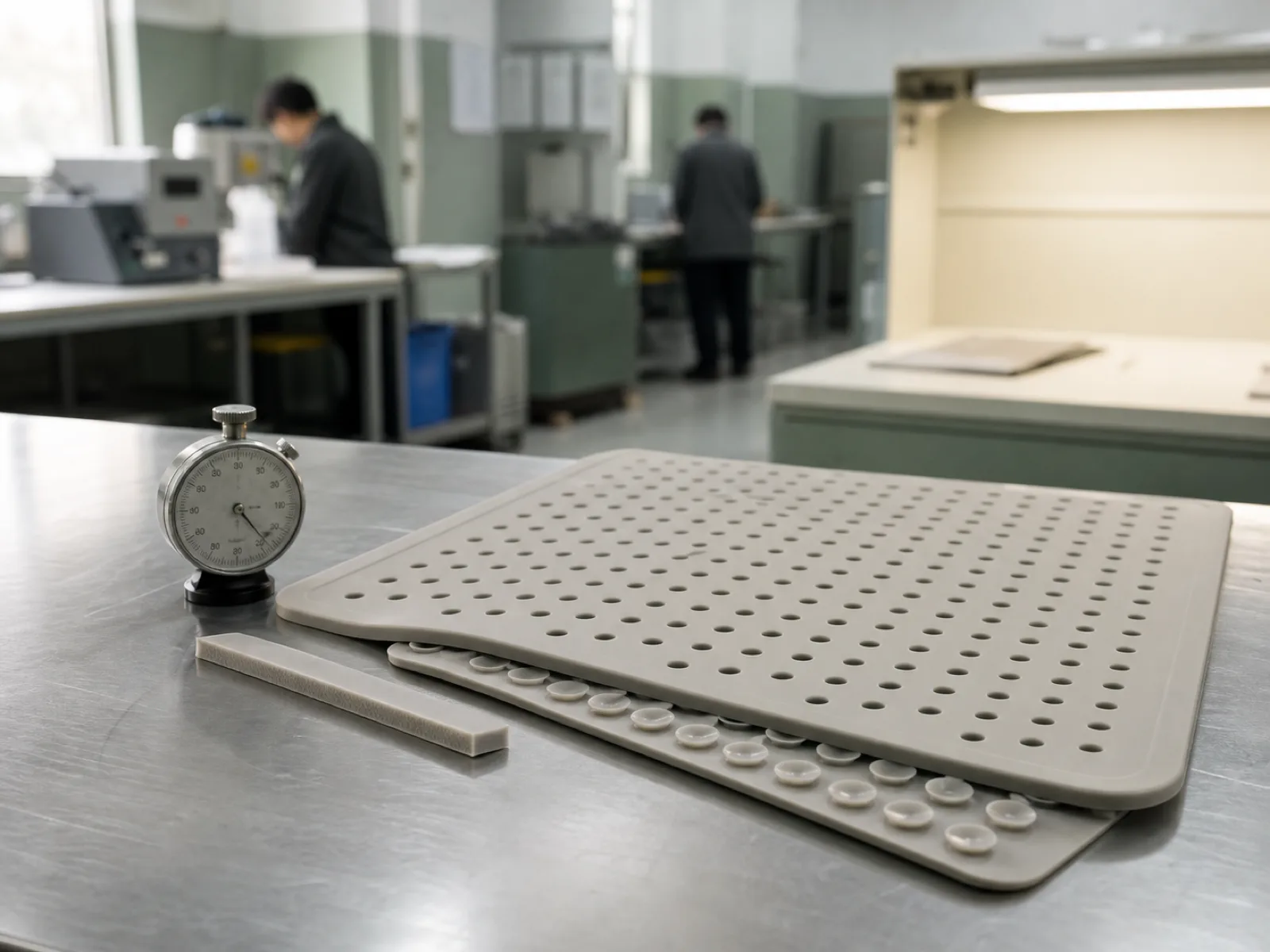 Buyer Guide
 A silicone shower mat is a platinum-cured, food-grade silicone bath-safety product engineered for wet-skin contact, typically at Shore A 40-55 hardness and 4-6 mm thickness. OEM programs run at 500-piece MOQ on existing tooling or 3,000-5,000 pieces on a new mold, with tooling amortization landing between $0.13 and $0.22 per unit at 30,000 pieces. Lead time is 25-40 days for mass production after PPAP sign-off, plus 20-30 days for a new steel mold.
This guide is written for product managers and sourcing leads at bath-and-body brands, hospitality amenity programs, and sink or housewares brands extending into the bath category. It covers the material spec that survives a hot shower, the anti-slip physics that actually holds under a wet foot, the tooling math that separates a defensible unit price from a bleeding one, and the lead-time Gantt from RFQ to container. Every number is a spec you can hand to your QA team without further translation.
What silicone grade is required for a shower mat?
Platinum-cured (addition-cured) silicone certified to FDA 21 CFR 177.2600[^fda-177-2600] and backed by LFGB §30/31 test reports[^lfgb-bfr-xv]. Warm shower water accelerates residual-monomer migration, so peroxide-cured stock — which can leave 2,4-dichlorobenzoic acid byproducts on the mat surface — is engineering-disqualified for repeated wet-skin contact, even though it costs 12-18 % less at the raw-material line.
The regulatory clause matters because a shower mat is a repeated-contact article, not a single-use one. FDA 21 CFR 177.2600 governs rubber articles “intended for repeated use in contact with food”; regulators and retail buyers extend that same clause to wet-skin contact because the migration mechanism is identical — warm liquid pulls loosely-bound residues off the polymer surface. Peroxide-cured silicone uses benzoyl peroxide or DCBP as the cure initiator; residuals live in the polymer matrix and vent slowly. Platinum-cured silicone uses a platinum catalyst and produces no byproducts — the cure reaction is a clean addition across the vinyl group.
For the EU market, LFGB §30/31 is the umbrella; the underlying reference is BfR Recommendation XV for silicones1, which caps total extractables at 0.5 % and volatile organics at 0.5 %. A spec sheet that names only “food-grade silicone” without a clause number is a red flag on RFQ review — the clause is the auditable claim.
If you want the deeper cure-system comparison, see platinum-cured vs peroxide-cured silicone — it’s the reference doc our engineering desk sends buyers who want to write this into a compliance packet.
What Shore A hardness and thickness spec does a shower mat use?
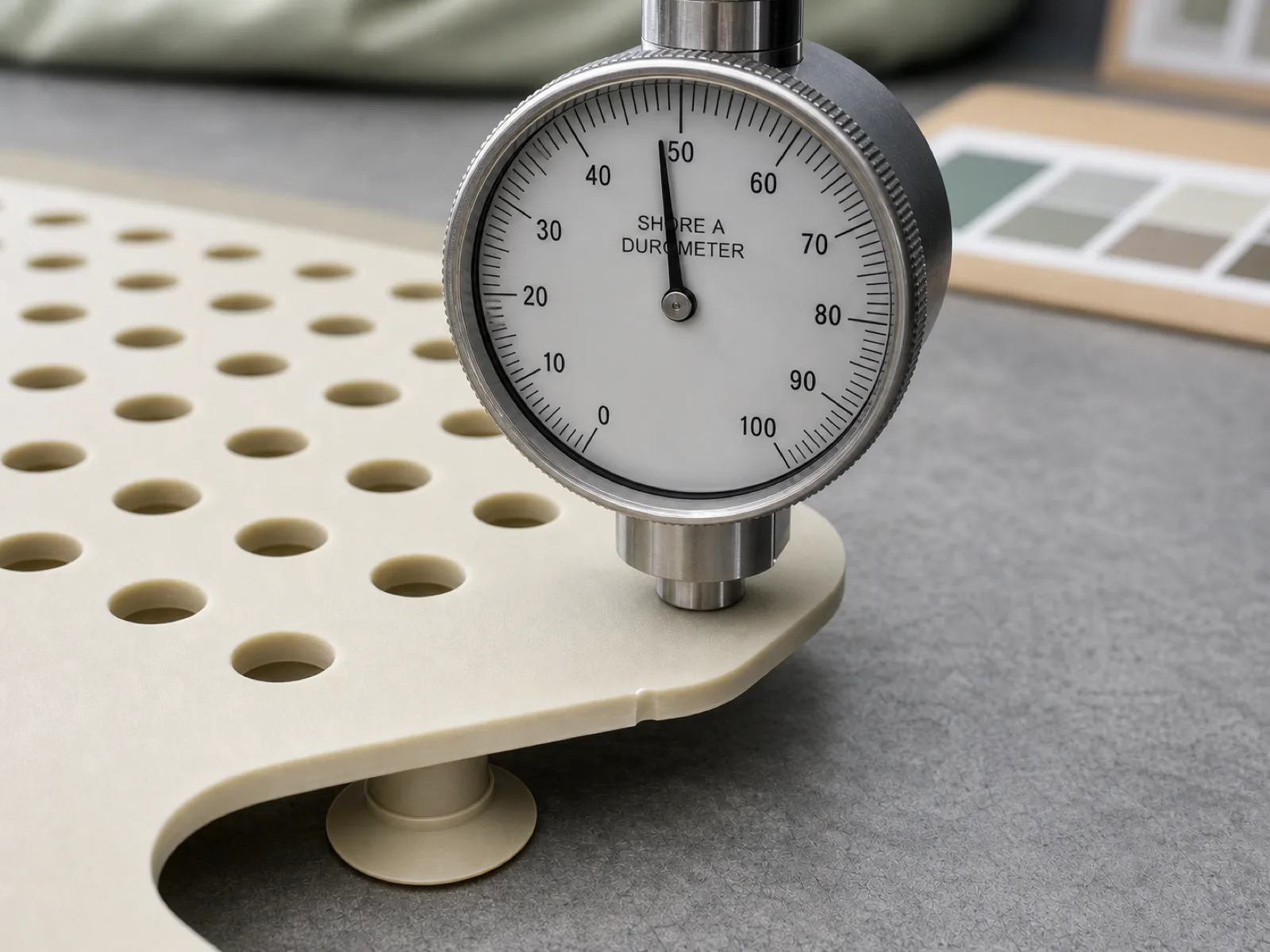
Shower mats sit at Shore A 40-55 per ASTM D2240[^astm-d2240] and 4-6 mm thickness. Softer than sink grids (60-70A) so the mat conforms to a curved tub floor without lifting at corners; thicker than a drying mat (2-3 mm) so drainage holes don't collapse under body weight and so the mat has enough mass to stay flat when the shower head hits it.
The durometer-thickness pairing is what buyers get wrong most often on a first RFQ. A 65A × 3 mm mat feels premium in a photo but slides on a curved acrylic tub floor because it can’t deform enough to hug the surface. A 30A × 8 mm mat conforms beautifully but folds into a wet lump you can’t hang-dry between uses. The 40-55A × 4-6 mm envelope is where every retail-tested spec lands after two or three PPAP loops.
| Spec | Shower mat target | Sink grid | Drying mat |
|---|---|---|---|
| Shore A hardness | 40-55A | 60-70A | 45-55A |
| Thickness | 4-6 mm | 8-12 mm | 2-3 mm |
| Cure system | Platinum | Platinum | Platinum |
| Temp range | -40 °C to +230 °C | -40 °C to +230 °C | -40 °C to +230 °C |
| Regulatory clause | FDA 177.2600 + LFGB | FDA 177.2600 + LFGB | FDA 177.2600 + LFGB |
| Typical density | 1.10-1.15 g/cm³ | 1.15-1.20 g/cm³ | 1.10-1.15 g/cm³ |
Durometer verification runs on the ASTM D2240 procedure with a Type A durometer, three readings per lot averaged, tolerance ±5A. If a supplier can’t produce durometer traces per lot, they’re guessing at hardness rather than measuring it.
Suction-cup base vs textured base — which anti-slip system is defensible?
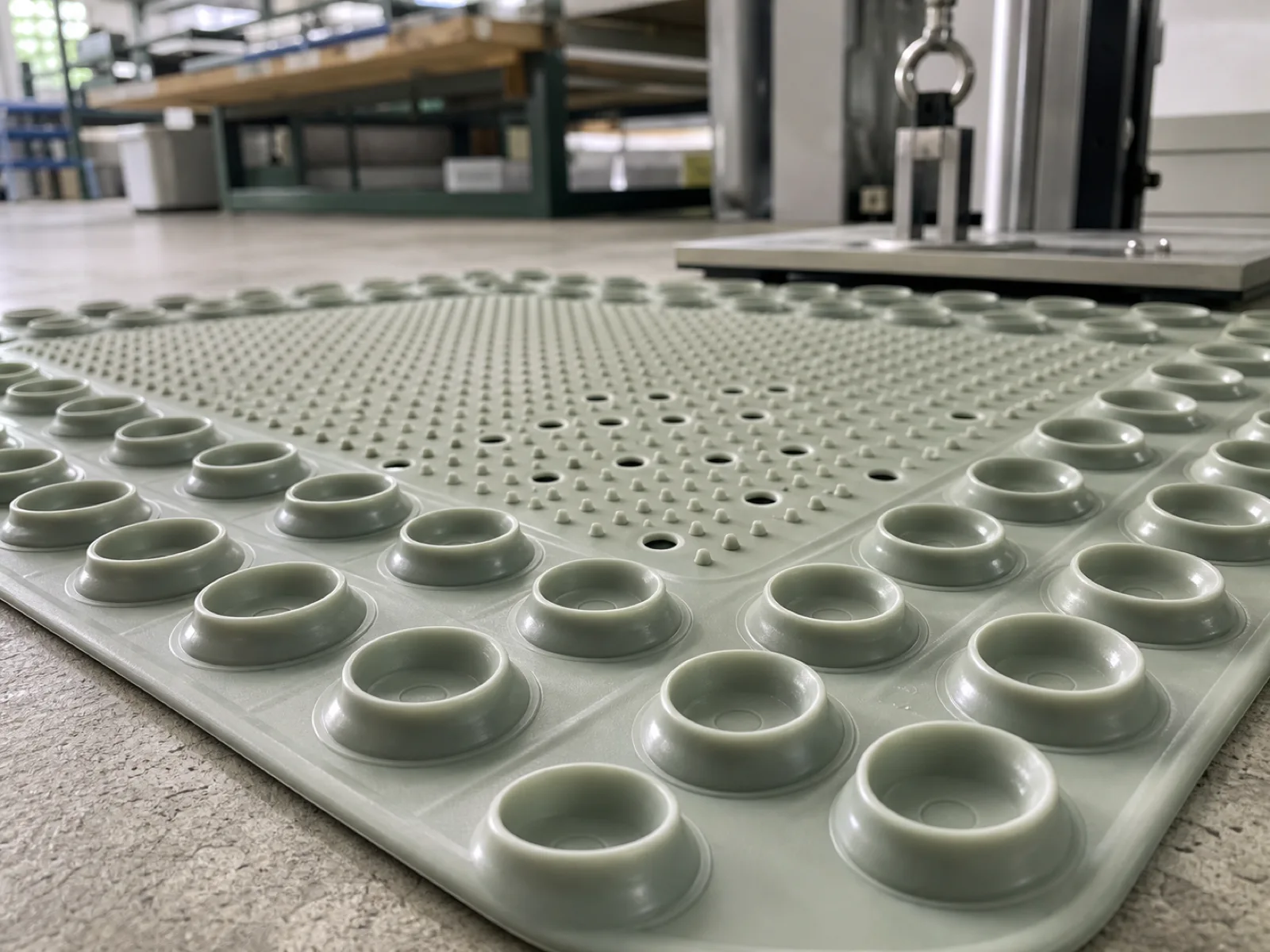
Suction cups win on smooth acrylic or porcelain: a 40-cup base delivers 320-560 N of total pull-off force (8-14 N per cup). Textured bases win on tiled floors with grout lines because suction cups can't seat — a textured base must clear wet coefficient of friction ≥ 0.6 per ASTM F462[^astm-f462]. Most retail programs spec both zones in a single mold.
The physics is unambiguous. A suction cup on smooth acrylic creates a partial vacuum when body weight compresses it; pull-off force is proportional to cup diameter squared and the sealing perimeter’s compliance. On a tiled floor, the cup can’t seal against the grout topology, so the anti-slip system collapses to bulk friction — which is a material property, not a mechanical one.
The regulator-friendly benchmark is ASTM F4622, the consumer safety specification for slip-resistant bathing facilities. It defines static coefficient of friction ≥ 0.04 under load as the floor of defensibility; the industry defensive spec — what a product-liability lawyer wants to see on the file — is ≥ 0.6 wet CoF measured on the finished mat, not on a silicone plaque. Reputable factories will run this test on shipped samples; the CPSC’s own slip-injury data3 makes the case for testing on the assembly, not the material.
Pull-force testing on suction cups uses a calibrated force gauge pulled at 90° to the mat plane at 50 mm/min; readings below 6 N per cup on smooth acrylic mean the cup profile is wrong (too shallow a dome or too rigid a lip). Wetop’s shower-mat mold library includes three suction-cup profiles — 15 mm shallow-dome for premium retail, 12 mm deep-dome for hospitality, and a hybrid 18 mm perimeter cup that couples with a textured center for tile-floor SKUs.
What does the tooling cost and who owns the mold?
A single-cavity steel compression mold for a 400 × 700 mm shower mat runs $3,800-$5,500; adding a debossed logo cell or a second cavity pushes it to $5,500-$8,500. LSR injection tooling runs roughly 2× the compression price. Mold ownership transfers to the buyer after the amortization schedule (typically 20,000-30,000 units) is paid off; until then, Wetop holds the tool under written NDA.
Mold cost is driven by four inputs: cavity count, steel grade (P20 vs H13 vs S136), surface finish (SPI A1 mirror vs B1 satin vs C1 textured), and undercut complexity (flat mat is one thing; a suction-cup base is a family of small undercuts that need cold-runner or slide considerations on LSR). Compression tooling forgives more of these; LSR is unforgiving and prices in the tolerance.
Amortization math is where buyers who’ve only shipped ODM programs get surprised. A $4,800 mold amortized over 30,000 units is $0.16 per unit; amortized over 5,000 units it’s $0.96 per unit — the difference between competitive and dead-on-arrival at a Tier 2 retail chain. If your first-year forecast is 8,000-12,000 units, split the amortization across a 24-month schedule instead of the first PO. The pricing structure is covered in more depth in the silicone OEM pricing structure guide.
| MOQ tier | Tooling status | Per-unit tooling amortization | Total landed unit indicative |
|---|---|---|---|
| 500 pieces | Existing Wetop mold, minor mod | $0.00 (no new tool) | $4.20-$6.80 |
| 3,000 pieces | New compression mold | $1.35-$1.95 | $3.60-$5.40 |
| 10,000 pieces | New compression mold | $0.40-$0.55 | $2.90-$4.20 |
| 30,000 pieces | New compression mold | $0.13-$0.22 | $2.40-$3.60 |
| 60,000 pieces | New LSR injection tool | $0.14-$0.22 | $2.10-$3.10 |
Mold-life is a spec sheet item. A P20-steel compression mold for shower mats holds tolerance for 300,000+ shots under normal cycle discipline; an LSR injection tool can go past 1 M shots. Wetop tracks shot count per mold in a mold-life log; buyers with active tooling receive a monthly usage extract on request.
What is the lead-time Gantt from PO to shipment?
Existing tooling: 25-35 days mass production after deposit. New tooling: 20-30 days mold cutting → 7-15 days T1 sampling and PPAP → 25-40 days mass production. Ocean freight Yantian to US West Coast adds 14-18 days transit; air freight is 4-7 days at roughly 6× the sea rate. Sea Chinese New Year and Golden Week windows shift the Gantt by 15-30 days.
The lead-time schedule buyers write into their retail POs is a Gantt, not a single number, and the two flexes that catch programs off-guard are the T1 sample loop and the PPAP sign-off round trip. T1 samples ship on day 20-30 after mold cutting begins; buyer inspection and dimensional verification takes 5-10 days; if any dimension falls outside ±0.15 mm on a critical hole pattern, T2 samples add another 10-14 days. PPAP (Production Part Approval Process) sign-off — dimensional report + material cert + first-piece color-match — adds 5-7 days on top of T1 approval.
| Stage | Existing tooling | New tooling |
|---|---|---|
| Deposit clear → production start | 3-5 days | 3-5 days |
| Mold cutting | — | 20-30 days |
| T1 sample + inspection | — | 7-15 days |
| PPAP + color sign-off | 5-7 days | 5-7 days |
| Mass production | 25-35 days | 25-40 days |
| Ocean transit (Yantian → LAX/LGB) | 14-18 days | 14-18 days |
| Total PO → US warehouse | 47-65 days | 74-115 days |
For deeper MOQ and lead-time framing, see the MOQ and lead time for silicone OEM reference — it walks through the deposit / DAP / DDP scenarios in more detail.
What logo and pattern customization survives 200+ hot-shower cycles?
Debossed and embossed logos survive because the geometry is integral to the silicone. Silk-screen and pad-printed inks fade in 200-400 hot-shower cycles. Laser-engraved marks on cured silicone are durable but read as low-contrast gray-on-color. Premium retail defaults to a debossed logo cell added to the mold at $180-$400 — a one-time cost that outlasts the mold.
Debossing recesses the logo 0.3-0.6 mm into the mat top surface; embossing raises it 0.3-0.5 mm. Both are in-mold operations — the logo cell is machined into the tool, so every shot from that mold carries the mark for free after the tooling adder is paid. Silk-screen is a post-molding operation using platinum-cured silicone inks; adhesion is decent on a plasma-treated surface but the ink film wears at the peaks of the anti-slip pattern under foot pressure. Pad printing is faster and cheaper per unit but less durable than silk-screen.
CNC milling the logo cell into the mold takes 6-10 hours of shop time; laser engraving on cured silicone parts is $0.05-$0.12 per unit and works best on a smooth flat panel — impossible on a heavily textured mat. For a full breakdown of the marking options and their durability envelopes, see the customize silicone logo deboss / print / laser guide.
Color-matching runs on Pantone Solid Coated targets with a two-round master-batch approval loop: first round hits ΔE ≤ 2.5, production round holds ΔE ≤ 1.5 measured on a spectrophotometer against a signed color plaque. Muted brand palettes (sage, cream, dove gray, warm taupe) are easier to hold under UV than saturated primaries — silicone is UV-stable but pigment loadings above 4 % risk migration in hot water.
FAQ
For every question below, the frontmatter FAQ answer is the source of truth for the FAQPage schema; the visible page mirrors it verbatim so schema and human copy agree.
What silicone grade should a shower mat spec sheet call out? Platinum-cured (addition-cured) silicone certified to FDA 21 CFR 177.2600 for repeated-use rubber articles, backed by LFGB §30/31 test reports. Warm shower water accelerates any residual-monomer migration, so peroxide-cured silicone — which can leave 2,4-dichlorobenzoic acid byproducts — is disqualified for wet-skin contact even though it’s cheaper.
Are suction cups actually more slip-safe than textured silicone? On smooth acrylic or porcelain tubs, yes — a 40-suction-cup base delivers 320-560 N of total pull-off force, an order of magnitude above the friction a textured base can offer. On tiled shower floors with grout lines, suction cups can’t seat, so a textured base with a wet coefficient of friction ≥ 0.6 per ASTM F462 becomes the safer spec.
What is the MOQ for a custom silicone shower mat? 500 pieces per SKU on Wetop’s tooling library (existing rectangular molds in 400×700 mm and 530×530 mm). For a new die-line — custom shape, custom drainage pattern, brand-debossed logo cell — the practical MOQ is 3,000-5,000 pieces to amortize the $3,800-$6,500 mold cost into a competitive unit price.
How much does a shower mat mold cost and who owns it? A single-cavity steel compression mold for a 400×700 mm shower mat runs $3,800-$5,500; adding a debossed logo cell or a second cavity pushes it to $5,500-$8,500. LSR injection tooling is roughly 2× the compression price. Mold ownership transfers to the buyer after the amortization schedule (typically 20,000-30,000 units) is paid off — until then, Wetop holds the tool under written NDA.
What drainage-hole pattern actually prevents mildew? Field-durable specs use Ø 4-8 mm holes at 8-12 % surface density, with a 0.5 mm chamfered rim so water breaks contact instead of beading. Holes smaller than 4 mm clog with soap scum in 6-8 weeks; holes larger than 10 mm let the mat curl at the pattern edge. The chamfer is what separates factories that have shipped this product from ones copying an image.
Compression molding vs LSR injection for shower mats — which wins? Compression wins below 20,000 units/year: tooling is half the price, cycle time is fine at 180-240 s, and suction-cup undercuts release cleanly from a two-plate mold. LSR injection wins above 40,000 units/year because cycle drops to 45-90 s and flash is nearly eliminated, but tooling doubles and suction-cup geometry demands cold-runner nozzles that add $8,000-$15,000.
How long is the lead time from PO to shipment? For existing tooling: 25-35 days mass production after deposit clears. For new tooling: 20-30 days mold cutting → 7-15 days T1 sampling and PPAP → 25-40 days mass production. Ocean freight from Yantian to US West Coast adds 14-18 days transit; air freight is 4-7 days at roughly 6× the sea rate.
What logo customization options survive a hot-water environment? Debossed (in-mold recessed) and embossed (in-mold raised) logos last the life of the mat because the geometry is integral to the silicone. Silk-screen and pad-printed inks fade in 200-400 hot-shower cycles. Laser-engraved marks on cured silicone are durable but read as low-contrast gray-on-color. For premium retail brands, we default to a debossed logo cell added to the mold at $180-$400.
Can silicone shower mats ship with Amazon FNSKU labeling? Yes. Wetop runs FNSKU/UPC-A/EAN-13 barcode application inline with retail-box packing at $0.04-$0.08 per unit. FNSKU polybag prep for FBA (bag, suffocation warning, barcode placement per Amazon’s SPD guide) adds $0.06-$0.12 per unit depending on bag material. All barcodes verify at grade B or better per ISO/IEC 154164.
What’s the freight math — LCL or FCL — for a shower mat program? A rectangular 400×700 mm shower mat cartons at roughly 0.04 CBM per master carton of 20 pieces. A 40 ft HC container fits ~68 CBM, or about 34,000 units. Break-even between LCL and FCL is around 10-12 CBM (5,000-6,000 units); anything above that ships FCL at half the per-unit ocean cost. We quote both scenarios on the initial pro-forma.
Talk to the engineering desk
If you’re specifying a silicone shower mat program — new brand, private-label extension, or hospitality amenity replacement — bring the spec sheet you already have, and we’ll return a marked-up version with the anti-slip zone, drainage-hole geometry, and tooling amortization schedule filled in. First-round quotes ship within 48 business hours and include the mold cost, the T1 sample fee, and the per-unit landed price at three MOQ tiers. Send us an RFQ from the contact page — the engineering desk, not a salesperson, answers the first email.
Footnotes
FAQ
-
What silicone grade should a shower mat spec sheet call out?
Platinum-cured (addition-cured) silicone certified to FDA 21 CFR 177.2600 for repeated-use rubber articles, backed by LFGB §30/31 test reports. Warm shower water accelerates any residual-monomer migration, so peroxide-cured silicone — which can leave 2,4-dichlorobenzoic acid byproducts — is disqualified for wet-skin contact even though it's cheaper.
-
Are suction cups actually more slip-safe than textured silicone?
On smooth acrylic or porcelain tubs, yes — a 40-suction-cup base delivers 320-560 N of total pull-off force, an order of magnitude above the friction a textured base can offer. On tiled shower floors with grout lines, suction cups can't seat, so a textured base with a wet coefficient of friction ≥ 0.6 per ASTM F462 becomes the safer spec.
-
What is the MOQ for a custom silicone shower mat?
500 pieces per SKU on Wetop's tooling library (existing rectangular molds in 400×700 mm and 530×530 mm). For a new die-line — custom shape, custom drainage pattern, brand-debossed logo cell — the practical MOQ is 3,000-5,000 pieces to amortize the $3,800-$6,500 mold cost into a competitive unit price.
-
How much does a shower mat mold cost and who owns it?
A single-cavity steel compression mold for a 400×700 mm shower mat runs $3,800-$5,500; adding a debossed logo cell or a second cavity pushes it to $5,500-$8,500. LSR injection tooling is roughly 2× the compression price. Mold ownership transfers to the buyer after the amortization schedule (typically 20,000-30,000 units) is paid off — until then, Wetop holds the tool under written NDA.
-
What drainage-hole pattern actually prevents mildew?
Field-durable specs use Ø 4-8 mm holes at 8-12 % surface density, with a 0.5 mm chamfered rim so water breaks contact instead of beading. Holes smaller than 4 mm clog with soap scum in 6-8 weeks; holes larger than 10 mm let the mat curl at the pattern edge. The chamfer is what separates factories that have shipped this product from ones copying an image.
-
Compression molding vs LSR injection for shower mats — which wins?
Compression wins below 20,000 units/year: tooling is half the price, cycle time is fine at 180-240 s, and suction-cup undercuts release cleanly from a two-plate mold. LSR injection wins above 40,000 units/year because cycle drops to 45-90 s and flash is nearly eliminated, but tooling doubles and suction-cup geometry demands cold-runner nozzles that add $8,000-$15,000.
-
How long is the lead time from PO to shipment?
For existing tooling: 25-35 days mass production after deposit clears. For new tooling: 20-30 days mold cutting → 7-15 days T1 sampling and PPAP → 25-40 days mass production. Ocean freight from Yantian to US West Coast adds 14-18 days transit; air freight is 4-7 days at roughly 6× the sea rate.
-
What logo customization options survive a hot-water environment?
Debossed (in-mold recessed) and embossed (in-mold raised) logos last the life of the mat because the geometry is integral to the silicone. Silk-screen and pad-printed inks fade in 200-400 hot-shower cycles. Laser-engraved marks on cured silicone are durable but read as low-contrast gray-on-color. For premium retail brands, we default to a debossed logo cell added to the mold at $180-$400.
-
Can silicone shower mats ship with Amazon FNSKU labeling?
Yes. Wetop runs FNSKU/UPC-A/EAN-13 barcode application inline with retail-box packing at $0.04-$0.08 per unit. FNSKU polybag prep for FBA (bag, suffocation warning, barcode placement per Amazon's SPD guide) adds $0.06-$0.12 per unit depending on bag material. All barcodes verify at grade B or better per ISO/IEC 15416.
-
What's the freight math — LCL or FCL — for a shower mat program?
A rectangular 400×700 mm shower mat cartons at roughly 0.04 CBM per master carton of 20 pieces. A 40 ft HC container fits ~68 CBM, or about 34,000 units. Break-even between LCL and FCL is around 10-12 CBM (5,000-6,000 units); anything above that ships FCL at half the per-unit ocean cost. We quote both scenarios on the initial pro-forma.
References
Authoritative sources cited in this guide
- US Food and Drug Administration. 21 CFR 177.2600 — Rubber articles intended for repeated use. https://www.ecfr.gov/current/title-21/chapter-I/subchapter-B/part-177/subpart-C/section-177.2600 — The clause every repeated-contact silicone (mats, grids, tubing) must clear for US market entry.
- German Federal Institute for Risk Assessment (BfR). BfR Recommendation XV — Silicones. https://www.bfr.bund.de/en/bfr_recommendations_on_food_contact_materials-7498.html — The reference standard underlying LFGB §30/31 test reports for silicone consumer goods sold into the EU.
- ASTM International. ASTM F462-79(2020) — Standard Consumer Safety Specification for Slip-Resistant Bathing Facilities. https://www.astm.org/products-services/standards-and-publications/standards.html — Defines the wet coefficient-of-friction test method (≥ 0.04 static under load) that shower-safety products defend against product liability with.
- International Organization for Standardization. ISO 9001:2015 — Quality Management Systems — Requirements. https://www.iso.org/standard/62085.html — The quality-system standard Wetop's process discipline (documented PPAP, AQL 1.5 inspection, mold-life tracking) is certified against.
- ASTM International. ASTM D2240 — Standard Test Method for Rubber Property — Durometer Hardness. https://www.astm.org/d2240-15r21.html — The Shore A hardness method used to verify shower-mat durometer (40-55A target).
- International Organization for Standardization. ISO/IEC 15416:2016 — Bar code print quality test specification — Linear symbols. https://www.iso.org/standard/65577.html — The barcode-print-quality standard Amazon's FNSKU verification is derived from.
- US Consumer Product Safety Commission. CPSC — Slips, Trips and Falls in Bathtubs and Showers. https://www.ecfr.gov/current/title-16 — US regulator data on bathroom-slip injuries — the risk envelope shower-mat spec sheets need to satisfy.
Start a custom program
Send a brief. Get an engineer’s reply in one business day.
Every Wetop program is tooled from a customer’s specification. Send a CAD file (STEP · IGES · DWG) or a written brief and we’ll reply with a mold cost estimate, price brackets at MOQ 500 / 1,000 / 5,000, and any engineering questions.