Buyer Guide · commercial intent
Silicone Snack Cup OEM Guide — Baby & Toddler Feeding
What changed: First publication under v2 advanced-GEO standard — direct-answer per H2, 7 FAQs, 8 Tier-1 references, dedicated Codex-generated hero image.
 Buyer Guide
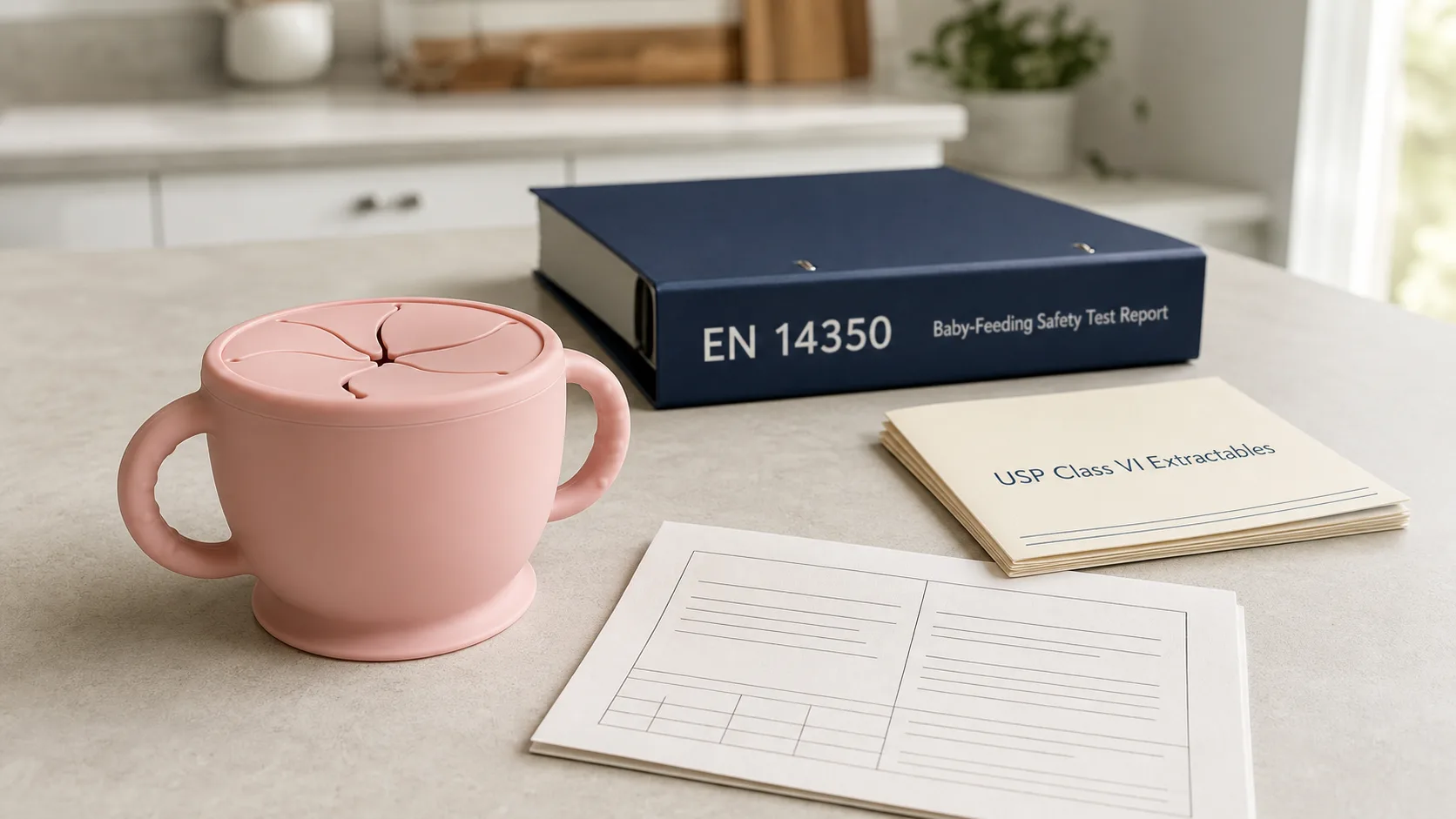
 The single most-common question on a silicone baby snack cup RFQ is “can you clear EN 14350 and USP Class VI on the same batch?” — usually asked by a product manager at a premium baby brand where ‘medical-grade silicone’ is a key retail-shelf differentiator. This guide is the compliance stack, the geometry framework, and the per-unit economics for a private-label snack cup program.
A silicone baby snack cup OEM program uses platinum-cured LSR with EN 14350 + FDA 21 CFR 177.2600 + LFGB §30/31 per-batch compliance documentation. Premium programs add USP Class VI extractables + PFAS non-detect testing. MOQ 500 per unique SKU (color × size × decoration); a typical retail-family program spans 3-6 SKUs. Baseline unit price at MOQ 500: $2.50-$4.50 FOB Yantian; drops to $1.80-$2.80 at MOQ 5,000. Lead time 90-120 days for a first-time program on new tooling.
What compliance stack does a silicone snack cup OEM program actually need?
Depends on the target retail markets. US-only mass retail: FDA 21 CFR 177.2600[^fda-177-2600] per-batch third-party extract report. EU-scope programs add LFGB §30/31 per BfR Recommendation XV[^bfr-lfgb-xv] and EN 14350 baby-feeding safety[^en-14350]. Premium retail (Whole Foods orbit, Waitrose Duchy, MPreis): the full stack plus PFAS non-detect testing per batch. Medical-adjacent brand positioning: add USP <88> Class VI extractables documentation[^usp-class-vi]. CPSIA per-lot children's product certification[^cpsia-silicone] applies to all US-market baby products.
The compliance stack by target market:
| Target market | FDA 177.2600 | LFGB §30/31 | EN 14350 | PFAS non-detect | USP <88> | CPSIA |
|---|---|---|---|---|---|---|
| US Amazon FBA | ✅ Required | Nice-to-have | – | Increasingly expected | – | ✅ Required per-lot |
| US mass retail | ✅ Required | Nice-to-have | – | Increasingly expected | – | ✅ Required per-lot |
| US premium natural (Whole Foods orbit) | ✅ Required | ✅ Required | – | ✅ Required | Increasingly expected | ✅ Required per-lot |
| US medical-adjacent brand | ✅ Required | ✅ Required | – | ✅ Required | ✅ Required | ✅ Required per-lot |
| EU mass retail | Nice-to-have | ✅ Required | ✅ Required | Nice-to-have | – | – |
| EU premium retail (Waitrose Duchy, MPreis) | ✅ Required | ✅ Required | ✅ Required | ✅ Required | – | – |
| UK premium baby retail | ✅ Required | ✅ Required | ✅ Required | ✅ Required | – | – |
The FDA vs LFGB decoder walks the food-contact regulatory framework; the PFAS-free silicone guide covers the additional PFAS non-detect requirement.
What snack cup geometry actually works for toddler self-feeding?
Four critical dimensions define whether a snack cup fits its use case. Interior volume 120-300 ml (smaller for 6-12 months, larger for 12-36 months). Collapsible rim angle ~45° (small hand can press through, cup catches spills when tipped). Rim wall thickness 2-3 mm (thin enough to collapse under toddler grip, thick enough to survive 500+ drop-and-throw cycles). Lid seal engagement 1-1.5 mm interference fit (survives diaper-bag transport, adult-releasable without excessive force). All four dimensions verified per ASTM International consumer product standards[^astm-baby-safety].
The four-dimension spec framework:
| Dimension | Typical range | Age range | Design consideration |
|---|---|---|---|
| Interior volume | 120-300 ml | 120-150 ml → 6-12 mo · 200-300 ml → 12-36 mo | Match to typical snack portion for age tier |
| Collapsible rim angle | ~45° | All | Toddler hand can press through; cup catches spills when tipped |
| Rim wall thickness | 2-3 mm | All | Survives 500+ drop-and-throw cycles typical of toddler use |
| Lid seal engagement | 1-1.5 mm interference | All | Adult-releasable, survives diaper-bag transport |
| Base non-slip footprint | Full-base grip pattern | All | Reduces tipping; toddler self-feeding at high-chair use case |
Standard formulation: Shore A 40-50 for the collapsible rim (softer, easier to press); Shore A 50-60 for the cup body (firmer, holds volume without sagging).
Why is platinum-cured silicone the default cure system for baby-feeding programs?
Two reasons drive the platinum-cure default. First, extractables profile — platinum-cure produces no organic decomposition byproducts, so the material clears USP Class VI biological reactivity testing[^usp-class-vi] with room to spare. Peroxide-cure with disciplined post-cure clears most food-contact tests but doesn't reach Class VI without formulation changes. Second, brand-narrative economics — premium baby retail brands charge $18-45 shelf for snack cups where 'medical-grade silicone' positioning is a key differentiator. The 15-25% platinum-cure premium recovers in shelf-tier positioning at the premium price band.
The cure-system decision framework specifically for baby snack cups:
- Premium baby brand (medical-adjacent positioning) — Platinum-cure LSR, USP Class VI extractables documentation, PFAS non-detect testing per batch. Standard on all premium DTC baby brands and premium retail programs.
- Mid-tier retail baby brand ($15-25 shelf) — Platinum-cure LSR still recommended for the brand narrative, but USP Class VI is optional. FDA + LFGB per batch is the baseline.
- Amazon FBA private-label baby brand ($10-18 shelf) — Platinum-cure with FDA + LFGB per batch is the safer commercial bet. Peroxide-cure with disciplined post-cure works technically but positions the SKU below the premium-perception threshold buyers now expect on baby-feeding accessories.
- Cost-led baby brand (rare in current market) — Post-cured peroxide-cure with PFAS-free process aids verified per batch. Limited retail-tier acceptance in 2026 as PFAS regulatory trajectory continues.
See platinum vs peroxide cure decision guide for the full cure-system decision framework.
How does MOQ scale across a multi-SKU baby-feeding retail family?
MOQ 500 per unique SKU where a SKU is defined by geometry (size/shape) + color + decoration combination. A program with 3 sizes × 4 colors = 12 unique SKUs = MOQ 6,000 total in the initial run. On reorders against existing tooling, MOQ drops to 250 per SKU. Programs targeting narrower initial launch typically start with 2 sizes × 3 colors = 6 SKUs = MOQ 3,000 total. Volume tier discount curve drops per-unit cost 20-40% moving from MOQ 500 → MOQ 5,000+.
The MOQ scaling math for typical baby-feeding retail-family programs:
| Program scope | Sizes | Colors | Unique SKUs | Initial MOQ | Per-unit price at MOQ (baseline) |
|---|---|---|---|---|---|
| Narrow launch (Amazon FBA test) | 1 | 2 | 2 | 1,000 pcs | $3.20-$3.80 |
| Standard mid-tier retail | 2 | 3 | 6 | 3,000 pcs | $2.80-$3.50 |
| Full premium retail family | 3 | 4 | 12 | 6,000 pcs | $2.30-$3.00 |
| Extended coordinated range | 3 | 6 | 18 | 9,000 pcs | $2.00-$2.60 |
Per-batch third-party testing scales sub-linearly with SKU count. A 12-SKU program at 500 pieces per SKU shares testing costs across the batches — the compliance packet references the master-batch lot of the compound going into the initial press run, not per-SKU.
What is the actual per-unit cost breakdown at MOQ 500?
Seven line items drive per-unit price at MOQ 500 for a typical silicone snack cup with collapsible rim + lid. Raw silicone compound (25-30% of unit price); P20 mold amortization (biggest volume-driven line item); dedicated LSR injection cycle time; mandatory post-cure oven; per-batch EN 14350 + FDA + LFGB testing; master-batch Pantone color matching; retail-ready packaging with hangtag or box. Baseline unit price at MOQ 500: $2.50-$4.50 FOB Yantian depending on geometry complexity and lid inclusion.
Line-item breakdown for a baseline $3.20 MOQ 500 silicone snack cup:
| Line item | Approximate cost/unit at MOQ 500 | % of $3.20 unit price |
|---|---|---|
| Raw silicone compound (platinum-cure LSR baseline) | $0.90-$1.10 | 28-34% |
| P20 mold amortization ($2,000-3,500 across MOQ 500) | $4-$7/unit at 500 → drops to $0.40-$0.70 at 5,000 | Volume-driven |
| Dedicated LSR injection cycle time | $0.30-$0.50 | 9-16% |
| Post-cure oven (mandatory 4-6 hr at 180-200°C) | $0.20-$0.35 | 6-11% |
| Per-batch EN 14350 + FDA + LFGB testing | $0.15-$0.25 (at 500) / $0.02-$0.03 (at 5,000) | 5-8% |
| Master-batch Pantone color matching (±0.5 ΔE) | $0.20-$0.30 | 6-9% |
| Retail-ready packaging (box + hangtag typical) | $0.60-$1.00 | 19-31% |
See silicone OEM pricing structure for the complete pricing framework and volume-tier discount curve.
What Wetop OEMs on silicone snack cups
Wetop OEMs silicone baby snack cups with platinum-cure LSR (standard), Shore A 40-50 collapsible rim + 50-60 cup body, ±0.5 ΔE Pantone-matched master-batch color across the brand family, in-mold non-slip base, per-batch EN 14350 + FDA + LFGB + PFAS-free documentation bundled at no add-on. MOQ 500 per unique SKU. Program scope typical: 3-6 unique SKUs. See our [pet slow-feeder multi-color case study](/case-studies/pet-slow-feeder-multi-color-oem/) for the coordinated-finish Pantone discipline pattern applied to an adjacent premium consumer category.
Wetop’s silicone snack cup program defaults:
- Platinum-cure LSR — standard cure system for baby-feeding programs; USP Class VI extractables documentation on request for premium/medical-adjacent brand positioning.
- Coordinated retail family — Pantone-matched master-batch color at ±0.5 ΔE tolerance across 3-6 SKUs verified per batch with spectrophotometer measurement.
- Compliance packet — EN 14350 + FDA 21 CFR 177.2600 + LFGB §30/31 + PFAS non-detect + master-batch lot cert bundled in one PDF per shipment referencing the PO number.
- CPSIA per-lot documentation — for US-market children’s products, per-lot children’s product certification supplied with every shipment.
MOQ 500 per SKU on new tooling. See MOQ & lead time on custom silicone for how multi-SKU programs schedule, silicone OEM pricing structure for the seven-line cost stack, and platinum vs peroxide cure decision guide for the cure-system decision framework.
Sourcing a private-label baby snack cup program? Email inquiry@wetopsilicone.com with your target retail tier, SKU family scope, and target ship date — we come back with the cure-system recommendation, per-unit pricing at MOQ 500 / 1,000 / 5,000, and the 5-stage program schedule.
Ready to source? Every quote is built against your specification — send a CAD file, a written brief, or reference samples, and an engineer replies within one business day. Request a quote →
FAQ
-
What compliance certifications does a baby-feeding silicone snack cup need?
Depends on the target retail markets. US-only: FDA 21 CFR 177.2600[^fda-177-2600] per-batch third-party extract report. EU-scope: FDA + LFGB §30/31 per BfR Recommendation XV[^bfr-lfgb-xv] + EN 14350 baby-feeding safety[^en-14350]. Premium retail (Whole Foods orbit, Waitrose Duchy, MPreis): the full stack + PFAS non-detect testing per batch aligned with ECHA restriction trajectory[^echa-pfas-proposal]. Medical-adjacent brand positioning: add USP <88> Class VI extractables documentation[^usp-class-vi]. See the [FDA vs LFGB decoder](/guide/fda-vs-lfgb-silicone/) for the food-contact certification framework.
-
What snack cup geometry actually works for toddler self-feeding?
Four critical dimensions. (1) Interior volume 120-300 ml — smaller sizes (120-150 ml) for 6-12 month age, larger (200-300 ml) for 12-36 months. (2) Collapsible rim angle ~45° — the rim geometry that lets a small hand press through to reach snacks while still catching spills when the cup tips. (3) Rim wall thickness 2-3 mm — thin enough to collapse under toddler grip, thick enough to survive 500+ drop-and-throw cycles typical of toddler use. (4) Lid seal engagement 1-1.5 mm interference fit — secure enough to survive diaper-bag transport, releasable by an adult without excessive force.
-
What Pantone tolerance can I hold across a coordinated baby-feeding retail family?
±0.5 ΔE Pantone tolerance verified per batch via spectrophotometer measurement against TPX (matte) or TPG (glossy) Pantone reference per CIE color measurement standards[^cie-color]. Standard for premium baby retail; anything looser than ±1 ΔE shows visible batch-to-batch drift on retail shelf, which the brand's creative team will flag. Wetop holds ±0.5 ΔE reliably across programs of 6-8 coordinated SKUs by mixing color in master-batch (the silicone gum itself is dyed) rather than surface-coating. See [customize silicone logo guide](/guide/customize-silicone-logo-deboss-print-laser/) for the color-matching workflow detail.
-
What per-unit price should I expect at typical volumes?
$2.50-$4.50 FOB Yantian at MOQ 500 for typical geometry (120-300 ml volume, collapsible rim, standard lid). $1.80-$2.80 at MOQ 5,000. The range depends on: geometry complexity (multi-rim + integral lid adds cost), decoration method (in-mold debossing vs IML four-color adds 30-60¢/unit), cure system choice (platinum-cure adds 15-25%), and packaging (retail-ready box + hangtag adds $1-$2/unit). See [silicone OEM pricing structure](/guide/silicone-oem-pricing-structure/) for the seven-line cost stack.
-
How do I spec the collapsible rim so a toddler can push through but the cup still catches spills when tipped?
The collapsible rim is the single load-bearing geometry on a silicone snack cup — get it wrong and the SKU either won't let a toddler self-feed or won't contain spills, and either failure kills reorder rate. Four dimensions govern the rim behavior. First, rim angle: ~45° inward from the cup wall is the standard for 9-24 month use case. Steeper (30°) requires more grip force and frustrates the child; shallower (60°) fails the tip-and-spill test because the opening stays too open when the cup rolls. Second, rim wall thickness: 2-3 mm. Below 2 mm the rim collapses too easily and won't recover shape after a diaper-bag squash; above 3 mm the toddler can't press through consistently. Third, Shore A hardness on the rim itself: 40-50 (softer than the cup body at 50-60). This dual-hardness spec requires either two-shot molding or a single-material formulation tuned to the softer end. Wetop specs 45 Shore A on the rim for premium programs (feels 'clinical soft' — the descriptor buyers use) and 50 Shore A on cost-tier programs (still functional, marginally stiffer). Fourth, rim inside diameter: typically 40-55 mm depending on cup volume — sized so a toddler's fist plus 2-3 finger-tips fit through comfortably. Verify all four dimensions on first-article samples with a calibrated snap-gauge and durometer per ASTM International consumer product standards[^astm-baby-safety]; log the readings in the PPAP packet.[^en-14350]
-
What defect modes should I write into the AQL inspection plan for silicone snack cup lots?
Six defect modes drive silicone snack cup returns and retail chargebacks — build them into the AQL 2.5 major / 4.0 minor sampling plan on every lot. (1) Rim tear at the collapsible transition: the crease where the rim folds sees the highest cyclic stress; a molding short or knit-line in that geometry seeds a tear within 50-100 collapse cycles. Classify as major. (2) Lid interference-fit drift: if lid seal engagement falls below 1 mm the lid pops off in a diaper bag; above 1.5 mm an adult can't open it without excess force. Verify with a pull-force gauge at 8-12 N release target. Classify as major. (3) Base non-slip pattern flash or under-fill: retail returns cluster here because the cup slides on a high-chair tray. Classify as major. (4) First-heat odor at first dishwasher cycle: incomplete post-cure (below 4 hours at 180°C) leaves volatile siloxane residue that generates the 'rubbery smell' Amazon 1-star reviews complain about. Verify with post-cure oven log and a random-sample sniff test after one dishwasher cycle. Classify as major. (5) Color drift beyond ±0.5 ΔE across the SKU family: spectrophotometer-verify per CIE colorimetry[^cie-color]. Classify as minor unless drift exceeds 1.0 ΔE. (6) Pantone bloom or surface haze after 30 days: platinum-cure LSR should not bloom; peroxide-cure with insufficient post-cure will. Classify as major. Log all six on the per-lot inspection report referenced against the PO number.
-
How do I coordinate a snack cup with sippy cups, bibs, and plates as a single retail-shelf family?
A silicone snack cup rarely ships as a standalone SKU — premium baby brands merchandise it alongside 3-5 coordinated pieces on the same retail endcap. Three coordination axes have to be locked at the program-brief stage, not left to the factory. First, Pantone lockstep: every piece in the family runs against the same master-batch color reference at ±0.5 ΔE tolerance verified per CIE colorimetry[^cie-color]. This means the snack cup, sippy, bib silicone panel, and plate all pull from the same pigment master-batch lot within a program cycle. Wetop reserves master-batch by kilogram against the full family SKU count at PO acceptance to prevent drift between the snack cup pressing and the sippy cup pressing three weeks later. Second, surface-finish lockstep: matte vs semi-gloss vs high-gloss is set by mold surface texture (VDI or SPI standard) and has to match across the family. A matte snack cup next to a semi-gloss sippy cup looks like two different brands on shelf. Third, geometry-language lockstep: the collapsible rim on the snack cup, the sippy spout profile, the plate suction ring — all should share a design vocabulary (radii, edge chamfers, rib pitch). This is a tooling-engineering coordination task done at CAD review, before the first mold is cut. Wetop runs a single tooling-engineering review across all family SKUs before any P20 steel is machined. See the pet slow-feeder multi-color case study for the same coordinated-finish discipline applied to an adjacent premium consumer category.
-
What is the PPAP-style documentation packet a premium baby brand should demand on a snack cup program?
Premium baby brands (medical-adjacent DTC, Whole Foods orbit, Waitrose Duchy, MPreis) increasingly demand PPAP-style production sign-off borrowed from the automotive playbook, not just an FDA test report. The eight-element packet Wetop delivers on a snack cup PPAP: (1) Design record — CAD file with all four critical dimensions dimensioned and toleranced (interior volume ±5%, rim angle ±2°, rim wall thickness ±0.15 mm, lid seal engagement ±0.1 mm). (2) Process flow diagram — from platinum-cure LSR compound receipt through injection, post-cure, decoration, and packaging. (3) Process FMEA — the six defect modes above with severity/occurrence/detection ratings and control-plan responses. (4) Control plan — the inline check frequency for each critical dimension per lot. (5) Dimensional results — first-article and periodic-sample measurement records against the CAD tolerances. (6) Material certifications — platinum-cure LSR compound cert, master-batch pigment cert, PFAS non-detect per batch aligned with ECHA restriction trajectory[^echa-pfas-proposal], EN 14350[^en-14350] compliance report, FDA 21 CFR 177.2600[^fda-177-2600] extract report, LFGB §30/31 per BfR Recommendation XV[^bfr-lfgb-xv] migration report, USP <88> Class VI extractables[^usp-class-vi] on premium programs, CPSIA per-lot children's product certification[^cpsia-silicone]. (7) Sample retention — three per-lot samples retained for 24 months against the PO number. (8) Sign-off — the founder or engineering lead signature on the packet PDF referencing PO and shipment number. Ask for a redacted sample packet on the first RFQ — a factory that can't produce one shouldn't be shortlisted for a premium baby-feeding program.
References
Authoritative sources cited in this guide
- European Committee for Standardization (CEN). EN 14350 — Child use and care articles — Drinking equipment. https://www.cencenelec.eu/ — The EU baby-feeding safety standard covering drinking equipment for children. Applies specifically to silicone snack cups and equivalent baby-feeding accessories.
- US Food and Drug Administration. 21 CFR 177.2600 — Rubber articles intended for repeated use. https://www.ecfr.gov/current/title-21/chapter-I/subchapter-B/part-177/subpart-C/section-177.2600 — The US food-contact regulation whose extraction testing is the baseline for silicone baby-feeding products.
- German Federal Institute for Risk Assessment. BfR Recommendation XV — Silicones. https://www.bfr.bund.de/en/bfr_recommendations_on_food_contact_materials-7498.html — The technical standard behind LFGB §30/31 for silicone; the three-simulant migration test applies to snack cup finished parts.
- United States Pharmacopeia. USP <88> — Biological Reactivity Tests, In Vivo. https://www.usp.org/harmonization-standards/pdg/excipients/plastic-materials — The biocompatibility standard applied to premium/medical-adjacent baby-feeding silicone with 'medical-grade' brand positioning.
- European Chemicals Agency (ECHA). PFAS Universal Restriction Proposal. https://eur-lex.europa.eu/legal-content/EN/TXT/?uri=CELEX%3A32006R1907 — The regulatory framework driving PFAS non-detect testing as a standard compliance packet line item on premium baby-feeding programs.
- US Consumer Product Safety Commission. Consumer Product Safety Improvement Act (CPSIA). https://www.ecfr.gov/current/title-16 — The US framework governing children's product safety — applies to silicone baby-feeding products and requires per-lot documentation for children's product certification.
- International Commission on Illumination (CIE). CIE Colorimetry Standards. https://cie.co.at/publications/colorimetry-4th-edition — The reference framework for the ΔE color-difference measurement behind ±0.5 ΔE Pantone tolerance on multi-SKU baby-feeding retail families.
- ASTM International. ASTM International Consumer Product Standards. https://www.astm.org/products-services/standards-and-publications/standards.html — ASTM's framework for consumer product safety including silicone baby-feeding accessory dimensional and mechanical testing standards.
Start a custom program
Send a brief. Get an engineer’s reply in one business day.
Every Wetop program is tooled from a customer’s specification. Send a CAD file (STEP · IGES · DWG) or a written brief and we’ll reply with a mold cost estimate, price brackets at MOQ 500 / 1,000 / 5,000, and any engineering questions.