Comparison · commercial intent
Silicone vs Viton O-Ring — Engineering Comparison Guide
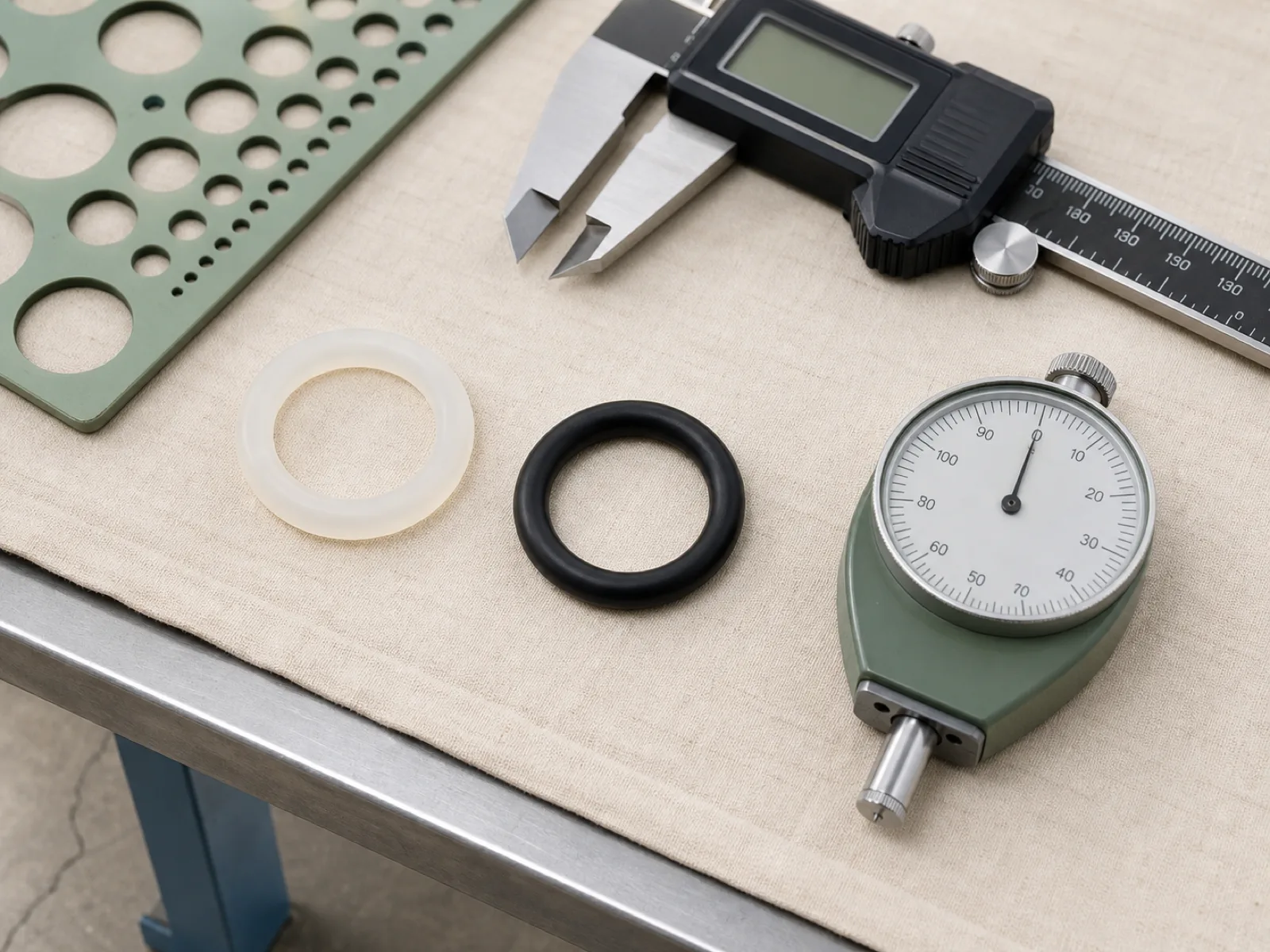 Comparison
 Silicone (VMQ) and Viton (FKM) O-rings solve different problems. Silicone wins on temperature range, food and medical compliance, and cost — it seals from -60 °C to 230 °C, clears FDA 21 CFR 177.2600 on platinum cure, and costs three to five times less than FKM per kilogram. Viton wins on chemical resistance — it holds under fuel, oil, aromatic solvent, and dilute acid where silicone swells and fails within hours.
This guide is written for OEM procurement engineers and product-development leads deciding between silicone and Viton O-rings for kitchen, medical, HVAC, EV, semiconductor, or fluid-handling programs. It replaces the “Viton is better because it’s more expensive” folklore with the numbers you need on the RFQ — temperature envelopes, ASTM D471 volume-swell data, compression-set targets, ISO 3601 sizing, compliance mapping, and the MOQ and lead-time economics we see on 500-pcs custom O-ring runs.
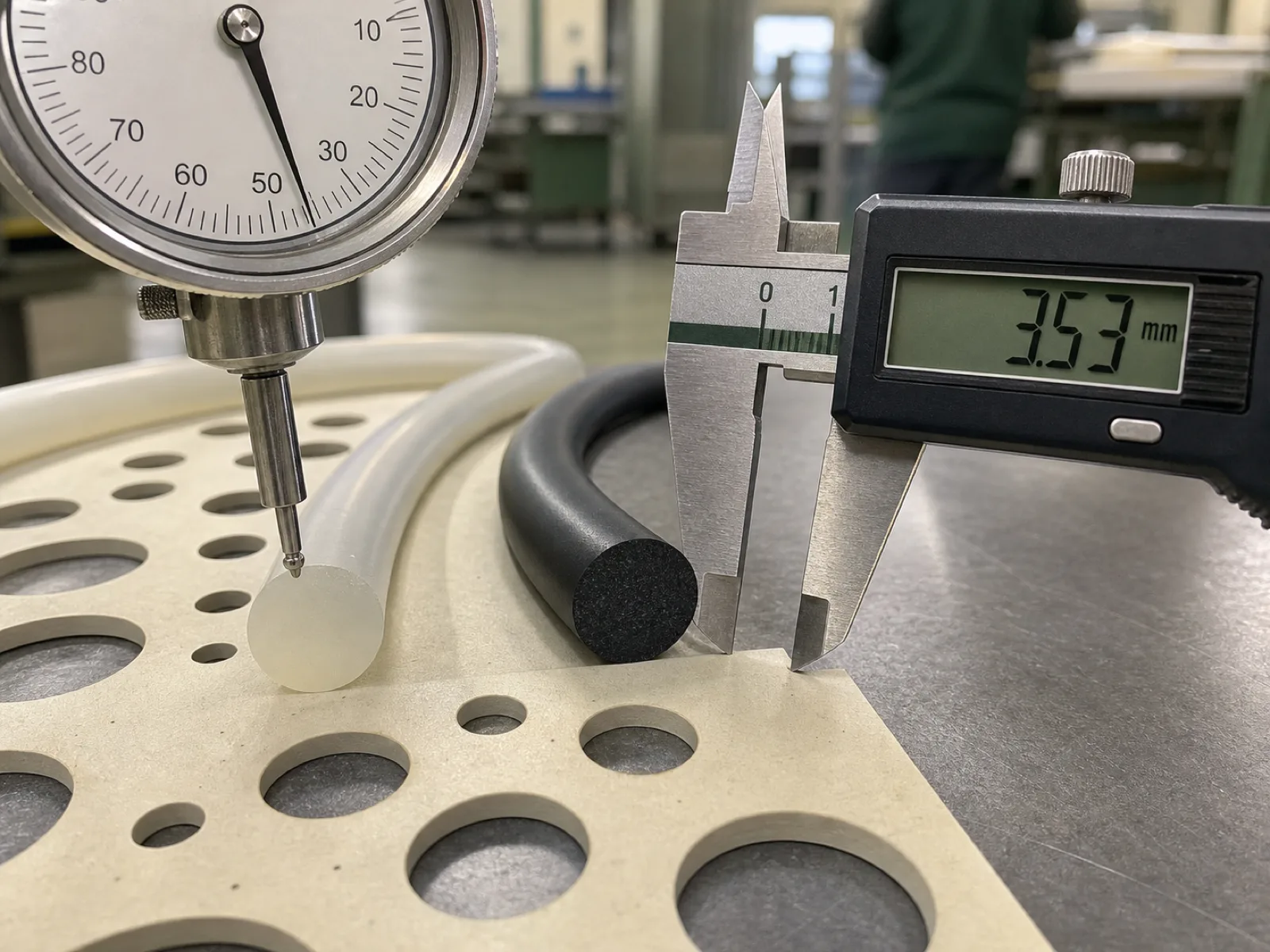
Silicone vs Viton O-ring — what’s the fundamental difference?
Silicone is a siloxane (Si-O backbone) elastomer designated VMQ under ASTM D1418. Viton is DuPont's trade name for fluoroelastomers designated FKM — carbon-fluorine backbone. The chemistry decides everything downstream: silicone gives thermal range and food compliance, FKM gives chemical resistance and hot-oil stability. They are not substitutes; they are different tools.
The naming trips up first-time buyers. “Viton” is a Chemours (formerly DuPont) brand for FKM fluoroelastomers — the generic material class is FKM, and Chinese-manufactured FKM O-rings usually carry a non-Viton brand (Daikin Dai-el, 3M Dyneon, or Solvay Tecnoflon) at 40-60 % of Viton-branded pricing with equivalent mechanical properties. On the RFQ, spec the ASTM D1418 designation (VMQ for silicone, FKM for Viton-equivalent) rather than the brand name unless a customer contract mandates genuine Viton.
Silicone O-rings dominate any application where the sealed medium is water, air, steam under 150 °C, food, or a biocompatible fluid. FKM O-rings dominate anywhere the medium is petroleum-derived, aromatic, chlorinated, or oxidizing above 100 °C. The silicone O-ring specifying guide walks through the drawing-note format for VMQ specifically; this guide is the material-selection layer that comes before that specification step.
What’s the temperature range difference between silicone and Viton O-rings?
Silicone (VMQ) O-rings hold -60 °C to 230 °C continuous and 300 °C intermittent. Viton (FKM) O-rings hold -20 °C to 205 °C continuous and 230 °C intermittent. Silicone wins the cold end by 40 °C; FKM narrowly wins hot chemical service. For cryogenic seals, silicone is the only mainstream elastomer that stays flexible; for hot fuel, FKM is the only mainstream elastomer that survives.
Temperature range is where most datasheet-only comparisons stop, and it’s misleading. The published continuous ceilings assume dry air; add hot oil, and FKM’s practical ceiling climbs while VMQ’s collapses. Add cold cycling, and VMQ’s brittle point holds while FKM turns glassy.
| Metric | Silicone (VMQ) | Viton (FKM) |
|---|---|---|
| Continuous service, dry air | -60 to 230 °C | -20 to 205 °C |
| Continuous service, hot oil | -60 to 150 °C (limited by chemistry) | -20 to 205 °C |
| Intermittent peak, < 30 min | 300 °C | 230 °C |
| Brittle point | -60 to -65 °C | -18 to -25 °C |
| Cold flexibility (TR-10, ASTM D1329) | -50 to -55 °C | -12 to -20 °C |
The cold-end gap is the reason silicone dominates refrigeration, freezer-line food-processing seals, cryogenic vent lines, and outdoor equipment in continental climates. FKM at -30 °C is a hockey puck. Silicone at -30 °C is still sealing.
Silicone vs Viton O-ring chemical compatibility — where does each fail?
Silicone (VMQ) fails in petroleum, aromatic solvents, and concentrated acids — swelling 20-60 % in gasoline per ASTM D471 and losing seal in hours. Viton (FKM) fails in hot amines, low-molecular-weight ketones, strong caustics, and hot high-pressure steam. Chemical compatibility is the primary axis of the silicone vs Viton O-ring decision; get this wrong and no amount of temperature margin will save the seal.
Volume swell above 20 % is generally considered a seal failure regardless of the retained mechanical properties — the O-ring extrudes, distorts the gland, and leaks under thermal cycling. The table below summarizes ASTM D471 volume-swell data at 70 h in the media at the noted temperature.
| Medium | Silicone (VMQ) swell | Viton (FKM) swell | Winner |
|---|---|---|---|
| Water, 70 °C | < 4 % | < 3 % | Both fine |
| Steam, saturated 150 °C | < 8 % (short-term) | 20-40 % | Silicone |
| Gasoline (Fuel B), 23 °C | 20-40 % | < 5 % | FKM |
| Diesel, 60 °C | 25-50 % | < 6 % | FKM |
| Engine oil (ASTM IRM 903), 150 °C | 40-80 % | < 8 % | FKM |
| Brake fluid (glycol), 100 °C | 30-60 % | 15-25 % | FKM |
| Ethanol, 23 °C | 5-10 % | 3-8 % | Both fine |
| Sulfuric acid, 30 %, 23 °C | Attacks | < 5 % | FKM |
| Sodium hydroxide, 30 %, 70 °C | < 8 % | Attacks | Silicone |
| Amines (MDA, TETA), hot | < 8 % | Attacks | Silicone |
| Ozone, 200 pphm, 40 °C | No cracking | No cracking | Both fine |
| UV, 500 h QUV | No cracking | No cracking | Both fine |
The chemistry map explains why silicone dominates food-processing (water, steam, sanitizer) and medical (aqueous, biocompatible) and FKM dominates automotive fuel systems, hydraulic power, and semiconductor wet-etch equipment. For a program that mixes chemistries — say, an EV thermal-management loop that carries glycol coolant but might see occasional oil contamination — the correct answer is often a fluorosilicone (FVMQ) O-ring that trades some cost for both compliance and chemical breadth.
What’s the compression set and mechanical property difference?
Compression set at 175 °C, 70 h per ASTM D395: platinum-cured VMQ lands 12-25 %, FKM lands 15-30 %. Tensile strength: VMQ 6-10 MPa, FKM 10-14 MPa. Tear resistance per ASTM D624: VMQ 15-30 kN/m, FKM 20-40 kN/m. FKM is stronger and more tear-resistant; silicone recovers better from thermal cycling and stays flexible at cold.
Mechanical properties are where FKM’s higher material cost buys you real performance. On tensile, tear, and abrasion, FKM outperforms silicone by roughly a factor of 1.5. On compression set — the number that predicts whether a static seal will hold pressure at 12 months — the gap narrows and can invert depending on the exact compound.
| Property | Silicone (VMQ) | Viton (FKM) |
|---|---|---|
| Shore A hardness range | 30-80 | 65-95 |
| Tensile strength (ASTM D412) | 6-10 MPa | 10-14 MPa |
| Elongation at break | 300-700 % | 150-300 % |
| Tear strength (ASTM D624) | 15-30 kN/m | 20-40 kN/m |
| Compression set (D395, 175 °C, 70 h) | 12-25 % | 15-30 % |
| Specific gravity | 1.10-1.20 | 1.80-1.90 |
| Abrasion resistance | Fair | Good |
| Dynamic seal suitability | Poor to fair | Fair to good |
The lower elongation-at-break on FKM (150-300 % versus VMQ’s 300-700 %) is why silicone is preferred for O-rings installed by stretching over a large diameter — an FKM O-ring stretched more than 5 % of its ID risks nicking or thin-spot damage that shortens service life.
Silicone vs Viton O-ring — food, medical, and certification comparison
Silicone (platinum-cured VMQ) is the standard elastomer for FDA 21 CFR 177.2600, USP Class VI, NSF 51, and LFGB compliance — every major food and medical program specifies VMQ. FKM is rarely certified to food or medical standards; the fluoropolymer chemistry, catalyst residues, and cure system make regulatory qualification expensive. If food or medical contact is on the spec, silicone is the default answer.
The compliance gap is not a technical limitation of FKM — it’s an economic one. FKM compounds could clear FDA and USP Class VI, but the extractables testing, catalyst residue characterization, and lot-traceability overhead cost 3-5× a comparable VMQ program, and the fluoropolymer supply chain has never optimized for food-grade production. The FDA vs LFGB compliance breakdown explains which clause number belongs on which market’s drawing for silicone-based food seals.
| Certification | Silicone (VMQ) | Viton (FKM) |
|---|---|---|
| FDA 21 CFR 177.2600 | Standard on platinum cure | Rarely certified |
| USP Class VI | Standard | Rarely certified |
| NSF/ANSI 51 (food equipment) | Standard | Rarely certified |
| NSF/ANSI 61 (potable water) | Standard | Rarely certified |
| LFGB (Germany / EU food) | Standard | Rarely certified |
| MIL-R-83248 (aerospace fluorocarbon) | N/A | Standard |
| REACH SVHC | Screened | Screened |
| UL 94 V-0 flame class | Available (FR grade) | Available |
For aerospace and defense fluid systems, MIL-R-83248 is the FKM specification most drawings cite; there’s no VMQ equivalent because silicone is not qualified for jet-fuel or hydraulic-oil service.
Silicone vs Viton O-ring — cost, MOQ, and lead time comparison
Viton (FKM) raw material runs 3-5× the price of silicone (VMQ) per kilogram. On a 500-pcs custom OEM O-ring run, delivered unit price typically doubles moving from silicone to FKM. Tooling economics are similar for both — 1,500-6,000 USD for a compression mold — but FKM specialty compound lead time runs 4-6 weeks against 1-2 weeks for standard VMQ, adding one calendar month to first-article delivery.
Cost separates into three buckets: raw material, tooling, and per-unit processing. Silicone wins raw material by a wide margin; tooling is identical (same compression-mold cavities work for both); processing is roughly a wash. On volume-normalized total cost, the OEM pricing structure guide walks through how tooling amortizes across a 500 or 5,000 piece run — the same amortization math applies whether the compound is VMQ or FKM.
| Cost component | Silicone (VMQ) 500-pcs | Viton (FKM) 500-pcs |
|---|---|---|
| Compound cost per kg | 4-8 USD | 25-40 USD |
| Tooling (single-cavity aluminum) | 1,500-4,000 USD | 1,500-4,000 USD |
| Sample lead time (existing tool) | 7-15 days | 7-15 days |
| Sample lead time (new tool) | 15-25 days | 25-40 days |
| Compound lead time (specialty) | 1-2 weeks | 4-6 weeks |
| MOQ (existing tooling) | 500 pcs | 500 pcs |
| MOQ (new tooling, amortized) | 2,000-5,000 pcs | 2,000-5,000 pcs |
| Typical delivered unit price (10 mm ID, 2 mm cross-section) | 0.05-0.10 USD | 0.10-0.25 USD |
Total cost of ownership can still favor FKM in fuel or aggressive-chemistry service where a silicone seal would fail in months and force a warranty replacement — the elastomer choice is almost never a pure per-part price contest.
When should I choose silicone over Viton, and vice versa?
Choose silicone (VMQ) when the medium is water, air, food, medical fluid, or dry heat; when cold-service below -20 °C matters; when food or medical certification is required; or when unit cost dominates. Choose Viton (FKM) when the medium is fuel, hot oil, aromatic solvent, or dilute acid; when hot-chemical service between 100 °C and 200 °C is continuous; or when aerospace and defense specifications require FKM.
The decision matrix reduces to five questions. Answer them in order and the material almost always picks itself.
1. What is the sealed medium? Water, air, steam under 150 °C, food, aqueous biological fluid → silicone. Petroleum, hot oil, aromatic solvent, brake fluid, dilute mineral acid → FKM. Amines, hot caustic, chlorinated organics at cold → silicone. Mixed or ambiguous → fluorosilicone (FVMQ).
2. Is there a food, potable-water, or medical compliance requirement? Yes → silicone. FKM programs for these applications are rare and expensive.
3. What is the continuous service temperature? Below -25 °C → silicone. Above 205 °C in dry air → silicone. -20 °C to 200 °C with hot chemistry → FKM.
4. Is the O-ring a static or dynamic seal? Static face or gland seal → silicone is preferred for cost, dynamic is FKM’s territory.
5. Is unit cost the dominant driver? Yes and the chemistry allows it → silicone.
Ninety percent of B2B OEM O-ring programs on our RFQ desk are silicone by the time step 3 finishes. FKM shows up on the remaining ten percent that involve fuel, hot oil, or an existing aerospace drawing that already specifies FKM. There is almost no application that legitimately needs both — the correct answer is usually one or the other, not a hedge.
What are the common failure modes on silicone and Viton O-rings?
Silicone O-rings fail by chemical swelling (petroleum contact), extrusion under high pressure, and tear during installation. Viton O-rings fail by cold-brittle cracking below -20 °C, steam hydrolysis above 150 °C, and amine attack. Both share compression-set failure when under-cured or over-temperature. The failure mode is usually diagnostic: swollen and soft = silicone in wrong fluid; hard and cracked = FKM at wrong temperature.
Failure diagnosis on a returned O-ring is one of the fastest ways to confirm you had the wrong material. The five most common failures we see on customer returns:
- Swollen, soft, distorted VMQ — silicone O-ring exposed to petroleum, aromatic solvent, or brake fluid. Wrong material for the service; switch to FKM or FVMQ.
- Hard, cracked, glassy FKM — Viton O-ring installed on a cold-service line below -25 °C. FKM is out of its cold envelope; switch to VMQ.
- Flattened, taken permanent set — either material with high compression set. Under-cured compound or service temperature above rated. Require ASTM D395 data at actual service temperature.
- Cut, nicked, or extruded — installation damage or excessive gland-fill. Gland design issue, not a material issue; check ISO 3601 gland tolerances.
- Cracked, crazed surface without chemical exposure — ozone or UV degradation on a non-elastomer-grade compound. Rare on both VMQ and FKM; check for a cheaper substitute (NBR, EPDM) that was swapped in.
What documentation should I demand on a silicone or Viton O-ring order?
Require Certificate of Analysis (COA) per lot with Shore A, specific gravity, tensile, and compression set; Certificate of Compliance (COC) citing the applicable standard (FDA 21 CFR 177.2600 for food VMQ, MIL-R-83248 for aerospace FKM); first-article inspection with dimensional CMM per ISO 3601; and material designation per ASTM D1418 (VMQ or FKM) on every drawing and every packing list.
The paperwork stack is identical between VMQ and FKM — same test methods, same first-article process, same lot-traceability requirement. The silicone factory sourcing checklist covers the full audit sequence we walk EU and North American buyers through; the abbreviated version for O-ring programs:
- Material COA per lot — Shore A, specific gravity, tensile per ASTM D412, elongation, compression set per ASTM D395, ASTM D1418 designation.
- COC citing the standard on the drawing — FDA 21 CFR 177.2600, USP Class VI, NSF 51, or MIL-R-83248 as applicable.
- First-article inspection — dimensional CMM report per ISO 3601 tolerances, material properties, appearance photos.
- REACH SVHC declaration for EU delivery; California Prop 65 statement for CA delivery.
- Traceability from raw compound lot back to finished-goods carton on both VMQ and FKM lots.
Any supplier who charges extra for standard COA/COC documentation on a production order is signaling a cash-flow problem, not a quality-system problem — the paperwork is a byproduct of a functioning ISO 9001 quality system, not a premium service.
Wetop’s silicone vs Viton O-ring OEM position
Wetop is a platinum-cured silicone specialist — we do not manufacture FKM O-rings. When a program spec's FKM, we refer the customer to a qualified FKM supplier rather than substitute VMQ where the chemistry doesn't support it. Our silicone O-ring MOQ is 500 pcs on existing tooling, 2,000-5,000 pcs on new tooling amortized over 12 months, with 7-15 day sample lead time on catalog cross-sections.
The reason we don’t run FKM: it’s a different chemistry, different curing infrastructure, different quality-control regime, and mixing FKM and VMQ compounds in the same facility is where cross-contamination incidents happen. Specialization is why our platinum-cured VMQ compression-set numbers land 12-18 % rather than the industry-typical 20-25 %.
If your program is genuinely silicone (water, food, medical, air, dry heat, cold-service, USP Class VI, LFGB, or NSF 51) and you need a 500-pcs to 500,000-pcs custom O-ring run at ISO 3601 tolerances with full FDA / USP documentation, we can quote in 24 hours from a DXF or a 3D file. If your program needs FKM for fuel or hot-oil service, we’ll tell you that on the first call rather than sell you a silicone O-ring that will fail in the field.
Request an OEM silicone O-ring quote with your ISO 3601 size, target Shore A, service temperature, and sealed medium — we come back within one business day with a compound recommendation, unit price at 500 / 5,000 / 50,000 pcs, tooling amortization schedule, and sample lead time.
FAQ
-
Silicone vs Viton O-ring — which one holds higher temperature?
For continuous dry-heat service in air, silicone (VMQ) wins narrowly at -60 °C to 230 °C versus Viton (FKM) at -20 °C to 205 °C. FKM edges silicone on hot chemical service (hot oil, hot fuel), where silicone's low chemical resistance collapses the effective ceiling well below the datasheet number. Below -20 °C, silicone is the only choice — FKM stiffens and cracks.
-
Silicone vs Viton O-ring — which resists fuel, oil, and aromatic solvents?
Viton (FKM) wins decisively. Standard silicone (VMQ) swells 20-60 % in gasoline, diesel, and aromatic solvents per ASTM D471 and is never specified for fuel-system service. FKM holds volume swell under 8 % on the same media. For fuel, oil, or brake-fluid contact use FKM or fluorosilicone (FVMQ); do not use general-purpose silicone.
-
Is silicone or Viton O-ring safer for food and medical contact?
Silicone. Platinum-cured VMQ is the standard elastomer for FDA 21 CFR 177.2600 food-contact and USP Class VI medical compliance. Standard FKM compounds are not certified for food contact and rarely carry USP Class VI; the fluoropolymer chemistry, cure system, and residual metal catalyst make food and medical qualification expensive and uncommon.
-
What is the compression-set difference between silicone and Viton O-rings?
At 175 °C for 70 hours per ASTM D395, platinum-cured VMQ typically lands 12-25 % and FKM lands 15-30 %. Both are acceptable for 12-month static seals. Silicone recovers faster from thermal cycling (excursions between -40 °C and 180 °C); FKM holds set better under continuous high-temperature chemical exposure.
-
Silicone vs Viton O-ring — which costs more?
Viton (FKM) costs 3-5× the raw-material price of silicone (VMQ). On a 500-pcs custom OEM O-ring run, delivered unit price typically doubles moving from silicone to FKM. Total cost of ownership can still favor FKM in fuel or aggressive-chemistry service where a silicone seal would fail and force a warranty replacement.
-
Can I use silicone O-rings on a dynamic seal or a rotating shaft?
Rarely. Silicone's tear strength (typically 15-30 kN/m per ASTM D624) and abrasion resistance are lower than FKM. For dynamic seals under sliding or rotating motion, FKM, HNBR, or a filled high-tear silicone grade is the safer specification. Static face-seal and flange applications are where silicone O-rings dominate.
-
Do silicone and Viton O-rings share the same ISO 3601 sizing standards?
Yes. Both silicone and Viton O-rings are manufactured to ISO 3601-1 dimensional standards and share cross-section series and inside-diameter tolerances. Swapping between VMQ and FKM in the same gland is a compound change, not a dimensional change — but always re-validate compression, gland fill, and chemical compatibility before substitution.
-
What is the ASTM D1418 designation for silicone versus Viton O-rings?
Silicone O-rings are ASTM D1418 designation VMQ (or MQ, PMQ, PVMQ variants). Viton O-rings are ASTM D1418 designation FKM. The letter code carries onto every material Certificate of Analysis; require the designation on your drawing so the supplier cannot substitute an EPDM or HNBR compound without a change order.
-
What is the MOQ and lead time for custom silicone vs Viton O-rings?
Wetop OEM MOQ on custom silicone O-rings is 500 pcs on existing tooling and 2,000-5,000 pcs on new tooling amortized over 12 months. Sample lead time is 7-15 days on existing tooling and 15-25 days on new aluminum soft tooling. Custom FKM O-rings carry similar tooling economics but longer material lead time (4-6 weeks on specialty FKM compounds).
-
How do I choose between silicone and Viton O-rings for outdoor UV and ozone exposure?
Both silicone (VMQ) and Viton (FKM) resist ozone, UV, and weathering well and are appropriate for outdoor static seals. Silicone edges FKM at cryogenic temperatures (-40 °C and below); FKM edges silicone above 200 °C. For a purely outdoor weather seal with no chemistry exposure, silicone is cheaper and equally durable over a 10-year window.
References
Authoritative sources cited in this guide
- ASTM International. ASTM D1418 — Standard Practice for Rubber and Rubber Latices—Nomenclature. https://www.astm.org/d1418-22.html — The standard that assigns VMQ to silicone and FKM to Viton on every material COA.
- ASTM International. ASTM D471 — Rubber Property—Effect of Liquids. https://www.astm.org/d0471-16a.html — Volume-swell test used to compare silicone vs Viton O-ring chemical compatibility.
- ASTM International. ASTM D395 — Standard Test Methods for Rubber Property—Compression Set. https://www.astm.org/d0395-18.html — The compression-set method both silicone and Viton O-ring datasheets cite.
- ASTM International. ASTM D2000 — Standard Classification System for Rubber Products in Automotive Applications. https://www.astm.org/d2000-18.html — The line-callout system used to specify silicone (GE) and Viton (HK) O-rings on automotive drawings.
- International Organization for Standardization. ISO 3601-1:2012 — Fluid power systems — O-rings — Inside diameters, cross-sections, tolerances. https://www.iso.org/standard/56830.html — Dimensional standard shared by silicone and Viton O-rings.
- US Food and Drug Administration. 21 CFR 177.2600 — Rubber articles intended for repeated use. https://www.ecfr.gov/current/title-21/chapter-I/subchapter-B/part-177/subpart-C/section-177.2600 — The federal food-contact rule silicone O-rings routinely clear and standard FKM O-rings do not.
- United States Pharmacopeia. USP <88> Biological Reactivity Tests, In Vivo (Class VI). https://www.usp.org/harmonization-standards/pdg/excipients/plastic-materials — The biocompatibility standard cited on silicone medical O-rings.
- US Department of Defense. MIL-R-83248C — Rubber, Fluorocarbon Elastomer, High Temperature, Fluid, and Compression Set Resistant. https://www.nist.gov/standardsgov — The military specification governing Viton (FKM) O-rings for aerospace and defense.
- NSF International. NSF/ANSI 51 — Food Equipment Materials. https://www.ecfr.gov/current/title-21/chapter-I/subchapter-B/part-177 — The food-equipment materials standard silicone O-rings frequently carry.
Start a custom program
Send a brief. Get an engineer’s reply in one business day.
Every Wetop program is tooled from a customer’s specification. Send a CAD file (STEP · IGES · DWG) or a written brief and we’ll reply with a mold cost estimate, price brackets at MOQ 500 / 1,000 / 5,000, and any engineering questions.