Buyer Guide · commercial intent
Custom Silicone Teether OEM Guide — Engineering Brief
 Buyer Guide
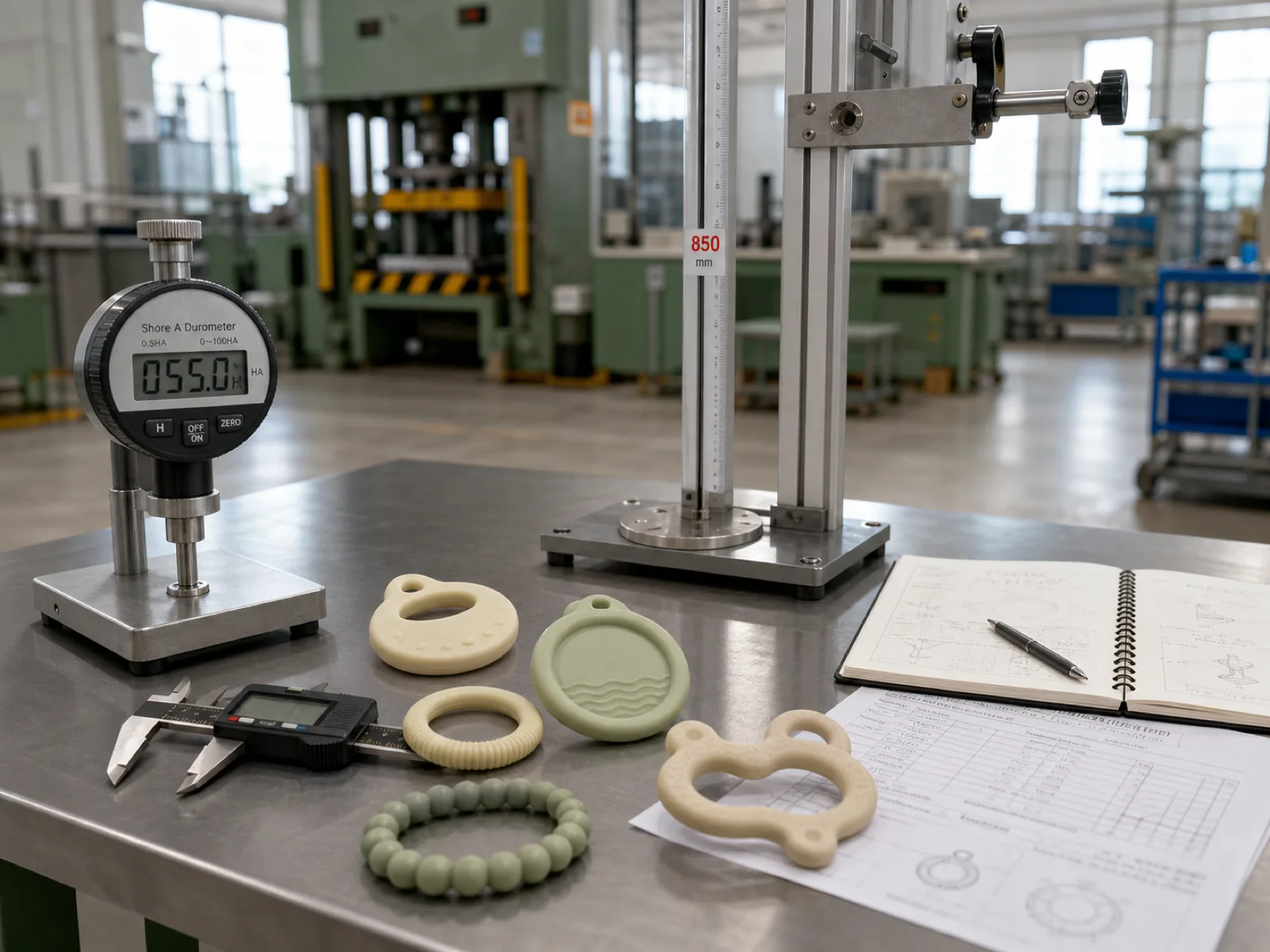
 A custom silicone teether is a one-piece platinum-cured food-grade silicone article — ring, pendant, animal shape, or pacifier-clip attachment — molded to a 35-50 Shore A hardness that infant gums can bite safely without bruising or tearing. For an OEM baby brand, the useful specification is not "food-grade silicone" — it is a defensible packet of CPSIA lead and phthalate reports, EN 71-3 migration data, ASTM F963-23 mechanical clearance, and a mold-flow layout with no weld line across a bite-tension axis. Wetop molds custom silicone teethers on our platinum-cure compression and LSR lines in Dongguan with a 500-piece MOQ per SKU per color, per-lot third-party test reports, and the same Tier-1 retail QC discipline we run on sink-brand OEM programs.
Baby-category listings on Amazon Baby, Target, buybuy BABY, and boutique DTC brands are one of the highest-scrutiny categories in silicone housewares — a single failed EN 71-3 report or a CPSIA lead deviation pulls a SKU off the shelf immediately and the recall cost dwarfs any tooling savings from a low-tier factory. This brief is written for the sourcing lead, product engineer, or founder building or refreshing a custom silicone teether lineup — not for the parent comparing teethers at retail. Every claim below carries a number, a standard clause reference, or a process spec that Wetop’s engineering desk will hold against a purchase order and a compliance audit.
Why does material choice matter more on a teether than on any other silicone article?
Teethers live in an infant's mouth for hours a day across a six-to-eighteen-month use window, so any migratory compound — cure byproducts, colorant metals, uncross-linked chains — accumulates in the child. Only platinum-cured food-grade silicone rubber clears the combined FDA 21 CFR 177.2600[^fda-177-2600], EN 71-3[^en-71-3], and CPSIA[^cpsc-lead][^cpsc-phthalates] packets an infant-category buyer requires.
The chemistry distinction is not academic. Peroxide-cured silicone — still common in low-tier factory listings because it presses faster and needs no platinum catalyst — cross-links using dicumyl peroxide or 2,4-dichlorobenzoyl peroxide. Both leave acidic residues that migrate under warm saliva contact, drive the yellowing and sour odor buyers see in returns, and can push a batch over the EN 71-3 antimony or lead limit if the raw compound was already near the ceramic-pigment ceiling. Platinum cure uses a hydrosilylation reaction catalyzed by a platinum complex; the reaction leaves no migratory byproducts, and the compound holds appearance and taste-neutrality across the infant’s use window.
For the compliance packet, the RFQ line that eliminates most low-tier bidders is: “Platinum-cured food-grade silicone rubber, per-lot test report against FDA 21 CFR 177.2600, EN 71-3 (19 elements), and CPSIA total lead and phthalates. Reject any lot exceeding any migration or content limit.” If a factory hesitates on per-lot testing versus a generic material data sheet, they are not equipped for the infant category. For the underlying cure-chemistry comparison, see the platinum vs peroxide cure guide; for the FDA-vs-LFGB packet distinction, see the FDA vs LFGB guide.
What Shore A hardness is safe for infant gums?
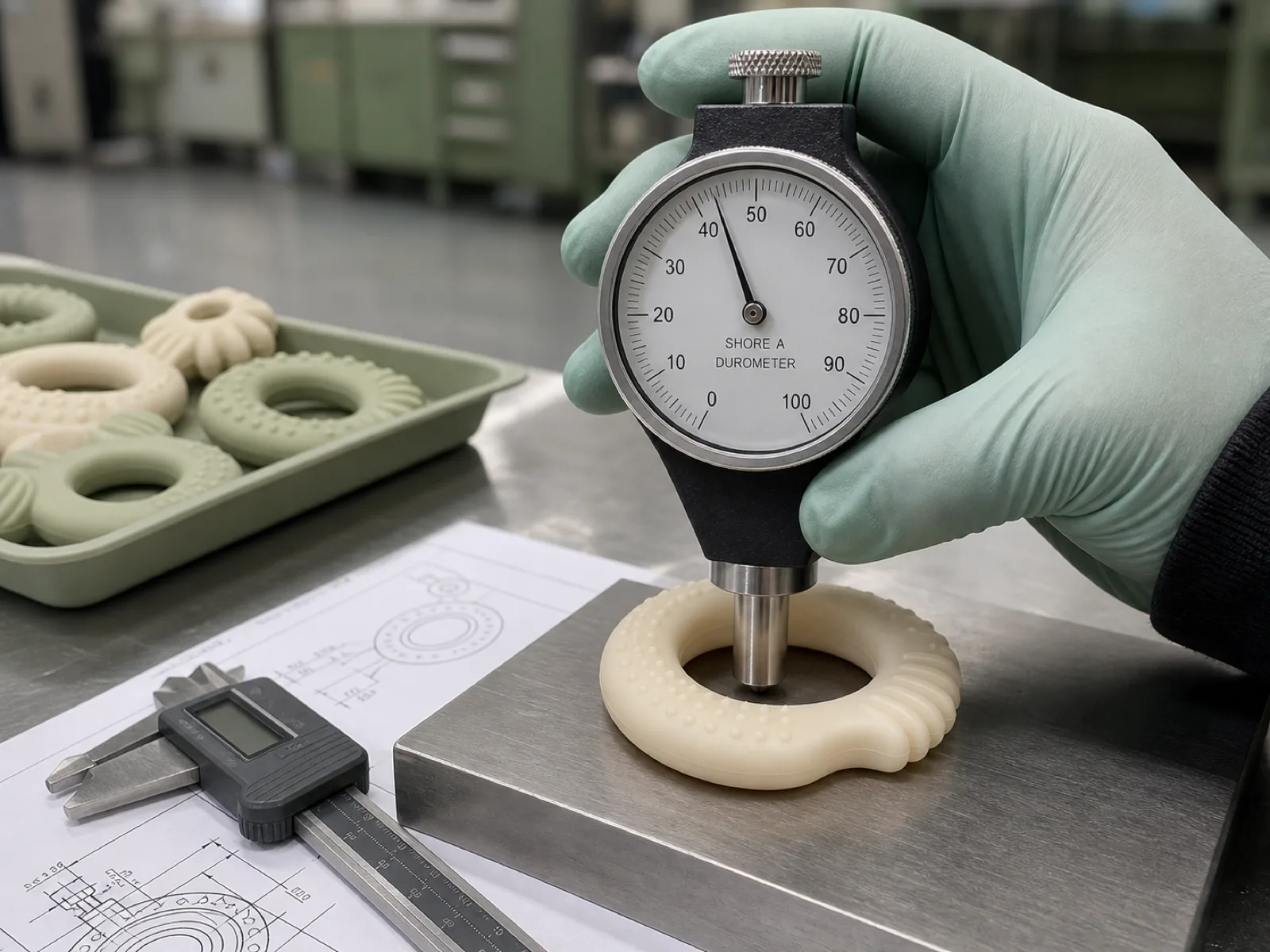
Wetop's engineering window for teether bite zones is 35-50 Shore A[^astm-d2240]. Below 30 A the compound tears at weld lines under bite loads and becomes a choking hazard; above 55 A infant gums bruise within days of use and drive return complaints. Default: 40 Shore A for ring and pendant formats; 45-50 A in bite ridges with 35 A soft accents on textured teethers.
Shore A hardness is measured per ASTM D22401 with a Type A durometer indenter loaded for 15 seconds on a specimen ≥ 6 mm thick. On a teether, the reading matters at two locations: the primary bite zone (the surface the infant actually gums) and any thin flexural feature (a wing, a leaf, a ring segment). The primary bite zone drives the safety window; the flexural feature drives the tear-strength calculation, which is why the compound also gets an ASTM D412 tensile spec pulling the same lot.
The 35-50 A window is a gum-mechanics window, not a marketing choice. Below 30 A, tensile strength drops below roughly 5 MPa and elongation-at-break climbs past 800 % — the compound feels great in the hand but propagates a tear from any surface imperfection under bite tension. Above 55 A, tensile improves but the compound feels like a hard plastic ring; pediatric dentistry references consistently report gum bruising and refusal within a week of use. The 40-45 A sweet spot balances chew feel, tear resistance, and dishwasher recovery.
| Teether format | Bite-zone hardness | Accent hardness | Tear strength target | Elongation at break |
|---|---|---|---|---|
| Simple ring / pendant | 40 Shore A | — | ≥ 20 kN/m | 600-700 % |
| Textured animal / shape | 45-50 Shore A | 35 A soft accents | ≥ 22 kN/m | 550-650 % |
| Pacifier-clip attachment | 40 Shore A | 50 A clip zone | ≥ 20 kN/m | 600-700 % |
| Chunky grip teether | 45-50 Shore A | — | ≥ 25 kN/m | 500-600 % |
What is the CPSIA and ASTM F963 packet for US retail?
The mandatory US packet is CPSIA total lead ≤ 100 ppm (16 CFR 1303[^cpsc-lead]), phthalate limits under 16 CFR 1307[^cpsc-phthalates], small-parts test 16 CFR 1501[^cpsc-small-parts], and ASTM F963-23[^astm-f963] mechanical, flammability, and toxicological compliance. All tests must run at a CPSC-accepted lab against the finished production lot — not the raw compound.
The CPSIA framework layers on top of FDA food-contact clearance. Where FDA 21 CFR 177.26002 covers overall migration to food (or saliva) simulants, CPSIA covers total content of lead, phthalates, and other regulated substances in the finished article. The two are complementary — a compliant teether needs both — and the two report types come from different test methodologies (extraction/migration for FDA, digestion/content for CPSIA lead).
Small-parts testing is the failure mode most first-time infant-category importers underestimate. Under 16 CFR 15013, a product intended for children under three cannot pass through a small-parts cylinder (roughly the choking gauge of a 3-year-old’s throat). That applies to the teether itself, any attached bead or clip, and any component that could reasonably be pulled off under normal use or abuse testing. A weld-line failure that separates a teether into two pieces automatically fails 1501 — which is why cavity gating and vent design have to be engineered so no weld line runs across a tension axis a baby can bite through.
| Test | Standard | Scope | Typical lab | Frequency |
|---|---|---|---|---|
| Total lead content | 16 CFR 13034 | ≤ 100 ppm total lead | Intertek / SGS | Per production lot |
| Phthalate content | 16 CFR 13075 | DEHP/DBP/BBP/DINP/DIDP/DnOP ≤ 1000 ppm each | Intertek / SGS | Per production lot |
| Small parts / choking | 16 CFR 15013 | Cylinder test + use-and-abuse | Intertek / BV | Per SKU qualification |
| Toy safety (mechanical + toxicology) | ASTM F963-236 | Full test battery | Intertek / SGS / BV | Per SKU qualification |
| International mechanical | ISO 8124-17 | Drop, tension, torque | SGS / TÜV | Per SKU qualification |
| Food-contact migration | FDA 21 CFR 177.26002 | Overall migration ≤ limits | SGS / Intertek | Per production lot |
What EN 71 and REACH tests does a teether need for EU retail?
EU retail requires EN 71-1 (mechanical), EN 71-2 (flammability), and EN 71-3[^en-71-3] (migration of 19 elements — antimony, arsenic, barium, cadmium, chromium, lead, mercury, and others). Pacifier-clip formats add EN 12586 (soothers). REACH SVHC[^echa-reach] declaration is required annually. LFGB §30/31 covers general food-contact migration and remains best practice.
EN 71-3 is the EU equivalent of CPSIA lead/heavy-metal control but tests migration under simulated saliva rather than total content. Category III (mouthable materials) applies to teethers and sets the tightest limits — lead migration ≤ 2.0 mg/kg, cadmium ≤ 1.3 mg/kg, and so on across 19 elements. A compliant platinum-cured silicone with clean food-safe masterbatches clears EN 71-3 with headroom; a compound using ceramic-pigment masterbatches designed for higher-temperature applications routinely fails at antimony or barium.
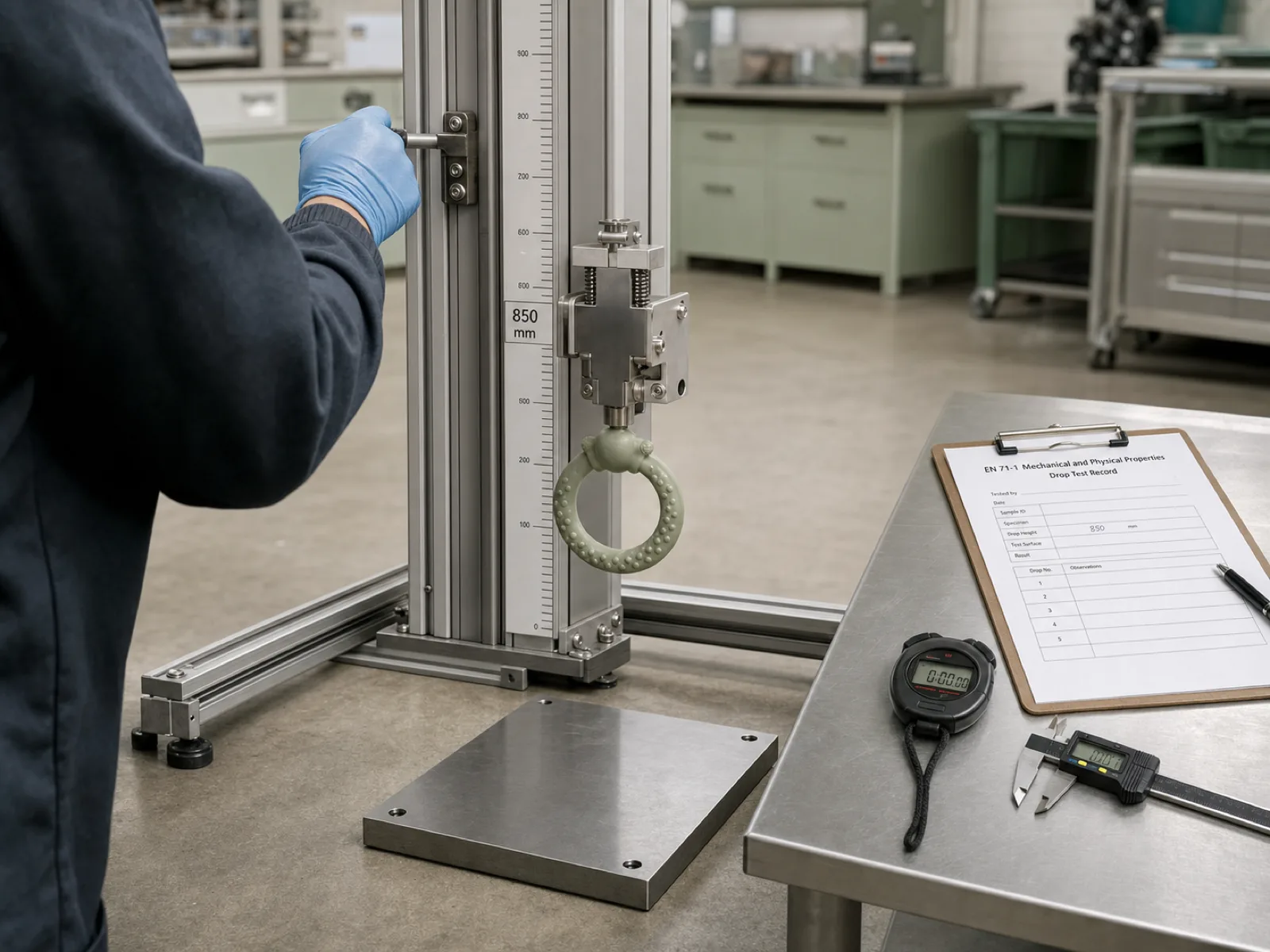
EN 71-1 mechanical testing includes drop test (typically from 850 mm onto a hard surface, per the standard), tension test (up to 90 N depending on part size), and small-parts cylinder equivalent to 16 CFR 15013. A teether that survives EN 71-1 usually survives ASTM F963-236 mechanical with no additional engineering — the mechanical philosophies converge under ISO 8124-17. Pacifier-clip formats add EN 12586 for the soother-holder attachment, which tests strap breaking strength, clip retention, and cord length limits — a category worth flagging separately in the RFQ because the clip subassembly usually requires an additional metal or plastic component from a qualified sub-supplier.
How does mold design prevent weld-line and choking-hazard failures?
Weld lines form where flow fronts meet inside the cavity and represent a discontinuity in cross-link density — the tension weak point in the finished part. On a teether, a weld line across the bite axis is a choking-hazard failure waiting to happen. Cavity gating, vent placement, and cure profile must be engineered so any unavoidable weld line falls in a low-tension zone away from the bite surface.
For compression molding, weld-line control comes from the billet layout — how the pre-weighed silicone billet is positioned in the cavity so the flow fronts converge in a controlled location. For LSR injection molding, weld-line control is a gating-and-vent problem: the runner geometry directs flow, the vent locations pull air out ahead of the flow front so the fronts meet cleanly instead of trapping micro-voids, and the cure profile ensures cross-link density equalizes across the weld interface during the mold-heat dwell.
Wetop’s teether tooling standard: no weld line within 8 mm of a designated bite zone, no vent flash left uncleaned (flash creates a tear-initiation site), and a T1-sample tear test that pulls the part apart at the suspected weld line to confirm the tear propagates through the bulk rather than along the weld. If the sample tears along the weld, the tool goes back for gate or vent revision — no exceptions. That discipline is expensive on the first article and cheap over the SKU’s life. It is also the discipline Tier-1 sink-brand OEM programs demand on gasket seams and grid welds, which is why the same QC infrastructure transfers cleanly to infant-category work.
What is the MOQ, tooling cost, and lead time for a custom teether program?
Wetop's MOQ is 500 pieces per SKU per Pantone-matched color. Aluminum prototype tooling runs 1,200-3,500 USD per SKU with a 15-25 day lead time and a 7-15 day sample cycle to T1. Production steel tooling runs 4,500-9,000 USD with a 30-40 day lead time and holds tolerance across 250,000+ cycles. Sample-approval iteration typically takes one to two rounds.
The MOQ math for a first-year private-label launch usually resolves to aluminum tooling on the first SKU family and a switch to steel once one shape breaks through 20,000 annual units. Aluminum holds ±0.10 mm cavity tolerance for the first 30,000-50,000 cycles before cavity wear starts producing visibly inconsistent flash or ridge sharpness; steel holds ±0.05 mm for 250,000+ cycles. For color-only variants of a proven shape, one tool with three color runs hits the aggregate 1,500-piece minimum without new tooling cost — the color changeover is a one-day cleaning and re-qualification cycle.
Sample flow: T0 concept and engineering drawing (Wetop-drafted, 3-5 days from brief) → T1 tooling drawing sign-off (buyer, 2-5 days) → cavity cut → T1 sample (aluminum tool, 5-7 days after cut) → sample-approval iteration (typically 1-2 rounds, adding 5-10 days each) → bulk PO release. Total: 5-8 weeks from brief to bulk shipment on aluminum tooling; 8-11 weeks on steel. For the underlying cost drivers, see the OEM pricing structure guide and the MOQ and lead time guide.
| Line item | Aluminum prototype tooling | Production steel tooling |
|---|---|---|
| Tool cost per SKU (single-cavity) | 1,200-3,500 USD | 4,500-9,000 USD |
| Tool cost per SKU (4-cavity) | 3,500-6,500 USD | 9,000-18,000 USD |
| Tool lead time | 15-25 days | 30-40 days |
| T1 sample after tool cut | 5-7 days | 5-7 days |
| First production run (500-1,500 units) | 25-35 days from PO | 30-45 days from PO |
| Cavity life | 30,000-50,000 cycles | 250,000+ cycles |
| Tolerance held | ±0.10 mm | ±0.05 mm |
What customization does an OEM teether actually support at 500-piece MOQ?
At 500-piece MOQ per SKU per color, Wetop includes Pantone-matched food-safe masterbatch, in-mold debossed logo, laser-marked lot code, retail-ready blister or window box, and the full CPSIA and EN 71 test packet. Two-color overmolding (soft-accent + firmer bite zone) requires a two-shot LSR cell and an incremental 1,000-piece MOQ per color combination.
Pantone match on food-safe masterbatch is a narrower palette than general silicone housewares work, because heavy-metal pigments used in some saturated colors are excluded by EN 71-38 and CPSIA lead-content limits. Wetop’s qualified palette covers roughly 800 Pantone chips in the sage/cream/pastel/muted-jewel spectrum a modern baby brand typically wants; loud reds and deep blacks are available but require iron-oxide or carbon-based masterbatches that we validate against EN 71-3 before quoting. ΔE ≤ 1.5 in D65 light-box comparison on solids; ΔE ≤ 2.0 on saturated colors.
In-mold debossed logo is engraved into the cavity — no post-mold operation, no adhesive layer that can peel and choke — so it costs nothing at the piece level once tooling is cut. Laser-marked lot codes are added post-press with a fiber laser at 2-3 mm character height in an unobtrusive location, providing full batch traceability from lot code through platinum-cure log, post-cure log, and third-party test report. Retail-ready packaging Wetop supports in-house: printed hangtag with age recommendation, cleaning instructions, and origin statement; PET or PP blister with card back; folded corrugated master carton with barcode. For the customization-mechanism deep dive, see the logo customization guide.
Why do teethers develop bloom, odor, or yellow tint — and how does post-cure prevent it?
Bloom, odor, and yellowing are cure-cycle failures, not material failures. Silicone leaving the press still holds residual cross-linker and low-molecular-weight silicone chains that outgas over weeks. A 4-6 hour post-cure at 200 °C drives these off. Skipping post-cure to shave 6-8 hours of lead time is the single top return driver on Amazon Baby and boutique DTC teether listings.
Post-cure is the most under-discussed step in silicone teether manufacturing and the one Wetop refuses to compromise on. In the press, cure completes to roughly 92-96 % cross-link density in 3-6 minutes at 180-200 °C — enough to demold and hold shape, not enough to drive out volatiles. The remaining 4-8 % of cross-linking, plus the residual chain fraction, needs a secondary thermal cycle in an oven at 200 °C for 4-6 hours. During that dwell, low-MW cyclosiloxanes (D3-D6) and any leftover platinum-catalyst byproducts volatilize off. The finished part is dimensionally stable, odor-free, and holds appearance across the SKU’s full use window.
Wetop’s post-cure log is part of every teether compliance packet: oven ID, load-in time, load-out time, thermocouple trace signed off by the shift lead, and a linked lot-code index that ties back to the compression run and the third-party test report. Any lot missing a valid post-cure record is held from shipment. This is not exotic — it is what ISO 90019 batch-traceability requires — but it is the discipline that separates a factory writing a defensible packet from one that will produce an odor complaint or an EN 71-3 deviation in month three.
References
The engineering positions above trace to the following standards and regulatory sources:
Ready to spec a custom silicone teether program?
If you’re building a new custom silicone teether lineup — or refreshing an existing one that keeps returning on odor, bloom, or EN 71-3 deviation — Wetop’s engineering desk will draft the shape geometry, cavity layout, cure profile, and full CPSIA plus EN 71 compliance packet against your target format, hardness spec, and retail channel. Send the brief through the contact form with target volume, format (ring / pendant / clip / textured), Pantone color, and destination markets, and expect a drafted engineering drawing within three business days. For the underlying compound and packet decisions, the platinum vs peroxide cure guide, the FDA vs LFGB comparison, and the Shore A hardness chart are the three companion reads.
Footnotes
-
ASTM D2240 — Standard Test Method for Rubber Property — Durometer Hardness. ASTM International. https://www.astm.org/d2240-15r21.html ↩
-
21 CFR 177.2600 — Rubber articles intended for repeated use. US Food and Drug Administration. https://www.ecfr.gov/current/title-21/chapter-I/subchapter-B/part-177/subpart-C/section-177.2600 ↩ ↩2
-
16 CFR 1501 — Method for Identifying Toys and Other Articles Intended for Use by Children Under 3 Years of Age Which Present Choking, Aspiration, or Ingestion Hazards. US Consumer Product Safety Commission. https://www.ecfr.gov/current/title-16/chapter-II/subchapter-C/part-1501 ↩ ↩2 ↩3
-
16 CFR 1303 — Ban of Lead-Containing Paint and Certain Consumer Products Bearing Lead-Containing Paint. US Consumer Product Safety Commission. https://www.ecfr.gov/current/title-16/chapter-II/subchapter-C/part-1303 ↩
-
16 CFR 1307 — Prohibition of Children’s Toys and Child Care Articles Containing Specified Phthalates. US Consumer Product Safety Commission. https://www.ecfr.gov/current/title-16/chapter-II/subchapter-C/part-1307 ↩
-
ASTM F963-23 — Standard Consumer Safety Specification for Toy Safety. ASTM International. https://www.astm.org/f0963-23.html ↩ ↩2
-
ISO 8124-1 — Safety of toys — Part 1: Safety aspects related to mechanical and physical properties. International Organization for Standardization. https://www.iso.org/standard/74477.html ↩ ↩2
-
EN 71-3:2019+A1:2021 — Safety of toys — Part 3: Migration of certain elements. European Committee for Standardization. https://standards.iteh.ai/catalog/standards/cen/72fbec0e-77bb-49e4-8b07-4ec50e4796c5/en-71-3-2019a1-2021 ↩
-
ISO 9001:2015 — Quality Management Systems — Requirements. International Organization for Standardization. https://www.iso.org/standard/62085.html ↩
FAQ
-
What silicone grade is safe for a custom baby teether?
Only platinum-cured food-grade silicone rubber that clears FDA 21 CFR 177.2600, LFGB §30/31, and EN 71-3 migration limits belongs in a teether. Insist on a per-lot test report tied to the production lot code, not a generic material data sheet. Peroxide-cured silicone leaves acidic byproducts that migrate under infant saliva and fail EN 71-3 lead, cadmium, or antimony limits within one to two production runs.
-
What Shore A hardness should a silicone teether be?
35-50 Shore A is the safe engineering window for infant gum contact. Below 30 A the compound tears at weld lines and becomes a choking hazard; above 55 A infant gums bruise and the product generates parent complaints. Wetop's default for teething-ring and pendant formats is 40 Shore A; for chunkier bite-and-grip textures we run 45-50 Shore A in the bite zones with 35 A soft accents.
-
What CPSIA tests does a custom silicone teether need for US retail?
The mandatory US packet is total lead ≤ 100 ppm (16 CFR 1303), phthalate compliance (DEHP, DBP, BBP, DINP, DIDP, DnOP each ≤ 1000 ppm per 16 CFR 1307), small-parts safety per 16 CFR 1501, and ASTM F963-23 toy-safety compliance covering mechanical, flammability, and heavy-metal migration. Reports must come from a CPSC-accepted lab (Intertek, SGS, Bureau Veritas, TÜV) against the finished production lot.
-
What EN 71 tests does a teether need for EU retail?
EN 71-1 (mechanical and physical properties, including tension, torque, drop, and small-parts tests), EN 71-2 (flammability), and EN 71-3 (migration of 19 elements — antimony, arsenic, barium, cadmium, chromium, lead, mercury, and others). Pacifier-clip formats add EN 12586 (soothers) and EN 14372 (feeding utensils) where applicable. All tests run against the finished product from the production lot.
-
Is the custom silicone teether BPA-free, phthalate-free, and PVC-free?
Platinum-cured food-grade silicone rubber contains no BPA, no phthalates, no PVC, no latex, and no BPS or BPF. Those chemicals are not part of the silicone polymer or the platinum-catalyst cure system, so a compliant compound is inherently free of them. The claim is still declared on the CPSIA and EN 71 test reports as a documented negative result — retail buyers require the declaration in writing.
-
What is the MOQ for a custom silicone teether?
Wetop's MOQ is 500 pieces per SKU per Pantone-matched color. A three-color lineup on one tool (same shape, three masterbatches) hits an aggregate 1,500-piece minimum. Custom Pantone match, in-mold debossed logo, retail-ready blister or window box, and CPSIA or EN 71 per-lot test reports are all included at that tier — no separate setup fee.
-
How long does custom silicone teether tooling take?
For a single-cavity aluminum compression or LSR injection tool: 15-25 days from art approval to T1 sample, with tooling cost 1,200-3,500 USD depending on cavity count and undercut complexity. Sample-approval iteration typically runs one to two rounds. A four-cavity production steel tool runs 30-40 days at 4,500-9,000 USD and holds tolerance across 250,000+ cycles for high-volume programs.
-
What colors and finishes work on a custom silicone teether?
Wetop delivers Pantone match to ΔE ≤ 1.5 on solids and ΔE ≤ 2.0 on saturated colors, using food-safe masterbatches with no migratory pigments. Finishes include soft-touch matte, polished gloss, and light texture. In-mold debossed logo is engraved into the cavity so it costs nothing at the piece level once tooling is cut. Printed graphics are not recommended for teethers — the print layer chips off under bite loads and fails EN 71-3.
-
Can a custom silicone teether be freezer-safe and dishwasher-safe?
Yes — platinum-cured food-grade silicone is stable from -40 °C to 230 °C, which comfortably covers residential freezer (down to -18 °C) and dishwasher sanitize cycles (70-85 °C). Sterilizer compatibility (steam sterilizer, UV cabinet, boiling water) is standard. The claim is defensible provided the platinum cure and 4-6 hour post-cure are both in the process spec — peroxide-cure product will bloom after 30-50 wet-heat cycles.
-
Who owns the tooling and the design on a custom silicone teether OEM program?
The buyer owns the tooling outright once tooling is paid in full and the T1 sample is signed off. Wetop stores the tool under the buyer's part number with a photographed shelf-location record; on request we ship the tool to another facility at cost. Design IP stays with whoever authored it — buyer-supplied artwork stays with the buyer, and any engineering work Wetop performs is documented under NDA with clear IP assignment in the tooling agreement.
References
Authoritative sources cited in this guide
- US Food and Drug Administration. 21 CFR 177.2600 — Rubber articles intended for repeated use. https://www.ecfr.gov/current/title-21/chapter-I/subchapter-B/part-177/subpart-C/section-177.2600 — The federal migration-limits regulation any US baby brand shipping silicone infant-contact articles must have on file per production lot.
- US Consumer Product Safety Commission. 16 CFR 1303 — Ban of Lead-Containing Paint and Certain Consumer Products Bearing Lead-Containing Paint. https://www.ecfr.gov/current/title-16/chapter-II/subchapter-C/part-1303 — The federal lead limit (≤ 100 ppm total lead) enforced under CPSIA for children's products, including silicone teethers.
- US Consumer Product Safety Commission. 16 CFR 1501 — Method for Identifying Toys and Other Articles Intended for Use by Children Under 3 Years of Age Which Present Choking, Aspiration, or Ingestion Hazards. https://www.ecfr.gov/current/title-16/chapter-II/subchapter-C/part-1501 — The small-parts cylinder test protocol every under-3 product — including teethers and any accessory (clips, beads, rings) — must pass before US retail acceptance.
- US Consumer Product Safety Commission. 16 CFR 1307 — Prohibition of Children's Toys and Child Care Articles Containing Specified Phthalates. https://www.ecfr.gov/current/title-16/chapter-II/subchapter-C/part-1307 — Phthalate limits under CPSIA — DEHP, DBP, BBP, DINP, DIDP, and DnOP each ≤ 1000 ppm — required on any child-mouth-contact product.
- ASTM International. ASTM F963-23 — Standard Consumer Safety Specification for Toy Safety. https://www.astm.org/f0963-23.html — The mandatory US toy-safety standard covering mechanical, flammability, and toxicological requirements for children's products including teethers.
- European Committee for Standardization (CEN). EN 71-3:2019+A1:2021 — Safety of toys — Part 3: Migration of certain elements. https://standards.iteh.ai/catalog/standards/cen/72fbec0e-77bb-49e4-8b07-4ec50e4796c5/en-71-3-2019a1-2021 — The EU migration-limits standard covering 19 heavy-metal elements — the primary chemical-safety hurdle for silicone teethers entering EU retail.
- International Organization for Standardization. ISO 8124-1 — Safety of toys — Part 1: Safety aspects related to mechanical and physical properties. https://www.iso.org/standard/74477.html — The international mechanical-safety standard aligned with ASTM F963 and EN 71-1, covering drop, tension, torque, and small-parts tests for teethers globally.
- International Organization for Standardization. ISO 9001:2015 — Quality Management Systems — Requirements. https://www.iso.org/standard/62085.html — The documented QMS Wetop's compression and LSR lines are certified against, including batch traceability and lot-code retention required for infant-category retail chains.
- ASTM International. ASTM D2240 — Standard Test Method for Rubber Property — Durometer Hardness. https://www.astm.org/d2240-15r21.html — The Shore A hardness test protocol referenced on every teether engineering drawing to specify the gum-safe 35-50 A window.
- European Chemicals Agency (ECHA). REACH — Registration, Evaluation, Authorisation and Restriction of Chemicals (Regulation EC 1907/2006). https://eur-lex.europa.eu/legal-content/EN/TXT/?uri=CELEX%3A32006R1907 — The EU chemicals regulation governing SVHC declarations required on any silicone infant product entering the EU retail channel.
Start a custom program
Send a brief. Get an engineer’s reply in one business day.
Every Wetop program is tooled from a customer’s specification. Send a CAD file (STEP · IGES · DWG) or a written brief and we’ll reply with a mold cost estimate, price brackets at MOQ 500 / 1,000 / 5,000, and any engineering questions.