Buyer Guide · commercial intent
Custom Silicone Watch Band Manufacturer — OEM Guide
 Buyer Guide
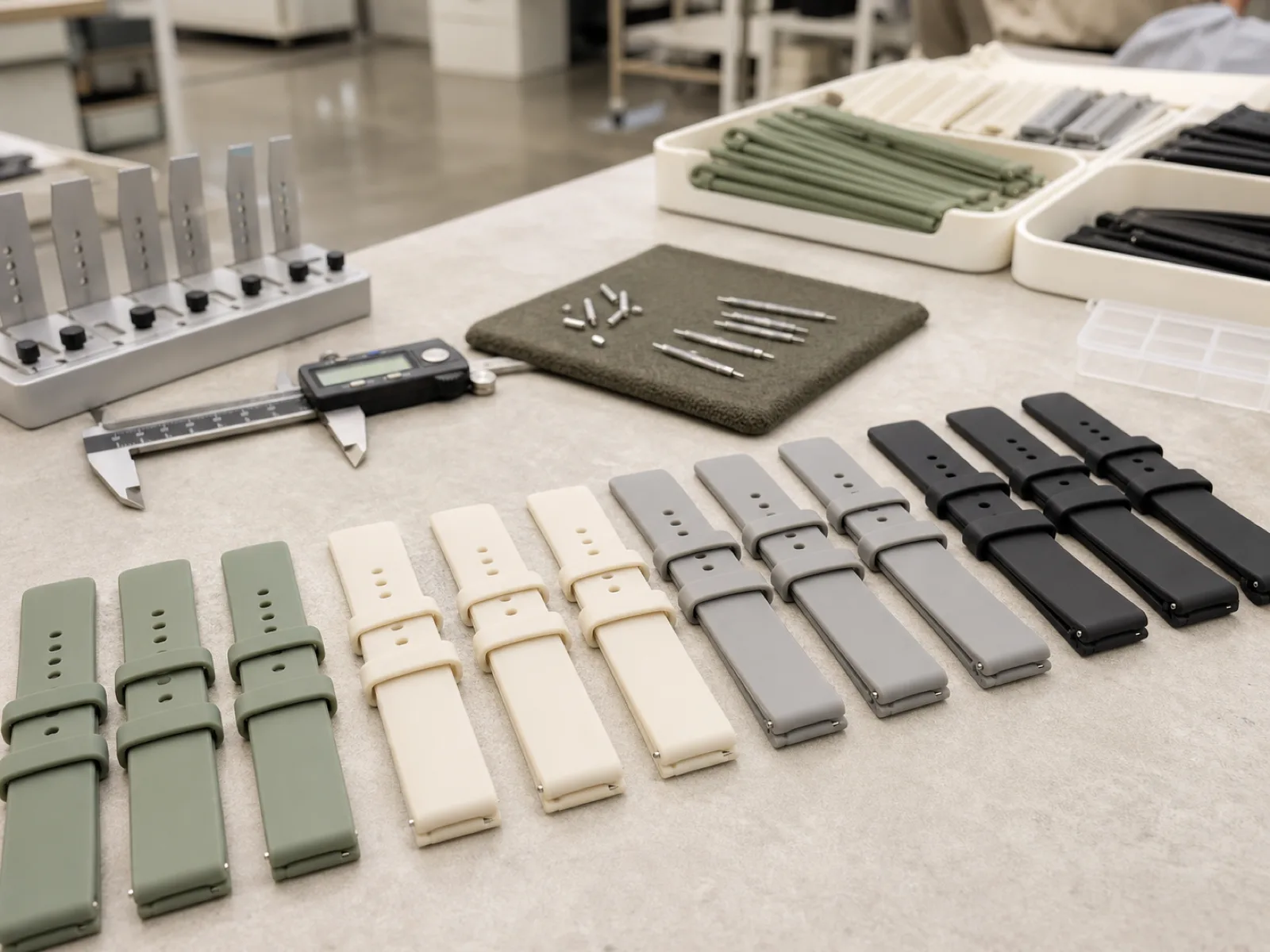
 A qualified custom silicone watch band manufacturer runs platinum-cured LSR injection or HCR compression in a segregated skin-contact cell, holds ±0.10 mm on lug width, and ships per-lot Certificates of Analysis referencing ASTM D624 tear strength and ISO 10993-5 cytotoxicity data. Standard OEM MOQ is 500 bands per SKU per colorway with 4-cavity tooling at $1,800-4,500 and 25-40 day production lead times. Compliance stacks in three tiers: consumer wearable (FDA 21 CFR 177.2600 + LFGB §30/31), extended-wear fitness (adds ISO 10993-5/-10), and medical wearable (adds USP Class VI).
Buyers arrive at “custom silicone watch band manufacturer” search after a private-label supplier has failed them — bands that tore at the lug hole in eight months, pin channels that drifted 0.3 mm across cavities, or a “food-grade” PDF that turned out to be a generic base-polymer datasheet with no compound-specific testing. This guide is written for smartwatch OEMs, watch brands, and Amazon-first private-label sellers who need to specify, quote, and qualify a silicone watch band factory for programs that will run through multiple seasonal launches. It covers the compliance stack for skin-contact wearables, LSR-vs-HCR process economics, lug and pin geometry, logo-durability tradeoffs, tooling amortization math, and the QC packet that separates a real skin-contact factory from a repackaged trader.
What separates a real silicone watch band manufacturer from a trader?
A real custom silicone watch band manufacturer owns the skin-contact molding cell, controls compound and colorant mixing on-site, and can produce a live video walk of the LSR pumping station or HCR compression press within 24 hours. Traders send generic "food-grade" declarations, cannot show a per-cavity dimensional report, and typically source from three or four small molders — so cavity-to-cavity lug drift compounds across shipments and no single supplier is accountable when tear failures return from the market.
Four fingerprints separate factories from traders on the sourcing call. First, quote turnaround: a factory returns a technical quote in 48-72 hours with a specific tooling number, cavity count, and cycle time; a trader takes 5-10 days and quotes only a per-band price. Second, sample lead time: a factory ships DFM feedback in 3-5 days and T0 samples in 10-15 days on new tooling; a trader takes 20-30 days because they are ordering samples from an unnamed molder. Third, drawing pushback: a factory engineer will call out unrealistic lug tolerances, undersized pin channels, or a mismatched logo process before quoting; a trader accepts every spec silently. Fourth, the QC packet: a factory sends per-cavity dimensional data with unique cavity IDs, operator IDs, and dates; a trader sends a PDF template with the same average value across all cavities and shipments.
What compliance stack do I need for OEM silicone watch bands?
Silicone watch band compliance breaks into three stacks by wear profile. Consumer fashion bands need FDA 21 CFR 177.2600 plus LFGB §30/31 plus REACH SVHC-free and California AB 1200 PFAS-free. Extended-wear fitness and smartwatch bands add ISO 10993-5 in vitro cytotoxicity and ISO 10993-10 irritation and sensitization. Medical wearables (patient monitoring straps, continuous glucose monitor bands) add USP Class VI biocompatibility on the specific compound and colorant.
The three stacks are cumulative — a medical-wearable line meets everything below it — but you should only qualify to the stack you actually need. USP Class VI adds $0.40-0.90 per band and 6-8 weeks of first-article testing that a consumer or fitness band does not require. What is not optional is that the testing is run on the actual compound plus colorant system, not on the base polymer alone. Colorants and pigments carry their own extractable and cytotoxicity profiles; a “food-grade base polymer” datasheet is not a compliance document for a red or teal pigmented band. See our FDA vs LFGB silicone guide for the food-contact stack in detail.
| Compliance stack | Applies to | Typical cost premium vs consumer |
|---|---|---|
| Consumer (FDA 177.2600 + LFGB + REACH + AB 1200) | Fashion watch bands, promotional straps, retail seasonal | Baseline |
| Fitness / smartwatch (adds ISO 10993-5 + ISO 10993-10) | Apple Watch / Garmin / Fitbit / Galaxy Watch compatible bands | +8-15 % |
| Medical wearable (adds USP Class VI) | Continuous glucose monitors, patient monitoring straps, medical alert | +25-40 % |
LSR vs HCR — which process for OEM watch bands?
LSR (liquid silicone rubber) injection is the correct process for smartwatch and premium watch bands at annual volumes above 5,000 units. It runs a closed heated cavity in 30-90 second cycles, holds ±0.05 mm on lug and pin geometry, and produces flash-free parts with no trim step — eliminating the tear-initiation sites that HCR flash lines can leave near the lug attachment. HCR (high-consistency rubber) compression is more economical below 5,000 annual units and remains the default for fashion and promotional watch bands where ±0.15 mm lug tolerance is acceptable and per-unit price dominates.
The LSR-vs-HCR decision is a volume-and-tolerance math problem, not a quality ranking. HCR compression uses a solid pre-formed rubber slug, compresses it in a heated mold for 3-6 minutes, then trims flash by hand or die. It produces excellent-feeling watch bands and is what most fashion silicone straps have been made from for two decades. LSR uses a two-part liquid dosed by a pumping station into a closed cavity — automation is baked in, cycle time drops 3-6×, and dimensional consistency across a 32-cavity family stays inside ±0.05 mm. What LSR does not do is lower per-band cost at low volume: tooling is 60-90 % more expensive, so payback is at 5,000-8,000 annual units depending on cavity count. Our platinum-cured vs peroxide-cured silicone guide covers the underlying cure chemistry.
How do I specify lug width, pin channel, and strap geometry?
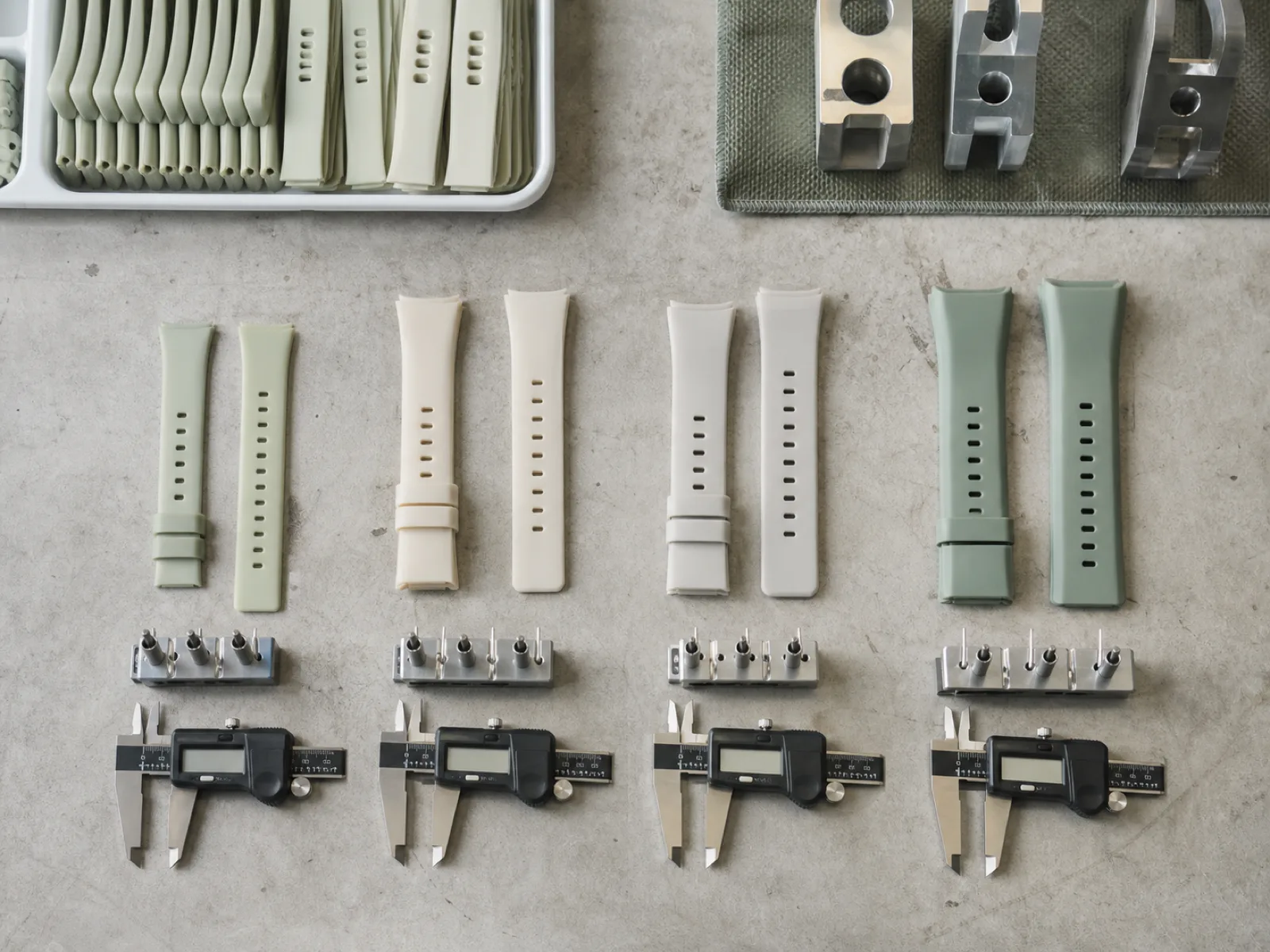
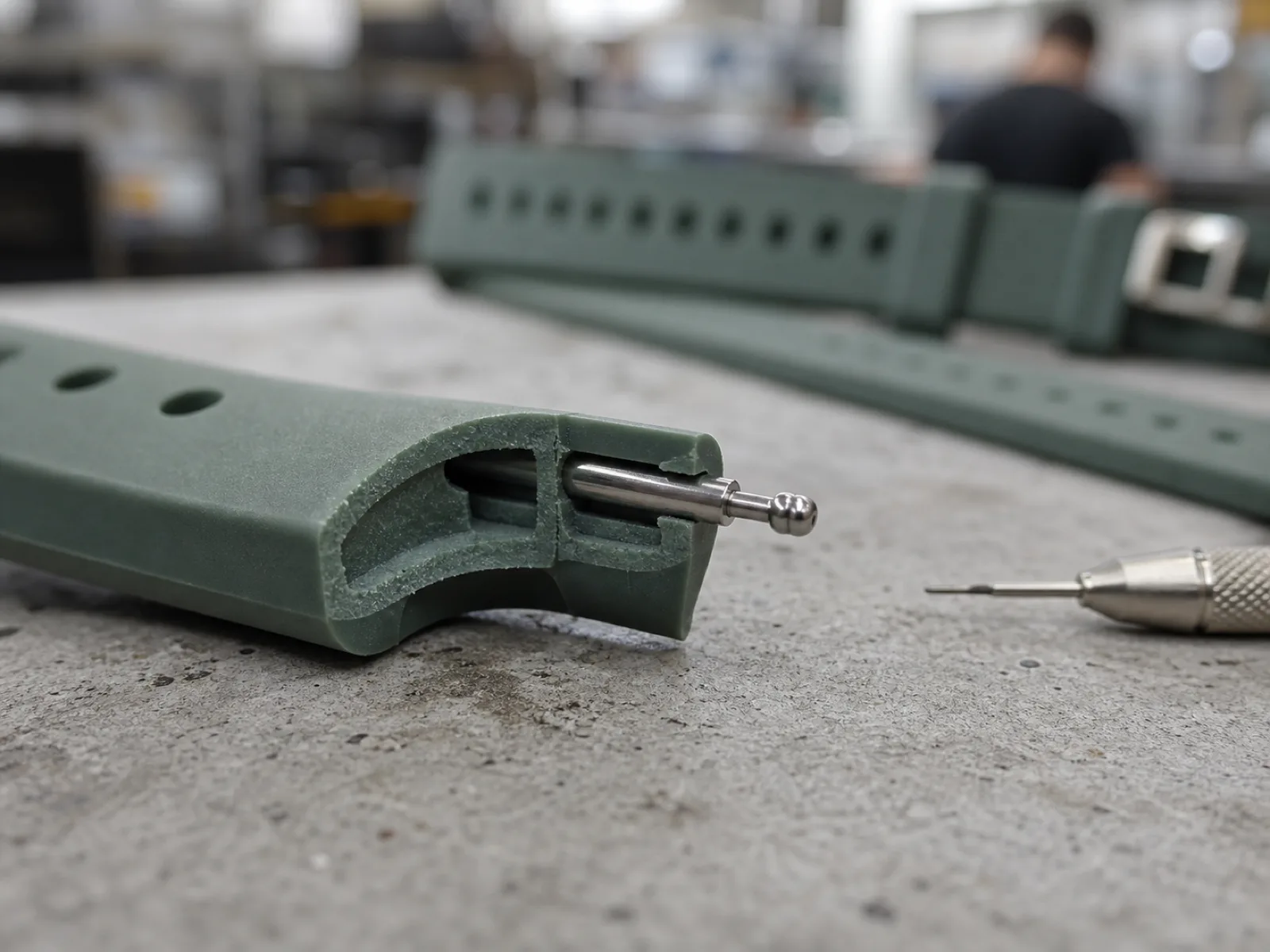
Every OEM silicone watch band drawing must carry seven specs: lug width (18, 20, 22, or 24 mm nominal), lug tolerance (±0.10 mm baseline, ±0.05 mm on LSR), pin channel bore (1.6 mm for 1.5 mm spring bars, 1.9 mm for 1.8 mm bars), strap thickness (2.0-3.5 mm typical), taper profile if applicable, Shore A hardness ±3 points per ASTM D2240, and cure system (platinum-cured is the default for skin contact). Anything missing gets filled by the factory — usually at looser tolerance to protect their yield.
Lug and pin geometry is where cheap watch bands fail in the market. If the lug is 0.2 mm undersized, the strap will not seat on the case and the spring bar pops out under wrist load. If the lug is 0.2 mm oversized, the strap seats but rotates on the pin, and lug-hole tear initiates within 6-8 months of daily wear. Standard OEM lug widths cover Apple Watch (38/40 mm case = 20 mm lug; 42/44/45 mm case = 22 mm lug), Garmin fēnix (22 or 26 mm depending on generation), Samsung Galaxy Watch (20 or 22 mm), and Fitbit Versa (22 mm). Non-standard widths (19, 21, 23 mm) run on custom tooling at the same tooling cost window. Our customize silicone logo guide covers logo geometry integration into the same drawing.
| Application / target device family | Standard lug width | Pin diameter | Strap thickness | Shore A |
|---|---|---|---|---|
| Apple Watch 38/40/41 mm | 20 mm | 1.5 mm | 2.4-2.8 mm | 50-60 |
| Apple Watch 42/44/45/49 mm | 22 mm (24 mm on Ultra) | 1.5 mm | 2.6-3.2 mm | 55-65 |
| Garmin fēnix / Instinct | 22 or 26 mm | 1.8 mm | 3.0-3.5 mm | 60-70 |
| Samsung Galaxy Watch | 20 or 22 mm | 1.5 mm | 2.4-2.8 mm | 50-60 |
| Fashion / traditional watch (18-24 mm) | 18, 20, 22, 24 mm | 1.8 mm | 2.6-3.2 mm | 55-65 |
What Shore A hardness, colors, and surface finishes are OEM-standard?
OEM silicone watch bands run Shore A 40-70 per ASTM D2240. 40-50 Shore A gives a soft, luxury-tactile feel used on premium smartwatch bands; 55-65 Shore A is the mainstream OEM window that feels substantial without stiffness; 65-70 Shore A is used for sport and thin fashion straps that must resist twist. Colors match Pantone Solid Coated with ±0.5 delta-E tolerance on standard colorants. Surface finish (matte, soft-touch, textured, gloss) is set by the mold cavity finish per SPI A1-C3, not by post-processing.
Color and finish specification carries hidden MOQ implications. Standard Pantone-matched pigment master-batches carry their own compound minimum — usually 20-50 kg — which for a 15-gram band equates to roughly 1,300-3,300 units. Dual-color overmold (two-shot molding or bonded assembly), pearlescent finishes, and glow-in-the-dark pigment each require a separate master-batch and a separate MOQ floor. Textured finishes molded into the cavity (perforated sport-band pattern, mesh look, brushed texture) require EDM cavity work at tooling stage and cannot be added post-mold. The customize silicone logo guide covers logo geometry; for surface finish, decide before cutting steel.
How do debossing, pad printing, and laser engraving compare for logo durability?
Debossing (recessed logo molded into the cavity) is the most durable option — it is a geometric feature of the part and survives 3-5+ years of sweat, UV, and wrist abrasion with no fade because there is no ink to lose. Pad printing lays silicone-compatible ink on the surface and reads brightly at ship but fades in 12-24 months on wrist-contact surfaces. Laser engraving vaporizes surface pigment on colored silicone; it stays sharp indefinitely but only reads well with strong color contrast. Debossing must be cut into the cavity at tooling stage — decide before tooling PO, not after.
Logo choice cascades into tooling cost, per-band price, and market perception. Debossing adds no per-unit cost but adds $200-400 to cavity EDM work per cavity — a 4-cavity mold with a 12 mm brand mark absorbs $800-1,600 of one-time tooling cost. Pad printing costs $0.08-0.20 per band per color and adds a post-mold operation with a 92-95 % yield — small print falls to 88-92 % yield. Laser engraving costs $0.15-0.35 per band and requires pigmented (not translucent) silicone for contrast. For retail packaging visibility on a first-launch shelf, pad printing wins on brightness; for lifetime brand presence on a returning customer’s wrist, debossing wins on durability. See customize silicone logo for the process comparison in detail.
What tear strength, elongation, and durability specs should I require?
Industry-baseline OEM watch band specs are: tear strength ≥ 25 kN/m per ASTM D624 Die C, tensile strength ≥ 8 MPa per ASTM D412, elongation at break ≥ 400 % per ASTM D412, Shore A hardness ±3 points per ASTM D2240, and compression set ≤ 30 % after 22 h at 100 °C per ASTM D395. Also require 500 h UV exposure per ASTM G154 with ≤ 10 % durometer shift and 100 sweat-cycle immersion per ISO 105-E04. Cheap private-label bands ship at 12-18 kN/m and tear at the lug hole within a year.
The single most predictive spec on an OEM watch band is tear strength at the lug attachment. Lug-hole tear is the failure mode that returns product from the market — a customer catches the strap on a doorframe, the pin loads the lug edge, and the strap propagates a tear at whatever stress-concentration flaw exists near the pin channel. A 25 kN/m Die C tear-strength floor combined with a properly molded pin channel (not a punched hole) reduces field failure to under 0.5 % over a 24-month wear cycle. Below 20 kN/m tear strength, field failure runs 3-8 % — visible on Amazon reviews and unforgiving on repeat-order rate.
What are MOQ, tooling, and lead time for OEM watch band programs?
Wetop's standard OEM MOQ is 500 bands per SKU per colorway. Tooling for a single-lug-width family runs $1,800-2,800 for a 4-cavity HCR compression mold or $3,200-4,500 for a 4-cavity LSR injection mold. Sample lead time is 10-15 days on new tooling; production lead time is 25-30 days on existing tooling, 35-40 days on new tooling. Full sample-to-PO cycle for a first-time program (DFM, tooling, T0/T1, engineering approval, MP) is 45-60 days. Air freight adds 10-14 days at $6-9 per band on 500-unit launch runs.
MOQ math is compound-and-colorant driven. A 500-band SKU floor is the compound minimum on a single Pantone-matched color; a program running four colorways at 500 bands each is a 2,000-band PO on four separate master-batches. Split-length or split-Shore-A runs on the same colorway combine toward the compound floor — a program running 300 short and 200 long on the same purple color hits the floor in a single production day. Our MOQ and lead time silicone OEM guide covers the compound-floor math in detail; the real factory MOQ math explains why 500 is a floor and not a negotiation.
| Cost line | HCR compression (4-cavity) | LSR injection (4-cavity) |
|---|---|---|
| Tooling (single lug-width family) | $1,800-2,800 | $3,200-4,500 |
| Cavity EDM for debossed logo | +$200-400 per cavity | +$200-400 per cavity |
| Cycle time per shot | 4-6 min | 30-90 s |
| Sample lead time (new tooling) | 10-12 days | 12-15 days |
| Per-band cost, 500 units | Baseline | +25-40 % |
| Per-band cost, 10,000 units | Baseline | -5-10 % |
| Dimensional tolerance on lug | ±0.15 mm | ±0.05 mm |
What QC packet should ship with every lot of OEM silicone watch bands?
Every OEM silicone watch band shipment should carry a five-document QC packet: (1) Certificate of Conformance referencing PO and drawing revision; (2) per-cavity dimensional report with lug width, pin channel bore, and thickness across all cavities; (3) per-lot Certificate of Analysis with actual tear strength per ASTM D624 Die C, tensile and elongation per ASTM D412, and durometer per ASTM D2240; (4) compound-level FDA 21 CFR 177.2600 and LFGB §30/31 reports dated within 12 months; (5) ISO 10993-5 cytotoxicity restatement for fitness and smartwatch programs. Colorant-specific extractable data on any non-standard pigment.
The per-cavity dimensional report is where trader-vs-factory becomes irreversible. On a 4-cavity mold, cavities drift at different rates as the mold cycles — a real factory measures all four cavities, tags them by cavity number, and either qualifies all four or holds the drifted cavity out of production. A trader sends an average across cavities and shipments, and the average hides the one cavity producing 30 % of your field failures. Ask for the raw per-cavity data on the T1 sample run and every 10,000-unit production lot after; if the numbers are identical across cavities and shipments, the report is fabricated.
How do I qualify a China-based custom silicone watch band manufacturer remotely?
Run a four-step remote qualification: (1) request the ISO 9001 certificate and cross-check the accreditation body against IAF MLA; (2) get a live video walk of the skin-contact molding cell showing the LSR pumping station or HCR compression press — not a stock reel; (3) order paid T0 samples on your drawing, measure lug and pin geometry on your own metrology, and send samples for third-party FDA 177.2600 and ISO 10993-5 testing at SGS or Intertek; (4) require a per-cavity dimensional report on T1 samples before releasing tooling PO. The four steps take 30-45 days and eliminate ~90 % of the fake-factory risk on skin-contact wearables.
Step 3 is the one buyers most often skip and most often regret. A factory sending its own dimensional data on the first article is not necessarily lying — it is measuring what came off the mold on the day the operator wanted the numbers to look good. Your metrology on your side of the ocean is the only data that matters, because it is what your customer service team will use to root-cause a field failure six months later. For China-specific logistics on skin-contact wearables — Yantian port cut-off, Shenzhen airport routing, sample-to-PO cadence — see our sourcing silicone factory checklist.
Wetop as your custom silicone watch band manufacturer
Wetop runs a segregated platinum-cured LSR injection cell and a separate HCR compression cell for skin-contact wearables, holds ISO 9001:2015 factory certification, and ships per-cavity dimensional reports plus per-lot Certificates of Analysis referencing ASTM D624 Die C tear strength and ASTM D412 tensile data. Our engineering desk quotes watch band programs in 48-72 hours with specific tooling numbers, cavity counts, cycle times, and a tooling amortization schedule across the first two POs. We are a founder-led independent factory in Dongguan — 90 minutes to Yantian Port and two hours to Hong Kong airport — with a 60-person team on 7,500 m², and we run food-contact, wearable, and industrial programs on segregated compound batches with independent tooling.
If you are moving off an Amazon-tier private-label supplier and want a real custom silicone watch band manufacturer to quote your drawing, send us the spec and we will return a technical quote within three business days, including compound compliance documentation, tooling cost, per-cavity dimensional expectations, and a first-article timeline. Include your lug width, pin system, strap thickness, Shore A target, colorway list, logo process, compliance stack, and annual volume estimate.
References
The specifications, tolerances, and compliance references in this guide are drawn from the following primary standards and regulatory sources. All URLs are the publisher’s canonical location; specifications and clause numbers cited above match the current published revision.
FAQ
-
What should I look for in a custom silicone watch band manufacturer for OEM programs?
Ask for four things before quoting: (1) segregated skin-contact cell — LSR injection or HCR compression not shared with industrial or automotive compounds; (2) ISO 9001 certificate plus documented ISO 10993-5 cytotoxicity data on the actual compound, not a compound-family datasheet; (3) sample QC packet showing tear strength per ASTM D624 Die C, elongation per ASTM D412, and per-cavity lug dimensional data; (4) a compound-level FDA 21 CFR 177.2600 report and LFGB §30/31 report dated within 12 months. A custom silicone watch band manufacturer that cannot produce all four in 48 hours is a trading company, not a factory.
-
What is the MOQ for a custom silicone watch band and how is tooling priced?
Wetop's standard OEM MOQ is 500 bands per SKU per colorway. Tooling for a single-lug-width family (one lug width, one strap length range) runs $1,800-2,800 for a 4-cavity HCR compression mold or $3,200-4,500 for a 4-cavity LSR injection mold. Tooling is amortized across the first two POs at $0.60-1.20 per band. Below 5,000 annual units, HCR compression is more economical; above 5,000 annual units, LSR pays back in cycle time and lower tolerance drift within the first PO cycle.
-
Is LSR or HCR silicone better for OEM watch bands?
LSR (liquid silicone rubber) is better for smartwatch and premium watch bands at annual volumes above 5,000 units — it is injection-molded in a closed heated cavity in 30-90 seconds, holds ±0.05 mm on lug and pin geometry, and produces flash-free parts that skip the trim step. HCR (high-consistency rubber) compression is more economical below 5,000 annual units and remains the default for fashion watch bands and promotional programs where ±0.15 mm lug tolerance is acceptable. Feel is nearly identical at the same Shore A hardness; the differences are dimensional, throughput, and per-unit price at volume.
-
What silicone grades are safe for skin contact on a watch band?
Any watch band worn against skin should be molded from platinum-cured food-grade silicone meeting FDA 21 CFR 177.2600 and LFGB §30/31, plus REACH SVHC-free. For extended-wear fitness bands with sweat and heat exposure, add ISO 10993-5 in vitro cytotoxicity and ISO 10993-10 irritation and sensitization testing on the specific compound and colorant system — not the base polymer alone. Peroxide-cured silicone is not appropriate for skin-contact wearables because uncontrolled 2,4-DCBA extractables can cause contact dermatitis. Fluorosilicone (FKM/FVMQ) is unnecessary for watch bands — it costs 4-6× more and offers no skin-safety benefit over platinum-cured VMQ.
-
What lug widths and quick-release pin systems can you produce?
Standard OEM lug widths are 18 mm, 20 mm, 22 mm, and 24 mm — covering roughly 95 % of Apple Watch, Garmin, Samsung Galaxy Watch, Fitbit, and traditional watch geometries. Non-standard widths (19 mm, 21 mm, 23 mm) run on custom tooling with the same $1,800-4,500 tooling window. Quick-release spring bars are 1.5 mm or 1.8 mm diameter with 0.8 mm lever travel; the lug channel is molded with a 1.6 mm or 1.9 mm bore respectively to accept the pin with a 0.05-0.10 mm clearance fit. Apple Watch adapter lugs (stainless-steel insert overmolded in silicone) require a separate insert-molding cell and add $2,400-3,600 to tooling.
-
What Shore A hardness and colors are typical for OEM watch bands?
Watch band Shore A hardness lives in a 40-70 window depending on wear feel. 40-50 Shore A is a soft, luxury-tactile feel used on premium smartwatches. 55-65 Shore A is the mainstream OEM window — it feels substantial without being stiff and holds pin channels precisely. 65-70 Shore A is used for sport bands and thin fashion straps where the strap must resist twist. Colors are matched to Pantone Solid Coated with ±0.5 delta-E tolerance on standard colorants; special-effect finishes (glow-in-the-dark, dual-color overmold, pearlescent) require separate pigment master-batches and add MOQ. Matte, soft-touch, and textured surface finishes are set by the mold cavity finish (SPI A1-C3), not by post-processing.
-
How do debossing, pad printing, and laser engraving compare for logo durability on silicone bands?
Debossing (recessed logo molded into the cavity) is the most durable option — it is a geometric feature of the part and survives 3-5+ years of sweat, UV, and wrist abrasion with no fade because there is no ink. Pad printing lays a thin silicone-compatible ink on the surface and reads brightly at ship but fades in 12-24 months on wrist-contact surfaces; use it for retail packaging visibility, not lifetime brand presence. Laser engraving vaporizes surface pigment to expose the underlying silicone; it stays sharp indefinitely but only reads well when there is strong contrast (black-on-white or white-on-black). Choose the logo process before tooling because debossing requires the cavity to be cut with the logo negative.
-
What tear strength, elongation, and durability specs should I require on OEM silicone watch bands?
Industry-baseline OEM watch band specs are: tear strength ≥ 25 kN/m per ASTM D624 Die C, tensile strength ≥ 8 MPa per ASTM D412, elongation at break ≥ 400 % per ASTM D412, Shore A hardness ±3 points per ASTM D2240, and compression set ≤ 30 % after 22 h at 100 °C per ASTM D395. Also require accelerated aging: 500 h UV exposure per ASTM G154 with ≤ 10 % durometer shift, and 100 sweat immersion cycles (ISO 105-E04 acid sweat) with no visible discoloration. Cheap Amazon-tier private-label bands ship at 12-18 kN/m tear and tear at the lug hole within a year — the tear strength number is the fastest way to separate real OEM programs from repackaged stock.
-
What is the sample-to-production lead time for a custom silicone watch band program?
Sample lead time on existing tooling is 5-7 days; sample lead time on new tooling is 10-15 days (10 days for HCR, 12-15 days for LSR). First-production lead time on existing tooling is 25-30 days ex-works; new tooling adds 10-14 days for cavity qualification. Full sample-to-PO cycle for a first-time program including DFM review, tooling PO, T1 samples, engineering approval, and mass production is 45-60 days. Add 3-5 days trucking to Yantian Port and 20-30 days ocean freight to US West Coast. Air freight (10-14 days total from PO) is available for launch qualification runs at $6-9 per band on 500-unit sample orders.
-
How do I qualify a China-based silicone watch band manufacturer without visiting the factory?
Run a four-step remote qualification: (1) request the ISO 9001 certificate and cross-check the accreditation body against IAF MLA; (2) get a live video walk of the skin-contact cell showing LSR pumping station or HCR compression press — not a stock factory tour reel; (3) order paid T0 samples on your drawing and measure lug width, pin channel bore, and thickness on your own metrology, then send the samples for third-party FDA 177.2600 and ISO 10993-5 testing at SGS or Intertek; (4) require a per-cavity dimensional report on the T1 sample run, not a factory-side average. The four steps take 30-45 days and eliminate ~90 % of the fake-factory risk on skin-contact wearables. See our [sourcing silicone factory checklist](/guide/sourcing-silicone-factory-checklist/) for the full audit protocol.
References
Authoritative sources cited in this guide
- US Food and Drug Administration. 21 CFR 177.2600 — Rubber articles intended for repeated use. https://www.ecfr.gov/current/title-21/chapter-I/subchapter-B/part-177/subpart-C/section-177.2600
- International Organization for Standardization. ISO 10993-5:2009 — Biological evaluation of medical devices — Tests for in vitro cytotoxicity. https://www.iso.org/standard/36406.html
- International Organization for Standardization. ISO 10993-10:2010 — Biological evaluation of medical devices — Tests for irritation and skin sensitization. https://www.iso.org/standard/40884.html
- ASTM International. ASTM D624 — Standard Test Method for Tear Strength of Conventional Vulcanized Rubber and Thermoplastic Elastomers. https://www.astm.org/d0624-00r20.html
- ASTM International. ASTM D412 — Standard Test Methods for Vulcanized Rubber and Thermoplastic Elastomers — Tension. https://www.astm.org/d0412-16r21.html
- ASTM International. ASTM D2240 — Standard Test Method for Rubber Property — Durometer Hardness. https://www.astm.org/d2240-15r21.html
- ASTM International. ASTM G154 — Standard Practice for Operating Fluorescent Ultraviolet (UV) Lamp Apparatus for Exposure of Materials. https://www.astm.org/g0154-16.html
- International Organization for Standardization. ISO 9001:2015 — Quality Management Systems — Requirements. https://www.iso.org/standard/62085.html
- European Chemicals Agency (ECHA). REACH Candidate List of substances of very high concern (SVHC). https://eur-lex.europa.eu/legal-content/EN/TXT/?uri=CELEX%3A32006R1907
- World Customs Organization. HS Code 9113.90 — Watch straps and parts thereof of materials other than metal. https://www.wcotradetools.org/en/harmonized-system
Start a custom program
Send a brief. Get an engineer’s reply in one business day.
Every Wetop program is tooled from a customer’s specification. Send a CAD file (STEP · IGES · DWG) or a written brief and we’ll reply with a mold cost estimate, price brackets at MOQ 500 / 1,000 / 5,000, and any engineering questions.