Buyer Guide · commercial intent
Hearing Aid Silicone Ear Tips OEM Guide
 Buyer Guide
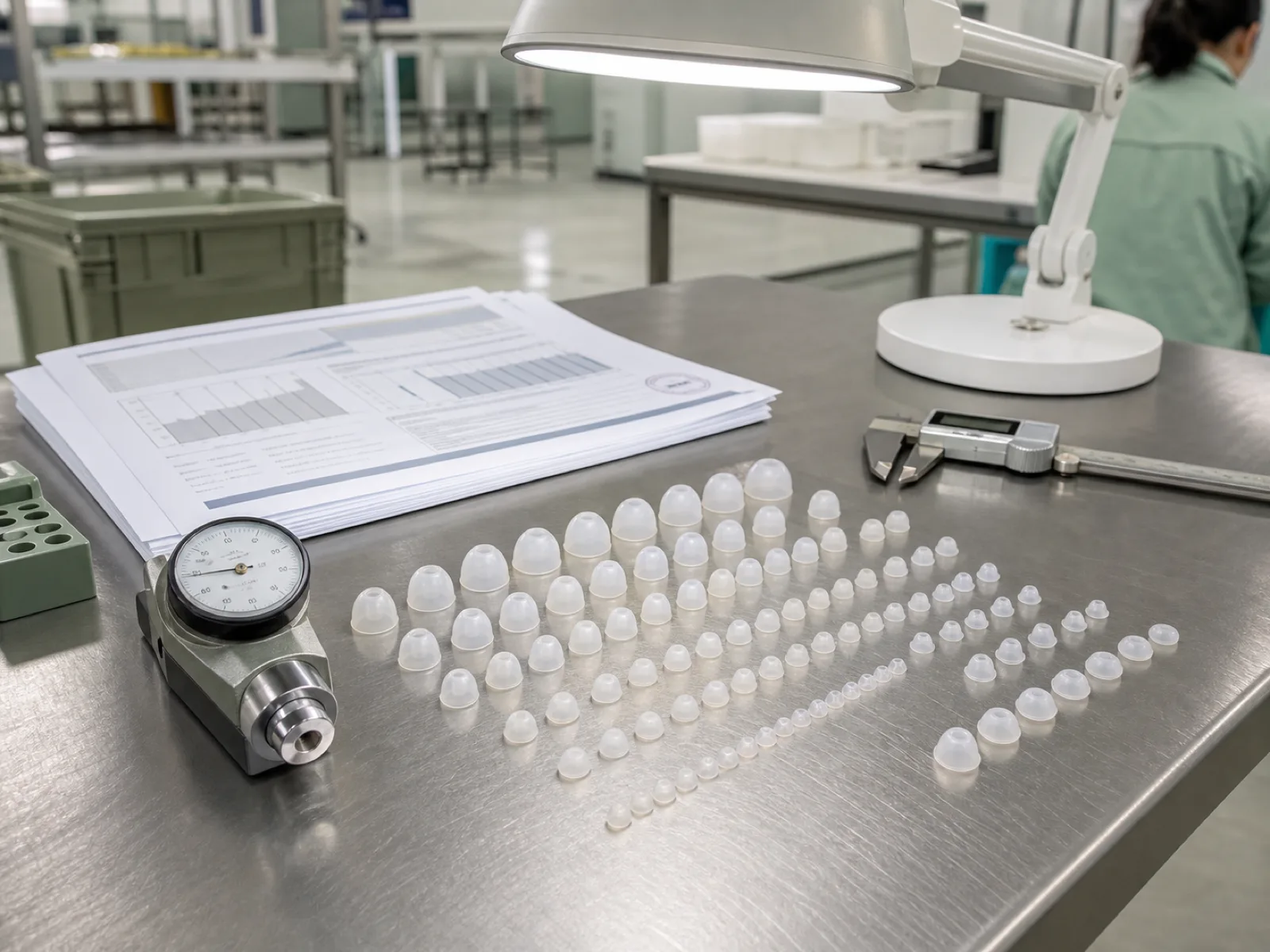
 Hearing aid silicone ear tips are skin-contact medical components molded from platinum-cured liquid silicone rubber and cleared to ISO 10993-5 cytotoxicity and ISO 10993-10 irritation/sensitization for prolonged ear-canal wear. The durometer envelope runs Shore A 30–60 — softer for comfort-first open domes, firmer for retentive closed and power domes — molded to ±0.05 mm on the sealing lip inside an ISO 14644-1 Class 7 or Class 8 cleanroom. Every lot ships with the ISO 10993-5 and USP Class VI test-report references against a defined master-batch, because a "medical grade" label without a test report on the specific compound lot is a claim, not a certification.
Buyers searching “hearing aid silicone ear tips” arrive from two directions. Hearing-instrument OEMs and contract manufacturers come with a receiver platform — BTE, ITE, RIC, or an IEM/earbud nozzle — and need a molder who can execute skin-contact biocompatibility discipline against a documented compound. Distributors, audiology-accessory brands, and private-label buyers arrive earlier and need to understand which silicone grade, which durometer, which dome geometry, and which test packet a defensible program actually requires. This guide covers both, written from inside a Dongguan LSR injection floor and benchmarked against ISO 10993-1[^iso-10993-1], ISO 10993-5[^iso-10993-5], and USP <88>[^usp-88] — not against a marketplace listing. One framing note up front: Wetop molds the silicone component. We are a component supplier, not a finished-device manufacturer, and nothing here claims device clearance — that is your regulatory submission, built on the biocompatibility evidence we deliver with the part.
What are hearing aid silicone ear tips, and why is material grade the whole decision?
Hearing aid silicone ear tips are the soft, replaceable interface between an acoustic receiver and the ear canal — the dome, sleeve, or petal that seals sound in and holds the device in place. Because they sit in warm, occluded, prolonged skin contact, material grade is the entire decision: only platinum-cured, biocompatibility-tested silicone belongs in the ear canal.
The ear tip does three jobs at once: it retains the device against gravity and jaw movement, it sets the acoustic seal that determines how much amplified sound reaches the eardrum versus leaks out as feedback, and it does both while resting against living tissue for 8–16 hours a day. The first two are geometry and durometer problems. The third is a materials problem, and it is the one that separates a defensible OEM program from a commodity listing.
Silicone earned its place here because it is inert, non-plasticized, thermally stable across body-temperature swings, and it does not harden, yellow, or off-gas the way thermoplastic and PVC ear tips do over months of wear. But “silicone” alone is not a spec. The grade is defined by cure chemistry and by the biocompatibility test stack behind the compound:
- Cure system. Platinum-cured (addition-cure) silicone leaves no by-products and is the only defensible chemistry for the ear canal. Peroxide-cured silicone leaves residual 2,4-dichlorobenzoyl peroxide by-products that, without a full post-cure, can migrate and irritate warm occluded skin — see the platinum-cured vs peroxide-cured silicone guide for the full decision matrix.
- Biocompatibility evidence. ISO 10993-5 cytotoxicity and ISO 10993-10 irritation/sensitization on the specific compound lot, categorized per ISO 10993-1[^iso-10993-1] as a surface-contacting device with prolonged exposure.
- Compliance floor. FDA 21 CFR 177.2600[^fda-177-2600] as the food/skin-contact baseline beneath medical grade — the floor, never the whole stack.
The trap is a listing that markets “medical grade silicone ear tips” against a peroxide-cure compound with no post-cure log and no test report. Grade is a claim until a report against a named compound lot backs it.
Medical-grade LSR vs HCR silicone — which process for skin-contact ear tips?
For high-volume ear tips with thin, precise sealing lips, medical-grade LSR (liquid silicone rubber) is the defensible process: it injects into a heated mold, cures in 20–90 seconds, holds ±0.05 mm, and runs fully automated with minimal flash. HCR (solid gum silicone) is retained for low-volume custom sleeves or specialty compounds, at looser tolerance and higher labor.
Both LSR and HCR can be platinum-cured to the identical biocompatibility stack — the choice between them is process economics and dimensional precision, not safety. For a broader material-tier explainer see food-grade vs medical-grade silicone.
LSR (liquid silicone rubber) arrives as two pumpable parts (vinyl-terminated PDMS + hydride cross-linker + Pt catalyst) metered and injected into a heated tool. It cures in seconds, demolds clean, and repeats a thin dome lip to ±0.05 mm across a multi-cavity tool. That repeatability is why LSR dominates ear tip production: the sealing skirt on a dome is often 0.3–0.6 mm thick, and a 0.05 mm swing in wall thickness changes both seal and comfort. LSR also runs low-flash, which matters when flash on a dome lip is a tactile defect against skin.
HCR (high-consistency rubber) is a dough-like gum compression- or transfer-molded in longer cycles with more manual loading. Tolerance is looser (±0.10–0.20 mm typical), labor is higher, and cycle times are minutes not seconds. HCR keeps a niche for very low volumes where LSR tooling amortization does not pencil out, for oversized custom sleeves, and for specialty or self-lubricating compounds only available in gum form.
| Attribute | Medical-grade LSR | HCR (solid/gum silicone) |
|---|---|---|
| Cure system | Platinum (addition) | Platinum or peroxide |
| Cycle time | 20–90 s | 2–6 min |
| Dimensional tolerance | ±0.05 mm | ±0.10–0.20 mm |
| Flash / lip finish | Very low, clean lip | Higher, may need de-flash |
| Automation | Fully automated injection | Semi-manual loading |
| Best fit | High-volume domes, thin lips | Low-volume sleeves, specialty compounds |
| Two-shot overmold | Native (2K LSR) | Difficult |
For an OEM shipping tens or hundreds of thousands of domes a year across a size ladder, LSR is the answer. The one caveat: LSR tooling is a real capital step ($3,500–9,000 per multi-cavity tool), so the process only pays off above the MOQ floor.
What biocompatibility testing do hearing aid ear tips need?
Ear tips are surface-contacting components with prolonged (24 h–30 day) tissue exposure, so ISO 10993-1 scopes the test set to cytotoxicity (ISO 10993-5), irritation and skin sensitization (ISO 10993-10), and typically USP <88> Class VI biological reactivity. These run on the specific compound lot — a device-family claim on a different lot does not transfer.
ISO 10993-1[^iso-10993-1] is the map. It categorizes a component by the nature of contact (intact skin / breached skin / mucosal — the ear canal is treated as surface-contacting skin/mucosal) and the duration of contact (limited < 24 h, prolonged 24 h–30 day, long-term > 30 day). A daily-wear ear tip lands in the prolonged surface-contact box, which scopes the following evidence:
| Test | Standard clause | What it demonstrates for an ear tip |
|---|---|---|
| Cytotoxicity, in vitro | ISO 10993-5[^iso-10993-5] | Compound extract does not kill or damage cultured cells — the first-pass screen |
| Irritation | ISO 10993-10[^iso-10993-10] | Compound does not provoke a local inflammatory reaction on skin/mucosa |
| Skin sensitization | ISO 10993-10[^iso-10993-10] | Compound does not trigger an allergic sensitization response — the basis of a “hypoallergenic” claim |
| Biological reactivity, in vivo | USP <88> Class VI[^usp-88] | Systemic injection + intracutaneous + implantation on the same compound |
| Chemical characterization (as needed) | ISO 10993-18 | Extractables/leachables profile when the risk assessment calls for it |
Two disciplines separate a real program from a paper one. First, the reports must reference the specific master-batch lot used in your tips, including any color master-batch — pigment is a frequently overlooked extractables source, and an uncolored-base test report does not cover a colored dome. Second, reports age: most OEM audits want biocompatibility evidence re-qualified within the last 3–5 years. For a plain-language walk-through of what the six USP Class VI reactivity tests actually check, see the USP Class VI biocompatibility explainer.
A component supplier delivers this evidence; it does not deliver device clearance. Your regulatory affairs team folds the ISO 10993 evidence into a device-level biological evaluation under ISO 10993-1 as part of your own submission.
What does USP Class VI mean for ear-canal contact?
USP Class VI is the most stringent tier of USP <88> biological-reactivity testing — it requires a compound to pass systemic injection, intracutaneous, and implantation tests. For ear tips it is the biological-reactivity baseline most OEM audits request, giving buyers a defensible prolonged-skin-contact benchmark, but it is not device clearance and not a full substitute for the ISO 10993 series.
USP <88>[^usp-88] classifies plastics I through VI by how many in-vivo reactivity tests the compound passes; Class VI is the top tier and the one buyers name in an RFQ almost by reflex. For a skin-contact ear tip it is a sensible, well-understood baseline — but three clarifications keep it honest:
- Class VI tests the compound, not your part geometry. A Class VI report proves the silicone chemistry is biologically inert. It says nothing about whether your specific dome flashes, retains cleaning residue, or seals — those are separate part-level checks.
- Class VI is not the whole biocompatibility stack. ISO 10993-1 may still call for cytotoxicity and sensitization data organized under the ISO 10993 framework regardless of a Class VI pass, because Class VI and the ISO 10993 series answer overlapping-but-distinct questions.
- Class VI is not device clearance. No component certificate clears a finished hearing aid. That is your regulatory pathway, and a component supplier cannot and should not claim it.
Practically: ask for the USP <88> Class VI report referencing the compound lot from the last 3–5 years, and pair it with ISO 10993-5[^iso-10993-5] and ISO 10993-10[^iso-10993-10] on the same lot. That trio is the evidence bundle a defensible ear tip program actually inspects.
What Shore A hardness fits ear tips, and how does durometer affect seal and comfort?
Hearing aid ear tips run Shore A 30–60. Soft 30–40A silicone flexes to the canal for comfort-first open and vented domes with reduced occlusion; firmer 45–60A silicone holds an acoustic seal and resists pull-off for closed domes, power domes, and custom sleeves. Durometer is the single spec that most changes day-long wear comfort and feedback control.
Durometer, measured on the Shore A scale per ASTM D2240[^astm-d2240], is the comfort-versus-seal dial. Push it soft and the dome conforms, breathes, and disappears in the ear — but seals less and can migrate. Push it firm and the dome grips and seals against feedback — but the wearer feels it, and a too-firm dome in a sensitive canal drives return complaints. The mapping we see across hearing-instrument programs:
| Shore A | Feel | Typical ear tip use | Trade-off |
|---|---|---|---|
| 30–35A | Very soft, pillowy | Open/vented domes, occlusion-relief tips | Max comfort, minimal seal + retention |
| 35–45A | Soft, conforming | Tulip/petal domes, comfort sleeves | Balanced comfort with light seal |
| 45–55A | Medium, springy | Closed/single domes, RIC sleeves | Reliable seal, still comfortable |
| 55–60A | Firm, retentive | Power/double domes, custom locked sleeves | Max seal + retention, more noticeable |
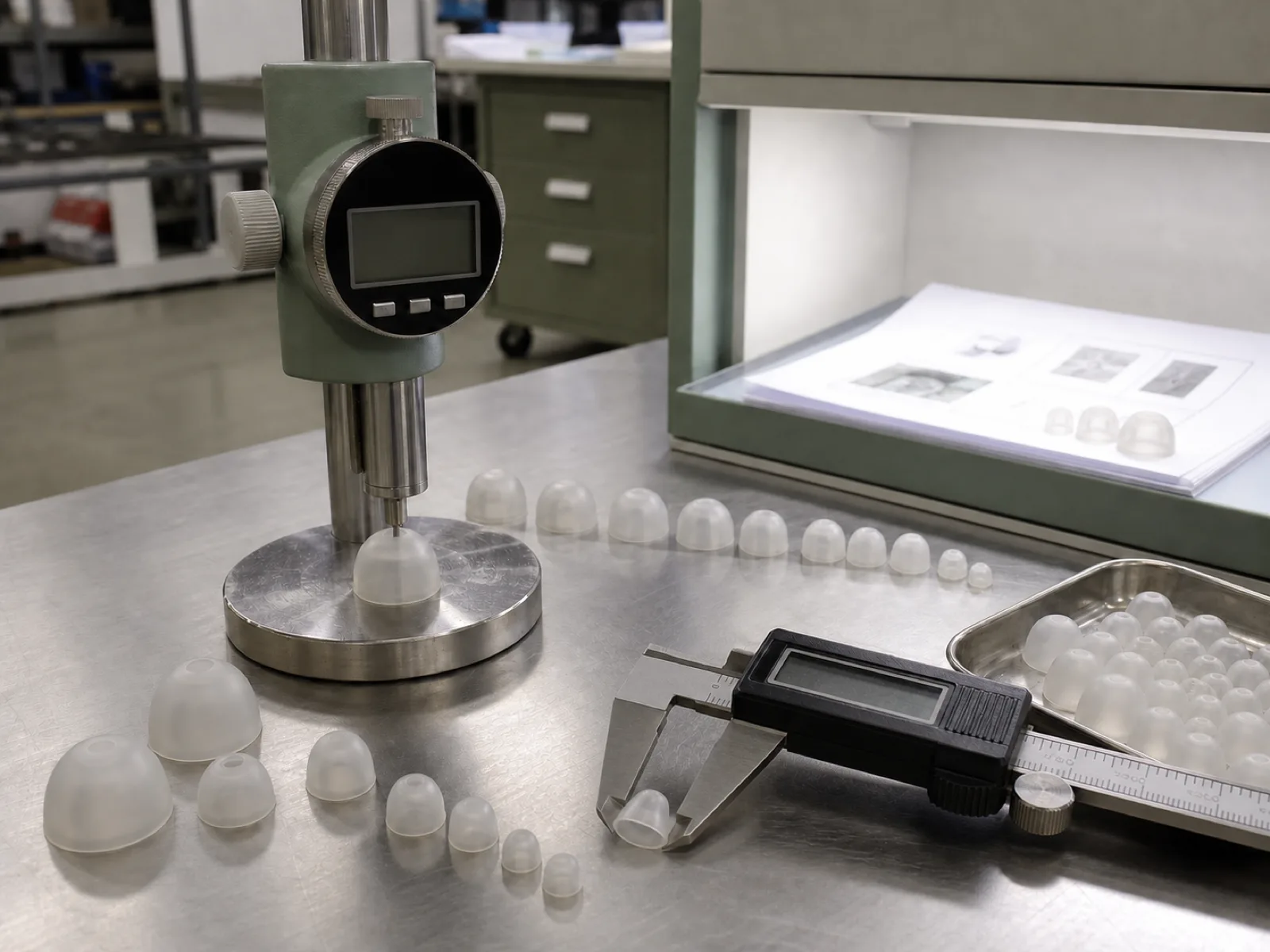
Two engineering notes. First, durometer interacts with wall thickness — a 40A dome with a 0.6 mm skirt can feel firmer in the ear than a 50A dome with a 0.35 mm skirt, because thin walls flex regardless of hardness. Specify both. Second, durometer drift is real: an under-cured or mis-metered LSR shot can land 3–5 points off target, which is why we durometer-check the sealing skirt on every lot rather than trusting the compound data sheet. For the full hardness reference across silicone applications, see the Shore A hardness chart.
What ear tip geometries exist — open dome, closed dome, tulip, double dome, sleeve?
The standard families are open (vented) domes, closed (single) domes, tulip/petal domes, double and power domes, and custom-molded sleeves. Geometry — not the electronics — sets the acoustic trade-off between sealing amplified sound in and letting natural sound and air pass through, and it drives retention and the occlusion effect the wearer feels.
Dome geometry is chosen against the hearing-loss profile and the receiver platform. The families and their acoustic behavior:
| Geometry | Seal | Occlusion effect | Best-fit hearing loss | Notes |
|---|---|---|---|---|
| Open / vented dome | Minimal | Very low | Mild high-frequency | Low frequencies pass naturally; reduces “plugged” feel |
| Tulip / petal dome | Light–moderate | Low–moderate | Mild–moderate | Flexible petals balance seal and comfort |
| Closed / single dome | Moderate | Moderate | Moderate | More low-frequency amplification retained |
| Double dome | High | Higher | Moderate–severe | Second skirt tightens the seal against feedback |
| Power dome | Maximum | High | Severe | Max amplification without feedback |
| Custom sleeve (RIC/IEM) | Tunable | Tunable | Any, platform-specific | Molded to a receiver or nozzle; can be two-shot overmolded |
Typical dimensional envelope for a stock dome ladder: outer diameters roughly 6–14 mm in 2 mm steps, skirt wall 0.3–0.6 mm, bore sized to the receiver stem (commonly 1.0–2.4 mm). A retention or grip feature — an internal barb, a locking ring, or a textured stem grip — is molded into the tip rather than added later.
The design lever buyers underuse is the size ladder. A single geometry usually ships as a 3–5 size family so one receiver fits a range of canals; each size is its own SKU and its own tool cavity, so the ladder is a cost and MOQ decision as much as a fit decision. We flag that in design-for-manufacture review before a tool is cut, because adding a sixth size after tooling is a new cavity, not a tweak.

How are LSR ear tips molded — single-shot, two-shot overmold, and cleanroom class?
Ear tips are LSR injection molded single-shot for a one-material dome, or two-shot (2K) overmolded to bond a soft sealing dome onto a firmer core or rigid sleeve in one tooling sequence. Skin-contact production runs inside an ISO 14644-1 Class 7 or Class 8 cleanroom under an ISO 13485 quality system with per-shift particle-count logs and lot traceability.
Single-shot LSR is the workhorse: one durometer, one geometry, injected and cured in a multi-cavity tool. It covers the whole open/closed/power dome family and most stock sleeves.
Two-shot (2K) overmolding injects two materials in sequence — typically a firmer core or a rigid thermoplastic sleeve first, then a soft LSR dome (Shore A 30–45) bonded over it. The bond is achieved through a self-bonding LSR grade or substrate-adhesion chemistry plus a mechanical interlock designed into the tool, and it is verified by a pull-off force test on every lot. Two-shot gives the best of both worlds — a rigid grip on the RIC receiver or IEM nozzle with a soft comfortable lip — and removes a downstream assembly step. It costs more tooling and adds 1–2 weeks of tool lead.
The manufacturing environment is where a serious program is audited:
- Cleanroom class. ISO 14644-1[^iso-14644-1] Class 7 (≤ 352,000 particles ≥ 0.5 μm/m³) for skin-contact molding; Class 8 acceptable for tips sterilized or cleaned downstream by the device OEM. Ask for per-shift particle-count logs tied to the molding lot.
- QMS scope. The ISO 13485[^iso-13485] certificate wording should explicitly cover molding of skin-contact silicone components — not only assembly. Check the certificate body (BSI, TÜV, DNV, DEKRA, SGS are defensible).
- Material traceability. Every molding lot tied to a master-batch lot tied to the base-compound supplier’s CoA (Wacker, Momentive, Dow, Shin-Etsu are the defensible base-LSR suppliers).
- De-flash and inspection. Cryogenic or manual de-flash, then AQL sampling (ISO 2859-1, AQL 1.0–1.5 typical) with durometer, dimensional, and visual checks on the sealing lip.
A photo of a clean-looking room without particle logs and a scoped ISO 13485 certificate is not a cleanroom program — it is a backdrop.
What is the custom OEM/ODM workflow — DFM, tooling, MOQ, and lead time?
The custom ear tip flow runs six stages over 45–75 days: RFQ intake with platform and dome spec, engineering DFM review, LSR tool cut, first-article sample with the ISO 10993-5 and USP Class VI test-report references, buyer validation, and production under lot-traceable QC. MOQ starts at 500 pcs per SKU with 7–25 day first samples.
The stage-by-stage flow Wetop runs on hearing aid ear tip programs:
Stage 1 — RFQ intake (day 0–3). Buyer submits: (a) receiver platform (BTE / ITE / RIC / IEM nozzle) with stem or bore dimensions, (b) dome geometry and size ladder, (c) durometer target, (d) color and finish, (e) required documentation — ISO 10993-5, ISO 10993-10, USP Class VI, CoA/CoC. The engineering desk returns a DFM review within 3 business days flagging lip-wall risk, de-flash strategy, retention-feature moldability, and cavity/size-ladder cost drivers.
Stage 2 — Compound + quotation (day 3–7). Master-batch selection (platinum-cured medical LSR standard; self-bonding LSR if two-shot). MOQ-tier pricing quoted at 500 / 5,000 / 50,000 / 200,000 pcs FOB Yantian.
Stage 3 — Tooling (day 7–25). LSR tool cut — single-shot dome tool $3,500–6,000, two-shot overmold tool $6,000–9,000, cavity count set by volume. A 50% tooling deposit triggers the cut.
Stage 4 — First article + test packet (day 25–35, or 7–25 days on an existing tool). First-article shots against the spec, delivered with: durometer per ASTM D2240[^astm-d2240], dimensional CoA on OD/bore/wall, ISO 10993-5[^iso-10993-5] and USP Class VI[^usp-88] test-report references against the compound lot, cleanroom particle-count log for the shift. Buyer runs incoming validation.
Stage 5 — Validation + PPAP (day 35–45). On first-article approval, the QC method, sampling plan (ISO 2859-1 AQL 1.0), and pull-off spec (two-shot) are locked. PPAP-style documentation on request.
Stage 6 — Production + shipment (day 45–75 incl. sailing). 20–35 days for 20,000–200,000 pcs, then per-lot CoA/CoC packet ships with the order. FOB Yantian; sailing 14–18 days US West Coast, 25–32 days US East Coast, 30–38 days Northern Europe.
| Program parameter | Value |
|---|---|
| MOQ | 500 pcs per SKU (one geometry × one size × one durometer) |
| First sample lead | 7–25 days (existing tool → new tool) |
| Single-shot tool cost | $3,500–6,000 |
| Two-shot overmold tool cost | $6,000–9,000 |
| Production lead | 20–35 days for 20k–200k pcs |
| Temperature stability (in-service) | −40 °C to +200 °C (platinum-cured LSR) |
How do ear tips map across BTE, ITE, RIC, and IEM/earbud platforms?
Ear tip design changes by receiver platform: BTE and RIC use dome tips on a thin receiver stem, ITE uses a molded shell face or soft sleeve, and IEM/earbud nozzles use pressure-fit sleeves. The silicone grade and biocompatibility stack stay constant across platforms — what changes is bore, retention feature, and whether a two-shot rigid-to-soft construction is needed.
The platform-to-tip mapping across hearing-instrument and consumer-audio programs:
- RIC (receiver-in-canal). The largest dome market — a soft dome (Shore A 35–50) snaps onto a thin receiver stem via an internal grip. Open, closed, tulip, and power variants all live here across a 3–5 size ladder. Two-shot overmold is common to bond a soft dome onto a firmer retention core.
- BTE (behind-the-ear). Traditionally a custom earmold, but slim-tube BTE increasingly uses the same dome family as RIC. Durometer skews slightly firmer for retention on an active wearer.
- ITE / ITC (in-the-ear / in-the-canal). The device sits in the canal; the silicone element is a soft sleeve or a comfort skirt on a molded shell. Fit is tighter, so durometer and sealing-lip geometry drive both comfort and feedback control.
- IEM / consumer earbuds. A pressure-fit sleeve on a rigid nozzle — same LSR chemistry, same biocompatibility discipline for prolonged skin contact, but the bore is sized to the nozzle and retention is friction plus a locking lip rather than a receiver grip.
Across every platform the material decision is constant: platinum-cured medical-grade LSR, ISO 10993-5/-10 tested, USP Class VI baseline, hypoallergenic and latex-free by construction. What the platform changes is the fit geometry and the tool, which is exactly the part a component molder engineers against your receiver drawing. A single compound and a single test packet can therefore serve a buyer’s full BTE/RIC/ITE/IEM range — a real advantage when consolidating a supplier base around one audited silicone source.
Frequently asked questions
The FAQ block above the References list is rendered from the guide frontmatter and mirrors the FAQPage schema verbatim — Gemini and other AI answer engines use it for claim verification.
Sourcing hearing aid silicone ear tips — what happens next
Wetop molds hearing aid silicone ear tips at MOQ 500 pcs per SKU on platinum-cured medical-grade LSR, inside an ISO 14644-1 cleanroom under ISO 13485 discipline, with ISO 10993-5 / ISO 10993-10 / USP Class VI test-report references and per-lot CoA/CoC packets delivered against every shipment. Founder-led engineering desk in Dongguan; no trading intermediary. We supply the biocompatible silicone component — your team owns the finished-device submission.
To move from RFQ to first-article sample in 7–25 days, talk to the engineering desk with your receiver platform, dome geometry and size ladder, durometer target, and required documentation list. Sample turnaround is quoted against a defined LSR master-batch lot with the ISO 10993-5 and USP Class VI test-report references attached — not a stock claim.
FAQ
-
Are silicone ear tips safe for long-term wear inside the ear canal?
Platinum-cured medical-grade silicone ear tips are the standard skin-contact material for prolonged ear-canal wear because they are inert, non-plasticized, hypoallergenic, and latex-free. Safety is not a marketing claim — it is demonstrated by ISO 10993-5 cytotoxicity and ISO 10993-10 irritation/sensitization testing on the specific compound lot, categorized per ISO 10993-1 as a surface-contacting device with prolonged (24 h–30 day) tissue exposure. Peroxide-cured silicone is disqualified because residual 2,4-dichlorobenzoyl peroxide by-products, if not fully post-cured, can trigger contact irritation in the warm, occluded ear canal. Demand the actual test report against the compound lot number, not a generic "medical grade" label.
-
What Shore A hardness is best for hearing aid dome tips?
Most hearing aid dome tips fall between Shore A 30 and 60. Soft 30–40A silicone is used for open and vented domes where all-day comfort and reduced occlusion matter more than seal; it flexes to the canal wall and reduces the "plugged" sensation. Firmer 45–60A silicone is used for closed domes, power domes, and custom sleeves that must hold an acoustic seal against feedback and resist being pulled off the receiver during removal. There is a direct trade-off: softer domes are more comfortable but seal less and retain less; firmer domes seal and retain but can feel intrusive. The right durometer is set by fit strategy and hearing-loss profile — see the [Shore A hardness chart](/guide/shore-a-hardness-silicone-chart/) for how durometer maps to feel.
-
What is the MOQ and sample lead time for custom silicone ear tips?
Wetop's custom silicone ear tip MOQ starts at 500 pcs per SKU (a "SKU" being one geometry in one size in one durometer). First-article samples run 7–25 days against a defined LSR master-batch lot — faster on an existing dome tool, longer when a new injection tool must be cut. A new multi-cavity LSR ear tip tool runs roughly $3,500–9,000 depending on cavity count and dome complexity. Production lead is 20–35 days for 20,000–200,000 pcs. Sample delivery includes the ISO 10993-5 cytotoxicity and USP Class VI test-report references against the compound lot, so your regulatory affairs team can start incoming validation immediately.
-
Do custom hearing aid ear tips need USP Class VI certification?
USP Class VI is the biological-reactivity tier most OEM audits ask for on ear-canal-contact silicone, even though the ear tip is a component and not a finished device. Class VI runs systemic injection, intracutaneous, and implantation tests on the same compound, giving buyers a defensible baseline for prolonged skin and mucosal contact. It is not a substitute for the device-level biological evaluation your team organizes per ISO 10993-1, and it is not device clearance — a component supplier cannot grant that. Ask for the USP <88> Class VI report referencing the specific compound lot from the last 3–5 years, plus ISO 10993-5 and 10993-10 on the same lot.
-
What is the difference between medical-grade LSR and solid HCR silicone for ear tips?
LSR (liquid silicone rubber) is a two-part platinum-cured system injected into a heated mold and cured in 20–90 seconds, holding ±0.05 mm on thin dome lips with fully automated, low-flash, high-repeatability output. HCR (high-consistency rubber, "solid" or gum silicone) is a dough-like compound compression- or transfer-molded in longer cycles with more manual handling and slightly looser tolerance. For high-volume ear tips with thin, precise sealing lips and consistent durometer, LSR is the defensible process; HCR is retained for low-volume custom sleeves or when a specialty compound is only available in gum form. Both can be platinum-cured to the same biocompatibility stack — the difference is process economics and dimensional precision, not safety.
-
Are silicone ear tips hypoallergenic, latex-free, and phthalate-free?
Platinum-cured silicone is inherently latex-free and, when compounded without phthalate plasticizers (which medical-grade LSR is not — silicone needs no plasticizer), phthalate-free by construction. That makes it the preferred material for allergy-sensitive wearers who react to latex or thermoplastic ear tips. "Hypoallergenic" is defensible only when backed by ISO 10993-10 skin sensitization and irritation testing on the compound lot — it is a test result, not an adjective. Insist that the supplier's ISO 10993-10 report covers the exact master-batch used in your tips, and that color master-batches are also food/skin-contact compliant, because pigment is a common overlooked source of extractables.
-
How do open, closed, and double dome ear tips differ acoustically?
Open (vented) domes let low-frequency sound and air pass, minimizing the occlusion effect and the plugged feeling — best for mild high-frequency loss where natural low-frequency hearing is preserved. Closed (single) domes block more of the vent, giving a moderate seal and more low-frequency amplification for moderate loss. Double domes and power domes add a second sealing skirt for the tightest seal and maximum amplification without feedback, used for moderate-to-severe loss. Tulip or petal domes sit between open and closed, with flexible petals that balance seal and comfort. The dome geometry, not the electronics, sets how much amplified sound is retained versus how much natural sound leaks in.
-
Can you overmold a soft silicone ear tip onto a rigid receiver sleeve?
Yes — two-shot (2K) LSR overmolding bonds a soft silicone dome (Shore A 30–45) onto a firmer core or a rigid thermoplastic sleeve in a single tooling sequence, giving a retentive rigid grip on the RIC receiver or IEM nozzle with a soft, comfortable sealing lip. The bond is achieved through material chemistry (LSR-to-substrate adhesion or a self-bonding LSR grade) plus mechanical interlock designed into the tool, and it is verified by a pull-off force test on every production lot. Two-shot tooling costs more than a single-shot dome tool and adds 1–2 weeks of tooling lead, but it removes a downstream assembly step and the failure mode of domes separating from the sleeve in the field.
References
Authoritative sources cited in this guide
- International Organization for Standardization. ISO 10993-1:2018 — Biological evaluation of medical devices — Part 1: Evaluation and testing within a risk management process. https://www.iso.org/standard/68936.html — Defines how a surface-contacting component like an ear tip is categorized by contact nature and duration to scope the biocompatibility test set.
- International Organization for Standardization. ISO 10993-5:2009 — Biological evaluation of medical devices — Part 5: Tests for in vitro cytotoxicity. https://www.iso.org/standard/36406.html — Cytotoxicity is the first-tier biocompatibility screen required on every skin-contact silicone ear tip compound lot.
- International Organization for Standardization. ISO 10993-10:2010 — Biological evaluation of medical devices — Part 10: Tests for irritation and skin sensitization. https://www.iso.org/standard/40884.html — Irritation and sensitization testing is the tier that substantiates a hypoallergenic claim for prolonged ear-canal contact.
- United States Pharmacopeia. USP <88> Biological Reactivity Tests, In Vivo. https://www.usp.org/harmonization-standards/pdg/excipients/biological-reactivity-tests — Defines USP Class I–VI. Class VI is the baseline biological-reactivity tier OEM audits request for ear-canal-contact silicone.
- ASTM International. ASTM D2240-15(2021) — Standard Test Method for Rubber Property — Durometer Hardness. https://www.astm.org/d2240-15r21.html — Reference method for the Shore A durometer readings that define ear tip softness and seal behavior.
- International Organization for Standardization. ISO 13485:2016 — Medical devices — Quality management systems — Requirements for regulatory purposes. https://www.iso.org/standard/59752.html — Medical-device QMS standard whose scope should cover molding of skin-contact silicone components at the audited facility.
- International Organization for Standardization. ISO 14644-1:2015 — Cleanrooms and associated controlled environments — Classification of air cleanliness by particle concentration. https://www.iso.org/standard/53394.html — Defines Class 7 / Class 8 airborne-particle limits verified during cleanroom molding of medical silicone ear tips.
- US Food and Drug Administration. 21 CFR 177.2600 — Rubber articles intended for repeated use. https://www.ecfr.gov/current/title-21/chapter-I/subchapter-B/part-177/subpart-C/section-177.2600 — US food-contact baseline for silicone — the floor beneath medical-grade skin-contact compliance, not a substitute for USP Class VI.
Start a custom program
Send a brief. Get an engineer’s reply in one business day.
Every Wetop program is tooled from a customer’s specification. Send a CAD file (STEP · IGES · DWG) or a written brief and we’ll reply with a mold cost estimate, price brackets at MOQ 500 / 1,000 / 5,000, and any engineering questions.