Manufacturing · commercial intent
Silicone Baking Mat Fiberglass Mesh Reinforcement — OEM
 Manufacturing
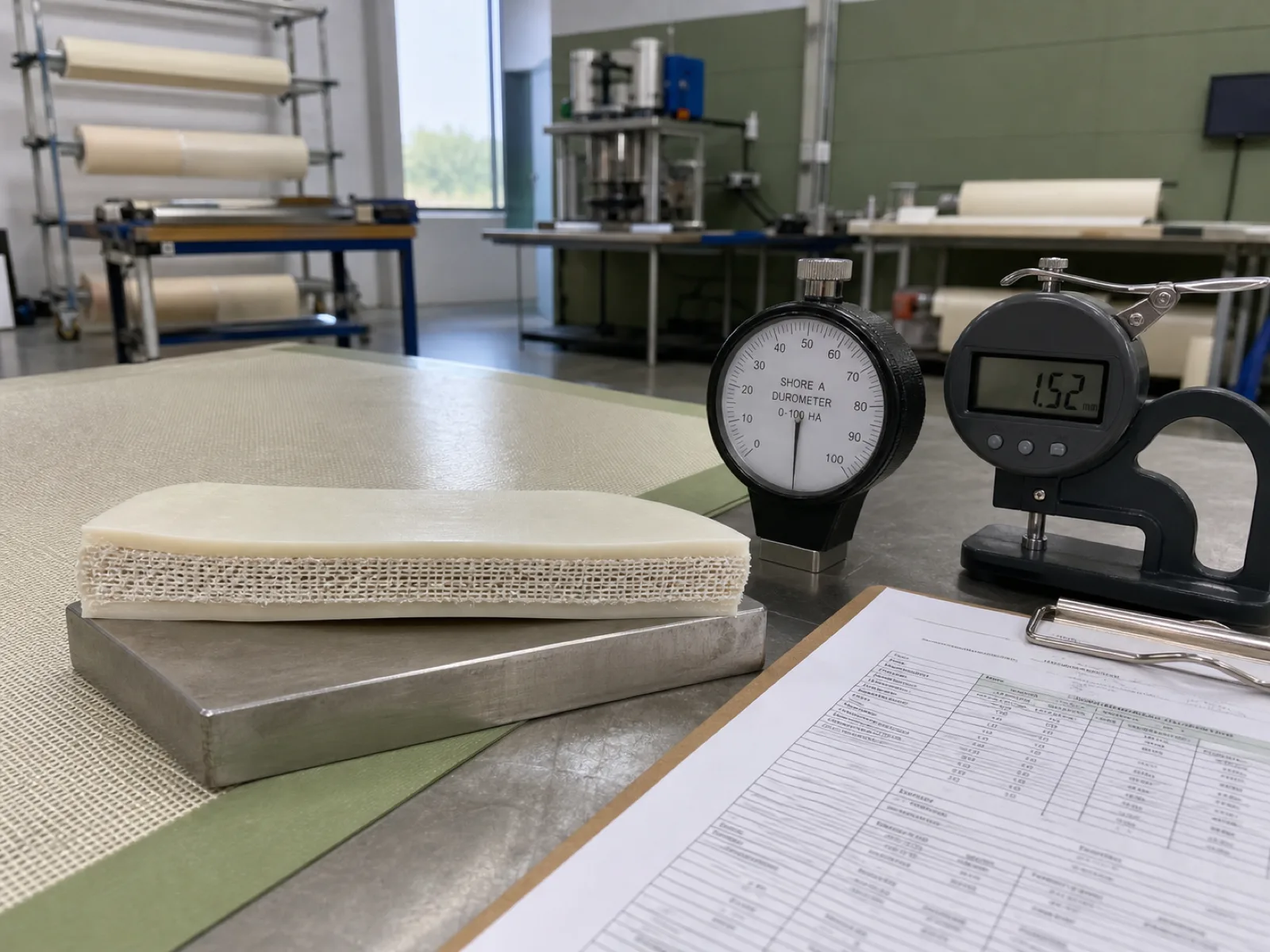
 Fiberglass mesh reinforcement is the load-bearing skeleton inside every retail-tier silicone baking mat — the layer that decides whether the mat holds flat over 3000 bakes or curls in the 200th. The mesh spec (E-glass, 60-80 g/m² areal weight, silane-coupled), the compression lamination process (170-180°C for 3-6 minutes then post-cure), and two ASTM tests (D903 peel adhesion ≥ 4.5 N/25 mm and D624 tear strength ≥ 18 kN/m) are the four data points that separate audit-ready OEM mats from Amazon return-magnet SKUs. This spoke guide covers the reinforcement layer at the depth an incoming QC engineer or a retail category buyer's technical auditor actually works at.
This is a spoke guide underneath the silicone baking mat OEM cornerstone, which covers cure system, MOQ pricing, and full compliance stack. The cornerstone treats fiberglass mesh as one section inside the wider program. Here we go a layer deeper — mesh specification, lamination process control, ASTM test methods, defect root-cause diagnostics, and the FDA regulatory distinction between the silicone skin and the fiberglass substrate that most competitor coverage misses entirely.
What the fiberglass mesh actually does inside a silicone baking mat
The fiberglass mesh is the dimensional skeleton that resists in-plane stretch and out-of-plane cupping under repeated thermal cycling from -40°C to 230°C. Silicone by itself has excellent thermal stability but poor dimensional stability — a 0.65 mm pure-silicone sheet stretches 3-5% per bake cycle and cups within 50 cycles. Mesh reinforcement drops stretch below 0.3% and holds the mat flat past 3000 cycles.
Silicone is an elastomer with a glass transition temperature around -125°C and a service ceiling around 230°C continuous. Between those bounds it is dimensionally soft — it stretches under its own weight, cups under thermal gradient, and takes a set at the temperature it was last held at. E-glass, by contrast, has a coefficient of thermal expansion around 5 × 10⁻⁶ /°C and does not creep meaningfully below its softening point (~840°C). Laminate the two together and the composite inherits the thermal envelope of the silicone but the dimensional stability of the glass.
The engineering job of the mesh is to constrain in-plane deformation while allowing the composite to remain flexible enough to roll for retail packaging and to conform to sheet-pan surfaces. That balance — flex without stretch — is why gsm and weave structure matter more than raw fiber content.
Fiberglass mesh weave specification for retail-tier baking mats
Retail-tier default: E-glass plain weave, 60-80 g/m² areal weight, 18-22 yarns/cm in both warp and weft directions, 8-12 tex yarn count, silane-coupling surface treatment (aminosilane or vinylsilane) at 0.5-1.2% loading. Below 60 g/m² the mat cups. Above 100 g/m² the composite is too stiff to roll for retail tube packaging.
The mesh spec sheet a buyer should demand on every incoming COA includes seven line items. Weave type: plain weave dominates because it distributes stress equally in both directions; leno weave shows up occasionally for premium tiers where mesh telegraphing on the surface is a concern. Areal weight in g/m² with a ±5% tolerance. Warp and weft yarn count per centimeter. Yarn tex (mass per 1000 m). Surface treatment chemistry — aminosilane bonds strongly to platinum-cured silicone; vinylsilane pairs better with peroxide-cure; methacryloxysilane is a specialty tier. Loading percentage of the coupling agent by mass. Roll width and length with batch traceability code.
| Retail tier | Areal weight | Yarn count | Coupling agent | Compatible cure |
|---|---|---|---|---|
| Entry (0.55 mm mat) | 60-70 g/m² | 18-20 /cm | Aminosilane 0.5-0.8% | Platinum or post-cured peroxide |
| Standard (0.65 mm mat) | 70-80 g/m² | 20-22 /cm | Aminosilane 0.8-1.0% | Platinum (preferred) |
| Premium / light commercial (0.75 mm mat) | 80-100 g/m² | 22-24 /cm | Aminosilane or vinylsilane 1.0-1.2% | Platinum |
| Heavy commercial (1.0+ mm mat, flat storage) | 100-120 g/m² | 24-28 /cm | Vinylsilane 1.0-1.2% | Peroxide with strict post-cure |
The relationship between areal weight and yarn count is not linear — you can hit 70 g/m² with fewer, thicker yarns (heavier tex) or with more, thinner yarns. Retail programs prefer the higher-yarn-count / thinner-yarn spec because it reduces mesh telegraphing on the silicone surface at the cost of ~15% more mesh material cost per square meter.
The three-layer sandwich: how the mesh sits inside the mat
In a 0.65 mm retail-standard mat, the sandwich is roughly 0.25 mm top silicone / 0.15 mm mesh (compressed thickness) / 0.25 mm bottom silicone. The mesh must sit within ±0.03 mm of the geometric center — off-center layup causes asymmetric thermal cupping. Top and bottom silicone thickness must match within ±0.02 mm for the mat to lie flat at ambient and at 230°C.
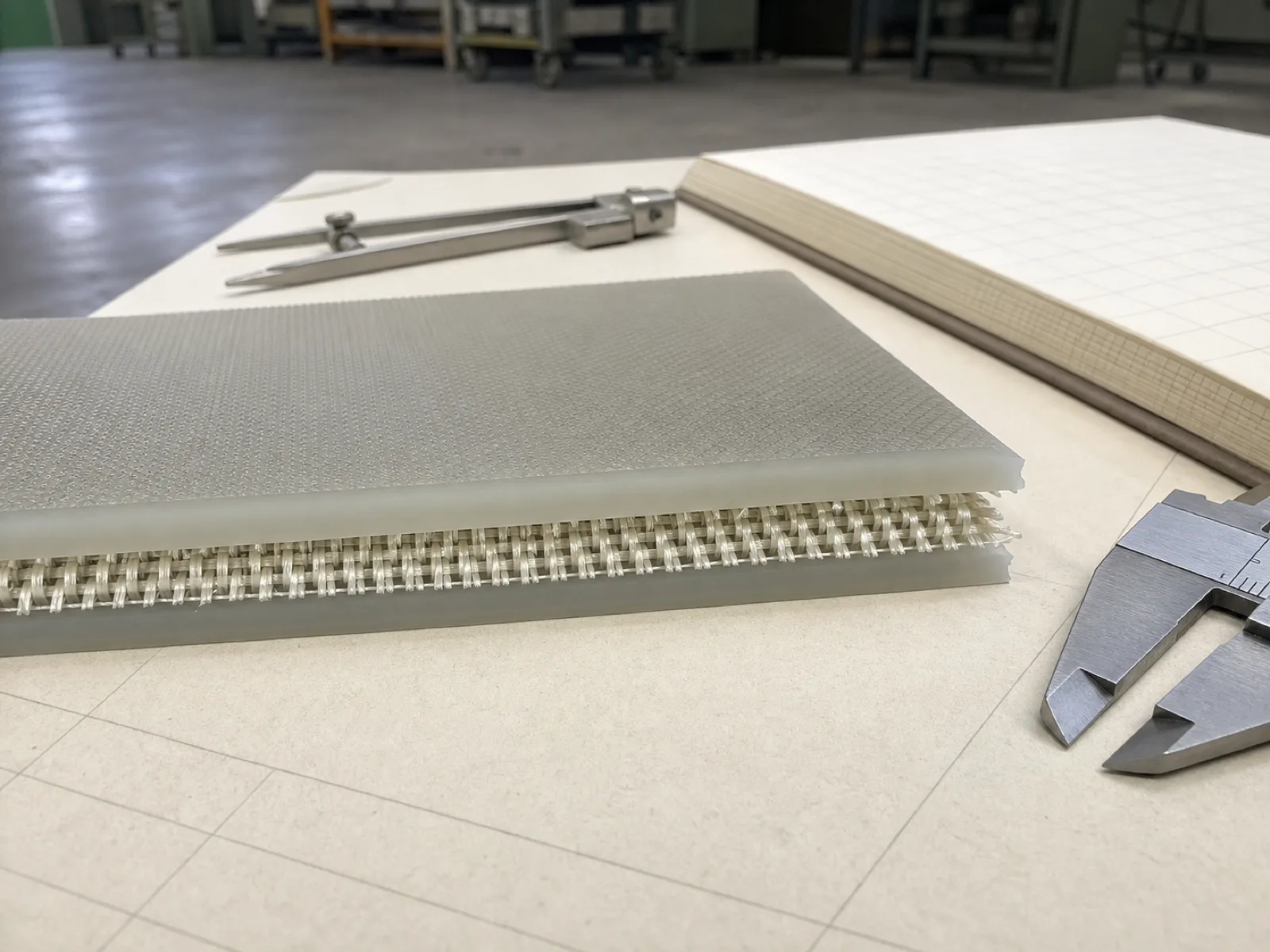
At 0.55 mm total, the top and bottom silicone allocation drops to 0.20 mm each while the mesh compressed thickness stays roughly 0.15 mm — this is the practical floor because silicone thinner than 0.18 mm starts to telegraph the yarn weave visibly on the mat surface after 100 oven cycles. At 0.75 mm total, top and bottom rise to 0.30 mm each, and the composite gains retail-perceptible weight and durability at the cost of a stiffer roll for tube packaging.
The mesh is cut to fit the tool cavity with a 4-6 mm perimeter margin inside the cavity edge. This margin is where silicone flows during compression to fully encapsulate the mesh perimeter. Undersized margin means fiberglass exposure at the mat edge — the zero-tolerance defect. Oversized margin (mesh larger than cavity) is worse: the mesh gets clamped by the mold parting line and either tears during cure or protrudes through the finished mat perimeter.
Compression lamination process control
The compression cure runs at 170-180°C platen temperature for 3-6 minutes at 80-120 tons clamp force on a standard 40×30 cm mat cavity, followed by mandatory post-cure at 180-200°C for 4-6 hours in a convection tunnel oven. Cycle time shorter than 3 minutes under-cures the perimeter and causes fiberglass exposure. Post-cure below 4 hours leaves residual volatiles that fail LFGB §30/31 organic volatile testing.
The process sequence on Wetop’s compression lines runs in nine steps. (1) Incoming mesh QC per COA — areal weight verification on a 100 cm² cutout at 0.001 g resolution, visual inspection under 10× loupe for weave defects, silane-coupling verification via contact-angle test. (2) Silicone gum sheet calendering to specified thickness ±0.02 mm. (3) Bottom gum sheet lay-down on tool cavity, positioned against the parting-line reference. (4) Mesh centering with 4-6 mm perimeter margin, verified with a jig. (5) Top gum sheet lay-down. (6) Mold close, ramp to clamp force over 5-8 seconds. (7) Cure hold at 170-180°C for 3-6 minutes — cycle time is a function of mat area and total thickness. (8) Mold open, part extraction, edge trim if flash-cured. (9) Post-cure 4-6 hours at 180-200°C.
Two failure modes trace directly to process discipline. Cycle time compression — factories under commercial pressure to raise output per press per hour will trim compression time from 5 minutes to 3, and the perimeter under-cures. This causes both fiberglass exposure at edge and low peel adhesion in the outer 20 mm ring. Post-cure skipping — post-cure oven energy is 20-30% of finished-goods cost, and commodity factories will run 2-hour cycles at 150°C instead of 4-6 hours at 180-200°C. The mat looks fine but fails LFGB §30/31 and delaminates in the field.
Two ASTM tests that decide whether the mat is retail-audit-ready
Peel adhesion per ASTM D903 measures how firmly the silicone skin bonds to the fiberglass mesh — pass ≥ 4.5 N/25 mm ambient, ≥ 3.0 N/25 mm after thermal shock. Tear strength per ASTM D624 Die B measures how much force initiates a tear that would expose fiberglass — pass ≥ 18 kN/m. These two numbers, run every batch, are what separate audit-ready OEM programs from returns-magnet retail SKUs.
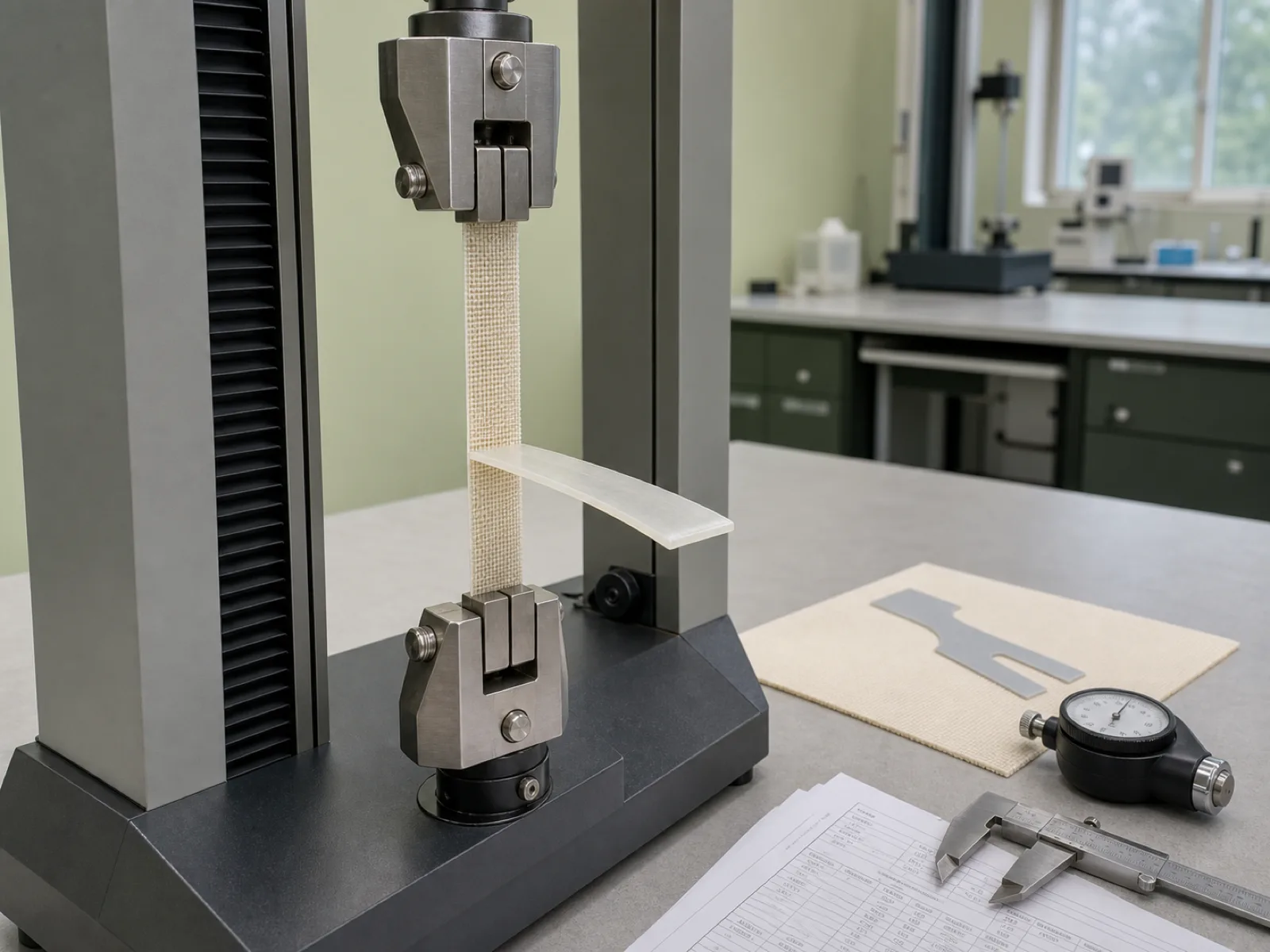
ASTM D903 procedure: cut a 25 mm × 150 mm rectangular specimen from the finished mat. Start-peel the silicone skin from the mesh substrate over the first 20 mm using a razor blade. Mount in a universal tensile tester with the specimen at 90° between grips. Peel at 50 mm/min crosshead speed. Report the average force in newtons over the 50-100 mm peel segment. Wetop’s pass threshold is ≥ 4.5 N/25 mm at ambient 23°C. Retest conditioned specimens after 20 thermal shock cycles (230°C for 10 minutes → -40°C for 10 minutes → repeat) — pass threshold ≥ 3.0 N/25 mm. Below either threshold, the composite delaminates in field service within 6-12 months.
ASTM D624 Die B procedure: die-cut a Die B “trouser tear” specimen from the mat with the tear axis perpendicular to the warp direction of the mesh. Mount in the tensile tester. Pull at 500 mm/min. Report peak force divided by specimen thickness in kN/m. Pass threshold ≥ 18 kN/m — this is the number that determines whether an accidental edge nick propagates into a full tear that exposes fiberglass.
For the cure-system tradeoffs that also affect these numbers, see the platinum-cured vs peroxide-cured silicone decision guide.
FDA and LFGB regulatory basis for the fiberglass substrate
FDA 21 CFR 177.2600 covers the silicone skin as a rubber article for repeated food contact. The fiberglass substrate itself is regulated under the functional-barrier doctrine — FDA accepts that a fully encapsulated inorganic substrate not in direct food contact does not migrate. This is exactly why perimeter encapsulation is zero-tolerance CTQ: torn edges or exposed mesh collapse the functional-barrier defense and technically make the mat adulterated.
Most competitor coverage stops at “the mat complies with FDA 177.2600” without noting that this clause governs only the silicone. The fiberglass substrate falls into a separate regulatory bucket. FDA guidance under the functional-barrier doctrine (drawn from the 1995 threshold-of-regulation framework and subsequent food-contact notification precedent) accepts that a fully encapsulated non-migrating substrate does not require separate clearance provided the barrier layer meets its own migration criteria. This is why the ASTM D903 peel adhesion and ASTM D624 tear strength numbers above are not just quality metrics — they are the technical evidence that the functional barrier holds.
On the EU side, LFGB §30 and §31 organic volatile testing per BfR Recommendation XV governs the silicone skin. Regulation (EC) No 1935/2004 provides the overarching framework that any composite food-contact material must satisfy — Article 3 requires the material not transfer constituents to food in quantities that could endanger human health, change food composition, or deteriorate organoleptic characteristics. A properly encapsulated fiberglass-reinforced mat with silicone skin passing LFGB §30/31 satisfies the framework. A mat with exposed perimeter fiberglass does not — the fiber itself becomes a direct-contact material without clearance. For the wider certification stack see the FDA vs LFGB silicone guide.
Defect modes specific to the reinforcement layer
Five defect modes trace directly to the fiberglass mesh layer: edge fiberglass exposure, silicone-mesh delamination, mesh telegraphing on the surface, fiber bloom over service life, and asymmetric cupping from off-center layup. All five have discrete process root causes — none are inherent to the fiberglass-reinforced format.
| Defect | Visible symptom | Root cause | Prevention |
|---|---|---|---|
| Edge fiberglass exposure | Visible glass strands at mat perimeter | Mesh cut oversized to cavity, low gum viscosity, short compression cycle | 4-6 mm perimeter margin, gum viscosity spec, minimum 3 min cycle |
| Silicone-mesh delamination | Blister or bubble under silicone skin | Contaminated mesh surface, insufficient silane loading, under-cure | Incoming mesh COA verification, 4-6 hr post-cure |
| Mesh telegraphing | Yarn pattern visible on mat surface after 100 cycles | Top silicone thickness < 0.18 mm, excessive clamp force | Top silicone spec ≥ 0.20 mm, clamp force in 80-120 ton range |
| Fiber bloom | Micro-fibers migrating to surface over 500+ cycles | Poor silane-silicone bond development, wrong coupling chemistry | Match silane chemistry to cure system, verify contact angle on incoming mesh |
| Asymmetric cupping | Mat cups toward one side under heat | Mesh laid off-center, top/bottom gum thickness mismatch | Layup jig, calendered gum thickness ±0.02 mm |
The tempting shortcut when a factory sees fiberglass exposure is to reduce mesh cavity margin — cut the mesh smaller so it never reaches the edge. This works for perimeter visibility but shifts the failure mode: with less mesh coverage the mat now cups at the edges under thermal cycling because the reinforcement doesn’t reach where the thermal gradient is highest. The correct fix is process control (gum viscosity, cycle time, layup jig) not spec compromise.
Cost delta and MOQ tier pricing for the reinforcement layer
The fiberglass mesh itself adds $0.15-$0.28 per unit to a standard 40×30 cm baking mat at Wetop MOQ 500 pcs. This is offset by the fact that the reinforced format uses 3-4× less silicone by mass — the reinforced mat at $1.85-$2.40 FOB is 3-4× cheaper than a fiberglass-free equivalent at $5.50-$7.20 FOB, because the mesh replaces 2-3 mm of gum weight with 0.10-0.15 mm of low-cost glass.
Mesh cost as a component of FOB price on a standard 40×30 cm mat, indicative Q3 2026 benchmarks:
| MOQ tier | FOB total | Mesh component | Silicone component | Post-cure + labor + overhead |
|---|---|---|---|---|
| 500 pcs | $1.85-$2.40 | $0.22-$0.28 | $0.65-$0.85 | $0.98-$1.27 |
| 1,000 pcs | $1.55-$1.95 | $0.20-$0.25 | $0.55-$0.72 | $0.80-$0.98 |
| 5,000 pcs | $1.20-$1.55 | $0.17-$0.22 | $0.42-$0.55 | $0.61-$0.78 |
| 10,000 pcs | $1.05-$1.35 | $0.15-$0.20 | $0.36-$0.48 | $0.54-$0.67 |
Mesh cost scales less steeply than silicone with volume because the mesh supplier already sells to Wetop at commodity roll pricing — the leverage lives in silicone master-batch discounts and post-cure oven amortization. For the wider pricing structure see the silicone OEM pricing structure guide and for lead-time math the MOQ and lead time silicone OEM guide.
How buyers audit a fiberglass-mesh baking mat factory
Four documents plus one physical test cover 90% of what a fiberglass-mesh baking mat factory audit needs to verify: mesh COA archive by finished-goods batch, ASTM D903 and D624 test reports batch-by-batch, compression cycle logs, post-cure oven logs, and a live 10× loupe perimeter inspection of five random mats from a receiving carton. A factory that produces all four documents on any specific batch within a business day is running a real system.
The audit checklist a retail category buyer’s technical auditor should run, whether in person or remote:
- Request incoming mesh COA for a specific finished-goods batch shipped in the last 30 days. Confirm areal weight, yarn count, silane-coupling agent, roll ID. Verify the mesh COA lot ties to the finished-goods lot in the ISO 9001:2015 traceability record.
- Request ASTM D903 peel adhesion and ASTM D624 Die B tear strength test reports on the same batch. Confirm ambient values ≥ 4.5 N/25 mm and ≥ 18 kN/m respectively. Confirm the thermal-shocked D903 retest ≥ 3.0 N/25 mm.
- Request the compression press cycle log for the batch — should show cycle time, platen temperature, clamp force, and operator. Cycles under 3 minutes are a red flag.
- Request the post-cure oven log — should show 4-6 hours at 180-200°C. If the log is a hand-written back-fill dated the same day for a batch shipped two weeks ago, the system is fictional.
- Live 10× loupe perimeter inspection on five random mats from a shipping carton. Any single visible fiberglass strand quarantines the batch.
For the wider factory audit framework applied to any silicone OEM, see the sourcing silicone factory checklist.
Next step
Every fiberglass-reinforced silicone baking mat Wetop ships carries the mesh COA, ASTM D903 and D624 batch report, compression cycle log, and post-cure log inside the shipping documents. If you’re specifying a retail-tier silicone baking mat program at MOQ 500-10,000 and want the reinforcement spec sheet, ASTM test protocol, and MOQ-tier pricing worked against your target retail price and thickness build, send us the brief through the contact form — you’ll get a real engineer’s quote back in one business day, not an Alibaba boilerplate.
FAQ
-
What areal weight (gsm) fiberglass mesh should a silicone baking mat use?
For retail-tier programs, Wetop specifies E-glass plain-weave mesh at 60-80 g/m² areal weight with 18-22 yarns/cm and a silane-coupling surface treatment. Below 60 g/m² the mesh cannot resist thermal-cycling stretch and the mat cups on the sheet pan after ~200 bakes. Above 100 g/m² the composite becomes too stiff to roll into a 60 mm diameter retail tube, forcing flat-pack shipping and killing retail unit economics. Commercial-kitchen positioning (heavy-duty, flat-storage) uses 90-120 g/m² for extended service life.
-
How does the fiberglass mesh get bonded to the silicone during manufacturing?
The mesh is delivered on rolls with a silane-based surface treatment already applied (this is the coupling agent that lets silicone chemically bond to glass). On the compression line, technicians lay down a bottom silicone gum sheet (0.20-0.30 mm), center the pre-cut mesh on the tool cavity with 4-6 mm perimeter margin inside the cavity edge, lay the top silicone gum sheet, then close the hydraulic press at 170-180°C for 3-6 minutes at 80-120 tons clamp force. Cure chemistry (platinum or peroxide) initiates crosslinking, and the silicone flows into every yarn interstice. Post-cure at 180-200°C for 4-6 hours drives out residual volatiles and completes bond development.
-
What is the ASTM peel adhesion spec between silicone and fiberglass mesh?
Wetop tests peel adhesion per ASTM D903 — a 90-degree peel of the silicone skin from the fiberglass substrate at 50 mm/min crosshead speed on a 25 mm wide specimen. Pass threshold: ≥ 4.5 N/25 mm at 23°C ambient, ≥ 3.0 N/25 mm after 20 thermal shock cycles (230°C → -40°C → 230°C) per ASTM D1149-adjacent conditioning. Failures below these numbers correlate almost 1:1 with retail return complaints for delamination inside 6-12 months of home use. The ASTM D903 result and the ASTM D624 tear result are the two data points every OEM incoming QC packet should demand batch-by-batch.
-
Is fiberglass exposure at the mat edge a food safety risk?
Yes — visible fiberglass strands at the mat perimeter are a zero-tolerance defect. E-glass fibers are not acutely toxic if ingested at trace levels but they are a physical contamination hazard, a consumer-perception disaster, and a retail-audit fail. Wetop runs a 100% visual + tactile perimeter inspection under a 10× loupe on the AQL 1.5 sampling plan per ISO 2859-1, plus destructive tear-strength verification per ASTM D624 Die B. Root causes when exposure does occur: mesh cut oversized to cavity, silicone gum viscosity too low, or compression press cycle shorter than 3 minutes. Any of the three is a process discipline problem, not a materials cost problem.
-
What is the FDA regulatory basis for the fiberglass layer, separately from the silicone?
This is the audit question that separates serious factories from marketing coverage. FDA 21 CFR 177.2600 governs the silicone skin as a rubber article intended for repeated food contact. The fiberglass substrate itself, being inorganic glass, falls under 21 CFR 177.1200 (Cellophane) by analogy or — more commonly — under the functional-barrier doctrine, where FDA accepts that a fully encapsulated substrate not in direct food contact does not migrate. This is exactly why edge encapsulation matters so much: if the silicone skin tears or the perimeter exposes fiberglass, the functional-barrier defense collapses and the mat is technically an adulterated food-contact article.
-
How thick should a fiberglass-reinforced silicone baking mat be?
Three retail-tier thickness bands: 0.55 mm for lightweight/entry retail ($8-12 shelf), 0.65 mm for standard retail ($12-22 shelf, Home Depot / Wayfair tier default), 0.75 mm for premium retail and light-commercial ($22-35 shelf). Mesh sits centered so top silicone / mesh / bottom silicone allocation is roughly 0.20 / 0.15 / 0.20 mm at the 0.55 mm build, 0.25 / 0.15 / 0.25 mm at 0.65 mm, and 0.30 / 0.15 / 0.30 mm at 0.75 mm. Thickness variance across the mat must hold ±0.05 mm — beyond that, heat distribution during baking becomes uneven and consumers notice hot spots.
-
What defect modes are specific to the fiberglass mesh layer?
Five failure modes trace directly to the reinforcement layer. (1) Edge fiberglass exposure — mesh cut oversized to cavity. (2) Delamination between silicone and mesh — insufficient silane coupling, contaminated mesh surface, or under-cured composite. (3) Mesh telegraphing — the yarn weave shows through the silicone surface, driven by top silicone thickness under 0.18 mm or excessive compression pressure squeezing gum too thin. (4) Fiber bloom — micro-fibers migrating to the surface over 500+ oven cycles, indicating poor silane bond development. (5) Asymmetric cup — mesh laid off-center in the sandwich, top and bottom silicone thickness mismatch, mat cups toward the thinner side under thermal cycling.
-
How much more expensive is a fiberglass-reinforced mat vs a fiberglass-free silicone mat at OEM MOQ?
At Wetop MOQ 500 pcs on a standard 40×30 cm form factor: fiberglass-reinforced (0.65 mm total) runs $1.85-$2.40 FOB Yantian. Fiberglass-free at equivalent 2-4 mm thickness runs $5.50-$7.20 FOB — the reinforced format wins on unit cost by 3-4× because the reinforcement replaces 2-3 mm of silicone gum weight with 0.10-0.15 mm of low-cost mesh. The cost of the mesh itself is $0.15-$0.28 per unit at retail-tier gsm. Fiberglass-free is a defensible premium tier at $30-45 shelf but is not a retail mass-market answer — see the [private-label silicone kitchen products guide](/guide/private-label-silicone-kitchen-products/) for the sourcing tradeoff.
-
What incoming COA should a buyer demand for the fiberglass mesh itself?
The incoming certificate of analysis on every mesh roll should list: E-glass composition per ASTM D578, areal weight (g/m²) with ±5% tolerance, warp/weft yarn count per cm, tensile strength per ASTM D5035, silane-coupling surface treatment type (aminosilane, vinylsilane, methacryloxysilane) and loading %, roll width and length, roll ID and batch traceability code. Wetop archives the mesh COA against the finished-goods batch traceability in the ISO 9001:2015 record, so any downstream retail complaint traces back to the incoming mesh lot within 30 minutes. If your factory can't produce the mesh COA on a specific finished batch inside a day, the record system is fictional.
References
Authoritative sources cited in this guide
- US Food and Drug Administration. 21 CFR 177.2600 — Rubber articles intended for repeated use. https://www.ecfr.gov/current/title-21/chapter-I/subchapter-B/part-177/subpart-C/section-177.2600 — The primary US food-contact regulation covering the silicone skin of a baking mat.
- US Food and Drug Administration. 21 CFR 177.1200 — Cellophane. https://www.ecfr.gov/current/title-21/chapter-I/subchapter-B/part-177/subpart-B/section-177.1200 — The FDA framework cited by analogy when auditing the fiberglass substrate under the functional-barrier doctrine.
- ASTM International. ASTM D903-98(2017) — Standard Test Method for Peel or Stripping Strength of Adhesive Bonds. https://www.astm.org/d0903-98r17.html — The peel-adhesion test standard Wetop runs on every silicone-to-fiberglass bond specification.
- ASTM International. ASTM D624-00(2020) — Standard Test Method for Tear Strength of Conventional Vulcanized Rubber. https://www.astm.org/d0624-00r20.html — The Die B tear-strength standard verifying the composite resists edge-initiated tearing that would expose fiberglass.
- ASTM International. ASTM D578/D578M-05(2018) — Standard Specification for Glass Fiber Strands. https://www.astm.org/products-services/standards-and-publications/standards.html — The compositional and dimensional specification for E-glass yarns used in the reinforcement mesh.
- ASTM International. ASTM D5035-11(2019) — Standard Test Method for Breaking Force and Elongation of Textile Fabrics. https://www.astm.org/d5035-11r19.html — The tensile-strength test for the woven fiberglass mesh itself, reported on incoming COA.
- International Organization for Standardization. ISO 2859-1:1999 — Sampling procedures for inspection by attributes. https://www.iso.org/standard/1141.html — The AQL 1.5 sampling standard Wetop runs pre-shipment on every baking mat batch, including 100% perimeter inspection.
- German Federal Institute for Risk Assessment. BfR Recommendation XV — Silicones. https://www.bfr.bund.de/en/bfr_recommendations_on_food_contact_materials-7498.html — The BfR framework behind LFGB §30/31 organic volatile testing that governs post-cure requirements for the finished laminate.
- International Organization for Standardization. ISO 9001:2015 — Quality Management Systems — Requirements. https://www.iso.org/standard/62085.html — The batch-traceability framework Wetop uses to tie incoming mesh COA to finished baking mat production records.
Start a custom program
Send a brief. Get an engineer’s reply in one business day.
Every Wetop program is tooled from a customer’s specification. Send a CAD file (STEP · IGES · DWG) or a written brief and we’ll reply with a mold cost estimate, price brackets at MOQ 500 / 1,000 / 5,000, and any engineering questions.